The Next Decade of Discovery in Solar and Space Physics: Exploring and Safeguarding Humanity's Home in Space (2025)
Chapter: 5 Comprehensive Research Strategy: A HelioSystems Laboratory and Supporting Research and Technology
5
Comprehensive Research Strategy: A HelioSystems Laboratory and Supporting Research and Technology
5.1 INTRODUCTION
The comprehensive and balanced research strategy presented in this chapter builds on the solar and space physics mission statement with its two interlinked themes (Figure 5-1).
As requested by the sponsors through the statement of task, the research strategy to advance solar and space physics science and space weather research is ambitious, but also realistically achievable. This research strategy was developed to enable significant progress on the focus areas identified and motivated in Chapters 2, 3, and 4. This section presents a high-level summary of the strategy. Details and specific recommendations are presented in Sections 5.2–5.4.
The scientific research discussed in Chapter 2 focuses on three themes: studying Sun–Earth–Space as an interconnected system, understanding the underlying physical processes that are the basic building blocks of this system, and exploring our cosmic neighborhood and beyond. Under the three scientific research themes (see Figure 2-1) are guiding questions, three for each scientific research theme, and under these guiding questions are focus areas. It is through these science focus areas that progress is made on answering the guiding questions.
The space weather research discussed in Chapter 3 also focuses on three themes: systems of systems drivers, responses of the physical system, and impacts on infrastructure and human health. Notably, the three space weather research themes are interlaced with the science themes. Different from the science themes, space weather research is driven largely by the needs of space weather users. Therefore, the three space weather themes (see Figure 3-2) have focus areas that lead to specific operational outcomes for space weather.
Further unifying basic scientific research and space weather application is the realization that advancement of both requires a vibrant and engaged solar and space physics community. The four themes that develop and transform the community, described in Chapter 4, are the following: demographics, space science education, DEIA+,1 and expanding public outreach. For the enrichment of the community over the next decade, these four themes (see Figure 4-1) lead to five recommendations.
The comprehensive research strategy, which that grew out of the science, space weather, and state of the profession themes discussed in the previous three chapters, is both ambitious and realistic. Ambitious to mirror
___________________
1 DEIA stands for diversity, equity, inclusion, and accessibility, a phrase used to define policies, behaviors, and beliefs that support the opportunity for all to participate and develop within a community. The “+” includes anti-racism, accountability, and justice.

SOURCE: Created by AJ Galaviz III, Southwest Research Institute.
the ambitious science and space weather guiding questions and realistic by prioritizing research focus areas that are compelling and where significant progress will be made in the next decade.
This research strategy, summarized in Figure 5-2, is comprehensive in that it addresses all of the themes in Chapters 2, 3, and 4 and all of the funding agencies: the National Aeronautics and Space Administration (NASA), the National Oceanic and Atmospheric Administration (NOAA), the National Science Foundation (NSF), and the Air Force Office of Scientific Research. In addition, this strategy has important international and cross-divisional contributions. In fact, the strategy is realized only through combined investments of these agencies in ground- and space-based observations, theory and modeling efforts, research and analysis, and development of the workforce to meet the broader needs of the field.
The strategy is balanced in that it includes research for the entire community to participate in shaping solar and space physics in the next decade. One common theme in both science and space weather research (Chapters 2 and 3) is that the local cosmos must be studied as a system, which requires the data from an integrated HelioSystems Laboratory (HSL) and the analysis and workforce development in DRIVE+.2 While this theme is in common with both science and space weather, the other four themes in science and space weather carry equal weight in this balanced strategy. This balance is necessary to make significant progress on all science focus areas and achieve all space weather outcomes.
There are several critical elements to the strategy that are organized into three broad categories (Figure 5-2). The HSL and DRIVE+ are defined in Sections 5.2 and 5.3, respectively. DRIVE+ includes technology development that is needed for the assets in the next decade. Section 5.4 presents the preparation for beyond the next decade, including the technological and programmatic preparation that needs to occur in the next decade to prepare solar and space physics for beyond the end of the next decade. Chapter 6 includes the budget implications and decision rules for the research strategy and summarizes Chapter 5, including a summary of all recommendations in the report.
Figure 5-3 provides a timeline representation of the decadal research strategy, illustrating how the critical elements of the strategy are woven together to make significant science and space weather progress over the next decade. The figure also shows how existing programs are interleaved with new missions and programs. One new program is the flagship community science modeling program discussed in detail below. A major component of
___________________
2 The 2013 decadal survey introduced the original Diversify, Realize, Integrate, Venture, Educate (DRIVE) initiative, a long-term framework for organizing and enhancing agency research programs that reflects the need for interagency cooperation. The recommended research strategy transforms DRIVE into DRIVE+ an includes recommended enhancements in supporting research and technology programs that are essential for realizing ambitious scientific progress.

SOURCES: Composed by AJ Galaviz III, Southwest Research Institute; Background elements from NASA/Goddard.
this strategy includes two discovery-enabling new NASA missions (see Figure 5-3). The new Solar Terrestrial Probes (STP) mission is represented by the notional Links mission, a groundbreaking combination of an in situ constellation and remote sensing imaging spacecraft of the highly structured magnetospheric and ionospheric plasmas in a heterogeneous constellation. This mission applies innovative technology to provide definitive answers to long-standing questions on global solar wind energy entry on the day side of the magnetosphere, and subsequent energy transport through the night side of the magnetosphere to the aurora and regions of large-scale currents. Furthermore, this mission determines the impacts that “intermediate-scale” or meso-scale processes have on the larger-scale evolution of the system. The answers and fundamental understandings from this mission are of high relevance for accurate and timely space weather predictions. The combined Geospace Dynamics Constellation (GDC) and Dynamical Neutral Atmosphere–Ionosphere Coupling (DYNAMIC) missions (the high-priority missions from the 2013 solar and space physics decadal survey report [NRC 2013; hereafter “the 2013 decadal survey”] that are currently under development) act as a forerunner for technologies related to operating a heterogeneous constellation like the Links mission, where different spacecraft perform different observations.
The second discovery-enabling new NASA mission is a solar polar mission, represented by the notional Solar Polar Orbiter in the Living With a Star (LWS) program. This exploratory mission will, for the first time, measure magnetic fields and velocity structure for extended periods at the Sun’s poles. These measurements are critical for understanding the origin of the solar magnetic dynamo and how the magnetic field drives solar activity and
shapes the heliosphere over the course of the solar cycle. Understanding the polar fields and velocity structures is also a key factor in predicting space weather approaching Earth. Its vantage point enables comprehensive study of the creation and structuring of the solar corona and solar wind.
The research strategy timeline in Figure 5-3 also includes critical new ground elements—a new NSF Major Research Equipment and Facilities Construction (MREFC) project and two new NSF Mid-scale Research Infrastructure (MSRI) projects. The next-generation Global Oscillations Network Group (ngGONG) is the MREFC project in Figure 5-3 that is an enhanced successor to the National Solar Observatory’s (NSO’s) Global Oscillations Network Group (GONG) network. This comprehensive ground-based network is the first to include operational space weather requirements from its conception. The highest-priority, ground-based, mid-scale projects in Figure 5-3 are a MSRI-1 observing system simulation experiment (OSSE) study of Distributed Arrays of Small Heterogeneous Instruments (DASHI) and an MSRI-2 implementation of the Frequency-Agile Solar Radiotelescope (FASR). Both critical mid-scale projects perform important ionosphere–thermosphere–mesosphere (ITM), magnetospheric, and solar heliospheric science and broadly serve the ground-based solar and space physics community.
The missions and projects described above are key components of the integrated HSL. The full HSL takes advantage of these new missions and projects, HSL components already in operation, HSL components in development, and an enhanced model and simulation program within the HSL to achieve the ambitious and exciting science and space weather research described in Chapters 2 and 3. In this sense, the HSL is the ultimate resource, or laboratory, that the solar and space physics community uses to understand the complex and intertwined systems that make up the local cosmos. The HSL includes, but is distinct from, the NASA Heliophysics System Observatory (HSO) and relies on the integration within and across agencies and foundations to achieve this science and space weather research.
Significant progress on the entirety of the research guiding questions will not be possible without additions to this HSL, beyond the LWS and STP missions and the MREFC and MSRI projects described above. In particular, there is a growing need—driven in part by rapid advancements of spacecraft and instrument technologies—for a new NASA Explorer class that falls between the current Medium-Class Explorers (MIDEX) and larger-scale LWS and STP lines. To fill this mission cost gap and contribute to the balance of the overall research strategy, the decadal survey committee recommends establishing the Heliospheric Large Explorer (HeLEX) (see Section 5.2). HeLEXs are comparable to principal investigator (PI)-led New Frontiers missions in the NASA Planetary Science Division and expand the opportunities for PI-led scientific missions. The HeLEX class of missions would enable the realization of, for example, smaller-scale constellation missions, which have become increasingly important for studying the heliophysics system of systems.
There are a number of high-priority NASA missions whose development continues in the next decade and these missions are key elements of the research strategy. They include Explorer missions, the Interstellar Mapping and Acceleration Probe (IMAP), GDC, and DYNAMIC. As this decadal survey builds on the 2013 decadal survey that prioritized these missions, they contribute significantly to science progress and provide important balance to the overall research strategy in the next decade.
Space weather research in the next decade benefits from cross-agency coordination and collaboration as prescribed by the 2020 Promoting Research and Observations of Space Weather to Improve the Forecasting of Tomorrow Act (PROSWIFT Act; P.L. 116-181). This act outlines the space weather roles and responsibilities of the various agencies and the quad-agency memorandum of agreement, signed in 2023, among NASA, NSF, NOAA, and the Department of the Air Force, outlining opportunities for collaboration. The coordination groups around space weather (see Chapter 3 for details) are paving the way for efficient use of resources with increased scientific and societal impacts. For solar and space physics, such coordination and collaboration are major steps forward, and the space weather recommendations highlight some further steps that would continue the positive development.
Basic science research and technology development programs are the backbone of the research strategy. The 2013 decadal survey (NRC 2013) took an important step toward organizing research and technology programs with its recommendation of the DRIVE initiative. DRIVE continues to be a powerful organizational tool for research and technology programs into the next decade. It is multiagency, building on the strengths and investments of each agency, while reflecting the interagency cooperation needed to achieve decadal survey science goals. This decadal survey’s research strategy for the next decade includes a transformation of DRIVE into DRIVE+ (Section 5.3). In Figure 5-3, DRIVE+ is part of the research strategy timeline. Where the integrated HSL provides all the data for

NOTES: Acronyms provided in Appendix H. This figure was modified after release of the report to correct the NOAA space weather program of record.
SOURCE: Composed by AJ Galaviz III, Southwest Research Institute.
the science in the next decade, the science is accomplished through the vibrant research program that is DRIVE+. DRIVE+, like the integrated HSL, has existing elements as well as new enhancements in the research program for the next decade.
The research strategy extends beyond 2033, the end of the decadal survey interval. An important element of this strategy is the preparation for future decades (Section 5.4). This preparation includes developing new technologies and important interagency and international developments to pave the way for implementation of the inherently collaborative and international solar and space physics strategy beyond the next decade.
The investments that are needed to support the research strategy are described in Chapter 6.
5.2 AN INTEGRATED HELIOSYSTEMS LABORATORY
5.2.1 Introduction to the HelioSystems Laboratory3
The decadal science and space weather themes (Chapters 2 and 3) encompass scientific research that requires diverse sets of heterogeneous observations. However, the vastness of the local cosmos will always leave much of the space unobserved; thus system-level models are required to fill the gaps, provide the large-scale context, and bridge spatial and temporal scales. This section introduces the concept of an integrated HSL to describe all the missions, projects, and program elements that generate the data sets (from both observations and models) that are key to expanding the frontiers of solar and space physics and enabling significant progress across the broadest range of science and space weather themes.
There is already significant progress on these themes. For system science, NASA has moved toward managing its Heliophysics Division fleet as a coherent network, the HSO. The 2019 report Progress Toward Implementation of the 2013 Decadal Survey for Solar and Space Physics: A Midterm Assessment (NASEM 2020a) recommended that NSF and NASA coordinate their respective ground-based and space-based assets. The PROSWIFT Act codifies the space weather roles and interagency cooperation for NASA, NOAA, NSF, DoD, and the Department of the Interior (DOI). Notably, most of the NASA mission concepts submitted to this decadal survey (through community input papers) were constellation and/or remote sensing missions and, in many cases, these missions consisted of heterogeneous elements combining a variety of measurements from best-suited vantage points, including from the ground. Many of the concept ground-based facilities also consisted of distributed arrays of heterogeneous instrumentation or imaging arrays. There is a fundamental paradigm shift from individual spacecraft or ground-based facilities to heterogeneous constellations and integrated arrays of ground-based facilities that is emerging in solar and space physics for the next decade. Multiagency coordination between ground-based and space-based assets is needed to effectively achieve system science objectives.4
Solar and space physics is inherently transdisciplinary and requires a systems approach to understand the complex interactions between domains over a wide range of spatial and temporal scales. This necessitates comprehensive measurements around the globe, and from multiple vantage points in the space environment. Solar and space physics is therefore a global enterprise for which international collaboration is not just desirable, but necessary.
In the next decade, U.S. leadership in the international solar and space physics community requires development of diverse platforms of in situ and remote sensing instrumentation. This instrumentation must provide spatially distributed measurements with temporal continuity and integrated data processing. These measurements need to be supported by large-scale, system-level modeling to fully understand the diverse phenomena throughout our local cosmos. Integration of all solar and space physics ground-based and space-based assets is accomplished through NASA, NOAA, NSF, and Department of the Air Force–Air Force Office of Scientific Research (AFOSR) strategic science partnerships, complementing the space weather partnerships that have formed for coordination and collaboration on space weather research-to-operations-to-research programs. The vision for solar and space
___________________
3 This section was modified after release of the report to correct agency responsibilities for ground-based infrastructure.
4 This paragraph was modified after the release of the report to provide factual clarity regarding multiagency coordination for achieving the next decade’s science goals.
physics for the next decade to discover the secrets of the local cosmos and to expand and safeguard humanity’s home in space is realized with an integrated HSL, discussed below.
The collection of individual elements in the HSL described in this chapter is a “laboratory” in the broadest sense of the term, defined as a source of scientific and operational data. The laboratory is not confined to a specific type of element (e.g., a space-based mission or missions that would constitute an observatory). Rather, the HSL encompasses a wide range of elements that may be space-based, ground-based, or, analogous to the equipment (measuring devices, computers, etc.) used in a laboratory, theory and modeling. These assets are used both to conduct scientific experiments and to make space weather forecasts and predictions.
In this laboratory, the solar and space physics community conducts investigations into and makes predictions about heliosystems. This term is a shorthand for all the systems in the local cosmos, including the Sun, the heliosphere, and planetary magnetospheres, ionospheres, thermospheres, and mesospheres (including Earth’s). The interplay within and among all these heliosystems and the comparison of these systems to other stellar systems is the essence of solar and space physics.
A key attribute of this laboratory is that it is integrated. A common scientific and space weather theme that prevails in this report (see Chapters 2 and 3) is the interconnectedness of all regions and entities under study. The next decade heralds a new era where the primary way to make progress on this common theme is to employ the assets of an integrated HSL.
Another key aspect of this integrated HSL is that major advances on critical science and space weather questions will require missions or combinations of missions that provide large-scale, heterogeneous constellation measurements, measurements from both the ground and space, and measurements within and away from the Sun–Earth line. In the next decade, single- and multiple-spacecraft missions will continue to provide critical observations to answer targeted questions—for example, in science theme 2, A Laboratory in Space; Building Blocks of Understanding. At the same time, these missions will add to the heterogeneous measurements of the HSL. Thus, missions will have a dual nature where they address fundamental science and at the same time add to the system. Also in the next decade, the Sun–Earth line will continue to be an important vantage point to explore and diagnose the Sun–Earth system. However, other vantage points have grown in importance as necessary for a full understanding of the dynamics of the Sun and the space between it and Earth.
An underexploited dimension to international science collaborations is to leverage extant ground- and space-based instruments to jointly attack problems of interest. Such efforts require close cooperation and coordination. Examples include the Whole Sun Month (Biesecker et al. 1999), the Whole Heliosphere Interval (Woods et al. 2009), and the Whole Heliosphere and Planetary Interactions international campaigns (Gibson et al. 2023; UCAR 2024). These efforts have been largely voluntary with limited resources available at the institutional or agency level. The development of tools to enable coordinated observations, coordinated data analysis, and data sharing between international partners would facilitate such collaborations.
Increasing the lead time and accuracy of space weather predictions requires monitoring the Sun and solar wind with ecliptic and off-ecliptic vantage points, each having their own benefits. Collaboration with the European Space Agency (ESA) on the Vigil mission provides an opportunity to demonstrate the capabilities of solar and solar wind monitoring from what will be a novel vantage point in the ecliptic, but away from the Sun–Earth line. (See also Section 5.2.3.) Vigil’s operational demonstration supports the NASA Artemis Moon to Mars initiative, which requires monitoring the inner heliosphere over a wide range of solar longitudes as the relative positions of Earth and Mars vary over time. The collaboration with ESA also underscores the important role that international collaboration plays in the integrated HSL.
Conclusion: Achieving the vision for solar and space physics and realizing the research strategy requires significantly enhanced communication within and across the funding agencies. Meeting the diverse observational (both ground-based and space-based) and modeling needs is achieved only through an interagency strategic planning activity. Such planning would allow evaluation of missions and projects based solely on traceable implementation plans and ensure that the needs of all agencies are addressed, from fundamental science to space weather research and applications. Lastly, an interagency strategy would foster coordinated use of resources across agencies without explicit community direction in each case.
Recommendation 5-1: The National Aeronautics and Space Administration (NASA), the National Science Foundation (NSF), and the National Oceanic and Atmospheric Administration (NOAA) should address the science and space weather goals of the decadal survey by managing space-based missions and ground-based instruments within the context of an integrated HelioSystems Laboratory (HSL). The HSL would include the NASA missions that comprise the Heliophysics System Observatory (HSO), NSF-funded ground-based instruments, NOAA space-based assets, and flagship-level theory and modeling, which all work together in concert to provide data for scientific and space weather research.
Specific recommendations for elements of the HSL are as follows:
- NASA, NSF, and NOAA should create an HSL working group to develop tools and standards for the scientific community to coordinate joint observations of NASA, NSF, NOAA, and international assets. The goal is to encourage joint observing campaigns by making collaboration easier.
- NASA should manage the HSO as a strategic network of all current and planned missions, with regular assessments of contributions from international missions and NASA missions in their prime phase, and potential contributions from planned missions. For missions in the extended phase, NASA should determine how the senior review and infrastructure mission evaluations fit into a strategic framework that emphasizes system-level coherence.
- NASA should organize a tactical HSO working group, with membership from HSO mission teams, to coordinate observations and maximize the scientific return of the HSO.
- Early in the pre-formulation phase of each new space mission, NSF, NASA, and NOAA, possibly in collaboration with international partners, should hold strategic discussions about potential contributed ground-based components that could enhance the science return.5
- NSF should conduct regular portfolio reviews and consider the current and potential roles of ground-based instruments relevant to the HSL during these reviews. Renewal or recompetition of continuing operations of existing instruments should include consideration of their contributions to the HSL.
- To contribute to the HSL, NOAA should make the data from its missions fully accessible and useable for scientific research.
The creation of an HSL working group would benefit from community input and involvement. This working group would enable the agencies to facilitate coordination within the scientific community to increase synergy and overall science return. The emphasis of this working group would be on coordination and information transfer among the HSL elements. Some of the tools developed by this working group would enable the creation of top-level observing timelines for multimission, multiobservatory campaigns and the sharing of details of each asset’s contribution to the joint endeavor. The working group would also facilitate international cooperation by providing a single entity to engage the international science and space weather communities.
The recommendation on HSO strategic management is in line with the report The 2023 Senior Review of the Heliophysics System Observatory Missions (NASA 2023b). The senior review panel suggested that NASA “develop opportunities for HSO science working groups.” However, Recommendation 5-1 goes beyond the senior review panel suggestion by incorporation into the broader HSL. These working groups ultimately would be coordinated through the HSL working group and provide opportunities to focus on a richer mission and project portfolio outside of the HSO.
___________________
5 This language was changed following the release of the report to clarify the roles of the agencies to which this recommendation is directed.
The 2020 senior review introduced process and policy changes that included creating a new infrastructure category of missions. Following the 2023 senior review, four projects were approved for extended missions that included science investigations. Nine projects were approved for operations funding, without project-funded science investigations (i.e., designated as infrastructure). This included three that were already in the infrastructure category (Luce 2023).
The purpose of the infrastructure category and the process used for transitioning missions was not clearly communicated to the community. In response to questions submitted by the decadal survey committee, NASA stated, “the changes implemented in Senior Reviews 2020 and 2023 were driven by program management goals and budget realities.” While NASA goals include “ensuring the availability and usability of high-value data products and integrating the HSO projects into Division strategic efforts,” the criteria used for decision-making have not been clearly articulated. It may be beneficial to transition missions whose main contributions are the collection of data in strategic regions as part of the HSO (e.g., solar wind measurements) in that it lessens the burden of the senior review process. For other missions, science investigations often lead to innovative approaches (e.g., The Time History of Events and Macroscale Interactions during Substorms [THEMIS] mission spawned a new mission, Acceleration, Reconnection, Turbulence and Electrodynamics of Moon’s Interaction with the Sun [ARTEMIS] when it moved two of its spacecraft to the Moon), coordinated data collection (e.g., special modes during special scientific opportunities like an eclipse, and fortuitous conjunctions with other spacecraft), and scientific data validation by experts familiar with the instruments. Moving missions to infrastructure prematurely could have adverse impacts on the quality of data collected.
Conclusion: The decadal survey committee is concerned about the decision-making process for moving missions to the infrastructure category. The criteria for transitioning missions in the previous senior review did not appear to be based on developing a coherent program. It is critical that NASA understand how the senior review of the HSO, especially the process of moving missions to infrastructure status, impacts the operation of the HSO as an essential component of the HSL.
The elements of the integrated HSL are illustrated schematically in Figure 5-3. Each HSL element is comprised of several parts and there are several groups within these parts (Table 5-1). Each element of the HSL fulfills a specific role in the research strategy and thereby comes with recommendations for the next decade. The research needs and recommendations are discussed below.
TABLE 5-1 Elements in the Integrated HelioSystems Laboratory
| Assets in the Integrated HelioSystems Laboratory | |
|---|---|
| Ground-based assets and community modeling | NSF ground-based projects |
| NOAA and NSF ground-based infrastructure for space weather | |
| Theory and modeling | NASA flagship community science modeling program |
| Space-based and suborbital assets | NASA and NSF CubeSats |
| NASA suborbital program (sounding rockets and balloons) | |
| NASA Heliophysics Explorers | |
| NOAA space weather observations | |
| NASA Space Weather program | |
| NASA Heliophysics System Observatory | |
NOTE: This table was updated after the release of the report to correct ground-based assets.
5.2.2 Ground-Based Assets in the Integrated HelioSystems Laboratory6
NSF Ground-Based Instrumentation and Facilities
NSF funds a wide range of ground-based facilities and programs that support solar and space physics research. Some of the major ground-based facilities are shown in Figure 5-4. One of these facilities is the Daniel K. Inouye Solar Telescope, which commenced science operations in 2022 and is managed by the NSO. There are plans for continued instrument development for Inouye as part of the NSO cooperative agreement with the NSF. This ongoing instrument development is critical to insure continued scientific productivity and leadership.
NSF funds national centers that support solar and space physics observations (e.g., the National Center for Atmospheric Research [NCAR] High Altitude Observatory [HAO], NSO, and the National Radio Astronomy Observatory [NRAO]), as well as many smaller facilities. Many processes, particularly in the upper atmosphere occur over a broad spatial scale. Thus, their study calls for coordination of both existing NSF assets and future investments. An example where NSF stepped in to facilitate coordination of independent ground-based measurements is the SuperDARN global radar network. A separate example of NSF coordination of spaced-based measurements is the Active Magnetosphere and Planetary Electrodynamics Response Experiment (AMPERE) field-aligned current measurements.7
The locations of the ground-based facilities (Figure 5-4) underscore the strong international collaboration that exists between NSF and other agencies. NSF currently supports U.S. partnerships in incoherent scatter radars (AMISRs and Jicamarca in Figure 5-4) and worldwide networks such as SuperDARN and GONG (also in Figure 5-4). The NSF collaborations also enable the aggregation and dissemination of data from a ground-based network of magnetometers distributed around the globe (SuperMAG). NSF’s international engagement extends to 20 nations located in the Americas, Asia, Europe, and Africa.
The system science central to the next decade emphasizes the need to build on existing NSF assets. The NSF portfolio review process (Recommendation 5-1) is important for identifying upgrades and continued operation of these existing assets. These existing facilities are important for the collaboration between ground-based projects and space-based missions in the next decade. The community input papers submitted to the survey also revealed a strong need for mid-scale ground-based research infrastructure and include many concepts for novel, exciting, and timely ground-based instruments and facilities. The mid-scale projects represent a vibrant innovation space that address frontier science priorities both as standalone investigations and as important components of an integrated HSL.
Until recently, the NSF funding opportunities included a significant gap between Major Research Infrastructure (MRI; capped at $4 million) and the MREFC ($100 million and above) funding opportunities. NSF responded by introducing the MSRI program in 2016 as one of its 10 “Big Ideas.” NSF defines research infrastructure as any combination of facilities, equipment, instrumentation, or computational hardware or software, and the necessary human capital in support of the same. The MSRI program is divided into two tracks: MSRI-1 supports both research infrastructure design projects and implementation projects. For design projects, the cost range is $400,000 to $20 million; for implementation projects, the range is $4 million to $20 million. MSRI-2 supports research infrastructure implementation projects with a total cost in the range of $20 million to $100 million. The first call for the MSRI was in 2019, with opportunities recurring every 2 years. The decadal survey committee has identified two priority mid-scale projects for this new funding program. These projects are important elements of the ground-based part of the HSL.
The priority MSRI-2 project is FASR, a solar radiotelescope that was a top priority of the 2003 and 2013 solar and space physics decadal surveys (NRC 2003 and NASEM 2013, respectively), was identified by the 2010 astronomy and astrophysics decadal survey as “doable now” (NRC 2010), and by the 2020 astronomy and astrophysics decadal survey as “a missed opportunity” (NASEM 2023). FASR is first and foremost a basic research instrument that opens a new window onto fundamental processes on the Sun. FASR images the solar atmosphere in
___________________
6 This section was modified after release of the report to correct agency responsibilities for ground-based infrastructure.
7 Although AMPERE measurements are from a space-based data buy, it is included here because NSF has supported its coordination and implementation for many years.
![Major ground-based facilities either developed by the National Science Foundation (NSF) or with substantial NSF support. The blue dots represent incoherent scatter radars (Advanced Modular Incoherent Scatter Radar [AMISR], Poker Flat Incoherent Scatter Radar [PFISR], Jicamarca Radio Observatory, Millstone Hill Radar); the black dots represent Super Dual Auroral Radar Network (SuperDARN) sites; the red dots represent radio observatories (Atacama Large Millimeter/submillimeter Array [ALMA], Green Bank Telescope [GBT], Very Large Array [VLA], Expanded Owens Valley Solar Array [EOVSA]); the yellow dots represent optical observatories (GONG, Mauna Loa Solar Observatory [MLSO], Daniel K. Inouye Solar Telescope [Inouye]); and the orange square represents the High-frequency Active Auroral Research Program (HAARP).](https://uwnxt.nationalacademies.org/read/27938/assets/images/img-166.jpg)
SOURCES: (Inouye) NSO/AURA/NSF, https://nso.edu/gallery/gallery-dkist/#foogallery-50374/i:12. CC BY 4.0; (EOVSA) Courtesy of Dale Gary, NJIT; (Jicamarca) Woodman et al. (2019), https://doi.org/10.5194/hgss-10-245-2019. CC BY 4.0; (RISR-N) Reprinted with permission from T. Valentic, J. Buonocore, M. Cousins, et al., 2013, “AMISR the Advanced Modular Incoherent Scatter Radar,” Pp. 659–663 in 2013 IEEE International Symposium on Phased Array Systems and Technology, https://doi.org/10.1109/ARRAY.2013.6731908. Copyright © 2013, IEEE; (SuperDARN) NSF/USAP/Peter Rejcek; (GONG) GONG/NSO/AURA/NSF, https://nso.edu/telescopes/nisp/gong. CC BY 4.0; (ALMA) NRAO/AUI/NSF, “ALMA Background 7,” https://public.nrao.edu/gallery/alma-background-7. CC BY 3.0.
three-dimensional (3D) at radio wavelengths (frequencies from 200 MHz to 20 GHz) from the midchromosphere up into the midcorona with a high degree of angular (1″ at 20 GHz) and temporal resolution (as high as 20 ms). This innovative array (Figure 5-5) measures the plasma state of the solar atmosphere in less than 1 second (snapshot imaging) with a high degree of fidelity and dynamic range.
The unique characteristic of FASR is its ability to make quantitative measurements of chromospheric and coronal magnetic fields, both on the disk and above the limb, in both quiescent plasma and in energetic and dynamic phenomena such as flares and coronal mass ejections (CMEs) and to measure the spatiotemporal evolution of the electron distribution function for both quiescent and explosive phenomena. As a 3D “camera,” FASR will observe the Sun’s atmosphere as a coupled system, providing entirely new perspectives on its role as the central driver of heliosystems.

SOURCE: S. Yu, New Jersey Institute of Technology.
The Expanded Owens Valley Solar Array (EOVSA), an array of 13 antennas, has served as the FASR pathfinder and science testbed since 2017. All significant technical risks have been retired; procedures to calibrate, archive, and disseminate data using automatic processing have been developed; and strategies to address key science objectives have been determined. FASR is ready to proceed to the development of the project execution plan and to implementation immediately. Cost estimates place FASR within the MSRI-2 line.
Conclusion: There has been a longstanding need to exploit imaging and spectroscopy over a broad range of radio wavelengths to take advantage of unique and complementary diagnostics of the plasma state and plasma processes in the Sun’s atmosphere and to observe them as a system from the chromosphere to the midcorona. As a high-performance radio array designed to perform ultra-broadband imaging spectropolarimetry at radio wavelengths, FASR fulfills this need.
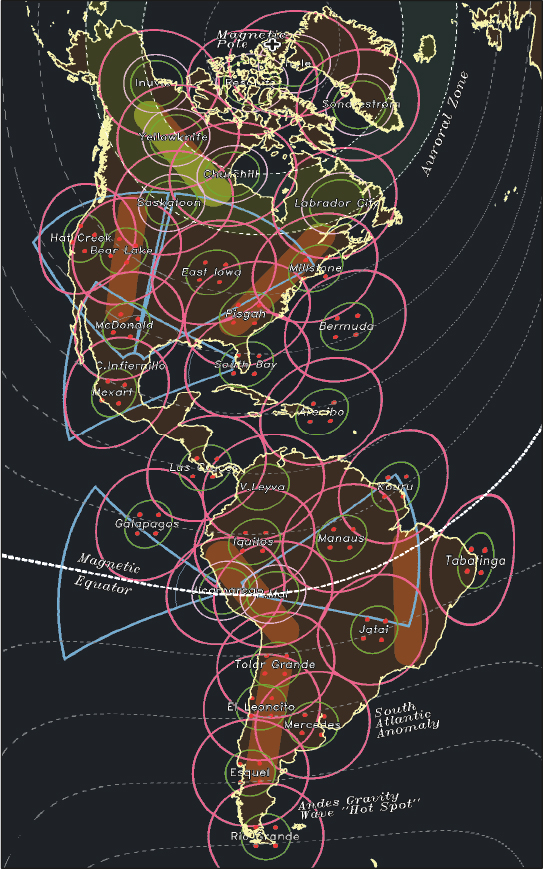
The priority MSRI-1 project is DASHI, which targets the ITM DASHI concept goals and magnetosphere distributed network goals. This mid-scale concept was recognized by both the 2003 and 2013 decadal surveys (NASEM 2013; NRC 2003) and the 2015 Space Weather Action Plan (NSTC 2015a). DASHI greatly extends the spatial coverage of current ground-based sensor arrays spanning North and South America, transforming present-day, ad hoc sensing approaches into a strategically planned network needed for carrying out a diverse set of system science investigations. DASHI provides continuous distributed observations of key state parameters of the upper atmosphere, including plasma and neutral density, composition, temperature, and electrodynamic parameters from about 80 to 400 km altitude.
The unique ability of DASHI is that its concerted observations allow resolution of spatio-temporal couplings in multiple scales, which enables transformative advances in understanding the coupled mesosphere–thermosphere–ionosphere–magnetosphere system. Such a system is needed to provide the upper atmosphere linkages and feedback processes to the magnetospheric mesoscale dynamics, which is recognized as a key research area for the next decade. The unique ability of DASHI to resolve vertical, horizontal, and temporal variations makes it a highly valuable tool for space weather by providing input into comprehensive nowcasting and forecasting models.
The DASHI concept builds on observing stations that are distributed geographically and host an array of different instruments. When combined, this instrumentation provides simultaneous measurements covering wide
areas. The instruments may include scanning Doppler imagers, Fabry-Pérot interferometers, all-sky imagers, global navigation satellite system (GNSS) receivers, meteor radars, magnetometers, ionosondes, and other instrumentation. DASHI complements the incoherent and coherent scatter radars (the existing and planned various incoherent scatter radars and the SuperDARN network). Because most of the instruments have been successfully deployed before, the concept is technologically mature.
The DASHI concept could be realized in multiple ways in terms of number and location of observing sites as well as the instrumentation. Several implementation options were described by the decadal survey panels. It is clear that a comprehensive network, such as that illustrated in Figure 5-6, is well beyond the Distributed Array of Small Instruments (DASI) in number and complexity of the instrumentation. However, OSSE modeling studies are needed to determine the optimal number and location of the DASHI sites in terms of balance between observing requirements that are tied to science objectives and available resources, including the cyber-infrastructure needed to support scientific use and interactions between the DASHI sites. The completed OSSE, followed by deployment of prototype instrument arrays, will yield a cost estimate that determines whether a full-scale DASHI is realized
SOURCE: Conde et al. (2022), https://doi.org/10.3847/25c2cfeb.593c3238. CC BY 4.0.
through the NSF MSRI-2 or the MREFC line. The OSSE and associated planning and prototyping activities are a good match to the MSRI-1 track.
Conclusion: DASHI combines new and existing resources to create a distributed array for the NSF geospace community to enable a transformative systems science approach to mesosphere–thermosphere–ionosphere–magnetosphere coupling. Before full implementation, the DASHI concept requires OSSE modeling studies to determine the optimal number and location of DASHI sites and their optimal instrumentation to maximize the ITM and magnetospheric science return, as well as associated planning and prototyping activities to determine the cost.
The combined FASR and DASHI high-priority projects benefit both the solar and geospace communities. In fact, the combined projects constitute a strategic plan for convergent research that crosses the NSF Mathematical and Physical Sciences (MPS) and Geosciences (GEO) directorates. Furthermore, these two projects contribute to space weather research. As such, this plan for the MPS and GEO communities is synergistic with recommendations to better coordinate solar, geospace, and space weather research at NSF.
Recommendation 5-2: The highest priorities for the National Science Foundation’s Mid-scale Research Infrastructure (MSRI) programs are to
- Develop the project execution plan for the Frequency Agile Solar Radiotelescope (FASR) and proceed to implementation as a MSRI-2 project; and
- Develop and deploy a prototype Distributed Array of Scientific Heterogeneous Instruments (DASHI) as a MSRI-1 project that includes an observing system simulation experiment and a cost estimate for a full-scale DASHI.
The ground-based projects in Recommendations 5-2 and 5-3 are those that best contribute to the comprehensive, balanced research strategy. Other high-priority projects considered for the various NSF programs are listed in Table 5-2 in alphabetical, but not in priority, order.
While there is keen interest in mid-scale infrastructure, larger investments in ground-based infrastructure in support of solar and space physics are also needed. The ngGONG (Figure 5-7) is a modern and enhanced successor to the NSO’s GONG network. Originally deployed in 1995, GONG was designed to explore the Sun’s interior using helioseismology with homogeneous instrumentation on six sites distributed around the globe to provide continuous observations of the Sun. The network was later enhanced to make Hα observations. GONG has also become a valuable space-weather asset, as the project has made magnetograms and far-side images available.
Now approaching 30 years of service, GONG is an aging infrastructure that is difficult to maintain and operate. Yet, its measurements have become more important than ever before, both for scientific research and space weather operations. These important measurements will be extended by ngGONG. For scientific research, ngGONG will continue and expand critical measurements on the Sun–Earth line complementing the space-based observations, enabling more comprehensive study of the Sun’s interior, the nature of the solar magnetic dynamo, and mapping solar activity on the far-side of the Sun. For space weather operations, ngGONG will continue to be a critical part of the infrastructure for space weather operations.
The ngGONG facility will be the first ground-based network that includes operational space weather requirements from its conception. Cost estimates suggest that ngGONG is appropriate for development and deployment under the NSF MREFC line. However, as a facility that plays a role in both research and space weather operations, and because it is inherently international in nature, ngGONG requires collaboration with NOAA, DAF-AFOSR, and international partners such as the European counterpart to ngGONG, the Solar Physics Research Integrated Network Group (SPRING) of the SOLARNET project.
Conclusion: With its combined science and space weather operations mission, ngGONG is an example of a facility with dual purpose in the integrated HSL.
TABLE 5-2 Other Priority Ground-Based and Other National Science Foundation (NSF)-Funded Projects Listed in Alphabetical Order and Not Priority Order
| NSF-Funded Asset | Primary Measurement | Discipline | Purpose/Need |
|---|---|---|---|
| Active Magnetosphere and Planetary Electrodynamics Response Experiment/Iridium-NEXT (AMPERE-Next) | Magnetic field | Magnetosphere | The AMPERE project uses magnetometer recordings from operational Iridium satellites to deduce the large-scale field-aligned current pattern coupling the magnetosphere and ionosphere. The second-generation Iridium-NEXT spacecraft have been launched, and the new data products first available in 2022, AMPERE-Next needs further investments in ground-processing and operations infrastructure to enhance system state determination and now-casting capabilities. |
| Coronal Solar Magnetism Observatory (COSMO) | Magnetic field | Solar-Heliosphere | The dynamical evolution and reconfiguration of the magnetic field in the solar atmosphere are critical processes that underlie a host of outstanding problems concerning the corona and solar wind, and impulsive energy release in flares and eruptions. The central component of COSMO is a 1.5 m refractive coronagraph observing in multiple spectral lines to establish the density and line-of-sight velocity in the plane of the sky as well as the orientation of the coronal magnetic field. It is anticipated that the coronal magnetic field along the line-of-sight is also measured via the Zeeman effect. The coronagraph is complemented by a full-disk/limb-imaging spectropolarimeter (Community Synoptic Chromospheric Magnetograph [ChroMag]) and a white light coronagraph (COSMO K-coronagraph [K-Cor]). |
| Extended GNSS Network | Total electron content and scintillation | Ionosphere–Thermosphere–Mesosphere | Total electron content and scintillation measurements are used to characterize the ionosphere on horizontal scales of ~100 km. These measurements are both scientifically significant and critically important for space weather predictions for ground-satellite and other high-frequency communications. Upgrades are needed to existing surface-based GNSS receiver infrastructure as well as expansion into low-latitude coverage oceanic and the African regions, and to provide operational support to exploit these data more fully for space weather operations and assimilative modeling. |
| Light Detection and Ranging (LiDAR) | Altitude profiles of neutral atmosphere parameters | Ionosphere–Thermosphere–Mesosphere | LiDARs provide altitude resolved thermospheric temperatures, composition and winds. A new, high-power aperture LiDAR facility capable of providing continuous altitude profiles of the upper atmosphere fills an important altitude gap in these measurements. |
| Meteor Radar Network | Ionosphere–Thermosphere–Mesosphere | Meteor radar networks measure neutral winds in the upper atmosphere and provide key insights into tidal and planetary wave activity. A global network is needed for whole-atmosphere modeling and studies of gravity waves. It has been identified as critical ground-based infrastructure to characterize the global distribution and variability of wind and gravity waves. |
| NSF-Funded Asset | Primary Measurement | Discipline | Purpose/Need |
|---|---|---|---|
| Midlatitude or Subauroral Incoherent Scatter Radar (IS-Radar) | Ionosphere–Thermosphere–Mesosphere and Magnetosphere | A modern midlatitude/subauroral IS-Radar is needed to remotely sense the dynamics of the inner magnetosphere. It would complement Advanced Modular Incoherent Scatter Radar (AMISRs), provide ionosphere-to-magnetosphere convection comparisons with magnetospheric missions and complement DASHI. | |
| Poker Flat/Resolute Bay IS-Radar refurbishment | Ionosphere–Thermosphere–Mesosphere and Magnetosphere | The AMISR network comprising three stations—Poker Flat Incoherent Scatter Radar (PFISR), Resolute Bay Incoherent Scatter Radar-North (RISR-N), and RISR-Canada (RISR-C)—provides comprehensive measurements of ionospheric parameters for study of magnetosphere–ionosphere–thermosphere–mesosphere coupling. Having operated more than a decade, both NSF stations need refurbishment of the antenna elements. The PFISR facility is critical for the success of the high-latitude sounding rocket program, because it aids in launch conditions and crucial contextual measurements for auroral, neutral atmosphere, and electrodynamic missions (e.g., Geospace Dynamics Constellation [GDC] and Dynamical Neutral Atmosphere-Ionosphere Coupling [DYNAMIC]). | |
| Super Dual Auroral Radar Network (SuperDARN) Network | Ionospheric flows | Ionosphere–Thermosphere–Mesosphere and Magnetosphere | Auroral radar network to make multiscale measurements of ionospheric flows in both the northern and southern hemisphere, critical for quantifying the relative importance of electric field variations on various scales for energy deposition rates. Continuing support of U.S.-led dual auroral radars and their participation in the international SuperDARN consortium is needed, as are upgrades to in hardware and software to improve station imaging capabilities. |
Recommendation 5-3: The highest-priority large Major Research Equipment and Facilities Construction-scale project for the National Science Foundation for the next decade is the Next Generation Global Oscillations Network Group (ngGONG). In light of its importance to space weather, the development, implementation, and operation of ngGONG should be supported through partnerships with the National Oceanic and Atmospheric Administration, the Department of Defense-Air Force Office of Scientific Research, and international partners.
Table 5-3 summarizes mid-scale and large investments projects considered by the three science panels and prioritized by the steering committee.
In the next decade, the NSF contributions to space weather will increase significantly. Several of the existing and future NSF facilities support and provide key data for space weather observations (see Table 5-4). To integrate these increased contributions into NSF and into the national space weather endeavor, NSF needs an agencywide plan. The recommendation that NSF develop this agencywide strategic space weather plan is in Chapter 3 (see Recommendation 3-1).
Ground-Based Infrastructure for Space Weather
Ground-based infrastructure provides valuable information for space weather with importance to both predictions and monitoring of the current state of the system. Similar to their space-based counterparts, ground-based

SOURCE: Hill et al. (2019), https://baas.aas.org/pub/2020n7i074/release/1. CC BY 4.0.
space weather assets range from dedicated operational monitoring systems, controlled by a variety of organizations to science instrumentation, which also serves as a source of space weather information. An example of such dual use is the solar monitoring provided by ngGONG (see the discussion above and Table 5-4). In the next decade, the synergy between NOAA and other agencies will be expanded and enhanced. For both ground- and space-based data, the use of NOAA data in scientific research and the use of scientific data in NOAA research will be key to advancing the research strategy. For NOAA, Recommendation 3-7 (see Chapter 3, Section 3.3.5) states that the agency should take advantage of new data opportunities by assessing the value of new data streams. This recommendation includes both ground-based and space-based data streams.
Ground-based space weather assets are not limited to the NSF assets in Table 5-4. The U.S. Air Force 557th Weather Wing has the responsibility for providing space weather information to all DoD services worldwide, which it does by operating the Space Weather Operation Center and by providing data to NOAA Space Weather Prediction Center (SWPC). Data from the Solar Electro-Optical Network (SEON) and Radio Solar Telescope Network (RSTN) are publicly available but not all other data are accessible. To maximize the potential of these space weather assets, they need to be integrated and managed strategically, and made publicly accessible. The PROSWIFT Act provides some guidance by identifying which agencies are responsible for which assets.
TABLE 5-3 Summary of the Highest-Priority Ground-Based Projects for the National Science Foundation Programs
| Program | Ground-Based Project |
|---|---|
| Mid-scale (MSRI-1) | OSSE study of Distributed Arrays of Small Heterogeneous Instruments (DASHI) |
| Mid-scale (MSRI-2) | Implementation of the Frequency-Agile Solar Radiotelescope (FASR) |
| Large | Next Generation Global Oscillations Network Group (ngGONG) |
NOTE: MSRI, Mid-scale Research Infrastructure; OSSE, observing system simulation experiment.
TABLE 5-4 Examples of Existing and Planned National Science Foundation–Supported Ground-Based Instrumentation with Potential for Providing Space Weather Information
| Insrument/Project | Space Weather Capability | ||
|---|---|---|---|
| Existing | Future | ||
| Solar | GONG | ngGONG | Vector B field in the photosphere and chromosphere |
| FASR | Three-dimensional plasma state including B field from chromosphere to corona; shocks and energetic electrons | ||
| Magnetosphere | AMPERE | AMPERE-Next | Field-aligned currents in the ionosphere |
| DASHI | Ionospheric parameters and ground magnetic variations | ||
| Ionospheric scintillations | |||
| Ionosphere | Incoherent scatter radars | GNSS Network | Total electron content and scintillation measurements |
| LiDAR Facility | Neutral winds, temperature, and composition | ||
| Meteor Radar Network | Neutral winds | ||
| Midlatitude, PFISR/RISR/Sub-Auroral | Ionospheric electron density, electron temperature, ion temperature, line-of-sight ion velocity | ||
| SuperDARN | Ionospheric convection | ||
| DASHI | Ionospheric parameters and ground magnetic variations | ||
NOTE: AMPERE, Active Magnetosphere and Planetary Electrodynamics Response Experiment; DASHI, Distributed Arrays of Small Heterogeneous Instruments; FASR, Frequency Agile Solar Radiotelescope; GNSS, Global Navigation Satellite System; GONG, Global Oscillation Network Group; LiDAR, light detection and ranging; ngGONG, Next Generation Global Oscillations Network Group; PFISR, Poker Flat Incoherent Scatter Radar; RISR, Resolute Bay Incoherent Scatter Radar; SuperDARN, Super Dual Auroral Radar Network.
NASA Flagship-Level Community Science Modeling Program
Space- and ground-based observations and theory and modeling form a triad for discovery in solar and space physics. In the past decade, physics-based models have made great strides in delivering scientific breakthroughs, explaining data from existing assets, motivating new missions, and furthering the national space weather enterprise. These advances were achieved with relatively modest investment by the funding agencies via a hierarchy of programs (see Section 5.3) ranging from regular grants to large-scale programs such as the recent NASA Space Weather Centers of Excellence and DRIVE Science Centers (DSCs; see Section 5.3). The past decade’s advances brought the field to a state where the current funding paradigm no longer meets future challenges. These challenges include ever-increasing physical complexity of the models, the emerging paradigm of model-data fusion, using artificial intelligence (AI) for data assimilation, rapid development of the high-performance computing (HPC) landscape and the need to adhere to open science standards. Simply put, developing and maintaining complex community models has become as expensive as building and operating space missions or major ground-based facilities.8
To make progress in solar and space physics, the heliosphere and the heliosystems comprising it need to be treated as complex systems composed of several interacting components. These interactions occur across vast ranges of spatial and temporal scales, from the electron micro-scales to the global scales of the entire system.
___________________
8 For reference, a large part of the NCAR annual budget of $100 million goes toward supporting community Earth system modeling (Slingo et al. 2022). The UK meteorological office is procuring more than $1 billion over the next decade for the hardware required to support climate modeling (e.g., https://www.hpcwire.com/2021/05/13/behind-the-met-offices-procurement-of-a-billion-dollar-microsoft-system).
Numerical simulations of such systems require developing highly complex models that encapsulate different physical regimes, couple disparate spatial regions, and cover an enormous range of length scales. The challenge is analogous to simulations of fusion devices, nuclear reactors, or numerical prediction of weather and climate. A good example of a complex community model with sustained infrastructure is the Community Earth System Model (CESM). This model was developed for climate prediction by the National Center for Atmospheric Research (NCAR) in collaboration with the larger research community.
State-of-the art solar and space physics models already push the boundaries of physical and algorithmical complexity. However, modeling efforts by individual groups are hampered by a lack of sustained infrastructure necessary to harness already available and emerging software and hardware technologies. Computational capacity has increased by roughly three orders of magnitude in the past decade. The world’s first exascale supercomputer entered production in 2022. Cloud resources now play a growing role in all aspects of HPC, data analysis, and storage. AI, machine learning, and data mining are increasingly used for improvement of numerical algorithms, model-data fusion, and analysis of big data produced by the models. These transformative advances in supercomputing present a unique and timely opportunity to tackle open questions involving cross-scale and cross-domain coupling (see Chapter 2), setting solar and space physics on the precipice of new discoveries. Moreover, it allows the United States to maintain leadership in space environment modeling, which has both scientific and national security implications.
To bring about this new era of discovery, the solar and space physics community needs a framework that allows models to efficiently utilize the largest supercomputers and other HPC systems and take advantage of cloud and AI resources, while enabling broad community participation in algorithmic and model development and use. Challenges in harnessing modern HPC technologies include porting highly complex models, often consisting of multiple interconnected components, to increasingly heterogeneous supercomputer architectures while in a way that achieves performance that allows capable simulations on a massive scale.
Development and maintenance of software for such models requires sustained curation of large and complex code bases and improving model fidelity, which demands a new level of error analysis, uncertainty quantification, and data assimilation. The implementation of sustained maintenance of large ensembles of curated uniform data streams, standardized file formats, and testbeds entails large intellectual, computational, communication, storage, and system administration resources. Open accessibility implies development and maintenance of software that will enable broad research community participation including contributions to open source code development, performing model runs, and carrying out analyses based on simulation data. All the above requires sustained infrastructure for training, hiring, and retaining a new type of interdisciplinary workforce with overlapping expertise ranging from HPC-specialized research software engineers to experienced applied mathematicians, domain scientists, and program managers. Such a sustained, professional workforce is paramount to meeting the nascent modeling challenges in solar and space physics but is not being achieved within the current hierarchy of the funding programs.
The solar and space physics community is ready to embrace the open science and open software paradigms. However, even the largest modeling programs currently cannot efficiently serve the broader community, because the programs do not have the resources to recruit the necessary workforce, nor do they possess the sustained infrastructure to retain it. Therefore, a new paradigm is necessary to implement an open science approach to solar and space physics modeling. This new paradigm should incentivize and develop the new modeling workforce in ways that allow appropriate prioritization of both scientific throughput and development of community models. The flagship-level community modeling program recommended below would be a prime example of NASA’s commitment to open science.
Conclusion: A significant expansion of the funding hierarchy for theory and modeling is needed to meet the challenges of ever-increasing physical complexity of the models, rapid development of the high-performance computing landscape, and adherence to open science standards.
Recommendation 5-4: In addition to maintaining the current range of grant opportunities for theory and modeling, the National Aeronautics and Space Administration (NASA) should establish a flagship-level heliophysics community science modeling program capable of addressing heliophysics problems that have broad community interest and that require complex community models. This program should be funded at a level that enables training, hiring, and retaining interdisciplinary teams of highly specialized professionals. NASA should establish a sustained
infrastructure for these core teams to engage community participation in developing, using, and maintaining the models. To define and implement the program, NASA Heliophysics Division should gather community input and consider examples (e.g., the various Earth system models) from other NASA divisions, other federal agencies, and international organizations.
A critical part of space weather operations is the use of models, data assimilation, and AI methods. The use of these methods assembles available observations into a coherent framework that describes the past sequence of events and predicts future evolution. The NASA flagship community science modeling program described above focuses on the three science themes of Chapter 2 and not on real-time monitoring and predictions. Thus, the operational space weather organizations should join forces to support a parallel modeling effort where the increased scientific understanding from the flagship community model is transitioned to operational services, as described in Chapter 3, Recommendation 3-4.
5.2.3 Space-Based Assets in the Integrated HSL
The science and space weather guiding questions and focus areas introduced in Chapters 2 and 3 require an integrated HSL that has a wide array of space-based measurements. Measurements of the heliosystems include remote sensing and in situ techniques. Most often, remote sensing requires space-based observation platforms because of the need to have different vantage points, duration and cadence of the measurements, and measurements above the dense atmosphere of Earth. In addition, almost every science focus area in Chapter 2 requires in situ measurements of plasmas (including thermal plasma through energetic particles), neutrals, and magnetic and electric fields in regions from very close to the Sun and Earth to out into the local interstellar medium.
Figure 5-8 shows that the NASA space-based and selected NSF-funded elements of the integrated HSL include NASA and NSF CubeSats, sounding rockets, balloons, the existing HSO, the Explorers and Missions of Opportunity (MOs), space weather missions, and the STP and LWS Heliophysics mission lines. Cross-divisional collaboration within NASA brings in measurements of the interplanetary medium by planetary missions in their cruise phase between Earth and their planetary targets, as well as potential data from the outer heliosphere boundaries from the Planetary Science Division’s New Horizons mission. Figure 5-8 also shows selected NSF facilities, including the recently commissioned Inouye Solar Telescope and the new ground-based facilities recommended by this decadal survey. In the next decade, combining ground-based and space-based assets is important for the comprehensive research strategy.
Acquiring these measurements requires data links from the space-based assets to the ground. These links become increasingly challenging as the number of space-based assets increases and the assets move farther from Earth into interplanetary and even interstellar space. In addition, new, increasingly sophisticated instruments produce large quantities of data while science investigations require measurements at high cadence and space weather operations require these measurements in (near) real time. Thus, continuous transfer of large data quantities over long distances becomes a significant bottleneck to achieving both the science and space weather goals. Elimination of these bottlenecks requires upgrades and expansion of data receiving and processing ground facilities; specific recommendations for these communications facilities are provided in Section 5.4.
NASA Suborbital Program
From its inception, NASA’s suborbital Sounding Rocket and Scientific Balloons Programs have had a two-pronged focus on both technology development and science. These smaller- and shorter-timescale projects have provided significant achievements both independently focusing on targeted research questions and as complementary elements in support of larger missions. In addition, the program has advanced instrument concepts for future explorer and strategic missions and expertise in the solar and space physics community. For example, the Twin Rocket Investigation of Cusp Electrodynamics (TRICE-2) sounding rockets produced significant science results on the physics in Earth’s magnetospheric cusps, while providing a significant technology development step for the Tandem Reconnection And Cusp Electrodynamics Reconnaissance Satellites (TRACERS) Small Explorer (SMEX) mission. Another highly prolific suborbital mission has been the Balloon Array for Radiation-belt Relativistic Electron Losses (BARREL) mission that flew multiple campaigns during the Van Allen Probes era (and beyond). BARREL

NOTE: Acronyms provided in Appendix H.
SOURCES: Composed by AJ Galaviz III, Southwest Research Institute; (Top) Background elements from NASA/Johns Hopkins APL/SwRI/Steve Gribben; (Middle) Sun background from NASA/Goddard; Magnetosphere background from SwRI; (Bottom) Earth background from NOAA.
provided unique scientific insight as well as providing context for and comparison to Van Allen Probes radiation belt observations.
The sounding rocket program provides primary access to the “ignorosphere” at 80–300 km in altitude, where satellite orbits rapidly decay, and balloons cannot reach. However, the fundamental plasma physics that can be studied in this hard-to-reach region is not to be underestimated: neutral winds and upper atmosphere composition, auroral emissions and related current structures, energy dissipation through Joule heating and wave-particle interactions all are fundamental aspects of the ITM system and its coupling to the magnetosphere above and atmosphere below.
The high-altitude balloon program has been instrumental in accessing the upper atmosphere and viewing space from a stable platform that can stay aloft for days to weeks (in contrast to sounding rockets whose flights last on the order of 10 minutes). Balloon programs have contributed valuable science to studies of the Sun, the auroras, and other emissions from particle precipitation and its impacts on the upper atmosphere.
While suborbital flights are often used as testbeds for new instrument and concept developments, they also provide training of students and early career researchers in the rigors of spaceflight missions, preparing them for future hardware responsibilities and leadership positions. Rocket and balloon missions are ideal training grounds for future PIs of Explorer missions, instrument suites, and other mission involvement. The skillsets developed include exposure to the NASA mission architecture, team management, complex budget and schedule preparation, and a multitude of leadership credentials. The support and expansion of these programs is vital to producing a future set of instrument-providers and leaders for NASA PI-led missions (see also Section 5.3).
NASA and NSF CubeSats
The proliferation and capabilities of CubeSats have grown significantly over the past decade since NSF took the lead by implementing a modest but highly successful CubeSat program in 2008. One of NSF’s first missions, CSSWE (Colorado Student Space Weather Experiment) was launched in 2012 and contributed to at least 24 peer-reviewed publications, including in the journal Nature (Baker et al. 2014; Li et al. 2017). In a review of early CubeSat missions, Spence et al. (2022) quantitatively demonstrated that they had weighted publication impact factors comparable to those of larger missions. CubeSats (e.g., CSSWE and Focused Investigations of Relativistic Electron Burst Intensity, Range, and Dynamics [FIREBIRD]) have also been used in support of major missions such as NASA’s Van Allen Probes.
NASA provided technical support for NSF’s program early on, and the agencies have jointly supported projects. The highly successful Electron Losses and Fields Investigation (ELFIN) mission made groundbreaking discoveries about radiation belt electron precipitation and plasma wave-particle interactions. To date, more than 35 peer-reviewed publications in high-impact journals are based on ELFIN observations. Since the 2015 launch of the first NASA Heliophysics Division science CubeSat, the Miniature X-ray Solar Spectrometer (MinXSS),9 NASA’s CubeSat program has expanded significantly. As of early 2024, 13 CubeSat missions had launched, and 14 were in development.10
Although typically funded through the research and analysis (R&A) program, suborbital and CubeSat projects are included in the HSL because of their scientific and data contributions. With the intention to offer low-cost access to space, the CubeSat program provides important program balance at NASA. However, a program that was envisioned originally as inexpensive (~$1 million per mission) has grown in complexity and cost (current mission costs range between $4 million and $8 million) and has been hampered by internal and external problems; even with the explosion of launches by the commercial sector, launch opportunities for CubeSats suffer from lengthy delays and cost growth. New launch companies available through the Venture Class Launch Service (VCLS) demonstrations have been plagued by delays and launch failures. The COVID-19 pandemic had a significant impact both on teams and on the supply chain. Although these issues are mostly resolved, CubeSat projects, which may have all the complexities of a larger mission, have no reserves and therefore less resiliency to deal with problems.
___________________
9 MinXSS made new observations of the solar X-ray spectrum, was the first CubeSat mission to demonstrate pointing control better than 10 arcsec and led to more than 30 publications. It was followed by MinXSS-2, which was launched in 2018.
10 This number does not include CubeSats that are part of larger missions—for example, Explorers—which are becoming more common. See NASA (2024c).
As the costs have increased, the engagement of smaller institutions and early career PIs has become increasingly challenging, because they may not have sufficient resources in the proposal phase to compete against institutions that have large internal teams and funding. Furthermore, there is growing concern over the right level of management oversight, which contributes to the increased total program costs.
The community has also voiced a need for better support for project teams in addressing issues such as radio licensing and ground station access, as well as better opportunities for community input to NASA and sharing of lessons learned. Maximizing the return on investment in the CubeSat program calls for assessment of project costs, program structure, as well as identification of potential solutions to the challenges described above. After nearly a decade over which the program has grown, a review to ensure its continued success would be beneficial.
The NSF CubeSat program, despite its early successes, appears to have stagnated. The midterm assessment of the 2013 decadal survey pointed out that the CubeSat solicitation was not offered in 2016 or 2017 when the program was reinvented as the Foundation-wide CubeSat Ideas Lab program. In 2022, five NSF-supported CubeSat missions were expected to launch in 2023–2024 timeframe (Sharma 2022). However, the agency has not solicited new proposals since 2019. The Physics Division has established a new cross-NSF program in partnership with the GEO and ENG directorates—Ecosystem for Leading Innovation in Plasma Science and Engineering (ECLIPSE), which supports sensor development for CubeSats (NSF n.d.). The 2017 National Academies of Sciences, Engineering, and Medicine’s report Assessment of the National Science Foundation’s 2015 Geospace Portfolio Review recommended that “the NSF Geospace Section carefully consider the impact associated with decreasing funding for the CubeSat program before additional resources through intra-divisional partnerships can be obtained” (NASEM 2017, p. 35).
Conclusion: The CubeSat programs at NASA and NSF are important elements of the HSL, contributing data and scientific results. These programs continue to be valuable and need to continue meeting the original goals of science, training, and participation.
Recommendation 5-5: To ensure continued success, the National Aeronautics and Space Administration and the National Science Foundation should conduct comprehensive, community-based reviews of their CubeSat programs.
Recommendation 5-5 is written generally so that NASA and NSF determine their own means to go about the review of CubeSat programs. However, important aspects to consider include, but are not limited to, the following:
- Balance between technology demonstration, education, and science investigations and the appropriate risk postures for each;
- Methods for sharing lessons learned and enhancing support for potential or inexperienced PIs. One possibility would be to expand activities where experienced NASA scientists and engineers work directly with the project team;
- Facilitation of cross-government coordination and identification of areas where funding agencies could provide additional guidance or support—for example, when applying for a radio license or other regulatory requirements;
- Appropriate levels of management and oversight;
- More formalized means for community input to the agencies. For example, NASA’s Sounding Rocket Working Group is a possible model for this input;
- Evaluation of current access to space—for example, an assessment of time from selection to launch, launch success rates, availability of CubeSat Launch Initiative–supported launches and other potential opportunities for funding launches; and
- Appropriate levels of funding needed to maintain a robust program.
The increased costs of NASA MOs (see the next section) have created a gap in the funding between the current CubeSat funding level (~$4 million to $8 million) and the lower end of the MOs ($35 million). Missions in this gap could include larger balloon or rocket missions or multiple CubeSats—for example, for science requiring multipoint
measurements or larger suborbital launches. Similar gaps in the Astrophysics and Earth Science Divisions were recently filled with the new Pioneers Program and with Earth Venture instruments, respectively. The implications of this gap in Heliophysics should be considered, because such gaps affect program balance within NASA.
Recommendation 5-6: The National Aeronautics and Space Administration should create opportunities for principal investigator–led projects in the size range $10 million to $35 million (not including launch costs) that could accept higher risk than the Missions of Opportunity and be realized with minimal requirements for mission assurance and agency oversight.
This program could be implemented quickly and in a cost-effective manner if the Heliophysics Division partnered with or otherwise leveraged the approach of the Astrophysics Pioneers Program.
NOAA Space Weather Observations
The current NOAA missions monitor the Sun and the space environment, providing the data needed to make operative space weather forecasts and predictions. Future missions are designed to provide continuous monitoring of the Sun and the space environment well into the next decade (see Figure 5-9). These future missions include the Space Weather Follow-On Lagrange 1 (SWFO-L1) and Space Weather Next programs. There is substantial

NOTES: Acronyms provided in Appendix H. The image and caption were modified after release of the report to clarify which NOAA satellite missions are for space weather.
SOURCE: NOAA.
international involvement in these missions. The SWFO-L1 mission, scheduled for launch in 2025, requires an international ground network for 24/7 mission data acquisition. A number of agreements are in place (Japan’s National Institute of Information Technology and Communications and Korea Radio Research Agency) or are being negotiated (South Africa and Brazil) to continue the Real Time Solar Wind network (RTSWnet) and supplement the SWFO antenna network. Discussions are under way with the Indian Space Research Organization to explore opportunities for collaboration—for example, data exchanges between SWFO-L1 and Aditya L-1. Space Weather Next program has multiple project components designed to extend space weather observations to a variety of critical vantage points: from L1 and L5 orbits, geostationary orbit, low Earth orbit (LEO), and ground support networks. NOAA’s National Environmental Satellite, Data, and Information Service (NESDIS) will provide a compact coronagraph to be hosted on ESA’s Vigil mission (2031 launch) and is exploring other instrument hosting opportunities with other international hosts, including the Canadian Space Agency, the Taiwan Space Agency, and the Korea AeroSpace Administration.
In addition to their primary monitoring task, these missions produce a wealth of data that support research space weather science and guide development of models used in forecasting and predicting space weather. It is important that NOAA develop systems to make those data readily available to the research community in a format that is compatible with other data sources.
While the decadal survey committee acknowledges and supports the NOAA satellite missions, it was not tasked with assessing the current and future monitoring missions or providing recommendations on their operational aspects. However, there are findings and recommendations of this decadal survey that focus on space weather research, the research to operations transfer, and the operations to research feedback (research to operations to research [R2O2R]). Space weather research and R2O2R pervades all solar and space physics, to the extent that it is included as a second part of the mission statement of this decadal survey—to serve humanity.
NASA Space Weather Program
The NASA Space Weather Program provides explicit transition of scientific knowledge to operational applications (see Figure 5-11). The Space Weather Program will provide a space weather science instrument on the ESA Vigil mission. Vigil (previously known as Lagrange) is an ESA space weather mission to observe the Sun from the Sun–Earth Lagrange point L5, away from the Sun–Earth line. This vantage point allows the propagation of coronal mass ejections emitted by the Sun toward Earth to be observed, as well as observations of the solar disk before it rotates into view from Earth. The Vigil mission will image the solar disk and corona as well as the inner heliosphere and measure the interplanetary medium at its location at 1 AU. The remote sensing instrument provided by the NASA Space Weather Program fills the gap between the Vigil photospheric magnetograph and the coronagraph provided by NOAA. The inclusion of a space weather monitoring instrument on a partner’s mission is a blueprint for future monitoring instruments onboard other NASA and international space missions.
As part of the Artemis program, the Lunar Gateway will be a Moon-orbiting outpost for astronauts heading to and from the lunar surface. Gateway will carry the Space Weather Program Heliophysics Environmental and Radiation Measurement Experiment Suite (HERMES), which consists of four instruments monitoring space weather conditions in lunar orbit. Similar to the space weather monitoring instrument on Vigil, HERMES has basic science goals and also provides observations that will be useful for space weather monitoring.11 HERMES is a blueprint for deployment of future monitoring instruments, for projects under the auspices of the Moon to Mars strategy.
Given the increased need for space weather services in the coming decade, the NASA Space Weather Program needs to grow with fresh funding that does not come at the expense of the Heliophysics Division science. Specifically, funding for instruments that are vital for the safety of the lunar infrastructure and humans needs to be covered from sources outside the Heliophysics budget. In addition, if the Space Weather Program funding were sufficient, the program could fund model improvement efforts and analysis to demonstrate its operational effectiveness. The resulting techniques that showed sufficient improvement in forecasting and specification skill would then be candidates for transition to operations. As with the transition of instruments to operational status,
___________________
11 This paragraph was modified after release of the report to accurately reflect the purpose of HERMES.
the transition of models to operational status requires close coordination with NOAA. This NASA and NOAA modeling effort is part of the larger R2O2R framework described in Section 3.3.1.
The Space Weather Program recommended for the next decade includes funding for a stand-alone mission up to the size of a SMEX as well as MOs. The program is designed to provide NASA with the means and flexibility to conduct stand-alone missions as needed. These missions would complement the Space Weather Program initiatives by providing demonstration instruments for missions carried out by other agencies and international partners. In keeping with the overall charter of the Space Weather Program, target objectives of these stand-alone missions need to be based on those observations or techniques that have been identified as showing promise for implementation as operational components of NOAA’s space-based fleet. NASA and NOAA need to work together to develop metrics and transition plans to transfer research results to NOAA operations, as recommended in Chapter 3 (see Recommendation 3-5).
The Panel on Space Weather Science and Applications (see Appendix E) reviewed the space weather value of all the missions that went through the evaluation (i.e., technical, risk, and cost evaluation [TRACE]) process (see Appendix G). The panel also suggested potential space weather enhancements for NASA missions. (See Chapter 3, Recommendation 3-6.) These add-ons range from enhanced data acquisition, modification of proposed instrumentation, to addition of space weather–related demonstration or even operational instrumentation. The panel review concluded that all new Heliophysics Division missions have the potential for space weather enhancements. Specifically, LEO satellites are ideal platforms to host GNSS receivers with upgraded firmware that enables total electron content (TEC) measurements, while medium Earth orbit (MEO) and highly elliptical orbit (HEO) satellites could host charge-discharge sensors. Orbits beyond Earth orbit are ideal for hosting sensors for measuring solar energetic particles. Space weather enhancements are best accommodated early in the mission development. Space weather is further discussed below.
Heliophysics System Observatory
The HSO comprises a wide range of space-based missions that are in its extended mission operations phase. Figure 5-8 contains the current HSO as part of the HSL but does not show the important contributions to the HSO from NOAA assets. Over the past decade, this observatory has grown in size and range of observations as many Explorer and larger-class missions have reached the end of their prime mission and have successfully completed senior reviews that emphasize new systems science objectives within the HSO. In fact, of the missions in Figure 5-8 that are currently in operation, only two, Parker Solar Probe (PSP) and Solar Orbiter, are in their prime mission phase. In addition, NASA has created and, in the 2023 senior review, greatly expanded a new infrastructure category for the HSO. The Solar and Heliospheric Observatory (SOHO), Advanced Composition Explorer (ACE), and Wind were a part of the original infrastructure category. Following the 2023 senior review, new infrastructure missions—Global-scale Observations of the Limb and Disk (GOLD), Hinode, Solar Dynamics Observatory (SDO), Solar Terrestrial Relations Observatory (STEREO), Thermosphere, Ionosphere, Mesosphere Energetics and Dynamics (TIMED), and Voyager—receive funding solely to continue operations for the next 3 years. In the future, these and the other infrastructure missions are invited to a programmatic review that is on a similar cadence as the senior review. The Interface Region Imaging Spectrograph (IRIS), THEMIS, Interstellar Boundary Explorer (IBEX), and Magnetospheric Multiscale Mission (MMS), which currently make up the rest of the HSO missions in extended operations, continue both operations and science. Additionally, NASA has been developing capabilities of the Heliophysics Digital Resource Library’s with an intent to integrate it into the management of the HSO mission data sets.
The combined fleet of infrastructure and science missions is considered as a single observatory, in effect a large-scale heterogeneous constellation. The value of the HSO in the previous decade was dramatically illustrated by numerous solar flare observations. Simultaneous observation by multiple HSO assets enabled major breakthroughs in the understanding of explosive energetic releases. For example, the flare on September 10, 2017, was simultaneously observed over the entire electromagnetic spectrum by NASA missions (SDO, IRIS, Reuven Ramaty High Energy Solar Spectroscopic Imager [RHESSI], Fermi), international spacecraft (SOHO, Hinode, Project for Onboard Autonomy 2 [PROBA2]), NOAA assets (Geostationary Operational Environmental Satellites
[GOES]/Solar Ultraviolet Imager [SUVI]), and ground-based observatories (EOVSA, Coronal Multi-Channel Polarimeter [CoMP], Low-Frequency Array [LOFAR]), and by ground-based neutron monitors. The multitude of observations measured the magnetic field strength along the current sheet, mapped out locations in the sheet where electrons were energized, and located the position within the current sheet where magnetic reconnection occurred and energy was released.
In the magnetosphere, fortuitous conjunctions of HSO spacecraft and NOAA assets offered glimpses of the highly complex magnetospheric dynamics, its response to various driving conditions, and highlighted the potential for future multispacecraft observations at various scales and in different regions. For example, a study involving GOES 13 and three THEMIS satellites found the first evidence that magnetic reconnection very close to Earth (near geosynchronous orbit, at 6.6–10 Earth radii [RE]) could power intense geomagnetic storms. Another multispacecraft conjunction study using MMS, THEMIS, Two Wide-angle Imaging Neutral-atom Spectrometers (TWINS), Van Allen Probes, and Cluster observations led to new understanding of the extreme thinning and stability properties of the magnetotail current sheet during active geomagnetic conditions. Simultaneous observations by Van Allen Probes, THEMIS, MMS, and GOES were used to probe the extreme variability of Earth’s outer radiation belt electrons, addressing the role of electron acceleration in the magnetotail as a possible source of outer belt electrons. These studies have made it clear that understanding the entire inter-connected system that makes up the magnetosphere, ionosphere, thermosphere, and mesosphere requires coordinated multiregion and multiscale observations.
For the systems science–focused themes of this decadal survey, constellation missions, new vantage points, and the HSO become critical elements of the research strategy. The distributed HSO has flexibility and capabilities that evolve with each new mission launched. Its current composition includes a significant number of diverse solar, heliospheric, and magnetospheric missions. However, with the loss of the Ionospheric Connection Explorer (ICON) spacecraft (after its highly successful prime and extended missions), there is a dearth of upper atmosphere (ITM) missions (see Figure 5-8). This shortcoming is remedied only when GDC and DYNAMIC are launched and included in the HSO near the end of the next decade.
NASA is actively engaged with the international community through HSO missions such as Hinode, IRIS, PSP, Solar Orbiter, Wind, SOHO, STEREO, MMS, and THEMIS. In the next decade, the importance of international missions in the HSO and the integrated HSL will continue to grow. Inner-heliospheric research takes on a much more international character with the inclusion of some important international missions, such as the BepiColombo dual-spacecraft mission to Mercury, and later in the survey interval, the Vigil and Solar-C missions observing the Sun and the solar wind. This international character could be strengthened even more if other space agencies, like the Indian Space Research Organization (ISRO) and the newly established Korean Aerospace Administration (KASA), are included in the HSL. The combination of these remote and in situ inner heliospheric measurements forms an unprecedented inner heliosphere observational capability in the next decade. Figure 5-10 illustrates the opportunities to measure the inner heliosphere either over a range of radial distances along a Parker spiral establishing a magnetic connection between the measurements (top panel) or a wide range of longitudes covering the global solar activity (bottom panel). The coordinated use of this fleet of spacecraft is a pathfinder for future science of the Sun and inner heliosphere—in particular, propagation of disturbances from the Sun to and beyond 1 AU.
Multiagency Support for Space Weather
While the NASA Heliophysics Division and NSF programs are focused on fundamental science and understanding of the local cosmos, space weather research is inseparably intertwined with the fundamental research.
Table 5-5 summarizes assets in the NSF, NOAA, and NASA programs of record (both operative and upcoming) and their space weather potential. The plans for ngGONG (see Section 5.2.2) include a space weather component from the planning of the infrastructure, while the other assets are scientific instruments that provide valuable space weather monitoring capabilities if the data are received and distributed to the users in a timely manner.

SOURCE: Composed by AJ Galaviz III, Southwest Research Institute.
Figure 5-11 shows the relationship between the two NASA mission programs (STP and LWS), the NASA Space Weather Program, and their direct linkage to NOAA operational missions. The LWS program focuses on basic science that targets questions that have relevance for space weather prediction capabilities. However, the boundaries between the STP and LWS programs are somewhat diffuse, as improvement or development of almost any space weather capability still relies on new fundamental research results. Moreover, many of the past STP missions have contributed greatly to understanding space weather phenomena from the Sun (STEREO) to the magnetospheric (MMS) and ionospheric (TIMED) processes.
For decades, the NASA Heliophysics program has provided critical solar (SOHO, SDO, STEREO) and solar wind observations (ACE, WIND) to the NOAA SWPC for its operational space weather products. The research strategy for the next decade includes the space weather IMAP Active Link for Real-Time (I-AliRT) system (Spann et al. 2023) on the IMAP mission and opens additional, new opportunities for using magnetospheric and ionospheric observations for operational purposes. Moreover, CubeSats, sounding rockets, balloons, and Explorer missions bring new elements to understanding, predicting, and monitoring space weather (see Figure 5-8).
In the next decade, ITM space weather research is enhanced significantly with the launch of GDC and DYNAMIC. These two upper-atmosphere missions form a coordinated constellation, where GDC observes
TABLE 5-5 Current and Future Missions and Projects and Their Capabilities for Space Weather
| Agency | Domain | Instrument/Mission | Space Weather Capability | |
|---|---|---|---|---|
| Current | Future | |||
| NSF | Solar | GONG | ngGONG | Solar magnetic field |
| FASR | Solar spectroscopy, coronal field, energetic phenomena, and space weather drivers | |||
| COSMO | Solar magnetic field | |||
| Magnetosphere | AMPERE | AMPERE-Next | Field-aligned currents | |
| Magnetosphere–ionosphere–thermosphere | DASHI | Ionospheric parameters and ground magnetic variations | ||
| Ionosphere–thermosphere | GNSS Network | Ionospheric scintillations and total electron content (TEC) | ||
| LiDAR Facility | Neutral atmosphere parameters | |||
| Meteor Radar Network | Neutral winds | |||
| Incoherent scatter radars (PFISR/RISR) | Midlatitude, refurbished PFISR/RISR/Subauroral | Ionospheric electron density | ||
| SuperDARN | Ionospheric convection | |||
| NOAA | LEO | COSMIC-2 | TEC, ionospheric electron density, ionospheric scintillation, and ion density | |
| Commercial Data Program | Ionospheric electron density and TEC | |||
| POES/METOP | Space environment monitor | |||
| GEO | GOES-R serie | s Space Weather Next GEO missions | B-field, plasma, energetic particles, solar X-rays, and EUV | |
| L1 | DSCOVR | SWFO-L1, Space Weather Next SOL (formerly Space Weather Next L1 Series) | Solar wind and interplanetary magnetic field (IMF); coronagraph imagery and suprathermal ions (future missions only) | |
| L5 | Vigil | Coronagraph imagery | ||
| HERMES | Energetic particles and magnetic fields | |||
| NASA Program of Record | Solar and solar wind | ACE | Solar wind and IMF | |
| Wind | Solar wind and IMF | |||
| IRIS | Solar imaging and spectroscopy | |||
| SDO | Solar imaging, magnetic field | |||
| STEREO | Solar imaging | |||
| SOHO | Solar imaging | |||
| PSP | Solar wind and IMF | |||
| Agency | Domain | Instrument/Mission | Space Weather Capability | |
|---|---|---|---|---|
| Current | Future | |||
| Solar Orbiter | Solar wind and IMF, solar imaging, and spectroscopy | |||
| EUVST | Solar imaging and spectroscopy | |||
| HelioSwarm | Solar wind turbulence | |||
| MUSE | Solar imaging and spectroscopy | |||
| PUNCH | Solar imaging | |||
| SunRISE | Solar radio emissions | |||
| IMAP | I-ALiRT monitoring, solar wind, and IMF | |||
| Magnetosphere | THEMIS | Magnetospheric plasmas and fields | ||
| Artemis | Plasmas and fields in lunar orbit | |||
| MMS | Magnetospheric plasmas and fields | |||
| EZIE | Auroral electrojet | |||
| TRACERS | Magnetopause reconnection | |||
| Ionosphere | GDC | Auroral precipitation, ionospheric electron density, thermospheric winds, and waves | ||
| DYNAMIC | Thermospheric winds and waves, auroral imaging, and ion composition | |||
| Carruthers | Exospheric imaging | |||
| Ionosphere-Thermosphere-Mesosphere | AWE | Atmospheric waves | ||
| Planetary | ESCAPADE | Energetic particles at Mars | ||
NOTES: Acronyms provided in Appendix H. This table was modified after release of the report to accurately reflect NOAA’s current and future missions and projects, as of the time the report was written.
Earth’s high-latitude energy and momentum input resulting from coupling with solar wind and magnetosphere and DYNAMIC measures momentum and energy forcing resulting from coupling with the lower atmosphere through waves. In addition, GDC and DYNAMIC will trace the global energy and momentum transport through the ITM system and record the impacts on the global dynamical state of the system. These NASA observations will be made available in near real time to NOAA through optimized transmission content and latency for NOAA’s space weather notification system.
The near-real-time observations will contribute to space weather by (1) providing situation awareness data and space traffic management services to commercial space operators especially at LEO; (2) notifying operators providing communications, navigations, and surveillance services of the radio propagation conditions; (3) providing geomagnetic activity information to power grid and other system operators; and (4) monitoring the LEO radiation environment impacting spacecraft systems and human health.
As mentioned above, the Panel on Space Weather Science and Applications suggested space weather enhancements for NASA missions. These enhancements are significant because they provide a direct link between the NASA Heliophysics Division and the research to operations efforts of NASA and NOAA. Such enhancements

SOURCES: Composed by AJ Galaviz III, Southwest Research Institute; Left and middle background and upper right inset images from NASA; Right background image from ESA.
could also be included on NOAA operational missions as well as missions led by other federal agencies, given sufficient lead time in the mission development. Each additional datapoint in the sparse network is an important addition for space weather predictions; therefore, it is imperative to take advantage of all opportunities to increase the observational coverage. Each time an agency plans a new spacecraft or a ground-based facility, it would be advantageous to assess whether a space weather instrument, data stream, or other space weather component could add value at a reasonable cost. Instrument add-ons are best accommodated early in the mission development, which implies that it would be desirable to have an early space weather assessment as a standard practice by the agencies.
The NASA Explorer Program
The Explorer program is as old as NASA itself. The first U.S. satellite, Explorer 1, discovered Earth’s magnetosphere and radiation belts. Since then, the increased cadence and diversification of the mission classes has resulted in a program that responds rapidly and cost-effectively to science opportunities that evolve over the decadal survey intervals. The program has been an outstanding success, with missions that uniformly achieve their focused science objectives and provide major, new science results during their extended missions. The existing Explorers are critically important and cost-effective components to the HSO and hence the HSL. Truly, the Explorer program lives up to its name, providing exploratory science that paves the way for strategic missions. An outstanding, recent example is the IBEX SMEX, whose discoveries informed many of the science objectives for the strategic STP IMAP mission.
A significant success in the previous decade, following from recommendations by the 2013 decadal survey, was the increase in the cadence of Explorer solicitations. The increase to a cadence of 2–3 years, the inclusion of MOs in every solicitation, and alternating MIDEX and SMEX solicitations have resulted in a vibrant, cost-effective program that serves a significant portion of the solar and space physics community. The increased cadence has in no way diminished the quality and quantity of selectable Explorer proposals.
However, the success of the Explorer program, combined with other changes in the operational environment, has come with some unintended consequences. Improved spacecraft reliability and long lifetimes have increased the costs of extended mission operations, putting additional pressure on the Explorer budget. Selection delays, supply chain and workforce issues during the COVID-19 pandemic, the pace of mission selection (two SMEX missions in 2019 and two MIDEX missions in 2022), and Heliophysics budget pressures have resulted in an Explorer program that will grow to encompass >40 percent of the total current Heliophysics Division budget by 2026. The trend of increased management oversight (see NASEM 2020) is another cost-driver. In addition, any delays in the start of the mission development that follow from more than one Explorer selection have a disproportionate impact on smaller institutions that do not have institutional resources to keep a team together when project funding is reduced or cut because of a delay. Last, implementing the nine Explorer missions currently in development requires more than one launch per year over the next decade to resolve the backlog.
Conclusion: The 2013 decadal survey recommendation for Explorers cadence (2–3 years) assumed a single selection per opportunity. Selection of multiple missions, combined with other budget pressures, has put pressure on other important programs.
Figure 5-12 shows recent PI-managed cost caps for different classes of Explorers and MOs. At the lower end of the cost scale for the Explorer program, the MOs offer an excellent opportunity for very targeted science and allow a wider range of participation in mission development. Recent MO solicitations were concurrent with other

NOTE: Acronyms provided in Appendix H.
SOURCE: Composed by AJ Galaviz III, Southwest Research Institute.
Explorer solicitations, even though the announcements of opportunity (AOs) are not the same (Stand Alone MO Notice Program Element Appendix versus standard AO), and the evaluation panels are different. Concurrent solicitations potentially disadvantage institutions that lack the resources to produce multiple proposals simultaneously, forcing proposers from these institutions to choose between proposing a MO and a full mission. The concurrent solicitations can have the effect of reducing the quantity and competitiveness of the MO proposals. This could have contributed to no MO being selected in the recent SMEX 2022 cycle.
At the upper end of the cost scale for the current Explorer program, the MIDEX missions offer an excellent opportunity to perform important science on a budget that falls between the SMEX budget and the strategic LWS and STP missions budgets. However, the current structure, implementation, and cost caps of the Explorer program are not conducive to launching the constellations of spacecraft needed for reaching the science goals of the next decade. The current Explorers cost cap and offered launch options limit constellations to ~10 CubeSats and a single launch. An increase in the MIDEX cost cap from $250 million to $300 million, as assumed for the next decade (see Chapter 6), does not substantially reduce these limitations. Furthermore, the current definitions and implementation of risk class and reliability focus on single flight systems or small constellations, which makes it difficult for constellation missions to compete against other missions in the current Explorer program. New approaches are needed to facilitate efficient operations and maintenance of these large constellations. Increased use of autonomy may be necessary to manage large constellations, in addition to new approaches to communications, including increased use of commercial providers or inter-satellite crosslinks. While the current cost caps limit the number of spacecraft in a constellation, there are other viable Explorer missions (small constellations of larger spacecraft and single spacecraft) that could fit within the cap.
Conclusion: Multipoint science observations and system science are the next frontier in heliophysics. Implementing large satellite constellations (≥24 satellites), as submitted in many community input papers to this decadal survey, is not feasible in the current Heliophysics Division–competed (PI-led) mission portfolios.
Conclusion: There is currently a significant gap in funding between MIDEX and the recommended strategic LWS and STP missions. This gap needs to be filled to maintain program cost balance across the Heliophysics Division.
These conclusions drive the following recommendations for necessary revisions to the Explorer program. These revisions are designed to enhance the effectiveness of an already extremely successful program and enhance accommodation of constellation missions. They clarify the recommended Explorer cadence, the association between Explorers and MOs, and add a new class to the Explorer program to fill an increased mission cost gap between the MIDEX missions and the strategic LWS and STP missions. Specifically, the addition of a new class of Explorers arises from the critical need for moderate-scale constellation missions.
Recommendation 5-7: The National Aeronautics and Space Administration should maintain a robust and vibrant Explorers program by
- Adding a Heliophysics Large Explorer (HeLEX)-class mission to the Explorer line. The HeLEX-class mission should have a principal investigator–managed mission cost roughly twice that of the Medium-Class Explorer (MIDEX) and could be supported at least once per decade;
- Maintaining a balance in Explorer mission sizes by alternating opportunities; in the period of this decadal, the next Explorer opportunity should be MIDEX, followed by a Small Explorer (SMEX), then HeLEX and then SMEX;
- Striving to maintain a 2–3 year cadence for Explorers and a 2–3 year cadence for Missions of Opportunity (MOs);
- Carefully considering the balance of all mission sizes across the Heliophysics Division before selecting more than one Explorer mission after Phase A and ensure that the 2–3 year cadence can be maintained;
- Separating the announcement of opportunity and proposal cycles for MOs from those of the full missions (SMEX, MIDEX).
This recommendation is also designed to improve the balance between different mission costs within the Heliophysics Division budget so that larger missions are competed less often than smaller missions. Also, the recommendation is designed to create a wider range of mission classes to provide opportunities for all types of solar and space physics institutions. One way to leverage these improvements and increase participation in the Explorer program is to select more mission concepts for funding for Phase A studies. For example, an extended Phase A study brought the SunRISE MO to successful completion with a launch date in 2024. Another way to leverage these improvements is to incentivize inclusive partnerships between large and small institutions or between NASA centers and small institutions. While these may be some obvious first steps for improvement, additional changes to this highly successful Explorer program beyond Recommendation 5-7 require careful analysis and development.
The recommendation for a HeLEX mission grew out of the increased gap between the MIDEX costs and the strategic programs (LWS and STP). The average costs of the strategic programs in Figure 5-12 are discussed in Chapter 6. The most pressing need from the community input papers and identified by the decadal survey panels is for larger and/or more heterogeneous constellations than currently possible under the current Explorer program cost cap. The New Frontiers missions in the Planetary Science Division and Astrophysics Probe Explorer in the Astrophysics Division have specific scientific focus areas. Similarly, the HeLEX solicitation could focus on system science objectives that might require multisatellite constellations. Appendix G, which contains the TRACE results, lists several multisatellite constellations that could be tailored to fit within the notional HeLEX cost cap.
Developing an AO for a HeLEX constellation solicitation through the Explorer program would offer to NASA a testbed for larger constellation missions. Such an AO would put the Heliophysics Division in a leadership position for setting policies on constellation missions and open possibilities for negotiations with the Launch Services Program on launch options that provide multiple targets (e.g., multiple orbital planes). In the longer term, an ongoing program would encourage development of capabilities (infrastructure and processes) to support procurement of multiple instruments and satellite systems by leveraging commercial capabilities. Per the TRACE analysis of missions in this decadal survey (see Appendix G), this procurement is one of the cost and schedule drivers for large constellations.
For programmatic balance, it would be advantageous to alternate the HeLEX solicitation with the MIDEX solicitation. For example, a possible nominal sequence could be to have the first HeLEX solicitation in 2031 (replacing the MIDEX solicitation in that year). The 2–3 year cadence of MIDEX (nominally in 2025)–SMEX–HeLEX–SMEX–MIDEX, and so on, with MO opportunities on the same cadence, would maintain a strong, balanced, and stable Explorer program that would continue to produce world-class science.
LWS and STP Missions
Major discovery-level science and significant progress on the guiding questions and focus areas discussed in Chapter 2 requires major missions that have resources and complexity beyond the Explorer-class missions described above. In the next decade’s research strategy, these missions are implemented within the Heliophysics Division’s two major programs: STP and LWS. The distinguishing characteristics of these two programs are summarized in Figure 5-11.
STP missions are driven by the need of the science community to understand fundamental physical processes in solar and space physics. These missions make scientific discoveries that close knowledge gaps to advance the first part of the solar and space physics mission to explore our habitable cosmos.
LWS missions are driven by the scientific curiosity of the science community, informed by scientific advances needed to respond to space weather needs. These missions have targeted science goals that contribute to the understanding that ultimately leads to operational space weather prediction and forecasting. The LWS program has synergies with the NASA Space Weather Program that focuses on effective transition of space weather relevant knowledge, capabilities, technology, and techniques to operations.
The STP and LWS programs do not have any cost caps or programmatic strategies. These are implementation strategies of the major missions in the Heliophysics Division, and it is up to the division to determine how best to manage missions on a case by case basis.
LWS and STP Missions from the 2013 Decadal Survey: GDC and DYNAMIC
The highest-priority LWS and STP missions from the 2013 decadal survey, GDC and DYNAMIC, are currently in development (as part of the NASA program of record) and the science that these missions represent has only been amplified over the years.
There are four reasons to complete these missions in the next decade: First and foremost, they are needed for significant progress on critical, high-priority science focus areas related to the interactions between overlapping upper atmosphere systems. Second, they restore health to the community by balancing the overall Heliophysics Research Program that currently lacks upper atmosphere missions (see Figure 5-8). Third, these two missions, when executed simultaneously, act as a pathfinder for the heterogeneous constellation-class missions that are to follow in the next decade. Fourth, these missions have significant space weather science components as well as near-real-time measurement capabilities that are important for progress in space weather research. The next paragraphs address each of these reasons separately.
Science—As presented in Chapter 2, determining how the ionosphere and thermosphere respond to and process energy inputs from both large-scale waves originating in the lower atmosphere and particles and currents from the magnetosphere is central to understanding the heliophysics system. The combination of GDC and DYNAMIC provide key in situ and remote sensing observations of these energy inputs and quantify the multiscale response of the ionosphere and thermosphere to these inputs. These observations enable determination of the high-latitude ionosphere and thermosphere response to changing solar wind and magnetic energy inputs and how that response leads to plasma motion, neutral winds, and creation of coherent structures. The plasma and neutral population responses to these energy inputs are covered over a range of different scales, from local to global. These responses include the partition between chemical and dynamical processes that lead to effects such as enhancements of thermospheric density at LEO altitudes. GDC and DYNAMIC resolve how processes internal to the ionosphere and thermosphere redistribute mass, momentum, and energy in response to global-scale waves originating lower in the atmosphere. Importantly, the two missions determine the underlying causes of long-term changes in the planetary space environment.
Health of the community—With the loss of the ICON mission and the change of the GOLD and TIMED missions to infrastructure HSO missions, upper atmosphere (ITM) research has at its disposal only one ITM instrument on the space station (AWE). GDC and DYNAMIC restore some of the balance to the research strategy, allowing ITM research to renew and flourish.
Pathfinder missions—The next generation of solar and space physics missions, especially in the magnetosphere and ITM, are mostly implemented as constellations of heterogeneous spacecraft. This completely new type of scientific mission category has multiple spacecraft making different (in situ and remote) observations from different orbits tuned for the measurement needs. These mission characteristics come with significant new challenges. Not only does the constellation need multiple, different spacecraft to be developed, but often also multiple launches are required to reach the different orbits. Overcoming these challenges while keeping mission, instrument, spacecraft bus, and operations costs within reason requires new approaches to instrument manufacturing and testing, spacecraft bus development, as well as risk and quality assurance practices and requirements. The combined GDC and DYNAMIC missions form an important pathfinder for such heterogeneous constellation missions.
Space weather—Chapter 3 and the space weather subsection of this chapter outline the many significant contributions that GDC and DYNAMIC bring to understanding, monitoring, and predicting space weather. Chapter 3 identified space traffic management and collision avoidance at LEO to be among the highest-priority needs from space weather research. GDC and DYNAMIC contribute importantly to this key space weather scientific, societal, and technological challenge for the next decade.
Highest-Priority New STP Mission: Links
The highest-priority new STP mission for the next decade is represented by the notional “Links Between Regions and Scales in Geospace” (Links) constellation, pushing the boundaries of coordinated multipoint measurement technologies (see summary of technical and cost information in Appendix G). Links is a flagship-class systems science mission to discover the dynamic couplings and connections across regions and scales in the near-Earth space environment. This notional mission contributes to progress on all science themes in Chapter 2
by determining the combinations of fundamental processes (Section 2.2) that build up the complex dynamics between the solar wind and Earth’s coupled magnetosphere–ionosphere systems (Section 2.1). The foundational understanding from a mission like Links may help assess the habitability of exoplanets (Section 2.3) as well as to build next-generation space weather applications (Chapter 3).
This bold constellation mission concept comprises two platforms for auroral and magnetospheric imaging along with 24 satellites making in situ observations in the magnetosphere. The auroral imagers provide unprecedented simultaneous coverage of the northern and southern auroral ovals, unraveling questions related to (a)symmetries between the two hemispheres. The magnetospheric imagers provide the first-ever portrayal of the tenuous plasma system engulfing Earth, as the fleet of 24 satellites resolve for the first time the striated plasma flows and structured magnetic fields providing ground truth for the global imagers (Figure 5-13).
The simultaneous conjugate auroral observations from the two hemispheres are provided by spacecraft in circular polar orbits that view both the auroral oval and the magnetotail transition region near the equatorial plane. The high (~20 km) spatial resolution of the imagers resolves the meso-scale auroral dynamics and energy deposition that close an important gap in the global energy circulation process. The dual imager system reveals asymmetries in energy deposition and auroral processes between the two poles, and how such asymmetries between the poles impact the magnetotail processes.
Each imaging spacecraft carries three energetic neutral atom (ENA) imagers that provide remote sensing observations of the magnetospheric ion populations. These images reveal for the first time the shapes, sizes, velocities, and pathways of these dynamic structures that are the main carriers of energy from the outer magnetosphere inward. The composition and spectral information define the role of ionospheric sources in magnetic storm processes.
This ground-breaking constellation will be the first ever to resolve magnetotail dynamics simultaneously along and across the magnetotail, allowing the spatial structure and the temporal evolution to be uncovered at the same time. The in situ satellites have mesoscale (0.5–1 RE) spacing near their apogees, designed to resolve the flow channels and the associated magnetic flux bundles and filamentary current systems in the magnetotail as well as transient phenomena within and around the bow shock and dayside magnetopause. Each in situ spacecraft carries

SOURCES: Modified from Sorathia et al. (2020), https://doi.org/10.1029/2020GL088227. CC BY 4.0; Auroral images from the Department of Energy.
an instrument suite consisting of ion and electron plasma and energetic particle detectors and a magnetometer, enabling measurements of high-speed plasma flows, particle injections, magnetic field dipolarizations, and dayside transient plasma and magnetic field structures.
The notional Links mission responds to the primary objective of the STP mission line, to “understand fundamental physics processes from the Sun to Earth” with its scientific objective to determine the mass, momentum, and energy flow in the magnetosphere. It will advance understanding of the cross-scale and cross-regional coupling that directly feeds to broad scientific progress with applications beyond the terrestrial space environment. It is also expected to pinpoint key processes in the coupled system dynamics at Earth, thus its discoveries will enable operational space weather prediction and forecast models to take major leaps forward. As with all STP missions, Links would benefit greatly from international participation.
More details of this constellation-class mission are provided in the report of the Panel on the Physics of Magnetospheres in Appendix C. The cost information from the TRACE process for this mission is provided in Chapter 6 and Appendix G.
Recommendation 5-8: The highest priority for a new Solar Terrestrial Probes mission is one to investigate the system-level global coupling between the solar wind, magnetosphere, and ionosphere, while resolving mesoscale dynamics. This requires a heterogenous constellation mission that includes in situ measurements and remote sensing. If a science and technology definition team study is appropriate for the implementation, then it should be done early in the decadal survey interval in time to support development starting in fiscal year 2027.
Highest-Priority New Living With a Star Mission: Solar Polar Orbiter
The highest-priority new LWS mission for the next decade is a mission that focuses on the Sun’s poles. The notional mission that underwent the TRACE process was the Solar Polar Orbiter (SPO), shown schematically in Figure 5-14.
SPO is an ambitious mission concept to image the Sun from a completely new place to answer fundamental questions about how the Sun generates its magnetic field and how the field drives solar activity and shapes the heliosphere over the course of the solar activity cycle. The SPO would be the first mission to image the extended polar regions of the Sun, focusing on the solar magnetic fields. Historically, solar observations have been made from the ecliptic plane (on which Earth orbits the Sun) and most often from the Sun–Earth line. ESA’s Solar Orbiter is a notable exception, but even its measurements are limited to relatively small out-of-the-ecliptic viewing angles. The polar regions are key to understanding the cyclic behavior of solar activity and these regions are observable only from a high-inclination vantage point.
A mission to observe the solar poles is needed to establish how the Sun’s differential rotation evolves from the equator to the poles, how the plasma convects at and near the poles, and what the strength and distribution of the magnetic field is at and near the poles. These measurements are critically important to constrain models of the solar magnetic dynamo and to understand the time-variable extension of the solar magnetic field into the interplanetary medium. SPO builds on results from previous missions. The Ulysses mission made several passes above the solar polar regions and recorded the solar cycle variability of the solar wind and magnetic field structures at high solar latitudes. However, focused on in situ observations, Ulysses did not resolve the solar sources of these fields and flows. While ESA’s Solar Orbiter will eventually observe from a vantage point that is as much as 30° out of the ecliptic, it does not provide the kind of sustained observations necessary to make significant progress on these questions. Furthermore, SPO imagery provides an entirely new perspective on the corona and heliosphere by observing from well above the ecliptic plane. For example, SPO can determine the longitudinal structure of the streamer belt, radial and longitudinal extent of solar eruptions, and the longitudinal origins of fast solar wind streams.
SPO makes progress on all the science themes described in Chapter 2. By revealing details and variability of the magnetic fields at the solar poles, SPO data helps uncover the “solar magnetic field through the heliosphere” (Section 2.1). The SPO observations are crucial for the guiding question, “How is the Sun’s global magnetic field created and maintained, and what causes its cyclical variations?” (Section 2.2). The SPO mission contributes to

SOURCES: Composed by AJ Galaviz III, Southwest Research Institute; Sun image from Hassler et al. (2022), https://doi.org/10.3847/25c2cfeb.408d006f. CC BY 4.0.
“exploration of new environments” (Section 2.3), as very little is known of the dynamics of the solar poles. Prior missions to the giant planets have shown beautiful vortices such as those in the Jovian polar regions (Juno) and an intriguing hexagonal jet stream at Saturn’s poles (Cassini). If such vortices or jets were found at the Sun’s poles, they would likely play a critical role in determining the generation of magnetic fields in the Sun. As the solar magnetic field structure is the key driver for space weather (Chapter 3), the SPO mission has direct relevance for understanding long-term space climate evolution.
SPO responds to the primary objective of the LWS mission line, to “provide scientific understanding that leads to predictive capability.” Specifically, the space weather advancements come through recording the first polar magnetograms over multiple solar rotations and simultaneous 360° longitudinal views of coronal structure, variability, and coronal mass ejections (CMEs). The comprehensive suite of instrumentation on SPO includes a compact doppler magnetograph, extreme ultraviolet (EUV) imager, white light coronagraph, ion electron spectrometer, ion mass spectrometer, heliospheric imager, and an energetic particle suite. The spacecraft uses planetary gravity assists to achieve a 3-year orbit that is >70 degrees out of the ecliptic plane, allowing extended periods of unobstructed observation of both the northern and southern solar poles. The mission lifetime spans at least one solar activity cycle. As with all LWS missions, SPO would benefit greatly from international participation.
More details of this out-of-the-ecliptic mission are provided in the report of the Panel on the Physics of the Sun and Heliosphere in Appendix B. Cost information from the TRACE process for SPO is provided in Chapter 6.
Recommendation 5-9: The highest priority for a new National Aeronautics and Space Administration Living With a Star mission is one to explore the solar polar regions to understand how polar magnetic fields and flows reveal the Sun’s global dynamics and the mechanisms that underlie the solar dynamo and shape the solar activity cycle. A science and technology definition team study should be completed by approximately the middle of the decadal interval (i.e., before fiscal year [FY] 2029) in time to support mission development starting in FY 2029.
5.2.4 Integrated HelioSystems Laboratory and Scientific Progress
Data from the integrated HSL make substantial progress on all focus areas in Chapter 2. Advances in the focus areas will ensure progress on the guiding questions for each science and space weather theme.
The existing elements of the HSL (Figures 5-4 and 5-8) contribute to this scientific progress. However, transformational progress is only possible if these existing elements are augmented by the missions and projects in development and the new elements of the HSL that are recommended in this decadal for the next decade. Especially, major discoveries and groundbreaking new understanding hinge on the major STP and LWS missions proposed above.
Table 5-6 repeats the themes, focus areas, and guiding questions in tabular form for easy cross-referencing with Table 5-7, which shows how the missions and projects (both in development and recommended by this decadal) connect with the guiding questions and focus areas. Naturally, the larger resources reserved for flagship missions like GDC, DYNAMIC, Links, and SPO make progress on many more focus areas than, for example, cost-capped Explorer missions. The focused science made by the Explorer missions, achievable with a budget that is several times smaller than the broader flagship missions with larger hardware resources and science personnel, is nonetheless highly valuable and fills in gaps in the science progress that would not be covered otherwise.
While Tables 5-6 and 5-7 focus on science and the HSL, the integrated HSL also includes NOAA space weather operations. The link between the NOAA space weather operational missions and the space weather themes is presented in complete form in Chapter 3.
TABLE 5-6 Science: Explore Our Habitable Cosmos—Themes, Guiding Questions, and Focus Areas from Chapter 2
| Guiding Question | Focus Area |
|---|---|
| Theme 1: Sun–Earth–Space: Our Interconnected Home | |
|
1.1 How does our heliosphere function as a nested system? |
1.1a Energy and momentum flow across and within the heliosystem parts 1.1b Dominant physical processes within system interactions 1.1c Interactions across large-scale regions and long timescales |
|
1.2 How do heliosystem boundaries manifest themselves? |
1.2a System impacts of magnetic boundary processes 1.2b Role of transition regions in system coupling 1.2c Interactions at plasma-neutral transition regions |
|
1.3 How do the components of the Sun–Earth system interact with each other? |
1.3a Magnetic connections across the Heliosystem 1.3b Multiple drivers and feedback mechanisms |
| Theme 2: A Laboratory in Space: Building Blocks of Understanding | |
|
2.1 How is the Sun’s global magnetic field created and maintained, and what causes its cyclical variations? |
2.1a Flows and fields across all solar latitudes 2.1b Linkages of the interior field to the global heliosphere 2.1c Longitudinal variation of the dynamo and the field |
|
2.2 How are explosive phenomena created and dissipated across the heliosphere, and what are the fundamental processes that contribute to the energy conversion? |
2.2a Energy conversion in explosive events 2.2b Consequences of the aggregator of individual explosive events 2.2c Response of systems to explosive events |
|
2.3 How do the fundamental processes govern the cross-scale coupling, and what are the global properties and consequences of these processes? |
2.3a Cross-scale implications of magnetic reconnection 2.3b Cross-scale coupling through interactions between magnetic reconnection, turbulence, shocks, wave-particle interactions, and particle acceleration 2.3c Instabilities and waves with cross-scale consequences 2.3d Nature and consequences of coupling between ionized fluids and neutral fluids |
| Guiding Question | Focus Area |
|---|---|
| Theme 3: New Environments: Exploring Our Cosmic Neighborhood and Beyond | |
|
3.1 What can we learn from comparative studies of planetary systems? |
3.1a Mass and energy flow processes driving planetary magnetospheres 3.1b Interactions of plasmas with solid body surfaces and atmospheres 3.1c Diversity of auroral processes |
|
3.2 Why does the Sun and its environment differ from other similar stars? |
3.2a Similarities and differences between solar and stellar dynamos 3.2b Implications of different solar and stellar flare rates, amplitudes, and distributions 3.2c Differences between the heliosphere and other astrospheres |
|
3.3 What internal and external characteristics have played a role in creating a space environment conducive to life? |
3.3a Role of a magnetosphere in planetary atmosphere evolution 3.3b Role of a magnetic field as a shield from external radiation 3.3c Implications of internal particle acceleration, trapping and loss |
NOTE: The color scheme matches the color scheme for the science questions in Figure S-1.
TABLE 5-7 The Connection Between the Elements of the HelioSystems Laboratory (HSL) and the Themes, Questions, and Focus Areas in Table 5-6
| Theme 1: Sun–Earth–Space: Our Interconnected Home | Theme 2: A Laboratory in Space: Building Blocks of Understanding | Theme 3: New Environments: Exploring Our Cosmic Neighborhood and Beyond | |||||||
|---|---|---|---|---|---|---|---|---|---|
| GQ1.1 | GQ1.2 | GQ1.3 | GQ2.1 | GQ2.2 | GQ2.3 | GQ3.1 | GQ3.2 | GQ3.3 | |
| Program of Record: HSL Elements in Development | |||||||||
| Vigil | 1.1a 1.1c | 2.1c | |||||||
| HERMES | 3.3b | ||||||||
| AWE | 2.3b | ||||||||
| Carruthers | 3.3a 3.3b | ||||||||
| EZIE | 1.3b | 2.3b 2.3c | |||||||
| Solar-C/EUVST | 1.1a | 1.2a 1.2b | 2.1a 2.1b 2.1c | 2.2a 2.2b 2.2c | 2.3a 2.3b 2.3c | 3.2b 3.2c | |||
| SunRise | 2.2a | ||||||||
| PUNCH | 1.1a | 1.3c | 2.2b | 2.3c | |||||
| TRACERS | 1.1a | 1.2a | 2.2a | 2.3a | |||||
| MUSE | 1.1a | 1.2a 1.2b | 2.2a 2.2b 2.2c | 2.3a 2.3b 2.3c | 3.2b | ||||
| HelioSwarm | 2.3b | ||||||||
| Theme 1: Sun–Earth–Space: Our Interconnected Home | Theme 2: A Laboratory in Space: Building Blocks of Understanding | Theme 3: New Environments: Exploring Our Cosmic Neighborhood and Beyond | |||||||
|---|---|---|---|---|---|---|---|---|---|
| GQ1.1 | GQ1.2 | GQ1.3 | GQ2.1 | GQ2.2 | GQ2.3 | GQ3.1 | GQ3.2 | GQ3.3 | |
| DYNAMIC | 1.1a 1.1b 1.1c | 1.2b | 1.3b | 2.2c | 2.3b 2.3c 2.3d | ||||
| IMAP | 1.1a 1.1c | 1.2a | 1.3b | 2.3b 2.3d | 3.2c | ||||
| GDC | 1.1a 1.1b 1.1c | 1.2b | 1.3b | 2.2b 2.2c | 2.3b 2.3c 2.3d | ||||
| New Elements of the HSL | |||||||||
| DASHI | 1.1b | 1.2b 1.2c | 1.3a 1.3b | 2.2c | 2.3b 2.3c 2.3d | ||||
| FASR | 1.1a 1.1b | 1.2b 1.2c | 1.3b | 2.2a 2.2b | 2.3a 2.3b 2.3c | 3.2a 3.2b | |||
| ngGONG | 1.1a 1.1c | 1.2c | 2.1a 2.1b 2.1c | 3.2a 3.2b | |||||
| SPO | 1.1a 1.1b 1.1c | 1.3a | 2.1a 2.1b 2.1c | 3.2a | |||||
| Links | 1.1a 1.1b 1.1c | 1.2a 1.2b 1.2c | 1.3a | 2.2a 2.2b 2.2c | 2.3a 2.3b | ||||
| Supporting Elements of the HSL for Theme 3 | |||||||||
| ESCAPADE | 3.1b 3.1c | 3.3a 3.3b | |||||||
| Venus Missions | 3.1b | 3.3a 3.3b | |||||||
| Uranus Orbiter | 3.1a 3.1c | 3.3a 3.3b 3.3c | |||||||
| PLATO | 3.2b | ||||||||
| Juno | 3.1a 3.1b 3.1c | 3.2b | 3.3a 3.3b 3.3c | ||||||
| Bepi-Columbo | 3.1a 3.1b | 3.3b 3.3c | |||||||
| Jupiter Icy Moons Explorer | 3.1b | 3.3a 3.3b 3.3c | |||||||
| Europa Clipper | 3.1a 3.1b | 3.3a 3.3b 3.3c | |||||||
NOTES: The color scheme matches the color scheme for the science questions in Figure S-3. Acronyms provided in Appendix H.
5.3 DRIVE+: ENHANCEMENTS IN RESEARCH AND TECHNOLOGY
Supporting research and technology programs are essential elements for realizing the scientific potential of investments in spaceflight and ground-based projects. Broadly speaking, these are grant programs that support data analysis, theory and modeling, research infrastructure, technology development, and workforce development. The integrated HSL described in Section 5.2 provides the coordinated data needed to pursue the ambitious goals of the coming decade. To reach these goals, data need to be analyzed, combined with theory, and turned into scientific results. A vibrant and integrated research program is needed to support a healthy, productive workforce and the scientific advances they will produce.
The 2013 decadal survey took an important step toward integrating research programs by introducing the original DRIVE12 concept (Box 5-1). DRIVE continues to be a powerful organizational tool for research and technology programs. Its multiagency nature builds on the strengths and investments of each agency, while reflecting the interagency cooperation needed to achieve decadal survey science goals.
This decadal survey recognizes the value in retaining the DRIVE organizational framework, but also recognizes that enhancements are required to realize ambitious scientific progress. In the next decade, the recommended program builds on the success of DRIVE with “DRIVE+,” which includes recommendations for enhancements in four areas—workforce, collaboration and coordination, research tools, and technology development (Figure 5-15).
The DRIVE+ framework consists of recommendations that are responsive to new challenges while reflecting the emerging opportunities and the new ways of conducting scientific research that are required to make progress on the decadal survey themes (Chapters 2 and 3). The integrated HSL (Section 5.2) enables better coordination between a wide range of community facilities that produce data, including ground-based and space-based observatories. DRIVE+ works with the HSL, turning HSL data into scientific results.
In the next decade, the HSL is augmented with the Links and SPO missions, two new ground-based mid-scale projects (FASR and DASHI), ngGONG (important for science and space weather), and a flagship-level community science modeling program. The confluence over the past few years of HPC, AI, and the emergence of small satellites and associated technologies is also having an extraordinary impact on solar and space physics research. While these emerging technologies and techniques offer great opportunities, major scientific progress will require their efficient use and new tools and methods for managing and integrating heterogeneous multipoint/multiplatform measurements and the resulting large data sets. DRIVE+ provides the framework for realizing the scientific potential of these advances through enhancements to workforce development and cross-divisional and cross-agency coordination for enhanced research and technology programs.
BOX 5-1
DRIVE
DRIVE was introduced in the previous decadal survey as a multidecadal framework for organizing and enhancing agency research programs. Key achievements include three NASA DRIVE Science Centers selected in 2022, reorganization of technology programs and increased funding for suborbital and CubeSat missions, a boost to Research and Analysis programs (e.g., the Heliophysics Guest Investigator-Open program element), and the new National Science Foundation mid-scale infrastructure project line. Consistent with the midterm assessment (NASEM 2020), this decadal survey continues these efforts while evolving them to meet the needs of the coming decade.
___________________
12 The 2013 solar and space physics decadal survey recommended, “implementation of a new, integrated, multiagency initiative (DRIVE—Diversify, Realize, Integrate, Venture, Educate) that will develop more fully and employ more effectively the many experimental and theoretical assets at NASA, NSF, and other agencies” (NRC 2013, p. 77).

SOURCES: Composed by AJ Galaviz III, Southwest Research Institute; Background image from NASA. Inset circle images: Drive Centers from ©Pixza/Adobe Stock; Open Science from ©totojang1977/Adobe Stock; Cross Agency/Cross Divisional from ©Yingyaipumi/Adobe Stock; Student Training from ©goodluz/Adobe Stock; Cedar, Gem, & Shine from ©AnnaStills/Adobe Stock; Computing/AI from ©frender/Adobe Stock; Space Weather Centers of Excellence from ©Artsiom P/Adobe Stock; Ground Space Data from HSL from ©Windawake/Adobe Stock; HESTO from NASA; Early Career from ©sutadimages/Adobe Stock.
5.3.1 Workforce of Tomorrow
Like many areas in modern science, solar and space physics requires a diverse set of tools and a workforce with a broad range of knowledge and skills. A sustained and productive workforce is an essential foundation for all scientific progress. Ultimately, it is the people who dream up new ideas; conceive and execute new missions, facilities, or models; and creatively analyze their data to advance science. A productive workforce is a healthy and diverse workforce that continues to evolve. The programs that support the current and future solar and space physics workforce form an essential element of DRIVE+.
Ongoing supporting research and technology elements important for building and training the workforce include graduate student fellowships (e.g., NSF Graduate Research Fellowships Program [GRFP], NASA’s Future Investigators in NASA Earth and Space Science and Technology [FINESST]) and support for postdoctoral researchers (e.g., NASA’s Postdoc Program and Jack Eddy Postdoctoral Fellowship) and early career researchers (NASA’s Early Career Research program [ECIP], AFOSR Young Investigator Program [YIP]). Suborbital and
CubeSat programs, in addition to providing valuable data for science, are essential for providing hands-on training opportunities (Section 5.3.4). Materials to support future mission leaders are provided by the NASA SMD list of resources for PIs13 and the PI LaunchPad Workshops, which were initiated in 2019 to provide better access and training for aspiring mission PIs.
Chapter 4 discusses the current state of the profession and includes recommendations for ensuring a sustainable workforce that meets evolving basic research and space weather needs. Those recommendations that fall into the DRIVE+ framework include the following: Recommendation 4-2, which details how the funding agencies can expand the reach of space physics in education to recruit students from diverse areas of study; Recommendation 4-3, which asks NSF to continue and expand support for the Faculty Development in geoSpace Science (FDSS) program in solar and space physics at colleges and universities; and Recommendation 4-4, which asks funding agencies to increase opportunities for researchers to lead summer schools, workshops, and other skill-building activities for undergraduate and graduate students.
5.3.2 Collaboration and Coordination
Different aspects of solar and space physics research are supported by different agencies, reflecting its interdisciplinary nature and the diverse types of data and tools required to advance the science. The integration of heterogeneous data sets and models, and the cross-divisional and cross-agency coordination required to enable it, are essential for addressing the science goals and space weather needs of the next decade.
Space Weather
Cross-agency collaboration in the field of space weather has advanced significantly; however, the December 2023 memorandum of agreement between agencies is a positive step, but needs to be followed by action (Section 3.3). Areas where further coordination would lead to a better use of resources, and improved outcomes, were identified in Chapter 3 and are not repeated here. However, the committee emphasizes the importance of space weather research priorities being informed by user-driven needs and outcomes. The space weather research recommendations relevant to DRIVE+ include the following: Recommendation 3-2 to NOAA and DoD to identify high-priority space weather research goals and develop processes to ensure communication of these priorities across NASA, NSF, NOAA, and DoD-DAF; Recommendation 3-3, which asks NASA and NSF to target their research programs to these prioritized research goals; and Recommendation 3-4 to NOAA to establish a space weather research program and partner with DoD to develop large-scale predictive space weather models that can meet the operational demands.
Combining Ground- and Space-Based Data Sets
Community interest in expanding, coordinating, or integrating instrument networks in support of systems science has been steadily increasing. Improvements in coordination are needed to make significant progress toward decadal science goals. For example, now that Inouye is online, good coordination between NSF and NASA is critical for realizing the scientific potential of combining ground- and space-based observations across the spectrum and in situ. The recent ISTP-Next report that grew out of a community-led grassroots effort expresses the coordination needs by stating that “the current uncoordinated and oftentimes fractured observational, analysis, and modeling activities are incompatible with the holistic system-of-systems approach that is needed to answer many of the outstanding science questions of this era” (ISTP-Next 2023). Recommendation 5-1 addresses the need for agencies to coordinate development and operations of ground- and space-based assets through strategic management of an integrated HSL. This is necessary but not sufficient; after the HSL data are collected, research support for their combined analysis is needed to turn data into scientific results.
Systems science methodology emphasizes a close integration of ground- and space-based assets because they observe different aspects of a single phenomenon. Use cases abound but with differing emphasis depending on
___________________
13 “New Principal Investigator (PI) Resources,” for Researchers, NASA, https://science.nasa.gov/researchers/new-pi-resources, accessed June 2, 2024.
subdiscipline. For instance, solar physics requires comprehensive remote sensing observations across the electromagnetic spectrum, as well as in situ observations of particles and fields, from multiple vantage points.
ITM and magnetospheric studies demand a combined data set registered to common coordinates. Data returned from space missions and ground-based facilities are currently managed by different agencies, or different directorates within an agency (e.g., at NSF). As a result, data formats and other aspects of archiving and distribution are not handled uniformly. Furthermore, the agencies prioritize different data sets in their strategies and decision-making. This creates artificial barriers and unnecessary risk at the proposal phase, in particular, to projects that seek a tight integration of space- and ground-based observations at the mission planning phase.
Agencies have started to recognize that combined assets can be more than the sum of their parts and are making efforts to improve coordination, such as NASA’s HSO with data accessible through the Space Physics Data Facility (SPDF). NSF has invested in enabling joint analysis of ground magnetometers through the SuperMAG facility as well as the combined use of the individual SuperDARN radars. The HSL proposed in this decadal survey is the first attempt to bring together observations from heterogeneous sources and multiple platforms, essential for continued scientific progress.
Despite these positive steps, increased and sustained coordination will be required to achieve measurable progress in the identified research focus areas for the coming decade. This calls for new innovative approaches to obtaining, accessing, and analyzing diverse data sets. Recommendation 5-1 for an integrated HSL addresses the need for coordinated observations. Additional measures are needed to make scientific progress using these data.
Conclusion: Data analysis that combines ground- and space-based observations is essential for scientific advances in solar and space physics. Coordination among federal agencies (NASA, NSF, NOAA, and Air Force-AFOSR) is needed to enable data access and sharing of tools in a seamless and efficient way. Continued barriers to this kind of coordination limit scientific progress.
Recommendation 5-10: The National Aeronautics and Space Administration (NASA) and the National Science Foundation (NSF) should expand and coordinate opportunities for carrying out scientific research that combines ground- and space-based observations. Grant funding opportunities should continue to enable and enhance joint analysis of ground-space data as appropriate. NSF and NASA should offer additional funding opportunities that support joint aggregation, assimilation, and analysis of ground- and space-based data and production and archiving of combined ground-space data products.
Cyberinfrastructure and Data-Driven Discovery
The explosive growth of data and computing capabilities over the past decade have ushered in a new era of data-driven discovery, impacting all areas of science, technology, and society. The integration of data science methods (e.g., AI, machine learning, big data, deep learning) into solar and space physics is rapidly changing the way researchers approach scientific discovery. This trend is only expected to accelerate in the coming decade with the proliferation of multipoint ground- and space-based measurements, remote sensing, and supercomputer simulations producing enormous amounts of data. These advances make it imperative for the solar and space physics community to develop a sustained cyberinfrastructure (“the hardware, software, networks, data and people that underpin today’s advanced information technology”14) for collection, storage, and shared analysis of disparate data sets.
The community has started organizing at the grassroots level to respond to these challenges, while NASA and NSF have launched strategic programs to embrace and capitalize on this cultural shift.15 NASA’s Open
___________________
14 “Cyberinfrastructure and Advanced Computing,” Our Focus Areas, National Science Foundation, https://new.nsf.gov/focus-areas/cyberinfrastructure, accessed June 2, 2024.
15 “Workshop for Collaborative and Open-Source Science Data Systems,” Meetings, Laboratory for Atmospheric and Space Physics, University of Colorado Boulder, https://lasp.colorado.edu/meetings/sds-workshop, accessed June 2, 2024. “IHDEA and DASH Hybrid Meeting 14-18 October 2024,” International Heliophysics Data Environment Alliance, https://www.cosmos.esa.int/web/ihdea/ihdea-dash-2024, accessed June 2, 2024. “Python in Heliophysics Community,” PyHC, https://heliopython.org, accessed June 2, 2024.
Source Science initiative16 endeavors to make publicly funded scientific research transparent, inclusive, accessible, and reproducible. Within the initiative, NASA has instituted a 5-year Transform to Open Science (TOPS) program dedicated to establishing a robust infrastructure to train scientists and researchers on the critical definitions, tools, and resources underpinning the open science culture and to provide participants at all career levels with recommendations on best practices. Since 2017, NSF has embraced “10 Big Ideas” to “define a set of cutting-edge research agendas and processes that are uniquely suited for NSF’s broad portfolio of investments, and will require collaborations with industry, private foundations, other agencies, science academies and societies, and universities.”17
Among the Big Ideas is “Harnessing the Data Revolution,” which seeks to engage NSF’s research community in the pursuit of fundamental research in data science and engineering. This is realized through three principal components: research that seeks convergence across NSF directorates, educational pathways that support a data science–literate workforce, and advanced cyberinfrastructure to accelerate data-intensive research.
The solar and space physics community can build on this Big Idea through a coordinated strategy among NASA Heliophysics Division, NSF Geospace Section, NSF Division of Astronomical Sciences, and relevant parts of NOAA. With an increasing emphasis on systems science in the next decade, combined use of data from all sources with efficient means to access and process it will become crucial. This includes combining ground- and space-based; scientific, operational, and commercial; solar, heliospheric, magnetospheric, and upper atmospheric observations to describe the entire heliospheric system of systems. Such a common, sustained cyberinfrastructure, providing a single point of entry to all solar and space physics data for the entire community, is critical and would serve multiple inter-related purposes.
NASA’s Heliophysics Division has done a commendable job in collecting observations from the HSO into a common SPDF and Solar Data Analysis Center (SDAC), open to all researchers. However, this system needs a major update to ingest vastly increased data volumes and to provide modern tools that enable combined analysis of heterogeneous data sources. For example, sophisticated search engines that facilitate finding multimessenger coordinated data of specific events is not something that SDAC currently allows. In addition, solar and space physics scientific observations are being augmented by a fleet of satellites operated by NOAA (e.g., the Polar Operational Environmental Satellites [POES] and DSCOVR), other government organizations, and private industries. While many of these organizations are willing and able to provide data for scientific use, there is no coordinated activity to bring those data to formats and platforms easily usable by the research community.
Furthermore, ground-based infrastructure to monitor space and the upper atmosphere has a variety of ownership and operational models. While some data are collected to common databases (e.g., the NSF-funded SuperMAG ground-based magnetometer data collection facility, the SuperDARN radar network data distribution system, AMPERE LEO magnetometer data facility, and the Virtual Solar Observatory [VSO]), there is no coordination or resourcing to bring these assets to a common framework. This results in wasted time and resources when individual researchers repeat data collection and processing tasks and limits the use of these valuable data in studies addressing systems science questions. Resolving these challenges at NSF will require coordination across NSF directorates, including the MPS Division of Astronomical Sciences (AST) (solar) and the GEO Division of Atmospheric and Geospace Sciences (geospace).
While it may not be feasible to build a single data repository with all data, it is feasible to build a common cloud-enabled cyberinfrastructure that links to existing data sources. Cloud resources will enable the analysis to be done where the data reside, eliminating the need to move around large volumes of data. Projects such as HelioCloud18 are already enabling such functionality, albeit with a limited scope. Such efforts need to be scaled up to include disparate observational and modeling data sets from across solar and space physics.
___________________
16 “Open Science at NASA,” Science, NASA, https://science.nasa.gov/open-science, updated May 31, 2024.
17 “10 Big Ideas for Future NSF Investments,” National Science Foundation, https://scepscor.org/documents/nsf_big_ideas.pdf, accessed June 2, 2024; and “NSF’s 10 Big Ideas,” Special Report, National Science Foundation, https://www.nsf.gov/news/special_reports/big_ideas, accessed June 2, 2024.
18 “Cloud Software for the Heliophysics Research Community,” HelioCloud, https://heliocloud.org, accessed June 2, 2024.
In summary, cross-agency strategies for implementation of a common cyberinfrastructure for solar and space physics should address the following needs:
- Cloud-ready, flexible, and standardized data formats and archives that embrace the FAIR principles (findable, accessible, interoperable, reusable) and facilitate investigations based on coordinated use of ground- and space-based data sources.
- Decentralized solutions such as “federated cloud” (Aristotle Cloud Federation 2024; HPCwire 2021).
- Strategies for funding cloud-enabled workflows (e.g., addressing who pays for data storage and analysis).
- Sustained funding infrastructure to employ teams with highly specialized expertise in data management and software engineering.
- Means for attributing proper credit to data and software providers—for example, adopting a formal citation system for data and software (including digital object identifier creation); developing metrics that assess the impact of data sets and software tools (usage statistics, downloads, citations); and supporting open science initiatives (e.g., NASA TOPS) that value and acknowledge contributions of data and software providers.
- Sustained efforts that expand and integrate data assimilation, machine learning, and empirical modeling, which, along with the use of OSSEs, have been shown to enable scientific and applied advancements in the climate/weather community.
- Automated methods to alleviate the burden of data annotation and curation, including the use of AI methods to create labeled data for machine learning.
- Implementation of a framework for discovery and innovation—for example, opportunities that encourage innovation without anticipating a given outcome.
Conclusion: NASA has made important strides through its Open Source Science (OSS) and Transform to Open Science (TOPS) initiatives, and NSF has created synergistic opportunities through its Harnessing the Data Revolution (HDR) initiative. Existing data collection and sharing facilities (e.g., NASA SPDF and SDAC; NSF SuperMAG, SuperDARN, AMPERE, and VSO) provide essential science-enabling services, but there is a critical need to build modern tools enabling combined analysis of heterogeneous data sources. Realizing the full potential of emerging technologies will require cross-program/cross-agency collaborations, supported by substantial investments in cyberinfrastructure.
Recommendation 5-11: The National Science Foundation (NSF), the National Aeronautics and Space Administration (NASA), and the National Oceanic and Atmospheric Administration (NOAA) should continue to support the development of modern cyberinfrastructure to enable effective sharing and utilization of heterogeneous data produced across the integrated HelioSystems Laboratory. Future investments should consider the following agency roles and approaches:
- NSF is well positioned to take a leadership role in this activity because the agency has an established history of funding community cyberinfrastructure programs of this scope.
- The NSF Cyberinfrastructure for Sustained Scientific Innovation program could serve as a funding vehicle; early-stage proof-of-concept efforts can be funded through this and other programs that offer smaller grants.
- NASA Heliophysics Division should integrate data-storage and data-sharing facilities, such as the space physics data facility, virtual observatories, and mission science gateways, into the new cyberinfrastructure.
- Integration of data systems should include coordination with NOAA, which should invest in the capability to provide data in formats compatible with the research data.
Cross-Divisional Coordination Within NASA and Within the National Science Foundation
Most space-based solar and space physics research at NASA is supported by the Heliophysics Division. The increasing focus on understanding planetary habitability and Earth’s atmosphere and climate motivates new opportunities for cross-divisional collaboration on topics such as exoplanets, stellar activity, and particle accelera-
tion (Astrophysics Division) and planetary magnetospheres and upper atmospheres (Planetary and Earth Sciences Divisions) (Figure 5-16). Opportunities for cross-divisional collaboration on missions and technologies are further discussed in Section 5.4.
NASA has recognized the need for multi-, cross-, and transdisciplinary research to address critical heliophysics science goals. As one example, the 2018 announcement of opportunity for Heliophysics Phase I DSCs addressed this as a central theme, calling for centers to “play a major role in enabling interdisciplinary science and innovative approaches.. . . Create a rich environment that provides valuable research and educational experiences for the broader community.”19 Recognizing the importance of the multidisciplinary characteristics of successful DSCs, proposers were expected to include a “talented, diverse, multi/inter/trans-disciplinary, and fully integrated team to execute the research program.” These centers are already expanding the traditional sub-disciplinary boundaries within the Heliophysics Division, which has resulted in major scientific advances and novel methodology developments—for example, the ongoing development of the Multiscale Atmosphere–Geospace Environment (MAGE) model now available to the broader community via the NASA Community Coordinated Modeling Center (CCMC).20
Space weather research is also inherently interdisciplinary, because it covers the full chain of processes occurring from the Sun, through interplanetary space, to planetary magnetospheres and upper atmospheres, as well as the impacts on humans and technological systems in space and on the ground. The Space Weather Centers of Excellence selected in 2023 combine expertise from a broad range of solar and space physics, and in many cases, also from the AI and machine learning research communities. These investments expand the solar and space physics community into the information sciences area and foster engagement with organizations developing or using the space weather information (e.g., NOAA, companies developing space weather products, and the space weather user community).

SOURCE: Composed by AJ Galaviz III, Southwest Research Institute.
___________________
19 “Amendment 24: DRAFT B.13 DRIVE Science Center Call Released for Community Comment.” NASA Science Research website, https://science.nasa.gov/science-research/for-researchers/roses/amendment-24-draft-b13-drive-science-center-call-released-community-comment, updated May 22, 2023.
20 “MAGE.” Model Catalog, Community Coordinated Modeling Center, https://ccmc.gsfc.nasa.gov/models/MAGE~0.75, accessed June 2, 2024.
Solar and space physics is poised to provide connections between the different disciplines to enable transformational scientific progress. The guiding questions from Theme 3 (Section 2.3) are intrinsically interdisciplinary. Solar and space physics research has already provided new insights into the different planetary magnetospheres. The Mercury Surface, Space Environment, Geochemistry and Ranging (MESSENGER) mission has shown how a smaller magnetosphere in a denser solar wind responds on shorter timescales than at Earth. Orbiting missions at Saturn (Cassini) and Jupiter (Galileo, Juno) have shown how plasma sources from moons and rings plus strong coupling to the planet’s rotation (via ITM processes) produce large magnetospheres with extensive plasma disks, strong aurora, and, particularly at Jupiter, intense radiation belts. The fundamental processes at work across all planetary systems are thought to be similar (see Section 2.2), but as the magnetic field, plasma density, and other environmental conditions vary by orders of magnitude, their relative importance and impacts can be vastly different. The expertise of the solar and space physics community in these areas is invaluable for understanding these remote systems covered by sparse observations. Comparison of Earth’s magnetosphere and ionosphere to those of other planets, and the Sun and heliosphere to other stars and their astrospheres, will answer questions about the potential habitability of other systems. As more exoplanets are discovered, the parameter space of natural space plasma laboratories is expanded. Moreover, a complete system-level understanding of the coupling and interactions of the Sun–Earth system (see Section 2.1) can only be obtained by comparing and contrasting results from systems with different parameter regimes and environments.
NASA Heliophysics is a participant in several cross-divisional or multidisciplinary efforts such as the Exoplanets Research Program and Habitable Worlds program elements. There is considerable community interest in expansion of such opportunities, demonstrated, for example, by grassroots activities such as the Whole Heliosphere and Planetary Interactions initiative and the recently initiated NSF Geospace Environment Modeling (GEM) focus group “Comparative Planetary Magnetospheric Processes.” At the intersection of solar and space physics and Earth sciences research, modeling studies (e.g., Whole Atmosphere Community Climate Model-eXtended [WACCM-X]) have revealed that this significant change in ITM affects ozone chemistry as well as atomic hydrogen production and escape, which in turn affects the structure of the exosphere and its charge-exchange coupling to ions in the plasmasphere and magnetospheric ring current. (See also Section 5.4.4.)
At NSF, solar and space physics is supported from multiple divisions and directorates (see Box 5-2 and Section 5.3.3), illustrating the interdisciplinary nature of the field. Moreover, the broad mandate of NSF facilitates
BOX 5-2
Solar and Space Physics at the National Science Foundation
At the National Science Foundation (NSF), solar and space physics encompasses three different divisions: the Geospace Section of the Division of Atmospheric and Geospace Sciences (AGS) under the Directorate for Geosciences (GEO) and the Division of Astronomical Sciences (AST) and Division of Physics (PHY) under the Directorate for Mathematical and Physical Sciences (MPS). As of January 2024, AGS has been split into three clusters—the Atmosphere Cluster, the Geospace Cluster, and the Infrastructure Cluster—to “reflect the trans-disciplinary nature of science as it is increasingly conducted today in the research community” (Johansen 2024). Ground-based solar physics research is spread across two divisions in different NSF directorates (MPS/AST and GEO/AGS). For example, the NSO is supported through AST, the NCAR support for HAO comes from AGS, and the Goode Solar Telescope and EOVSA are supported by the Geospace Section of the AGS. The geospace facilities portfolio resides entirely under the Geospace Section of AGS, as do the strategic programs Coupling, Energetics, and Dynamics of Atmospheric Regions (CEDAR), Geospace Environment Modeling (GEM), and Solar, Heliospheric, and Interplanetary Environment (SHINE), and the Solar-Terrestrial program. The Office of Polar Programs also provides critical logistical support for instrumentation in Antarctica and works with NASA’s balloon program to support balloon-based solar and space physics research.
NOTE: This box was updated to accurately reflect solar and space physics activities at NSF.
transdisciplinary research spanning areas that are outside the field of space science, connecting space plasma research to that of laboratory plasmas and energy production; theory and modeling in solar and space physics with mathematical, statistical, computational, and information sciences; and, as an emerging topic, connecting NSF’s basic research endeavors with the applied field of space weather. NSF has been proactive in supporting multidisciplinary efforts—for example, through a variety of space weather calls and by enabling community-organized efforts such as the Comparative Planetary Magnetospheres focus group mentioned above. Nevertheless, some areas of research near the boundaries can fall through the cracks, such as outer heliosphere and planetary sciences, neither of which seem to find a home in either geosciences or solar physics.
Recommendation 5-12: The National Aeronautics and Space Administration (NASA) and the National Science Foundation (NSF) should actively contribute to a cultural change that would better foster cross-divisional research. Specifically, they should increase support for cross-divisional research by
- Gearing research and data analysis programs toward better supporting cross-disciplinary projects. Mechanisms could include stating interdisciplinary goals in proposal calls, explicitly identifying calls that may span multiple divisions or directorates and improving the review process—for example, by broadening the panelist expertise.
- Initiating and funding interdisciplinary workshops to advance and develop cross-disciplinary collaborations.
- Initiating and funding NASA Science Mission Directorate (SMD)-wide opportunities for cross-disciplinary “Centers of Excellence” that would combine multidisciplinary teams to address cross-disciplinary research questions spanning across SMD divisional boundaries.
Although these opportunities for expansion are valuable and would benefit the entire scientific community, it is important that these efforts to not take resources away from the core of solar and space physics research because there are still critical unanswered questions about the heliosphere and the basic physical processes at play.
Support by multiple divisions at the NSF (see Box 5-2) has sometimes been advantageous to solar and space physics. For example, funding is available from multiple NSF divisions for both researchers and different institutes, offering more diverse opportunities. Inouye is an excellent example of a major research facility that was supported both by AST and GEO. On the other hand, there may be significant benefits in consolidating solar, heliospheric, space physics, and space weather science within a single division. These include the ability to develop and enable a single strategic vision, better advocate for solar and space physics within NSF, enable better integration between ground-based facilities and programs, provide better interfaces to other space- and ground-based “system components,” enable efficiencies and opportunities in proposal submission and review, and enable a single NSF entity to coordinate with other agencies and to provide a consolidated interface to national and international space weather science.
The 2013 decadal survey and its midterm assessment highlighted challenges related to the fragmented organizational structures at NSF, and those have become even more pressing in recent years. The astronomy and astrophysics decadal surveys have historically provided recommendations to AST for ground-based solar physics. However, in 2020, the astronomy and astrophysics decadal survey narrowed its scope to solar physics done in the service of astronomy. Thus, the AST division needs to respond to two decadal surveys (astronomy and astrophysics, solar and space physics), released at different times, to fully serve the solar community.
Additionally, as discussed in Chapter 4, there are challenges associated with identifying members of the solar and space physics community, and thus in obtaining accurate demographic information of the profession. Different terminology used by NASA (Heliophysics) and NSF (Geosciences and Astronomical Sciences) causes confusion in communicating the science to a broad audience and leaves solar and space physics without a clear identity in the public mind (e.g., the solar eclipse of 2024 was mostly identified as an astronomical event by the press). The different organizational structures can leave gap areas and make it more difficult to coordinate across agencies, especially in areas that deal with systems science problems spanning a broad range of disciplines. The new space weather mandate for the NSF (see Chapter 3) is at an institutional level, encompassing multiple divisions, which makes it more challenging to identify a clear point of contact.
Recommendation 5-13: The National Science Foundation (NSF) should address the challenges that arise from having the subdisciplines of solar physics, heliospheric physics, geospace sciences, space weather, and plasma physics managed within different directorates and divisions. NSF should conduct a study to examine possible organizational structures within the foundation that would serve these disciplines in an optimal way. The study would examine
- Potential advantages and disadvantages of creating a single new division covering all fields of solar and space physics;
- Other solutions for addressing challenges arising from the organizational separations;
- Practices that ensure adequate support for all research areas and enable convergent research; and
- The challenges associated with incorporating recommendations from multiple decadal surveys within a single division or section.
5.3.3 Enhancements in Science Support
Much of solar and space physics scientific research is supported by NASA and NSF R&A programs. At NASA, the annual Research Opportunities in Space and Earth Science (ROSES) solicitation invites proposals for a variety of research program elements across all science divisions. These support basic research, including, but not limited to, theory and modeling (e.g., Heliophysics Theory, Modeling and Simulation [HTMS]), analysis of data from currently operating missions (HGIO), LWS research programs, space weather R2O, and support for early career scientists. As detailed above, NSF funds solar and plasma physics out of the MPS Directorate and geospace research out of the GEO Directorate. Annual summer workshops supported by the GEM, CEDAR, and SHINE programs are a focal point for many in the community and are an important forum for graduate students and early-career researchers to learn and connect with other scientists.
In 2013, NASA Heliophysics reorganized its R&A programs, increasing the number of program elements from six in 2013 to seventeen in 2023. In general, these varied research programs have been highly successful and are routinely updated to foster new opportunities (e.g., recent Heliophysics Data Environment Enhancements [HDEE] and Heliophysics AI/ML Ready Data [H-ARD] elements, and the separation of technology programs into several more targeted elements such as Heliophysics Low Cost Access to Space [H-LCAS], Heliophysics Flight Opportunity Studies [H-FOS], and Heliophysics Flight Opportunities for Research and Technology H-FORT]). At NSF, a new solicitation, “Collaborations in Artificial Intelligence and Geosciences” (CAIG) was released in early 2024. However, some recommendations from the 2013 decadal survey (reaffirmed by the midterm assessment) have still not been realized. These include a joint NSF/Department of Energy (DOE) program on laboratory plasma science, adequate support for subjects falling outside of AST or AGS (e.g., outer heliosphere), and explicit collaboration with NASA on the DSCs.
DRIVE+ includes enhancements and updates to agency research programs in response to continuing challenges, such as the continued fallout from the COVID-19 pandemic, increases in inflation and other budget pressures, and new opportunities such as new tools in data science and the move to open science.
Data Products and Validation for NASA Infrastructure Missions
A major development since the 2013 decadal survey is the creation of an infrastructure mission category for the HSO (Section 5.2.1). These extended missions receive funding only for mission operations, data validation, and archiving, but not for carrying out scientific research.21
The community has voiced a lack of understanding of the process and raised concerns about the potential impacts of moving missions to the infrastructure category. In particular, the funding provided to infrastructure missions for data products does not seem consistent across missions, and there is confusion about the extent to
___________________
21 Definition from NASA, 2023, “2023 Heliophysics Senior Review Call for Proposals,” https://lasp.colorado.edu/galaxy/download/attachments/1900656/2023%20Heliophysics%20Senior%20Review%20Call%20For%20Proposals%20FINAL.pdf.
which scientific analysis can be supported by the mission funding (see also the 2024 Heliophysics Advisory Committee Report [NASA 2024b], which includes findings and recommendations on this topic), because part of data validation is always achieved through scientific analysis. These decisions communicate NASA’s prioritization of science carried out by the broader research community rather than by the mission science team (Leisner 2024). While engagement of the broader community through guest investigator programs is commendable and expands the reach of each mission, it is essential to involve the mission science teams who understand instrument operations and can validate the data. Early career researchers often play an integral role in producing and validating mission data products; their participation is enabled by mission funding that also supports their own scientific research, necessary for advancing their careers.
Recommendation 5-14: For missions that are moved to the infrastructure category, the National Aeronautics and Space Administration should ensure that sufficient funding is provided for mission teams to calibrate and process data to Level 2 (calibrated data products that are in physical units, appropriate for use by the rest of the science community), deliver to the Space Physics Data Facility, and carry out scientific validation.
Realizing the Scientific Potential of Archival Data
In addition to the increased number of infrastructure missions for which scientific data analysis is not supported as part of the mission funding, some Heliophysics Division missions have ended their operations. These include Imager for Magnetopause-to-Aurora Global Exploration (IMAGE 2000–2005), Van Allen Probes (2012–2019) and its supporting BARREL balloon project (2013–2020), RHESSI small explorer (2002–2018), and ICON, which achieved full mission success at the completion of its primary mission (2019–2022). Together with the other integrated HSL components, significant amounts of high-quality data produced by these missions would form a valuable part of the HSL archive.
As many of the (combinations of) observations from the past and presently operative missions form unique data sets that will not be available in the foreseeable future, there is an acute need for program elements that support the analysis of archival data. This is important for both basic science research and space weather research. Recommendation 3-4 proposes that NOAA establish a new space weather research program that could support such analysis. At NASA, the HGIO program only supports analysis of currently operating missions, while the Heliophysics Supporting Research (HSR) program element encourages projects that combine data analysis with a theory or modeling component. While the combination of observation and theory/modeling is not strictly required, NASA has communicated—and the community broadly believes—that proposals not including both elements have lower priority for selection. A NASA presentation to HPAC in February 2024 stated as follows:
Investigations focused primarily on data analysis of currently operating HSO missions may be more suitable for HGIO. Investigations that include only theory, modeling and/or simulation may be better suited to HTMS . . . proposals better suited for other programs but submitted to HSR may have a lower priority for funding. (Koehn 2024)
Conclusion: A significant amount of archival data has not been fully analyzed, leading to an under-utilization of prior investments to make scientific advancements and inform new missions and models.
Recommendation 5-15: To maximize the scientific return on previous investments, the National Aeronautics and Space Administration (NASA) should provide expanded opportunities for scientific research that uses archival data alone, without also requiring data from NASA infrastructure missions, currently operating missions, or a theory or modeling component. This could be achieved by expanding existing programs or creating a new heliophysics data analysis program element that would support data analysis projects.
Sustaining Robust Research Programs
The integrated HSL (Recommendation 5-1) and enhanced cyberinfrastructure (Recommendation 5-11) will offer new opportunities for ground-breaking research in the next decade. Robust support for research programs will ensure that the community can take advantage of improved access to new data new analysis tools and novel techniques.
It is important to ensure that the awarded grants are sized appropriately for the increased research costs, be they driven by inflation, increased student stipends and salaries, or auxiliary tasks expected of the team. Inflation reached a high of 7 percent in 2021 and remains at 3.5 percent as of the time of this report. Graduate student stipends have also increased at many institutions as the cost of living has risen.22
As agencies take positive steps toward open science goals, the additional tasks needed to meet the open science requirements increase the nonscientific workload for each grant. Providing research products in an open format with long-term availability and useability generates both monetary and personnel costs. The TOPS requirement is particularly onerous and expensive for theory and modeling grants. Specifically, open-source software releases, documentation, code maintenance, data management, and long-term storage all require significant additional resources and an expert workforce. Many, especially smaller, institutions do not have existing personnel and support structures for open science, and grant holders are left to find individual solutions, leading to researcher time being used for operational tasks. While the decadal survey committee generally supports NASA Heliophysics Division efforts to transition existing software to open source, the increased costs need to be compensated for in new grants.
Conclusion: It is critical to ensure that the work required to carry out individual research projects is adequately funded. The size of grants needs to be commensurate with increased costs such as those owing to inflation and increases in requirements on grantees.
In addition to increased costs for individual grants, increases in proposal pressure can lead to decreased success rates. According to a recent report to HPAC, NASA saw a large increase in the number of proposals for some R&A programs in 2023 (Koehn 2024). While the average success rate for research proposals has remained at about 25 percent between 2016–2022 (Koehn 2024), a recent drop in selection rates for ROSES-23 (e.g., 14 percent for HSR and 17 percent for Heliophysics Flight Opportunities Studies [HFOS]) causes concern. Such concerns are amplified by other developments that have the potential to increase proposal pressure, such as recently announced changes to the Heliophysics Internal Scientist Funding Model program that provided funding for civil servants to carry out directed work and the transition of more NASA missions to the infrastructure category. The decadal survey committee is concerned that the scientific research using infrastructure missions will lead to increased proposal pressure for research elements such as HGIO, thus it would be beneficial to evaluate the impacts of these decisions in the next decadal survey midterm assessment.
A survey of grant writers found that success rates below 20 percent are likely to drive at least half of the active researchers away from federally funded research (von Hippel and von Hippel 2015). One article suggests that with success rates below 18 percent, decision-making becomes arbitrary (Kamerlin 2022). Low success rates are particularly detrimental for researchers, who are fully supported by external grants: if each 3-year grant funds one-third of an annual salary, the researcher must have funding equivalent to three active grants at any given time. If some of this funding comes from grants where the researcher is a co-investigator (Co-I), then the number of active grants is likely to be higher. Thus, for an average success rate of 15 percent, the researcher must submit 5–6 PI proposals or a higher number of proposals as PI and Co-I per year. An average success rate of 25 percent lowers this to 3–4 PI proposals submitted per year. Noting that proposal preparation can take hundreds of hours, writing five proposals annually amounts to at least 25 percent of the researcher’s notional work time, which inevitably leads to lower scientific output. At academic institutions, grants often support graduate students and postdoctoral researchers. Low success rates may reduce opportunities for career development and have a negative impact on the workforce.
___________________
22 See, for example, Nietzel (2022).
Conclusion: The proposal success rate is a good metric for assessing adequate funding levels and balance between different research program elements. A healthy proposal success rate is 25 percent or better.
Recommendation 5-16: The National Aeronautics and Space Administration (NASA) Heliophysics Division’s research program should be augmented to maintain a typical proposal success rate of at least 25 percent and to increase grant sizes to account for cost increases owing to inflation and open science requirements. In the longer term, NASA should conduct an analysis to determine the appropriate size for research grants, taking into consideration typical salaries in the field, how people are funded, how many grants is a reasonable expectation for each person to have, grant duration, and the particular challenges of open source requirements for theory and modeling.
Although the focus of previous recommendations is on NASA research programs, these considerations apply to research programs at all the agencies. Proposal success rates specific to solar and space physics at NSF are not available to the committee or the public, thus it is difficult to assess whether the level of funding is adequate. It would be valuable if NSF and NOAA could similarly assess whether the grant size and proposal success rates for their research programs meet current needs.
Support for Theory and Modeling
Theory and modeling (T&M) are an integral part of heliophysics research (Section 5.2). The heliosphere is vast; in situ measurements are only available at a small number of locations at any given time, and remote sensing techniques provide only a glimpse of the global context. T&M, therefore, play a critical role in driving intuition, interpreting data, and motivating new measurements by making predictions. In addition, like other research fields that have a significant applied component, heliophysics relies on numerical modeling for forecasting and mitigation of space weather hazards.
Section 5.2 describes a new flagship community science modeling program that is part of the HSL; the community science models are included in the HSL because they are a resource for the community to obtain modeling data. DRIVE+ supports smaller-scale T&M efforts through grant programs, which enable smaller groups of researchers to tackle targeted problems.
The heliophysics T&M community leverages HPC facilities provided by multiple government agencies. NASA research grant proposals have the option of including a High-End Computing (HEC) allocation request for supercomputers supported by the NASA Advanced Supercomputing (NAS) Division. These allocations are granted upon proposal selection and can be extended as needed during the project’s period of performance. NSF provides HPC resources to the U.S. research community via two avenues. Anyone with NSF funding can request an allocation on NCAR supercomputer facilities.23 NSF also supports many academic supercomputers in the United States. Researchers can request an allocation via the NSF-sponsored Advanced Cyberinfrastructure Coordination Ecosystem: Services and Support (ACCESS) program. Furthermore, DOE owns 4 of the top 10 supercomputers in the world (according to the November 2023 TOP500 list24) and allocates a portion of their resources to the U.S. research.
While all these HPC facilities are available to the heliophysics T&M community, their limited resources are shared with many other scientific communities. Large allocations are highly competitive, and particularly challenging, because proposers must demonstrate their ability to make efficient use of a significant fraction of the HPC resource (e.g., demonstrate scalability with increased number of cores). Only a few heliophysics computational modeling codes achieve this efficiency because the development of such research software requires a highly specialized workforce and sustained funding to retain it. As a result, the community is not able to benefit from the full capacity of the existing national HPC resources, which limits transformative modeling-enabled advances in heliophysics research. A well-funded and long-term T&M program is necessary to overcome these technical barriers.
___________________
23 The new NCAR Derecho supercomputer, with nearly 20 petaflops peak performance, entered production at the beginning of 2024.
24 “November 2023,” Lists, TOP500, https://www.top500.org/lists/top500/2023/11, updated November 2023.
Historically, T&M have been supported by the funding agencies (NASA, NSF, Air Force-AFOSR, NOAA) via a range of programs spanning from regular grants to large-scale projects that fund a team of scientists. The modeling needs for space weather were discussed in Section 3.3.4, and Recommendation 3-4 recommends that NOAA and DoD partner to develop large-scale predictive models. The hierarchy of the NASA T&M programs is shown in Figure 5-17, including the new, recommended flagship community science modeling (CSM) program (see Section 5.2).
Having a range of funding as well as targeted opportunities from the different agencies are essential for maintaining a healthy and sustainable T&M research program. For NSF, this includes base grants and GEM, CEDAR, and SHINE grants, through the larger-scale Advancing National Space Weather Expertise and Research toward Societal Resilience (ANSWERS) and Next Generation Software for Data-driven Models of Space Weather with Quantified Uncertainties (SWQU) programs. For NASA, this includes HTMS and LWS strategic capabilities through the larger-scale DSCs and Space Weather Centers of Excellence. Other essential opportunities target different parts of the community demographics, such as the NASA and AFOSR early-career programs.
Conclusion: The decadal survey committee supports the efforts of the funding agencies to provide opportunities for theory and modeling projects at a range of individual project sizes. It is critical to retain this variety to allow a full spectrum of theory and modeling research from pure theory (requiring support for individual researchers, graduate students, or postdocs) to large-scale model development (requiring support for large groups of scientists and other professionals—for example, research software developers).
The NASA HTMS program deserves a special mention because it was established to fill a specific niche to enable theory and modeling research carried out by relatively small teams. The program is also rather unique in providing support for purely theoretical efforts at a significant level. However, because HTMS grant sizes have never been adjusted for inflation or for increased complexity of model development (due to the evolving HPC landscape, including advancements in both HPC software and hardware), the HTMS program alone cannot respond to all current needs.

SOURCE: Created by AJ Galaviz III, Southwest Research Institute.
Conclusion: The HTMS program was established to cover a variety of theory and modeling projects from pure theory to model development. The HTMS grant size has never been adjusted for inflation or increased complexity of model development. Therefore, HTMS no longer serves the originally intended purpose efficiently.
The inclusion of T&M early in the formulation of NASA missions is also critically important because much of the scientific research in solar and space physics relies on the synthesis of observations and modeling. This is especially true for systems science objectives. This inclusion happens naturally in Explorer-class missions where the PIs build their teams to accomplish the mission objectives. The focus of the AO for directed missions is weighted toward instrument selection, and instrument teams are not well-positioned to include adequate mission-level T&M support in their proposals. Interdisciplinary scientist (IDS) programs—for example, like that associated with GDC25—provide an excellent mechanism for incorporating T&M into missions. However, it is crucial that T&M are part of the early mission formulation, ideally, from the pre-formulation stage when the science objectives are being defined. This early identification would ensure that T&M needs are well formulated by the time IDS teams are selected.
Conclusion: Theory and modeling are important components of solar and space physics missions of all sizes. In the case of Explorer-class missions, the science team is responsible for identifying these needs and including them in its proposal. A clear mechanism is needed for ensuring that strategic missions incorporate these elements early in mission planning stages.
Recommendation 5-17: The National Aeronautics and Space Administration (NASA) should ensure that theory and modeling needs are identified early in the pre-formulation phase for strategic (Living With a Star and Solar Terrestrial Probes) missions—for example, as part of a science and technology definition team. NASA should then determine the appropriate mechanisms for filling these needs. Selecting interdisciplinary scientists through open competition to join the mission team is one possible way to accomplish this.
The DSCs form a key element of the DRIVE initiative recommended by the 2013 decadal survey and reaffirmed by its midterm assessment. However, while the recommendation states that “NASA and NSF together should create heliophysics science centers” (NASEM 2020, p. 87), the program was implemented by NASA alone (with some behind-the-scenes input from NSF), and later in the decade than originally recommended. The NASA DSCs were competed in two phases with nine Phase I proposals selected in December 2019 and three out of these nine selected for Phase II in February 2022.
The three DSCs currently in Phase II are the Center for Geospace Storms (CGS), Consequences of Flows and Fields in the Interior and Exterior of the Sun (COFFIES), and Solar wind with Hydrogen Ion charge Exchange and Large-Scale Dynamics (SHIELD). These three centers engage in interdisciplinary scientific research, model development, communications, outreach, workforce development, and various other broadening impacts activities. All three DSCs are currently in the second year of Phase II, and the next class of DSCs is expected to start when the current ones are completed. The ongoing DSCs are already enabling research that would not be possible within the regular grants program because it requires relatively large teams. The DSC program fulfills a recommendation from the 2013 decadal survey and continues to be an important element of DRIVE+ in the next decade (Figure 5-15). Because the DSC program was implemented relatively late in the previous decade, it is expected that, around the time of the next midterm assessment, there will be lessons learned that could be taken into account in the future implementation. The NASA Space Weather Centers of
___________________
25 “Amendment 5: Final Text and Due Dates for B.15 the Geospace Dynamics Constellation Interdisciplinary Scientists Program,” NASA Science for Researchers, https://science.nasa.gov/researchers/solicitations/roses-2021/amendment-5-final-text-and-due-dates-b15-geospace-dynamics-constellation-interdisciplinary, updated September 11, 2023.
Excellence program was implemented even later, and there is a similar expectation of lessons learned by the time of the midterm assessment.
While different agencies may have different constraints, the DSC program would benefit from enhanced collaboration between NASA and NSF. Potential NSF contributions could be involvement by NSF facilities (e.g., by providing expertise on data usage) or by leveraging NSF’s strengths in broadening impacts activities.
Recommendation 5-18: To ensure their continued success, the National Aeronautics and Space Administration should review the structure of DRIVE Science Centers program and Space Weather Centers of Excellence program around the time of the midterm assessment. This could be either in conjunction with the midterm assessment or as a separate study feeding into the midterm assessment.
Laboratory Space Plasma Advancing Solar and Space Physics
Laboratory plasma physics has made useful contributions to understanding of space plasmas. Several laboratory experiments have facilitated comparisons with solar and heliophysics conditions, enabling direct comparisons with solar and space physics observations and models. Several laboratories were at the forefront of this effort; the Line-Tied Reconnection Experiment (LTRX) plasma physics facility at the University of Wisconsin, Madison, was built to investigate ideal and resistive magnetohydrodynamic instabilities for various boundary conditions and equilibria. This experiment is suitable for solar physics because the boundary conditions are similar to those in the solar atmosphere. The Facility for Laboratory Reconnection Experiments (FLARE) at the Princeton Plasma Physics Laboratory (PPPL) is an intermediate collaborative user facility whose focus is on magnetic reconnection processes.26 The Basic Plasma Science Facility (BAPSF) at the University of California, Los Angeles, is a national facility for fundamental plasma science sponsored by DOE and NSF. BAPSF, and its primary experimental device, the Large Plasma Device (LAPD), provide a platform for studying processes such as plasma waves, collisionless shocks, magnetic reconnection, wave-particle interactions, and turbulence. The Naval Research Laboratory uses the Office of Naval Research (ONR)-sponsored Space Physics Simulation Chamber (SPSC) to complement theory, modeling, and in situ space measurements with laboratory experiments. Often laboratory experiments cannot fully match the relevant parameters and conditions of heliophysics systems. T&M can help connect laboratory experiments with the actual system. SPSC allows for collaborative investigations of space plasma physics under controlled, reproducible, scaled laboratory conditions, suited particularly well to problems addressing the near-Earth space plasma environment. SPSC provides a reasonably realistic testbed facility for the development and preflight testing of space diagnostics and hardware.
In addition to laboratory facilities that explore elements of basic plasma physical phenomena, spectroscopic diagnostics is an important means to determine the physical conditions in solar and heliospheric plasmas. Models of optically thin radiation rely on atomic cross-sections, ionization/recombination rates, electron excitation rates, and radiative decay rates calculated theoretically and validated against laboratory data. Two major resources used for space applications include the CHIANTI atomic database27 for emission lines for calculating spectra from astrophysical plasmas and the Atomic Data and Analysis Structure (ADAS), which is an interconnected set of computer codes and data collections for modeling the radiative properties of ions and atoms in solar and heliospheric plasmas. However, even though many solar and heliospheric plasmas include very heavy elements, the available databases lack essential data on these elements, and existing codes cannot treat these elements. Benchmarking of atomic data models requires new, high-resolution laboratory spectrometers in the ultraviolet (UV) and X-ray wavelength regions as well as adequate funding for maintaining and updating production codes and databases.
___________________
26 FLARE was constructed by a consortium of five universities (Princeton University; University of California, Berkeley; University of California, Los Angeles; University of Maryland; University of Wisconsin–Madison) and two DOE national laboratories (PPPL and Los Alamos National Laboratory).
27 “CHIANTI,” CHIANTI Database, https://www.chiantidatabase.org, accessed June 2, 2024.
The midterm assessment noted,
Laboratory research, from plasma physics to spectroscopy, is a critical, foundational component for heliophysics research. The NASA LNAPP [Laboratory Nuclear, Atomic, and Plasma Physics] program is a positive step toward increasing opportunities for laboratory experiments, but it does not fully address the decadal survey recommendation, specifically the need for increased NASA-DOE collaboration. (NASEM 2020, p. 71)
New laboratory measurements of atomic and molecular reaction rates, spectra, cross-sections (collision and ionization, etc.) transition and recombination rates are key to the physical understanding of the ITM system and modeling of this region. Further laboratory measurements of gas–surface interactions are necessary to accurately relate atmospheric density to satellite drag, and thus are important for space weather applications and prediction.
The current facilities developed and used over the past decade do not cover the full range of scales in collisionless regimes mostly targeted by solar and space physics missions. To complement spacecraft observations and numerical simulations, the need for a next-generation laboratory facility is under discussion—for example, the “Solar Wind Machine,” which would isolate, control, and diagnose plasma phenomena related to complex solar wind behavior and would have the ability to operate in the collisionless regime and to cover a wider range of scales than the existing laboratory experiments. With costs significantly less than a modern space mission, such a facility could foster, engage, and broaden participation of laboratory and observational space plasma physicists, including space physicists engaged in T&M. A next-generation laboratory facility at the intersection of space physics and basic plasma science may therefore represent an opportunity to respond to the recommendation in Plasma Science: Enabling Technology, Sustainability, Security, and Exploration for increased coordination and collaboration by developing a multiagency (NASA, NSF, DOE, ONR, and AFOSR) laboratory-based “space mission” at a fraction of the cost of a real mission (NASEM 2021, p. 377).
5.3.4 Technology Development
Solar and space physics discoveries come from exploring new places as well as from bringing new capabilities to previously visited environments. Advances in technology, particularly those related to new measurement capabilities, are thus critical for advancing science. Improvements in existing instruments (e.g., sensitivity, resolution, reduced accommodation requirements), novel ground-breaking techniques (e.g., imaging of tenuous plasmas), and technologies for multipoint measurements (critical for systems science) are all important directions for making progress on the goals of this decadal survey. A robust and sustained technology development program ensures advancement of measurement capabilities across the full range of maturity, from inception of a novel concept that may or may not work, to mass production of hundreds of instrument copies.
The past decade has seen the rapid emergence of new opportunities that can benefit solar and space physics. These include advances in small satellite technologies, commercial balloons and rockets with rideshare opportunities, and advances in materials science. In 2022, NASA established the Heliophysics Strategic Technology Office (HESTO) to coordinate and manage technology development efforts to carry out the agency’s new technology strategy. The new advances and organizational structures provide a solid foundation on which to build a thriving technology program if appropriate investments are put in place.
Instrument Development
Instrument development needs identified for both high-priority science goals of this decadal survey as well as for future missions are shown later in Table 5-8 (Section 5.4.2). Some of these developments can be advanced through current technology programs, while others will require larger investment during specific project formulation phases.
NASA’s Heliophysics Technology and Instrument Development for Science (H-TIDeS) Instrument Technology Development program supports development of instrument concepts with a goal of maturing them to the point that they could be proposed for in-flight demonstrations—for example, on rockets, balloons, or CubeSats
and eventually on future flight missions. Recognizing that new technology development efforts are not always successful, the recent H-TIDeS solicitations strongly encourage high-risk/high-impact concepts, which the decadal survey committee endorses.
After the potential of new instrument concepts has been demonstrated, opportunities to raise the technology readiness level (TRL, a scale from 1 to 9, with TRL 1–2 being basic technology research, TRL 6—technology demonstration in a relevant environment, and TRL 9—flight proven) are provided by NASA’s suborbital and CubeSat programs as well as through technology demonstration options (TDOs) on larger missions. These are described below and in Section 5.4. Results from the TRACE analysis of proposed mission concepts highlighted the healthy technology infusion roadmap of NASA’s technology programs, as several prior CubeSat instruments were proposed for the STP and LWS mission concepts. However, the analysis also revealed that some of these instruments may still need significant design modifications and test updates before they qualify for larger-scale, longer-duration science missions with more stressing operational requirements.
The need for multipoint measurements is a theme that emerged from the mission concepts introduced in the community input papers to this decadal survey and were further developed by the panels to address priority science. Many of the mission concepts involve heterogeneous constellations, which comprise several types of measurements made from different vantage points. The implementation of such constellations often involves nonidentical spacecraft and multiple launches. Examples include the prioritized Links notional mission (see Section 5.2) and a host of other concepts that were studied (see Appendixes C, D, and G). Furthermore, building and calibrating the instruments for a large constellation of dozens or more satellites required by some of the concepts requires new processes and capabilities.
The past few years have witnessed an explosion in the number of commercial satellites, many of which are part of mega-constellations for communications (i.e., Internet in space). The increasing number of commercial satellites could mean an increase in opportunities for hosted payloads, providing another means for obtaining multipoint measurements. In a panel discussion hosted by the “Access to Space” working group of this decadal survey, representatives from the commercial sector were unanimously willing to work with the science community to implement hosted scientific payloads onboard commercial spacecraft. However, they also indicated that including hosted payloads is commercially viable only if instruments are hosted on hundreds of their satellites and conform to existing bus resource capabilities. Such resource limitations currently preclude field of view and pointing requirements assumed for many ITM instrument concepts (see Appendix D). Even for instruments with less stringent accommodation requirements, the nonrecurring engineering costs are too high to host only a handful of instruments. The system science goals provide an obvious use case for hundreds of hosted sensors, but the capability to build that many copies of science instruments does not currently exist.
In 2020, NASA established a centrally managed SMD rideshare office to develop standard rideshare processes, provide a single interface between NASA and rideshare providers, and to maximize science return of rideshare opportunities (Mendoza-Hill 2021). This positive step toward improving coordination and identifying rides for heliophysics instruments was taken in response to the report Agile Responses to Short-Notice Rideshare Opportunities for the NASA Heliophysics Division (NASEM 2020b) However, the TRACE analysis identified several challenges regarding building multiple high-precision science instruments and pointed out that the limiting factor is the instruments rather than the satellite bus. Building instruments en masse may require instrument technology licensing to multiple providers to enable rapid production through parallel builds. Managing multiple providers requires additional systems engineering and management. Because science instruments are often highly specialized, there may be only a few potential providers, and careful consideration is also needed for science-unique requirements and characteristics such as EMI and magnetic cleanliness, spinning platforms, relatively tight stability and attitude control, or accommodating unique payloads.
The challenges outlined above require concerted efforts to create processes for realizing mega-constellations for science. A HeLEX class of Explorer missions (Recommendation 5-7) could offer opportunities for pathfinder concepts to develop manufacturing processes and capacity for multiple instrument builds that could support even larger constellation missions. A more general discussion of large scientific constellation mission requirements is given in Section 5.4.2.
Conclusion: The multipoint measurements needed to address the science goals of the next decade can be realized by leveraging commercial satellite developments. However, the capability to build many copies of science instruments does not currently exist and represents a major barrier.
Suborbital and CubeSat Platforms
Rockets, balloons, and CubeSats provide valuable scientific data and are an important part of the integrated HSL (Section 5.2). These platforms are also critical for technology development and training of the next generation of scientists and engineers. Because suborbital and CubeSat programs have demonstrated their high value for NASA, the decadal survey committee is concerned about the budget, which has been reduced from $20 million per year to $9 million per year and is held constant at that level in the recent fiscal year (FY) 2025 President’s Budget Request (NASA 2024a).
Suborbital flights have long been a testbed for maturing new technologies before they are implemented on expensive spaceflight missions. New sensors and instruments are often deployed on sounding rockets or balloons to gain flight heritage and to improve their performance. Furthermore, suborbital platforms often have extra volume and mass capacity that allows them to accommodate extra “piggyback” instruments. The collection of data in spaceflight conditions has long been an important avenue for testing of new sensor components or complete instruments. For example, the RHESSI detectors were used on balloon-borne investigations for both solar and astrophysics, collecting valuable science data and proving the technology prior to its selection as a SMEX.
NASA SMD now allows scientists to fly their experiments on commercial reusable suborbital platforms such as those provided by Virgin Galactic. The rapid turnaround of such flights enables rapid increase of instrument or subsystem TRL. Because these short suborbital flights can be realized using commercial-off-the-shelf parts, the costs are substantially lower than full space missions. However, it is necessary that NASA coordinates between the companies, who may not be aware of scientists’ needs, because the PIs may not have the experience needed for commercial negotiations. A partnership between NASA’s Space Technology Mission Directorate (STMD) and SMD can be an effective pathway to supporting PIs and leveraging these opportunities.
The use of small satellites and CubeSats has expanded rapidly over the past decade. As of early 2024, 13 CubeSat missions had launched, and 14 were in development (NASA 2024c). The relatively low cost of the NASA CubeSat program allows for higher risk tolerance making them great platforms for instrument development. As mentioned above, the success of NASA’s CubeSat program is demonstrated by the incorporation of CubeSat instruments in the mission concepts proposed in the community input papers to this decadal survey.
Suborbital and CubeSat missions are not only testbeds for technology; they are platforms for gaining mission and leadership experience. These projects provide invaluable training of students and early career researchers in the rigors of spaceflight missions, preparing them for future leadership and hardware responsibility positions. Rocket and balloon missions are ideal training grounds for future PIs of Explorer missions, instrument suites, and other large mission involvement. The skill sets these activities provide include exposure to the NASA mission architecture, team management, complex budget and schedule preparation and management, and leadership experience. In effect, a suborbital program can be a crash course in spaceflight mission design and execution. Future support and expansion of these programs is vital to educating the next generation of instrument providers and leaders for the coming Explorer-class and strategic NASA missions.
As small as they are, CubeSat science missions also need technology advances. In particular, CubeSats need better communications support. It is not uncommon for CubeSats to retrieve only a few percent of the data acquired by their instruments. As communications challenges are a reality for larger missions also, the more risk-tolerant CubeSats provide an opportunity to experiment with novel solutions that could be applied to larger missions (Spence et al. 2022). Other challenges CubeSats encounter include orbital debris requirements, collision avoidance, and radio licensing. Recommendation 5-5 (Section 5.2) encourages NASA and NSF to conduct reviews of their highly valuable and successful CubeSat programs. Recommendation 5-6 urges creation of opportunities for more ambitious and complex CubeSat missions by providing funding in the $10 million to $35 million range, similar to
the new Astrophysics Pioneers Program. Building on the earlier success, following these recommendations would allow for even more ambitious CubeSat missions.
NASA Heliophysics Strategic Technology Office
Recently, the Wallops Flight Facility, as part of Goddard Space Flight Center, implemented a new Heliophysics Strategic Technology Office (HESTO) to support NASA’s Heliophysics Division in all technology matters. HESTO’s tasks include recommendation of strategic investments, management of non-mission-specific technologies within the Heliophysics Division, coordination with other relevant technology groups, and fostering infusion of new technology into future missions.
The implementation of HESTO and its current work on gap and trend analysis and managing of H-TIDeS and HFOS is encouraging. However, the HESTO portfolio is currently limited and includes only a few elements, which are competitively selected through the NASA ROSES solicitation (ROSES B.8 [H-TIDeS] and ROSES B.10 [HFOS]). Current incubating technologies supported by NASA Heliophysics have historically outpaced the available opportunities for demonstration in flight. HESTO is already playing an important role to increase flight opportunities. For example, it works closely with the Sounding Rocket Program28 and the Scientific Balloon Program29 to manage flight technology maturation efforts, as well as with the Small Satellite and Special Projects Office that assists SMD with managing small satellite missions.
Conclusion: In addition to current suborbital technology maturation as part of full science investigations, the newly formed HESTO office can play a critical role in matching instrument development teams with technology maturation pathways, ultimately leading to flight demonstration. It would be important for these implementations to evolve into a strong advocate for PIs in negotiating access to space for technology maturation.
Recommendation 5-19: The National Aeronautics and Space Administration (NASA) Heliophysics Division should expand opportunities for instrument development that align with decadal survey goals and provide opportunities for in-flight demonstrations to raise technology readiness levels. NASA should consider expanding the role of the Heliophysics Strategic Technology Office to manage some of these activities and increase collaboration with the Space Technology Mission Directorate as appropriate.
5.4 PREPARATION FOR THE NEXT DECADE AND BEYOND
The decadal survey research strategy provides the framework for making significant progress in each of the focused research areas identified in Chapter 2. The guiding questions within each basic science and space weather theme are broader than these focus areas; continued progress requires a multidecadal effort. Priority areas of investment can be made in the next decade to prepare for future endeavors. These include investments in new technologies and advancing new mission architectures, establishing organizational structures within SMD to enable science that crosses discipline boundaries, and identifying future opportunities for international collaboration.
In May 2021, NASA, NSF, and NOAA sponsored the Heliophysics 2050 workshop to provide a forum for the community to discuss future goals. A second workshop on measurements and techniques was held in February 2022.30 The vibrant discussions and strong community engagement at these workshops highlighted the importance of planning for the future. Planning for beyond the next decade is an ongoing effort and will require continued engagement by both the scientific community and agencies’ leadership.
___________________
28 “Sounding Rockets,” NASA, https://www.nasa.gov/mission_pages/sounding-rockets/index.html, updated March 28, 2024.
29 “Scientific Balloons,” NASA, https://www.nasa.gov/scientificballoons, updated January 10, 2024.
30 “Heliophysics 2050 Workshop,” NASA Heliophysics Resources, NASA, https://science.nasa.gov/heliophysics/resources/heliophysics-2050-workshop, accessed June 2, 2024.
5.4.1 Instrument Technology Development
Section 5.3.4 discusses the NASA’s Heliophysics research programs that support instrument development and flight opportunities on suborbital and CubeSat platforms that are critical for raising instrument TRLs. Specific instrument technologies requiring further development were identified through this decadal survey’s TRACE process (Table 5-8). It should be noted that some of these concepts were not prioritized for the coming decade; all concepts that went through the TRACE process are summarized in Appendix G, and the two prioritized missions are described in Section 5.2.
The prioritized new STP mission concept is a heterogeneous constellation to investigate system-level global coupling between the solar wind, magnetosphere, and ionosphere. Key technology developments needed include the capacity for building multiple copies of the instruments and Evolved Expendable Launch Vehicle (EELV) Secondary Payload Adapter (ESPA)-class spacecraft and maturation of the energetic neutral atom (ENA) narrow angle camera, which is currently at TRL 5. Additionally, the complexity of early operations may require additional ground station resources such as the U.S. Tracking and Data Relay Satellite System (TDRSS) and the Deep Space Network (DSN).
The prioritized new LWS mission concept, a solar polar orbiter (SPO) to explore the solar polar regions, will require developments for boomless magnetometry which is also at TRL 5, and environmental qualification for the compact Doppler magnetograph. Development is in progress for boomless magnetometers on Lunar Gateway HERMES and a 6U CubeSat, but further testing is needed to cover the expected mission environment and the larger, more complex spacecraft. Other needs for an SPO include engineering efforts for deploying Ultraflex solar arrays, addressing thermal and communications constraints, and further trajectory design work to optimize solar pass durations.
In addition to technology needs of the prioritized missions, Table 5-8 captures examples of instrument development needs identified through the TRACE process as potential areas of investment that could enable missions in future decades. A few science use cases are provided below to illustrate the potential benefits of such investments.
Understanding particle acceleration in solar flares has progressed as far as permitted by the technology of the previous decade. The next generation of focusing imaging spectrometers, combined with solid-state detectors capable of detecting individual photons at the high fluxes found in solar flares, and possibly measuring polarization, would allow simultaneous observation of all regions relevant to electron dynamics: acceleration, propagation, and deposition.
The role played by high-energy ions in solar flares is not well understood, even if there are suggestions that the ions may contain a significant share, if not the majority, of the flare energy. Development and deployment of high-resolution (~5 arcsec) imaging gamma-ray spectrometers at energies above 500 keV will pave the way to addressing this question. Another way to measure the ions is by imaging ENAs. Combining observations of the ions with higher-resolution electron observations will resolve the acceleration mechanism and its role in solar flare energetics.
One lingering, crucial challenge in space physics is mapping of magnetic field lines from the equatorial plane to Earth’s atmosphere and ionosphere. There are several techniques to approximate this mapping, including use of sophisticated magnetic field models. However, the large uncertainties are apparent when comparing conjunction measurements between equatorial spacecraft and ground-based or low-altitude data. A new method for obtaining definitive mapping of field lines from equatorial regions to their footprints in the ionosphere (Borovsky et al. 2022) uses a particle accelerator onboard an equatorial spacecraft to produce a 1 MeV electron beam aimed into the loss cone. Ground-based all-sky imagers could potentially image the emission of that beam, thus providing the definitive location of the field line footprint. Some development has already been done to advance this concept, and further development to better understand its capabilities could enable its use on future missions.
Understanding the response of the upper atmosphere to solar forcing from above and wave/tidal forcing from below requires a means to measure the temperature, density, and drift of targeted neutral species at thermospheric altitudes. Spatially resolved measurements of neutral temperature, wind, and abundance would untangle the full three-dimensional (3D) structure of the gravity waves (at regional scale) and enable assessment of the energetic state of the entire thermosphere (at planetary scale). These are further discussed in Appendix D. Better characterization of high-order tidal modes, mean flow, and planetary waves would constrain future ITM models at daily
TABLE 5-8 Representative Heliophysics Technologies Identified in the Decadal Survey
| Instrument Name | Notional Mission Concept (Domain) | TRL | Instrument Type | Development Needed | Roadmap |
|---|---|---|---|---|---|
| Terahertz Limb Sounder (TLS) | BRAVO, I-Circuit, Resolve (ITM) | 4/5 | Atomic oxygen narrowband heterodyne spectrometer | Low resource (CubeSat compatible) solid state receiver and Schottky diode frequency multiplied local oscillator. Sub 1m class antenna for smallsats. Dual frequency (2.0 and 4.7 THz) capability. | Lab-based sensitivity, power, and thermal performance verification. In space validation on dedicated LEO spacecraft (S/C). |
| Energetic Neutral Atom (ENA) Imaging | Links (MAG), ion acceleration in solar flares (SH) | 5 | Time of flight for mass separation, charge conversion of neutral atoms to ions, electrostatic analyzer | Improved angular resolution and sensitivity. | Environmental testing of full prototype. |
| Boomless Magnetometer | SPO (SH) and other missions (MAG) | 5 | Magneto-inductive chip-based magnetometer with ML enabled detection | Develop magnetic noise identification methods enabled by ML. Training and baseline noise calibration of ML module with matrixed sensors on notional spacecraft bus. | In space validation on dedicated LEO/highly elliptical orbit smallsat with follow-on accommodation on LWS/STP or Explorer-class mission bus. |
| Lyman-alpha Hanle Coronagraph | MCEM (SH) | 4 | Imaging UV spectropolarimeter | Further system performance modeling to refine design, requirements, and processing. Optical system modified from previous prototypes. | System-level sounding rocket prototype demonstration (intended for 2028). |
| White Light Coronagraph | SPO and ECH missions (SH) and space weather forecasting | 5 | Low-level white-light occulting coronagraph with an active pixel sensor | Miniaturized version of STEREO, SOHO. | System-level smallsat or sounding rocket prototype demonstration. |
| Solar Irradiance Instrument | ECH (SH), thermospheric modeling (ITM), space weather forecasting | 5 | High dynamic range, short X-ray imager with complementary metal oxide semiconductor (CMOS) detection | Simplified optical design, new Simultaneous High Dynamic Range algorithm with complementary CMOS detectors for compact design. | System-level smallsat or sounding rocket prototype demonstration. |
| Hard X-ray and Gamma-ray Spectroscopic Imaging Instruments | MCEM | 4 | Solid state detectors (Ge, CdTe), gamma ray imaging technologies (modulation collimators) and focusing X-ray optics | Adaptation of balloon and rocket experiments to space Mission; hard X-ray optics for 1 arcsec resolution; faster readout electronics. | Further system-level balloon and rocket demonstrations; environmental testing of space instrument prototypes. |
| Relativistic Electron Accelerator | Referenced by MAG Panel report | 4 | Active MeV-class modulated electron beam | Radiofrequency cavity design and thermal management, electron injector (gun) design and operation including high-voltage power supply, beam transport design, and ground detection OSSE and architecture optimization. | System-level sounding rocket prototype demonstration. |
NOTE: Notional mission concepts referenced are BRAVO (Buoyancy Restoring-force Atmospheric-wave Vertical-propagation Observatory), I-CIRCUIT (Interhemispheric Circuit), SPO (Solar Polar Orbiter), MCEM (Multipoint Comprehensive Eruptive Mission), and ECH (Ecliptic Heliospheric Constellation).
(or better) time variation. Density measurement at orbital altitudes would also significantly improve satellite drag estimates—a key goal for space weather forecasting.
Atomic oxygen (AO) measurements at 2.060 THz and 4.75 THz frequency bands offer an optimal means to gauge thermospheric winds, energy, and dynamics required to address such science and space weather imperatives. These radiofrequency lines are radiometrically brighter (by several orders of magnitude) than visible or near-infrared (IR) AO emission features and can be measured without need for scattered sunlight or auroral correction (Yee et al. 2021). Advances in terahertz local oscillator and heterodyne mixers fabrication, enabled by a series of recent H-TideS grants, have converged to describe the terahertz limb sounder (TLS) as an AO spectrometer capable of providing 4 km limb altitude resolution across 80–400 km altitudes with estimated 5 s integration time per sample (Wu et al. 2016; Wang et al. 2018). The TLS technology development described in Table 5-8 is standard radio frequency engineering required for implementation on a 6U-class CubeSat.
Although the Heliophysics Division research program can support small-scale instrument development, some technology developments will require larger investment and are more appropriately carried out through other programs or as part of mission formulation. NASA currently provides opportunities and incentives for in-space demonstration of heliophysics instrument systems via TDOs on Explorer-class missions. For strategic missions, it may also be possible in some cases to allocate a directed “instrument slot” for use by lower-TRL heliophysics instruments in need of validation.
Conclusion: Advanced instrument technologies will enable scientific discoveries in the decades to come. Heliophysics Division research programs are a critical part of the instrument development pipeline, but larger investments may be required to mature instruments for future flagship missions.
5.4.2 Advancements in Mission Design and Architectures
Advancements in mission design and architectures are also critical for enabling scientific discoveries in the future. These include mega-constellations consisting of tens to hundreds of satellites (or more) and “dipper” missions that can probe deep into Earth’s ITM system.
Small satellite technologies and developments in the commercial sector now enable significantly larger constellations than were possible a decade ago. These capabilities are particularly relevant for meeting the systems science needs of Heliophysics (along with Earth sciences). Section 5.3.4 discusses some of the challenges of manufacturing and calibrating the large number of heliophysics science instruments needed for larger constellations. The TRACE analysis of this decadal survey also revealed some other challenges that will need to be solved to realize this new mission architecture.
Before large science constellations can be realized, it is likely that mission assurance guidance and related mission risk class and life cycle cost analysis need to be revised. Currently, the definitions and implementation of risk class focuses on single flight systems or small constellations, not accounting for the fact that larger constellations can permit individual flight elements to have lower mission risk class and yet retain greater constellation resiliency.
Constellation orbit selection impacts the technical effort, cost, and schedule for deployment. Constellations that require satellites to be distributed in orbits with different inclinations or ascending nodes are harder to achieve. Options include multiple launches that increase costs; slow drift, which can impact science mission duration; or onboard propulsion systems that are heavy. Cost savings can be achieved by taking advantage of rideshare opportunities, including to Sun-synchronous and Geosynchronous Transfer Orbit (GTO). However, to take advantage of rideshares, space vehicle design must maintain compatibility with multiple launchers and launch dispensers. Late launch selection for rideshares can increase costs; orbits or launch environments are not well known even late into mission development. NASA has been proactive about engaging with commercial providers. In 2020, the SMD Rideshare Office was established to address these issues.
There are also emerging small launch vehicles that enable launch to unique orbits or the replenishment of constellations. These capabilities need to be explored with launch providers in mission-specific analyses as these vehicles come online.
Increased use of autonomy may be necessary to manage large constellations and their data to reduce ground interactions. Other developing technologies, such as inter-satellite crosslinks, may be needed to ensure data are downlinked with sufficient timeliness or for formation flying to coordinate maneuvers. Use of commercial ground capabilities is likely to be necessary and will require additional coordination and additional ground compatibility testing, as discussed in Section 5.4.4.
Beyond the general considerations above, the TRACE analysis resulted in conclusions specific to heliophysics:
- Many concepts are based on heterogeneous constellations composed of similar, but not identical, spacecraft;
- Maximizing commonality and minimizing nonrecurring engineering can save development costs; and
- These cost savings are best realized with a common vendor; however, this may trade with a longer schedule depending on constellation size.
One surprising result is that common bus designs do not always yield cost savings. A tailored bus solution may be cheaper than an oversized, common bus. Early formulation studies will need to investigate suitable applications for common buses.
The transition region at 100–200 km altitude in the upper atmosphere is a critical but under-explored region of space. This is the region where Earth’s atmosphere and the space plasmas interact, and where the electric fields and particle precipitation from above have profound consequences on system dynamics. While the region can be probed by ionospheric radars and other remote-sensing observations, there are very few in situ observations from this region owing to the short orbital lifetimes of spacecraft with perigees at such low altitude. Successful low perigee passes by the Atmospheric Explorer missions brought information on the chemistry and composition, but not of the electrodynamics of the system. A mission with dedicated low-perigee satellites would be ideally suited for exploring this region that has so far been inaccessible.
The mesosphere and lower thermosphere are regions where the dominant driver of the dynamic transitions from the neutrals at lower altitudes to charged particles at higher altitudes. Thus, the dynamics of this region are governed by the combined interacting and coupling of neutral and charged particle populations. Energy transfers between ions and neutrals in either direction, depending on the dominant driving mechanism, and regulates the interaction between the upper atmosphere/ionosphere and the magnetosphere/solar wind. Coordinated multipoint in situ measurements and distributed ground-based observatories will be a gamechanger for understanding this region. To that end, the ESA/NASA Lower Thermosphere–Ionosphere Science (ENLoTIS) working group has explored future lower thermosphere–ionosphere satellite mission concepts. Engineering development work to mitigate effects of the low-perigee environment is expected to be needed. Specifically, the effects of AO on materials, aerothermal heating on ram facing components, and deflection of electric field booms may impact instrument performance and component lifetimes. Additionally, high sensitivity to assumptions used for drag calculation are also a challenge for missions operating at such low altitudes.
5.4.3 Communication Infrastructure Needs for Heliophysics Division
NASA’s Space Communications and Navigation (SCaN) Program will provide foundational telecommunication support for space science (heliophysics) missions in the next decade, primarily through its legacy DNS and Near Space Networks (NSN) and emerging commercial networks.
The SCaN program’s aspiration to “develop, operate, and manage all NASA space communications capabilities” (Volosin 2023) is uniquely challenged by existing HSO missions, which require links over distances from LEO to the outer heliosphere. Likewise, it will be challenging for SCaN to support near-space constellation missions with tens to hundreds of spacecraft, or to support low-latency space weather beacons from instruments on both research and commercial spacecraft.
Of current HSO missions, only a handful are tracked by DSN, and most of those missions are arguably in the near-space range, appropriate for NSN or commercial network support (see Table 5-9). Currently, two operational heliophysics missions—SOHO and PSP—critically depend on the DSN network coverage while accounting for
TABLE 5-9 Range Domain for Heliophysics System Observatory Missions in Operation, Formulation, Implementation, or Study Phase
| Domain | Orbit | Range to Earth (km) | Mission | DSNa | Near Spaceb |
|---|---|---|---|---|---|
| 42–280 × 106 | Parker Solar Probe | ||||
| Parabolic Heliocentric | 25–300 × 106 | Solar Orbiter | |||
| 10–309 × 106 | STEREO-B | ||||
| Inner Heliosphere | SOHO, ACE, WIND | ||||
| L1 Halo | 1.49 × 10⁶ | CGO, IMAP | |||
| Mission Cc | |||||
| L4 Halo | 149 × 106 | Mission Cc | |||
| Near Moon | Lunar Equatorial | 351–415 × 103 | THEMIS+Artemis | ||
| Polar Near Rectilinear Halo | ~400 × 103 | HERMES | |||
| High Earth Orbit (HEO) | 70.2–382.7 × 10³ | HelioSwarm | |||
| 51.3–190.7 × 10³ | GeoTail | ||||
| Highly Elliptical Earth Orbit (HEEO) | 7.00–221 × 103 | IBEX | |||
| 470–83 × 103 | THEMIS | ||||
| 2.55–153 × 103 | MMS | ||||
| Near Earth | 1.5 × 8 Re | ||||
| 1.3 × 11 Re | Mission Ac | ||||
| 1.1 × 15 Re | |||||
| Supersynch GEO | 36.4 × 10³ | SunRISE | |||
| Geosynchronous (GEO) | 36.1 × 10³ | SDO | |||
| GOLD | |||||
| 618 × 658 | IRIS | ||||
| 671 × 697 | Hinode | ||||
| Sun Synchronous | >600 | EUVST | |||
| 570 | PUNCH | ||||
| 504 × 513 | AIM | ||||
| ~620 | MUSE | ||||
| Low Earth | 608 × 609 | TIMED | |||
| 600 | TRACERS | ||||
| Low Earth Orbit (LEO) | 413 × 422 590 | AWE (ISS) EZIE | |||
| TBD | GDC | ||||
| TBD | DYNAMIC | ||||
| 600 | Mission Bc | ||||
| Mars Surface | 56–401 × 106 | RAD (MSL) | |||
| Outer Heliosphere | Mars Orbit | 56–401 × 106 | ESCAPADE, MAVEN | ||
| Jupiter Orbit | 5.9–9.7 × 10⁸ | Europa Clipper | |||
| Interstellar | Hyperbolic Heliocentric | 23.8 × 10⁹ | Voyager 1 | ||
| 19.9 × 10⁹ | Voyager 2 |
a Current (blue) and future (orange) HSO missions listed on the September 2023 DSN dashboard provide an example of DSN usage at a snapshot in time.
b Near space boundary defined by range to Earth <2 × 10⁶ km—green shading.
c Notional Missions A. B and C, studied by current decadal survey, are included for reference (Table 5-10).
NOTE: CGO, Carruthers Geocorona Observatory; ISS, International Space Station; MAVEN, Mars Atmosphere and Volatile Evolution; MSL, Mars Science Laboratory; RAD, Radiation Assessment Detector.
more than 20 percent of DSN antenna utilization hours during FY 2022 (NASA 2023a). Meanwhile, the DSN and NSN system capacity must also contend with planetary, astrophysics, Earth sciences, and international space missions.
System-wide telecommunications pressure comes at a time when many DSN and NSN assets are aging, new heliophysics sensors are generating rapidly increasing data rates, and the lunar exploration (Artemis) program is levying strict requirements for contiguous network coverage for safe crewed operations. A recent investigation of DSN congestion pointed out a significant loss of science coverage while assets were focused on the Artemis-1 mission primary spacecraft and associated rideshare SmallSats (Foust 2023).
NASA has proactively responded to this looming communication crisis on multiple fronts, including increasing the total number of 34 m DSN antennas, enhancing half of those antennas for high-capacity Ka-band operation, creating a new subnetwork of 17 m antennas solely for Lunar Exploration Ground Support, and exploring how commercial network partners can offload network demand. NASA SCaN actively pursues international partnerships to provide additional large apertures with increased geographic coverage. NASA is also exploring the role of infrared laser communications in increasing system capacity and has recently reported high-definition television-class data rates from a deep space lasercom system at a range of 16 million km (roughly 0.1 AU) (NASA 2023b).
The notional space science mission concepts created for this decadal survey included assessing the optimal use of the heterogeneous NASA network (DSN, NSN, and commercial partners). Table 5-10 lists the concepts that set the highest demands for the network in terms of data downlink rate, number of spacecraft, range to Earth, and orbit architecture.
During the Artemis-1 mission, the communication resources required by Exploration System Development Mission Directorate (ESDMD) missions have tended to get priority over SMD science missions. Recognizing that such conflicts have occurred before, the Space Operations Mission Directorate (SOMD), SMD, and ESDMD carried out the “DSN Futures Study,” which seeks to address near-term network issues (network scheduling efficiency, network and element brittleness, and fragility), and projected capability needs through 2050. Furthermore, NASA SCaN has discussed creation of a joint “prioritization working group” between the same invested parties to better prepare for and mediate mission conflicts. For this prioritization working group to fairly gauge all future missions, it is critical to evaluate the full set of U.S. government, international, and commercial communication obligations outside of NASA.
Conclusion: Increasing pressure on NASA’s shared communications infrastructure has the potential to create significant conflict, impacting future Heliophysics missions. A NASA-wide study is needed to find solutions before the situation becomes untenable.
TABLE 5-10 “Most Stressing” Notional Mission Concepts
| ID | Mission Type | Orbit Configuration | Number of Spacecraft | Max Rate |
|---|---|---|---|---|
| A | Magnetospheric Constellation | 1.5 × 8 RE | 8 | 9.2 kbps |
| (HEEO 24 S/C) | 1.3 × 11 RE | 8 | 7.6 kbps | |
| 1.1 × 15 RE | 8 | 8.2 kbps | ||
| B | Thermospheric Constellation | 600 km polar inclination | 72 | 2.0 kbps |
| (LEO 72 S/C) | 6 planes, 30 spacing | |||
| 12 S/C per plane | ||||
| C | Inner Heliophysics Constellation | Sun–Earth L1 Halo | 2 | 250 Mbps |
| Sun–Earth L4 Halo | 1 | 42 Mbps |
5.4.4 Cross-Divisional and Cross-Directorate Coordination at NASA
Transformational research is often found at the boundaries between disciplines, and both cross-agency and cross-divisional collaboration have proven to be highly productive (Section 5.3). While cross-agency collaboration will remain important in future decades, this section focuses on cross-divisional coordination within NASA. Some of the most pressing and fundamental questions are shared across science divisions at NASA, and the unique expertise and skills of scientists from across SMD need to be harnessed to forge new frontiers. The solar and space physics community has developed a detailed expertise in understanding how a star interacts with its planets and is eager to share that knowledge in partnership with other divisions.
Cross-divisional research is discussed in Section 5.3.3, but collaboration needs to begin with the missions that provide data to enable scientific breakthroughs. There is a long history of collaboration between the Heliophysics and Planetary Sciences Divisions. The solar and space physics community has made major contributions to the scientific discoveries of interdisciplinary missions (see Section 2.3), starting from the Voyagers traversing the heliosphere (with groundbreaking observations in the magnetospheres of Jupiter, Saturn, Uranus, and Neptune along the way) to planetary missions such as MESSENGER at Mercury, MAVEN at Mars, Galileo and Juno at Jupiter, and the Cassini mission to Saturn. More recently, PSP made flybys of Venus, fueling the debate about the assumption that the magnetic field of Earth protects the planet from atmospheric escape (Figure 5-18).31

SOURCE: Collinson, et al., “A Revised Understanding of the Structure of the Venusian Magnetotail from a High-Altitude Intercept with a Tail Ray by Parker Solar Probe,” John Wiley and Sons. Collinson, G.A., Ramstad, R., Frahm, R., Wilson, L. III, Xu, S., Whittlesey, P., et al., 2021, “A Revised Understanding of the Structure of the Venusian Magnetotail from a High-Altitude Intercept with a Tail Ray by Parker Solar Probe,” Geophysical Research Letters 48:e2021GL096485, https://doi.org/10.1029/2021GL096485.
___________________
31 “Parker Solar Probe Captures Its First Images of Venus’ Surface in Visible Light, Confirmed,” NASA, https://www.nasa.gov/general/parker-solar-probe-captures-its-first-images-of-venus-surface-in-visible-light-confirmed, updated July 26, 2023.
Such opportunities enable quantitative comparisons of the solar wind interactions with the atmospheres of Earth, Venus, and Mars, critical for advancing understanding of planetary magnetospheres.
Opportunities exist for capitalizing on both the traditional mechanism whereby one division participates in another division’s mission (e.g., smaller missions that are achievable within a certain division’s budget but could be augmented to do more science by collaboration), and for truly cross-divisional missions (and funded by SMD) where scientists from each division are involved from the planning stages through the whole mission.
An example of a smaller mission is MAVEN where a Planetary Discovery mission included substantial Heliophysics objectives on the solar wind interaction with Mars’s atmosphere and ionosphere. For much earlier missions—Voyager, Galileo, Cassini, and MESSENGER—space physics goals were included in the original science objectives and highly capable (for the time) particles and fields instruments were competed and selected. In more recent years, as planetary missions have developed more specific and demanding science goals (requiring more payloads), the particles and fields instrumentation has become more limited (e.g., JUICE, Europa Clipper). Nevertheless, NASA and ESA are to be commended for setting up working groups to support interplanetary science on the cruise phases of JUICE and Europa Clipper as well as coordinating observations upstream and within the magnetosphere of Jupiter.
Looking to future missions, ESCAPADE (Escape and Plasma Acceleration and Dynamics Explorers) is a Mars mission funded by Heliophysics (originally selected in the Planetary SIMPLEx program) that is due to launch in 2024 to send two spacecraft to study solar wind energy and momentum through Mars’s unique hybrid magnetosphere. At Jupiter, the measurements of the intense radiation belts by Juno generated enthusiasm in Earth’s radiation belt community about a future mission to Jupiter that would send multiple spacecraft orbiting within the planet’s intense radiation belts to quantify particle acceleration, transport, and loss processes. Owing to the strength of Jupiter’s intrinsic magnetic field and the presence of Io, the radiation belt environment is extremely different from Earth’s. Yet some similar related phenomena have been observed, such as aurora, ultra-low-frequency and chorus waves, and solar wind–driven storms. Such a mission would be primarily for space physics but with some planetary applications and would be important for understanding particle acceleration processes.
The scientific overlap between Earth science and solar and space physics has garnered more interest in recent years. Changes in concentrations of anthropogenic greenhouse gases CO2, and also CH4 and H2O, have caused warming in the troposphere, as well as cooling in Earth’s stratosphere and ITM system. For example, decreasing trends in thermospheric mass density of ~1 to ~10 percent per decade depending on altitude has been inferred from aerodynamic drag of LEO satellites. These decreasing trends in air mass density have significant implications on space debris accumulation. Owing to these significant and persistent anthropogenic trends, there is a need to understand ITM climate change and its impact in support of improved prediction and potential mitigation efforts. Particle precipitation can cause chemical changes in the mesosphere and lower thermosphere that can then propagate to lower altitudes and affect the concentration of ozone in the stratosphere. This is primarily observed in the polar winter and is a result of the polar vortex strength and other dynamics that are not fully understood. When and where the effect of energetic particle deposition is most significant is also not well known. This coupling between the magnetosphere and ionosphere–thermosphere system is of great interest to climate scientists, especially if it can explain some of the under-estimated chemical effects found in whole atmosphere model runs (e.g., Randall et al. 2005). Studies of these effects do not fit neatly into either Earth science or the solar and space physics funding opportunities, thus, it would be of great benefit to explicitly provide opportunities for cross-divisional research between ESD and HPD.
Some missions are truly cross-divisional and may require significant investment well beyond any single division’s budget. For example, the Habitable Worlds Observatory (with origins in the 2020 astronomy and astrophysics decadal survey [NASEM 2023]) has a broad scope of exploring habitability of exoplanets and would benefit from involvement of solar and space scientists (as well as planetary and Earth scientists). Similarly, a mission to interstellar space would be an ambitious multidecade mission to send a spacecraft out of the heliosphere to 1000 AU, deep in the very local interstellar medium (VLISM). This would be a truly cross-divisional mission with Heliophysics, Planetary and Astrophysics objectives that need to be addressed by an interdisciplinary team. Such a mission will take time to develop, including technologies such as “next generation” radioisotope thermoelectric generator power systems, enhanced communications, and, perhaps, onboard data processing.
Space weather is another critical area of cross-divisional coordination at NASA. It is broadly recognized that radiation prevention and prediction are important to include in planning of Moon-to-Mars missions. Space situational awareness is not only important for commercial space but is impacting NASA missions. The expertise of solar and space physicists can contribute to the nation’s most pressing needs in these areas.
Advances in technology are also critical. Measurements at 0.2 AU would increase the lead time by a factor of 20, reaching about 10- to 20-hour lead time that would substantially enhance the ability of space weather users to take protective action (NASEM 2022). While there are other implementations, solar sails are one propulsion technology that could enable this. Solar sail technologies are being developed that would allow placing a solar wind monitor at 1.8 times the distance to L1 (approximately 0.02 AU), which would almost double the lead time from the present 40–60 minutes, and with L1 monitors, would allow monitoring the changes in the arriving interplanetary coronal mass ejection structure (e.g., Akhavan-Tafti 2023). The technology still requires flight demonstration.32
Conclusion: A cross-divisional approach is needed in planning, operation and management of projects and programs to address interdisciplinary science issues in the near- and long term.
Recommendation 5-20: The National Aeronautics and Space Administration Science Mission Directorate (SMD) should develop a cross-divisional approach for planning, operation, and management of future projects and programs for interdisciplinary science. Specifically,
- Include science representatives from all SMD divisions in the planning stages for Habitable Worlds Observatory;
- Support development of a mission to interstellar space and other future, large, long-term cross-divisional missions;
- Coordinate inclusion of interdisciplinary instruments on flagship missions to diversify science opportunities (e.g., include particles and fields instruments on Uranus Orbiter Probe, support for Europa Clipper cruise phase);
- Facilitate the cross-divisional aspects of space weather (e.g., radiation prevention and prediction) in particular, in the planning of Moon-to-Mars missions;
- Proactively engage with the Space Operations Mission Directorate (SOMD) and the Exploration Systems Development Mission Directorate (ESDMD) to ensure that communications needs for SMD missions will continue to be met in the future;
- Assess science-enabling instrument and flight system technology needs for the next generation, including next-generation radioisotope thermoelectric generators and solar sails.
5.4.5 Future Opportunities for International Coordination
Solar and space physics is an interdisciplinary and global undertaking whose success relies on strong international collaboration. As pointed out earlier, the scientific value of such collaboration has been recognized and strongly encouraged by previous solar and space physics decadal surveys, and NSF, NASA, and NOAA are to be applauded for their wide-ranging engagement with the international community. Looking forward, this section highlights specific opportunities for coordination with international partners.
NSF currently supports U.S. partnerships in incoherent scatter radars (AMISRs, Jicamarca) and worldwide networks such as SuperDARN and GONG. It also enables the aggregation and dissemination of data from a ground-based networks such as SuperMAG, a network of magnetometers distributed around the globe, or a Global Neutron Monitor Network. NSF international engagement extends to 20 nations located in the Americas, Asia, Europe, and Africa.
NASA is deeply engaged with the international community through active missions such as Hinode, IRIS, PSP, Solar Orbiter, WIND, SOHO, STEREO, MMS, and THEMIS. It is also collaborating with the international
___________________
32 This paragraph was updated after release of the report to reflect the status of solar sail propulsion technology.
community through confirmed missions like NASA’s IMAP mission (expected to be launched in 2025), ESA’s Vigil mission (to be launched around 2031), and Japan Aerospace Exploration Agency’s (JAXA’s) Solar-C mission (to be launched around 2028). The THEMIS mission is supported by a Canadian ground-based network of all-sky imagers. NASA supports launch sites at a variety of locales for both sounding rockets (e.g., Norway and Sweden) and balloons (e.g., New Zealand, Australia, Sweden, and Antarctica). NASA has cultivated partnerships with sister space agencies such as ESA and JAXA, observatories, and institutes. As discussed in Section 5.2.3, international collaborations are in progress in the area of space weather through SWFO and Space Weather Next programs.33
Ongoing and expanding opportunities for international collaboration are key to the success of the decadal strategy outlined herein, to address the core science program and to support space weather science and operations. On the ground, there is increased need for measurements around the globe with heterogeneous instrument arrays—for example, the DASHI concept. In space, opportunities may be available for international participation in the upcoming program of record GDC and DYNAMIC missions as well as in the recommended notional LWS SPO and STP Links missions. In this context, it is noted that ESA’s Voyage 2050 Senior Committee Report specifically describes the scope for international cooperation in the areas of solar polar science and magnetospheric constellations (ESA 2021). Such cooperation would share costs and thus enable more rapid development of these missions. Planning future missions involving two or more space agencies may benefit from coordinated community effort such as that represented by the ENLoTIS international working group. The decadal survey committee notes that on July 22, 2024, this working group issued a report on the scientific case for a satellite mission to the lower thermosphere–ionosphere transition region, which represents the first steps toward potential ESA-NASA cooperation on developing such a mission (ESA/NASA 2024).
Last, an area of international collaboration that promises large science return on a modest monetary investment is to leverage the active international coordination between existing ground- and space-based instruments to jointly address scientific objectives. This can be achieved by, for example, coordinating multiobservatory campaigns, sharing consolidated data sets with the international community for scientific analysis, and by supporting the development of tools for coordinated data analysis. So far, these efforts have been largely voluntary with limited resources available at the institutional or agency level. The development of tools to enable coordinated observations, coordinated data analysis, and data sharing between international partners would facilitate such collaborations (see Recommendation 5-1).
5.5 REFERENCES
Akhavan-Tafti, M., L. Johnson, R. Sood, J.A. Slavin, T. Pulkkinen, S. Lepri, E. Kilpua, et al. 2023. “Space Weather Investigation Frontier (SWIFT).” Frontiers in Astronomy and Space Physics 10. https://doi.org/10.3389/fspas.2023.1185603.
Aristotle Cloud Federation. 2024. “Federated Cloud Model.” https://federatedcloud.org/.
Baker, D., A.N. Jaynes, V.C. Hoxie, R.M. Thorne, J.C. Foster, X. Li, J.F. Fennell, et al. 2014. “An Impenetrable Barrier to Ultrarelativistic Electrons in the Van Allen Radiation Belts.” Nature 515:531–534. https://doi.org/10.1038/nature13956.
Biesecker, D.A., B.J. Thompson, S.E. Gibson, D. Alexander, A. Fludra, N. Gopalswamy, J.T. Hoeksema, et al. 1999. “Synoptic Sun During the First Whole Sun Month Campaign: August 10 to September 8, 1996.” Journal of Geophysical Research Space Physics 104(A5):9679–9689.
Borovsky J., B. Carlstern, G.L. Delzanno, E. Donovan, C. Gabrielse, B. Gilchrist, M. Henderson, et al. 2022. “The Missing Connections in the Magnetosphere-Ionosphere-Thermosphere System: The Science Motivation for the HMCS Magnetosphere-Ionosphere Observatory (MIO).” Community input paper submitted to the Decadal Survey for Solar and Space Physics (Heliophysics). National Academies of Sciences, Engineering, and Medicine. https://doi.org/10.3847/25c2cfeb.ee286484.
Collinson, G.A., R. Ramstad, R. Frahm, L. Wilson III, S. Xu, P. Whittlesey, S.H. Brecht, et al. 2021. “A Revised Understanding of the Structure of the Venusian Magnetotail from a High-Altitude Intercept with a Tail Ray by Parker Solar Probe.” Geophysical Research Letters 49(1). https://doi.org/10.1029/2021GL096485.
Conde, M.G., D.L. Hampton, D. Thorsen, A.J. Ridley, W.A. Bristow, B.J. Harding, M.S. Dhadly, et al. 2022. “The Need for a Large-Scale Dense Array of Ground Based Observatories to Monitor Thermospheric and Space Weather.” Community input paper submitted to the Decadal Survey for Solar and Space Physics (Heliophysics) 2024-2033. National Academies of Sciences, Engineering, and Medicine. https://doi.org/10.3847/25c2cfeb.593c3238.
___________________
33 This paragraph was modified after release of the report to accurately reflect which country supports the network of all-sky imagers.
Donovan, E., S. Mende, B. Jackel, H. Frey, M. Syrjäsuo, I. Voronkov, T. Trondsen, et al. 2006. “The THEMIS All-Sky Imaging Array—System Design and Initial Results from the Prototype Imager.” Journal of Atmospheric and Solar-Terrestrial Physics 68(13):1472–1487. https://doi.org/10.1016/j.jastp.2005.03.027.
ESA (European Space Agency) and NASA (National Aeronautics and Space Administration). 2024. Exploring Earth’s Interface with Space—The Scientific Case for a Satellite Mission to the Lower Thermosphere-Ionosphere Transition Region. ESA-EOPSM-ELTI-RP-4592. http://doi.org/10.5270/ESA-NASA.LTI-SC.2024-07-v1.0.
Foust, J. 2023. “NASA Deep Space Network Reaches ‘Critical Point’ as Demand Grows.” SpaceNews. August 29. https://spacenews.com/nasa-deep-space-network-reaches-critical-point-as-demand-grows.
Gibson, S.E., R.C. Allen, G. de Toma, B. Emery, F. Gasperini, I. Hewins, M. Hudson, et al. 2023. “Whole Heliosphere and Planetary Interactions (WHPI): The Big Picture on Solar Cycle Minima.” Journal of Geophysical Research: Space Physics 128. https://doi.org/10.1029/2023JA031550.
Hassler, D.M., S.E. Gibson, J.S. Newmark, N.A. Featherstone, L. Upton, J.T. Hoeksema, F. Auchère, et al. 2022. “Solaris: A Focused Solar Polar Discovery-Class Mission to Achieve the Highest Priority Heliophysics Science Now.” Community input paper submitted to the Decadal Survey for Solar and Space Physics (Heliophysics). National Academies of Sciences, Engineering, and Medicine. https://doi.org/10.3847/25c2cfeb.408d006f.
Henderson, M., L. Kepko, H. Spence, and M. Connors. 2002. “The Evolution of North-South Aligned Auroral Forms into Auroral Torch Structures: The Generation of Omega Bands and Ps6 Pulsations via Flow Bursts.” Paper presented at 6th International Conference on Substorms. https://doi.org/10.13140/RG.2.1.4976.9688.
Hill, F., H. Hammel, V. Martinez-Pillet, A. de Wijn, S. Gosain, J. Burkepile, C. J. Henney, et al. 2019. “ngGONG—The Next Generation GONG—A New Solar Synoptic Observational Network.” Bulletin of the AAS 51(7). https://baas.aas.org/pub/2020n7i074/release/1. White paper submitted to the Decadal Survey on Astronomy and Astrophysics 2020. National Academies of Sciences, Engineering, and Medicine.
HPCwire. 2021. “Aristotle Project Advances Campus Cloud Technologies.” https://www.hpcwire.com/off-the-wire/aristotle-project-advances-campus-cloud-technologies/.
ISTPNext. 2023. “Report of the ISTPNext Workshop Held May 8–10 at JHU/APL.” https://bit.ly/ISTPNext_report.
Johansen, A. Dr. Anne M. Johansen, Division Director GEO/AGS, to Colleague. January 19, 2024.
Kamerlin, S. 2022. “5 Suggestions to Increase Grant Application Success Rates 2022.” EMBOpress. https://doi.org/10.15252/embr.202254893.
Koehn, P. 2023. “R&A Status.” Presentation to the NASA Heliophysics Advisory Committee. https://science.nasa.gov/wp-content/uploads/2024/03/ra-status-hpac.pdf.
Koehn, P. 2024. “R&A Status.” Presentation to the NASA Heliophysics Advisory Committee. https://science.nasa.gov/wp-content/uploads/2024/03/hpac-feb-2024-ra.pdf.
Leisner, J. 2024. “NASA Heliophysics—Heliophysics Senior Review—Decadal Survey Questions Responses.” https://science.nasa.gov/wp-content/uploads/2024/07/nasa-decadal-survey-questionsresponses.pdf.
Li, X., R. Selesnick, Q. Schiller, K. Zhang, H. Zhao, D. Baker, and M. Temerin. 2017. “Measurement of Electrons from Albedo Neutron Decay and Neutron Density in Near-Earth Space.” Nature 522:382–385. https://doi.org/10.1038/nature24642.
Luce, P. 2023. “The Heliophysics System Observatory: Extended Operations and Senior Review.” Presentation to the Committee on Solar and Space Physics. National Academies of Sciences, Engineering, and Medicine.
Mendoza-Hill, A. 2021. “Science Mission Directorate Rideshare Office (SRO).” Presentation to NASA Town Hall. https://www.nasa.gov/wp-content/uploads/2021/08/9.mendoza-hill_nasa_town_hall_2021_smallsat-smd_rs_office.pdf.
NASA (National Aeronautics and Space Administration). 2023a. Audit of NASA’s Deep Space Network. NASA Office of Inspector General IG-23-01G. https://oig.nasa.gov/docs/IG-23-016.pdf.
NASA. 2023b. The 2023 Senior Review of the Heliophysics System Observatory Missions. 2023 Heliophysics Senior Review Panel. https://smd-cms.nasa.gov/wp-content/uploads/2023/09/final-2023-senior-review-report-tagged.pdf.
NASA. 2024a. “Fiscal Year 2025 Budget Request.” https://www.nasa.gov/fy-2025-budget-request.
NASA. 2024b. Heliophysics Advisory Committee (HPAC) Report: Report to the NASA HQ Heliophysics Division from the February 12–13, 2024, HPAC Meeting. 2024 Heliophysics Advisory Committee. https://science.nasa.gov/wp-content/uploads/2024/03/report-to-nasa-hq-heliophysics-division-february-2024.pdf.
NASA. 2024c. “SmallSat/CubeSat Fleet Missions Database.” Version 1.5.0. https://s3vi.ndc.nasa.gov/cubesat.
NASA, National Science Foundation, National Oceanic and Atmospheric Administration, and Department of the Air Force. 2023. “Nonreimbursable Memorandum of Agreement Between the National Aeronautics and Space Administration (NASA) and the National Science Foundation (NSF) and the United States Department of Commerce/National Oceanic and Atmospheric Administration (NOAA) and the Department of the Air Force (DAF) for Space Weather Research-to-Operations-to-Research Collaboration.” https://www.nasa.gov/wp-content/uploads/static/saa/domestic/40320_Signed_NASA_NSF_NOAA_USAF_Space_Weather_MOA.docx.pdf.
NASEM (National Academies of Sciences, Engineering, and Medicine). 2016. Achieving Science with CubeSats: Thinking Inside the Box. The National Academies Press. https://doi.org/10.17226/23503.
NASEM. 2017. Assessment of the National Science Foundation’s 2015 Geospace Portfolio Review. The National Academies Press. https://doi.org/10.17226/24666.
NASEM. 2020a. Progress Toward Implementation of the 2013 Decadal Survey for Solar and Space Physics: A Midterm Assessment. The National Academies Press. https://doi.org/10.17226/25668.
NASEM. 2020b. Report Series: Committee on Solar and Space Physics: Agile Responses to Short-Notice Rideshare Opportunities for the NASA Heliophysics Division. The National Academies Press. https://doi.org/10.17226/25726.
NASEM. 2021. Plasma Science: Enabling Technology, Sustainability, Security, and Exploration. The National Academies Press. https://doi.org/10.17226/25802.
NASEM. 2022. Planning the Future Space Weather Operations and Research Infrastructure: Proceedings of the Phase II Workshop. The National Academies Press. https://doi.org/10.17226/26712.
NASEM. 2023. Pathways to Discovery in Astronomy and Astrophysics for the 2020s. The National Academies Press. https://doi.org/10.17226/26141.
Nietzel, M.T. 2022. “As Grad Student Unionizing Effort Grows, Universities Raise Stipends, Benefits.” Forbes. December 16. https://www.forbes.com/sites/michaeltnietzel/2022/12/16/as-grad-student-unionizing-effort-grows-universities-raise-stipends-benefits/.
NRC (National Research Council). 2003. The Sun to the Earth—and Beyond: A Decadal Research Strategy in Solar and Space Physics. The National Academies Press. https://doi.org/10.17226/10477.
NRC. 2010. New Worlds, New Horizons in Astronomy and Astrophysics. The National Academies Press. https://doi.org/10.17226/12951.
NRC. 2013. Solar and Space Physics: A Science for a Technological Society. The National Academies Press. https://doi.org/10.17226/13060.
NSF (National Science Foundation). n.d. “Ecosystem for Leading Innovation in Plasma Science and Engineering (ECLIPSE).” Funding Opportunity. https://new.nsf.gov/funding/opportunities/ecosystem-leading-innovation-plasma-science. Accessed June 2, 2024.
NSTC (National Science and Technology Council). 2015a. National Space Weather Action Plan. https://obamawhitehouse.archives.gov/sites/default/files/microsites/ostp/final_nationalspaceweatheractionplan_20151028.pdf.
NSTC. 2015b. National Space Weather Strategy. https://www.sworm.gov/publications/2015/nsws_final_20151028.pdf.
Randall, C.E., V.L. Harvey, L.A. Holt, D.R. Marsh, D. Kinnison, B. Funke, and P.F. Bernath. 2015. “Simulation of Energetic Particle Precipitation Effects During the 2003–2004 Arctic Winter.” Journal of Geophysical Research: Space Physics 120:5035–5048. https://doi.org/10.1002/2015JA021196.
Sharma, M. 2022. “Update on the CubeSat Program of the National Science Foundation.” Proceedings of the Small Satellite Conference SSC22-WKVIII-05. https://digitalcommons.usu.edu/cgi/viewcontent.cgi?article=5255&context=smallsat.
Shumko, M., B. Gallardo-Lacourt, A.J. Halford, J. Liang, L.W. Blum, E. Donovan, K.R. Murphy, and E. Spanswick. 2021. “A Strong Correlation Between Relativistic Electron Microbursts and Patchy Aurora.” Geophysical Research Letters 48. https://doi.org/10.1029/2021GL094696.
Slingo, J., P. Bates, P. Bauer, S. Belcher, T. Palmer, G. Stephens, B. Stevens, T. Stocker, and G. Teutsch. 2022. “Ambitious Partnership Needed for Reliable Climate Prediction.” Nature Climate Change 12:499–503. https://doi.org/10.1038/s41558-022-01384-8.
Sorathia, K.A., V.G. Merkin, E.V. Panov, B. Zhang, J.G. Lyon, J. Garretson, A.Y. Ukhorskiy, et al. 2020. “Ballooning-Interchange Instability in the Near-Earth Plasma Sheet and Auroral Beads: Global Magnetospheric Modeling at the Limit of the MHD Approximation.” Geophysical Research Letters 47. https://doi.org/10.1029/2020GL088227.
Spann, J., J. Favors, and G. Fisher. 2023. “NASA Heliophysics Space Weather Program.” Presentation to 2023 Heliophysics Space Weather Vigil Focused Mission of Opportunity (VIGIL FMO) Pre-Proposal Conference. https://lws.larc.nasa.gov/vfmo/pdf_files/02_VFMO_PPC_Spann_SWxP.pdf.
Spence, H.E., A. Caspi, H. Bahcivan, J. Nieves-Chinchilla, G. Crowley, J. Cutler, C. Fish, et al. 2022. “Achievements and Lessons Learned from Successful Small Satellite Missions for Space Weather-Oriented Research.” Space Weather 20. https://doi.org/10.1029/2021SW003031.
Tacconi, L.J., C.S. Arridge, A. Buonanno, M. Cruise, O. Grasset, A. Helmi, L. Iess, et al. 2021. “Voyage 2050: Final Recommendations from the Voyage 2050 Senior Committee.” European Space Agency. https://www.cosmos.esa.int/web/voyage-2050.
Trattner, K.J., S.A. Fuselier, C.A. Kletzing, J. W. Bonnell, S.R. Bounds, S.M. Petrinec, R.P. Sawyer, T.K. Yeoman, R.E. Ergun, and J.L. Burch. 2023. “TRICE-2/SuperDARN Observations and Comparison with the Associated MMS Magnetopause Crossing.” Journal of Geophysical Research: Space Physics 129. https://doi.org/10.1029/2023JA032263.
UCAR (University Corporation for Atmospheric Research). n.d. “Whole Heliosphere and Planetary Interactions: Campaigns.” https://whpi.hao.ucar.edu/whpi_campaigns.php. Accessed September 22, 2024.
Volosin, J. 2023. “SCaN Program Presentation to the National Academies Decadal Survey in Solar and Space Physics/Heliophysics, Working Group on Communications Infrastructure and Innovations.” Presentation to the Decadal Survey for Solar and Space Physics (Heliophysics). National Academies of Sciences, Engineering, and Medicine.
von Hippel, T., and C. von Hippel. 2015. “To Apply or Not to Apply: A Survey Analysis of Grant Writing Costs and Benefits.” PLoS ONE 10(3). https://doi.org/10.1371/journal.pone.0118494.
Wang, N., S. Cakmakyapan, Y.J. Lin, H. Javadi, and M. Jarrahi. 2018. “Room Temperature Terahertz Spectrometer with Quantum-Level Sensitivity.” arXiv preprint. https://arxiv.org/pdf/1806.05256.
Woodman, R.F., D.T. Farley, B.B. Balsley, and M.A. Milla. 2019. “The Early History of the Jicamarca Radio Observatory and the Incoherent Scatter Technique.” History of Geo- and Space Sciences 10(2):245–266. https://doi.org/10.5194/hgss-10-245-2019.
Woods, T.N., P.C. Chamberlin, J.W. Harder, R.A. Hock, M. Snow, F.G. Eparvier, J. Fontenla, et al. 2009. “Solar Irradiance Reference Spectra (SIRS) for the 2008 Whole Heliosphere Interval (WHI).” Geophysical Research Letters 36. https://doi.org/10.1029/2008GL036373.
Wu, D.L., J.-H. Yee, E. Schlecht, I. Mehdi, J. Siles, and B.J. Drouin. 2016. “THz Limb Sounder (TLS) for Lower Thermospheric Wind, Oxygen Density, and Temperature.” Journal of Geophysical Research: Space Physics 121:7301–7315.
Yee, J.-H., I. Mehdi, D. Hayton, J. Siles, and D. Wu. 2021. “Remote Sensing of Global Lower Thermospheric Winds.” Pp. 469–486 in Upper Atmospheric Dynamics and Energetics, W. Wang, Y. Zhang, and L.J. Paxton, eds. American Geophysical Union. https://doi.org/10.1002/9781119815631.ch22.


