The Next Decade of Discovery in Solar and Space Physics: Exploring and Safeguarding Humanity's Home in Space (2025)
Chapter: 2 New and Emerging Frontiers in Science
2
New and Emerging Frontiers in Science
The achievements of the past decade that are sampled in Chapter 1 informed the first part of the solar and space physics “mission” (see Figure 1-15) to explore our habitable cosmos. They also informed the development of the three themes (see Figure 2-1) that the committee used to prioritize science for the next decade. The three science themes—interconnectedness, building blocks, and new environments—capture and combine common threads within the field of solar and space physics. These themes are deliberately broad, mostly region or subdiscipline agnostic, and encompass a wide range of solar and space physics science in a balanced fashion. The science themes for the next decade in Figure 2-1 emerged from the community white papers (henceforth called community input papers) and panel reports (included as appendixes) that identified many high-priority science goals while broadly spanning the entirety of the decadal survey’s statement of task.
Each broad science theme poses guiding questions (as listed in Figure 2-1), which serve to steer the research of the next decade. The individual guiding questions are not as broad as their associated themes; substantive progress in addressing these questions is possible in the next decade. This progress critically hinges on timely and complete implementation of the comprehensive and balanced research strategy described in detail in Chapter 5.
The three sections below expand on science themes and guiding questions. Under each guiding question, there are several focus areas that tie directly to specific, notional projects in the research strategy described in Chapter 5, where specific recommendations directed at the research strategy can be found. As the name implies, the focus areas are deliberately designed to target a particular aspect of a guiding question, and therefore are a prioritization of the science of the next decade. However, complete answers to every guiding question are not possible in the next decade. Furthermore, scientific discovery and progress rarely takes a direct path from a focus area through a guiding question to a theme. The discoveries of a third Van Allen Belt, the PSP magnetic switchbacks, and the understanding of the origin of the IBEX Ribbon (Funsten et al. 2009) are recent examples of the unexpected trajectories of science research, where discoveries led to follow-on research and new questions. Emerging questions lead to new missions or ground-based projects with unheralded objectives. The 2013 decadal survey contains an excellent example of such evolution, as many of the science objectives of the Interstellar Mapping and Acceleration Probe (IMAP) mission were not even conceived prior to the discovery of the IBEX Ribbon. Thus, to allow for scientific discoveries in the next decade, there is room within the guiding questions for research projects, theory and modeling efforts, targeted space missions, and ground-based projects that tackle specific aspects of each question.

SOURCES: Composed by AJ Galaviz III, Southwest Research Institute; Background image from NASA/Goddard Space Flight Center.
2.1 THEME 1—SUN–EARTH–SPACE: OUR INTERCONNECTED HOME
The Sun constantly expels a wind of electrically charged particles (plasma) into space, carving out a bubble called the heliosphere. The local cosmos, dominated by the energy released by the Sun, provides an opportunity to study plasma and neutral interactions ranging from those deep in the Sun’s interior, to those in the solar atmosphere, the solar wind, magnetospheres and atmospheres of planets and moons, and the farthest reaches of the solar system where the solar wind slams into the interstellar medium.
All these natural systems, called “heliosystems” in this report, are vast reservoirs of plasmas, energetic particles, neutral gases, and electromagnetic fields that exhibit complex interactions within and amongst themselves. Since the beginning of the space age, the solar and space physics community has made enormous strides in
understanding these heliosystems. The community has matured; in addition to new discoveries, much progress is being made in uncovering the global structure and fundamental processes of these systems.
The discoveries in the past decade show that there are still surprises in these heliosystems; however, these discoveries have led to perhaps the most significant outcome of all: the heliosphere as a whole, and its various parts, behave as a complex system of systems. To understand the behavior of this home in space, it is imperative to understand how each of these systems functions and how they interact with each other. Small scales (where kinetic processes are important) influence large scales (encompassing significant parts of a system), and charged particles and neutrals interact with one another. Fields and waves modify the characteristics of charged particles, which in turn shape the fields and waves. Together, these interactions result in emergent system behaviors—phenomena that are only present as a result of the interaction of all the parts. These phenomena include some of the most visually spectacular phenomena known to humankind. Two examples are coronal mass ejections (CMEs) from the Sun and aurora created in planetary atmospheres.
Achieving a systems-level understanding of phenomena like CMEs and the aurora requires new, strategic research approaches whereby space missions, ground-based facilities, theory, modeling, and data analytics are used in an orchestrated program that addresses the interactions among and between its subsystems. These interactions often happen on scales that are intermediate between the small and large scales and are challenging to address from either the kinetic or from the global system point of view.
The National Aeronautics and Space Administration (NASA) Time History of Events and Macroscale Interactions during Substorms (THEMIS) mission was a trailblazer in such systems science, with its five spacecraft and a dense network of ground-based, high-latitude, all-sky imagers. This Medium-Class Explorer (MIDEX) mission unequivocally demonstrated the power of coordinated ground-based and multispacecraft observations. Such distributed observing systems require collaboration between research teams leading the space mission and ground observatory development, and coordination and cooperation between the respective funding agencies (most notably NASA and the National Science Foundation [NSF]). Solar and space physics is now at a pivotal point, where the next major advances depend critically on effective mechanisms to obtain the necessary spatial coverage by combining space missions with simultaneous, coordinated ground-based observations and global modeling. The next decade thus heralds the arrival of a new, transdisciplinary branch of solar and space physics—heliosystems science.
The science theme Sun–Earth–Space: Our Interconnected Home centers on this systems aspect and contains three guiding questions that each have several research focus areas where significant progress is planned for the next decade (see Figure 2-2). The guiding questions with their tangible focus areas are discussed in detail below. The questions flow from understanding the entire system as a whole (“nested system”), to uncovering processes at the boundaries, to examining the detailed interactions between two of the system components.
2.1.1 Guiding Question: How Does Our Heliosphere Function as a Nested System?
The primary energy source of the heliospheric system is the Sun. The Sun’s magnetic dynamo produces magnetic fields that evolve in a complex and cyclic manner over a wide range of spatial and temporal scales. These magnetic fields structure the solar atmosphere and are drawn out into the solar wind. Upon leaving the Sun, the plasmas and fields encounter planets, comets, dust, and last, interplanetary space, creating a complex set of interactions and new dynamical systems. Solar system bodies can have internal magnetic fields, atmospheres, and their own energy sources. Each dynamical system is driven by a unique combination of solar energy input and internal mass, magnetic field, and dynamic processes. The nonlinearity of the systems, the complexity of the interactions, and the sensitivity of the dynamics to the small changes in the previous state make understanding and predicting this fascinating system of systems challenging.
Energy and Momentum Flow Across and Within the Heliosystem Parts
This focus area has three related topics: Solar Magnetic Field Through the Heliosphere, Energy Transfer Across Boundaries, and Energy Exchange Between Plasmas and Neutrals.

SOURCES: Composed by AJ Galaviz III, Southwest Research Institute; Background image from Naeblys/Shutterstock.com.
Solar Magnetic Field Through the Heliosphere
A vast amount of magnetic energy is released into interplanetary space through explosive events, such as solar flares and CMEs. Multipoint spacecraft measurements resolved how CMEs are released and how they evolve with distance from the Sun. However, the in situ observations and remote observations from a single perspective during the propagation of any of these structures through the heliosphere leave major questions unresolved about the solar sources and generation processes of CMEs as well as their expansion into the heliosphere.
Major challenges for the next decade are to understand the generation of magnetic fields inside the Sun, their emergence into the solar atmosphere, and how this magnetic field is carried by the supersonic solar wind to the outer heliosphere where it couples to the local interstellar medium. Further understanding of the origin of the Sun’s magnetic field and the fundamental role it plays in energy release requires measurements of the solar magnetic field as a function of latitude and longitude from the interior, through the surface (photosphere), up into the atmosphere (chromosphere and corona), and into the solar wind. Multiple techniques and multiple vantage points, particularly out of the ecliptic plane, coupled with extensive modeling, are therefore required. In the following,
the broader (italics) science questions are followed by selected examples where recent observations have indicated future research needs, while many others would naturally also fall under the titles
Energy Transfer Across Boundaries
Solar wind structures such as CMEs and fast solar wind streams impact the magnetospheres of Earth, other planets, and solar system bodies. The energy that these structures carry powers explosive magnetic reconfiguration processes as well as particle energization processes—such as magnetic reconnection—enabling energy, momentum, and plasma transport from the solar wind into the planetary space environments (magnetospheres). In the past decade, the MMS mission unraveled the micro-scale processes driving magnetic reconnection at Earth’s magnetic boundary and in the magnetotail. Now that the microphysics has been elucidated, major open questions are centered on the relative importance of solar wind and atmospheric driving (e.g., energy transferred from the lower atmosphere into the upper atmosphere and ionosphere) on meso- and global-scales, and whether the driver dominance varies for different processes and dynamic conditions.
In space plasmas, the flows and fields are impacted by microscale processes (e.g., turbulence or magnetic reconnection), driven by large-scale processes (e.g., solar wind coupling in the case of the magnetosphere), but they also produce structures (either spontaneously or in response to external processes) at intermediate or mesoscales, and these structures can have major impacts on large-scale dynamics (e.g., energy transfer across the magnetopause or energy release in a substorm).
Resolving these energy transfer processes and the dynamics leading to magnetospheric reconfiguration events requires spacecraft constellations that can resolve the mesoscales, combined with remote sensing observations of the broad region covering several mesoscale structures. Moreover, because the ability to cover the vast region of space is limited, these observations need to be complemented by comprehensive numerical modeling (see Figure 2-3).
Energy Exchange Between Plasmas and Neutrals
Explosive energy release events in the magnetosphere lead to a series of coupling processes connecting Earth’s high-altitude magnetosphere to the upper layers of the atmosphere, comprising the ionosphere, thermosphere, and

SOURCE: Modified from Ala-Lahti et al. (2022), https://doi.org/10.1029/2022GL100079. CC BY 4.0.
mesosphere. In addition, the upper atmosphere is “forced” from above by solar and other influences and from below by various processes and activities occurring in the lower atmosphere. The upper atmospheric system is driven from above by absorption of solar radiation, plasma transport between the ionosphere and plasmasphere, and gravitational escape of light neutrals (Figure 2-4). The state of the upper atmosphere also is strongly influenced from below—by neutral particle composition, winds, and temperature variations originating from the lower atmosphere (stratosphere and troposphere). Furthermore, there is transport of mass, momentum, and energy across internal transition regions within the upper atmospheric system itself, as it changes from a well-mixed, mostly neutral gas to a partially ionized, nearly collisionless region at higher altitude. However, current observational methods do not distinguish the relative roles of driving from above and below, nor do they follow the dynamics in sufficient detail to pinpoint the sequences of events under dynamic conditions.
The planned multiplane, multialtitude constellation ionospheric missions, Geospace Dynamics Constellation (GDC) and Dynamical Neutral Atmosphere–Ionosphere Coupling (DYNAMIC), will provide critical information on the electromagnetic system inputs at midlatitudes and high latitudes, and on the ways the upper atmospheric system processes and redistributes the inflowing energy.

SOURCE: NASA’s Scientific Visualization Studio.
Energy exchange between plasmas and neutrals occurs in many contexts. On the Sun, ambipolar diffusion is implicated in the ubiquitous presence of plasma jets called “spicules” in the solar chromosphere. Their role in the mass and energy budget of the corona and solar wind remains an active area of intense interest.
Dominant Physical Processes Within System Interactions
The Sun, the solar wind, and the planetary space environments are composed of distinct plasmas that each have their own characteristic composition and energy distribution, and these plasmas have their own dynamical evolution that is governed by different physical and chemical processes operating at various temporal and spatial scales. Nonlinear processes comprise instabilities and feedbacks and depend on both the available energy and the dynamic states of the interacting systems. Recent advances in large-scale numerical simulations have for the first time allowed comprehensive modeling of several parts of the system at the same time. However, the systems and their interactions are so complex and occur over such large distances that current observations cannot quantitatively determine the interaction drivers and responses in any single event.
This focus area has two related topics: Reconnection Driving Explosive Events in the Solar Atmosphere and Plasma Composition Effects for System Interactions.
Reconnection Driving Explosive Events in the Solar Atmosphere
One longstanding problem in solar physics is explaining the sudden, localized conversion of magnetic energy to radiation, energized plasma, and energetic electrons and ions. Another related problem is explaining the transport of these converted products in solar flares and their impact on the solar atmosphere and their escape into the interplanetary medium. In the past decade, significant advances in understanding were enabled by pathfinding observations at multiple wavelengths, including radio observations of the coronal magnetic fields and the evolving particle distributions by the Expanded Owens Valley Solar Array (EOVSA), hard X-ray and gamma-ray observations from the Reuven Ramaty High Energy Solar Spectroscopic Imager (RHESSI), and ultraviolet/extreme ultraviolet (UV/EUV) band recordings of the dynamics by NASA’s Interface Region Imaging Spectrograph (IRIS) and Solar Dynamics Observatory (SDO).
Further progress requires more comprehensive radio imaging and polarimetric observations across a broad frequency range. These observations are needed to quantitatively measure magnetic fields, properties of the thermal plasma, and the production and transport of nonthermal electrons throughout the solar atmosphere. The observations need to be coupled with imaging spectroscopic measurements from UV to gamma-ray energies as well as in situ measurements of energetic electrons and ions from multiple vantage points to effectively observe the corona as a system across multiple scales.
Plasma Composition Effects for System Interactions
The details of plasma composition provide fundamental clues about the nature and origin of a wide variety of phenomena, such as the first ionization potential (FIP) effect that impacts solar coronal abundances. In the near-Earth region, the plasma is a composite formed of solar energetic particles, the solar wind, and the planet’s atmosphere. Missions in previous decades have established that plasma sources include sputtering from the surface (mostly atmosphere-less planets); ionospheric outflow through a variety of processes; and the solar wind, mainly through magnetic reconnection. Any given dynamic state is a combination of the source and a variety of transport and energization processes active in the magnetotail (reconnection-driven convection and acceleration, rotational driven transport, acceleration by field-aligned potential drops, and other nonadiabatic processes) as well as loss processes such as plasmoids, charge exchange, and particle precipitation. At any given time, the relative importance of solar and atmospheric sources in different parts of the magnetosphere depends on solar UV flux and solar wind drivers as well as the dynamic state of the ionosphere–thermosphere–mesosphere (ITM) system. Mass-resolved ion composition measurements are needed, preferably in the solar wind source region, in and above the ionosphere source region, and in the magnetosphere where the source populations mix. These measurements provide high-quality observational constraints on the system’s boundary conditions.
Interactions Across Large-Scale Regions and Long Timescales
The unexplored frontiers of the outer heliosphere and local interstellar medium await new discoveries. The interaction of the solar wind with the interstellar medium creates a complex and dynamic system comprising a termination shock and the heliospheric boundary (heliopause). Near Earth, the magnetosphere and ionosphere are coupled by complex electrodynamic processes occurring at multiple temporal and spatial scales. The upper atmosphere system responds to persistent changes in the lower atmosphere, of both natural and anthropogenic origin, that vary the state of this system on timescales comparable to the sunspot cycle.
This focus area has two related topics: Particle Acceleration and Transport Near Plasma Boundaries, and Electromagnetic Coupling.
Particle Acceleration and Transport Near Plasma Boundaries
The past decade brought discoveries that generated ongoing debates on particle acceleration at plasma boundaries; for example, the boundaries of the heliosphere. As the Voyagers continue their epic journey in the very local interstellar medium, their measurements of magnetic fields, plasma, and energetic particles have indirectly elucidated the critical role that interstellar pickup ions play in shaping both the physics and structure of the heliosphere. For example, Voyager 1 revealed indirectly that the primary dissipation mechanism governing the heliospheric termination shock is pickup ions and not thermal solar wind ions, subsequently confirmed by direct pickup observations made at distant interplanetary shocks by New Horizons. The New Horizons spacecraft, currently on its way outward beyond the planetary system, measures pickup ions and thermal solar wind ions in the outer heliosphere, providing the most complete measurements of their properties so far. Anomalous cosmic rays come from acceleration of pickup ions. The overall shape of the heliosphere, and in particular the heliotail, is still under debate, even as the Voyagers measured the termination shock and heliopause, and the Interstellar Boundary Explorer (IBEX) remote sensing observations revealed how the boundary responds to the pressures of solar wind from the inside and the very local interstellar medium (VLISM) from the outside. Last, the boundary region accelerates and deflects cosmic rays in ways that are still not understood but have significance to the cosmic ray flux at Earth orbit. Such questions are only answered by in situ measurements of the magnetic fields and particle distributions covering the relevant energy scales. In the next decade, the IMAP mission will provide more detailed remote sensing observations of the outer heliosphere which, combined with modeling, will unravel the boundary structure.
Electromagnetic Coupling
The existence of a tight physical coupling between the magnetosphere and ionosphere has been deduced from observing the aurora and magnetic perturbations in the ionosphere and from multipoint measurements in the magnetosphere. These observations have revolutionized the understanding of the spatial structure and dynamics of field-aligned currents connecting the magnetosphere to the ionosphere and painted a more detailed picture of the dynamics of ionospheric plasma density, flows, and currents. Yet, there are major gaps in the understanding of the magnetosphere–ionosphere coupling processes. The multiprobe GDC mission will provide critical measurements quantifying the energy flow from the magnetosphere to the ionosphere across multiple scales, thus resolving the energy partitioning between particles and fields as well as distribution across different spatial and temporal scales.
In the next decade, combining new observations with system-level models has the potential for a quantum leap in how magnetosphere–ionosphere coupling is understood. However, this advancement requires several transformative steps in how the coupled system is treated: The thermospheric neutral winds need to be coupled to the ionospheric electrodynamic models for the conductivity, electric fields, and currents (see Figure 2-5). The current two-dimensional ionospheric electrodynamics models need to be replaced by three-dimensional ionosphere–thermosphere models that extend over all latitudes. Last, these new models must include inductive magnetosphere–ionosphere coupling that accounts for time-varying electromagnetic fields and resolves spatial and temporal scales that have remained elusive in current system-level models.

SOURCE: Brandt and Ridley (2022), https://doi.org/10.1029/2021SW002922. CC BY 4.0.
2.1.2 Guiding Question: How Do Heliosystem Boundaries Manifest Themselves?
In most space environments, magnetic fields enclose plasmas, separating them into distinct regions and restricting their mixing across the plasma boundaries defined by the field topology. Shocks, another class of narrow layers that separate two different plasma states, are abundant in the Sun and in the interplanetary medium. In addition, bow shocks form as a consequence of the interaction of the supersonic solar wind with the planetary magnetic fields, ionospheres, and atmospheres.
However, not all boundaries in space plasmas are sharp transitions across a (rotational or tangential) discontinuity or a shock. For example, layers of the solar atmosphere are identified by their temperature, density, ionization state, and the relative roles of gas and magnetic pressure, each changing continuously with altitude. The transition layer between the chromosphere and corona is mainly characterized by the sharp increase in temperature and simultaneous decrease in the plasma density. In the coming decade, these layers, and their interactions and couplings, will be probed by the Japan-led Extreme Ultraviolet High-Throughput Spectroscopic Telescope Epsilon Mission (EUVST) and NASA’s Multi-slit Solar Explorer (MUSE). Analogously, in Earth’s thermosphere, the atmosphere transitions from almost entirely neutral composition dominated by turbulent mixing to increasingly ionized with changing temperature and composition and diminished role of collisions between particles. These layers will be probed using a variety of techniques.
In the magnetosphere, the transition from the quasi-dipolar magnetic configuration in the inner magnetosphere to the cometary-like magnetotail occurs over a relatively short radial distance but marks a dramatic change in plasma and field conditions. This transition region is critically important, as it is the source of auroral precipitation and is home to many plasma transport and energization processes that contribute to the explosive energy release in substorms and the transport of energy and magnetic flux during geomagnetic storms. Many of these processes occur at mesoscales that are between the global scales of the system and microscales where kinetic physics becomes important. Probing these intermediate scales is equally challenging for simulations and observations. The former require high-resolution, complex models, while the latter require high-resolution, multipoint measurements combined with remote sensing.
System Impacts of Magnetic Boundary Processes
This focus area has three related topics: Boundaries as Source Regions, Local Processes Driving Large-Scale Energy Transfer, and Mesoscale Dynamics Within the Magnetosphere’s Transition Regions.
Boundaries as Source Regions
Magnetic boundaries separate the closed magnetic flux of the active corona from the open flux in the solar wind. The magnetic interchange reconnection process is prevalent across this boundary as it moves through the heliosphere. Magnetic reconnection between an open and closed magnetic field is described as “interchange” reconnection. This results in the opening of formerly closed field lines and the closing of formerly open field lines. Observations made by PSP within and just outside the solar atmosphere show magnetic fields with distinctive switch-back structures that have been proposed as signatures of interchange reconnection (Figure 2-6).

SOURCE: S.D. Bale, S.T. Badman, J.W. Bonnell, et al., 2019, “Highly Structured Slow Solar Wind Emerging from an Equatorial Coronal Hole,” Nature 576:237–242, https://doi.org/10.1038/s41586-019-1818-7, reproduced with permission from SNCSC.
These combined results indicate that energy released by this reconnection contributes in an important way to the heating and acceleration of the fast solar wind. These remarkable discoveries need to be explored further using in situ measurements of the solar wind, including measurements of the heavy ion composition. Ground-based instruments like the newly commissioned Daniel K. Inouye Solar Telescope and space-based EUV spectroscopic imagers, such as MUSE and EUVST, may constrain the role of interchange reconnection low in the solar atmosphere. Resolving solar surface activity requires magnetic field maps covering the full surface of the Sun, as enabled by either continuous measurements over a full rotation, and/or multipoint observations from several vantage points around the solar ecliptic.
Local Processes Driving Large-Scale Energy Transfer
The MMS mission provided the first observations of reconnection regions at Earth’s magnetic boundary (the magnetopause) that resolved the electron physics in the electron diffusion region. Observations in this region have, for the first time, combined studies of reconnection, turbulence, and shocks, as the turbulent magnetosheath is sandwiched between the upstream bow shock and the reconnecting magnetopause. Furthermore, complementary observations from NASA’s THEMIS and the European Space Agency’s Cluster missions, together with simulation models, have demonstrated the important role that Kelvin-Helmholtz waves play in energy conversion at the boundary.
There are still major gaps in understanding how energy, momentum, and mass are distributed, as geospace comprises several interconnected complex systems that interact on a variety of spatial and temporal scales. Understanding the control parameters of the energy transport processes at the magnetospheric (and other) boundaries requires a systems approach that addresses the transport of energy in both directions over the global surface and accounts for the state of the solar wind as well as that of the magnetosphere. Such results are only achieved by multipoint measurements covering the relevant regions and at scales that address both the large-scale system changes and mesoscale structuring. These multiscale measurements are achievable by a combination of multispacecraft in situ measurements, magnetospheric imaging, and numerical simulations capable of resolving mesoscale and ion-scale processes.
Role of Transition Regions in System Coupling
This focus area has two related topics: From Cool Neutrals to Hot Plasmas and Mesoscale Dynamics Within the Magnetosphere’s Transition Regions.
From Cool Neutrals to Hot Plasmas
The upper atmosphere’s mesosphere, thermosphere, and ionosphere are the layers where the neutral atmosphere is rarefied, ionized, and transformed in a continuous fashion into the near-space environment. Processes in this region are tightly coupled to the space above, through field-aligned currents, electrodynamic waves, feedback mechanisms, particle precipitation from the magnetosphere, and ionospheric outflow into outer space.
The ionospheric electron and ion density, plasma temperature, and plasma drifts are inferred by incoherent and coherent scatter radars (e.g., Millstone Hill, the Poker Flat Incoherent Scatter Radar [PFISR], and the Resolute Bay Incoherent Scatter Radar [RISR]), while plasma drifts are measured by incoherent scatter radars at mesoscales and by coherent scatter radars (e.g., the Super-Dual Auroral Radar Network [SuperDARN]) at larger scales. The auroral occurrence and dynamics are recorded by all-sky imagers, and ground-based magnetometer networks give a view to the horizontal electric currents in the ionosphere. In the next decade, the constellation formed by NASA’s GDC and DYNAMIC missions will make multiplane, multialtitude observations that bring critically needed information about the upper atmosphere system inputs in the regions connecting to the space environment.
Mesoscale Dynamics Within the Magnetosphere’s Transition Regions
The nightside transition region in the magnetosphere plays a key role in cross-domain and cross-scale coupling within geospace (Figure 2-7). This region connects the inner magnetosphere, dominated by Earth’s dipole magnetic field, to the more distant plasma sheet where the magnetic field is stretched to form the magnetotail. The solar

SOURCE: Courtesy of Matti Ala-Lahti, University of Michigan.
wind plasma and energy entering the magnetosphere through nightside reconnection are transported through the transition region and are ultimately deposited in the ring current, radiation belts, and the upper atmosphere, or flow around to the dayside along the flanks. All these energy flow pathways go through the transition region and are essential to system-wide geospace dynamics.
A significant fraction of plasma and magnetic flux transport in the nightside magnetosphere occurs in the form of bursty bulk flows. The bursty flows are mesoscale phenomena with cross-tail size of 1 to a few Earth radii. This cross-tail structure of the transition region has critical implications for how energy and magnetic flux are delivered into the inner magnetosphere, how the ring current and radiation belts are built up via particle injections, how energy and momentum are deposited in the upper atmosphere across different scales, and how these phenomena are reflected in a variety of mesoscale auroral forms. Much of the current observational knowledge about the transition region and its interaction with the upper atmosphere has been derived from fortuitous, but rare and ad hoc, multispacecraft conjunctions (e.g., THEMIS mission, Van Allen Probes mission, MMS mission, Geotail satellite, Los Alamos National Laboratory geostationary satellites, Geostationary Operational Environmental Satellites [GOES], and the Japanese Arase mission), space-based imaging (Two Wide-angle Imaging Neutral-atom Spectrometers [TWINS] and Imager for Magnetopause-to-Aurora Global Exploration [IMAGE]), and ground-based facilities (e.g., SuperDARN, riometers, all-sky imagers). However, the current spacecraft fleet is not sufficient to resolve the cross-tail structure of the transition region. In the absence of comprehensive observational evidence, models have provided key insights into the importance of the transition region for the coupled geospace dynamics (Figure 2-7); for example, models suggest that ring current and radiation belts may be substantially built up by mesoscale flows and particle injections. However, the ability to cross-check the models with observations is hampered by the lack of observational coverage at mesoscales. Furthermore, the physics of the transition region has proven particularly challenging for models because it is where fast flows, particle drifts, and ion gyro-radius effects are all important.
Studies of the transition region will be a major focus in the next decade. Addressing the physics of the transition region and its role in cross-domain and cross-scale geospace coupling will require a coordinated systems-level effort combining sufficiently resolved multipoint in situ measurements of the magnetosphere and imaging of the
magnetosphere and ionosphere, a network of ground-based observatories equipped with comprehensive instrumentation to monitor the upper atmosphere system, and new models addressing the challenging transition region physics (e.g., models based on “beyond-magnetohydrodynamic [MHD]” approaches) and its coupling with the upper atmosphere. Improvements in simulation, data science, and assimilation methods, and the associated computational resources would enable a self-consistent treatment of the transition region in the models. Furthermore, to understand how magnetospheric processes influence and are influenced by the dynamics and state of the upper atmosphere system, NASA’s GDC and DYNAMIC’s multiplane, multialtitude constellation will bring critically needed information about the upper atmosphere system in the regions that connect to the mesoscale processes at work in the transition region.
This focus area has two related topics: Explosive Processes Traversing the Sun’s Transition Region and Waves at the Transition Layer.
Explosive Processes Traversing the Sun’s Transition Region
The Sun’s atmosphere undergoes several distinct transitions above its visible surface, the photosphere, which is a largely neutral, hot gas with a temperature of nearly 6,000 K dominated by gas motions. The chromosphere is sensitive to impacts of magnetic energy release in the low corona that accelerate electrons, which, when streaming to the chromosphere, lead to heating, ionization, radiation, and dynamical expansion. NASA’s Interface Region Imaging Spectrograph (IRIS), SDO, Nuclear Spectroscopic Telescope Array (NuSTAR), Japanese HINODE, and the Goode Solar Telescope (GST) have contributed new insights on how the solar plasma is heated and how even the smallest magnetic energy release events—nanoflares—have observable signatures in the chromosphere. These new insights help constrain the role of nanoflares in energy budget of the low solar atmosphere.
Open questions remain concerning the energetics and dynamics as well as processes that lead to thermal and magnetic structuring of the chromosphere. In the next decade, Inouye will provide extraordinarily detailed new observations of the magnetic field and plasma dynamics in each of these regions. Complementary space-based and ground-based instruments, from radio to X-ray wavelengths, are needed to work in concert with Inouye to observe these transitions from a systems perspective.
Waves at the Transition Layer
Optical observations of the aurora capture the excitation of atmospheric atoms and molecules by high-energy particles from the magnetosphere and the solar wind. Two recent discoveries both highlight previously unknown transition layer dynamics: Dune aurora between the atmosphere and ionosphere reveals a wavy structure in the atmospheric density at auroral altitudes, thereby connecting atmospheric neutral gas and space plasma processes. The formation mechanism of such an unusual, horizontal auroral structure is not known. At another transition layer, between the auroral region and the lower-latitude sub-auroral region, STEVE (Strong Thermal Emission Velocity Enhancement) were observed but defy categorization as either traditional aurora or airglow (Figure 2-8).
Auroral imaging, complemented by energetic neutral atom imaging of the tenuous magnetosphere, provides a comprehensive view of the full range of dynamical processes in the coupled magnetosphere–ionosphere system. Auroras are routinely observed by ground-based all-sky imagers. However, the all-sky imagers are limited by clouds that obstruct the observations, and by the shape of Earth, which limits the field of view of a single camera to about 600 km. Addressing key science questions for the next decade related to mesoscale structuring and coupling to the adjacent layers and regions will require having continuous imaging of the entire auroral regions, extending to midlatitudes, and preferably over both poles.
2.1.3 Guiding Question: How Do the Components of the Sun–Earth System Interact with Each Other?
By the time the solar wind flow reaches the outer heliosphere, the solar magnetic field that is carried out with the wind wraps around the Sun and forms a tightly bound spiral. This spiral is disturbed by large solar eruptions that create both energetic particle bursts and plasma clouds that reach the outer fringes of the solar system. The ability of the magnetic field to guide and accelerate particles makes it a primary mediator of interactions between

SOURCE: Courtesy of Edwina Podemski, Cline River Photography.
the system parts. This mediation is as active at the heliospheric boundary as it is closer to the Sun where the interplanetary field interacts with the planetary magnetospheres.
Space plasmas are complex systems that have nonlinear feedback and interactions. Moreover, the heliosphere has several energy sources—the most significant being the Sun—but also including locally important planetary dynamos, planetary rotation, and tectonic activity—that drive dynamic processes that couple with those driven by the Sun. The multiple energy sources, combined with the nonlinearities in the physical laws guiding the field and plasma evolution, make the system theoretically difficult, while the vast system size and structuring in all spatial and temporal scales make it observationally challenging. However, the local space environment is the only place where detailed plasma measurements are made in systems not limited by artificial boundaries.
Magnetic Connections Across the Heliosystems
This focus area has only one related topic: Magnetic Fields as Connectors.
Magnetic Fields as Connectors
In one much-studied but still poorly quantified example, the terrestrial magnetic field acts as an invisible link between the magnetosphere and ionosphere. At lower latitudes, Earth’s dipolar magnetic field couples the two hemispheres to each other, while the higher-latitude ionosphere is coupled to more distant parts of the magnetosphere. Thus, the magnetic field creates a mapping between ionospheric and magnetospheric processes, and between processes in the two hemispheres.
Observational determination of the mapping is exceedingly difficult, especially in the magnetotail, where the magnetic field is both dynamically varying and highly stretched, mapping a vast volume in the magnetotail to a tiny spot in the ionosphere. Closer to Earth, where the field is still quasi-dipolar, some success has been achieved leveraging the discovery of high correlation of magnetospheric chorus waves with pulsating aurora (see Figure 2-9). Statistical data-based empirical magnetic field models are widely used to establish magnetic mapping but contain significant uncertainties.
Accurate magnetic mapping is necessary to answer critical questions of magnetosphere–ionosphere coupling that range from revealing sources of the puzzling hemispheric asymmetries to connecting multiscale plasma sheet

SOURCES: Top row: Adapted from Miyoshi et al. (2021), https://doi.org/10.1038/s41598-021-92611-3. CC BY 4.0. Bottom row: Adapted from Verronen et al. (2021), https://angeo.copernicus.org/articles/39/883/2021. CC BY 4.0.
structures to their auroral counterparts. Magnetic mapping is especially important in the magnetotail transition region, where the magnetic field changes from quasi-dipolar to tail-like, and where many auroral forms are believed to have their origin. The transition region is often dominated by mesoscale flows, highly structured magnetic field features, and particle injections, which all drive field-aligned currents that couple to mesoscale auroral features in the ionosphere. The rapid variations within the transition region and the multiscale nature of those variations make both observing and physics-based modeling challenging, thus magnetic mapping remains elusive.
While magnetic mapping remains a challenge, it has been shown that auroral processes in the two hemispheres contain unexplained asymmetries. Such asymmetries arise from the position of the dipole field slightly away from the center of Earth, its inclination relative to Earth’s rotation axis and to the ecliptic plane, and over shorter timescales from the orientation of the interplanetary magnetic field and solar wind flow. While it would be important to include such asymmetries in physics-based models, the lack of observations from the southern hemisphere limits the ability to quantify the asymmetries. Major advances in this area could be made by imaging the auroral distributions simultaneously over both hemispheres. Important synergy is achieved by combining these observations with observations of the ground magnetic field disturbances and field-aligned current patterns using
existing observational capabilities such as those from SuperMAG and the field-aligned current patterns from the Active Magnetosphere and Planetary Electrodynamics Response Experiment (AMPERE) project.
Multiple Drivers and Feedback Mechanisms
This focus area has two related topics: Between the Heliosphere and Interstellar Matter and Between the Atmosphere and Space.
Between the Heliosphere and Interstellar Matter
Plasmas and magnetic fields in the interstellar medium act as a barrier to the expanding solar wind. At the same time, neutrals from the interstellar medium penetrate into the heliosphere, influencing its dynamic evolution (Figure 2-10). Local interstellar matter is a source for the heliosphere through a variety of processes, most notably pickup ions. New Horizons may reach these distances as soon as the next decade and thus bring new observational insights into their contribution.

SOURCE: Adapted from D.A. Gurnett and W.S. Kurth, 2019, “Plasma Densities Near and Beyond the Heliopause from the Voyager 1 and 2 Plasma Wave Instruments,” Nature Astronomy 3:1024–1028, https://doi.org/10.1038/s41550-019-0918-5, reproduced with permission from SNCSC.
Heliospheric plasmas are permeated by solar magnetic fields that connect distant parts of the system via waves and particles propagating along the field. Understanding the physical processes that shape the heliosphere, including the heliosheath between the local interstellar matter and the heliospheric boundary, is a key challenge for the next decade that requires both remote and in situ observations of the processes at the boundaries. Remote observations are provided in this decade by IBEX and IMAP. Key challenges are to keep receiving the invaluable observations from the New Horizons and Voyager spacecraft, which are the only means to gain firsthand knowledge of the environment in the outer heliosphere and outside the heliospheric bubble.
Between the Atmosphere and Space
The ionosphere is not a passive recipient of dynamics driven by the magnetosphere and the solar wind. Rather, it plays an active, variable, and, at times, crucial role in many magnetospheric processes. In the ionosphere, the electric conductance, electric field, and field-aligned currents to and from the magnetosphere are combined to a complex nonlinear system with feedback processes. For example, charged particles carrying field-aligned currents increase the local conductance, which then allows for stronger current flow into the ionosphere. While the AMPERE project provides semi-continuous monitoring of the field-aligned currents at the global scale, there are currently no direct ways to resolve the regional (mesoscale) field-aligned current systems or the fine conductivity structures they create and that are critically important for the ionospheric energy dissipation processes.
Measurements of field-aligned currents are crucial for characterization of the electrodynamics within auroral forms that couple to the magnetotail. Such forms include auroral streamers associated with magnetotail bursty bulk flows or the westward-traveling surge forming at the onset of explosive magnetic field reconfiguration during substorms. Determining these key parameters for magnetosphere–ionosphere coupling requires measurements of the time-variable neutral density and composition and particle precipitation from the magnetosphere (and solar wind). The upcoming Electrojet Zeeman Imaging Explorer (EZIE) will characterize the structure and dynamics of the auroral electrojets flowing in the lower ionosphere, resolving some of the intense mesoscale horizontal currents in the magnetosphere–ionosphere system.
The ITM system changes over longer timescales as it responds to persistent changes in the lower atmosphere, of both natural and anthropogenic origin. Changes in the density of the thermosphere on multidecadal timescales have been observed, but it is not known what other consequences such slow composition variations may have, or how these variations may affect the response of this region to the solar wind and magnetospheric processes. Furthermore, it is not known how the changes in the lower atmosphere weather systems will alter the relative impact of the solar variability.
2.1.4 Sun–Earth–Space: Our Interconnected Home—Theme 1 Synopsis
Observing the entire Sun–Earth–Space system is challenging. The vast volume must be covered over a wide range of spatial scales to resolve processes from microscales to the system size, and temporal scales from fractions of seconds required by turbulence and wave-particle interactions to solar cycle decadal timescales needed to understand the solar dynamo. Major progress in understanding this interconnected system is achieved by imaging Earth’s space environment with newly developed technologies as well as utilizing both ground- and space-based platforms that provide in situ plasma and remote sensing measurements from many vantage points at scales not resolved previously (Table 2-1).
Because the ground- and space-based observing network will remain sparse in the vast interconnected heliosphere, great advances in data science, data assimilation, physics-based and empirical models and simulations, as well as artificial intelligence (AI), machine learning, and computer vision techniques, are needed to make full use of the available heterogeneous observations. Increases in the computational capacity—including transition to exascale, heterogeneous computing, hundreds of petabytes of storage, AI-optimized hardware, and cloud computing capabilities—hold promise for vast amounts of observations and more accurate, larger numerical models that can describe more of the individual system processes than was possible before. Data assimilation, ensemble modeling, and machine learning methods are needed to assess the state of the system and the most probable temporal evolution requires calibration across the heterogeneous instrument suite.
TABLE 2-1 Sun-Earth-Space: Our Interconnected Home—Theme 1 Guiding Questions, Research Focus Areas, Observations, and Modeling Needed to Carry Out the Research
| Guiding Question | Focus Areas | Observation Needs | Model Needs |
|---|---|---|---|
| How does our heliosphere function as a nested system? |
|
Heliosphere: Remote sensing and in situ observations from a range of vantage points. Magnetosphere: Multispacecraft plasma and field measurements with remote sensing capabilities. Upper atmosphere: Multiplane, multialtitude plasmas and fields, neutral densities, neutral winds, and atmospheric waves. |
Large-scale, integrative heliospheric systems models |
| How do heliosystem boundaries manifest themselves? |
|
Heliosphere: Magnetic field, plasma state and dynamics, and energetic particles at different layers of the solar atmosphere and throughout the heliosphere. Magnetosphere: Combination of multispacecraft in situ measurements, magnetospheric imaging, and numerical simulations. Upper atmosphere: Multiplane, multialtitude measurements of the auroral outflow processes, including plasma and neutral components. |
Detailed plasma physics and neutral gas models covering a variety of scales and processes from kinetic to large-scale coupling |
| How do the components of the Sun–Earth system interact with each other? |
|
Heliosphere: Plasmas, energetic particles, and fields in the inner and outer heliosphere Magnetosphere: In situ multipoint mesoscale resolving magnetic field and plasma measurements from magnetotail transition region combined with auroral and ionospheric plasma remote sensing observations. Upper atmosphere: Simultaneous observations of auroral and ionospheric processes at both hemispheres |
Large-scale, integrative heliospheric systems models combined with models covering one or a few of the systems with capability to resolve smaller mesoscale processes that have large-scale impacts. |
2.2 THEME 2—A LABORATORY IN SPACE: BUILDING BLOCKS OF UNDERSTANDING
The space around the planets and the Sun hosts myriad physical processes, many of which remain poorly understood. The local cosmos is largely accessible for studying the physics of these processes. These fundamental processes occur throughout the universe and locally, giving rise to some of the most spectacular and intriguing phenomena in the solar system. For example, the solar sunspot cycle is inexorably linked to the interior solar dynamo. Solar activity, driven by this dynamo, is responsible for effects throughout the heliosphere. These effects include, for example, the extreme variability of Earth’s magnetosphere and ionosphere, cosmic ray modulation, and propagation of shocks and pressure waves into the very local interstellar medium. Thus, understanding the solar dynamo is key to understanding solar activity and geomagnetic variability. It is now known that other stars exhibit cyclic behavior, and therefore the generation of magnetic fields in stars is a fundamental, universal process. By inference, the cyclic behavior in stars must drive variability in exoplanet magnetospheres and ionospheres.
Another fundamental process is cross-scale coupling in plasmas. This coupling connects the microscale with all other scales in a plasma. Nowhere is this connection more apparent than in explosive magnetic reconnection
(where “explosive” implies an instability growth time that is short compared to the timescales of other transport or interaction processes). The MMS mission has provided a deep understanding of the electron-scale microphysics of reconnection. What remains to be understood is how this turbulent and often highly variable process couples across many scales to produce large-scale, coherent structures like the explosive substorm reconnection process in the magnetotail. Understanding this cross-scale coupling process is key to understanding the magnitude and extent of variability in Earth’s magnetosphere and, by inference, variability in exoplanet magnetospheres. Theme 2—A Laboratory in Space: Building Blocks of Understanding is prioritized into three guiding questions (see Figure 2-11). Each guiding question comprises several focus areas, where significant progress is achieved in the next decade. Each guiding question and its respective focus areas are discussed in sequence in this section.
Last, the intermingling of ionized and neutral gasses is ubiquitous in planetary atmospheres and magnetospheres, the interplanetary medium, and in a wide variety of other regions throughout the universe. The nature and consequences of the coupling between ionized and neutral gases are only now beginning to be understood.

SOURCES: Composed by AJ Galaviz III, Southwest Research Institute; Background image from IM_photo/Shutterstock.com.
This coupling is extraordinarily complex in Earth’s upper atmosphere where the forcing on the region comes strongly from the magnetosphere above as well as from the lower atmosphere below. Understanding this complex interaction has the promise for application to other ionospheres and atmospheres such as those of Jupiter, Saturn, Uranus, and Neptune. In the context of the interplanetary medium, neutral gas, predominantly hydrogen, flows through the solar wind experiencing charge exchange and creating interstellar pickup ions that form the dominant thermal plasma component from about 20–30 astronomical units (AU) until the heliospheric boundary, the heliopause. A fraction of the pickup ion population is further energized to form the anomalous cosmic ray population. Indeed, pickup ion dynamics created via neutral interstellar gas are now recognized as one of the most important dynamical elements in determining the physics, size, and scale of the large-scale heliosphere. These and other fundamental processes have been a subject of a wide variety of investigations. Owing to their key role as building blocks of dynamical behavior, the solar and space physics system requires an understanding of these fundamental processes. Owing to their universality, an understanding of these fundamental processes holds the promise of deeper understanding of other environments.
While these fundamental processes are present throughout the universe, they are best studied where they are observed in situ. Many of the neutral gases and plasma regions in the local cosmos are readily accessible to spacecraft and suborbital assets. Furthermore, the relative closeness of these regions enables unprecedented temporal and spatial resolution using ground-based, suborbital, and space-based remote sensing assets. In the next decade, a new generation of instruments on the ground and in space, combined with the next-generation modeling, will revolutionize the understanding of building blocks of heliosystems.
2.2.1 Guiding Question: How Is the Sun’s Global Magnetic Field Created and Maintained, and What Causes Its Cyclical Variations?
One of the main factors creating the local space environment, coupled across the solar system, is the interior dynamo generating the Sun’s magnetic field. Dynamos are ubiquitous in the universe, generating magnetic fields in any astronomical body with a turbulent, electrically conducting fluid, including Earth, planets, and at least one moon in the solar system, as well as other stars, planets, accretion disks, and even galaxies. The Sun is the best example in which to study the universal process of stellar dynamos. Owing to its critical role in the solar system, the solar dynamo process has been a subject of study for over a century. The roughly 22-year cycle sets the rhythm of space weather, dictating the years with large flares and eruptions, and modulating the cosmic ray flux coming into the solar system.
Research into the Sun’s interior over the previous decade has produced many notable discoveries. Helioseismic measurements continue to yield an ever-clearer image of the flows inside the Sun, including subtle meridional flows and a previously undetected inertial mode known as a Rossby wave. Numerical models are growing in sophistication and fidelity and have shown differential rotation, periodic polarity reversals, aspects of torsional oscillations, and the so-called butterfly diagram. Empirical models are now sufficiently accurate to be useful for space weather forecasting. These models make use of parameterized flows, including meridional circulation cells assumed to extend toward the solar poles, and returning equatorward at some depth below the surface.
Flows and Fields Across All Solar Latitudes
Despite progress to date, the highest latitudes of the Sun remain terra incognita. Previous observations did not resolve either the structure or the dynamics of the polar regions. The current understanding of solar low- and mid-latitude processes has raised new compelling questions about the high-latitude regions. These questions need to be answered because the low-, mid-, and high-latitude regions are strongly coupled. Advances in numerical simulation point to the crucial role played by the poles in the operation of the global dynamo. Meridional flows are observed to move magnetic flux poleward, but the observations made to date do not show where these flows subduct, leaving the flux to reverse at some yet unknown latitude. Models have these flows subducting at or near the poles and returning at some hypothesized depth. Recent developments in empirical modeling have made clear that this reversal process is critical to setting the amplitude and timing of the Sun’s 22-year cycle. The subduction
remains largely unobserved from the ecliptic vantage point. Measuring this subduction and return flow is critical to understanding the solar dynamo, which is also critical for improving the ability to forecast solar activity.
Other rotating atmospheres, including those of Jupiter (as revealed by Juno) and Saturn (as revealed by Cassini), show organized vortices in their polar regions. It is not clear if the Sun has similar polar structures. Evidence for the presence of vortices in the polar regions of the Sun will reveal the relation between rotation and convection and inform dynamo models. There is tantalizing evidence that the magnetic network at high latitude includes stronger fields than the network seen directly from the ecliptic. Simulations also show that different dynamo regimes produce flows that are clearly distinguishable from a polar perspective (see Figure 2-12). This final piece of the global dynamo puzzle is answered using direct observations of the flows and magnetic fields in the Sun’s polar region.
Linkage of the Interior Field to the Global Heliosphere
The magnetic field anchored at the Sun’s high latitudes plays a crucial role in the formation of the heliosphere. Extrapolating from the surface field that is observed from the ecliptic leads to a prediction of open magnetic flux. Therefore, the heliospheric field above the corona out to 1 AU and beyond is predicted to be significantly weaker than what is observed in situ. This “open-flux problem” cannot be addressed, much less solved, until the magnetic fields at the poles are observed directly. Until this is done, the understanding of the heliosphere, even in the ecliptic, remains incomplete and speculative. In addition, the uncertainty that the open-flux problem creates in

SOURCES: Composed by AJ Galaviz III, Southwest Research Institute. Compiled from Hassler (2023), https://baas.aas.org/pub/2023n3i164/release/1. CC BY 4.0; Baldner (2023), https://doi.org/10.3847/25c2cfeb.f8b34dc8. CC BY 4.0.
the determination of the heliospheric magnetic field is a major detriment to space weather prediction capabilities because this field is a critical input into heliospheric models.
Longitudinal Variation of the Dynamo and the Field
The dynamo is known to produce a magnetic field with clear longitudinal variation on timescales less than a solar rotation. The view from one perspective in the ecliptic (i.e., along the Earth–Sun line) does not reveal the full longitudinal structure of the field. Nor does this single perspective help explain if the variation is the result of symmetry breaking in a dynamo with mostly axisymmetric flows, or if the flows themselves are asymmetric. Insight into the full longitudinal structure of the dynamo, its fields, and the heliosphere it creates is gained by measuring the flows and magnetic fields from multiple vantage points.
2.2.2 Guiding Question: How Do Fundamental Processes Create and Dissipate Explosive Phenomena Across the Heliosphere?
Space plasmas and neutral gasses across the solar system are hosts to sudden explosive events in which energy is rapidly converted from one form to another. Such phenomena include solar flares, geomagnetic storms and substorms, CMEs, bursty magnetotail convection, and atmospheric waves launched by volcanoes. The events themselves are fundamental to determining the state and time evolution of that particular system. Each kind of explosive event, however, occurs through the combined action of fundamental processes found throughout the solar system and beyond. Energy release and conversion occurs through the processes of magnetic reconnection, shocks, waves, turbulence, and particle acceleration. These universal processes remain the focus of study for space-based missions, ground-based facilities, and laboratory plasma experiments. It is only through these studies that explosive events and their consequences can be understood.
In the previous decade, coordinated observations by IRIS, RHESSI, SDO, Hinode, and EOVSA, among others, have revealed new details about the energy release process at work in solar flares. Upcoming observations by MUSE, able to make spectroscopic and imaging measurements simultaneously at high temporal cadence, promise to reveal still more about flares. MMS has observed in situ the energy release by magnetic reconnection in Earth’s magnetosphere, while THEMIS and other magnetospheric spacecraft and ground assets have observed the consequences of explosive reconnection throughout the magnetosphere. The unprecedented spatial resolution of MMS measurements has revealed the inner workings of energy thermalization within the small-scale region where magnetic reconnection “decouples” charged particles from magnetic field lines.
Energy Conversion in Explosive Events
Magnetospheric substorms and solar flares are prototypical examples of explosive events. Each occurs when stored magnetic energy is released by magnetic reconnection and converted into other forms. The understanding of many aspects of this process has improved through observations, theory, and modeling over the past decade; however, many crucial questions about these aspects remain unanswered. Key to understanding the energy output of explosive events are answers to questions such as, How much of the magnetic energy stored in advance is actually released? What fraction of the released energy is converted into bulk kinetic energy, waves, heat, or energy to nonthermal particles? How does a reconnection region form and evolve? and What is the interplay between reconnection, turbulence, and shock dynamics? Importantly, a portion of this energy both from solar flares and from substorms is deposited into Earth’s atmosphere either through electromagnetic energy transport or thorough particle precipitation.
Consequences of the Aggregation of Individual Explosive Events
The combination of individual explosive events plays a critical, and still poorly understood, role in structuring and establishing the state of plasma systems throughout the solar system. For example, frequent, small-scale flare-like energy releases, called nanoflares, are believed to be responsible for establishing the temperature and density of the Sun’s corona. The largest solar flares and CMEs constitute a population of events that may play a
collective role in structuring the global heliosphere. Small-scale interchange reconnection events play a role in accelerating and structuring the fast solar wind. Mesoscale reconnection events and the resulting plasma flows and injections may contribute to the generation of large-scale current systems (e.g., the substorm current wedge) and to the buildup of the ring current in Earth’s magnetosphere. Understanding the structuring of plasma systems from these example aggregations of small-scale and mesoscale events is a focus in the next decade.
Response of Systems to Explosive Events
A plasma or fluid system changes state in response to the impulsive driving from an explosive event. Studying the impulse response of a system is a widely recognized technique for studying a system itself. Advances in observations, theory, and modeling over the previous decade have opened the possibility to apply this technique with greater effect to systems across the heliosphere. The Sun’s photosphere and lower chromosphere is observed in exquisite detail, especially from the ground using, for example, the Inouye Solar Telescope. The response of these layers to the coronal energy released by a flare is a fruitful means of studying these layers as well as the energy release process itself, which has yet to be fully explored.
Explosive events in the terrestrial magnetosphere often occur in response to solar wind driving. The solar wind energy enters Earth’s magnetosphere through a series of boundaries such the bow shock and the magnetopause, which involves dissipative processes that allow the solar wind mass, momentum, and energy to be transported and energized across the boundaries. The entire geospace system responds to explosive events such as geomagnetic storms and substorms, from the global reconfiguration of the magnetosphere to impulsive and spatially structured current closure and energy deposition in the ionosphere manifested in spectacular auroral displays. Studying the system as a whole, filling in the gaps in the observations with theory and modeling, is key to progress in the next decade.
There is a basic understanding of the degree to which Earth’s upper atmosphere (ITM) system responds to impulsive driving by geomagnetic storms and solar flares from above and tsunamis, tornadoes, volcanic eruptions (Figure 2-13), and human-caused explosion events from below. Future constellation satellite missions, starting with GDC and DYNAMIC, in coordination with ground-based observations, will enable a systems science approach to

SOURCE: Liu et al. (2023), https://doi.org/10.1029/2023GL103682. CC BY 4.0.
determine the mechanisms of energy and momentum transformation/exchange during and after extreme events. This line of research will also quantify the most important salient factors governing the global ITM response during and following geomagnetic activity.
2.2.3 Guiding Question: How Do Fundamental Processes Govern Coupling Across Spatial Scales?
In the past decade, heliophysics missions have opened an unprecedented era of high-resolution observations in the near-Earth space and in the laboratory on Earth, leading to major progress in understanding the microphysics governing shocks, magnetic reconnection, turbulence, and wave–particle interactions, as well as neutral and plasma coupling. MMS has observed magnetic reconnection with unprecedented detail, making clearer the individual roles played by ions and electrons at disparate scales. At the same time, theory and modeling and laboratory plasma experiments have contributed significantly to the understanding of the microphysics by providing predictions for, and explanations of, the complex observations. However, these advances have also revealed important open questions—notably missing is the global context and impacts of this kinetic physics. It is not well understood how large-scale conditions control microscale processes, how the microscale processes impact the global dynamics, and how the interaction and feedback between the various scales operate. The understanding of how the fundamental plasma and neutral processes are coupled across multiple scales, as well as the global consequences of the processes, is crucial for applying the knowledge gained from studies of the solar system (from small magnetospheres at Mercury and Ganymede to the vast magnetosphere of Jupiter) and to astrophysical phenomena.
Cross-Scale Implications of Magnetic Reconnection
On Earth, magnetic reconnection is a dominant process that allows solar wind to enter the magnetosphere through magnetospheric boundaries. The entering solar wind energy ultimately drives geomagnetic storms, substorms and ionospheric dynamics such as auroras. Ultra-high-resolution and small-spatial-scale observations of reconnection regions made in the previous decade have led to major breakthroughs in the understanding of how magnetic field lines are able to break and reform at the reconnection site, explosively releasing magnetic energy into particle acceleration. Further examples are found in planetary magnetospheres such as reconnection in the magnetotail of Jupiter that leads to release of material down the tail in plasmoids (as observed by Galileo, New Horizons, and Juno).
Reconnection plays a critical role creating, structuring, and possibly heating the Sun’s corona. Remote sensing observations have revealed this process on ever smaller scales, although still far larger than the capability of in situ measurements. Reconnection is also implicated in the ongoing, sporadic exchange between the closed coronal field and the open solar wind. In situ observations made extremely close to the Sun, by PSP, have been matched against remote sensing observations of the corona itself to reveal how reconnection structures and accelerates the fast solar wind.
Instances of reconnection, in different solar system contexts, reveal a universal process but leave unanswered some of the most elementary questions about its operation. It is not known, for instance, what controls the onset of magnetic reconnection. Is it triggered by global forcing or by instabilities inside the local current sheets? It is also not understood why reconnection appears to be bursty and patchy in very different regions (see Figure 2-14), while often quasi-steady state and spatially extended in others. How does a process active on the smallest scales affect those operating at the largest scales? To answer these critical questions requires the determination of the spatial scale size and evolution of the reconnection region, as well as the simultaneous knowledge of microscale properties at the reconnection site and its surrounding large-scale dynamics. A major goal for the next decade is to achieve universal understanding of when and where reconnection can occur and to predict the occurrence and consequences of this process for different astrophysical and Earth-laboratory contexts.
Cross-Scale Coupling Through Interactions Between Magnetic Reconnection, Turbulence, Shocks, Wave–Particle Interactions, and Particle Acceleration
Although reconnection, turbulence, and shocks have been studied independently for decades, theory and observations made in the past 10 years have pointed to the exciting possibility that the distinct phenomena are

SOURCES: C. Shen, B. Chen, K.K. Reeves, et al., 2022, “The Origin of Underdense Plasma Downflows Associated with Magnetic Reconnection in Solar Flares,” Nature Astronomy 6:317–324, https://doi.org/10.1038/s41550-021-01570-2, reproduced with permission from SNCSC; Adapted from Sorathia et al. (2021), https://doi.org/10.3389/fspas.2021.761875. CC BY 4.0.
intimately related. Earth’s bow shock serves as an ideal structure to study the inter-relationship between these processes. Quasi-parallel shocks have been observed to generate large numbers of turbulent current sheets, many of which are reconnecting within the shock transition itself. A major surprise was the discovery that the small-scale reconnection often involves only electrons, with no ion coupling. The turbulence convects downstream, where reconnection continues to operate.
Turbulence is generated during the reconnection process throughout the reconnection layer. This turbulence could accelerate charged particles to high energies, possibly explaining how reconnection accelerates electrons and ions in many phenomena including solar flares. What is not clear is how much of the energy released through reconnection appears as turbulence. An open question is whether reconnection plays a significant role in the global dissipation of energy in shocks and turbulence. Answering this question requires simultaneous measurements, with proper instrumentation, of shocks and the surrounding turbulence and current sheets, from kinetic to MHD scales. The HelioSwarm mission (currently in development) promises to reveal this process at work in the heliosphere, and MUSE (also in development) will do so in the flaring corona. The future findings by HelioSwarm and others to be envisaged in the upcoming decade will have the potential of bringing all major fields of plasma physics together.
Shock research has seen tremendous progress in the past decade thanks to unprecedented high resolution in situ measurements at Earth’s bow shock and interplanetary shocks. The energy conversion mechanisms at shocks have been directly measured, including such mechanisms as a cross-shock electrostatic potential, current-driven instabilities, magnetic reconnection in the shock transition region, other wave-particle interactions, and particle acceleration and reflection. The region in front of the bow shock (the foreshock) is often turbulent, and this turbulence likely plays an important role in the fate of plasma as it crosses the shock (Figure 2-15). However, a global characterization of the bow shock, the heating and partition of energy across the shock, and the resulting turbulence has not been achieved due in part to the lack of multiscale measurements of the shocks and their surrounding regions. The termination shock at the edge of the solar system may play some role in the production and modulation of anomalous cosmic rays, although the nature of that role remains to be established.

SOURCES: NASA Goddard’s Conceptual Image Lab/Lisa Poje; NASA Goddard/Mary Pat Hrybyk-Keith; NASA Goddard’s Conceptual Image Lab/Josh Masters.
Instabilities and Waves with Cross-Scale Consequences
Wave–particle interactions lead to some of the most energetic phenomena in near-Earth space, such as particle acceleration in the radiation belt, the acceleration of particles that create the aurora, and the acceleration of ionospheric ions to create ion outflows. The Van Allen Probes made significant advances in the understanding of the dynamics of the inner magnetosphere, including the radiation belts and ring current, showing definitively that local acceleration by wave particle interactions occurs in the center of the radiation belts and are responsible for the formation, acceleration, and loss of energetic particle populations.
Combined data from Van Allen Probes, CubeSats, and balloons, together with modeling, revealed that orders-of-magnitude depletions of the radiation belts can occur in a few hours or less, caused by a combination of magnetopause shadowing and precipitation into the atmosphere owing to interactions with plasma waves. These results revealed the importance of nonlinear wave-particle interactions, drift-orbit bifurcations, and field-line-curvature scattering mechanisms in the radiation belts.
Open questions remain as to how wave particle interactions drive strong auroral outflow in both the dayside cusp and the nightside aurora. The outflowing particles are transported to the magnetosphere and could significantly impact magnetospheric dynamics during geomagnetically active times. Similarly, wave particle interactions are believed to accelerate particles to high energies to create the aurora, but exactly where and how electromagnetic energy is converted to particle energy to power the aurora is still unknown.
In the ITM system, key state parameters of the upper-atmosphere ITM system exhibit structure over spatial and temporal scales that span many orders of magnitude, from kinetic effects of individual particles to global-scale
oscillations. Many critical ITM processes are mediated by their bidirectional feedback coupling across these scales, often involving atmospheric waves. One example of a two-way, cross-scale coupling process is the coupling of small-scale atmospheric gravity waves with the large-scale wind flow. The wave dissipation is strongly influenced by the background flow. Meanwhile, gravity waves modify the flow (generating regions of strong wind shear), and when they dissipate, they in turn modify the background flow. Much of the energy and momentum from the lower atmosphere waves is deposited in the upper boundary of the atmosphere (lower thermosphere and ionosphere), influencing the mean state of the system. The altitude, location, and timing of this transition is still unknown, as well as the processes and scales that govern it. The Atmospheric Waves Experiment and ground-based observations, along with the DYNAMIC mission, offer the opportunities to elucidate the mechanisms that govern the transition in chemical, dynamical, and thermal drivers across the ITM from ~100–200 km; determine how the gravity wave spectrum cascades throughout the thermosphere and impacts the ITM system; and determine how nonlinear coupling between mean neutral atmosphere circulation, tides, and planetary waves drives ITM variability.
There is also significant cross-scale coupling associated with ionospheric plasma motion and instabilities. The ionosphere exhibits a high degree of spatial and temporal variability resulting from a wide range of drivers. These drivers include geomagnetic activity and electrodynamic effects of atmospheric waves, which generate features ranging from small-scale instabilities to global circulation patterns. At high latitudes, the auroral convection pattern has mesoscale variability embedded within a synoptic pattern, cascading into small-scale instabilities. Kelvin-Helmholtz instabilities are generated by, and subsequently regulate, large-scale and mesoscale flow shears. At equatorial latitudes, Rayleigh-Taylor plasma instabilities result in the formation of equatorial plasma bubbles (Figure 2-16) that are deleterious to the Global Navigation Satellite System (GNSS) and radio signal propagation. The quasi-periodic spacing of these features seen by GOLD may be indicative of an atmospheric wave, but what role such waves play in determining these structures is not known. Variability of these drivers on their various scales is poorly characterized owing to sparse data sets and inadequately characterized model drivers, precluding assessment of the role of preconditioning on these drivers and observed mesoscale variability.

SOURCE: Eastes et al. (2019), https://doi.org/10.1029/2019GL084199. CC BY 4.0.
GDC and DYNAMIC together will explore elements of system-level quantification to address the following priority science goals: determining how plasma irregularities are driven by and regulate large-scale ITM phenomena, and quantifying the relative roles of preconditioning and seeding mechanisms in controlling the emergence and evolution of ionospheric irregularities. Critically, GDC will exploit the phased deployment of its constellation to allow the investigation of different scales of drivers and the ITM response to solar and magnetospheric energy inputs. EZIE will investigate current closure at small scales, instantaneously, addressing cross-scale coupling phenomena on a restricted regional scale. Enhanced ground-based observations can provide the capability to determine how small-scale structuring in high-latitude ITM state parameters leads to mesoscale conductivity enhancements, which have aggregate global significance.
Nature and Consequences of Coupling Between Ionized and Neutral Fluids
Ionized plasmas and neutral fluids typically behave in different characteristic fashions, responding as they do to different kinds of forces. In several key locations in the solar system, they coexist and interact with one another to produce surprising behavior we are only beginning to understand.
Electric currents and large-scale electric fields are driven in Earth’s high-latitude upper atmosphere by neutral winds and electric potentials of magnetospheric origin. At low and equatorial latitudes, polarization electric fields created by the E- and F-region neutral wind dynamos effectively cause the uplift of the F-region plasma, creating the equatorial ionospheric anomaly.
Effective identification and quantification of plasma neutral coupling across scales has been hindered mainly by the narrow science focus of past and current missions that consider competing drivers and physical processes mainly in isolation from one another. The physical mechanism that governs the initiation, growth, and suppression of equatorial plasma bubbles is not well understood, and potential “seeding” of bubbles by gravity waves, especially during geomagnetically quiet periods, is still debated. The neutral wind field exhibits significant temporal variability on hour-to-day timescales, constituting upper-atmospheric “weather” during even the quietest geomagnetic conditions. While the theory that supports data analysis and numerical modeling is well established, quantitative knowledge regarding the numerous driver/response relationships and their relative significance under different conditions (spatial, climatological, temporal) is under-constrained.
The interaction of the plasma in the inner magnetosphere with the neutral exosphere, the outermost layer of Earth’s atmosphere, is one of the most critical processes leading to the ultimate loss of the plasma energy via charge exchange. The exosphere is constantly changing in response to disturbances in space above it and to the atmosphere below. However, it is still not known what the size, shape, and density profile of the exosphere is and how these parameters change with time. The NASA Carruthers Geocorona Observatory seeks to answer these basic questions.
The termination shock and heliopause are also influenced by the coupling of neutral and ionized components as neutrals entering the solar system are picked up by the out-bound solar wind. This interaction has been the subject of extensive modeling but has been observed chiefly with remote sensing through energetic neutral atoms by IBEX and soon with IMAP. These remote observations leave unclear details in the interaction between neutral and ionized components in this, the most remote corner of the local cosmos. Until these are clarified, the full nature of the solar system’s outer boundary will remain a puzzle.
In the past decade, the importance of plasma-neutral coupling in the layer separating the solar interior from its hot corona has been recognized. Persistent puzzles concerning the emergence of dynamo-generated magnetic fields into the corona may be solved, or mitigated, by considering this coupling. Explaining the observed thermal structure of the chromosphere may require invoking the interaction between its ionized and neutral components. While these effects have now been identified, verifying and exploring their significance is a task for the next decade. Inouye and EUVST will make important contributions to the puzzle.
2.2.4 A Laboratory in Space: Building Blocks of Understanding—Theme 2 Synopsis
Table 2-2 summarizes the guiding questions, focus areas, and observations for Theme 2. The space around the planets and the Sun hosts myriad physical processes, many of which remain poorly understood. These fundamental processes are the focus of Theme 2 and give rise to some of the most spectacular and intriguing phenomena in
TABLE 2-2 A Laboratory in Space: Building Blocks of Understanding—Theme 2 Guiding Questions, Research Focus Areas, and Observations Needed to Carry Out the Research
| Guiding Question | Focus Areas | Observation Needs | Model Needs |
|---|---|---|---|
| How is the Sun’s global magnetic field created and maintained, and what causes its cyclical variations? |
|
Sun: Remote sensing measurement of flows and magnetic field at one of the Sun’s polar regions and from one or more vantage points off the Sun–Earth line. Imaging of the corona from a wide range of longitudes, either from multiple vantage points around the ecliptic or from a polar vantage point. | Global models of the magnetic field generation that also incorporate emergence through the solar surface and creation of a corona. Integrated, physics-based model of the corona and solar wind. |
| How do fundamental processes create and dissipate explosive phenomena across the heliosphere? |
|
Sun: High cadence spectroscopic imaging of solar flares. Coronal and chromospheric vector magnetic field measurements. Magnetosphere: High-resolution distributed multipoint in situ and remote-imaging measurements of the critical transition regions in the magnetotail, the dayside magnetopause, and the ionosphere/cusp regions to capture the large-scale dynamics of explosive magnetospheric phenomena and their global effects on the ionosphere. Ionosphere–thermosphere–mesosphere (ITM): Constellation measurements of the global ITM and middle atmosphere key parameters in high spatial and temporal cadence. Ground-based observations of volcanic events, and high latitude magnetospheric and solar wind energy deposition. |
Models spanning local scales, where explosive events are triggered and nonideal and/or kinetic effects are manifest, through global scales, where the effects of these events aggregate into a system-level response. |
| How do fundamental processes govern coupling across spatial scales? |
|
Sun: Measurements of the reconnecting magnetic field in solar eruptive events. Heliosphere: Measurement of pick-up ions across the termination shock and heliosheath. Magnetosphere: Simultaneous, multiscale measurements of shocks and the surrounding turbulence and current sheets. Measurements of waves and particles, and simultaneous imaging at multiple altitudes between the ionosphere and magnetosphere. ITM: Concurrent and coincident observations of ITM forcing from above and below, and global key ITM parameters at a range of temporal and spatial scales using a constellation of satellites with varying separation, coupled with a network of ground-based observations, spanning from the lower to upper thermosphere. |
Models covering spatiotemporal scales from energy injection through micro-scales where energy is dissipated. Conversely, models of micro- and meso-scale processes that extend to scales large enough to capture global system impacts. |
the solar system. Progress on this theme relies on missions, projects, and theory and modeling that use the local cosmos as a laboratory.
2.3 THEME 3—NEW ENVIRONMENTS: EXPLORING OUR COSMIC NEIGHBORHOOD AND BEYOND
2.3.1 Exploring New Environments
Exploration is driven by humanity’s fundamental curiosity about the world. Solar and space scientists have always been intrepid explorers, pushing the boundaries of human understanding in space with the first detailed solar observations, the first in situ measurements in space by Explorer I, and the first observations streaming back from the very edge of the solar system and beyond by the Voyager spacecraft. In this dawn of a new age of multipoint measurements, systems science, and unprecedented access to space, solar and space physicists are looking outside the traditional domain of the field to new questions and curiosities in the local cosmic neighborhood and beyond.
There are new environments to explore, as well as new technologies and approaches to bring to previously studied regions. The core focus of solar and space physics is and remains the Sun, its plasma and magnetic fields, its interactions with planetary and small body magnetospheres and atmospheres, and the basic physics of space plasmas. Earth–Sun interactions continue to be a major focus because geospace is the realm in which human activity is centered. Yet, there is an unwritten chapter of discovery, and much to be learned from the magnetospheres and atmospheres of other planets. Discoveries in other environments provide new insights into Earth’s interaction with the space environment. As for the Sun itself, little is known about the solar poles, a region ripe for exploration. Moving outward, the boundary of the solar system where the Sun’s influence wanes and is replaced by the interstellar environment, there is much to be discovered. Knowledge of these borderlands is critical to understanding other stellar astrospheres. In particular, plasma processes happening on exoplanets and the evolution of young stellar winds play important roles in the environments of other stellar systems.
There are new discoveries to be made even within regions that have been studied for years in solar and space physics, owing to novel methods of accessing them and new approaches that emphasize a systems viewpoint (see Theme 1). Earth’s own upper atmosphere is one of those regions. The ionosphere–thermosphere system has been understudied for decades. While it is often a target of suborbital sounding rocket missions, the ability to make more continuous in situ observations is limited below ~300 km in altitude. With the advent of CubeSats or microsats that enable shorter spacecraft lifetimes experienced at low altitudes, and advances in fuel technologies that allow for periodic dips into this region, this system is ripe for discovery. Extending downward in the atmosphere, the mesosphere and upper stratosphere are sinks for energetic particle precipitation from space, yet so far, these have not been studied with the attention they merit. Similar opportunities exist to answer fundamental questions about the connections between space and climate. Enhanced collaborations across a range of Earth and geoscience disciplines enables pursuit of these answers. The anticipated return of humans to the Moon in the next decade is opening new doors to investigate space plasma processes and solar wind-lunar interactions. There is much to be learned about other moons and small bodies embedded in the continuous and ever-changing solar wind.
2.3.2 History of Exploration in Solar and Space Physics
Paleolithic rock drawings are the earliest evidence that humans have observed the Sun, its motion in the sky, seasonal changes, and the Sun’s influence on Earth. Observations of sunspots were reported in China before 800 BCE. The invention of radio communication quickly revealed (in the early 1900s) the ionospheric layer in Earth’s upper atmosphere. Cosmic rays were discovered by Victor Hess in 1912 with balloon experiments. The first detection of a magnetosphere came with discovery of bursts of radio emission from Jupiter in 1954 that revealed energetic electrons are trapped in the planet’s strong magnetic field (Burke and Franklin 1955). This was followed in 1958 by the launch of the first U.S. satellite, Explorer 1, and James Van Allen’s discovery of Earth’s radiation belts that now carry his name. The explosion of space exploration that followed revealed the roles of particles and fields in space. For example, direct detection of the solar wind provided new insights into the Sun’s influence on the solar system and Earth. The Mariner missions flew past Mars and Venus in the 1960s, revealing atmospheres,
ionospheres (but not internal magnetic fields), and solar interactions. The Apollo missions uncovered the Moon’s exposure to the solar wind and the potential risks of particle radiation to astronauts. (Luckily, the Apollo astronauts missed the big storms.) In the early 1970s, Pioneer 10 and 11 passed through the magnetosphere of Jupiter confirming the presence of intense fluxes of trapped energetic particles and began a new era of outer heliosphere exploration. This era continues today with the two Voyager spacecraft, now nearly 50 years in space, and New Horizons, now more than 18 years in space. The Voyager spacecraft have provided the first delimitative measure of the extent of the heliosphere.
Over the past 65 years, exploration of the space environment has evolved from single spacecraft making sparse measurements with limited instrumentation to highly capable, multicomponent, multispacecraft missions that coordinate multiple types of measurements, and collaboration between both space- and ground-based facilities. Such measurements have revealed the physical processes that link activity on the surface of the Sun to variations in the solar wind that drive Earth’s space environment and impact all planetary objects and beyond, out into the interstellar medium.
The guiding questions and research focus areas for Theme 3 (Figure 2-17) are intrinsically interdisciplinary in nature. They cross discipline boundaries that have traditionally separated solar and space physics from
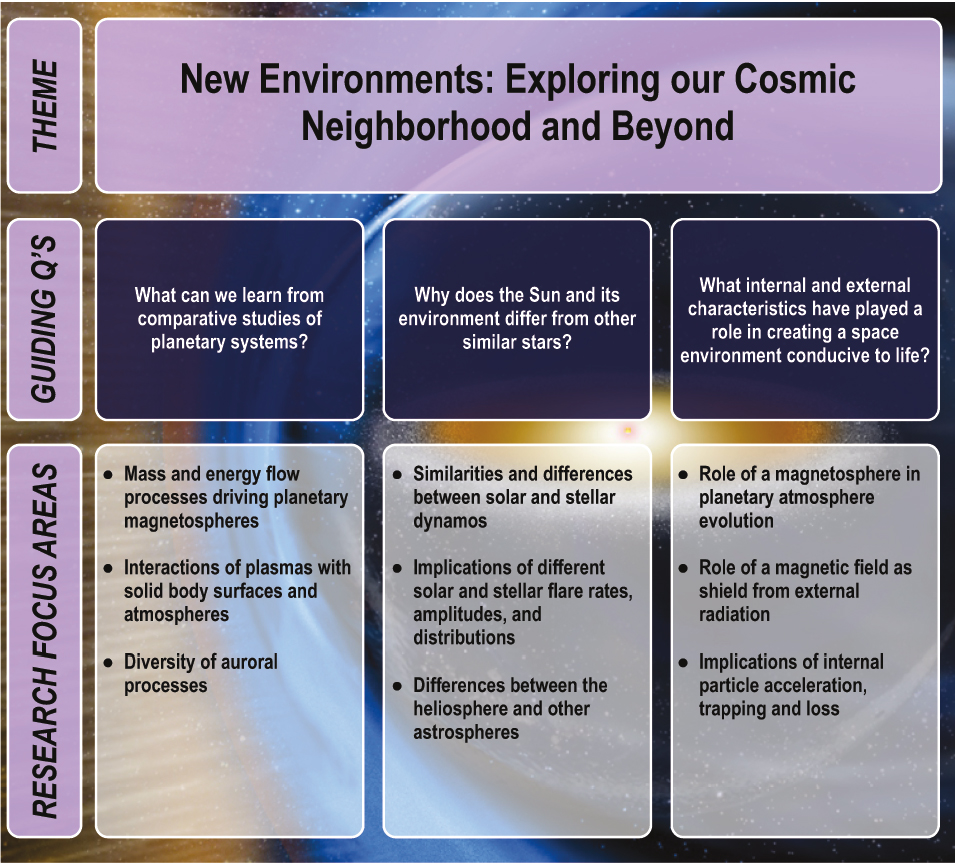
SOURCE: Created by AJ Galaviz III, Southwest Research Institute.
planetary science, astronomy and astrophysics, and Earth sciences. Comparing Earth’s magnetosphere and ionosphere to those of other planets, the Sun and heliosphere to other stars and astrospheres, and understanding how this system is conducive to life, helps answer the boldest questions about the solar system and potential habitability of other systems. In this sense, solar and space physics builds a new connection between these disciplines. Answering these guiding questions requires cross-discipline, cross-divisional, and cross-directorate collaboration. This section is partially a call for action to embolden the agencies to imagine ways in which the traditionally distinct fields can partner with each other to make transformational scientific progress on these ambitious questions.
2.3.3 Guiding Question: What Can We Learn from Comparative Studies of Planetary Systems?
Mass and Energy Flow Processes Driving Planetary Magnetospheres
A major focus of this report is how Earth’s magnetosphere and ionosphere respond as a system to the solar wind and interplanetary magnetic field. Exploration of the magnetospheres of other planets has shown that a similar system-wide response occurs; however, there are significant variations in this response (e.g., with distance from the Sun, strength and/or orientation of the magnetic field, and different plasma regimes). Furthermore, there are clearly different drivers in these other systems (e.g., rotation and satellite sources).
In the past decade, there have been particles and fields measurements made with instruments on planetary missions (funded by NASA Science Mission Directorate’s Planetary Science Division) that have provided new insights into magnetospheric science. For example, in 2011, MESSENGER (Mercury Surface, Space Environment, Geochemistry and Ranging) started its 4-year mission orbiting Mercury, exploring how vigorous solar wind at ~0.4 AU, and an Earth-like reconnection-driven Dungey cycle drive violent storms in Mercury’s small magnetosphere (Figure 2-18). The Dungey cycle loading and unloading of the magnetic flux in the tail lobes of Mercury is much more intense than at Earth and takes place on timescales of several minutes and closely resembles the several-hour long magnetospheric substorms observed at Earth. Electrons accelerated by tail reconnection precipitate onto Mercury’s surface, just equatorward of the polar cap boundary, and stimulate X-ray fluorescence, Mercury’s analogue to Earth’s auroral ovals.
At the opposite end of the size scale is Jupiter’s magnetosphere (Figure 2-18); Pioneer and Voyager flybys in the 1970s showed it to be ~100 times bigger than Earth’s. This huge size is owing to the combination of a very strong internal magnetic field, a weaker solar wind at ~5 AU, and a prodigious 1 ton/s source of material from the volcanic moon Io. The Galileo mission made 34 orbits around Jupiter and revealed that the moon Ganymede has its own magnetic field (comparable in strength to that of Mercury), making a magnetosphere within a magnetosphere, albeit surrounded by subsonic plasma flow (unlike the supersonic solar wind). Galileo also revealed induction currents at Europa, proving the existence of a liquid ocean under the icy crust. This discovery has made Europa a major target for exploring habitability and searching for life. Currently the Juno mission has been in a polar orbit around Jupiter for 8 years (with hope for another year or two before the particle radiation is too damaging), observing Jupiter’s intense aurora and measuring the associated particles and fields. Before Juno, the natural tendency was to invoke similar auroral processes to those at Earth. However, Juno measurements are showing a highly dynamic system, with turbulence playing a much stronger role than at Earth.
Meanwhile, in 2017, the Cassini spacecraft completed its mission after orbiting Saturn for 13 years. Again, an active satellite—Enceladus in this case, with active plumes of water—is the major source of plasma (made of dissociated and ionized water products). Cassini explored how magnetospheric plasma interacts with moons (including Titan) and rings, plus how ionosphere–magnetosphere coupling drives a strong aurora. A major mystery of Saturn’s magnetosphere is the high level of symmetry of the dynamo around the planet’s spin axis, combined with the noticeable oscillation produced by ionosphere–magnetosphere coupling.
In dramatic contrast to Saturn’s tightly aligned magnetic field, the magnetic fields of Uranus and Neptune are tilted at large angles (~50°) from their spin axes and are highly irregular (nondipolar). The Voyager flybys (1986 and 1989) provided a glimpse of these weird magnetospheres and once again showed the range of variability in planetary magnetospheres. It is particularly intriguing how the magnetosphere of Uranus changes with season because

SOURCE: Bagenal and Bartlett (2024).
Uranus’s spin axis is close to the ecliptic plane (obliquity = 98 degrees). This extreme tilt leads to radical changes in the geometry of the solar wind and interplanetary magnetic field interacting with Uranus’s magnetosphere. Figure 2-19 shows how the combination of the high obliquity of Uranus’s spin axis and high tilt of the magnetic field means that the magnetosphere of Uranus varies significantly over both the ~17-hour rotation period as well as the 84-year orbital period. As Uranus is the closest representative of an ice giant planet, understanding how this magnetosphere differs from that of Jupiter and Saturn is important for modeling of exo-ice giants around other stars.
Future Missions
ESA (with NASA collaborations) already has missions on their way to planetary targets—BepiColombo to Mercury and Jupiter Icy Moons Explorer (JUICE) to Jupiter—carrying instruments that make particle and field measurements relevant for solar and space physics. In the 2030s, JUICE is scheduled to encounter Jupiter and eventually go into orbit around Ganymede to explore this moon’s intriguing magnetosphere. NASA’s Europa Clipper will be launched in 2024 and the faster cruise phase of the mission leads to similar arrival times with JUICE, allowing synergistic measurements between JUICE and Europa Clipper. To optimize the scientific return from these missions, it is key that support is provided for an interdisciplinary approach to operations, data processing, and modeling at these planetary targets.

SOURCES: (a) Adapted and reprinted from C.S. Arridge, N. Achilleos, J. Agarwal, et al., 2014, “The Science Case for an Orbital Mission to Uranus: Exploring the Origins and Evolution of Ice Giant Planets,” Planetary and Space Science 104(A):122–140, Copyright (2014), with permission from Elsevier; (b, c, and d) From Cao and Paty (2017).
The planetary science decadal survey Origins, Worlds, and Life: A Decadal Strategy for Planetary Science and Astrobiology 2023–2032 (NASEM 2023a) identifies the Uranus Orbiter and Probe (UOP) as the highest-priority new flagship mission for initiation in the decade 2023–2032. The report states “UOP science objectives address Uranus’s (1) origin, interior, and atmosphere; (2) magnetosphere; and (3) satellites and rings. UOP will provide ground truth relevant to the most abundant, similarly sized class of exoplanets.” From a space science perspective, it is key that such a mission carry sufficient particles and fields instrumentation to fully explore the unique magnetosphere of Uranus.
Interactions of Plasmas with Atmospheres and Solid Body Surfaces
Until recently, the majority of the space science community embraced the idea that an intrinsic magnetic field was required to shield a planet from the solar wind eroding its atmosphere. While a planetary magnetic field does

SOURCES: (Left) NASA’s Scientific Visualization Studio and the MAVEN Science Team; (Right) Johns Hopkins APL/Joe Westlake.
protect the atmosphere from direct solar wind impact (causing sputtering and ionization), a magnetosphere can also enhance the net escape rate via the polar cap and cusp. In fact, there is no consensus on what fraction of outflowing ions ultimately escape Earth’s magnetosphere. Furthermore, when the solar wind impinges on an unmagnetized planet with a significant ionosphere, the interplanetary magnetic field piles up on the dayside of the planet, deflects the solar wind around it, and forms a magnetotail downstream. This shielding effect of the induced magnetosphere is potentially on par with that provided by an intrinsic magnetic field. Contrary to what was previously believed, the absence of a strong planetary magnetic field does not necessarily lead to atmospheric loss—and, conversely, a strong magnetic field does not necessarily shield the atmosphere from escape.
This issue of atmospheric escape at induced magnetospheres has been explored with direct measurements at Venus (by Venus Express and PSP), Mars (by Mars Atmosphere and Volatile EvolutioN [MAVEN]) (see Figure 2-20), as well as at Pluto (with New Horizons). Furthermore, plasma interactions with atmospheres have been studied at outer planet moons that have significant atmospheres and are embedded in their large planetary magnetospheres—for example, Titan and Enceladus at Saturn and Io, Europa, and Ganymede (where further complexity is added via the moon’s own magnetic field; see Figure 2-20) at Jupiter.
For objects that do not have significant atmospheres (i.e., Earth’s Moon, asteroids, Kuiper Belt objects, and the majority of the many moons of the giant planets), solar radiation (including X-rays and UV), the solar wind, and energetic particles (energetic solar protons and galactic cosmic rays) directly bombard the surface. The net effect depends on the energy and flux of the bombarding particles as well as the composition of the surface material. As a result, the chemistry and structure of the surface materials can be altered over time and sputtering of material forms a tenuous atmosphere or escapes into space.
Future Missions
At Jupiter, Juno made observations on flybys of Ganymede, Europa, and Io and will make several more (distant) flybys of Io before the end of the mission. Toward the end of the next decade, JUICE and Europa Clipper will focus on Ganymede and Europa respectively. Escape and Plasma Acceleration and Dynamics Explorers (ESCAPADE) is a heliophysics mission with multiple small satellites that will study the solar wind interaction with the Martian atmosphere. In the longer term, there are planned Venus orbiters, the Uranus Orbiter Probe mission (likely including satellite flybys), and multiple missions to the Moon. These missions need to be equipped with appropriate particles and fields instrumentation. Making the most of these exciting new data sets requires funding for interdisciplinary data analysis and modeling studies.

SOURCES: (Left) Greathouse et al. (2021); (Right) Bagenal (2024).
Diversity of Auroral Processes
Fundamentally, aurora are emissions produced when particles hit an atmosphere. Auroral emissions have been observed at Earth, Jupiter, and Saturn, as well as sparsely at Uranus and Neptune. Recently, auroral emissions have been also observed at Mars. While there are some similarities in the physical processes that produce aurora, the situation at each planet is different. For example, Earth’s auroras are driven by the solar wind interaction with the magnetosphere and are associated with ITM coupling in the polar regions. At Jupiter and Saturn, the primary driver is the coupling of the magneto-disk to the rotation of the planet, also via ITM coupling. The local processes that accelerate the particles bombarding the atmosphere at Earth and Jupiter are similar—quasi-static, field-aligned electric potentials and wave-driven turbulent (broadband) heating—but the former process dominates at Earth while the latter dominates at Jupiter (Figure 2-21). Moreover, the power emitted at Jupiter is 100 times that at Earth. Juno is also showing at least two types of unusual aurora in the polar region, poleward of the main auroral emission. Earth-orbiting X-ray telescopes (e.g., Chandra, XMM) have observed X-ray auroras from Jupiter for decades. These X-rays have a spectrum that suggests they were created by acceleration of heavy ions to megaelectronvolt energies and stripped of several electrons. Juno is now directly measuring these megaelectronvolt ions that are constantly bombarding the polar region. Yet there is little understanding of how megavolt potentials are produced along Jupiter’s magnetic field to accelerate these aurora-exciting ions. Another somewhat uniform region of emission near the poles (called the swirl when first detected with the Hubble Space Telescope) disappears when the auroral region rotates onto the nightside of Jupiter. The ITM processes that control this local time effect are unknown.
Over the past decade, it has become clear that solar wind interaction with Mars also produces auroral emissions. The MAVEN Imaging Ultraviolet Spectrograph instrument has mapped out hydrogen Lyman-α and Lyman-β emissions on the day- and nightsides of Mars, respectively (Figure 2-22). The nightside emission is thought to be produced by precipitation of energetic solar protons. The dayside emission is related to solar wind protons bombarding the dayside atmosphere. More recently the United Arab Emirates’ Mars Mission (EMM) ultraviolet spectrometer instrument detected far UV oxygen emissions on the dayside of Mars with detailed structures that suggest solar wind thermal electrons penetrate through the upper atmosphere but are directed by the strong crustal (remnant) magnetic fields to the footprints of the field lines. Predictions indicate that the aurora of Mars would be readily observed at visible wavelengths (the same oxygen lines that are visible on Earth), and camera systems as simple as modern smartphones should be capable of recording dynamic auroral displays anywhere on the surface of Mars, similar to observations of the polar aurora at Earth.

SOURCES: (Left) Lillis et al. (2022), https://doi.org/10.1029/2022GL099820. CC BY-NC-ND 4.0; (Middle and Right) Adapted from Schneider et al. (2021).
Future Studies
Recent planetary missions (Juno, Cassini, MAVEN, and EMM) have revealed the diverse auroral processes that occur at Jupiter, Saturn, and Mars. The next steps require considerable interdisciplinary (e.g., combining atmospheric and space physics) modeling of the processes, their comparison with the multitude of results from Earth’s auroral processes, and better understanding of the auroral processes at Earth. The UOP mission will use its auroral instrumentation to observe the auroral emissions generated by Uranus’s complex magnetic field interaction with the solar wind.
2.3.4 Guiding Question: Why Does the Sun and Its Environment Differ from Other Similar Stars?
The Sun with its solar system is only one of many stars with planetary systems in the Milky Way Galaxy. While the Sun is the only host that is known to harbor life, Sun-like stars are among the more abundant types of stars. While there are detailed observations about the Sun, the solar wind, and physical processes like solar flares and CMEs, these observations do not reveal what the Sun and heliosphere were like in the past, or what they will become in the future. Still, knowledge of physical processes that take place on the Sun help in the understanding other stars for which detailed observations do not exist.
The many new observations from the previous decade have placed the Sun and its surroundings in the wider context of astrophysics. The long, uninterrupted light curves of the hundreds of thousands of stars monitored by Kepler and the Transiting Exoplanet Survey Satellite (TESS) to find exoplanets have had a laudable side effect—the ability to detect stellar oscillation and do seismic studies analogous to early helioseismic studies of the Sun. These observations enable precise estimates of these stellar masses, their sizes and ages, and define true solar analogs that help place the Sun among the other stars. This revolution in Sun–star comparison has led to interesting conjectures related to the evolution of stellar rotation and magnetic fields, which indicate that the Sun is at the cusp of its dynamo being shut down. In general, older stars rotate more slowly, caused by the loss of angular momentum from stellar winds generated by global dynamo mechanisms. The rate at which the rotation period decreases with time, starting near the middle of a star’s main sequence lifetime for Sun-like stars at about the Sun’s current age. The observations suggest that stellar global dynamos begin to shut down when rotation becomes too
slow to affect convection through weakened Coriolis forces, reducing the shear induced by differential rotation and, in the process, disrupting the global dynamo. Thus, the Sun is at the precipice of change, although the change is certainly slow on human timescales.
Magnetically speaking, the Sun is already much quieter than other G-type stars. Stellar brightness variations caused by starspots on other solar-type stars show larger variations than the Sun. The larger variations may be either because the Sun is permanently less active than other stars, or that its activity levels vary over many thousands or millions of years. The higher activity of the other solar-type stars is also seen in their flare rates. While the Sun typically has few white-light flares, this type of flare appears to be common in other stars. In the first 3 years of the TESS mission, nearly 1 million candidate flare events were detected in about 160,000 stars. Furthermore, stars very similar to the Sun can have super-flares, which are flares with energies significantly greater than the Carrington flare of 1859. Statistical studies of the rates of super-flares on Sun-like stars indicate the occurrence of X700-class to X1000-class flares once every 3,000 to 6,000 years. While these rates are long compared to civilizations, they are short compared to geologic timescales.
Similar to the interplanetary magnetic field in the solar system, stellar magnetic fields are frozen into their stellar winds. The constant wind stream carries the stellar magnetic field outward into the astrosphere, building up the astrospheric magnetic field. While stellar activity is relatively easy to detect, astrospheres are not. The Hubble Space Telescope has successfully observed astrospheres of nearby dwarfs using Lyman-αabsorption. Magnetic field measurements using Zeeman Doppler imaging have enabled modeling of the astrospheres using codes developed for the heliosphere.
Observations to date have revealed that astrospheres of similar stars can be quite different. The size of the astrosphere and the magnetic field strength depend on one hand on the stellar activity and on the other hand on conditions of the surrounding interstellar medium. Habitability of these planets is ultimately determined by the conditions within the astrospheres: Too many strong flares and CMEs could lead to the stripping away of planetary atmospheres, making them uninhabitable. Thus, the elation of the 2016 discovery of a rocky planet in the habitable zone of Proxima Centauri, the Sun’s nearest neighbor, was tempered by the detection of a super-flare with total energy more than 100 times greater than the most powerful solar flare. While assumed common, the first X-ray observation of CMEs from a star other than the Sun was made by the Chandra Observatory.
Similarities and Differences Between Solar and Stellar Dynamos
Observations of stellar activity have revealed very different activity cycles, some very short and others long, apparently independent of stellar rotation rates (see Figure 2-23). Furthermore, multiple cycles including those resembling the Hale cycle have been detected. Explaining the differences in the activity cycles will require modeling efforts along with astroseismic observations of the star’s age and tachocline structure.
Implications of Different Solar and Stellar Flare Rates, Amplitudes, and Distributions
The study of other stars helps put the Sun and solar activity in context. The Sun is just one star at a given age, while there are many more stars, some similar to the Sun, some different, at various stages of their evolution. While it appears that the Sun is quieter than other stars, our observations span only a miniscule portion of the Sun’s history. More studies of an ensemble of solar twins adds to the current knowledge and drives forward the understanding of the Sun as a star.
The large flare rates, and the much larger energy in stellar flares compared with those on the Sun, is currently not understood. This is important for exoplanet habitability—although it is currently not known if superflares hinder or help sustain life. Uncovering the physics of large white-light flares require a deeper understanding of eruptive processes, including why the Sun has so few white-light flares. X-ray and UV observations of stellar flares combine with Zeeman Doppler imaging to identify their magnetic structure. It is also important to understand the conditions under which noneruptive flares occur, and to monitor the flare rates of known solar-type star systems with rocky planets in their habitable zones.
In astronomy, properties of the Sun are used as a baseline to describe stellar properties—stellar sizes, masses and luminosities invariably expressed in terms of the solar mass, radius, and luminosity—as are stellar metallicities.

SOURCES: Edited by AJ Galaviz III, Southwest Research Institute; From T.S. Metcalfe, R. Egeland, J. Saders, 2016, “Stellar Evidence That the Solar Dynamo May Be in Transition,” The Astrophysical Journal Letters 826(1):L2, https://doi.org/10.3847/2041-8205/826/1/L2. Reproduced by permission of the AAS.
Understanding solar magnetic phenomena will, similarly, help in understanding phenomena related to magnetic activity of other stars, and what these phenomena do to the interplanetary media of those systems. To fully benefit from these studies, knowledge of Sun’s magnetic phenomena at the poles, which is currently lacking, is urgently needed.
Differences Between the Heliosphere and Other Astrospheres
Comparing the heliosphere with other astrospheres requires concerted focus on observations and models. While Zeeman Doppler imaging observations, coupled with understanding of heliophysics enables modeling of other stars and astrospheres. These observations miss strong, small-scale magnetic features associated with flares and CMEs. Sun-as-a-star measurements (i.e., spatially unresolved measurements) to allow easy comparison with stellar data, while multiwavelength observations of stellar CME signatures (e.g., Hα, X-ray, and UV dimmings, radio bursts) resolve some of the current observational ambiguities. In parallel, heliospheric models (Figure 2-24) need to generate synthetic observations to quantify the detectability threshold and to facilitate comparison with observations, such as those from IMAP. Increased collaboration between the solar/heliospheric and stellar astrophysics communities provide opportunities for progress on these science challenges. One of the guiding questions of the decadal survey for astronomy and astrophysics was “How Do the Sun and Other Stars Create Space Weather?” (NASEM 2023), leading the way for formal cooperation between NASA’s Heliophysics and Astrophysics divisions. Given that the scope of the Habitable Worlds Observatory line is now being assessed, solar and space physicists may play an important role in ensuring that knowledge of the Sun and the heliosphere are easily applied, overcoming the organizational barriers within NASA.
2.3.5 Guiding Question: What Internal and External Characteristics Have Played a Role in Creating a Space Environment Conducive to Life?
The existence of a magnetosphere has long been considered a defining feature of habitable or once-habitable planets. The strength of the magnetic field may indicate the difference between sustaining an atmosphere or losing one to the vastness of space. A magnetosphere funnels charged particles, harmful to lifeforms, toward the magnetic poles and away from other areas of the planet. The magnetic field also traps particles in nearby space and fuel

SOURCES: Edited by AJ Galaviz III, Southwest Research Institute; From K. Herbst, K. Scherer, S.E.S. Ferreira, et al., 2020, “On the Diversity of M-star Astrospheres and the Role of Galactic Cosmic Rays Within,” The Astrophysical Journal Letters 897(2), https://doi.org/10.3847/2041-8213/ab9df3. Reproduced by permission of the AAS.
danger zones that affect organic life and technology. The heliosphere plays a similar role in funneling high-energy charged particles toward or away from the planets.
Role of the Magnetosphere in Planetary Atmosphere Evolution
The MAVEN mission to Mars was designed to determine how the early warm and wet environment of the red planet transitioned to its current state of a cold, nearly dry rock. Initial studies concluded that significant atmospheric losses occurred early in Martian history, driven by intense solar storms. Without an internal magnetic field like that of Earth’s, Mars transformed from a world potentially habitable to one incapable of supporting an atmosphere or life. However, later results suggest that outflow was increased by a global magnetic field concentrating particle precipitation at the poles. These results indicate that a working dynamo could have accelerated the loss of the Martian atmosphere. Thus, how exactly a magnetosphere contributes to sustenance or loss of a planetary atmosphere remains an open question. This question is answerable by careful comparisons of Earth’s atmospheric loss with that of previously magnetized planets, such as Mars, and weakly magnetized planets, such as Mercury.
Role of a Magnetic Field as Shield from External Radiation
Understanding the fundamental plasma physics that occurs within planetary magnetospheres can provide a better view of these life-sustaining systems. One distinct way in which Earth’s magnetic field protects life is by directing charged particles away from the low latitudes toward the poles of the planet. These solar particles are particularly energetic and therefore damaging to organic life during solar flares and storms. Because of Earth’s strong magnetic field, most of these particles get funneled to the poles, away from population centers. Biological effects of energetic particle precipitation are not fully understood. However, radiation doses onboard polar airline routes are higher than previously suspected, making this funneling effect on human activity more important than previously thought.

SOURCE: S.M. Krimigis, R.B. Decker, E.C. Roelof, et al., 2019, “Energetic Charged Particle Measurements from Voyager 2 at the Heliopause and Beyond,” Nature Astronomy 3:997, https://doi.org/10.1038/s41550-019-0927-4, reproduced with permission from SNCSC.
In a similar fashion, the interstellar medium continually buffets the heliosphere shielding, deflecting and focusing high-energy galactic cosmic rays from the habitable zone where Earth resides. The Voyager observations during traversal of the heliosheath (between the termination shock and the heliopause) answered a nearly century-old question about where the cosmic ray modulation boundary occurs. The Voyager spacecraft now provide direct measurements of the environment outside and reveal just how much the heliosphere attenuates external radiation (Figure 2-25). The IBEX mission probed the global heliospheric boundary revealing the large-scale influence of the interstellar medium on the morphology of the heliosphere. The upcoming IMAP mission will reveal more about the global, large-scale structure of the heliosphere, leading to better understanding of the role that heliospheric boundaries play in protecting the inner solar system from galactic cosmic rays.
Implications of Internal Particle Acceleration, Trapping, and Loss
Lower-energy radiation originating from the Sun gets trapped within planetary magnetospheres, including those of Earth and the giant planets (see Figure 2-26). Around Earth, these low-energy particles gain energy as they convect or are impulsively injected toward the planet. Trapped by the dipolar magnetic field, these particles

SOURCE: Based on I. Jun, H.B. Garrett, and R.W. Evans, 2019, “Trapped Particle Environments of the Outer Planets,” in IEEE Transactions on Plasma Science 47(8):3923–3930, https://doi.org/10.1109/TPS.2019.2907069. Reprinted with permission from IEEE Transactions on Plasma Science.
form the radiation belts, with energies from many kiloelectronvolts up to megaelectronvolts. At Earth, trapped radiation is a hazard to space-based and ground-based technology (see Chapter 3). As these radiation belt particles rain down into the atmosphere, they result in changes in the electrodynamics and composition of the atmosphere.
Currents produced during geomagnetic storms are routed through long conducting materials, such as power lines, harming their operations. On the positive side, precipitation also causes the fascinating auroral displays, which have captivated human imaginations for centuries. Auroras now fuel interest in the outer planets. The Van Allen Probes mission contributed greatly to understanding the processes at work in Earth’s radiation belts, and clues about processes in the Jovian radiation belt system have been provided by the ongoing Juno mission. These processes, following from solar wind-planet interactions, are important to understanding the evolution and history of life on Earth and other planets.
Future Missions
Missions to study the magnetic field systems of Jupiter, Saturn, Uranus, and Neptune would enable new comparative studies of magnetospheres. Each system is unique in the way that it controls particle acceleration and loss. For the atmospheric and climate implications, it is crucial to better explore the very local environment of the upper atmosphere at Earth. At a future time, these studies may be extended to the atmospheres of other planets—which will see very different effects from precipitation owing to their unique atmospheric and surface chemistries.
2.3.6 New Environments: Exploring Our Cosmic Neighborhood and Beyond—Theme 3 Synopsis
Table 2-3 summarizes the guiding questions, focus areas, and observational needs for Theme 3. Progress relies on having space physics instrumentation onboard planetary missions as well as making remote sensing observations of planets with astronomical telescopes, which is achieved through the ongoing, strong cross-divisional collaboration and coordination within the NASA Science Mission Directorate.
TABLE 2-3 New Environments: Exploring Our Cosmic Neighborhood and Beyond—Theme 3 Guiding Questions, Research Focus Areas, and Observations Needed to Carry Out the Research
| Guiding Question | Focus Area | Observation Needs | Model Needs |
|---|---|---|---|
| What can we learn from comparative studies of planetary systems? |
|
Particles and fields measurements throughout the magnetospheres of planets and their moons, ideally with synergistic multipoint observations. Measurements of fields and particles with composition near to solid surfaces/near to atmosphere/exosphere with concurrent observation of the neutrals in those regions. Remote sensing of aurora (ultraviolet [UV], visible, infrared, and radio) and in situ particles and fields measurements in polar regions of Uranus, and broadly distributed across Mars and Venus. |
Magnetosphere models that predict electromagnetic and particle fluxes under different assumptions of the magnetic field strength and configuration. Magnetospheric models that explore effects of different plasma sources (e.g., planetary ionosphere, moons, solar wind). |
| Guiding Question | Focus Area | Observation Needs | Model Needs |
|---|---|---|---|
| Why does the Sun and its environment differ from other similar stars? |
|
Asteroseismic data on other stars to resolve their mass, age, and tachocline. X-ray and UV observations of flares in other stars. Zeeman Doppler imaging of other stars Sun-as-a-star observations in UV, X-ray. Near-simultaneous Hα, X-ray, and UV dimmings, radio burst observations of other stars. |
Solar dynamo models expanded parameters of other types of stars. Models of the heliosphere that produce “Sun-as-a-star” synthetic observables to facilitate comparison with observations of other stars. Extension of heliospheric models to conditions around other types of stars and produce synthetic observables to compare with Sun-as-a-star data and quantify detectability thresholds. |
| What internal and external characteristics have played a role in creating a space environment conducive to life? |
|
In situ particles and fields at other planets as well as Earth of the middle and lower atmospheres. Remote sensing and imaging of atmospheric components and outflow rates. Thermal and high energy particles, magnetic field, surface level measurements of planetary magnetospheres, heliospheric boundary, and interstellar medium. Particles across a wide range of energies from auroral to radiation belts at different magnetic planets. Accurate measurements of precipitation at Earth and other planets. Remote sensing and in situ measurements of neutral atmospheric constituents at Earth and other planets. |
Detailed models of atmosphere–magnetosphere interactions under different assumptions of magnetic fields and atmospheric properties. Whole atmosphere simulations for Earth that have accurate particle precipitation as inputs. Diffusion models of wave-particle interactions within magnetized planets’ magnetospheres. Simulations of energy inputs to the atmosphere, including solar, electromagnetic, auroral precipitation, energetic particle precipitation, Joule heating effects, conductivity effects, neutral atmosphere dynamics and mesosphere–lower thermosphere effects including those of gravity and planetary waves. |
2.4 REFERENCES
Ala-Lahti, M., Pulkkinen, T.I., Pfau-Kempf, Y., Grandin, M., Palmroth, M. 2022. “Energy flux through the magnetopause during flux transfer events in hybrid-Vlasov 2D simulations.” Geophysical Research Letters 49:e2022GL100079. https://doi.org/10.1029/2022GL100079.
Arridge, C.S., N. Achilleos, J. Agarwal, C.B. Agnor, R. Ambrosi, N. André, S.V. Badman, et al. 2014. “The Science Case for An Orbital Mission to Uranus: Exploring the Origins and Evolution of Ice Giant Planets.” Planetary and Space Science 104(A):122–140. https://doi.org/10.1016/j.pss.2014.08.009.
Bagenal, F., and S. Bartlett. 2024. “Graphics Resource Page.” Magnetospheres of the Outer Planets Group, University of Colorado Boulder. https://lasp.colorado.edu/mop/resources/graphics.
Baldner, C.S. 2023. “Helioseismology of the Solar Probes.” Community input paper submitted to the Decadal Survey on Solar and Space Physics. National Academies of Sciences, Engineering, and Medicine.
Bale, S.D., S.T. Badman, J.W. Bonnell, T.A. Bowen, D. Burgess, A.W. Case, C.A. Cattell, et al. 2019. “Highly Structured Slow Solar Wind Emerging from an Equatorial Coronal Hole.” Nature 576:237–242. https://doi.org/10.1038/s41586-019-1818-7.
Brandt, D.A., and A.J. Ridley. 2022. “Statistical Characterization of GITM Thermospheric Horizontal Winds in Comparison to GOCE Estimations.” Space Weather 20:e2021SW002922, https://doi.org/10.1029/2021SW002922.
Burke, B.F., and K.L. Franklin. 1955. “Observations of a Variable Radio Source Associated with the Planet Jupiter.” Journal of Geophysical Research 60:213–217.
Cao, X., and C. Paty. 2017. “Diurnal and Seasonal Variability of Uranus’s Magnetosphere.” Journal of Geophysical Research: Space Physics 122:6318–6331, https://doi.org/10.1002/2017JA024063.
Deighan, J., S.K. Jain, M.S. Chaffin, X. Fang, J.S. Halekas, J.T. Clarke, N.M. Schneider, et al. 2018. “Discovery of a Proton Aurora at Mars.” Nature Astronomy 2:802–807. https://doi.org/10.1038/s41550-018-0538-5.
Eastes, R.W., S.C. Solomon, R.E. Daniell, D.N. Anderson, A.G. Burns, S.L. England, et al. 2019. “Global-Scale Observations of the Equatorial Ionization Anomaly.” Geophysical Research Letters 46:9318–9326. https://doi.org/10.1029/2019GL084199.
Funsten, H.O., F. Allegrini, G.B. Crew, R. DeMajistre, P.C. Frisch, S.A. Fuselier, M. Gruntman, et al. 2009. “Structures and Spectral Variations of the Outer Heliosphere in IBEX Energetic Neutral Atom Maps.” Science 326:964–966. https://doi.org/10.1126/science.1180927.
Future Learn. “Four Layers of the Atmosphere.” https://www.futurelearn.com/info/courses/learn-about-weather/0/steps/39415. Accessed May 22, 2024.
Greathouse, T., R. Gladstone, M. Versteeg, V. Hue, J. Kammer, R. Giles, et al. 2021. “Local Time Dependence of Jupiter’s Polar Auroral Emissions Observed by Juno UVS.” Journal of Geophysical Research: Planets 126:e2021JE006954. https://doi.org/10.1029/2021JE006954.
Gurnett, D.A., and W.S. Kurth. 2019. “Plasma Densities Near and Beyond the Heliopause from the Voyager 1 and 2 Plasma Wave Instruments.” Nature Astronomy 3:1024–1028. https://doi.org/10.1038/s41550-019-0918-5.
Hassler, D.M., S.E. Gibson, J.S. Newmark, N.A. Featherstone, N.M. Viall, L.A. Upton, J.T. Hoeksema, et al. 2023. “Solaris: A Focused Solar Polar Discovery-Class Mission to Achieve the Highest Priority Heliophysics Science Now.” Community input paper submitted to the Decadal Survey on Solar and Space Physics. National Academies of Sciences, Engineering, and Medicine.
Herbst, K., K. Scherer, S.E.S. Ferreira, L.R. Baalmann, N.E. Engelbrecht, H. Fichtner, J. Kleimann, et al. 2020. “On the Diversity of M-star Astrospheres and the Role of Galactic Cosmic Rays Within.” The Astrophysical Journal Letters 897(2). https://doi.org/10.3847/2041-8213/ab9df3.
Jun, I., H.B. Garrett, and R.W. Evans. 2019. “Trapped Particle Environments of the Outer Planets.” IEEE Transactions on Plasma Science 47(8):3923–3930. https://doi.org/10.1109/TPS.2019.2907069.
Krimigis, S.M., R.B. Decker, E.C. Roelof, M.E. Hill, C.O. Bostrom, K. Dialynas, G. Gloeckler, et al. 2019. “Energetic Charged Particle Measurements from Voyager 2 at the Heliopause and Beyond.” Nature Astronomy 3:997. https://doi.org/10.1038/s41550-019-0927-4.
Lillis, R.J., J. Deighan, D. Brain, M. Fillingim, S. Jain, M. Chaffin, S. England, et al. 2022. “First Synoptic Images of FUV Discrete Aurora and Discovery of Sinuous Aurora at Mars by EMM EMUS.” Geophysical Research Letters 49:e2022GL099820. https://doi.org/10.1029/2022GL099820.
Liu, H.L., W. Wang, J.D. Huba, P.H. Lauritzen, and F. Vitt. 2023. “Atmospheric and Ionospheric Responses to Hunga-Tonga Volcano Eruption Simulated by WACCM-X.” Geophysical Research Letters 50:e2023GL103682. https://doi.org/10.1029/2023GL103682.
Metcalfe, T.S., R. Egeland, and J. Saders. 2016. “Stellar Evidence That the Solar Dynamo May Be in Transition.” The Astrophysical Journal Letters 826:L2. https://doi.org/10.3847/2041-8205/826/1/L2.
Miyoshi, Y., K. Hosokawa, S. Kurita, S.I. Oyama, Y. Ogawa, S. Saito, I. Shinohara, et al. 2021. “Penetration of MeV Electrons Into the Mesosphere Accompanying Pulsating Aurorae.” Scientific Reports 11:13724. https://doi.org/10.1038/s41598-021-92611-3.
NASEM (National Academies of Sciences, Engineering, and Medicine). 2023a. Origins, Worlds, and Life: A Decadal Strategy for Planetary Science and Astrobiology 2023–2032. The National Academies Press. https://doi.org/10.17226/26522.
NASEM. 2023b. Pathways to Discovery in Astronomy and Astrophysics for the 2020s. The National Academies Press. https://doi.org/10.17226/26141.
NRC (National Research Council). 2013. Solar and Space Physics: A Science for a Technological Society. The National Academies Press. https://doi.org/10.17226/13060.
Podemski, E., 2019. “Aurora Borealis, Steve and the Picket Fence Over Abraham Lake.” Cline River Photography. https://www.flickr.com/photos/clineriverphotography/48668748758/in/album-72177720303446125.
Sarris, T.E. 2019. “Understanding the Ionosphere Thermosphere Response to Solar and Magnetospheric Drivers: Status, Challenges and Open Issues.” Philosophical Transactions of the Royal Society A 377:20180101. http://doi.org/10.1098/rsta.2018.0101.
Schneider, N.M., Z. Milby, S.K. Jain, J.-C. Gérard, L. Soret, D.A. Brain, et al. 2021. “Discrete Aurora on Mars: Insights into Their Distribution and Activity from MAVEN/IUVS Observations.” Journal of Geophysical Research: Space Physics 126:e2021JA029428. https://doi.org/10.1029/2021JA029428.
Shen, C., B. Chen, K.K. Reeves, S. Yu, V. Polito, and X. Xie. 2022. “The Origin of Underdense Plasma Downflows Associated with Magnetic Reconnection in Solar Flares.” Nature Astronomy 6:317–324. https://doi.org/10.1038/s41550-021-01570-2.
Sibeck, D.G., Q. Zong, P. Escoubet, G. Le, and H. Zhang. 2020. “New Results Concerning Solar Wind Entry into the Magnetosphere.” Eos. https://eos.org/editors-vox/new-results-concerning-solar-wind-entry-into-the-magnetosphere.
Sorathia, K.A., A. Michael, V.G. Merkin, A.Y. Ukhorskiy, D.L. Turner, J. Lyon, J. Garretson, M. Gkioulidou, and F. Toffoletto. 2021. “The Role of Mesoscale Plasma Sheet Dynamics in Ring Current Formation.” Frontiers in Astronomy and Space Sciences 8:761875. https://doi.org/10.3389/fspas.2021.761875.
Verronen, P.T., A. Kero, N. Partamies, M.E. Szeląg, S.-I. Oyama, Y. Miyoshi, and E. Turunen. 2021. “Simulated Seasonal Impact on Middle Atmospheric Ozone from High-Energy Electron Precipitation Related to Pulsating Aurorae.” Annales Geophysicae 39:883–897. https://doi.org/10.5194/angeo-39-883-2021.


