The Next Decade of Discovery in Solar and Space Physics: Exploring and Safeguarding Humanity's Home in Space (2025)
Chapter: Appendix G: Technical, Risk, and Cost Evaluation
G
Technical, Risk, and Cost Evaluation
G.1 OVERVIEW OF THE TRACE PROCESS
In carrying out its task for this solar and space physics decadal survey, an independent assessment of the technical readiness and life-cycle costs was needed for several high-priority, relatively high-cost, mission concepts under consideration for inclusion in a recommended comprehensive strategy. For this task, the National Academies of Sciences, Engineering, and Medicine contracted with The Aerospace Corporation to provide an independent evaluation. The corporation used the technical, risk, and cost evaluation (TRACE) process for its evaluation.
TRACE provides a common framework for the programmatic evaluation of concepts under consideration for decadal surveys and other studies by the National Academies (NASEM 2023a,b). A detailed discussion of the TRACE process is provided in the 2023 astronomy and astrophysics decadal survey report, Pathways to Discovery in Astronomy and Astrophysics for the 2020s.1 This decadal survey followed a process similar to that of the astronomy and astrophysics decadal survey, but with a few key differences. Notably, it focused exclusively on space-based projects. Additionally, unlike the astronomy and astrophysics decadal study, which used separate panels for determining science priorities and project priorities, this survey for solar and space physics consolidated these functions within a single panel.
In developing the lists of mission concepts to provide to the steering committee, each of the science study panels—the Panel on Physics of Ionospheres, Thermospheres, and Mesospheres; the Panel on the Physics of Magnetospheres; and the Panel on Physics of the Sun and Heliosphere—began with the identification of priorities for solar and space physics science. This identification was informed by literature reviews, feedback from community meetings and workshops, and especially responses from a request for information.2 In response to this request, the panels received 450 community input papers.
While the steering committee provided general guidance to the panels, they had considerable flexibility in the processes they employed to gather information and develop their mission concepts. After deliberations, each of the panel forwarded a short list of concepts that address the science priorities to the steering committee. The steering
___________________
1 See Appendix O in NASEM (2023a).
2 See links at https://www.nationalacademies.org/our-work/decadal-survey-for-solar-and-space-physics-heliophysics-2024-2033. At its highest level, the request for information asked respondents to 1. Provide an overview of the current state of solar and space physics science and applications; 2. Describe the highest-priority science goals to be addressed in the period of the survey; 3. Develop a comprehensive ranked research strategy that provides an ambitious but realistic approach to address these goals that includes ground- and space-based investigations as well as data and computing infrastructure to support the research strategy; and 4. Assess the state of the profession.
committee, in turn, selected 12 mission concepts that went through the full TRACE process. A 13th mission concept went through the technical and risk assessment but not the cost assessment.
For each mission concept that went through all or part of TRACE, details about the design (e.g., mission design, instrument, bus details) were gathered in coordination with the panels. The information was drawn from the community input papers, mission concept study reports when available, and additional requests for information to members of the community. The tradespace of technical solutions was then narrowed, and a baseline design was evaluated.
The TRACE process had specific steps that focused on technical aspects, cost, and schedule. First, an evaluation of the technical readiness and risk identification was carried out. Risks may be associated with different factors—including but not limited to instrument maturity, spacecraft bus accommodation, mission design, and operations—and are often associated with technology development. Some of the concepts evaluated are satellite constellations, which have unique challenges associated with multiple builds and rideshare accommodations. Individual risks were then collated to form an overall risk rating for the mission concept, which was assigned as a qualitative color rating of green (low risk), yellow (medium risk), or red (high risk).
A cost evaluation was then performed for each mission concept. The identified risks were quantified in terms of the effect on the estimated cost, based on the technical evaluation and historical data. The spacecraft and instrument hardware costs were estimated by Aerospace Corporation using standard cost evaluation methods, including analogies, models, and previous cost data. Cost estimates were performed down to the standard Level 3 Work Breakdown Structure (WBS) using National Aeronautics and Space Administration guidelines. A probabilistic cost risk analysis was performed using a triangular distribution of costs from least likely to most likely for each WBS element. Launch vehicle (LV) cost estimates were based on the technical assessment of the number and size of launch vehicles required and matched to candidate launch vehicles in the current Launch Services Program catalog. Future LV costs are unknown; therefore, current costs were used uniformly to put the mission concepts on an equal footing. The results of this cost assessment are documented in an “S-curve,” and a recommended cost reserve was estimated. Budget threats identified from the technical risk assessment were then added to the cost (Bitten et al. 2013).
A schedule analysis was also performed. All mission concepts were assumed to have a start date of 2025, except for Interstellar Probe, which requires significant technology development, driving an assumed 2029 start date. A draft mission schedule was developed considering science constraints (e.g., solar cycle), technology development, historical build duration data, special considerations such as multiple spacecraft builds, and the science operations timeline. The schedule risk for development (Phases A–D) was then assessed and documented in a schedule S-curve with schedule reserves estimated.
The analyses were then aggregated into a budget profile for each mission concept, and the profiles were validated and cross-checked through a series of reviews. Internal reviews were held at Aerospace Corporation with experienced personnel; they included an examination of the details of each TRACE to ensure that each concept was evaluated consistently. After the internal review, the results were presented to panel and steering committee members. Any disconnects in the science or mission assumptions were identified and resolved. In some cases, further consultation with the panels produced a “descope” of the concept, and an update to the budget analysis was performed.
G.2 SYNOPSIS OF TRACE RESULTS
G.2.1 The Selected Mission Concepts
As noted above, the steering committee selected 12 mission concepts for the full TRACE process and an additional one that went through the technical and risk assessment but not the cost assessment:
- Multipoint Comprehensive Eruptive Mission (MCEM)
- Ecliptic Heliospheric Constellation (ECH)
- Solar Polar Orbiter (SPO)
- Heliospheric Dynamics Transient Constellation (HDTC)
- Interstellar Probe
- Resolve

NOTE: GEO, geosynchronous orbit; inst., instruments; JGA, Jupiter gravity assist; L1 and L4, Lagrange points 1 and 4; S/C, spacecraft; SE-L1, solar ecliptic Lagrange point 1; SLS, Space Launch System; VGA, Venus gravity assist.
SOURCES: Composed by The Aerospace Corporation; Sun image from NASA Goddard; Jupiter image from NASA; Star field background from NASA/JPL.
- Interhemispheric Circuit (I-Circuit)
- Low-Altitude Ionosphere and Thermosphere In Situ Researcher (LAITIR)
- Buoyancy Restoring-Force Atmospheric-Wave Vertical-Propagation Observatory (BRAVO)
- Synchronized Observations of Upflow, Redistribution, Circulation, and Energization (SOURCE)
- Observatory for Heteroscale Magnetosphere-Ionosphere Coupling (OHMIC)
- Comprehensive Observations of Magnetospheric Particle Acceleration, Sources, and Sinks (COMPASS)
- Links: Links between regions and scales in geospace
Figures G-1 through G-3 show a summary of these 12 mission concepts, by subdiscipline. Quad-chart descriptions for each mission concept are shown below in Section G.2.5, in Figures G-6 through G-18.
G.2.2 Cost Analyses
A cost comparison for all mission concepts is shown in Figure G-4. Costs are divided into development and operations costs, which include all pre-Phase A technology development (if applicable) and Phases A–F3; LV costs; and budget threats, which were monetized. All costs are shown in fiscal year (FY) 2024 dollars. Budget threats are based on identified risks that could drive the cost above the baseline estimate.
___________________
3 Phase A, preliminary analysis; Phase B, definition; Phases C/D, design and development; Phase E, operations; Phase F, closeout.

NOTE: Ah, Amp-hours; E-spec, electron spectrometer; FUV, far ultraviolet; GNSS RO, Global Navigation Satellite System Radio Occultation; HEO, highly elliptical orbit; NIRCAM, near infrared camera; TLS, terahertz limb sounder.
SOURCES: Composed by The Aerospace Corporation; Earth image from NASA; Star field background from NASA/JPL.
The mission concepts evaluated for this decadal survey included multiple large, often heterogenous constellations; multiple concepts with heliocentric, interplanetary, or interstellar destinations; and longer operations phases. As such, the estimated cost of some concepts is commensurately higher than historical heliophysics missions, although the cost of the survey-prioritized Links and SPO notional concepts are estimated at $1.3–$1.4 billion. These costs are comparable to recent missions such as, Parker Solar Probe ($1.8 billion), Magnetosphere MultiScale (MMS) mission ($1.5 billion), Solar Dynamics Observatory (SDO) ($1.3 billion), and Van Allen Probes ($0.9 billion), when measured in FY 2024 dollars.
G.2.3 Risk Ratings
Risk ratings by subdiscipline are shown in Figure G-5 and reflect the degree of technical difficulty for the mission concept. All the heliophysics mission concepts that were evaluated fell into one of three categories:
- Medium-low, green: moderate new development, adequate margins, and/or moderate risk to achieve major mission objectives as proposed;
- Medium, yellow: medium new development, adequate to optimistic margins, and/or medium risk of achieving major mission objectives as proposed; or
- Medium-high, orange: significant new development, optimistic to negative margins, or significant risk of achieving major mission objectives.

NOTE: API, Auroral Plasma Instrument; CDS, charge discharge sensor; CPA, Core Plasma Analyzer; DES, Dual Electron Spectrometer; EFI, Electromagnetic Fields Instrument; ENA, energetic neutral atom; ESA, electrostatic analyzer; EUV, extreme ultraviolet; GCI, Geocoronal Imager; HPCA, Hot Plasma Composition Analyzer; MAG, magnetometer; MagCon, magnetospheric constellation; PARAGON, Plasma Acceleration, Reconfiguration, and Aurora Geospace Observation Network; Rcvr, receiver; SST, solid state telescope; UV, ultraviolet.
SOURCES: Composed by The Aerospace Corporation; Earth image from NASA; Star field background from NASA/JPL.
The Sun and heliosphere concepts were rated as relatively higher risk among the concepts studied, several of which require significant instrument technology development. Most ionosphere, thermosphere, and mesosphere and magnetosphere concepts are relatively lower risk, ranging between medium and medium-low. The Resolve, HDTC, and Links risk ratings are driven by development, deployment, and the operations of large constellations. COMPASS at Jupiter, HDTC, and SPO are interplanetary mission concepts with challenging flight environments and operational challenges. The interplanetary nature of most of the Sun and heliosphere missions is the primary driver for the higher-risk ratings.
G.2.4 Space Weather Enhancement Options
In addition to evaluation of the 13 selected mission concepts, the steering committee requested suggestions for space weather enhancements from the Panel for Space Weather Science and Applications. A detailed summary of space weather evaluations and enhancements is included in an annex to the panel report (see Appendix E). The Aerospace Corporation carried out a cost evaluation for a selection of those enhancements. The analysis found that space weather enhancements had only modest effects on project schedules and costs, with cost increases

NOTES: Development and operations includes phases from pre-Phase A through Phase F, excluding launch vehicle cost and threats, which are broken out separately. Threats are based on identified risks that could drive the cost above the baseline estimate. (Sun and Heliosphere) ISP, Interstellar Probe; MCEM, Multipoint Comprehensive Eruptive Mission; HDTC, Heliospheric Dynamics Transient Constellation; EHC, Ecliptic Heliospheric Constellation; SPO, Solar Polar Orbiter; (Ionosphere, Thermosphere, Mesosphere) I-Circuit, Interhemispheric Circuit; BRAVO, Buoyancy Restoring-Force Atmospheric-Wave Vertical-Propagation Observatory; Resolve; (Magnetosphere) COMPASS, Comprehensive Observations of Magnetospheric Particle Acceleration, Sources, and Sinks; SOURCE, Synchronized Observations of Upflow, Redistribution, Circulation, and Energization; Links; OHMIC, Observatory for Heteroscale Magnetosphere-Ionosphere Coupling.
SOURCE: Created based on TRACE data provided by The Aerospace Corporation.
ranging from $1 million to $36 million. The panel found that certain destinations are good targets for specific space weather enhancements. Examples are enhanced Global Navigation Satellite System receiver firmware to enable measurements of total electron content in low Earth orbit, charge-discharge sensors in medium and high Earth orbits, and sensors to measure solar energetic particles outside of Earth orbit.
G.2.5 Overall TRACE Results
A summary of TRACE results is shown in Table G-1. Quad-chart descriptions for the 13 selected mission concepts are shown in Figures G-6 through G-18, in order of most to least estimated cost by discipline area. LAITIR, which did not undergo cost evaluation, is included at the end.

NOTE: BRAVO, Buoyancy Restoring-Force Atmospheric-Wave Vertical-Propagation Observatory; COMPASS, Comprehensive Observations of Magnetospheric Particle Acceleration, Sources, and Sinks; EHC, Ecliptic Heliospheric Constellation; HDTC, Heliospheric Dynamics Transient Constellation; I-Circuit, Interhemispheric Circuit; ISP, Interstellar Probe; Links, links between regions and scales in geospace; MCEM, Multipoint Comprehensive Eruptive Mission; OHMIC, Observatory for Heteroscale Magnetosphere-Ionosphere Coupling; SOURCE, Synchronized Observations of Upflow, Redistribution, Circulation, and Energization; SPO, Solar Polar Orbiter.
SOURCE: Created by The Aerospace Corporation.
TABLE G-1 Summary of Technical, Risk, and Cost Evaluation Results
| Mission Concept | Technical Risk Rating | Assumed Launch Date | Mission Concept Cost Excluding LV, Phases A–F (millions of FY2024 dollars)a | LV Cost (millions of FY2024 dollars) | Concept Description Sectionb |
|---|---|---|---|---|---|
| Interstellar Probec | Med-high | 2036 | $4,185 | $1,592 | B.5.2.1 |
| MCEM | Medium | 2033/2034 | $4,266 | $281 | B.5.2.1 |
| EHC | Med-low | 2034 | $2,216 | $150 | B.5.2.1 |
| SPO | Medium | 2032 | $1,312 | $245 | B.5.2.1 |
| HDTC | Medium | 2033 | $2,926 | $161 | B.5.2.1 |
| BRAVO | Med-low | 2032 | $1,588 | $161 | D.6.2.1 |
| Resolve | Medium | 2034 | $705 | $52 | D.6.2.2 |
| I-Circuit | Med-low | 2031 | $1,489 | $405 | D.6.2.3 |
| COMPASS at Jupiter | Medium | 2031 | $2,076 | $291 | C.5.2.1 |
| Links | Med-low | 2032 | $1,390 | $150 | C.5.2.1 |
| OHMIC | Med-low | 2032 | $978 | $100 | C.5.2.1 |
| SOURCE | Med-low | 2032 | $1,429 | $220 | C.5.2.1 |
| LAITIR | Medium | 2030/2032/2035 | Not costed | Not costed | D.6.2.4 |
a Assuming Phase B start in 2025.
b Mission concepts are described in detail in Appendixes B-D (science panel reports).
c Phase B start in 2029.
NOTE: BRAVO, Buoyancy Restoring-Force Atmospheric-Wave Vertical-Propagation Observatory; COMPASS, Comprehensive Observations of Magnetospheric Particle Acceleration, Sources, and Sinks; EHC, Ecliptic Heliospheric Constellation; FY24, fiscal year 2024; HDTC, Heliospheric Dynamics Transient Constellation; I-Circuit, Interhemispheric Circuit; LAITIR, Low-Altitude Ionosphere and Thermosphere In Situ Researcher; Links, links between regions and scales in geospace; LV, launch vehicle; MCEM, Multipoint Comprehensive Eruptive Mission; OHMIC, Observatory for Heteroscale Magnetosphere-Ionosphere Coupling; SOURCE, Synchronized Observations of Upflow, Redistribution, Circulation, and Energization; SPO, Solar Polar Orbiter.

SOURCES: Composed by The Aerospace Corporation; Background image from Johns Hopkins University Applied Physics Laboratory.

SOURCE: Created by The Aerospace Corporation.

SOURCES: Composed by The Aerospace Corporation; HDTC Heliocentric Constellation image from Szabo et al. (2022), https://doi.org/10.3847/25c2cfeb.7fb78e78. CC BY 4.0.

SOURCE: Created by The Aerospace Corporation.

SOURCES: Composed by The Aerospace Corporation; SPO Mission image from Hassler et al. (2023), https://doi.org/10.3847/25c2cfeb.408d006f. CC BY 4.0.

SOURCE: Created by The Aerospace Corporation.
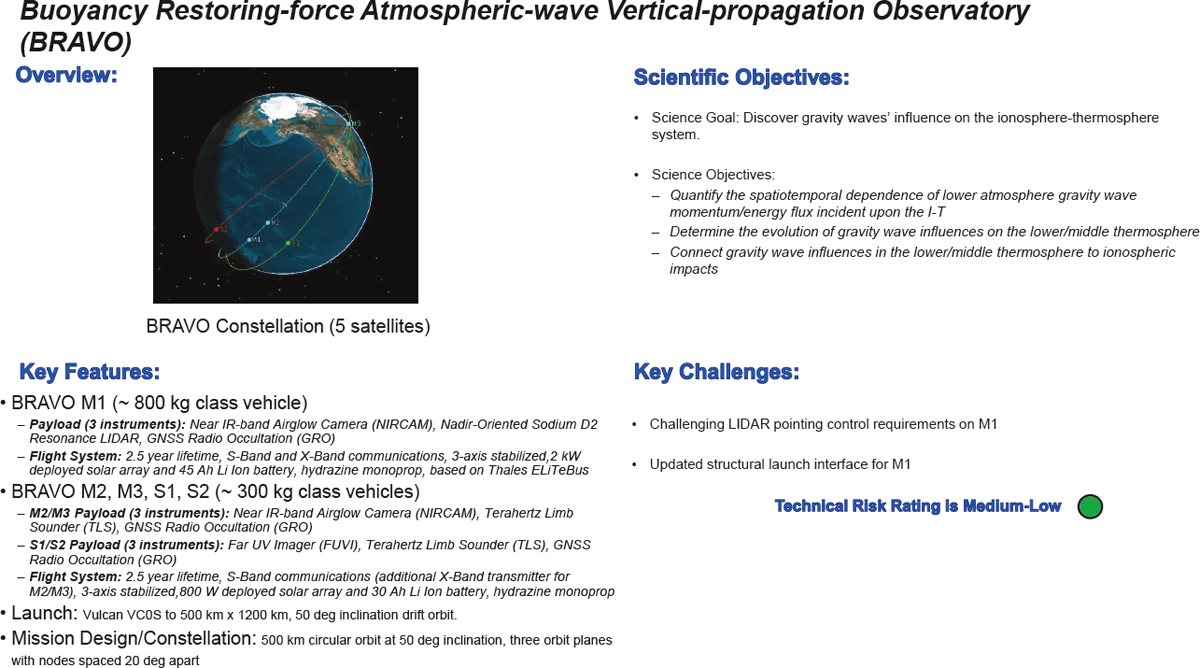
SOURCE: Created by The Aerospace Corporation.

SOURCE: Created by The Aerospace Corporation.

SOURCE: Created by The Aerospace Corporation.

SOURCES: Composed by The Aerospace Corporation; SOURCE Constellation image from Goldstein et al. (2023), https://baas.aas.org/pub/2023n3i132/release/1. CC BY 4.0.

SOURCE: Created by The Aerospace Corporation.

SOURCE: Created by The Aerospace Corporation.

SOURCE: Created by The Aerospace Corporation.
G.3 REFERENCES
Bitten, R., E. Mahr, and R. Kellogg. 2013. “Cost Estimating of Space Science Missions.” https://smd-prod.s3.amazonaws.com/science-red/s3fs-public/mnt/medialibrary/2013/06/24/secure-MAHR-BITTEN-Aerospace_Costing_Space_Science_Missions_ATR-2013-00108.pdf.
NASEM (National Academies of Sciences, Engineering, and Medicine). 2023a. Pathways to Discovery in Astronomy and Astrophysics for the 2020s. The National Academies Press. https://doi.org/10.17226/26141.
NASEM. 2023b. Thriving in Space: Ensuring the Future of Biological and Physical Sciences Research: A Decadal Survey for 2023–2032. The National Academies Press. https://doi.org/10.17226/26750.


