Summary
Over the past decade, groundbreaking explorations have unfolded throughout the heliosphere—the vast protective bubble formed by the solar wind that extends from the Sun to the outer fringes of the solar system. For the first time, humanity “touched the Sun,” and two spacecraft launched in 1977 crossed the boundary of the heliosphere where the influence of the solar wind ends and the interstellar medium begins. Fundamental discoveries were made over a vast range of scales, from microscopically small plasma processes to the global interconnected solar and space physics system, advancing the understanding of physics in space and the nature of living with a star.
Today, fundamental discoveries are waiting to be made by venturing into new environments and bringing new capabilities to familiar places. The heliosphere, home to our star and our planet, remains the only known habitable system in the universe. Studying the Sun and its influence within the heliosphere is paramount. This decadal survey identifies priority science, organized by theme, to enrich understanding of the space around us and to prepare humanity for the future.
As humanity looks to the future, solar and space physicists are uniquely positioned to study the heliosphere as the only known habitable system in the universe. The theories and models that describe the interactions of a star with the atmospheres and magnetic fields of its planets are essential for understanding both how life evolved on Earth and the physical conditions that may enable life elsewhere. The next decade may witness humans setting outposts on the Moon and preparing to venture to Mars, becoming a true space-faring civilization. As the dependence on technological infrastructure both on the planet and in space grows, the impacts of space weather and the importance of understanding the Sun and its influence continues to increase. Building upon the investments of the past decade, including a fleet of small to medium-sized missions ready to launch and the recent commissioning of the world’s largest solar telescope, a great opportunity has opened to realize the vision for the next decade and beyond—to discover the secrets of the local cosmos and to expand and safeguard humanity’s home in space.1
This decadal survey report from the Committee on a Decadal Survey for Solar and Space Physics (Heliophysics) 2024–2033 identifies the highest-priority science for the next decade and presents a comprehensive and balanced research strategy for making measurable progress on this science. As discussed in the preface, the statement of task is broader than those of the previous two decadal surveys in solar and space physics (NRC 2003, 2013).
___________________
1 Earth’s neighborhood in space—the local cosmos—provides a uniquely accessible laboratory in which to study the behavior of space plasmas (ionized gases) in a wide range of environments. By taking advantage of our ability to closely scrutinize and directly sample the plasma environments of the Sun, Earth, the planets, and other solar system bodies, we can test our understanding of plasmas and extend this knowledge to the stars and galaxies that we can view only from afar (NRC 2004).
Guided by this statement of task and additional counsel contained in the study approach, recommendations made to the study sponsors, the Air Force Office of Scientific Research (AFOSR), the National Aeronautics and Space Administration (NASA), the National Oceanic and Atmospheric Administration (NOAA), and the National Science Foundation (NSF), constitute an ambitious but realistic approach for realizing scientific and space weather advances and a vision for solar and space physics.
S.1 A VISION FOR SOLAR AND SPACE PHYSICS
Observing the space environment close to home enables detailed study of processes at work throughout the universe, and a close-up view of the system-level interactions between a star and its planets. Ultra-high-resolution images, out of reach for any star other than the Sun, have revealed turbulent structures, each the size of Texas, bubbling on the surface of the Sun. These constant motions transport energy from the solar interior to its surface, from which it can travel through space toward the planets. Understanding the changing Sun is critical for understanding its impacts on Earth. While Earth’s upper atmosphere is influenced by the Sun and the space environment, it is also driven from below by internal atmospheric processes. Studies of Earth’s upper atmosphere reveal the interplay between externally and internally driven atmospheric processes. Earth’s upper atmosphere is in fact far from quiet. Plasma bubbles in the ionosphere—stark voids in the charged plasma enveloping Earth—impact everyday lives by disrupting global positioning system signals that travel through the ionosphere.
Exploration is driven by humanity’s fundamental curiosity about the world, and solar and space scientists have always been intrepid explorers. In addition, with society increasingly reliant on technological systems and on the verge of a new era in space exploration, research knowledge has become essential to advance the applied science of space weather. The increasing importance of space weather was recognized by lawmakers with the enactment of the Promoting Research and Observations of Space Weather to Improve the Forecasting of Tomorrow Act (PROSWIFT) in 2020 (P.L. 116-181). Its importance to the U.S. economy is also illustrated by comments from Ajit Pai, former Chairman of the Federal Communications Commission, who stated, “Whether they know it or not, all companies will be space companies” (National Space Society 2019).
Thus emerges a two-part vision and mission for solar and space physics for the coming decade: research and exploration to discover the secrets of the local habitable cosmos, and applied science to expand and safeguard humanity’s home in space (Figure S-1). The first part of the mission reflects the curiosity-driven motivations for advancing solar and space physics research. The second part reflects the increasing importance of space weather for society. While these are two distinct and equally important reasons for investing in solar and space physics, they are integrally linked and have overlapping scientific goals; progress on one part of the mission invariably enables progress on the other.
S.2 A VISION FOR A HEALTHY AND VIBRANT COMMUNITY
The vision is only realized with a vibrant and engaged solar and space physics community. Workforce needs and challenges evolve, and continual assessment and improvements to the state of the profession are warranted. The study committee’s vision for the profession is a unified solar and space physics community with a diverse workforce that engages in interdisciplinary collaborations and makes advances in scientific research and practical applications.
The identity for the field needs to be solidified. “Solar and space physics” is one umbrella term that encompasses the different components of a discipline that includes solar, heliospheric, magnetospheric, ionospheric, thermospheric, mesospheric, and space weather communities and is the name adopted here for lack of a generally accepted alternative. The lack of a common identity was raised in the 2013 decadal survey report Solar and Space Physics: A Science for a Technological Society (NRC 2013; hereafter the “2013 decadal survey”) and continues to hinder the community’s ability to articulate broadly its science and applications, as well as to assess the state of the profession. A common and recognized name and identity for the field would benefit efforts in data gathering, recruitment, education, and public outreach.

SOURCE: Created by AJ Galaviz III, Southwest Research Institute.
S.3 FRONTIERS IN SOLAR AND SPACE PHYSICS RESEARCH
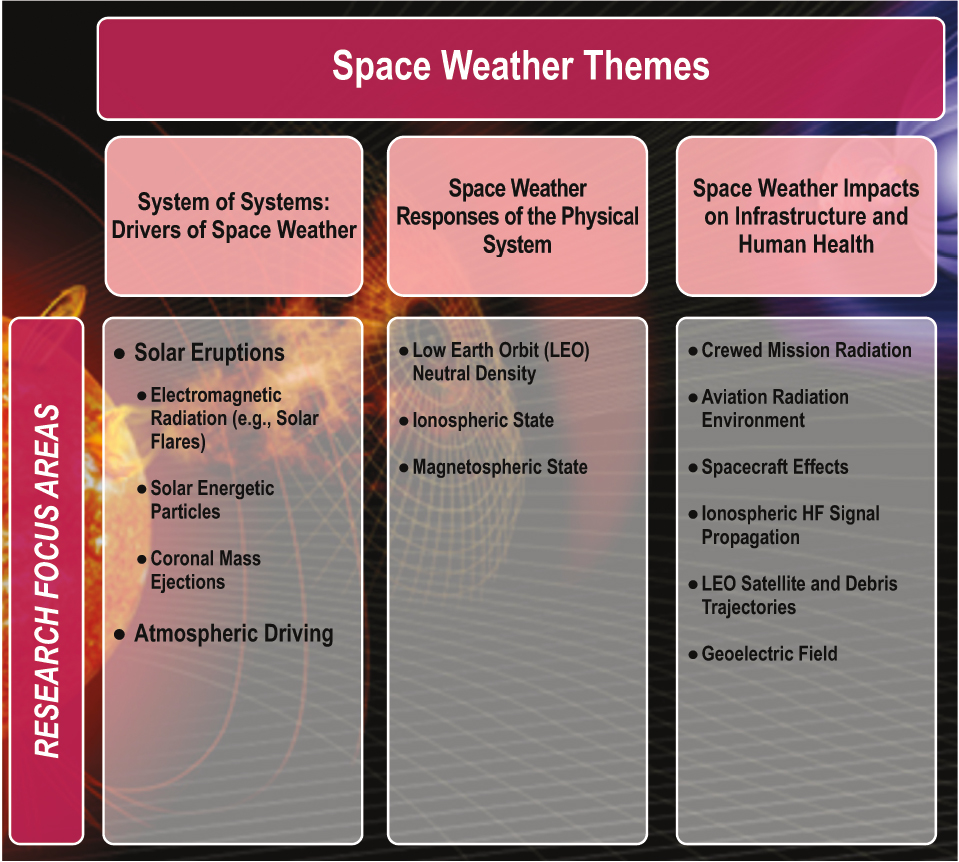
The vision and mission for solar and space physics translate into a broad set of themes that serve as a roadmap for the science and space weather goals of the decade (Figure S-2) and for the future workforce needed to achieve them.
- Science themes
- Sun–Earth–Space: Our Interconnected Home
- A Laboratory in Space: Building Blocks of Understanding
- New Environments: Exploring Our Cosmic Neighborhood and Beyond
- Space weather themes
- System of Systems: Drivers of Space Weather
- Space Weather Responses of the Physical System
- Space Weather Impacts on Infrastructure and Human Health
The three science themes recognize the interconnections between the parts of the heliosphere; reaffirm the importance of understanding the fundamental processes from which this dynamic, interconnected system is constructed; and embrace the expansion of the field to new environments. Achieving a level of understanding that enables prediction requires a systems science approach and an understanding of the space weather drivers and impacts on physical and technological systems as well as on humans in space, in the air, and on ground. The three space weather themes encompass these three aspects of space weather research.
For each science theme, guiding questions steer the research of the coming decade (Figure S-3). Within each guiding question, research focus areas were identified for which measurable progress can be made. Most questions and focus areas are not specific to regions of space or to subdisciplines of the field; rather they were formulated to capture the community’s common goals and interests. Questions and focus areas emerged from the synthesis of science questions developed by the three discipline-oriented science panels of the study (the Panels on the Physics

SOURCES: Composed by AJ Galaviz III, Southwest Research Institute; Center image from NASA, U.S. Naval Research Laboratory.
of the Sun and Heliosphere [SHP]; the Physics of Ionospheres, Thermospheres, and Mesospheres [ITM]; and the Physics of Magnetospheres [MAG]). The work of the panels was informed by 450 white papers (hereafter referred to as “community input papers”).
Space weather research is driven largely by the needs of space weather users such as the communications, aviation, electric power, and satellite industries, as well as the U.S. government. The steering committee chose a different structure for space weather research goals to reflect this difference. The Panel on Space Weather Science and Applications identified a comprehensive set of target outcomes that were prioritized by the steering committee. The steering committee then identified research focus areas under the umbrella of three broad themes (Figure S-4) where progress is needed to achieve the prioritized outcomes. The relationship between the themes, research focus areas, and prioritized operational outcomes achievable within the next decade is shown in Table S-1. System science is central to space weather research. This is reflected in the “System of Systems” theme—a term which recognizes that the Sun–Earth system itself comprises many other systems, all of which interact. These interconnected systems have distinct physical responses to space weather drivers and associated impacts on human infrastructure and health; the two remaining themes reflect these aspects of space weather.
Together, this collection of themes—with their guiding questions and research focus areas—captures the current state of the field and its most pressing questions. The themes are broad, signifying the possibilities for scientific growth in the future, while the focus areas are targeted, identifying where measurable progress is possible in the next decade.
Further unifying scientific research and space weather application is the realization that advancement of both requires a vibrant and engaged solar and space physics community. Focus areas of improvement for the state of the profession are organized into the following four themes: Demographics of the Workforce, Solar and Space Physics Education, DEIA+,2 and Expanding Public Outreach and Participation.
With research focus areas identified for science, space weather, and the state of the profession, a comprehensive research strategy was developed, reflecting the intimately linked nature of these goals.
___________________
2 DEIA+ represents a wide range of topics encompassing diversity, equity, inclusion, accessibility, anti-racism, accountability, and more.

SOURCES: Composed by AJ Galaviz III, Southwest Research Institute; Background image from NASA/Goddard Space Flight Center.
S.4 THE COMPREHENSIVE RESEARCH STRATEGY
This decadal survey recommends a comprehensive and balanced research strategy that advances the solar and space physics two-pronged mission (Figure S-1)—the framework needed to make progress on all areas within each science and space weather theme. The strategy includes three elements (Figure S-5): an integrated HelioSystems Laboratory (HSL) to coordinate the collection of data; the DRIVE+ initiative to organize the supporting research and technology programs that enable the scientific community to produce scientific results; and preparations for the decade and beyond to prioritize investments in preparation for future endeavors. The strategy includes recommendations in each of these areas, summarized in Section S.5 below.
The strategy is comprehensive because it addresses all the research focus areas within each science and space weather theme, and it includes contributions from NASA, NOAA, NSF, and AFOSR, as well as international partners. The strategy is realized only through combined investments by these agencies and partners in ground-based
SOURCES: Composed by AJ Galaviz III, Southwest Research Institute; Background image from NASA.
and space-based observations, theory and modeling, and the evolving and expanding workforce necessary to meet the broader needs of the field. Moreover, the strategy addresses a new level of cooperation between these agencies and partners that is needed to achieve systems-level science and space weather progress in the next decade.
The strategy also addresses the lack of a common identity for the solar and space physics community. There are challenges to deciding on a common name that are rooted in the different orientations of U.S. agencies engaged in solar and space physics research and operations, and even different divisions within an agency. This decadal survey recommends that agencies work together to support an entity, such as a solar and space physics consortium, that could address this issue. Such a consortium that solicits input from the community could be an effective mechanism for identifying a common name for the field and promoting efforts in data gathering, recruitment, education, and public outreach.
The strategy is balanced because significant progress on the aspirational decadal themes (Figure S-2) requires contributions from the entire solar and space physics community and from the widest possible range of missions and
TABLE S-1 Space Weather Operational Outcomes That Are Achievable in the Next Decade
| Space Weather Themes | Research Focus Areas | Operational Outcomes That Are Achievable in the Next Decade |
|---|---|---|
| System of Systems: Drivers of Space Weather | Solar flares and solar energetic particles (SEPs) | >12-hour forecast for solar flares and >6 hours for SEPs |
| Coronal mass ejections | 12-hour forecast for coronal mass ejections and their magnetic fields | |
| Atmospheric driving | Quantify the contributions of gravity waves that may seed ionospheric irregularities that produce scintillations | |
| Space Weather Responses of the Physical System | Low Earth orbit (LEO) neutral density | 24-hour forecast of thermospheric density during geomagnetic storms for LEO spacecraft operators |
| Ionospheric and magnetospheric states | Nowcast of ionospheric and magnetospheric state parameters including radiation environment, auroras, and ionospheric currents | |
| Reanalysis | Reanalysis capability for forecast/nowcast models to assess and validate models and forecast methods | |
| Space Weather Impacts on Infrastructure and Human Health | Crewed mission radiation | Characterize and monitor space radiation environment for crewed and robotic missions |
| Aviation radiation environment | Aviation radiation nowcasts and forecasts during large SEP events | |
| Spacecraft effects | Forecasts of spacecraft effects with multiday lead time | |
| Ionospheric high-frequency (HF) signal propagation | 1-hour ionospheric HF signal propagation disturbance forecasts | |
| LEO satellite and debris trajectories | Significantly improved models for LEO satellite and debris trajectories | |
| Geoelectric field | 1-hour geoelectric field variation forecasts with 200 km spatial resolution for power system operators |
NOTES: Because space weather is outcome-driven, each theme has identified focus areas with specific operational outcomes. Implementing the integrated research in the next decade results in the operational outcomes for the focus areas.
projects. The strategy provides opportunities for discovery and understanding in solar and heliospheric, magnetospheric, and ionospheric–thermospheric–mesospheric physics as well as for meeting the space weather imperatives of the nation. The recommended actions are also balanced in mission complexity and project costs. In the next decade, the strategy provides ample opportunities for the community to participate in frequent small missions and projects as well as targeted opportunities for flagship missions and large facilities. Less frequent flagship missions and projects, with their expanded resources, make significant progress on a wide range of the science and space weather themes while more frequent, smaller missions and projects make significant progress on many targeted areas within these themes. Last, scientific progress requires a balance between large projects and support for research, technology, and workforce, as well both near-term and long-term planning. The three components of the research strategy, the HSL, DRIVE+, and preparation for beyond the decade, work together to achieve this balance.
In addition to being comprehensive and balanced, the research strategy for the next decade is ambitious but also realistically achievable. It addresses ambitious and important science and space weather goals and is realistic

NOTES: Acronyms provided in Appendix H. This figure was modified after release of the report to correct the NOAA space weather program of record.
SOURCE: Created by AJ Galaviz III, Southwest Research Institute.
because it prioritizes specific research focus areas where significant progress will be made over the next decade. The technology exists or requires minimal investment for the recommended missions and projects in the next decade. The enhancements in DRIVE+ build on the significant achievements in the previous decade. If sufficient resources are provided, the entire research strategy can be accomplished in the next decade.
S.4.1 An Integrated HelioSystems Laboratory
This decadal survey introduces the concept of an integrated HSL to describe all the missions, projects, and program elements that generate the data sets (from both observations and large-scale community models) needed to expand the frontiers of solar and space physics, enabling significant progress across the science and space weather themes. The integrated HSL is the means by which the solar and space physics community observes and probes the local cosmos. The HSL is called a laboratory in the broadest sense of the term because it encompasses all assets that generate diverse, inhomogeneous data sets. The HSL highlights the need for a new level of coordination between agencies and within the scientific community to obtain the data necessary for progress on science and space weather (Figure S-3 and Figure S-4). Recommended new components of the integrated HSL for the next decade are shown in timeline form in Figure S-5 and include the following:
- Two new discovery-enabling NASA missions. The first is a Solar Terrestrial Probes (STP) mission that is a ground-breaking combination of an in situ constellation and a pair of imaging spacecraft. This mission leverages developments in the satellite industry to enable the large constellation of satellites needed to provide definitive answers to long-standing questions on global solar wind energy entry on the day side of the magnetosphere, and subsequent energy transport through the night side of the magnetosphere to the aurora and regions of large-scale currents. Further, this mission determines the impacts that “intermediate-scale” or meso-scale processes have on the larger-scale evolution of the system. The second is an exploratory LWS mission that, for the first time, resolves the magnetic fields in the polar regions of the Sun. The measurements provided by this mission are critical for understanding the origin of the solar magnetic dynamo and how the magnetic field drives solar activity and shapes the heliosphere over the course of the solar cycle. Understanding the polar fields and velocity structures is also a key factor in predicting space weather approaching Earth. The spacecraft’s vantage point enables comprehensive study of the creation and structuring of the solar corona and solar wind.
- A new NSF Major Research Equipment and Facilities Construction (MREFC) project and two new NSF Mid-scale Research Infrastructure (MSRI) projects. The Next Generation Global Oscillations Network Group (ngGONG) is an enhanced successor to the highly successful National Solar Observatory GONG network and is the highest-priority MREFC concept. This comprehensive ground-based network is the first to include operational space weather requirements from its conception. The highest-priority, ground-based, mid-scale projects are a MSRI-1 observing system simulation experiment (OSSE) study, a prototype development of the Distributed Arrays of Small Heterogeneous Instruments (DASHI) concept, and an MSRI-2 implementation of the Frequency Agile Solar Radiotelescope (FASR) concept. Together, these critical mid-scale projects serve the entire solar and space physics community facilitating important ionosphere–thermosphere–mesosphere, magnetospheric, and solar and heliospheric science.
- A flagship-level community science modeling program. This modeling program has the capacity to solve solar and space physics problems that have broad community interest and that require complex community models. It addresses challenges and opportunities associated with the increasing physical complexity of models, the emerging paradigm of model-data fusion, advances in artificial intelligence, and the rapidly developing high-performance computing landscape. This program provides the sustained infrastructure necessary for model development, maintenance, and broad-based use, as well as training, hiring, and retaining a new interdisciplinary workforce.
- An enhanced coordinated, multiagency space weather research and operations program. This program includes an extensive pipeline of demonstration instruments, missions, and projects that feed future space weather operational missions. This pipeline includes a possible stand-alone space weather demonstration
-
mission developed and operated by the NASA Heliophysics Space Weather Program and extensive integration of NOAA mission observations into the HSL. These two examples demonstrate the strong research to operations to research (R2O2R) of the HSL.
The HSL would be a strategically managed, space-based and ground-based laboratory that includes the new elements discussed above as well as major contributions from missions in development and missions and projects already in operation. Of the strategic missions in development, the Interstellar Mapping and Acceleration Probe (IMAP) mission, to be launched in 2025, provides important links between the inner heliosphere (inside 1 AU), the outer heliosphere, and the very local interstellar medium (beyond 100 AU). The Geospace Dynamics Constellation (GDC) and Dynamical Neutral Atmosphere–Ionosphere Coupling (DYNAMIC) missions, with targeted launch dates in 2031, provide critical ITM basic and applied science and space weather observations and help fill a significant gap in ITM space-based observations. They also act as a pathfinder for future heterogeneous constellation missions, ushering in a new era of constellation analysis and science that requires a new paradigm for combining observations, modeling, and theory. Nine small- and medium-class missions (e.g., Explorers) are in various stages of development and are expected to launch in the next decade. The HSL would include existing ground-based facilities, such as the newly commissioned Daniel K. Inouye Solar Telescope, both within the United States and managed by partners abroad.
The HSL assets need to be managed and operated in a coordinated fashion to obtain the joint observations required to address the science of the next decade. The combination of ground-based, space-based, and modeling data is critical for advancing solar and space physics research. This requires increased cooperation between agencies and with international partners, community input, and planning and development of new tools and standards.
- A vibrant, balanced Heliophysics Explorer program. Explorer missions and missions of opportunity with a broad range of cost caps are solicited at a 2- to 3-year cadence. Highly targeted missions of opportunity occur for every Explorer opportunity, and smaller, targeted Small Explorers (SMEX) missions occur twice as frequently as the larger missions. To fill a mission cost gap between the Medium-Class Explorers (MIDEX) and strategic missions, a new Heliophysics Large Explorer (HeLEX) class mission is introduced with the first solicitation occurring in 2031.
Beyond the Heliophysics Division of NASA, there are important opportunities for major scientific discoveries via NASA missions that cross divisional boundaries, such as Uranus Orbiter Probe, Escape and Plasma Acceleration and Dynamics Explorers (ESCAPADE) to Mars, and heliospheric measurements by planetary missions on their way to planetary targets. Furthermore, many human exploration missions rely on space weather prediction and mitigation of health risks owing to radiation. Research strategies extend across divisional boundaries and involve coordination at the agency level.
S.4.2 DRIVE+: Enhancements in Research and Technology Programs
Research and technology programs are the backbone of the research strategy, essential for realizing the scientific potential of investments in spaceflight and ground-based projects. While the HSL would provide the coordinated data needed to pursue the ambitious goals of the coming decade, these data must be analyzed, combined with theory, and turned into scientific results. The 2013 decadal survey took an important step toward integrating research programs by introducing the original Diversify, Realize, Integrate, Venture, Educate (DRIVE) initiative, a long-term framework for organizing and enhancing agency research programs that reflects the need for interagency cooperation. The recommended research strategy transforms DRIVE into DRIVE+ (Figure S-6) and includes recommended enhancements in supporting research and technology programs that are essential for realizing ambitious scientific progress. DRIVE+ works with the HSL, turning HSL data into scientific results. DRIVE+ includes both new initiatives and specific enhancements to existing program elements in four areas: workforce, collaboration/coordination, research tools, and technology development, some of which are listed in Figure S-6. They are responsive to existing challenges and reflect emerging developments and opportunities.

NOTE: AI, artificial intelligence; CEDAR, Coupling, Energetics, and Dynamics of Atmospheric Regions; ECIP, Early Career Investigator Program (NASA); FDSS, Faculty Development in GeoSpace Science program (NSF); GEM, Geospace Environment Modeling; HESTO, Heliophysics Strategic Technology Office; HSL, HelioSystems Laboratory; SHINE, Solar, Heliospheric and Interplanetary Environment.
SOURCES: Composed by AJ Galaviz III, Southwest Research Institute; Background image from NASA; Inset circle images: Drive Centers from ©Pixza/Adobe Stock; Open Science from ©totojang1977/Adobe Stock; Cross Agency/Cross Divisional from ©Yingyaipumi/Adobe Stock; Student Training from ©goodluz/Adobe Stock; Cedar, Gem, & Shine from ©AnnaStills/Adobe Stock; Computing/AI from ©frender/Adobe Stock; Space Weather Centers of Excellence from ©Artsiom P/Adobe Stock; Ground Space Data from HSL from ©Windawake/Adobe Stock; HESTO from NASA; Early Career from ©sutadimages/Adobe Stock.
Programs that improve the health and vitality of the profession and prepare the next generation of solar and space physics leaders are essential for sustaining progress. Recruitment and retention of a diverse workforce with a broad range of skills and expertise requires exposure to solar and space physics early in students’ academic careers and programs that support research opportunities and training workshops. Experimental opportunities are provided through robust suborbital and CubeSat programs. University faculty are best positioned to broaden the reach of space science in education and provide focused training to students already engaged in the space sciences, thus opportunities to expand the solar and space physics faculty are needed.

SOURCE: Created by AJ Galaviz III, Southwest Research Institute.
Although some progress has been made toward increasing women’s representation in solar and space physics, they remain underrepresented in comparison to other space science disciplines. The representation of ethnic minorities remains concerningly low. Increased awareness and identification of barriers for historically marginalized identities in science, technology, engineering, and mathematics (STEM) working within the field is needed. To promote change, researchers need increased support to better integrate DEIA+ into research activities and to fully leverage existing agency efforts.
DRIVE+ emphasizes increased coordination and cooperation between and within agencies. Data analysis that combines ground- and space-based observations is essential for scientific advances in solar and space physics. Coordination between federal agencies (NASA, NSF, NOAA, and AFOSR) is needed to enable data access and sharing of tools in a seamless and efficient way. To support this need and to make progress toward open-science goals, continued development of modern cyberinfrastructure3 will enable effective sharing and utilization of heterogeneous data produced across the integrated HSL. The increasing focus on understanding planetary habitability, Earth’s atmosphere, and climate motivates new opportunities for cross-divisional collaboration (Figure S-7).
Implementation of DRIVE+ will ensure robust and sustainable research programs through targeted investments. DRIVE+ ensures that the community has the resources it needs to best utilize data from past and currently operating missions and facilities. It also strengthens theory and modeling (T&M), ensuring support for a range of project scales. DRIVE+ supports small-scale theory and modeling efforts through grant programs whereby small groups of researchers tackle targeted problems. These efforts infuse knowledge into larger-scale models that are developed by larger teams through programs like NASA DRIVE Centers. This hierarchy ultimately enables
___________________
3 “The hardware, software, networks, data and people that underpin today’s advanced information technology.” See https://new.nsf.gov/focus-areas/cyberinfrastructure.
development of flagship-level community models that address the most challenging solar and space physics problems. The community models are incorporated into the integrated HSL as a resource for the community to obtain modeling data.
DRIVE+ also invigorates technology and workforce development programs that inject new capabilities and new ideas into the field. The rapid expansion of the commercial space sector, along with increased capabilities and availability of small satellite technologies, provides new opportunities for solar and space physics. Large satellite constellations for science are within reach and enable the multipoint measurements needed to understand the Sun–Earth–space system of systems that is humanity’s home. This requires the development of a new capability to efficiently build and calibrate hundreds of identical copies of scientific space instrumentation.
S.4.3 Preparation for the Next Decade and Beyond
An important element of the research strategy is preparation for the next decade and beyond. Small-scale Heliophysics technology programs such as Heliophysics Flight Opportunities for Research and Technology (H-FORT) and Heliophysics Instrument Development for Science (HTIDeS) provide opportunities to develop and mature instruments up to a certain level. More complex technologies and maturation to the level required for flagship strategic missions require larger investment. In some cases, future mission needs are shared across divisions within NASA’s SMD (such as missions to Uranus or interstellar space) and call for investment and coordination at the SMD level.
Preparation for beyond the next decade is not limited to hardware. Interagency, intra-agency, and international partnerships pave the way for implementation of future ambitious projects. Transformative research is often found at the boundaries between disciplines (Figure S-7). The solar and space physics community is well positioned to tackle emerging problems at these boundaries, and the most pressing national needs, such as space weather on the Moon and Mars. Increased coordination within the agencies is needed to capitalize on the solar and space physics expertise that has resulted from decades of investment.
S.4.4 Challenges and Opportunities
This comprehensive research strategy calls for increased agency budgets that are commensurate with the ambitious science and space weather themes for the next decade. Any progress toward the priority science themes and guiding questions (Chapter 2) requires a budget increase from fiscal year (FY) 2024 levels. In addition, without enhanced resources, the recommended strategy would be seriously imbalanced, because there would be no new LWS or STP missions, and only one of the highest-priority STP and LWS missions from the previous decade (IMAP) would be launched. In particular, the current budget does not support completion of the program of record, most notably Geospace Dynamics Constellation (GDC) and Dynamical Neutral Atmosphere-Ionosphere Coupling (DYNAMIC), two high-priority missions recommended in the 2013 decadal survey. The decadal survey committee acknowledges the significant progress in the development of GDC and strongly affirms the value of GDC science and the importance of this mission in advancing understanding and prediction of space weather. Without new missions, the imbalanced program and resulting lack of scientific progress would be devastating to the solar and space physics community. Furthermore, the lack of progress could be devastating to society, because it would inhibit progress on space weather prediction and mitigation. Increased reliance on space-based assets, increased vulnerability of ground-based infrastructure, and humanity’s venture beyond low Earth orbit make space weather research of paramount importance in the next decade.
The proposed research strategy is ambitious but also realistic (Table S-2). With a balance across mission and project size, cadence, subdiscipline science, institute size, and career stage, the research strategy broadly encompasses solar and space physics. The strategy integrates science and space weather, with realistically achievable space weather outcomes in the next decade. The recommendations include prioritized missions and ground-based projects, and implementation of the research strategy within NASA is further prioritized through decision rules (see Chapter 6). With sufficient resources, this balanced strategy is attainable and would make the next decade the golden age of discovery and understanding of our local cosmos and humanity’s place in it.
S.5 SUMMARY OF RECOMMENDATION TOPICS
TABLE S-2 Recommendation Topics in Order of Appearance in the Report, Agencies, and Cross-Reference Sections for the Research Strategy
| Recommendation Topic | Agency | Cross-Reference (Section) |
|---|---|---|
| Space Weather | ||
|
3-1 Foundation-wide strategic space weather plan |
NSF | 3.3.1 |
|
3-2 Space weather user surveys to set priority research goals |
NOAA, AFOSR | 3.3.2 |
|
3-3 Space weather research targeted to prioritized goals |
NASA, NSF | 3.3.3 |
|
3-4 Space weather research program and predictive models |
NOAA, AFOSR | 3.3.4 |
|
3-5 Space Weather Program growth to support space weather demonstration missions |
NASA | 3.3.5 |
|
3-6 Space weather mission enhancements |
NASA | 3.3.5 |
|
3-7 New data streams for operational services |
NOAA | 3.3.5 |
| State of the Profession | ||
|
4-1 Fund demographic data collection |
NASA, NSF, NOAA | 4.2.1 |
|
4-2 Expand definition of broader and broadening impacts |
NASA, NSF | 4.3.1 |
|
4-3 Faculty Development in geoSpace Sciences (FDSS) |
NSF | 4.3.2 |
|
4-4 Expanding the reach of space science in education |
All | 4.3.2 |
|
4-5 Enhancing DEIA+ |
All | 4.4.2 |
|
4-6 Increase public outreach and citizen science programs |
All | 4.5.2 |
| Integrated HelioSystems Laboratory | ||
|
5-1 Manage all assets as part of an integrated HelioSystems Laboratory |
NASA, NSF, NOAA | 5.2.1 |
|
5-2 Mid-scale Research Infrastructure (MSRI) |
NSF | 5.2.2 |
|
5-3 Major Research Equipment and Facilities Construction (MREFC) |
NSF | 5.2.2 |
|
5-4 Flagship-level Community Science Modeling Program |
NASA | 5.2.2 |
|
5-5 Review of CubeSat programs |
NASA, NSF | 5.2.3 |
|
5-6 Suborbital to Mission of Opportunity cost and risk gap |
NASA | 5.2.3 |
|
5-7 Heliophysics Explorer Missions |
NASA | 5.2.3 |
|
5-8 Solar Terrestrial Probes Program |
NASA | 5.2.3 |
|
5-9 Living With a Star Program |
NASA | 5.2.3 |
| DRIVE+ | ||
|
5-10 Research that combines ground- and space-based observations |
NASA, NSF | 5.3.2 |
|
5-11 Cyberinfrastructure development |
NASA, NSF, NOAA, AFOSR | 5.3.2 |
|
5-12 Cross-disciplinary research |
NASA, NSF | 5.3.2 |
|
5-13 NSF organizational structure review |
NSF | 5.3.2 |
|
5-14 Funding for infrastructure missions to validate data |
NASA | 5.3.3 |
|
5-15 Support for analysis of archival data |
NASA | 5.3.3 |
|
5-16 Augmentation of Heliophysics Research Program |
NASA | 5.3.3 |
|
5-17 Theory and modeling for strategic missions |
NASA | 5.3.3 |
|
5-18 Review the structure of DRIVE Centers and Space Weather Centers of Excellence |
NASA | 5.3.3 |
|
5-19 Instrument development |
NASA | 5.3.4 |
| Preparations for Beyond the Decade | ||
|
5-20 Cross-divisional approach for future projects and programs |
NASA | 5.4.4 |
| Decision Rules | ||
|
6-1 Decision rules for the recommended program |
NASA | 6.2.4 |
S.6 REFERENCES
NASA (National Aeronautics and Space Administration). 2024. “Space Weather.” Updated March 5. https://science.nasa.gov/heliophysics/focus-areas/space-weather.
NASA Goddard Media Studios. 2012. “August 31, 2012 Magnificent CME.” https://svs.gsfc.nasa.gov/cgi-bin/details.cgi?aid=11095.
NRC (National Research Council). 2003. The Sun to the Earth—and Beyond: A Decadal Research Strategy in Solar and Space Physics. The National Academies Press. https://doi.org/10.17226/10477.
NRC. 2004. Plasma Physics of the Local Cosmos. The National Academies Press. https://doi.org/10.17226/10993.
NRC. 2013. Solar and Space Physics: A Science for a Technological Society. The National Academies Press. https://doi.org/10.17226/13060.
NSF (National Science Foundation). “Cyberinfrastructure and Advanced Computing.” https://new.nsf.gov/focus-areas/cyberinfrastructure. Accessed May 21, 2024.
This page intentionally left blank.


