The Next Decade of Discovery in Solar and Space Physics: Exploring and Safeguarding Humanity's Home in Space (2025)
Chapter: Appendix C: Report of the Panel on the Physics of Magnetospheres
C
Report of the Panel on the Physics of Magnetospheres
The magnetosphere, the region of space where the magnetic field is dominated by the contribution from a planet’s internally generated field, is filled with charged particles of energies ranging from less than an electron volt (eV) to hundreds of megaelectron volts (MeV) that are transported and accelerated by magnetic and electric fields. Figure C-1 illustrates the main regions of the magnetosphere. Magnetospheres are dynamic systems owing to the interaction with the solar wind and interplanetary magnetic field (IMF), and the connections to the atmosphere and ionosphere close to the planetary surface as well as the influence of planetary satellites. All planets and moons with intrinsic magnetic fields have magnetospheres, but the most familiar and most studied example is Earth’s magnetosphere.
Magnetospheric physics is the study of this interconnected system. The science involves understanding how different particle populations enter the magnetosphere and how they are heated, accelerated, and transported within the magnetosphere, either flowing through the magnetosphere or becoming trapped. It involves understanding both how the steady-state configuration of the magnetosphere is formed and maintained and the dynamic changes that occur. Strong, sustained southward interplanetary magnetic fields drive geomagnetic storms, which result in intense currents both around Earth (the ring current), along the magnetic field lines, and through the ionosphere, causing magnetic disturbances on the ground. Geomagnetic storms can also increase the radiation belt flux that can damage spacecraft and can affect the ionosphere, disrupting global positioning system (GPS) navigation. Studies of magnetospheric dynamics will lead to better understanding and predictions of the impacts of solar and solar wind variability on Earth, life, and society.
Planetary magnetospheres—especially that of Earth—are also accessible laboratories for studying the fundamental physics of collisionless plasmas, including the above-mentioned reconnection, collisionless shocks, turbulence, electromagnetic wave generation, wave–particle interactions (WPIs) and charged particle acceleration. These processes drive the dynamics observed at Earth and other planets, as well as throughout the heliosphere—at the sun, in solar energetic particle events, in coronal mass ejections, at interstellar shocks, and at heliospheric boundaries. In addition, these plasma processes occur throughout the universe, for example in supernova remnants, accretion disks, and astrophysical jets. Earth’s magnetosphere is the most accessible location to study these processes in situ to better understand systems throughout the universe.
Through decades of analysis, researchers have developed a detailed understanding of the global magnetospheric configuration and its response to the solar wind. But the magnetosphere is a large dynamic system, and the wide range of temporal and spatial scales that are important have made it a challenge to disentangle many of

NOTES: The color indicates the density. A magnetic reconnection line can be observed forming in the near-Earth plasma sheet.
SOURCE: NASA’s Scientific Visualization Studio, the Space Weather Research Center (SWRC), the Community-Coordinated Modeling Center (CCMC), and the Space Weather Modeling Framework (SWMF).
the physical processes. Missions with a few spacecraft have led to tremendous breakthroughs in the understanding of the physics at a particular scale. However, they have also revealed that understanding the full dynamics requires a multiscale perspective and requires better understanding of the linkages between the different regions of the magnetosphere. Other planetary magnetospheres have not been studied with nearly the depth of Earth’s magnetosphere thus many basic questions still remain.
Section C.1 reviews the progress that has been made in the past decade. Section C.2 outlines the priority science goals (PSGs) for the next decade and show how these goals emerged from the current research activity. Section C.3 outlines a longer-range goal. In Section C.4, some emerging capabilities and technologies are identified that can be leveraged to advance the field. Last, Section C.5 outlines a research strategy for addressing the PSGs.
C.1 CURRENT STATE OF THE FIELD
Two major strategic missions—Van Allen Probes (2012–2019) and the Magnetospheric Multiscale (MMS) mission (2015–present)—launched and completed their prime missions during the previous decade. These two missions—combined with measurements from other spacecraft in the National Aeronautics and Space Administration’s (NASA’s) Heliophysics System Observatory (HSO), CubeSats, rockets, balloons, international missions, and ground-based assets—have led to substantial breakthroughs in the understanding of the inner magnetosphere, the physics of magnetic reconnection and other fundamental processes, global magnetospheric responses to magnetosphere–solar wind coupling and magnetosphere–ionosphere coupling. In addition, measurements at Jupiter, Saturn, Mercury, Mars and Venus have all contributed to the understanding of magnetospheric processes in diverse planetary environments. The following sections review the progress in each of these areas.
C.1.1 Inner Magnetosphere
The inner magnetosphere includes different interrelated, overlapping particle populations: the radiation belts at the highest (MeV and above) energies, the hot ring current and warm plasma cloak at lower (few eV to hundreds

SOURCE: From D.N. Baker, S.G. Kanekal, V.C. Hoxie, M.G. Henderson, X. Li, H.E. Spence, S.R. Elkington, et al., 2013, “A Long-Lived Relativistic Electron Storage Ring Embedded in Earth’s Outer Van Allen Belt,” Science 340:186–190, https://doi.org/10.1126/science.1233518. Reprinted with permission from AAAS.
of keV) energies, and the cold plasmasphere at the lowest (<1 eV) energies. Progress has been made in understanding the formation, acceleration, and loss mechanisms for all these particle populations.
Understanding the dynamics of the radiation belts was a key goal of the Van Allen Probes mission because of the severe space weather impacts this energetic population can have on operating spacecraft. Van Allen Probes showed definitively that local acceleration by wave particle interactions is occurring in the center of the radiation belts, causing fast local changes in the belts. In some cases, both WPIs and the long-studied radial diffusion are needed to explain the observed energization. Other key findings on the radiation belts include the following:
- Large-scale changes in the radiation belts: Observations showed dramatic spatial and temporal variability, including rapid flux enhancements in the outer radiation belt. These observations revealed that large-scale, highly coherent, transient structures can form, such as a third belt, as shown in Figure C-2.
- Radiation belt loss processes: Orders-of-magnitude depletions of the radiation belts were observed to occur in a few hours or less, revealing complex loss processes. Van Allen Probes combined with data from CubeSats and balloons, and models, determined that these are owing to a combination of magnetopause shadowing and precipitation into the atmosphere owing to interactions with plasma waves. These results revealed the importance of studying other mechanisms such as nonlinear WPIs, drift-orbit bifurcations, and field-line-curvature scattering.
- Importance of waves in the inner magnetosphere: Complete orbital coverage and advanced instrumentation enabled mapping of the spatial distribution of wave types (e.g., chorus, hiss, and electromagnetic ion cyclotron) and their parameterization with magnetospheric and interplanetary activity levels. This allowed significant improvements to diffusion-based models. Data assimilation methods were developed for 2D diffusion models.
- Moving toward radiation belt prediction: Novel methods such as observing system experiments (OSEs) and observing system simulation experiments (OSSEs) were recently applied to improve model accuracy, elucidate the belt response to an injection or to a change in the interplanetary driver, and help with future mission planning by optimizing ranges of orbital and sensor parameters. Some radiation-belt models, along with other magnetospheric models, are candidates for the research-to-operations (R2O) pipeline.
For the lower-energy populations there have been significant advancements in understanding how the ionospheric plasma feeds the storm-time ring current. Figure C-3 shows the main transport paths. Both observations and simulations have shown that the near-Earth plasma sheet changes from a solar wind plasma dominated population to an ionospheric plasma dominated population just before or during the storm main phase, and enhanced

SOURCE: Yamauchi (2019), https://doi.org/10.5194/angeo-37-1197-2019. CC BY 4.0.
convection then brings that population into the ring current. In addition, Van Allen Probes measurements showed that mesoscale energetic particle injections associated with magnetic field dipolarizations can also increase the ring current pressure and are also associated with direct outflow of O+ into the inner magnetosphere. This outflow has only a small impact on the ring current pressure owing to its low energy but is likely a source for the warm plasma cloak and perhaps the oxygen torus, a population of warm (<50 eV) oxygen ions located outside the plasmapause. Other key findings include:
- Contributions of ion outflow sources: There is strong auroral outflow in both the dayside cusp and the nightside auroral region during the storm main phase. The nightside auroral outflow is transported to the inner magnetosphere but does not reach high enough energies to affect the energy density. The outflow location of the energetic O+ that populates the ring current is more likely to be the cusp region.
- Minor ions provide diagnostics of outflow mechanisms: Data from the Arase satellite revealed that molecular ions (O2+, NO+, N2+) with energies above ~12 keV are frequently observed in the inner magnetosphere during storm times. The high occurrence rate of molecular ions indicates that fast ion outflows from deep in the ionosphere (<300 km) occur more frequently than expected during storm times.
- The ring current of Saturn: The Grand Finale of the Cassini mission at Saturn explored that planet’s ring current and found it to be influenced by multiple drivers, both external (i.e., the solar wind) and internal (i.e., planetary period oscillations), which trigger magnetospheric storms that result in a partial ring current of hot plasma on the nightside.
At the lowest energies, observations of plasmaspheric material at geosynchronous orbit have shown that the outward convection of this material can persist for weeks, making it a significant loss process for this population. Recent modeling suggests that high-speed outflows on convecting field lines may continue to feed the plume, which could explain its long duration. In addition, charge exchange reactions between energetic ring current ions and the ambient neutral exosphere are efficient enough to provide an additional source for the plasmaspheric plasma.
While this source is not large enough to compensate for the large losses observed, it could lead to a shortened early-phase plasmaspheric refilling period. Additional findings include:
- Measurements of cold electron density: While the core plasmaspheric particles most often could not be measured with Van Allen Probes owing to the spacecraft potential, the density could be determined using measurements of the spacecraft floating potential and the upper hybrid frequency. The large database of density measurements has led to new empirical models of the plasmasphere that are needed for use with radiation belt models.
- Atmospheric loss beyond Earth: New results from Venus and Mars have resulted in estimates of atmospheric loss that are of similar magnitude to that of Earth, despite the total lack and limited protection afforded these atmospheres by these worlds’ respective planetary magnetic fields. This has raised new questions about the validity of the understanding that planetary magnetic fields protect atmospheres from ablation by the solar wind.
C.1.2 Reconnection/Turbulence/Shock
The MMS mission provided the magnetospheric community with unprecedented high time resolution, small spatial-scale observations of reconnection regions in the magnetosphere, both on the dayside and in the magnetotail. As shown in Figure C-4, for the first time, observations directly captured the electron diffusion region (EDR) of magnetic reconnection, where magnetic field lines can break and reform, explosively releasing magnetic energy into bulk flows, heating, and the acceleration of particles, and ultimately allowing solar wind energy to enter the magnetosphere and driving space weather events. MMS discoveries of reconnection include observations of nongyrotropic electron distributions, illustrating acceleration and demagnetization occurring in the region; determination that the reconnection electric field is produced by electron inertia effects at the x-line and by the divergence of the electron pressure tensor at the stagnation point; and relation of the dimensions of the EDR to the gyro-scale of trapped electrons.
Other key findings on fundamental physical processes include the following:
- Collisionless dissipation in multiple environments: For the first time, the dissipation in low-collisionality plasmas was directly measured in different regimes, through new measurements of energy exchange, or by measuring different terms of the collisionless Ohm’s Law.

SOURCE: From J.L. Burch, R.B. Torbert, T.D. Phan, L.-J. Chen, T.E. Moore, R.E. Ergun, D.J. Eastwood, et al., 2016, “Electron-Scale Measurements of Magnetic Reconnection in Space,” Science 352:aaf2939, https://doi.org/10.1126/science.aaf2939. Reprinted with permission from AAAS.
- Interplay of reconnection, turbulence, and shocks: Numerous MMS observations have quantified how the quasi-parallel bow shock generates turbulence, which can generate large numbers of current sheets, many of which are reconnecting. Turbulence generated during the reconnection process occurs throughout the reconnection site, and can strongly accelerate electrons, especially in the magnetotail,
- Wide range of large-scale reconnection behaviors: At the mesoscale and global scale, fortuitous conjunctions of missions such as the Time History of Events and Macroscale Interactions during Substorms (THEMIS) and Cluster have provided measurements along the dayside magnetopause demonstrating that reconnection can be widespread, extending over many Earth radii, or limited in spatial extent, potentially active over less than a single Earth radii in one or a series of co-existing patches. Simulation models (two-fluid, particle-in-cell [PIC], and Hybrid Vlasov) have seen similar behavior.
- Impacts of cold plasma and heavy ions: Observations from THEMIS, MMS, and Cluster showed that magnetopause reconnection is affected by cold plasma and heavy ions mass loading the dayside reconnection region. Plasmaspheric plumes transported to the magnetopause as well O+ both from the dayside high-latitude ionosphere and from the warm plasma cloak can reduce the reconnection rate.
- Direct measurement of microscale turbulent cascade: For the first time, energy cascade rates at sub-magnetohydrodynamic (MHD) scales could be measured directly in the turbulent magnetosheath and compared with global-scale cascade rates. The microscale cascade rate was found to be somewhat lower than the global rate, consistent with some theories. Notably, the cascade rate in the magnetosheath is about 1,000 times larger than in the pristine solar wind.
- Fundamental processes beyond Earth: Turbulence has been discovered in the magnetosheath at Jupiter, magnetosphere of Saturn, and near the Venusian bow shock. New observations have advanced understanding of the drivers, variability, and characteristics of the bow shocks at Mercury, Venus, and Mars, Jupiter, and Saturn. In particular, in the latter case of bow shocks, these other planets give access to a range of shock regimes inaccessible at Earth and the solar wind.
C.1.3 Global Magnetospheric Dynamics
Major progress has been made defining the large-scale dynamics of Earth’s global magnetosphere resulting from the coupling with the solar wind, as well as the dynamics of other planetary magnetospheres.
Significant achievements and landmark discoveries over the past decade include:
- Quantifying dynamics of kinetic shock structures: THEMIS multipoint measurements provided the first observations of a now commonly seen structure called a foreshock bubble. These large structures accelerate charged particles locally and flow downstream where they collide with the magnetosphere, depositing energy into the system.
- Kelvin-Helmholtz energy conversion: Long-term studies using THEMIS data revealed that dynamic nonlinear Kelvin-Helmholtz waves occur at Earth’s magnetopause boundary much more frequently (as much as 20 percent of the time) than originally thought. Building on this discovery, the community made novel measurements identifying the long-ranging effects of these twisted magnetic structures—for example, releasing energetic particle injections and seeding ultra-low frequency waves that echo throughout the magnetosphere.
- Magnetotail transport and dynamics: A growing number of multisatellite studies leveraging serendipitous arrangements of magnetospheric assets (e.g., THEMIS, Van Allen Probes, MMS, Arase, Geostationary Operational Environmental Satellites [GOES], and Los Alamos National Laboratory [LANL] satellites) along with ground assets (e.g., riometers, all-sky-imagers, magnetometers) in the past decade have begun to constrain the azimuthal-scale size of energetic particle injections, as illustrated in Figure C-5. Injections, sudden increases in energetic particle fluxes close to geosynchronous orbit, are associated with the range of phenomena (e.g., bursty bulk flows, dipolarizing flux bundles, dipolarization fronts) that accompany the reconfiguration of the tail following reconnection, and so help to identify the spatial scales of global magnetotail dynamics.

SOURCE: NASA’s Scientific Visualization Studio.
- Energetic particle acceleration: Modeling studies, constrained by data from missions including THEMIS and MMS, have discovered that coherent dipolarization fronts or dipolarizing flux bundles can carry energetic electrons and ions earthward by trapping them in drifts around localized “magnetic islands.” This may play an important role in the energization and transport of particles from the tail into the inner magnetosphere.
- Structure of the substorm current wedge: New results from THEMIS, ground-based magnetometers, and all-sky imagers (ASIs), and models over the past decade have introduced multiple conflicting hypotheses for the structure of the large-scale substorm current wedge, the electrical current system that connects the magnetosphere to the ionosphere. The hypotheses include that it is one large system, as previously thought; that it originates from the pileup of multiple mesoscale structures; and/or that it is composed of multiple “wedgelets” that form simultaneously and continuously. These models provide advancement in understanding but also motivate some of the science questions for the next decade.
- Solar wind-magnetosphere coupling beyond Earth: New results from the Mars Atmosphere and Volatile Evolution (MAVEN) mission at Mars and Juno at Jupiter have provided evidence of magnetic reconnection at the dayside crustal magnetic fields and the planet’s dayside magnetopause, respectively. Conversely, new theoretical studies of the Ice Giants, Uranus and Neptune, suggest that the nature of the solar wind–magnetosphere coupling of these worlds may be driven more by viscous-like interactions rather than reconnection.
- Magnetotail dynamics beyond Earth: Mercury Surface, Space Environment, Geochemistry, and Ranging (MESSENGER) provided the first direct observation of substorm-related impulsive injections of electrons at Mercury. Likewise, reanalysis of Voyager 2 observations at Uranus found evidence of a tailward-directed plasmoid likely resulting from magnetotail reconnection.
C.1.4 Magnetosphere–Ionosphere–Thermosphere Coupling
The magnetosphere and ionosphere/thermosphere are coupled through a myriad of processes that affect the dynamics of both regions, as illustrated in Figure C-6. These processes occur on a range of spatial and temporal scales, with the possibility of cross-scale coupling; for example, long-term/global-scale processes affecting the development of shorter-duration/small-scale phenomena, and vice versa. Major progress has been made in understanding the transfer of mass, momentum, and energy between the magnetosphere and ionosphere/thermosphere.
Significant achievements and landmark discoveries over the past decade include the following:
- Kinetic and electromagnetic energy deposition in the ionosphere and thermosphere: Patchy processes with transverse scales in the topside ionosphere (100 km can be associated with extreme Poynting fluxes >170 mW/m2. There is an ongoing debate on the importance of these processes relative to larger-scale

SOURCE: Used with permission of The Royal Society (United Kingdom) from T.E. Sarris, 2019, “Understanding the Ionosphere Thermosphere Response to Solar and Magnetospheric Drivers: Status, Challenges and Open Issues,” Philosophical Transactions of the Royal Society A 377(2148):20180101, http://doi.org/10.1098/rsta.2018.0101; permission conveyed through Copyright Clearance Center, Inc.
- processes in determining global energy deposition rates, heating, and dynamics. In addition, it was shown that substantial electromagnetic/kinetic energy input and related ionosphere–thermosphere heating can occur outside major geomagnetic storms and at a range of altitudes. This high-latitude energy deposition can alter thermospheric wind circulation and lead to thermospheric composition change, which then affects the ionospheric density.
- Multiscale electrodynamic and mass coupling: The occurrence of dramatic enhancements in mid-latitude ionospheric convection flows are linked to the occurrence of an optical emission called STEVE (strong thermal emission velocity enhancement) and finally to structured flows and waves in the magnetosphere. In addition, the penetration and shielding electric fields from the magnetosphere during geomagnetic storms play a crucial role in the formation and evolution of the ionospheric density structures, such as the storm-enhanced density (SED) plumes and polar cap patches. These high-density structures have been shown to supply large fluxes of ionospheric heavy ions to the magnetosphere, which in turn can affect the magnetospheric dynamics, such as reconnection and ring current ion composition.
- The causes and consequences of north-south and east-west asymmetries: It was found that asymmetries dramatically alter the nominal structure of ionospheric convection patterns, large-scale current systems, wave activity, and geomagnetic disturbances. The sources of asymmetries include Earth’s offset dipole, seasonal variations in solar illumination leading to north-south hemisphere asymmetries in high-latitude energy deposition and ionospheric conductance, and asymmetries in solar wind driving conditions imposed on the magnetosphere–ionosphere system.
- Imaging magnetospheric processes with the aurora: New abilities to remote sense the magnetospheric dynamics using the aurora have been unlocked through analyzing the connections between magnetospheric processes, energy and species-dependent particle precipitation, and multiwavelength aurora. For example, discoveries have linked pulsating and diffuse aurora to a range of plasma wave dynamics in the inner magnetosphere.
- A new era of understanding magnetosphere–ionosphere coupling at Jupiter: The Juno mission provided the first in situ investigations of the poles of Jupiter. This revealed the presence of phenomena-like ion conics similar to those seen at Earth, but with others much more extreme, like megavolt electric potentials. These results have opened new debates as to whether these extreme polar acceleration regions may actually serve as a source of Jupiter’s extreme radiation belts.
C.2 PRIORITY SCIENCE GOALS FOR MAGNETOSPHERIC PHYSICS
Section C.1 highlights the tremendous progress that has been made in the past decade, particularly in understanding the dynamics of the radiation belts and the microphysics of magnetic reconnection. But the past decade has also revealed areas with significant open questions. First, it has become apparent that that the coupling between systems in the magnetosphere affects the global dynamics. While substantial previous work has focused on understanding the behavior in specific regions—such as the inner magnetosphere, the magnetotail, the magnetopause boundary, or the low-altitude auroral zone—each of these regions interacts with and affects the rest of the system. The links between these systems are in many cases not well understood. It has also become clear that much of the important dynamics are occurring at scales that are not well sampled. Most of magnetospheric dynamics is driven by magnetic reconnection-associated processes at the magnetopause and in the magnetotail. While the global scales of this interaction are understood, and the microscales have now been explored in detail with MMS, it is not yet understood how the microscale processes are initiated and how the regions around them evolve, ultimately leading to the observed global-scale dynamics.
It has also become evident that the contribution and impacts of the ionospheric source to the magnetosphere is not well understood. There is a cold ion component that dominates the density in much of the magnetosphere but is difficult to measure and so has not been well characterized. The processes that lead to outflow of the ionospheric plasma at different latitudes, how these processes vary with the energy input, and how this variation affects the energy distribution and composition of both the cold and hot components of the outflow still has many aspects that are not known. Furthermore, the impacts of these cold and hot components on various magnetospheric processes, such as WPIs, reconnection, and storm-time dynamics remains to be quantified.
The fundamental question of how particles are accelerated and heated throughout the magnetosphere is only partially resolved. While progress has been made in understanding the acceleration of the radiation belts, and acceleration by reconnection, there is still much that remains unknown.
Last, while Earth provides one example of a magnetosphere, exhibiting dynamics under one set of conditions, other planets provide a wide variety of characteristics that can be used to understand how magnetospheres operate universally. Many of these planets are largely unexplored.
Based on this assessment of unknowns, the panel has framed the following six questions:
- How is the solar wind energy input to the magnetosphere transmitted between different regions and across different scales?
- What are the characteristics, life cycle, and magnetospheric impact of plasma of ionospheric origin—both the cold populations and hotter energetic outflows?
- What controls the multiscale electrodynamic coupling between the ionosphere and the magnetosphere?
- What are the 3D global properties of turbulence, magnetic reconnection, and shocks, and what is their role in coupling energy in the magnetosphere?
- How are particles accelerated throughout planetary magnetospheres?
- How do other planets’ magnetospheric characteristics and configurations affect their magnetospheric processes, interactions, and dynamics?
All these questions are critical for the understanding of magnetospheric dynamics. For the next decade, the first four questions are prioritized. The sixth question, focusing on understanding the magnetospheres of other planets, is a longer-term goal. While there are aspects of this question that can be addressed in the next decade, fully exploring magnetospheric dynamics under all the different conditions represented by other planets requires significant resources beyond what is possible in the next decade. While the general topic of acceleration is not a focus for the coming decade, some important aspects of question 5, targeting particle acceleration, are included under the other questions: in particular, acceleration of ionospheric ions to create ion outflow is included in question 2, and acceleration and heating through reconnection, turbulence and shocks is included in question 4, and dynamics of radiation belts in other systems such as Jupiter is included in question 6. Investigations into all aspects of acceleration in the magnetosphere are still supported. Here the four PSGs are discussed in detail.
C.2.1 Priority Science Goal 1: How Is the Solar Wind Energy Input to the Magnetosphere Transmitted Between Different Regions and Across Different Scales?
The magnetospheric community has answered aspects of this question on global scales—that is, scales that span the width of the magnetotail—and has begun investigating how this occurs on meso-scales and small-scales as well. See Table C-1 for examples of global versus meso-scales in phenomena on Earth’s nightside and Table C-2 for scales on the dayside. Note the scale sizes are defined the same for dayside phenomena. But the results show that significant processes are occurring at spatial scales that are not yet resolvable with current measurements. These processes must be better understood to fully appreciate the complex dynamics. In addition, there are major gaps in the understanding of how energy, momentum, and mass are distributed, because geospace is comprised of several interconnected regimes that display a broad range of spatial scales and response times, and interact with each other with various degrees of feedback, hysteresis, and other aspects characteristic of complex systems. The barrier faced in achieving true system science progress is the lack of a coordinated program that can answer how energy, mass, and momentum are transferred between different regions of the solar wind–magnetosphere–ionosphere coupled system with sufficiently granular resolution to accommodate the broad range of space and timescales involved. Specific objectives required to make progress are given in Table C-3.
Much of the energy that drives geomagnetic and ionospheric disturbances and dynamics is extracted from the flowing solar wind and distributed throughout geospace. Over the past decade, while significant progress has been made in understanding the processing of plasma and flow of energy from the solar wind into the magnetosphere, clear gaps in understanding have emerged. The community has come to the consensus that magnetic reconnection
TABLE C-1 Examples of Global Versus Mesoscale Phenomena on Earth’s Nightside
| Phenomena | Spatial Size | Temporal Size | Additional Description |
|---|---|---|---|
| Dipolarization | Several hours MLT | Tens of minutes to >hour | Persistent magnetic field increase toward more dipolar; historical substorm indicator in the tail |
| Dipolarizing Flux Bundles | ~1–several RE (in YGSM) | Single DFB: ~40s; Train of DFBs: minutes (at satellite) | Temporal or spatial increases in Bz; typically associated with fast plasma flows |
| Dipolarization Front | ~500–1,000 km (in XGSM) | Seconds (at satellite); minutes to tens of minutes | Increase in Bz preceding a DFB; separates hot plasma inside DFB from cooler surrounding plasma |
| Substorm Current Wedge | Several hours MLT | Tens of minutes to >hour | Current diversion from the tail through the ionosphere; based on ground and space observations |
| Wedgelets | ~1–several RE in azimuth (~YGSM) | Single: ~40s; Train: minutes (at satellite) | Temporally or azimuthally localized wedge indicators; related to mesoscale flows |
| Global Aurora | >1,000 km, can span few hours MLT | Tens of minutes to hours | Auroral oval, large-scale diffuse and discrete aurora |
| Mesoscale aurora | ~10 km–500 km | Minutes to tens of minutes | Streamers, poleward boundary intensifications, etc. |
| Substorm Injection | Up to several hours MLT | Tens of minutes to >hour | Persistent energetic particle flux increases; historically at GEO |
| Mesoscale Injections | ~1–several RE | Tens of seconds (single) to minutes (at satellite) | Temporal energetic particle flux enhancements; observed in the near tail and inner magnetosphere |
NOTE: Acronyms defined in Appendix H.
SOURCE: Gabrielse et al. (2023), https://doi.org/10.3389/fspas.2023.1151339. CC BY 4.0.
TABLE C-2 Examples of Mesoscale Phenomena on Earth’s Dayside
| Hot Flow Anomalies | Spontaneous Hot Flow Anomalies | Foreshock Bubbles | Foreshock Cavities | Foreshock Cavitons | Foreshock compressional Boundaries | Density Holes | Short Large-Amplitude Magnetic Structures | |
|---|---|---|---|---|---|---|---|---|
| Duration | Tens of seconds to minutes | Tens of seconds to minutes | Tens of seconds to minutes | Tens of seconds to minutes | Tens of seconds to ~1 minute | Tens of seconds to minutes | Seconds to ~1 minute | Seconds to tens of seconds |
| Scale size | ~1 to a few RE | ~1 to a few RE | ~1 to a few RE | ~1 to a few RE | ~1 to a few RE | ~1 to a few RE | ~1 to a few RE | Up to 3,000 km |
SOURCE: Zhang et al. (2022), https://doi.org/10.1007/s11214-021-00865-0.
TABLE C-3 Objectives for Priority Science Goal 1
| Priority Science Goal (1 of 4) | Objectives |
|---|---|
| How is the solar wind energy input to the magnetosphere transmitted between different regions and across different scales? |
1.a. Determine the spatial scale size and extent and the temporal evolution of energy and mass transfer processes at the magnetopause. 1.b. Determine how processes at different spatial scales (kinetic versus mesoversus global scales) transport, store, and release energy in the nightside plasma sheet and into the ring current. 1.c. Determine the connection between multiscale structures in the plasma sheet and discrete structures in the aurora. |
is the primary mechanism for the transfer of energy into the magnetopause, yet it is unknown how this process presents itself spatially across the magnetopause. Under what conditions is reconnection spatially localized versus spatially extended? The spatial extent is closely linked to how much energy is being transferred from the solar wind at any given time. Other structures, such as boundary waves, and boundary conditions within the magnetosphere have also been found to impact the coupling and flow of energy, but their relative importance remains unknown. The role the magnetosphere and its internal plasma populations may play in modulating dayside reconnection remains a major open topic. These gaps in understanding are linked by a common thread: the cross-scale coupling of physics, specifically the link between spatial scales coupling ion- to MHD-scale physics.
In the magnetotail, it is known that after reconnection, most of the magnetic flux is transported via mesoscale (roughly 1–3 RE) fast plasma flows. Those flows and their magnetic structures have been extensively observed and modeled throughout the plasma sheet, but the transition points remain unclear. It is not known what initiates the magnetotail reconnection that starts these meso-scale flows, and what determines their scale size. When those flows reach Earth’s “transition region,” the region between ~6 RE to 12 RE downtail where Earth’s magnetic field transitions from dipolar to stretched field lines, it is not understood how that energy is transmitted: how much goes to the inner magnetosphere, how much is sent to the ionosphere, and how much slides around to the dayside.
To address this question, the primary transition points of interest are therefore the boundary between the solar wind and the magnetosphere (e.g., the magnetopause) to better understand energy transfer from the solar wind to the magnetospheric system, the transition from the plasma sheet to the inner magnetosphere to better understand how the tail supplies the radiation belts and ring current with particles and energy, and the connection between the magnetosphere and the ionosphere as a coupled system.
Current Research Activity
Operating and Past Missions
Many serendipitous spatial arrangements of current (and past) assets have been used to probe how energy is transmitted. For example, the THEMIS mission observed the dipolarization fronts and meso-scale flows that contributed to magnetic flux, particle, and energy transport toward the inner magnetosphere. The three THEMIS satellites closest to Earth have been used to try to constrain particle injection sizes and propagation directions in conjunction with NASA’s Van Allen Probes, Magnetospheric Multiscale Mission (MMS), Japan Aerospace Exploration Agency’s (JAXA’s) Arase satellite, and LANL and/or GOES satellites at geosynchronous orbit (6.6 RE). Ground-based assets have also been used with these missions, using auroral, riometer, and radar signatures to indicate where the plasma flows and particle injections may be occurring. Even with approximately sixteen satellites serendipitously located to study one event, injection characteristics were difficult to constrain.
Particle transport and heating has also been studied using conjunctions between in situ observations from NASA’s MMS mission and remote observations from the energetic neutral atom (ENA) spectrometers aboard NASA’s Two Wide-Angle Imaging Neutral-atom Spectrometers (TWINS) mission. The TWINS ENA data have been creatively mapped to the plasma sheet to provide a 2D view of the heated plasma flows and compared to MMS data. At a few-minute cadence, however, understanding of temporal evolution is limited. Similarly, NASA’s Interstellar Boundary Explorer (IBEX) provided ENA imaging of the bow shock and magnetosheath to study the energy input into the magnetosphere system. For example, ENA imaging of the plasma sheet location and shape
out to ~16 RE showed a possible tail disconnection event at ~10 RE on the nightside and the bow shock, foreshock, and subsolar magnetopause on the dayside. These ENA images provide context for large-scale structures and global dynamics in the magnetosphere in response to varying solar wind conditions, but the temporal and spatial scales required by this mission (many days) are not sufficient to study dynamic processes at meso-scales.
As a tetrahedron of satellites with separation distances that have ranged from 600–20,000 km, the European Space Agency (ESA) Cluster mission has made great strides in studying how meso-scale structures in the magnetosphere (on the order of 1–3 RE wide) propagate and what their scale sizes are. Cluster has measured the propagation direction and speed of dipolarization fronts at one location but is unable to follow the same magnetic structure along its evolution. Moreover, Cluster studies on this topic are limited as the spacecraft orbits only rarely pass through Earth’s transition region. The ability to follow the same magnetic structure along its evolution would help ascertain where and how the material and energy are transported. Was the magnetic structure/flow channel stopped before it could deposit energy, particles, and momentum in the inner magnetosphere? Did it deposit its information at the boundary of the transition region?
As a tetrahedron of satellites with tens of km separation distances, MMS has revealed kinetic-scale physics—especially related to reconnection—more than any other mission before it. HelioSwarm, a NASA Medium Class Explorer (MIDEX) mission currently in early development, will look at how energy is transferred across different scales. Although its primary focus is the solar wind, it will also spend time in the magnetosphere where it can probe magnetospheric turbulence. With apogee at almost lunar distances and perigee near 15 RE, HelioSwarm will not directly study the energy/mass/momentum transfer from the solar wind to the magnetosphere nor from the plasma sheet to the inner magnetosphere (or ionosphere).
Another mission in development to measure the solar wind and its dynamic interaction with the magnetosphere is the Solar wind Magnetosphere Ionosphere Link Explorer (SMILE) mission, a joint effort between ESA and the Chinese Academy of Sciences (CAS). Expected to launch in 2025, SMILE will observe the solar wind interaction with the magnetosphere with its X-ray and ultraviolet cameras, gathering simultaneous images and videos of the dayside magnetopause, the polar cusps, and the auroral oval. SMILE will also host an ion analyzer and a magnetometer to monitor the ions in the solar wind, magnetosheath and magnetosphere while detecting changes in the local magnetic field.
The Electrojet Zeeman Imaging Explorer (EZIE) mission, planned for launch in early Fall 2024, will address the topic of energy, mass, and momentum transport between the magnetosphere and ionosphere by obtaining remote observations of the structure of the electrojet currents in the ionosphere to help distinguish between multiple published hypotheses of the structure of the substorm current wedge originating in the magnetotail.
NASA’s Geospace Dynamic Constellation (GDC) mission, which is currently planned for launch no earlier than 2028, will lead to a better understanding of magnetosphere–ionosphere–thermosphere coupling. GDC will address crucial scientific questions pertaining to the dynamic processes active in Earth’s upper atmosphere; their local, regional, and global structure; and their role in driving and modifying magnetospheric activity. Leveraging a constellation of spacecraft to enable simultaneous multipoint observations, GDC will be the first mission to address these questions on a global scale. This investigation is central to understanding the basic physics and chemistry of the upper atmosphere and its interaction with Earth’s magnetosphere, but also will produce insights into space weather processes. GDC mission goals therefore fit very well under this scientific objective, and the timely development and launch of GDC is strongly supported.
Ground-Based Facilities
Ground-based observatories have been instrumental in making immense contributions to this PSG. On Earth’s dayside, Super Dual Auroral Radar Network (SuperDARN) radar stations have captured poleward-moving mesoscale flows that form after dayside reconnection. Ground-based magnetometers have also measured localized transients and activity indices. A combination of SuperDARN radars and ASIs have viewed related ionosphere flows and auroral forms as they propagate from the dayside across the polar cap and through the auroral oval. ASIs and incoherent scatter (IS) radars have captured the energy flux input from precipitating magnetospheric particles and estimated the related conductance, showing that meso-scale features contribute an important (sometimes the majority) fraction of the precipitating energy flux. These magnetospheric drivers have major impacts
on the ionosphere–thermosphere (IT) system (e.g., the neutral winds and neutral densities) and the ionosphere itself can influence the magnetosphere directly or via feedback mechanisms (e.g., conductance enhancements). IS radars also measure convection, field-aligned flows, altitudinal conductivity profiles, and energy deposition in three dimensions. The Active Magnetosphere and Planetary Electrodynamics Response Experiment (AMPERE) gives continuous observations of global field-aligned current systems.
From these and other disparate missions and programs, it is known that meso-scale phenomena are critical to the energy, mass, and momentum flow into, within, and out of the magnetosphere. It is known that meso-scale flux transfer events are important on Earth’s dayside for transporting magnetic flux from the dayside to the nightside. But details are still unknown.
Theory, Modeling, and Simulations
State-of-the-art models are just now achieving the meso-scale resolution required to address this science priority and are also working to couple different regions of geospace. Two-way coupled models are necessary to capture the important feedback effects that occur in a coupled system. In the patchwork model of models approach, the nightside transition region (6–12 RE) is typically treated as the overlap of ideal MHD in the stretched tail, which excludes drift kinetic physics, and an inner magnetosphere model, which assumes slow flow and equilibrated flux tubes. In other words, two incomplete models are combined with the hope to approximate the result of a self-consistent model. The lack of a self-consistent treatment of the transition region limits not only the ability to understand the coupling between the magnetotail and inner magnetosphere, but also a critical feedback loop spanning the magnetosphere, ionosphere, and thermosphere. The challenge of modeling the transition region is that this requires both highly resolved spatial scales over geospace timescales of several days and kinetic physics that goes beyond the typical ideal fluid treatments currently used. While the ideal fluid treatment is the simplest physical description typically used, capturing the role of mesoscale processes on the global geospace system in a model or two-way coupling of kinetic and fluid models has only become possible in the past decade and remains quite challenging. As an example, the self-consistent global modeling of mesoscale auroral forms, like auroral beads, pushes MHD-based geospace models to their highest resolution capabilities.
How Does the Current Research Activity Motivate the Goal?
To make progress in understanding these processes requires observations, either in situ or remote, that capture phenomena occurring nearly simultaneously throughout the magnetosphere as well as coupled models with high enough resolution to capture the dynamic evolution of the magnetosphere. Past and current missions have provided insight to the benefits and progress that can be made when coordinated, multispacecraft missions are designed to address a specific open question. It goes without saying, however, that the magnetosphere is very large and very wide. To constrain the particle and energy transport mechanism through the transition region, for example, requires a 2D view in both azimuth and radial distance. The magnetospheric community has been creative in using the HSO to study events in an ad hoc way when satellite orbits and ground-based observatories align by chance. However, fortuitous conjunctions are limited in scope and frequency, making it difficult to fully understand how particles and energy are transported without a planned program.
In terms of modeling, approaches aimed at advancing beyond ideal MHD, including global Hall MHD, embedded particle-in-cell (PIC), global hybrid, Vlasov and multifluid-Maxwell, impose enormous computational costs currently forcing trade-offs like reduced dimensionality, resolution degradation or limited duration. For example, a recent 3D global magnetosphere hybrid-Vlasov simulation required 15 million core hours per 25 minutes of model time.
The current research activity motivates this PSG by revealing the importance of understanding the coupled magnetosphere system. Capturing and understanding the transfer of energy, mass, and momentum at scales smaller than global from the solar wind, throughout the magnetosphere, and into the ionosphere has to date been left to serendipitous conjunctions between disparate satellite missions and ground-based programs that have limited the ability to understand the system as a whole. Improving on the current activity requires a system observatory infrastructure with better coordination to go after the most pressing science objectives. Addressing the goal requires
coordinated observations and modeling with detailed physics (beyond ideal MHD, e.g., including the Hall term and kinetic physics) with spatial resolution capable of fully simulating meso-scale structures over typical geospace timescales. (See Table C-2.) The focus of these observations and modeling needs to be of the “transition regions” within geospace—that is, the dayside where solar wind impinges on the magnetosphere, the magnetic field transition region between the magnetotail plasma sheet and the inner magnetosphere (including the radiation belts and ring current), and the connection between the magnetosphere and ionosphere.
C.2.2 Priority Science Goal 2: What Are the Characteristics, Life Cycle, and Magnetospheric Impact of Plasma of Ionospheric Origin—Both the Cold Populations and the Hotter Energetic Outflows?
There are two sources of near-Earth plasma: the external source from the Sun, including the solar wind and solar energetic particles, and the internal source provided by the planet’s atmosphere. Modeling and observations have shown that both sources play a role, with the ionosphere becoming more important during active times, but there are still many questions regarding where and when the different sources dominate, and what their pathways are through the magnetosphere. Accurate identification of the source of the protons, the dominant species in the magnetosphere, is challenging because protons are the primary constituents of both the solar wind and the high-altitude ionospheric plasma. However, the two sources differ in both their energy distribution and their composition, and these can be used to infer the source. While the solar wind plasma is on average 96 percent H+, the ionospheric plasma that escapes into the magnetosphere can have a significant fraction of singly charged heavy ions, predominantly O+ and N+. Tracking singly charged heavy ions can provide insights into the dynamic linkage between the ionosphere and solar wind, as well as clues regarding the generalized ionospheric outflow and its role in affecting the ionosphere–magnetosphere system. While both the solar wind and the ionospheric plasma can contribute to the hot (>0.5 keV) plasma, plasma from the ionospheric source can also be cold. Tracking this cold population also provides information on the ionospheric source, including its acceleration and transport throughout the magnetosphere.
Owing to the cross-scale, cross-regime, and cross-energy nature of the circulation and energization processes affecting plasma of ionospheric origin, and because of the challenges in measuring the lowest-energy (<eV) ions and electrons, this plasma life cycle remains poorly understood. Determining the physical processes acting in distinct regions along the transport paths of the ionospheric ions will enhance the overall understanding of the characteristics, and lifecycle of the plasma of ionospheric origin, and reveal the impacts on the global magnetosphere dynamics. Specific objectives related to PSG 2 are given in Table C-4.
The plasmasphere is a vast reservoir of cold (~<1 eV) plasma in the inner magnetosphere with densities that can be more than 1,000 cm–3, orders of magnitude larger than densities for particles at higher energies. The source of cold plasma is primarily direct outflow from the ionosphere, with some contribution from charge exchange of more energetic ions with the neutral hydrogen geocorona. Plasmaspheric density and composition can play critical roles in wave generation and propagation, WPIs, and energetic particle scattering, and so the dynamics of this population affects many other aspects of the magnetospheric system. There are still many unknowns regarding the physics of plasmaspheric erosion and refilling. There are still fundamental questions regarding the physics that controls the outflow at the field line footpoint, and how the outflowing particles become trapped. Theoretical and modeling efforts demonstrate difficulty in explaining the observed refilling rates, which can vary from a few to hundreds of particles per cubic centimeter per day.
TABLE C-4 Objectives for Priority Science Goal 2
| Priority Science Goal (2 of 4) | Objectives |
|---|---|
| What are the characteristics, life cycle, and magnetospheric impact of plasma of ionospheric origin—both the cold populations and hotter energetic outflows? |
2.a. Determine how the plasmasphere forms and evolves. 2.b. Determine what drives ion outflow, and by what pathways the ionospheric-source plasma moves throughout the magnetosphere. 2.c. Determine the impacts of ionospheric plasma on the magnetosphere. 2.d. Determine the ultimate fate of ionospheric-source plasma. |
While light ion (H+ and He+) outflows, including those that form the plasmasphere, can be primarily explained by classical polar wind theory, the more energetic outflows observed in the auroral zone, including the outflow of heavy ion species (N+, O+, and molecular species NO+, N2+, and O2+), are more complicated because they require additional energy to overcome Earth’s gravitational potential. Several mechanisms have been identified that can combine to accelerate the ions including: upwelling from low-altitude frictional heating, heating of ionospheric electrons by soft electron precipitation, enhancement of the ambipolar electric field, transverse heating of ions through WPIs, ponderomotive forces of Alfvén waves or field aligned currents (FACs) driving the parallel electric field, and centrifugal acceleration owing to field line convection and curvature changes. These resulting ionospheric outflows can be either transported into different regions of the magnetosphere (e.g., plasma sheet and tail lobes) or can be lost to space on polar field lines connected to the interplanetary magnetic field. In situ observations have revealed the presence of ionospheric plasma throughout the magnetosphere, extending more than 200 RE down the tail. Still, many questions remain on the interplay of the heating and acceleration processes at different altitudes responsible for transporting heavy ions throughout the magnetosphere.
How heavy ions impact magnetospheric dynamics remains an active research topic. It is still uncertain whether heavy ions facilitate or inhibit the occurrence of substorms in the magnetotail, and how they impact the unloading during tail reconnection. Recent observations show that cold and heavy ions can slow the local dayside reconnection rate, but how much global dynamics are impacted is not known. The cold ions and electrons in the inner magnetosphere can change wave properties and energy transfer via WPIs in multiple ways, but the lack of cold ion and electron distribution functions, as well as cold ion composition measurements, has made detailed comparisons between observations and theory difficult.
The study of the escape of ionospheric ions has a broader impact, as well. Leveraging the understanding of charged particle acceleration, heating, transport, and circulation throughout the terrestrial environment, can provide clues about atmospheric loss at geological scales, and can aid in identifying the characteristic attributes of planet-star pairs that support habitability. Several mechanisms have been invoked to explain planetary atmospheric loss. For present-day Earth, thermal escape of neutrals is limited to only the lightest elements like hydrogen and helium. However, oxygen and other heavy species can escape into interplanetary space as ions after gaining sufficient energy to overcome the gravitational potential. Therefore, ionospheric outflow provides a pathway for atmospheric migration and escape at a rate that generally depends on the solar wind interaction with the planetary magnetic field. Notably, this process occurs without necessitating direct interaction with the solar wind.
Current Research Activity
Operating and Past U.S. and International Missions
Over the past decade, growing evidence has supported the hypothesis that cold plasma populations in the magnetosphere play a pivotal role in driving the system’s dynamics, highlighting the need to understand the sources of cold plasma in the near-Earth region, their pathways and impacts. Several missions, both recent (e.g., Van Allen Probes, TWINS) and historical (e.g., the Imager for Magnetopause-to-Aurora Global Exploration [IMAGE] mission, Polar) have contributed to the current knowledge of the various processes and components making up this system. However, in situ measurements of the cold (~1 eV) plasma are difficult to make; a positive spacecraft potential often prevents these ions from reaching the spacecraft, while negative spacecraft potential and/or photo-electron contamination can complicate cold electron measurements. The last instrument dedicated to measuring the composition of cold ions was carried on Dynamics Explorer 1 (DE-1), which included an aperture bias to overcome the spacecraft potential. Cluster also carried a plasma instrument with a low energy mode to measure the higher-energy tail of the plasmasphere particle distribution. Similarly, Van Allen Probes measured down to 1 eV. While the density calculated by Van Allen Probes using the lowest energy measurements does approximately track the plasmaspheric density, it is about a factor of 40 lower.
To capture the full plasma population, indirect measurement techniques are often used. The spacecraft potential or the upper hybrid resonance frequency are used to estimate the total plasma density but give no information on composition or energy and angular distribution. The IMAGE mission measured the extreme ultraviolet (EUV) distribution of He+, thus revealing the entirety of the plasmasphere and providing insight into the global structure
and evolution of the plasmasphere and its mesoscale features, such as plasmaspheric plumes, shoulders, and notches. However, determining the full density from these images requires assumptions about the composition. Ground- and space-based measurements of field line resonances have been used to determine the mass density distribution of the plasmasphere statistically; these can be combined with measurements of the total density from the spacecraft potential or upper hybrid line to determine the average mass. Still, there is much that has not been measured, even for the plasmasphere, the densest of the cold plasma populations.
The plasmasphere is not the only location where a hidden cold population may be present. The Cluster spacecraft identified a cold ion population in the lobe region using measurements of a perturbation in the electric field measurement owing to a wake caused by cold plasma flow around the spacecraft. In the magnetotail, another cold ion population was identified when a spacecraft charged negatively while in eclipse. Similar cold ion populations have also been observed during eclipses on geosynchronous spacecraft. The importance of these cold populations outside the plasmasphere are only now starting to be explored.
Hotter ionospheric plasma is easier to measure–instruments on Fast Auroral SnapshoT (FAST), Cluster, Polar, Van Allen Probes and MMS all measure ions from ~10 eV to ~40 keV with moderate mass resolution. All are able to distinguish H+, He+ and the CNO group. The combination of FAST measurements of outflow at ~4,000 km altitude, Cluster measurements over the polar cap and into the lobe and plasma sheet, MMS measurements in the equatorial plasma sheet and Van Allen Probes in the inner magnetosphere has provided an extensive database of ion measurements for statistically tracking the transport paths of ions through the magnetosphere. In addition, ENA imaging from both IMAGE and TWINS have provided a global perspective on the evolution of ions in the inner magnetosphere during storms, including differences in H+ and O+ behavior.
There are fewer measurements available for determining the processes that affect outflow at different altitudes and latitudes. Measurements from FAST, Akebono, Polar, and Cluster, have provided insights into various facets of ion outflow across distinct altitudes, albeit usually not concurrently. Sounding rockets have made substantial contributions to the current understanding of ion heating occurring at lower altitudes and the physical processes driving ionospheric outflow. For instance, the Sounding of the Cleft Ion Fountain Energization Region (SCIFER) experiment probed the origins of the Cleft Ion Fountain at altitudes of ~1,000–2,000 km, while the Magnetosphere–Ionosphere Coupling in the Alfvén Resonator (MICA) sounding rocket observed particle distributions below 325 km that constitute the primary source of the ion outflow. Other rocket experiments, such as Visualizing Ion Outflow via Neutral Atom Sensing (VISIONS-1, -2, and -3), have provided insight into the possible mechanisms responsible for the cusp ion outflow via ENA imaging and in situ particle measurements. These platforms can probe lower altitudes in complement to spacecraft observations. However, the measurements necessary to both identify the heating mechanisms that bring ionospheric ions above the exobase and illuminate the altitude dependence of acceleration that brings the more energetic ions into the magnetosphere are missing.
Ground-Based Facilities
Ground-based facilities play a crucial role in tracking plasma of ionospheric origin. IS radars are particularly effective ground-based tools for profiling the ionosphere from the D-region to the exobase and provide high-resolution measurements of quantities fundamental for specifying low-altitude boundary conditions for spacecraft measurements and mass extraction models. Existing IS radar facilities operate in the auroral zone (i.e., Poker Flat), in the cusp/cleft and polar cap boundary zones (i.e., Svalbard), and in the polar cap (i.e., Resolute Bay).
Altitude profiles provided by IS radar measurements can be used to derive parameters that are not possible through single-point measurements. By employing smooth curve fittings to these IS radar altitude profiles, it becomes possible to evaluate quantities that require derivatives or integrals of the plasma state parameters, like the ambipolar electric field, the divergence of the upflow number flux, the ion pressure gradient, and electron heat flux associated with thermal conduction. Smooth curve fittings applied to topside profiles enable the extrapolation of IS radar-derived profiles to spacecraft altitudes. Comparisons of these extrapolated values to the in situ measurements can then be used to infer the nature of additional acceleration occurring in the intermediate region between the highest IS radar measurements and the spacecraft positioned at higher altitudes.
Additionally, IS radar data can be used to quantify Joule heating and discern its altitude distribution by measuring the Hall and Pedersen conductivities alongside electric fields. Specifying the height distribution of these quantities is relevant to ion outflow science because heat deposited at higher altitudes is more effective at producing F-region upflows. IS radar altitude profiles of the E-region electron density enhancements are useful for estimating the characteristic energy and energy flux of the precipitating electrons. E-region density measurements are instrumental in quantifying the effects of upward field-aligned currents on the generation of outflow.
Beyond the insights garnered from IS radar data, including ground-based measurements derived from magnetometer chains and comprehensive total electron content (TEC) maps provides valuable information regarding the properties and evolution of Earth’s plasmasphere. One prominent technique employed in this context is field line resonance, which uses ground-based magnetometer data to infer plasma densities within the magnetosphere. A key factor influencing the accuracy and efficacy of this technique is the density of the ground-based magnetometer networks. Generally, a denser network enhances the reliability and precision of employing field line resonance as an investigative tool. Furthermore, measurements derived from magnetometer chains at different longitudes could constrain the longitudinal plasma mass density.
Last, Global Navigation Satellite System (GNSS) TEC measurements have proven invaluable in delineating the extent and evolution of plasmaspheric plumes. These measurements serve as a complementary resource to in situ observations of cold plasma density.
Theory, Modeling, and Simulations
The past decade marked the departure from the fluid description of ionospheric outflow and the development of novel hybrid approaches. Several numerical models have been developed to transition from a hydrodynamic to a kinetic formalism to include kinetic effects such as WPI. Resonant WPI provides new pathways for ion heating and acceleration, both in the cusp and auroral region, as cyclotron resonance with observed electric field fluctuations leads to the formation of ion conics, features frequently observed above the cusp and auroral regions. However, the wave heating is parameterized based on empirically derived formulas, which include significant uncertainty in the exact altitude profile of the wave power, and temporal variation is not accounted for. Moreover, the wave heating parameter is not dependent on the magnetospheric input, which is an imperfect estimate, but the most accurate one available at present.
A variety of methods including multifluid MHD, individual test particle tracing in MHD fields, and most recently global hybrid codes have been used to model the ion transport from the outflow region through the lobes, into the plasma sheet and into the ring current. There are pros and cons to each method. While significant results showing the impact of O+ on the global dynamics have been obtained using multifluid approaches, adequately capturing the velocity separation of the outflow population that occurs in the lobes and the nonadiabatic behavior, particularly for O+, in the magnetotail requires a kinetic approach (beyond the fluid approximation). Increases in computing power are finally making this possible.
Over the past decade, tremendous progress has been made in developing complex frameworks that allow for the exchange of information between global magnetosphere models and those focused on specific regions, such as the polar wind, plasmasphere, ionospheric electrodynamics, and inner magnetosphere. These frameworks enable self-consistent coupling between the plasma and electromagnetic fields and involve different levels of sophistication in modeling collisionless plasma dynamics, ranging from ideal MHD to fully electromagnetic kinetic plasma models (PIC or Maxwell-Vlasov). While these recent developments have been remarkably successful in simulating complex plasma phenomena—such as geomagnetic storms and substorms—and have advanced the knowledge of the effect of ionospheric plasma on the magnetosphere, they still have significant limitations.
The limited cold plasma observations force global magnetosphere models to rely on approximations, assumptions, and empirical relationships for boundary conditions. Therefore, many global and regional numerical models operate on the gross assumption that the ionospheric plasma density is either constant or empirically prescribed and do not include the contribution of heavy ions to the plasma.
Although there are global magnetosphere models that include a cold, dense plasmasphere population or a hotter ring current population, most existing models do not incorporate both the hot and cold populations together
in a self-consistent manner. This is a major issue because the plasmasphere holds most of the ionized mass and inertia in the magnetosphere, while the ring current carries most of the energy density. However, observations of cold ions and electrons in the magnetosphere are sparse, in contrast to the more energetic particle populations frequently observed. As a result, progress in developing models for the low energy particle populations has been slow. A functional understanding of plasmaspheric refilling requires, for example, coordinated observations of ionospheric and magnetospheric conditions and significant advancements in numerical modeling.
Understanding the characteristics, lifecycle, and magnetospheric impact of low-energy plasma will advance the understanding of the complexity, coupling, feedback, and inherent nonlinearity of the magnetosphere–ionosphere system. This endeavor requires advances in measuring the neutral density, plasma composition and distribution functions, and simultaneous observations of the magnetospheric energy inputs, to better constrain ongoing modeling efforts.
How Does the Current Research Activity Motivate the Goal?
Recent advancements in modeling and observations have provided us with a better understanding of the various components involved in the circulation of ionospheric plasma through the ionosphere–magnetosphere system. However, there is still a crucial need to link the parts together. In addition to measuring the ionospheric outflow, it is vital to track this plasma as it convects and circulates through the system. These developments have highlighted the benefits of utilizing both heterogeneous and multipoint measurements. For instance, obtaining a global view of the plasmasphere along with simultaneous in situ measurements will constrain plasma density and composition estimates. Additionally, measuring at multiple altitudes can help distinguish between ion upflow and outflow.
C.2.3 Priority Science Goal 3: What Controls the Multiscale Electrodynamic Coupling Between the Ionosphere and the Magnetosphere?
Magnetosphere–ionosphere (M-I) coupling lies at the intersection of many of the science questions important to the understanding of the magnetosphere system, including processes that regulate the transfer of energy from the solar wind to the magnetosphere and processes that regulate ionospheric upflow and ultimately outflow into the magnetosphere. Comprehensive space- and ground-based measurements conducted at Earth have significantly advanced the understanding of the M-I coupling system, and the results have been applied to other planetary M-I systems, as well. Despite those advances, there is an urgent need to expand both observational and modeling capabilities to capture mesoscale (~100–500 km in the ionosphere) processes at sufficient temporal scale ((1-minute cadence) and specify critical physical parameters, such as neutral winds and ionospheric conductance. New results are challenging long-standing assumptions used in modeling and the interpretation of observations including that the ionosphere is a thin-conducting shell, that the northern hemisphere ionosphere is a mirror image of the southern, and that M-I coupling processes can be treated with a quasi-static approximation. While these assumptions have worked well in laying the foundations for understanding of M-I coupling and the development of global models, more sophisticated modeling and comprehensive observational capabilities are needed to move beyond them to account for the dynamic, multiscale processes that play key roles in connecting the ionosphere to the magnetosphere, including during geomagnetic storms.
The overarching science goal can be divided into the four objectives, given in Table C-5.
Current Research Activity
Missions and Facilities Addressing This Goal
While there are no currently flying NASA missions devoted to studying M-I coupling, there are several currently in development that will make significant contributions to addressing part of this priority goal. First, the multisatellite GDC mission would provide unprecedented multiscale I-T measurements and has the appropriate instrumentation to determine the energy deposition and response of the I-T system to energy input from the
TABLE C-5 Objectives for Priority Science Goal 3
| Priority Science Goal (3 of 4) | Objectives |
|---|---|
| What controls the multiscale electrodynamic coupling between the ionosphere and the magnetosphere? |
3.a. Determine the response of the ionosphere/thermosphere system to magnetospheric and solar wind input as a function of altitude, latitude, and magnetic local time, including asymmetries. 3.b. Determine how the state of the ionosphere affects magnetosphere–ionosphere coupling. 3.c. Determine the physical processes controlling the structure and intensity of the global multiscale field-aligned current system. 3.d. Determine the drivers of the different auroral forms and airglow. |
magnetosphere. This strategic Living With a Star (LWS) mission was recommended in the 2013 solar and space physics decadal survey (NRC 2013; hereafter the “2013 decadal survey”) and the subsequent midterm assessment, Progress Toward Implementation of the 2013 Decadal Survey for Solar and Space Physics: A Midterm Assessment (NASEM 2020), and a pressing need remains for these measurements. This need is even more urgent with the possible decommissioning of the Defense Meteorological Satellite Program (DMSP) satellites in the coming years and expected lack of subsequent energy deposition measurements needed to study M-I coupling. Second, the Electrojet Zeeman Imaging Explorer (EZIE), a SmallSat mission consisting of three satellites in low-Earth orbit (LEO), will provide auroral electrojet measurements using a remote sensing method to probe the poorly sampled ionospheric region where these currents are flowing. By examining electrojet dynamics in this region and under different driving conditions, EZIE will provide new insights into the electrodynamic coupling between the ionosphere and magnetosphere.
There are several other primarily National Science Foundation (NSF)-supported projects with objectives and corresponding measurements that relate to M-I coupling. Most of these projects involve ground-based measurements. Briefly, they include (1) SuperDARN radars that provide multiscale ionospheric flow measurements at 1- to 2-minute cadence, (2) IS radar measurements that provide comprehensive regional ionospheric plasma measurements, and (3) Iridium satellite magnetometer measurements that are used to determine global field-aligned current patterns (AMPERE) at ~10-minute cadence. Alongside these larger projects, there exist many other smaller principal investigator–led projects with a wide range of instrumentation and objectives, including projects involving ground-based magnetometers, ASIs, riometers, and so on. Although these projects provide the observations needed to address this science question, the more coordinated effort described below is needed to fill gaps in instrumentation and spatial coverage to make significant progress. Last, the NSF-supported Madrigal and SuperMAG databases provide essential tools needed to aggregate and access data sets with often widely varying formats.
International collaborations have provided key measurements needed to address this science question. Significant contributions have been made by the ESA Swarm mission and are likely to be made by the upcoming SMILE mission, which will use a combination of imagers and in situ measurements to explore how solar wind driving conditions affect the magnetosphere and high-latitude ionosphere. Ground-based magnetometers and ASIs operated through support from the Canadian Space Agency (CSA) have been essential in providing measurements needed to explore a wide range of M-I coupling processes. The new EISCAT 3D radars will provide unique volumetric measurements needed to probe M-I coupling in 3D. Last, international collaborations are providing key logistical support needed to access high-latitude southern hemisphere regions in Antarctica that are required to examine inter-hemispheric asymmetries; this is likely to become even more important in the next 10 years owing to expected reductions in logistical support by the U.S. Antarctic Program.
Quantifying the energy flow between the solar wind/magnetosphere and the I-T system is essential for holistically understanding energy flow across different geospace regions. This requires measurements of particle precipitation and electromagnetic energy input as a function of altitude, latitude, and magnetic local time (MLT) in both hemispheres. Currently, the DMSP satellites provide limited measurements of precipitating particle energy and Poynting flux into the I-T system at fixed local times, as well as the far ultraviolet (FUV) images of high-latitude regions needed to image the auroral zone from space. It is important to note that these satellites are expected to be decommissioned in the next few years, which will greatly impede efforts to quantify energy deposition. Sounding rocket and balloon investigations have also provided detailed single- and multipoint measurements of
these parameters. However, there are no global-scale measurements of these energy flows, which are critically needed as high-latitude drivers of global I-T models. Assuming that Joule heating in the ionosphere equals the input energy, Joule heating and, thus, conductance and convection electric field have often been calculated to estimate the input energy by ignoring neutral winds. However, the lack of global specification of both conductivity and neutral wind distributions at any timescale have introduced considerable uncertainties in quantifying the energy deposition into the I-T system and its response. In terms of the I-T response to energy input from above, there has been a lot of progress on how the ionosphere plasma content, such as the TEC, changes during storms and substorms, mainly owing to the rapidly increasing number of ground-based GNSS receivers, GNSS constellations, and conjunctions with complementary measurements, such as from IS radars and LEO satellites. In addition, understanding of the low and mid-latitude ionosphere and thermosphere responses to energy input during geomagnetic disturbances has been significantly improved by multiple recent missions, including Ionospheric Connection Explorer (ICON), Global-scale Observations of the Limb and Disk (GOLD), and Constellation Observing System for Meteorology Ionosphere and Climate 2 (COSMIC-2). However, progress in understanding I-T responses to external energy input at high latitudes is very limited.
For determining how the state of the ionosphere affects M-I coupling, ionospheric conductivity is a crucial physical parameter affected by solar radiation, precipitating particles from the solar wind and magnetosphere, and the neutral populations in the thermosphere. To calculate the conductivity, altitude profiles of multiple quantities—including plasma density and temperature and neutral density and composition—using a diverse set of instruments, are required. The neutral parameters are often obtained from empirical models, such as Mass Spectrometer Incoherent Scatter (MSIS). Currently, there are no measurements of the global distribution of conductivity required to understand how this critical parameter affects M-I coupling. Moreover, how the conductivity affects the magnetospheric dynamics is usually probed through numerical simulations owing to a dearth of in situ satellite observations in the magnetosphere.
Much progress on FACs has been achieved in the past decade, mainly owing to AMPERE and the Swarm mission. Utilizing the magnetometer onboard the Iridium satellite constellation, AMPERE provides continuous observations of global-scale FACs in both hemispheres, which enables numerous studies on the structure and intensity of the global FACs and how they respond to varying solar wind driving conditions. The AMPERE FACs are also used as high-latitude drivers for global I-T models. On the other hand, the Swarm mission provides high-sensitivity FAC measurements, including FAC filaments, through a single- or dual-satellite approach. Studies using Swarm have improved the understanding of small-scale FAC dynamics. However, what is missing is the ability to measure small-scale FACs over regional or continental scales. This is often needed to characterize the electrodynamic coupling within critical auroral forms, such as auroral streamers and the westward traveling surge, and convection features, such as cusp and Harang reversal. Drivers of FACs in the magnetosphere require multiple satellite constellations to calculate gradients of plasma pressure and flux tube volume. Unfortunately, there have been no dedicated missions targeting these important measurements.
Common auroral forms and airglow in the high-latitude regions—for example, auroral arcs, the westward traveling surge, Omega bands, and STEVE emission—are regions of intense coupling between the ionosphere and solar wind/magnetosphere. Energetic particles from the magnetosphere precipitate into the ionosphere and lead to enhanced ionization, conductivity, and spectacular optical emissions. Some of these emissions, such as STEVE, are associated with fast (up to 5 km/s) plasma jets in the ionosphere. These auroral forms and their evolution have long been used as a remote sensing tool to probe magnetotail dynamics. However, to fully decode the information transferred through them, their magnetospheric drivers need to be understood first. The limited number of in situ satellites in the magnetosphere and uncertainties of mapping between the ionosphere and magnetosphere have hindered progress in this area.
Theory, Modeling, and Simulations
Numerical modeling and simulations play an essential role in addressing M-I coupling. In the past decade, a coupled global I-T model was coupled with a global MHD model to self-consistently simulate the I-T response to energy input from the solar wind and magnetosphere and its role in regulating geospace dynamics. Significant progress has been achieved to characterize and quantify the I-T responses during geomagnetic disturbances.
Although coupled magnetosphere–ionosphere–thermosphere (M-I-T) models are now available, further developments are needed to address several science objectives. For example, neutral winds are a crucial parameter needed to determine heating rates and overall energy deposition rates for objective a. The neutral winds must be incorporated in global coupled simulations and validated against observations.
The altitude-dependent and energy-dependent particle precipitation into the ionosphere must be accounted for in coupled models. Moreover, the self-consistent coupling between the ionosphere and magnetosphere should account for induction and realistically treat electrodynamic coupling at a range of latitudes, moving away from the primarily high-latitude, electrostatic coupling that is typically assumed in global coupled models. Progress has been made in the past 10 years in several of these areas as more models incorporate advancements such as more realistic treatments of energy-dependent particle precipitation. However, more work is needed to (1) more widely incorporate a height-resolved ionosphere that includes inductive effects for transient phenomena, (2) develop more realistic treatments of particle precipitation that incorporate information from improved empirical models and/or physics-based approaches, and (3) develop models that can treat electrodynamic coupling processes that occur at high-, middle-, and low-latitudes, seamlessly coupling these regions to give global current continuity and plasma circulation.
To model FAC systems, self-consistently coupled M-I models must incorporate both north-south and east–west asymmetries. In the past 10 years, several models have explored the consequences of a range of asymmetries to multiscale FACs, including asymmetric currents arising from inclined interplanetary shocks and magnetotail dynamics. Future models need to more routinely include the capability of exploring the M-I-T coupling consequences of asymmetries such as inclined shocks, asymmetric reconnection, transient pressure disturbances from the ion foreshock and magnetosheath, ionospheric conductance, and the nondipolar components and offset axis of Earth’s magnetic field.
Addressing the drivers of auroral forms requires several of the modeling advances listed above. Most importantly, realistic treatments of particle precipitation need to be included in self-consistently coupled M-I-T models.
How Does the Current Research Activity Motivate the Goal?
Current modeling and observational capabilities have yielded important insights into global electrodynamic coupling processes. Although often uncoordinated, combinations of satellite measurements and multinetwork ground-based measurements during fortuitous conjunctions have shown that mesoscale processes can play important roles in mass, energy, and momentum transfer. These have shown the need to routinely sample mesoscale structures in both the magnetosphere and ionosphere and obtain global distributions of critical parameters, such as ionospheric conductance and neutral winds, to quantify their role in the overall mass, energy, and momentum transfer between the magnetosphere and ionosphere. They have also shown that a wider range of observations are needed at mid-latitudes and low-latitudes to quantify electrodynamic coupling processes that occur during geomagnetic storms, along with models that can seamlessly capture all the unique processes that occur at high-, mid-, and low-latitudes.
Similarly, observations and models have both shown over the past decade that spatial variations, including north–south and east–west asymmetries and altitude-dependent dynamics in the ionosphere, can substantially alter global electrodynamic processes important to the understanding of the dynamics of the magnetospheric system. Thus, more global coverage from a combination of satellites and ground-based instruments is needed to improve mapping between the magnetosphere and ionosphere, along with modeling capabilities that can account for an altitude-resolved ionosphere.
C.2.4 Priority Science Goal 4: What Are the 3D Global Properties of Turbulence, Magnetic Reconnection, and Shocks, and What Is Their Role in Coupling Energy in the Magnetosphere?
While major breakthroughs have occurred in the past decade on the microphysics governing reconnection, turbulence, and shocks, major gaps have remained in the 3D meso-/global-scale properties of these processes. Similarly, the interplay between these larger scales and microscales is largely unexplored. This motivates PSG 4 for the coming decade. Table C-6 lists the objectives needed to answer this question.
TABLE C-6 Objectives for Priority Science Goal 4
| Priority Science Goal (4 of 4) | Objectives |
|---|---|
| What are the 3D global properties of turbulence, magnetic reconnection, and shocks, and what is their role in coupling energy in the magnetosphere? |
4.a. Determine how the magnetic reconnection region forms and evolves on both the dayside and the nightside. 4.b. Determine the nature of and interplay among turbulence, magnetic reconnection, and shock dynamics. 4.c. Determine how energy is partitioned and converted at the bow shock. 4.d. Determine the feedback between the physics at macroscales and microscales in turbulence, magnetic reconnection, and shocks. |
The past decade saw an explosion of progress on the microscale physics of magnetic reconnection owing to the new MMS observations. While the electron diffusion region has been found and studied extensively, how magnetic reconnection onset occurs and how reconnection evolves at the magnetopause and in the nightside plasma sheet are still unsolved questions. What is still largely unknown are the mesoscale properties of magnetic reconnection and their feedback on global properties of the magnetosphere.
Earth’s bow shock preprocesses plasma before it directly interacts with Earth’s magnetosphere, compressing and heating it to form the magnetosheath. The region both in front of the bow shock (the foreshock) and behind the bow shock (the magnetosheath) are often turbulent, and this turbulence likely plays an important role in the fate of plasma as it crosses the shock. In the past decade, MMS was able to probe the small scales on the Earthward side of the shock with unprecedented resolution. However, as with reconnection, a global characterization of the bow shock and the resulting turbulence is missing.
The conversion of solar wind kinetic energy into heating and compression of the plasma strongly affects the geospace response and may contribute to negative space weather consequences. But, exactly how this conversion occurs, and the ultimate distribution of the energy is a major unsolved question.
It is understood that macroscale configuration changes trigger microscale processes, and that in turn the microscale processes impact the global dynamics. But the interaction and feedback between the scales is still not well understood.
Additional insight into the broad understanding of these fundamental processes can also be obtained by supporting comparative studies that leverage observations of these phenomena in Earth’s magnetosphere as well as those from elsewhere in the heliosphere (e.g., reconnection in the corona, turbulence in the solar wind, energy conversion at the termination shock).
Current Research Activity
Link to Current Missions
MMS has provided unprecedented views of the kinetic scales of reconnection regions as discussed in Section C.1. While direct measurements of kinetic dissipation are now possible, their impact on the dissipation and energy exchange at mesoscales and global scales are largely unexplored. MMS will maintain its electron-scale separation through calendar year 2023, but in subsequent years it will add time periods with larger separations in order to investigate cross-scale physics, including electron- to ion-scale time periods, and ion to MHD scale separations. Thus, MMS can be used to start to address the objectives of this goal. In addition, conjunctions between spacecraft from existing missions are being used to address this goal for limited time periods.
Conjunctions with probes from multiple space-based missions such as THEMIS and Cluster have provided measurements along the dayside magnetopause demonstrating that reconnection can be widespread, extending over many Earth radii, or limited in spatial extent, potentially active over less than a single Earth radius in one or a series of coexisting patches. Although some progress has been made at the necessary mesoscale and MHD scales to constrain numerical models, experimental results are lacking to test model predictions and are needed to enable progress in understanding.
Linking spatially localized patches of reconnection with longer extended reconnecting regions, time-dependent growth or spreading of reconnection remains an important area of research. Several pioneering studies have been conducted over the past decade using solar imaging from Solar Dynamics Observatory (SDO) as well as THEMIS in situ observations and ground-based radar to constrain models of reconnection spreading; however, possible experimental work in this area is limited owing to the meso- and macro-spatial scales of the problem and the limitations of current observing platforms. Temporally, micro-scale in situ observations of reconnection have reported an oscillating process while the connection to the macroscale properties or how the large-scale boundary conditions may drive temporal behavior remain unknown.
Although reconnection, turbulence, and shocks have been studied independently for decades, MMS has provided an initial assessment of their connections to each other. The dayside magnetosphere is an excellent laboratory for this interplay because of the interaction between Earth’s bow shock, the often turbulent magnetosheath, and the resultant reconnection. The larger scales measurements available from MMS in the next few years will provide new observations to help understand the interactions.
Using MMS to determine downstream energy fluxes and Wind to establish upstream conditions, individual case studies of the bow shock have been able to determine the partition of energy release between enthalpy flux, energetic particles, or some other form. The energy conversion mechanisms have been directly measured, including such mechanisms as a cross-shock electrostatic potential, current-driven instabilities (e.g., the Buneman and electron-cyclotron drift instabilities), electron-only magnetic reconnection in the shock transition region, other WPIs, and particle acceleration and reflection. But a focused mission with regular multipoint measurements on both sides of the shock would be necessary to resolve how energy is partitioned.
Looking forward, the NASA Tandem Reconnection and Cusp Electrodynamics Reconnaissance Satellites (TRACERS) mission is under development and will provide valuable measurements in this research area. The mission is scheduled to launch in 2024 and will be composed of two low-altitude, highly inclined spacecraft that will pass through the magnetospheric cusp. The two spacecraft will have the same orbit with the second spacecraft following the first by 10–120 s to probe how cusp ion dispersions evolve temporally. Cusp ion dispersions map to the reconnecting dayside magnetopause and with these measurements TRACERS will seek to (1) determine whether magnetopause reconnection is primarily spatially or temporally variable for a range of solar wind conditions, (2) determine how the reconnection rate evolves during temporally varying reconnection, and (3) determine to what extent dynamics structures in the cusp are associated with temporal versus spatial reconnection. These objectives are anticipated to lead to major progress and are well in-line with the driving science goals of the community for the next decade.
The HelioSwarm mission is a NASA MIDEX constellation that will capture the first multiscale in situ measurements of the solar wind. The primary science goals are (1) reveal the 3D spatial structure and dynamics of turbulence in a weakly collisional plasma, and (2) ascertain the mutual impact of turbulence near boundaries and large-scale structures. HelioSwarm is scheduled to launch in 2028 and consists of one hub spacecraft and eight co-orbiting small satellites called “nodes” that range in distance from each other and the hub spacecraft.
Ground-Based Facilities
Ground-based facilities are also used to study this area. The SuperDARN radars are used to study maps of ionospheric convection. When radar coverage and radar scatter is appropriate, these maps can cover large spatial regions (i.e., many hours in local time) at high latitudes where ionospheric field lines can map to the dayside magnetopause. Researchers have made major progress over the past decade using these tools to study the flow over the open-closed boundary that maps to reconnecting field lines along the magnetopause. At times the flow has been temporally steady and extended in local time as well as occurring in bursts or spatially localized local time regions, implying magnetic reconnection and subsequent convection can occur through a number of different modes at Earth’s dayside magnetopause. Substructure in the magnetospheric cusps is probed through the EISCAT and more recently the EISCAT3D radars in northern Europe. The density profiles and cusp substructures have revealed valuable information on particle precipitation and periodicity of magnetopause reconnection for different modes of solar wind driving.
Global and system-level solar wind-magnetosphere coupling has been probed using Polar Cap Indices (PCI), which are based on ground-based magnetometers. The PCI are commonly used for probing the role of solar wind features, such as density or Mach number, on the driving of the magnetosphere. Over the past decade, these have been used to further the knowledge of polar cap saturation and the potential role of features such as cold magnetospheric plasma, magnetosheath flow patterns, or uncertainty in solar wind measurements. Ground-based magnetometer arrays have also been used to advance the understanding of how the magnetosphere responds to temporally periodic features along the magnetopause such as Kelvin-Helmholtz waves or transient features impacting the boundary such as magnetosheath high-speed jets that can generate enhanced flow or traveling convection vortices that propagate tailward within the ionosphere over the polar cap.
Laboratory Experiments
Laboratory experiments complement these space- and ground-based observations of basic plasma phenomena. The advantage of laboratory experiments is that the system configuration can be controlled and tuned, and it is much more straightforward to determine the global magnetic topology of the system. On the other hand, these experiments often do not have the disparate separation of scales between global and micro found in the heliosphere. For example, the ratio of global to kinetic length scales in the magnetosphere is typically on the order of a thousand, while for many laboratory experiments it is a few tens. The PHAse Space MApping (PHASMA) device at West Virginia University has achieved the first laboratory measurement of electron distribution functions and studied how the plasma is heated during electron-only reconnection. The Magnetic Reconnection eXperiment (MRX) at Princeton Plasma Physics Laboratory has been used to study a wide range of problems recently, including plasma heating, anomalous resistivity, 3D effects, and reconnection rates. The Terrestrial Reconnection EXperiment (TREX) at the University of Wisconsin can strongly drive reconnection, leading to a shock magnetic flux pileup that accelerates the reconnection rate. The Swarthmore Spheromak Experiment (SSX) examines the merging of spheromaks and was able to directly measure the diverging flows associated with reconnection. The much larger, multi-institutional Facility for Laboratory Reconnection Experiments (FLARE) laboratory experiment is coming online presently. On a completely different front, reconnection in the high energy density regime has been measured using laser facilities such as OMEGA at Rochester or the National Ignition Facility (NIF) at Livermore National Laboratory.
Shocks in plasmas have been studied extensively at laser facilities (e.g., OMEGA and NIF). Pulsed power generators, such as Mega Ampere Generator for Plasma Implosion Experiments (MAGPIE) at Imperial College, have also been used, and a laser-driven magnetic piston has been implemented at the Large Plasma Device (LAPD) at the University of California, Los Angeles. Last, turbulence in the laboratory is being studied with plasma wind tunnels such as at LAPD, the SSX at Swarthmore, and at the Bryn Mawr Plasma Laboratory.
Theory and Modeling
For probing the kinetic physics critical to the study of shocks, turbulence, and reconnection, only fully kinetic models (e.g., Vector PIC [VPIC] and Electromagnetic PIC Code [P3D]) include all of the relevant physics. The difficulty of course with including all physics is that reaching even mesoscales in 3D requires extremely computationally time intensive experiments, only a handful of which can be run each year. On the other hand, 2D and smaller 3D simulations have yielded a wealth of information that has been cross compared with satellite observations and laboratory experiments. Two-fluid and PIC models exploring 3D effects have found that spatially localized reconnection is a natural product of reconnection physics on the mesoscale. The localized reconnection prevents sufficient current sheet thinning to enable widespread reconnection on meso- and macro-scales. Similar localized structure has been observed in global kinetic-hybrid models, such as Vlasiator, where dayside reconnection has manifested as spatially localized patches, even during steady driving solar wind conditions. Theory and both fluid and kinetic modeling efforts have produced a number of physical models to predict how quickly, in which direction, and with what driving physics reconnection may spread.
At the other extreme, global magnetospheric MHD simulations and associated computational frameworks (e.g., MAGE, Open Geospace General Circulation Model [OpenGGCM], and Space Weather Modeling Framework [SWMF])
allow a truly global picture of the magnetosphere system and nearby solar wind, can include self-consistent ionospheric convection models, and can simulate long periods in the magnetosphere at relatively low computational cost. However, the small-scale dissipation and reconnection physics is ad hoc. There are numerous avenues of research seeking to allow global models while at the same time model global spatial and temporal scales. Hybrid simulations (e.g., P3D-Hybrid) include ion kinetic physics but treat the electrons as a fluid, eliminating both electron kinetic scales from the simulation as well as plasma waves and lightwaves. Global hybrid simulations (e.g., ANGIE3D, HYbrid Particle Event-Resolved Simulator [HYPERS], and Vlasiator) in the past decade have become attainable, especially in 2D or with artificially larger kinetic scales. Another avenue is to embed kinetic PIC simulations inside of global MHD simulations (e.g., MHD with Adaptively Embedded PIC [MHD-AEPIC]). Determining how to allow the two-way flow of information at the boundaries between the two simulations is an area of ongoing research.
How Does the Current Research Activity Motivate the Goal?
As mentioned previously, in the past decade MMS has opened an unprecedented era of high-resolution observations in near-Earth space, leading to major progress in understanding the microphysics governing shocks, magnetic reconnection, and turbulence. However, the meso-scale evolution, interplay between the different processes and impacts of this kinetic physics is missing.
The current research activity highlights the need for a mission or missions that will establish the behavior for these fundamental processes over a full range of scales. Such a mission is critical for developing the system-level science necessary for predictive models of near-Earth space.
C.2.5 Role of Research and Analysis Development Grant Programs for the Priority Science Goals
While the focus is often on the role that missions and ground-based facilities play in moving science forward, much of the scientific output is funded by smaller grants from NASA, NSF, the Air Force Research Laboratory, and the Department of Energy (DOE). The general programs play a very important role in enabling investigations over the full range of topics, allowing innovative, high-risk ideas to be pursued. The more focused programs have also played a very important role. For example, the NSF Geospace Environment Modeling (GEM) program, particularly with its annual GEM workshops, has fostered community discussions that motivate the PSGs stated here. Specific examples of connections to recent focus groups include: “Magnetotail Dipolarizations and Its Effects on the Inner Magnetosphere” (PSG 1), “The Impact of the Cold Plasma in Magnetospheric Physics” (PSG 2), “Interhemispheric Approaches to Understanding M-I Coupling” (PSG 3), and “Magnetic Reconnection in the Age of the Heliophysics System Observatory” (PSG 4). A new focus group, “Comparative Planetary Magnetospheric Processes” also supports the panel’s longer-range science goal.
Similarly, the LWS Targeted Research and Technology (TR&T) Program has encouraged in-depth studies of topics that have informed the PSGs. Recent topics have included “Coupling of the Solar Wind Plasma and Energy to the Geospace System” (PSG 1), “Ion Circulation and Effects on the Magnetosphere and Magnetosphere–Ionosphere Coupling” and “Pathways of Cold Plasma Through the Magnetosphere” (PSG 2), “Causes and Consequences of Hemispherical Asymmetries in the M-I-T system” (PSG 3), and “Fast Reconnection Onset” (PSG 4). The most recent call for the topic, “Synergistic View of the Global Magnetosphere,” supports the overall objective to obtain a system science view of the magnetosphere.
Last, one of the science themes for the Center for Geospace Storms (CGS)—one of the first NASA Diversify, Realize, Integrate, Venture, Educate (DRIVE) Science Centers—is improving modeling of the mesoscale dynamics of the plasma sheet and its connection to the inner magnetosphere, a topic at the heart of PSG 1.
One unique challenge in addressing PSG 3 relates to the emphasis of some programs on projects that primarily involve satellite data analysis efforts with little or no support for combined efforts involving both space- and ground-based data. Recent modifications to programs (e.g., NASA Heliophysics Supporting Research [HSR]) to allow for more substantial ground-based data analysis efforts address this challenge. Another challenge is that there are limited opportunities for proposing data analysis on open topics using missions that are no longer operating. While HSR does permit analysis of data from all spacecraft, proposers are encouraged to include a substantial amount of theoretical work.
Instrument technology development through the NASA Heliophysics Technology and Instrument Development for Science (H-TIDeS) program is critical for the instrumentation needed to achieve the panel’s science priorities. Examples include development of instrumentation to measure the lowest energy ions and electrons, improved neutral imaging to enable higher temporal and spatial resolution global measurements of magnetosphere particles, soft X-ray instruments designed to monitor global charge-exchange processes, and EUV instruments tailored to novel wavelengths to observe different species.
Last, the Heliophysics Low-Cost Access to Space (H-LCAS) and Heliophysics Flight Opportunities in Research and Technology (H-FORT) programs play a number of critical roles. Sounding rockets can get high-resolution data in regions inaccessible to spacecraft, and so often perform cutting-edge science, particularly in the area of M-I coupling. These lower-cost opportunities allow testing of newly developed instrumentation to increase technical readiness and they provide opportunities for students to get hands-on experience in developing space hardware, experiencing integration and testing as well as mission operations, and the subsequent data analysis.
C.3 LONGER-RANGE GOAL: HOW DO OTHER PLANETS’ MAGNETOSPHERIC CHARACTERISTICS AND CONFIGURATIONS AFFECT THEIR MAGNETOSPHERIC PROCESSES, INTERACTIONS, AND DYNAMICS?
While the previous four goals have focused on Earth’s magnetosphere, the processes studied apply to magnetospheres at all planets. As discussed in Cohen et al. (2023), one of the best ways to learn about Earth and where it resides on the planetary spectrum is to study the diversity of magnetospheric and atmospheric systems and processes that exist on neighboring worlds. The planetary systems within the solar system provide data points that can provide deep insight into the fundamental physics that governs the local heliophysics environment.
The space environments of the worlds in the solar system also provide natural laboratories to study processes that occur throughout the universe. Throughout the solar system, researchers can combine the ground truth of in situ particle measurements with simultaneous remote measurements equivalent to what is done for extrasolar objects. So much more can be learned about the fundamental physical processes in the universe by adding in situ measurements from additional data points to those of Earth, specifically those that may be more analogous to other astrophysical systems (i.e., with relativistic particle acceleration, very strong and rapidly rotating magnetic fields, synchrotron electromagnetic emissions, natural X-ray sources).
To date obtaining sufficient measurements across multiple magnetospheres of the solar system has been difficult owing to the sparse, sometimes decades-long gaps between magnetospheric missions beyond Earth and the resource limitations that usually accompany them. Although most systems (with the exception of Uranus and Neptune) have been explored more than once, those missions are still largely limited to specific local times, radial distances, inclinations, and/or measurement capabilities. As expected, no magnetosphere has been explored as comprehensively as Earth’s. Entire regions, energy and frequency regimes, emission bands, populations, and seasons remain unexplored at the other magnetospheres in the solar system.
The objectives necessary to answer this question are given in Table C-7.
The diverse worlds within the solar system provide crucial environmental conditions that are not replicated at Earth but can provide deep insight into fundamental space plasma physics processes. The parameter space covered by these systems not only provides insights into processes that cannot be observed at Earth but can also be used to understand Earth’s magnetosphere, both today and in the past. Earth’s magnetosphere is often used as a template from which to understand other planetary environments. However, as understanding of other magnetospheres in
TABLE C-7 Objectives for the Longer-Range Goal
| Longer-Range Goal | Objectives |
|---|---|
| How do other planets’ magnetospheric characteristics and configurations affect their magnetospheric processes, interactions and dynamics? |
LR.a. Determine which processes are common to all planetary magnetospheres. LR.b. Determine how variations in planetary systems give rise to specific magnetospheric characteristics. LR.c. Determine scaling laws for fundamental magnetospheric processes that can be extrapolated for application to exoplanetary systems. |
As discussed in Cohen et al. (2003):
the solar system has grown, researchers have begun to reassess how common Earth’s magnetosphere may truly be. Exploring and understanding the characteristics and dynamics of other planetary magnetospheres can help to better understand how Earth’s magnetosphere compares to the range of magnetospheric possibilities.
[The terrestrial magnetosphere] is often used as the archetype for a solar wind-driven system in contrast to that of Jupiter, which is largely believed to be driven by internal mechanisms. However, Mercury boasts the unique combination of a weak internal magnetic field and close proximity to the Sun, producing an Earth-like magnetosphere which is possibly the most solar-wind-driven in the heliosphere. Venus’s interaction with the solar wind-sourced interplanetary magnetic field drives currents within its ionosphere and potentially metallic core, which create an induced magnetosphere including an extended magnetotail. Mars’s interaction with the solar wind largely occurs via currents that link to the ionosphere; its small, incredibly strong localized patches of surface magnetization in its crust create areas where local magnetic fields block the access of the solar wind to the ionosphere. The complexity of interactions with the solar wind that exist within our own solar system [need to] be leveraged to increase the understanding of our own planet and of the fundamental interactions that are shared between planets. Other objects such as asteroids and comets, can also be responsible for large magnetospheres in the solar system.
The terrestrial aurora remains a major focus of study of M-I coupling, with decades of observations of the global field-aligned current system and auroral precipitation. However, despite having only regional “mini magnetospheres,” multiple distinct auroral processes—including diffuse, discrete, and proton aurora—are still found at Mars. Cohen et al. (2023) also discussed that Neptune’s magnetospheric configuration generates a unique configuration where the plasma sheet becomes cylindrical; a major mystery persists as to how such a complex current sheet would close. As with many things, Jupiter has the most intense auroral emission in the solar system, which seems to be largely decoupled from solar wind interactions and is instead dominated by internal processes. However, new results suggest that extreme auroral energies at Jupiter may provide a seed mechanism for the acceleration of the energetic particles in its radiation belts.
Overall, the magnetospheres beyond Earth’s remain largely unexplored. Even Mars, Jupiter, and Saturn, which have been surveyed the most, have only been investigated using disjointed missions targeting different science aspects with different instrumentation over several decades. As such, understanding global system dynamics is incredibly difficult compared to Earth where a majority of the HSO operates missions spanning from sounding rockets and to large-scale multispacecraft missions in coordination with ground-based assets.
C.3.1 Current Research Activity
Operating and Past Missions
In addition to the myriad of geospace missions in the HSO that have been discussed in addressing the previous science goals, a wide array of in situ missions and ground-based and orbital remote sensing assets have also addressed the longer-range goal of comparative magnetospheric studies. Mercury has been explored by the Mercury Surface, Space Environment, Geochemistry, and Ranging (MESSENGER) mission, which ended in 2015, and will be further investigated by the joint ESA-JAXA BepiColombo mission expected to insert into the system in 2025. The induced Venusian magnetosphere was studied by the Venus Express mission, which ended in 2014, as well as flybys by both the Parker Solar Probe and Solar Orbiter missions. The understanding of Mars’s bow shock, localized “mini magnetospheres,” and ion outflow have come from the ongoing MAVEN mission. Additional investigations of the solar wind-magnetosphere interaction at Mars is expected from the upcoming Heliophysics Division-funded ESCAPADE mission. New insights into the Jovian polar regions have come from the ongoing Juno mission with novel multipoint investigations expected to come from ESA’s Jupiter Icy Moons Explorer (JUICE) and NASA’s Europa Clipper missions that are anticipated to arrive in the system in the 2030s. A much more comprehensive understanding of the Saturnian magnetosphere resulted from the Cassini mission,
which concluded in 2017. Remote sensing of the upper atmospheres, aurorae, kilometric radiation, and synchrotron radiation of the giant planets has also come from ground-based (e.g., Low Frequency Array [LOFAR], Very Large Array, Atacama Large Millimeter/submillimeter Array [ALMA], and Arecibo) and space-based (e.g., Hubble Space Telescope, Hisaki, and James Webb Space Telescope [JWST]) assets at Earth.
Research and Analysis and Development Grant Programs
Comparative planetary magnetosphere studies are supported by several rather focused opportunities across funding agencies. At NASA, the most explicit opportunities for broad comparative studies are the Heliophysics Division’s LWS Program—where a strategic science area focuses on topics such as atmospheric depletion and stripping and magnetospheric shielding that readily support investigation of varying magnetospheric configurations and characteristics and the Planetary Science Division’s Solar System Workings Program—which tends to accept a very wide scope of planetary science investigations. While several mission-limited programs in both the Heliophysics and Planetary Science Divisions could potentially support comparative studies, these investigations must be focused primarily on the missions prescribed in each opportunity; these include the Heliophysics Guest Investigator Open (HGIO), HSR, Discovery Data Analysis, New Frontiers Data Analysis, Cassini Data Analysis, and Mars Data Analysis programs. Recently, several NSF programs—notably the Magnetosphere Research and GEM—have specifically welcomed studies focusing on comparative magnetospheric studies.
Theory, Modeling, and Simulations
As previously discussed, the past decade has seen a significant advance in the development of new magnetospheric models as well as the adaptation and application of high-fidelity models developed for geospace studies to other planetary systems. At Mercury, recent studies have investigated the induction effect of the planetary conducting core on the global magnetospheric interaction and the magnetopause dynamics under various solar wind driving conditions. Similar studies also explored the effects of solar wind driving conditions on the locations and characteristics of the bow shocks and the induced and localized magnetospheres of Venus and Mars. Multiple models have also found surprising similarities in the levels of ion outflow and atmospheric escape across Venus, Earth, and Mars despite their very different magnetospheres. Advanced high-resolution MHD simulations of Jupiter explore the interactions of the planet’s rapidly rotating magnetic field with the planet’s upper atmosphere, the solar wind and IMF, including generation of boundary instabilities, the Io plasma torus, and the magnetic field of Ganymede. Similar studies at Saturn found that the magnetopause location is insensitive to the orientation of the IMF and leveraged kinetic simulations to explore the access of energetic particles to the exobase of its largest moon, Titan. Although still somewhat crude compared to those of other planets owing to the lack of in situ observations to constrain them, new MHD simulations were developed in the past decade to explore the seasonal and diurnal variability of the highly dynamic and complex magnetospheres of Uranus and Neptune. Unfortunately, to-date studies are missing that implement a framework to simulate outer planetary radiation belt populations by tracing test particles through underlying MHD simulations, as has been performed for Earth.
C.3.2 How Does the Current Research Activity Motivate the Goal?
The limited research of planetary magnetospheres and M-I coupling beyond Earth has traditionally been conducted by missions and research programs led by the NASA Planetary Science Division. Historically, these collaborations between the Heliophysics and Planetary Science Divisions have been very successful. However, the science priorities of the planetary science community have narrowed over the past decade toward planetary origins, processes, and habitability. This is showcased by the fact that the latest planetary science and astrobiology decadal survey, Origins, Worlds, and Life: A Decadal Strategy for Planetary Science and Astrobiology 2023–2032 (NASEM 2023) only list magnetospheres as a part of 1 of its 12 priority science question topics. Unlike most planetary missions, those funded by the Heliophysics Division at Earth are usually instrumented with payloads that comprehensively explore the particle and field populations necessary for most magnetospheric studies.
In situ particle and field instrumentation is becoming less frequent on planetary science missions. For example, the high-energy particle instrument was descoped from the Europa Clipper payload early in its formulation. The planned plasma measurements will be coarse and are only meant as a tool to support characterizing the magnetic induction from Europa’s subsurface ocean. Likewise, the recent Uranus Orbiter and Probe concept—the highest-priority, new large-scale mission in Origins, Worlds, and Life—allocates only 14.5 kg and 13.1 W (~20 percent) for the in situ fields and particle instruments (compared to >100 kg [>33 percent] for the in situ instruments on Cassini). Furthermore, neither of the Discovery missions selected for Venus (i.e., Venus Emissivity, Radio Science, InSAR, Topography, and Spectroscopy [VERITAS] and Deep Atmosphere Venus Investigation of Noble gases, Chemistry, and Imaging [DAVINCI]+) will carry any instruments of significance for space physics research, as has been the case for the majority of the most recent Discovery missions. The Earth system also benefits from persistent upstream solar wind monitoring from the Sun–Earth L1 point that enables advanced knowledge of the solar wind driving of the system.
Over the past decade there has been growing interest in the solar and space physics community in comparative magnetospheric studies. As previously discussed, a number of research programs in the NASA Heliophysics Division and the NSF Geospace Section have solicited and supported comparative planetary magnetosphere studies. NASA Heliophysics has also increased its support of missions to other planets by funding the upcoming ESCAPADE mission, assuming operations of the Radiation Assessment Detector (RAD) on the Mars Curiosity rover and coordinating cruise science operations for future outer solar system missions such as JUICE and Europa Clipper. Community interest in these comparative magnetospheric studies is also represented by cross-disciplinary efforts such as the Whole Heliosphere and Planetary Interactions initiative and the Comparative Planetary Magnetospheric Processes Focus Group under way as part of the NSF GEM program. As has been the case for several decades, the space physics community also took advantage of serendipitous opportunities for collaborations with the Planetary Science Division, largely stemming from long cruise durations (e.g., Juno, BepiColombo, JUICE, and Europa Clipper), unique access to regions of the outer solar system (e.g., New Horizons), and gravity assists (e.g., Parker Solar Probe). However, except for the upcoming ESCAPADE mission, the NASA Heliophysics Division has yet to select and fly a mission targeting a planetary system besides Earth.
Despite this growing interest, a comprehensive understanding of comparative planetary magnetospheres will require a long-term approach. First, interplanetary cruises to other planets— especially those in the outer solar system—take years, if not decades. As such, even missions implemented today would take a much longer time (relative to typical Earth missions) to return their initial science results. Furthermore, because there are so many magnetospheres in the solar system to study and compare, simply exploring them all will take significant time and investment by the community. Several examples exist for how this could be implemented. The first example would be a direct hardware contribution by the Heliophysics Division to future Planetary Science Division missions. However, this approach would be the most intrusive on the primary mission’s scope and requirements; it is also unclear how this would be implemented for PI-led (e.g., Discovery or New Frontiers) mission. A second example would be for NASA Heliophysics to solicit, select, and fund “cross-disciplinary scientists” to join the primary Planetary Science mission science team to define objectives and coordinate the necessary observations to address compelling heliophysics science. The final option would be for NASA Heliophysics to fund the instrument teams on Planetary Science missions to obtain, calibrate, and archive additional heliophysics-relevant data that is outside the scope of the primary mission, as has been considered for Europa Clipper.
C.4 EMERGING OPPORTUNITIES
Sections C.2 and C.3 have focused on specific PSGs to address over the next decade. In addition, the panel has identified a number of impactful developments that have recently emerged that are expected to contribute significantly to the broader understanding of magnetospheric processes over the next 10 years. The first two are new topics where magnetospheric expertise can contribute to new discoveries. The next four are new technological advancements that will enable advancement of discoveries in magnetospheric physics.
C.4.1 Leverage the Capability to Detect Exoplanet Magnetospheres to Enable Comparative Studies with Known Solar System Magnetosphere
Although the direct remote detection of auroral emissions from exoplanets (i.e., planets orbiting stars other than the Sun) has yet to be confirmed, emissions from larger objects such as ultracool dwarfs can provide estimations of their magnetic fields and insight into the presence of electrons in the MeV range. As observing capabilities rapidly advance, the direct detection of exoplanetary kilometric radiation with ground-based telescopes may not be far off and the search for exo-magnetospheres has become an exciting topic. Looking ahead, the community will be presented with new opportunities to meaningfully interpret these anticipated future observations. First, it will be necessary to acquire in situ measurements of auroral radio emissions within the solar system to understand these local sources and therefore build up the reference frame from which to interpret distant radio emissions from magnetospheres that will never be explored via in situ spacecraft. Second, it will be critical to expand theory and modeling efforts to investigate the diversity of magnetospheric characteristics and stellar-magnetosphere interactions that may exist beyond the solar system.
C.4.2 Leverage the Growing Field of Astrobiology to Address the Question of Whether a Magnetic Field Affects Habitability
Earth constitutes a uniquely habitable planetary body with a present atmospheric composition quite different from both that of other planets in the solar system and that which existed on Earth billions of years ago. Variations in atmospheric oxygen levels and geomagnetic field intensity may influence the habitable environment on Earth; therefore, understanding the evolution of the atmosphere over geological times can provide insights into the history of the planet. It can also allow researchers to identify the circumstances under which habitable conditions similar to those on Earth can exist elsewhere.
Several key factors control atmospheric evolution, including particle influx from space (e.g., meteors), biospheric reactions, subsurface activities (e.g., volcanic, bacterial denitrification), and a net particle escape of atmospheric constituents into space. Owing to the size of Earth’s magnetosphere, there is no direct interaction between the solar wind and the neutral atmosphere, an interaction that can play a crucial role in escape at nonmagnetized planets like Mars. In addition, the thermal escape of neutrals from Earth is limited to only the lightest elements, like hydrogen and helium. However, heavier elements can escape into interplanetary space as ions after gaining sufficient energy to overcome the gravitational force. This escape pathway is facilitated by the chemical and electrodynamics processes operating in the terrestrial ionosphere, allowing atmospheric migration and escape to occur without requiring direct interaction with solar wind particles or high thermal speeds.
Furthermore, magnetic fields of rocky planets are thought to play an essential role in planetary habitability, as they may regulate the interaction between a planet and the stellar wind, hence the global distribution of energy dissipated into the planetary atmosphere by the stellar wind. Conversely, the absence of an intrinsic magnetic field may make a planet more prone to atmospheric ablation because it allows for direct interaction between the stellar wind and the neutral atmosphere. However, the extent to which a planetary magnetosphere prevents or controls the loss of its atmosphere owing to stellar wind erosion depends primarily on how well it prevents energy and momentum transfer into the atmosphere or inhibits the plasma escape. This is still largely unknown, and the role of planetary magnetic fields in facilitating habitable environments remains an open question of significance for studies of Earth’s history, as well as those of Mars, other solar system planets, and exoplanets.
Comparative observations and modeling of atmospheric loss under different magnetic field configurations are needed to determine the impacts of magnetic fields on atmospheric evolution. This is a strongly interdisciplinary problem requiring the expertise of scientists who study Earth’s magnetosphere and atmosphere, other solar system planets and exoplanets. Much of the detailed knowledge needed to extrapolate to other systems comes from extensive studies of plasma interactions and atmospheric loss at Earth. Cross-divisional studies are needed to better define the conditions required for habitability and to determine how to extend in situ knowledge from Earth to other solar system bodies and then to the vast number of exoplanets that are being discovered.
C.4.3 Leverage Large Commercial Constellations to Advance Magnetospheric System Science
The Need for Expanding Presently Available Multipoint Observations
The PSGs in Section C.2 emphasized the importance of system science for magnetospheric physics. Fully characterizing the vast, complex, highly dynamic magnetospheric environment requires simultaneous measurements at a large number of locations over long intervals so that the observations will encompass many representative levels of activity. The self-organization properties of plasmas are helpful in producing a coherent picture from the limited number of observations available. At the same time, using modern, low-resource sensor technologies to collect basic plasma and field measurements from as many locations as economically possible would vastly increase the knowledge of the system.
Multipoint data have several uses in the large, undersampled magnetosphere system:
- Model development and validation: Having extended coverage of magnetospheric regions is key in creating and improving models. Depending on the types of data available, several functions and higher-level products can be generated to provide constraints on model behavior.
- Data assimilation: Ingesting observations into models has shown promise for radiation belt and ionospheric environments. The community is developing data assimilation techniques for the magnetosphere as well as advanced techniques such as OSEs and OSSEs. In all of these the use of multipoint measurements is essential and leveraging commercial constellations can make a significant difference.
- Data analysis: Having extended coverage of magnetospheric regions is key in resolving questions regarding relevant scale sizes and long-term environment characterization, as well as providing context for event analysis. Having a historic record that is as continuous and as consistent as possible will be useful for statistical studies, space climate (solar cycle) studies, and event selection and comparison.
Emerging Observational and Technology Options
Several recent developments can significantly advance the required measurements for system science.
- Commercial satellite constellations: The advent of these constellations in the early part of the 21st century is an emerging opportunity for magnetospheric (and ionospheric) observations. Deployed predominantly at LEO, but in smaller numbers also in medium Earth orbit (MEO) and geostationary Earth orbit (GEO), these satellites can provide additional observational platforms for basic magnetospheric measurements. Successful scenarios include either collecting data via the satellites’ commercial payload or by hosting dedicated scientific sensors. Mission goals can range from a technology demonstration for a novel sensor to a quasi-operational function. Data from constellations as diverse as Iridium Next, Spire, PlanetIQ, Starlink, and others have been used to improve models of the magnetospheric environment and the ionospheric boundary.
- Low-resource, smart instruments: Instruments of low size, weight, and power (SWaP) have become widely available. Standard payload components that can have a dual use, for satellite health status and science measurements, include dosimeters, charging monitors, magnetometers, accelerometers, GPS sensors, visible (VIS) and infrared (IR) complementary metal oxide semiconductor (CMOS) detectors, and others. Sensors combining silicon detectors with an electrostatic analyzer have been used to measure precipitating energetic electron and proton spectra at LEO. Low-SWaP fluxgate magnetometers have also been developed by several groups for precision measurements and many other applications. CMOS-based imaging components have steadily decreased in size and mass while maintaining high performance. Novel coatings have been developed for multispectral UV, VIS, and IR optical elements. Improving on legacy UV and VIS auroral sensors—such as those from NASA’s Polar and TIMED missions and the Department of Defense’s (DoD’s) DMSP satellites—new designs for compact, wide-field, multispectral imagers for LEO have been developed.
- Commercial spacecraft standardization: Technology improvements are not limited to instruments. High-capacity SmallSat and CubeSat buses are becoming more standardized and interoperable. These buses can serve as platforms that collect basic plasma, particle, and field measurements to address the PSGs.
- Increasing data accessibility: In some cases, environmental data have been measured on government or commercial satellites but need to be made available to the research community to advance model development. The GPS particle data release is a case in point. In 2017–2018, several proton flux data sets from the GPS constellation’s Combined X-ray Dosimeter (CXD) and Burst Detector Dosimeter (Block) IIR (BDD-IIR) sensors were released to the community. The release has enabled intercalibrations with sensors at GEO and LEO, increased radiation belt model accuracy, and an improved understanding of acceleration and loss processes in the heart of the outer belt.
Use Cases and Relation to Priority Science Goals
In a typical scenario, a commercial satellite system may provide in situ or remote sensing data such as the plasma density, particle flux, ambient magnetic field, and/or auroral and airglow imagery. Depending on the number and configuration of deployed sensors and the accuracy, range, and resolution of the resulting data, additional magnetospheric and ionospheric variables can be derived.
One such example is the NSF-funded AMPERE project, which has utilized commercial data to provide nearly continuous, global observations of a critical parameter of M-I coupling—FAC density at high latitudes—for over a decade. AMPERE data comprises global magnetic field measurements from the Iridium satellite constellation via the telemetry stream from the body-mounted avionics magnetometers and provides instantaneous observations of both hemispheres spanning all levels of geomagnetic activity, rather than requiring statistical analysis for local time coverage or multiple passes at different times that may not capture all of the temporal variation of FAC development. Along with revealing details of magnetospheric dynamics and solar wind-magnetosphere interactions through current closure in the polar cap region and impacts of high-latitude driving on the ionosphere–thermosphere–mesosphere (ITM) system, AMPERE has demonstrated utility for machine learning algorithms and data assimilation and shown promise for Earth main field studies and models.
Another project is the remote sensing of ionospheric electron density via radio occultation techniques implemented by commercial providers such as Spire and PlanetIQ. This is important for understanding characteristics and responses of the ionosphere as well as phenomena in the ITM environment, both of which have significant impacts on aspects of M-I coupling processes. Because of the significance of these measurements and implications for space weather, the National Oceanic and Atmospheric Administration (NOAA) has developed a commercial data buy project that includes these providers.
In a third use case, measurements from the GPS, DMSP, ESA’s Meteorological Operational (MetOp), and NOAA’s Polar Operational Environmental Satellites (POES) satellite systems provide particle flux data used in developing and validating models. They are also used in calculating radiation belt activity indices.
Expected results from this emerging opportunity are directly related to the PSGs discussed in Section C.2:
- PSG 1: The response of the magnetosphere to the time-varying solar wind input and the complex energy exchange between magnetospheric regions and with other regions of geospace are topics that require multipoint, multimodal measurements in the solar wind and geospace. Related science questions focus on magnetospheric plasma flow, particle acceleration, WPIs, and the onset and time evolution of plasma turbulence. Several aspects of these questions can be addressed by particle and field measurements at LEO, GEO, and other orbital regimes.
- PSG 2: Understanding the origins and impacts of cold plasma from the ionosphere and plasmasphere will benefit from distributed measurements in LEO and MEO, even from low-capability sensors. Prime examples include in situ particle precipitation at low orbits and the potential for radio occultation measurements to investigate the plasmasphere.
- PSG 3: M-I coupling is one of the main targets of leveraged science studies owing to the proliferation of commercial satellites at LEO. The structure and dynamics of high-latitude FACs and ionospheric current systems, of particle precipitation, and of low-frequency wavefield variations are significant research topics.
- Implications for space weather modeling: In addition, space weather-related science can benefit significantly from these measurements because commercial satellite systems are one of the primary users of space environment information. Synergies between commercial and research organizations have been exemplified in several research projects.
TABLE C-8 List of Current Commercial Constellations
| Primary and Derived Measurements | Physical Processes | Constellation (Project) | Space Weather Relevance |
|---|---|---|---|
| Magnetic field Radial current density |
Field-aligned current intensification and decay Related high-latitude electrodynamics |
Iridium (NSF/AMPERE) | Geomagnetic disturbance development |
| Electron density, TEC, other parameters Charging diagnostics high-frequency noise |
Particle precipitation Other magnetosphere–ionosphere coupling |
Spire (NOAA/RO, DARPA/Ouija) PlanetIQ (NOAA/RO) |
Spacecraft charging |
| Particle flux | Radiation belts: particle acceleration, transport, and loss | GPS | Spacecraft charging |
| Thermospheric density, O/N2 ratio Ionospheric parameters |
Thermospheric processes Ionospheric electrodynamics including magnetosphere–ionosphere coupling |
Starlink | Satellite drag Spacecraft charging |
NOTE: Acronyms defined in Appendix H.
The relation between measured quantities, the science involved, and benefits for space weather nowcasting and forecasting are myriad. Current constellations and their primary and derived scientific measurements, magnetospheric and ionospheric processes, and space weather relevance are presented in Table C-8.
Moving Forward
Agencies are continuing to develop these observational options through funding opportunities such as NASA’s Commercial LEO Development (CLD) and Commercial Lunar Payload Services (CLPS) programs, and NOAA’s Commercial Weather Data Pilot (CWDP) and Commercial Data Purchase (CDP) programs.
- Use of commercial constellations and satellites in data purchases and hosting programs: It is important to leverage the increased availability of commercial platforms, especially that of constellations, in magnetospheric regions and orbits such as LEO, MEO, GEO, and cislunar. In the future there may be opportunities for commercial satellites at high Earth orbit (HEO)—for example, for telecommunications or Earth observation. It is important to engage providers in government-commercial partnerships for data purchase and sensor hosting programs.
- Open access to magnetospheric data sets: It would be valuable to have access to data sets which have been compiled by government and/or commercial organizations, but owing to technical or programmatic reasons have not yet been accessible to the research community.
- Development of standardized basic sensors: Taking advantage of commercial flight opportunities would benefit from the development of a standard basic magnetospheric instrumentation payload for hosting on nonresearch platforms. Such instruments could include particle and plasma sensors, magnetometers, and compact multispectral imagers. Standardization of entry-level sensors will facilitate hosting on commercial satellites and could also be used for other programs that benefit undergraduate and early graduate research.
C.4.4 Leverage Low-Cost Ground-Based Sensors to Increase Spatial Resolution in Magnetospheric Measurements
In the past 10 years, the cost of several ground-based sensors has significantly decreased with commercial, mass-produced options increasingly available. Many of these options include the same types of sensors currently
used by the magnetospheric research community, albeit in some cases with reduced accuracy, precision, or other capabilities. For example, in the past 10 years low-cost GNSS sensors that make use of multiple constellations are increasingly available and have been widely deployed and adopted for a range of investigations across the geosciences (e.g., cryosphere, seismology, and geodesy); this advance has enabled the development of higher spatial resolution TEC maps with fewer data gaps that are now a crucial research tool used for a range of scientific investigations. As another example, magneto-inductive sensors are a new magnetometer technology rapidly being developed for both space- and ground-based magnetic field measurements; these sensors are a fraction of the cost of the more widely used fluxgate magnetometers, and there are already plans for large deployments of these sensors as a ground-based student engagement component of the upcoming EZIE mission. As yet another example, low-cost, commercially available cameras that operate reliably in extreme temperature conditions open the possibility for more widely available aurora images.
The value of these low-cost sensors to PSGs 1–4 relates to the fact that for all these questions, increased spatial resolution and reducing data gaps is desirable. For example, PSG 1 requires measurements that resolve mesoscale structures in the ionosphere related to mesoscale flows and transients in the magnetosphere. Although existing and planned ground-based projects address this goal, they do so in a limited spatial region and with a limited spatial resolution. The incorporation of additional sensors would enable the study of phenomena across a wider range of spatial scales and spatial regions—for example, tracking the magnetic signature of fine structures in the aurora as they move equatorward during geomagnetic storms. Incorporating a significantly larger number of sensors, even if less precise/accurate than the more expensive sensors in wider use by the magnetospheric research community, would thus be a significant benefit.
Given that there are lower-cost versions of multiple sensors that are mainstays of solar and space physics research—GNSS receivers, magnetometers, all-sky cameras, ionosondes, and so on—efforts have recently begun to create multi-instrument platforms with multiple low-cost sensors. Analogous to platforms that are widely deployed by volunteers to study terrestrial weather, these platforms provide one avenue for significantly improving the ability to address PSGs 1–4. For the same reasons that current and planned multi-instrument platforms are being used to enable a wider range of investigations and the creation of higher-level data products (e.g., ionospheric conductance), multi-instrument low-cost platforms would open the door to a wider range of science investigations and potentially improve and/or validate the results found by the limited number of more expensive multi-instrument stations.
Taking the concept of low-cost ground-based sensors to the extreme, some measurements are available at zero cost from smartphones. The hardware in smartphones, including GNSS receivers that now routinely access multiple satellite constellations and more routinely available magnetic field measurements, have significantly advanced in the past 10 years. At the same time, artificial intelligence (AI) tools are now available that can conceivably identify and remove noise sources from these often less precise measurements. This is an emerging opportunity in the next 10 years, with initial efforts to analyze data from smartphones already under way.
Volunteers, also referred to as citizen scientists, are expected to play a key role in making the most of opportunities related to low-cost sensors. In the past 10 years, they have played key roles in early efforts to deploy low-cost sensors and perform pilot studies using these sensors. In the next 10 years, large-scale deployments of low-cost sensors analogous to what has already been done in the terrestrial weather (Personal Weather Station Network from Weather Underground), seismology (Raspberry Shake), and other communities could conceivably be achieved through volunteer support. These volunteers provide access to land, regular maintenance, valuable scientific contributions, and can potentially purchase the sensors to offset the cost of deploying the network.
C.4.5 Leverage Artificial Intelligence and Machine Learning to Advance Data Selection, Data Mining, and Empirical Modeling in Magnetospheric Physics
AI and machine learning (ML, subfield of AI focused on enabling computers to learn from data and make predictions or decisions without explicit programming) techniques have been increasingly adopted in magnetospheric research over the past 10 years, and this is only expected to increase in the next decade as the capabilities of these techniques continue to advance. There are several areas where ML techniques are already making key contributions to magnetospheric research, for example, using neural networks to model plasmasphere and radiation belt dynamics. Recent efforts have begun focusing on feature extraction from large data sets, using ML techniques to automate the detection of the electron diffusion region and other magnetospheric regions and boundaries.
The combination of improved AI techniques and the significantly larger data sets that are expected to become available in the next 10 years from both simulations and measurements lend themselves to several emerging opportunities.
Several of the planned missions will produce a significant quantity of data. As is the case with currently operating missions such as MMS, only a portion of these data can be returned, and so currently scientists examine low-resolution survey plots to determine which high-resolution data should be returned. AI techniques applied onboard the spacecraft are a powerful tool that enhances these capabilities. Most importantly, these tools have the advantage that they can be applied to the full resolution data onboard the spacecraft to determine which data segments should be returned to the ground, unlike the scientists on the ground who can only use lower-resolution survey data for their assessments. These advantages also apply to ground-based sensors deployed in remote locations where telemetry is similarly limited.
Several of the science questions require the identification of mesoscale phenomena that may be challenging to automatically identify in single instrument data sets. For example, the ground-based counterpart to an intense magnetospheric flow may be associated with different auroral forms from one event to the next. AI techniques can be developed that identify common features across multipoint, multi-instrument data sets to automatically identify desired phenomena using the full range of data sets available. This has the advantage that fewer events will be missed when analyzing large, multipoint, multi-instrument data sets where features may be more obvious in different instruments from event to event. In short, AI techniques will be powerful tools for data mining in the next 10 years and beyond.
ML techniques have also already been used as part of models that assimilate sparse data sets to develop models of radiation belt dynamics, plasmasphere dynamics, and so on. The increased spatial coverage afforded by several of the satellite and ground-based assets discussed so far presents a significant emerging opportunity for the development of more accurate models of a wider range of magnetospheric dynamics through data assimilation.
Last, measurements collected by satellite and ground-based instruments—especially the low-cost sensors discussed in the next section—are often noisy and affected by various sources of contamination that vary from location to location and event to event. AI techniques represent one tool for identifying and removing noise sources and contamination more thoroughly than existing techniques. Promising initial efforts have already been applied to sensors discussed in this report.
C.4.6 Leverage the Growing Capability of Supercomputers to Model the Magnetosphere
Numerical modeling of the magnetosphere system represents a grand challenge problem. First, the magnetosphere is a collection of coupled physical domains (system of systems), with each domain having very different physics and disparate length and timescales. Second, even within each separate domain, the plasma (and sometimes neutral) gas populations immersed in electromagnetic fields evolve on a wide range of length and timescales. Usually, the dynamics of the large (macro-), meso-, and microscale strongly affect each other, making the dynamics multiscale.
Even with these difficulties, significant gains have occurred in modeling capabilities in the past decade. For the first time, 3D global hybrid simulations of the magnetosphere are computationally accessible, allowing ion kinetic effects to be factored into the global magnetospheric dynamics. 2D and 3D fully kinetic simulations of reconnection, turbulence, and shocks are now regularly simulated that resolve microscales while extending all the way out to mesoscales. Global MHD coupling frameworks now regularly include more realistic inner M-I-T physics into the models, allowing direct determination of parameters such as aurora and ionospheric conductances. Whole atmosphere models that include the I-T can now resolve scales as small as 25 km in the horizontal direction.
However, addressing the full magnetosphere system of systems requires a new generation of models that (1) couple together models of individual systems or regions, and (2) resolve mesoscales while also incorporating the physics that govern microscales. Such simulations require unprecedented computing power. Fortunately, there are emerging opportunities in the coming decade in computational resources that will help facilitate scientific progress.
First, Moore’s Law will likely continue into the next decade, allowing a continuous increase in computing power. Already, humanity has entered the era of exascale supercomputing with the first supercomputer, Frontier at Oak Ridge’s Leadership Computing Facility, exceeding 1018 computations per second. Increasing processing power by more than a factor of 10 (following Moore’s Law) would allow major advances in modeling the magnetosphere.
Second, graphical processing units (GPUs) have entered the mainstream and are widely available for scientific computing. GPUs accelerate processing speed by vectorizing calculations through a very large number of cores. However, modifying simulation models to use GPUs can require significant person-hours because memory access must be carefully planned to efficiently use GPUs. This barrier has prevented many widely used codes from being ported for GPU use.
In the next decade, scientists can build on the advances in model sophistication and leverage the nascent power of exascale supercomputing and GPUs to create the first generation of cross-scale holistic geospace models. Dedicated programs from NASA and NSF, including collaboration with the DOE which currently hosts exascale computing facilities, are needed to leverage these advances. Joint programs can facilitate development of models that are tailored to these heterogeneous architectures, as well as analysis and visualization tools that are able to ingest vastly larger amounts of modeling output volume. Accomplishing this leap forward will require a funding environment and heliophysics profession that can attract and retain a cross- and trans-disciplinary workforce spanning applied mathematics, physics, computer science, data science, and software engineering.
C.5 RESEARCH STRATEGY
C.5.1 Synopsis of Major Gaps
Having identified the priority and longer-range science goals and the emerging opportunities that can be leveraged, the following section outlines the research strategy needed to achieve the goals. Table C-9 summarizes the measurement and theoretical and modeling advancements that are needed in order to resolve each of the panel’s PSGs. To address these needs, five missions and five facilities are presented that would promote significant progress on the science goals. In addition, areas where technology development is needed are identified, and collaborations between agencies, divisions and international partners that would strengthen the program are described. The use of existing and new assets and the role of the HSO in addressing the full system of the magnetosphere are discussed. Last, areas where investments in new programs and infrastructure are needed are identified.
C.5.2 Ability of Five Ground-Based and Five Space-Based Projects to Make Progress
The following mission concepts and projects have been identified as those that will move the magnetospheric community forward, closing the most gaps in the panel’s PSGs.
Projects Most Ready to Make Real Progress
Space-Based Project: Links Between Regions and Scales in Geospace (Links)
The Links Between Regions and Scales in Geospace, or “Links,” mission has the main scientific objective to understand the links between Earth’s coupled M-I system, from energy input to the dayside to energy transfer from the nightside magnetotail to the aurora and ring current.
The Links mission will provide a detailed examination of the impacts of the near-Earth plasma sheet transition region, the dynamic region from 6–12 RE where the magnetic field changes from dipolar to stretched. Diverse phenomena occur in this region including the interrelated: particle injections, dipolarizations, flow braking and deflection, magnetic flux pile-up, generation of the substorm current wedge or wedgelets, and FAC generation. This transition region between the plasma sheet and inner magnetosphere acts as the “gateway” to the inner magnetosphere, providing the population that creates the ring current that drives geomagnetic storms as well as seeding particles that fill the radiation belts. It is also where many intense auroral forms are driven, as flow braking and dipolarization drive FACs that cause aurora, and more recent results suggest it is where an instability forms that creates a bead-like structure on the substorm’s quiet auroral arc. The links between this transition region and both the aurora and the inner magnetosphere are main foci of this mission.
Another focus is the link between the solar wind and the dayside magnetopause. It is known that dayside reconnection is a primary mechanism for transferring energy from the solar wind to the magnetosphere, and much
TABLE C-9 Future Needs Required to Address the Priority Science Goals (PSGs)
| Priority Science Goals | Objectives | Future Needs | |
|---|---|---|---|
| Measurement | Theory/Modeling | ||
| PSG 1. How is the solar wind energy input to the magnetosphere transmitted between different regions and across different scales? | 1.a. Scale size and evolution of transfer processes at the magnetopause 1.b. Transport, storage, and release of energy in the nightside plasmasheet 1.c. Connection between plasmasheet and auroral structures |
|
|
| PSG 2. What are the characteristics, life cycle, and magnetospheric impact of plasma of ionospheric origin—both the cold populations and hotter energetic outflows? | 2.a. Plasmasphere formation and evolution 2.b. Drivers and pathways for Ion outflow 2.c. Magnetospheric impacts of ionospheric plasma 2.d. Ultimate fate of ionospheric-source plasma |
|
|
| PSG 3. What controls the multiscale electrodynamic coupling between the ionosphere and magnetosphere? | 3.a. IT response to magnetospheric and solar wind input 3.b. Effects of ionospheric state on M-I coupling 3.c. Physical processes controlling field-aligned currents 3.d. Drivers of auroral forms and airglow |
|
|
| PSG 4. What are the 3D global properties of turbulence, magnetic reconnection, and shocks, and what is their role in coupling energy in the magnetosphere? | 4.a. Reconnection region formation and evolution 4.b. Interplay among turbulence, reconnection, and shock dynamics 4.c. Energy partitioning across bow shock 4.d. Feedback between macro and micro scales |
|
|
| LRG. How do other planets’ magnetospheric characteristics and configurations affect their magnetospheric processes, interactions, and dynamics? | LR.a. Common processes across planetary magnetospheres LR.b. Variations in planetary systems and effects on magnetospheric characteristics LR.c. Scaling laws for fundamental magnetospheric processes |
|
|
NOTE: Acronyms are defined in Appendix H.
progress on the mechanics has been made with the MMS and THEMIS missions. However, researchers have yet to determine quantitatively the extent and temporal evolution of magnetopause reconnection, which requires a mission with magnetopause imaging capabilities and/or multipoint in situ measurements with a spacing on ion- and MHD-scales (thousands of km to ~1 RE) and separated along the magnetopause boundary. Mapping the knowledge of local reconnection physics to a potentially spatially extended process spanning many RE across the magnetopause remains a major understanding gap which could be addressed by an array of spacecraft with ion to MHD-scale spacing. The Links mission can also study the spatial extent of kinetic transients from the shock and magnetosheath such as hot flow anomalies (several RE) and magnetosheath jets (0.5 RE), important phenomena that have been observed to cause dramatic (many RE) distortions of the magnetopause and trigger magnetic reconnection locally. Although these structures are known to exist, their global impact on the flow of energy into and through the magnetosphere and ionosphere is linked to their temporal frequency and spatial extent which has not been observed.
Although the list of science questions that Links could address is exciting and long, the consolidated main science objectives are the following:
- Determine how plasma sheet mesoscale structures transport and energize particles from the plasma sheet to the inner magnetosphere.
- Determine how much and under what conditions mesoscale structures contribute to the build-up of the ring current.
- Determine how the aurora and conductance in each hemisphere respond to multiscale plasma sheet structures and their evolution.
- Determine quantitatively the extent and temporal evolution of magnetopause energy coupling as functions of solar wind and magnetosheath conditions and associated driving structures.
The objectives will be met with a combination of at least 24 in situ satellites—eight spacecraft each on three elliptical, low-inclination (~10°) orbits—along with at least two imaging satellites along a singular 9 RE circular polar orbit, as illustrated in Figure C-7. The baseline mission duration is 3 years. The three low-inclination elliptical orbits are in resonance to capture the spatial progression of the various phenomena listed above in the transition region with target apogees and perigees of ~8.24 RE × 1.49 RE, ~10.79 RE × 1.29 RE, and ~15 RE × 1.11 RE. At apogee, the in situ satellites have 1 RE spacing across ± 5 RE to capture and constrain the meso-scale phenomena. (Note that the along-track spacing can be adjusted for different mission phases.) This spacing can capture and constrain the 1–3 RE wide mesoscale flow bursts/DFBs. The orbits will precess together, taking approximately a year to complete a full precession.
For at least one dayside season, as they precess along the flanks toward the dayside, the in situ satellites will use a small amount of fuel to reduce their along-track separations such that the satellites have 0.5 RE spacing near apogee. This smaller spacing is driven by the scale sizes of the features under investigation. On the nightside, mesoscale flows and their related dipolarizing flux bundles and current wedgelets are ~1–3 RE wide. On the dayside, magnetosheath jets are on the order of 0.5 RE across. Hot flow anomalies are ~3 RE across, meaning that 1–2 of the 3-year baseline may not require any maneuvering between nightside and dayside, keeping the spacing at 1 RE.
All of the in situ satellites will carry an ion and electron plasma instrument (e.g., electrostatic analyzer covering ~2 eV–32 keV), an energetic particle instrument (e.g., solid state telescope covering ~30 keV to several MeV), and a fluxgate magnetometer. This instrument suite enables them to measure plasma flows, particle injections, dipolarizations and dipolarization flux bundles, and the V×B electric field.
The imaging spacecraft will be in polar orbits with ~9 RE apogee in order to image both the auroral oval and the plasma sheet and transition region. The two spacecraft will be co-orbital but with different phasing throughout the 3-year mission lifetime. During part of the mission, the spacecraft will be separated by about 90 degrees to allow for extended coverage of the auroral oval in one hemisphere. In another mission phase, the two spacecraft will be separated by 180 degrees to image both the northern and southern hemispheres simultaneously, allowing Links to determine interhemispheric asymmetries in the aurora that may play a key role in unfolding M-I coupling processes.
Each will carry two FUV imagers with different wavelengths (140–160 nm and 160–180 nm), which will be used to observe the aurora and to measure the precipitating energy flux and mean energy that is deposited into the

SOURCES: Modified from Sorathia et al. (2020), https://doi.org/10.1029/2020GL088227. CC BY 4.0; Auroral images courtesy of Los Alamos National Laboratory, Department of Energy, https://doi.org/10.13140/RG.2.1.4976.9688.
ionosphere from the magnetosphere. They will have a ~20 km resolution at nadir in order to resolve the smallest meso-scale auroral streamers. FUV wavelengths can image both the nightside and the dayside, meaning precipitation will be imaged even on the sunlit side, providing 2D context for dayside events. The FUV imagers will also be used to derive 2D conductance measurements, which are important for M-I coupling studies. For example, precipitation increases conductance, and larger conductance decreases ionosphere plasma flow speeds and the related electric fields. This feeds back to the magnetosphere and has been shown via simulations to alter magnetospheric phenomena–like where reconnection in the tail occurs. The FUV imagers will also observe the auroral manifestation of the various phenomena occurring in the tail, like streamers (North-South aligned equatorward-moving arcs caused by fast earthward-traveling plasma flows), the substorm onset arc and its poleward expansion (initiating somewhere in the magnetotail transition region), and so on.
In addition to the FUV imagers, the polar orbiting spacecraft will also carry three ENA imagers: two narrow-angle ENA cameras (oriented orthogonally) to view the plasma sheet with a 50° × 50° field of view centered on the Sun–Earth line, and one wide-angle ENA camera for viewing the ring current with a 90° × 120° field of view. The magnetotail is wide compared to the size of the meso-scale structures of interest (~40 RE versus 1–3 RE). Thus, even with 24 in situ satellites, knowing the context of the phenomena (such as fast earthward flows) would be difficult without some form of 2D imaging. For example, studies that have used up to 16 in situ satellites to study particle injections have found it difficult to fully constrain their azimuthal size and penetration depth. Because flows can divert azimuthally, it may be hard to distinguish whether a flow stopped before reaching the inner orbit or if it was diverted elsewhere. Ground-based ASIs have been used to provide 2D context, assuming that equatorward-traveling auroral streamers are caused by earthward-traveling plasma flows in the plasma sheet. Although great results have been derived from this technique, the exact mapping from the ionosphere to the magnetosphere is in question whenever discrete aurora are involved. Lastly, to estimate the ring current enhancement owing to mesoscale particle injections, several assumptions must be made that make the answer difficult to determine, even with multiple in situ satellites flying within the ring current.
ENA imaging provides not only a global image of the plasmas in space, but also compositional and spectral information about the parent ion population (3–300 keV protons, 20–300 keV O+). It is currently the only technique
capable of imaging the ion population in the plasma sheet and ring current. Present ENA instrument limitations result in low counting statistics, only allowing for few to tens of minutes time-averaged measurements, rendering exploring the mesoscale, fast-moving mode of transport practically impossible. The narrow-angle ENA imagers on Links would provide temporal resolution of <60 s and spatial resolution of <0.5 RE. With a view downtail, they would therefore provide the 2D context to definitively determine whether the in situ satellites are observing the same structure propagating between their three (3) orbits. It would also provide information on the structures’ scale sizes and velocities. The wide-angle ENA imager looking at the ring current would measure its enhancement with <1 RE spatial resolution and <300 s temporal resolution.
The combination of both FUV and ENA imagers will also assist with connecting magnetotail observations to ionosphere observations. The objectives do not require perfect mapping knowledge, which is quite difficult. However, with ENA imaging providing context with regards to the frequency and locations of heating in the tail, changes in auroral structures and conductance that form in the same MLT sectors can be linked.
Links fits well within the STP program. Links is studying the fundamental physical processes that determine the mass, momentum and energy flow, consistent with STP program goals. Furthermore, understanding the impact of the dynamics at mesoscales would lead to significant broad-based scientific progress for the field, another STP qualifier. However, Links also has aspects of an LWS mission. Incorporating the mesoscales into future (or current) models would be a new system science capability which could lead to better operational space weather prediction.
Links could be upscoped by adding one additional polar orbiting imager to enable constant comprehensive coverage of the auroral oval. It could also be upscoped by adding four additional in situ satellites per orbit, for a total of 36 in situ satellites to enable a faster revisit time of the region of interest. The baseline Links mission comprises 24 in situ satellites assuming 80 percent resiliency, which allows for modest cost saving in the spacecraft design and can accommodate the loss of 1–2 in situ satellites per orbit (i.e., ~20 total operational in situ satellites). This worst-case scenario would decrease the revisit time as well as remove valuable data points. As mentioned, previous studies have used ~16 ad hoc satellites from the HSO and other assets in conjunction to study meso-scale injection events with limited results.
Although Links would meet its science objectives with the proposed instrumentation and spacecraft, it would be greatly enhanced by the ground-based facilities proposed in this report. In particular, the Distributed Network (discussed below) provides multiple avenues for science enhancement. For example, the ASI network can provide auroral information such as precipitated particle energy flux and conductance in 2D and be intercalibrated with ground truth measurements from IS radars at higher spatial and temporal resolution than Links’s UV imagers will have off-nadir. The Links data set, which will contain conductance values estimated from the short and long Lyman-Birge-Hopfield (LBH) bands that can also be intercalibrated with IS radar measurements, could also potentially be cross examined and cross calibrated to establish the cross-scale distribution of the deduced precipitating characteristic energy and energy flux. Furthermore, when Links’s two imaging spacecraft are separated by 180°, the ASIs may provide continuous coverage while the Links spacecraft are not above the poles. The ground-based magnetometers would be instrumental in measuring the currents related to the mesoscale features Links is studying, further helping us understand the electrodynamic coupling between magnetosphere and ionosphere. The riometers would provide the ground-based view of particle injections. They have been used to constrain the injection location in space as well as their azimuthal width, generally showing a localized precipitation increase that spreads azimuthally, poleward, and equatorward. Having a network of riometers would support Links’s objective to understand how injections contribute to the ring current as well as the additional objective of understanding the coupling between magnetosphere processes and the ionosphere’s response. The TEC values provided by GNSS receivers distributed across North America provide a similar data point, demonstrating where more electrons are being deposited.
SuperDARN is also science-enhancing for Links, as it provides 2D measurements of the ionosphere plasma flows that form thanks to their magnetospheric counterpart, the meso-scale fast plasma flows in the tail. They have been correlated with the meso-scale, equatorward traveling auroral streamers, which are the visible footpoint of those magnetotail plasma flows. SuperDARN therefore can support Links by providing characteristics and statistics of these flows, which are not only a proxy of the magnetosphere flows but also an observable way that the ionosphere responds to magnetospheric input. This supports the system science Links is performing, linking the magnetosphere to the ionosphere (and can be further used in models of the thermosphere).
The Links mission is clearly focused on PSG 1: the energy, mass, and momentum transfer between the solar wind and magnetopause, between the magnetotail plasma sheet and the inner magnetosphere, and between the magnetosphere and the ionosphere. Links was designed to address the important outstanding questions connecting these systems within the larger magnetospheric system.
Links also contributes significantly to PSGs 3 and 4. For Goal 3, Links will measure the ionospheric conductance in 2D, addressing the objective to determine how the state of the ionosphere affects M-I coupling. In addition, it will address the coupling between the magnetotail transition region and the auroral region which directly address the subquestion: “What are the drivers of the different auroral forms and airglow?”
For Goal 4, the Links observing capability will enable a wide range of compelling research into how plasma and energy from the solar wind is processed in through the shock and magnetosheath and then coupled into the magnetosphere. The cross-scale spatial properties of reconnection could finally be probed. The in situ spacecraft would enable definitive measurements of the varying spatial extents of magnetopause reconnection as well as temporal dynamics, such as reconnection growth and which characteristics control it. Also critical for quantifying the energy input into the magnetosphere and producing a global energy budget is a measure of the efficiency of reconnection as a function of position along an x-line or reconnecting separator. Beyond magnetic reconnection, the cross-scale coupling and the impact of waves and large-scale structures along the magnetopause boundary would also be probed. Boundary instabilities such as Kelvin-Helmholtz (KH) waves are routinely observed by in situ spacecraft along the flanks of the magnetopause, yet the complicated cross-scale physics of nonlinear KH waves make it challenging to evaluate their role in accelerating plasma, triggering ULF and other plasma waves, or transferring mass and energy into the magnetosphere. The differential micro- to macro-scale spacing with the in situ Links spacecraft along the flank magnetopause would enable the measurements necessary to answer these questions.
Upstream of the magnetosphere, magnetosheath and shock kinetic physics will also be studied. A diverse set of structures and discontinuities develop through small-scale kinetic instabilities such as foreshock cavities, magnetosheath jets, hot flow anomalies, Short Large-Amplitude Magnetic Structures (SLAMS), solitons, and density holes. After forming, most of these transient magnetosheath structures travel downstream and collide with the magnetopause. A major problem is understanding how these structures grow, evolve, and couple energy into geospace. When apogee of the Links petals is on the dayside, the constellation will permit the community to measure the evolution of these structures from meso-scale to macro-scale and their interaction with the magnetosphere.
Space-Based Project: SOURCE
The Synchronized Observations of Upflow, Redistribution, Circulation, and Energization (SOURCE) mission concept consists of five spacecraft in four different orbital regions to track plasma flows from the ionosphere and through the magnetosphere, as shown in Figure C-8. The primary science goal of SOURCE is to understand the processes and pathways by which core magnetospheric ions flow from the ionosphere and are energized and redistributed within and throughout geospace. To accomplish this goal, the mission targets four more specific science objectives:
- Determine how magnetospheric and solar energy inputs cause outflow of ionospheric plasma into the magnetosphere.
- Determine the mechanisms that drive refilling and isotropization of the plasmasphere.
- Determine the pathways of core plasma transport and energization through the lobes and tail to help create the plasmasheet, warm plasma cloak, and ring current.
- Understand how the plasmasphere is eroded and redistributed during disturbances.
Core plasma is defined here as that which originates in the ionosphere and is initially cold (<10 eV) but may become heated (to ~10s eV or keV) through various energization and transport mechanisms as it permeates the magnetosphere.
Owing to the inherently cross-energy, cross-regime, and cross-scale nature of these questions, the mission concept uses five spacecraft, with both imaging and in situ instrumentation, to piece together a full picture of the system. The first two spacecraft (M1 and M2) are identical in situ spinning observatories in LEO spanning the

SOURCE: Goldstein et al. (2023), https://baas.aas.org/pub/2023n3i132/release/1. CC BY 4.0.
exobase transition region (ETR) (~350–1,500 km altitude). Their slightly elliptical orbits are phased in such a way to achieve conjunctions along the field line at high latitudes, allowing for tracking of ion distributions and energy inputs versus altitude and time. This distinguishes it from past measurements such as those from FAST or Polar, which could only study ion outflow outside the ETR, and thus were unable to determine the mechanisms controlling atmospheric escape. These spacecraft will measure electron and ion distributions, including ion composition, from fractions of eV to tens of keV, as well as magnetic and electric fields and waves, to directly address the missions’ first science objective—how core plasma escapes the ionosphere.
The third spacecraft (M3) is a nadir-pointing imaging spacecraft in a 20 RE circular polar orbit, to provide global to regional-scale imaging of refilling, evolution, erosion and circulation of core ions in the plasmasphere and O+ torus. To do so, it is instrumented with EUV imagers at two wavelengths (similar to those on IMAGE), an ENA suite consisting of low- and medium-energy instruments (similar to those from JUICE and TWINS), as well as a geocoronal imager (such as those on ICON and the Carruthers Geocorona Observatory). Together these instruments will produce system-level observations of the plasmasphere and ring current, the formation and structure of the O+ torus, and quantified exospheric neutral hydrogen variability, important for regulating upward light ion escape. A GPS receiver will also be included onboard M3, to be combined with existing GNSS assets to measure TEC between the spacecraft. These measurements can complement and validate densities derived from EUV line-of-sight imaging.
To complement the remote sensing observations on M3, the fourth spacecraft (M4) is a Sun-pointing spinning spacecraft, this time in a near equatorial geotransfer-like orbit, similar to that of the Van Allen Probes (~1.1 × 5.8 RE). It includes a fields suite, to measure magnetic and electric fields and waves (same as on M1 and 2), as well as a plasma instrument (similar to that on Van Allen Probes) to capture direct measurements of ion density and composition, to constrain the remote observations produced by M3. One modification from the previous Van Allen Probes instrument design would be inclusion of a Sensor-Panel-Bias system to enable direct measurements of the coldest, ~0 eV ions. The in situ observations provided by M4 will be able to measure cold ion refilling, heating, composition, and transport in the plasmasphere, O+ torus, and trough regions, thus helping address second and fourth mission science objectives.
The fifth and final spacecraft (M5) is also an in situ spinner, but in a higher-altitude, elliptical, and more inclined orbit at ~4 × 15 RE. The aim is to have M5 in the same orbital plane as M1 and M2, such that it can measure outflowing ions that have been energized and transported in the lobes, plasma sheet, and cloak. It again includes the Fields Suite (like M1, M2, and M4), as well as hot electron measurements in addition to comprehensive
measurements of ion distributions, including ion composition, from fractions of eV to tens of keV. The addition of this M5 spacecraft, in coordination with measurements from the other four, helps address the third mission science objective, to track core plasma through its energization and circulation cycle deeper in the magnetosphere.
The SOURCE mission is well suited to the LWS mission line. Core plasma is a critical component of the space environment, controlling wave growth and WPIs that can enhance or deplete the radiation belts, or impact spacecraft charging. Better understanding of the processes and pathways by which core plasma flows from the ionosphere would lead to significant model developments to improve space weather prediction and forecasting. This mission concept also has some aspects relevant to the STP Program. It addresses the fundamental processes of ion acceleration across the exobased transition region as well as those driving plasmaspheric refilling, isotropization, and erosion. Progress on all these processes would advance the understanding of fundamental physics present throughout solar and space physics.
While some components of the SOURCE mission, for example, could be accomplished at the individual level by smaller-scale missions, one of the primary benefits of the five-spacecraft mission as described here is the system-level contributions it will be able to provide.
The SOURCE mission science goals and objectives directly address PSG 2, in particular objectives 2a, 2b, and 2d, and would lead to substantial progress in the understanding of the characteristics, life cycle, and magnetospheric impact of plasma of ionospheric origin.
However, the SOURCE mission also plays a role in addressing PSG 1. SOURCE is a systems-level mission that targets the full life cycle of core plasma, from its ionospheric origin to its magnetospheric energization and impact. It uses imaging to quantify the distribution, composition, system-level transport, and dynamics of core plasma. In situ measurements capture the local transport and physical processes that are responsible for creating highly structured core plasma distributions of the plasmasphere, dense O+ torus, and warm cloak. Understanding the mass coupling between the ionosphere and the magnetosphere will be a major advance in the understanding of geospace, addressing objective 1a. SOURCE takes us beyond electrodynamic M-I coupling to consider a key knowledge gap: the mass exchange side of the interaction. SOURCE’s major innovation is a cross-scale, start-to-finish understanding of this mass coupling and its profound impact on the magnetosphere—that is, how ion outflows are generated, how they are trapped, and their transport pathways and contribution to hot and cold plasma populations.
In addition, SOURCE also plays a role in addressing PSG 3. The M1 and M2 spacecraft will examine the details of the escape of plasma owing to energy inputs from the magnetosphere, addressing objective 3a: “What is the response of the ionosphere/thermosphere system to magnetospheric and solar wind input?”
Space-Based Project: OHMIC
The Observatory for Heteroscale Magnetosphere–Ionosphere Coupling (OHMIC) consists of four spacecraft that combine high-time-resolution plasma and fields measurements in the auroral acceleration regions (AARs) with high-resolution local and global auroral imaging. The primary science goal of OHMIC is to discover how electromagnetic energy is converted to particle energy to power the aurora and ionospheric outflows. To accomplish this goal, the mission targets three more specific science objectives:
- Determine how energy conversion and transport vary along the magnetic field.
- Determine how ionospheric outflow is mediated by ion heating, convection and field-aligned transport.
- Determine how coupled parallel and perpendicular dynamics regulate energy conversion in discrete aurora.
These mission science objectives directly address PSG 2 and would lead to substantial progress in the understanding of the characteristics, lifecycle, and magnetospheric impact of plasma of ionospheric origin.
The OHMIC mission utilizes a fleet of four spacecraft to comprehensively study the auroral region of the magnetosphere. Figure C-9 illustrates three of the four spacecraft. Two spacecraft identically instrumented for in situ measurements of particles and fields fly through the auroral regions at ~6,000 km altitude with magnetic field-aligned separations varying from 10 to 1,000 km. One satellite with an Ultraviolet Imaging Instrument co-orbits with the upper in situ spacecraft providing images of the magnetic footpoint. A second imaging satellite

SOURCE: Burch et al. (2023), https://baas.aas.org/pub/2023n3i041/release/1. CC BY 4.0.
orbits with an apogee of 8 RE, providing global images of the aurora. Unlike previous missions that relied on a single spacecraft, this approach enables two spacecraft to measure temporal variations and spatial structures in situ, while the other two perform global and local auroral imaging with high resolution.
In order to fully understand the process by which electromagnetic energy is transformed into particle kinetic energy, it is necessary to accurately measure the changes in energy conversion and transport along the geomagnetic field. The field-aligned gradient scale lengths and characteristic plasma scale lengths play a pivotal role in determining the processes responsible for auroral particle acceleration. Obtaining measurements at two points with magnetic field separations of different length scales is required to gain a comprehensive understanding of how electromagnetic energy is converted into particle kinetic energy to produce the aurora.
OHMIC uses a combination of plasma and field measurements, along with auroral imaging, to study the energy conversion and particle acceleration in auroras. This is done by capturing images of the auroral morphology and energy flux using multispectral cameras on a three-axis stabilized satellite. The “triple conjunction” strategy enables OHMIC to determine the electron energy flux at three different altitudes, which provides critical information about the physics of auroral energy conversion and particle acceleration. The orbital strategy of OHMIC uses the differential apsidal precession rates of two satellites to achieve inter-satellite separations along field lines ranging from 10 to 1,000 km.
The instrumentation, which has a high heritage from previous missions such as IMAGE, FAST, ICON, MMS, Van Allen Probes, and Juno, includes a plasma instrument, an electromagnetic fields instrument, and a UV imager. The plasma instrument measures 3D distributions of electrons and ions (with composition) over an energy/charge range of 1 eV to 40 keV at a time resolution of 0.1 s. The fields instrument measures 3D AC, DC electric, and magnetic fields (DC to 1 MHz) and plasma density at 0.1 s. The UV imager measures LBH total (140–180 nm) and LBH long (160–180 nm) photons with a field of view of 8°, an angular resolution of 0.03°, and a time resolution of 10 s. Because of their heritage, no technological developments are needed.
The OHMIC mission will address basic research in the category of planetary ionospheres/upper atmospheres and so falls best within the STP Program. This mission concept concentrates on closing a knowledge gap on
understanding how inflowing energy drives the aurora and ion outflow. Advancements in these processes would greatly improve the understanding of particle acceleration, both in the auroral acceleration region, but more generally throughout the heliosphere.
OHMIC addresses an aspect of PSG 2 that is not met by the SOURCE mission. While the two low-altitude SOURCE spacecraft (M1 and M2) address the ion heating that causes the upflow of ions, it does not include the further acceleration, distributed along the field line that converts upflow to outflow. Understanding this additional acceleration is critical to understanding the source of heavy ions to the magnetosphere.
In addition, OHMIC addresses PSG 3. By measuring the relationship between auroral energy input, the resulting acceleration, and the local and global auroral features, OHMIC determines the role of the ionosphere in driving ion outflow. By distinguishing the importance of the different acceleration processes and their relationship to the auroral features, OHMIC examines the fundamental physics involved in M-I coupling.
Space-Based Project: MAKOS
One area of opportunity highlighted for focused study in the next decade is collisionless shock physics. One example of a mission with the ability to make major progress in the understanding of the processing of material through shocks is the Multi-point Assessment of the Kinematics of Shocks (MAKOS) mission. The mission concept provides multipoint spacecraft measurements with the goal to unravel outstanding fundamental physics questions linked to shocks and energy partition. The mission would provide comprehensive measurements of particles and electromagnetic fields with a pair of spacecraft upstream and a second pair downstream of the terrestrial bow shock to quantify the partitioning of energy through a collisionless shock as well as the driving physics. One potential question to address is how is energy partitioned across a collisionless shock and what may control these processes? Figure C-10 illustrates the dynamic region that is the focus of the mission and the planned spacecraft configuration. Each pair of spacecraft just upstream and downstream will orbit with varied inter-spacecraft spacing ranging from ion-scale (100–1,000 km each pair) to MHD-scale (several RE) to probe developing 3D physics linked to the shock. For particles, each spacecraft would carry an identical suite of instruments capable of measuring and resolving the core of the solar wind particle distribution, particles with energies ranging from cool to suprathermal as well as minor species such as He, C, N, O, and Fe. To monitor waves, each spacecraft would carry identical instruments to measure 3D DC and AC electric and magnetic fields. A number of mechanisms have been proposed to partition the energy through the shock including cross-shock electrostatic potential, current-driven instabilities such as the Buneman and electron-cyclotron drift instability, magnetic reconnection, and other WPIs, and particle acceleration and reflection. The balance and varying roles of these mechanisms, as well as their coupling between spatial scales, remain unknown and could be probed by the MAKOS mission.
Although collisionless shocks are one of the few fundamental mechanisms that process and accelerate plasma throughout the universe, the community has lacked the necessary experimental measurements to quantify how material and energy is processed through the boundary. The solar and space physics environment offers a front-row seat where detailed, multipoint, in situ measurements can be made to provide insight that can be applied to a wide range of systems. With a variable incident solar wind, regular measurements from a dedicated mission can probe the physics over a wide range of plasma beta and Mach number, as well as incident magnetic field geometries.
The broad, wide-ranging physical understanding which would be enabled within the heliosphere and throughout the universe places the MAKOS concept most closely within the STP resource line for space-based missions.
The MAKOS mission directly addresses PSG 4. Shocks are a fundamental physical process. Understanding shock properties and key physics governing them are the focused goal of this mission. The multispacecraft measurements will lead to the discovery of the kinetic physical processes and their spatial properties. The results from MAKOS on particle acceleration at shocks would have universal applications in many astrophysical environments.
Space-Based Project: COMPASS at Jupiter
As detailed previously, the Longer-Range Goal focusing on comparative planetary magnetospheres has been supported by operating ground- and space-based missions and facilities funded by NASA and NSF at Earth and beyond. While these assets have made significant advancements in addressing system-specific questions, they have
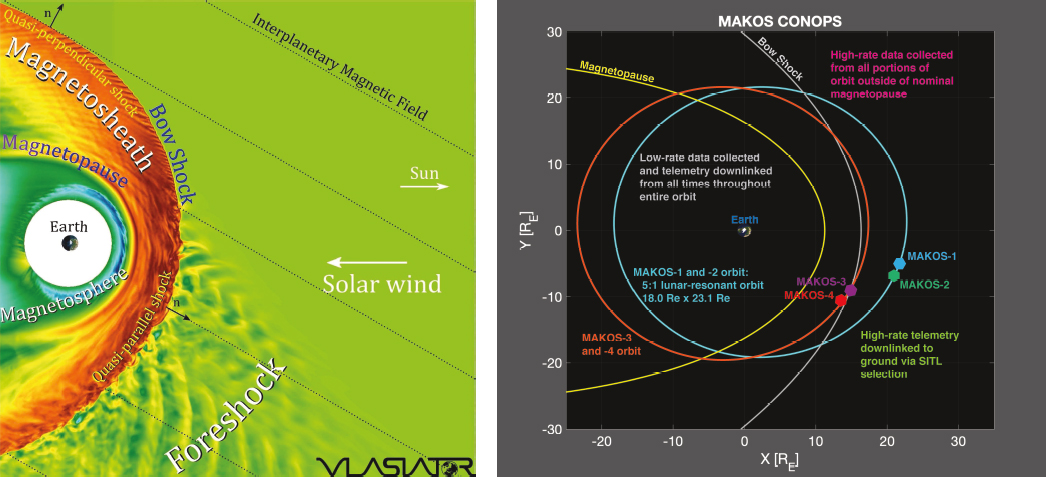
SOURCES: (Left) Goodrich et al. (2023a), https://baas.aas.org/pub/2023n3i134/release/1. CC BY 4.0; (Right) Goodrich et al. (2023b), https://baas.aas.org/pub/2023n3i135/release/1. CC BY 4.0.
only scratched the surface of enabling comparative magnetospheric studies. At the other systems beyond Earth, large regions, populations, and/or processes remain wholly unexplored by previous planetary science missions.
Several community input papers focused on questions surrounding the particle origins, acceleration processes, and losses in the Jovian radiation belts, which are the most intense in the solar system, but remain largely unexplored. Jupiter is a natural stepping stone beyond Earth because it boasts the strongest magnetic field; largest magnetosphere; the most active moon, Io, which is the primary plasma source for the system; the fastest rotation; and the most powerful aurora and radiation belts. Additionally, Jupiter’s environment continually exhibits extreme regimes that cannot be emulated even during the most extreme geomagnetic storms at Earth. Heavy ions in the heart of the Jovian radiation belts reveal a local source of >50 MeV/nucleon oxygen, a phenomenon that does not occur at Earth but may be analogous to stellar or astrophysical acceleration processes. The Comprehensive Observations of Magnetospheric Particle Acceleration, Sources, and Sinks at Jupiter (COMPASS at Jupiter) mission concept is designed to investigate these questions.
COMPASS aims to make significant progress toward understanding the distinctive and universal processes at play across complex space environments by focusing on the Jovian system where the large, material-laden magnetosphere with active moons hosts numerous processes that simultaneously facilitate in the production, but also sculpt losses in particle distributions. Figure C-11 illustrates many of these processes. COMPASS will aim to understand how particle origins, acceleration, and loss processes compete across a multidimensional parameter space that includes space, time, energy, composition, and charge state. To do this, the COMPASS mission will address four science goals: (1) discover how moon and ring material in the Jovian space environment contribute to the radiation belts, (2) reveal additional particle sources of the Jovian radiation belts, (3) discover how Jupiter accelerates charged particles to such exceptionally high energies, and (4) reveal the loss processes of energetic charged particles in Jupiter’s magnetosphere and resulting X-ray emissions. The Jovian magnetosphere is laden with ions sourced by its geologically active moons, although major questions remain regarding the ultimate origin of the heavy ions—that is, whether they come primarily from Io or Europa. Furthermore, observational evidence suggests that the aurora, solar wind, and/or atmosphere may also provide significant particles to the radiation belts. Acceleration processes found at Earth, such as radial transport and wave–particle interactions, are also known

SOURCES: Clark et al. (2023), https://baas.aas.org/pub/2023n3i067/release/1. CC BY 4.0; Modified from Nénon et al. (2017, 2018).
to occur at Jupiter, although their relative impacts on the overall system may differ. The fact that Jupiter’s magnetosphere greatly exceeds the energies and intensities found in any other planetary environment despite its high density of neutrals that absorb and cool charged particles remains one of the largest mysteries in planetary magnetospheres. Balancing losses with acceleration and source processes is critical for establishing and sustaining robust planetary radiation belts. Jupiter, like Earth, loses particles via precipitation to the atmosphere, but unlike Earth the magnetopause is too far away (60–100 RJ) to impact the radiation belts. Therefore, losses in the inner magnetosphere, such as WPIs near Io and resulting scattering into the atmospheric loss cone and direct absorption by inner moons, are likely the critical factors in sculpting the radiation belt particle distributions.
COMPASS will achieve this using a single solar powered spacecraft on a 5.5-year interplanetary trajectory to Jupiter that leverages a deep space propulsive maneuver and an Earth gravity assist. Upon arriving at Jupiter, the COMPASS mission is broken into two science phases over the nominal ~1.5-year mission. During Phase I, the COMPASS spacecraft moves into a high-inclination (~50°) orbit with perijove near Io’s orbital distance (5.9 RJ), which is critical for investigating particle origins and losses science objectives via X-ray imaging. During Phase I, the mission leverages several flybys of Io to reduce the orbital period and slowly move the apojove in from >200 RJ to ~60 RJ; it then uses a series of Callisto flybys to simultaneously reduce inclination (to ~25°) and perijove altitude (to <2 RJ). During Phase II, at low (≤15°) inclination with periapsis ~1.3 RJ, the spacecraft will make several deep dives into the most intense radiation environment to obtain the first in situ measurements of the near-equatorial radiation belt and synchrotron regions.
COMPASS carries a comprehensive space physics payload of ten instruments. The particle instrument complement includes two thermal plasma detectors (~10 eV/Q to ~10 keV/Q), a suprathermal particle detector (few keV/Q to 100s keV/Q including mass and charge-state compositions), an energetic particle detector (10s keV to > few MeV), a relativistic particle detector (~1 to 10s of MeV), and an ultra-relativistic particle detector (~10 to 10,000s MeV/nuc ions and ~8 MeV to > 50 MeV electrons). The fields instruments include a fluxgate magnetometer, a search coil magnetometer, and an electric field waves sensor, each of which can measure the target fields in three dimensions. Last, COMPASS also carries an ~0.5–10 keV X-ray imaging instrument to distinguish soft and hard X-rays.
Despite neither targeting the Sun nor the terrestrial system, COMPASS is appropriate for the STP Program as it will directly addresses multiple STP objectives, such as understanding fundamental physical processes of the space environment at other planets, understanding how the habitability of planets is affected by solar variability and planetary magnetic field, and developing the capability to predict the extreme and dynamic conditions in space.
COMPASS is studying the fundamental science of particle acceleration and loss, making it appropriate for an STP mission. It is exploring a region that has never been explored before, so the maturity level is low. Still, it has
aspects of an LWS mission. It is focused on understanding the radiation belts, a known hazard to spacecraft. In this way, it supports preparation for heliospheric exploration to extreme environments.
COMPASS is directly aimed at the Longer-Range Goal on comparative magnetospheres. It will study how Jupiter accelerates charged particles to such exceptionally high energies and how moon and ring materials in the Jovian space environment help create the radiation belts even though they simultaneously limit them. It will further reveal the processes seeding Jupiter’s unique, intense radiation belts and the loss processes of relativistic charged particles in Jupiter’s magnetosphere and the resulting X-ray emission.
Ground-Based Project: Distributed Network
Multipoint, multi-instrument observations have made crucial contributions to the understanding of 3D ionospheric electrodynamics, but progress has been limited by the reliance on mostly ad hoc combinations of measurements from networks with a wide range of scientific objectives and instrumentation. The Distributed Network Facility would be a paradigm shift toward a coordinated measurement strategy designed to transform the understanding of multiscale, 3D ionospheric electrodynamics. These 28+ platforms would be deployed across North America, as illustrated in Figure C-12, with each platform including red-green-blue ASIs, magnetometers, GNSS receivers, riometers, and high-frequency (HF) sounders.
Most of these instruments are analogous to a system currently being deployed across Canada by Canadian universities with support from CSA, and international collaboration to maximize spatial coverage would be a key aspect of the deployment of the Distributed Network. Little technology development is needed apart from the HF sounder, which would be used to provide an additional diagnostic of ionospheric conductance. This blend of instruments would enable the network to constrain critical state parameters across a wide area, including the traditionally sparsely sampled mid-latitude region in the United States. These parameters, including ionospheric conductance and current, would complement the ionospheric flows provided by SuperDARN to provide a complete specification of the system needed to quantify energy deposition rates for multiscale phenomena. They would

SOURCE: Based on S.B. Mende, S.E. Harris, H.U. Frey, et al., 2008, “The THEMIS Array of Ground-Based Observatories for the Study of Auroral Substorms,” Space Science Reviews 141(1–4):357, https://doi.org/10.1007/s11214-008-9380-x, Springer Nature.
also complement AMPERE, sampling smaller spatial scales and shorter temporal scales but over a more limited area. They would also provide the conductance measurements—validated against co-located IS radar conductance measurements—needed to understand how the magnetosphere responds to changes in the ionosphere. Last, the measurements provided by the Distributed Network in the northern United States would be a game changer in terms of understanding the unique electrodynamic coupling processes that occur during extreme events. Despite much of the northern United States being a high-hazard region for geomagnetically induced currents, and despite numerous studies showing that the auroral oval dips into the United States during moderate and extreme storms, this region is sparsely covered by most of the instruments contained in the distributed network platform, including ASIs. The Distributed Network would also have the ability to redeploy some platforms to address new science objectives or fill spatial gaps left by other projects should they arise.
The Distributed Network of 28+ platforms would be Mid-scale Research Infrastructure (MSRI), most likely in the MSRI-2 category; there would be the possibility to identify efficiencies in deployment and operations through, for example, international collaborations.
The Distributed Network would predominantly address PSGs 1 and 3. For Goal 1, it would provide multiscale information about auroral structures, ionospheric current systems and flows, and particle injections/precipitation across a wide area. For Goal 3, it would provide a complete set of ionospheric parameters, including the critical conductance parameters, across a wide area. The network would also enable continuous space and time coverage of high- and mid-latitude regions needed to maximize the science return from several upcoming and proposed satellite missions. Studies of energy deposition and I-T dynamics using GDC mission measurements could exploit the Distributed Network’s ability to continuously monitor multiscale ionosphere phenomena and resolve ambiguities related to temporal/spatial variations observed by GDC. The OHMIC mission would benefit from ASIs providing observations of meso-scale processes related to acceleration regions and networks of GNSS receivers showing the ionospheric impact of auroral processes, making the Distributed Network relevant to PSG 2. As another example, the multiscale specification of ionospheric state parameters in 2D, combined with the multipoint in situ measurements of magnetospheric processes provided by Links, would transform the understanding of how ionospheric processes impact the magnetosphere and vice versa.
Last, in addition to the PSGs discussed in this section, the Distributed Network also provides measurements of several parameters needed for a range of I-T investigations (e.g., TEC and conductance) and for space weather monitoring and data assimilation (e.g., geomagnetic disturbance and TEC).
Ground-Based Project: SuperDARN Network
SuperDARN provides multiscale measurements of 1D and 2D ionospheric flows in both the northern and southern hemispheres. By providing measurements of both steady and rapidly varying flows and electric fields, this network of radars provides crucial information needed to quantify the relative importance of electric field variations with different spatial and temporal scales for overall energy deposition rates. Working together with the Distributed Network and satellite missions such as Links, studies using the existing SuperDARN network can also identify the causes of ionospheric electric field variations and their effect on multiscale energy dissipation on the M-I system.
The panel endorses continued support for operations at existing U.S.-led radars (MSRI-1) when the current NSF grant expires and continued U.S. participation in the international SuperDARN consortium. In addition, the panel endorses NSF support to upgrade the hardware and software to improve 2D imaging capabilities for individual radars. The upgraded SuperDARN imaging capabilities would further improve the ability to remote sense mesoscale flow variations needed to assess local and global impacts of mesoscale disturbances and track energy flow through the M-I system. Last, SuperDARN provides global measurements that by themselves, or assimilated into global convection maps, provide crucial information about north-south and east-west asymmetries in the coupled M-I system. These asymmetries are known to significantly affect, and be affected by, M-I coupling processes.
The continued operation and upgrades to SuperDARN would predominantly affect PSGs 1 and 3. SuperDARN measurements will continue to play an essential role in monitoring global electrodynamic coupling processes. For example, the SuperDARN convection maps are assimilated into global simulations that require measurements in both hemispheres to realistically capture M-I current systems during asymmetric solar wind driving conditions.
In addition, SuperDARN provides ionospheric flow measurements and related global convection patterns that are used for a range of ITM investigations and for space weather monitoring.
Ground-Based Projects: PFISR/RISR Incoherent Scatter Radars
The Advanced Modular Incoherent Scatter Radar (AMISR) network includes three faces: PFISR at Poker Flat, Alaska and RISR-North and RISR-C at Resolute Bay, Canada. PFISR and RISR-North are owned by NSF, while RISR-C is owned by the University of Calgary. IS radars provide comprehensive ionospheric plasma parameter measurements, including line-of-sight plasma flows and thus convection, plasma temperature, density, and other derived parameters, such as composition and neutral wind profiles. IS radars are valuable for fundamental magnetosphere–ionosphere–thermosphere–mesosphere (M-I-T-M) coupling science through continuous observations of comprehensive ionospheric plasma parameters at various latitudes, providing key information about the energy deposition rate to the I-T system, conductivity, and initiation of ion outflow. They also remotely sense dynamics and key features in the magnetosphere. More specifically, located deep in the polar cap, RISR-N measures polar cap ionosphere density structures, convection, and cusp reconnection rate during northward interplanetary magnetic field (IMF). On the other hand, PFISR measures the subauroral and auroral ionosphere routinely, and measures cusp dynamics during strong southward IMF.
Both NSF AMISR faces have been operating for more than a decade and require complete refurbishment of antenna elements to bring back full capacity. Continuous support of the AMISR network (MSRI-2) is required to ensure long-term operation. Their field-of-view overlaps with the proposed Distributed Network, and so their measurements can be used to validate the Distributed Network observations, including the conductance obtained from the new HF sounder technique. They also both extend the network measurements to 3D and complement their measurements in parameter space.
IS radar measurements are directly relevant to PSGs 1, 2, and 3. IS radars can measure the convection electric field and electron density and temperatures, which can then be used to calculate the conductivity and the energy deposition rate from the solar wind-magnetosphere to the I-T system. These energy deposition rates can be estimated across different scales in locations corresponding to different magnetospheric regions depending on the location of IS radars and the geomagnetic activity level. Through their comprehensive measurements, IS radars can reveal where and how the ionospheric plasmas are extracted from the ionosphere into the magnetosphere. The ionospheric upflow can be produced by frictional heating of the ions and/or enhanced ambipolar electric field owing to electron heating, parameters measured by the IS radars. Therefore, IS radars are essential ground-based instruments for understanding the energy and mass transfer between the M-I-T-M system.
More specifically, IS radars can contribute to planned and proposed magnetosphere missions, space weather studies, and other solar and space physics disciplines, such as I-T-M. IS radars provide ionospheric measurements from the subauroral zone to the polar cap and remotely sense aspects of magnetospheric dynamics such as fast convection flow channels, which are directly relevant to the Links and OHMIC missions concepts. IS radars also provide the location, characteristics, and initiation mechanism of ion upflow, complementing the SOURCE satellite measurements. The conjunction of existing missions, such as DMSP, Van Allen Probes, THEMIS and MMS, with IS radars have provided unprecedented opportunities for enhancing the M-I-T-M system science return. IS radar also frequently provide critical and/or supplementary observations for sounding rocket missions targeting M-I coupling processes. The continuous observations of comprehensive ionospheric plasma parameters from IS radars also provide a key long-term data set for model verification and trend identifications. Regarding space weather, IS radars altitude profiles of plasma density provide key information for understanding their role in the production of radio wave scintillation, including GNSS.
Ground-Based Project: AMPERE-NEXT
AMPERE is a unique program that has been providing important FAC observations of the high-latitude M-I-T-M coupling region since 2010. It utilizes the magnetometer measurements onboard the Iridium satellite constellation and is an excellent example of collaboration between a government agency and private space industry. AMPERE (MSRI-1) has been incredibly valuable for fundamental M-I-T-M coupling science through direct,
continuous observations of global FAC systems, providing key contextual observations for other spacecraft and ground-based assets, and being used in empirical models and physics-based simulations of the I-T system as high-latitude electrodynamic drivers and for validation.
AMPERE-NEXT became available in 2022 and provides up to 10 times higher attitude accuracy, approximately 2 times lower error in δB, and over twice the sampling cadence per spacecraft than data from the Iridium Block-1 constellation originally used for AMPERE.
In the next decade, robust investment in ground-processing infrastructure and operations support is required to enable AMPERE to become a valued resource for now-casting and system-state determination. With ever increasing LEO satellite constellations, the AMPERE program has the potential to be expanded to incorporate additional constellation data streams with either data from Iridium NEXT and future Iridium satellites or other LEO satellites or constellations to increase the temporal and spatial resolutions of FAC measurements. In addition, opportunities need to be explored for hosted payloads consisting of smaller, low-cost sensors that provide a more complete picture of global electrodynamics, such as precipitating particles and plasma convection measurements, on the satellites generating the AMPERE data stream.
The AMPERE-NEXT measurements are directly relevant to PSGs 1, 2, and 3. The AMPERE measurements reveal how global 2D FACs evolve in response to changing solar wind–magnetosphere–ionosphere conditions, including north–south and dawn–dusk asymmetries. They provide global contextual information in the regions where ionospheric upflow and outflow are initiated. Combined with other measurements, such as the SuperDARN convection, they could also be used to determine how global DC Poynting flux evolves in response to changing solar wind and magnetosphere conditions.
More specifically, AMPERE-NEXT can contribute to planned and proposed magnetospheric missions, space weather studies, and other solar and space physics disciplines, such as ITM. The coordination of existing missions with AMPERE, such as DMSP and TIMED, has demonstrated opportunities for enhanced science return. In the future, AMPERE can provide 2D global context in both hemispheres, including mesoscales in the latitudinal direction, for three magnetospheric mission concepts (e.g., Links, OHMIC, and SOURCE). It also provides an additional diagnostic of energy input related to ionospheric upflow and outflow for the SOURCE mission concept. In terms of contribution to space weather studies, AMPERE FACs have already been incorporated into global I-T models as high-latitude drivers and AMPERE has the potential to provide critical contributions to space weather operations and space domain awareness.
Ground-Based Project: Mid-latitude Incoherent Scatter Radar
Multiple community input papers recommended expanding midlatitude and subauroral science capabilities in upcoming observation systems. The mid-latitude I-T region maps to the inner magnetosphere, where the hot and cold plasma interface is located, and thus remotely senses dynamics in the inner magnetosphere. Compelling science phenomena, such as subauroral polarization stream (SAPS), STEVE emission, and storm-enhanced density, occur in this region. A mid-latitude IS radar (MSRI-2) would provide measurements of the subauroral and auroral convection flows and other plasma properties in this region. During strong solar wind driving conditions, IS radar measurements combined with spacecraft measurements at higher altitudes could be used to understand the initiation conditions of ion upflow and outflow.
Similar to AMISRs, the mid-latitude radar is directly relevant to PSGs 1, 2, and 3, and will be able to remote sense magnetospheric dynamics and provide ionosphere-to-magnetosphere convection comparison for magnetospheric missions (e.g., Links, SOURCE, OHMIC). The mid-latitude IS radar field-of-view needs to overlap with that of the Distributed Network and would complement and expand their measurements in parameter space. The temporal and spatial resolution of ionospheric measurements need to be improved either through innovative improvement of an existing facility or through building a new phased-array mid-latitude radar.
Projects That Need New Technology Development
Magnetosphere–Ionosphere Observatory (MIO): A major objective of PSGs 1 and 3 is to determine the connection between multiscale structures in the plasma sheet and the discrete structures in the aurora. While the Links
mission concept will observe both the plasma sheet and the aurora, the actual connection between them will have to be inferred. To definitively determine the link between them requires a technique to actually trace the field line from the plasma sheet to the ionosphere. The Magnetosphere–Ionosphere Observatory (MIO) mission concept is designed to do exactly that. MIO will make measurements directly connecting the magnetosphere to the ionosphere, a key knowledge gap in the understanding of M-I-T-M phenomena. This is achieved by operating a powerful 1 MeV electron accelerator on a primary spacecraft in the equatorial nightside magnetosphere. The beam is directed into the atmospheric loss cone and deposits the energy of ionizing electrons into the atmosphere to optically illuminate the magnetic footpoint of the spacecraft. An associated network of ground-based imagers in Alaska and Canada will locate the optical beamspot to unambiguously establish the connection between equatorial magnetospheric measurements and ionospheric phenomena. The equatorial magnetospheric measurements are made by four nearby daughter spacecraft that are used to identify magnetospheric regions, boundaries, and generator mechanisms, enabling the magnetospheric drivers of various aurora, ionospheric phenomena, and FACs to be determined.
“Magnetosphere-to-Ionosphere Field-Line Tracing Technology” using an energetic electron beam fired from a magnetospheric spacecraft was listed in the 2013 decadal survey as an “instrument development need and emerging technology” that (a) is in need of a technology boost and that (b) could have a substantial impact in solar and space physics. There is still a need in the coming decade to further develop high-power (~kW) energetic electron beam (~1 MeV) technology so that mission concepts that utilize it can be realized.
Dropper/dipper probes: The altitude range from ~80 to ~160 km—that is, the D- and E-regions of the ionosphere—is a critical region where key aspects of the energy and momentum transport between the M-I-T system take place. This region is immensely important because it is the altitudinal crossroads where ionospheric electrodynamics (e.g., Joule heating and current closure) occur in concert with significant neutral densities and thermospheric processes (e.g., neutral winds). Unfortunately, despite the importance of this region in understanding the intricacies of the coupled near-Earth space system, it still remains woefully underexplored with most focused investigations coming from the sounding rocket program. The paucity of measurements in this region stems from the general inability to investigate these altitudes using orbital spacecraft owing to substantial atmospheric drag that arises from the combination of required high orbital velocities and relatively large plasma and neutral densities at altitudes below ~400 km. While previous LEO missions have provided information on the magnetospheric input into the upper atmosphere and ionosphere—as well as preliminary insight into its response—these missions have been unable to probe the mechanisms of coupling. Although concepts for orbital “dipper” missions that regularly dip into very low Earth orbit (VLEO; i.e., the E-region ionosphere) have been circulating in the community for several decades, no such mission has been developed in the United States; the Daedalus mission formulated—but not implemented—by ESA was to follow a similar approach.
Over the next decade, the community would benefit from further development of the “dipper” architecture—that is, repeatedly descending into this region and then using propulsion to regain altitude—and/or explore the feasibility and technology necessary for deployable (and expendable) low-resource “dropper” probes that can deorbit to explore these very low altitude regions.
Low SWaP capable instruments: Two conditions are emerging that rely on low-SWaP instruments and provide significant opportunities. First, as the understanding of the magnetosphere matures, the community requires more measurements to constrain the conceptual understanding and models. One way to enable this continued growth is through lowering the SWaP of instruments to permit more complex instrument suites to be flown simultaneously on a single platform or with the same hosting resources. Second, the number of spacecraft being launched has steadily grown over the past several years and is projected to rapidly expand over the next decade. Much of the expansion is occurring in the commercial and defense sectors, which are growing through single-spacecraft missions but also through constellations with hundreds and even thousands of spacecraft. Opportunities have begun to emerge to fly hosted payloads, placing science-based instruments on commercial spacecraft. Such opportunities are expected to continue and grow. These opportunities often come with low-SWaP resource accommodations. Investing in developing novel low-SWaP instruments as well as reducing the resources required for current instrumentation while maintaining performance is expected to enable major science discovery in the next decade through participation in such rideshare opportunities.
C.5.3 Opportunities for Collaboration
Collaborations Between NASA and NOAA
Upgraded L1 Solar Wind Monitor
As global-MHD, radiation belt, and other magnetospheric models become more accurate, an ultimate test for each one is to represent realistic, complex relevant intervals such as storms, substorms, and smaller events. Accurate, high-resolution, and continuous measurements of the solar wind velocity and density and of the IMF from L1 are essential in representing the solar wind state as it couples to the magnetospheric state. In addition, NOAA and DoD use several magnetospheric models operationally, so continuous monitoring of the solar wind is a needed capability for space weather forecasts.
NOAA, in close collaboration with NASA, is planning to replace operational data sets from the Solar and Heliospheric Observatory (SOHO), Advanced Composition Explorer (ACE), and Deep Space Climate Observatory (DSCOVR) missions, which are all expected to reach the end of their life in the mid-2020s. NOAA’s Space Weather Follow On (SWFO) program features the SWFO-Lagrange 1 (SWFO-L1) observatory planned to launch in 2025 with state-of-the-art instruments, including plasma, suprathermal particle, and magnetic field sensors, as well as a coronagraph to provide continuity from SOHO. An additional SWFO coronagraph was onboard the GOES-19 satellite, which launched in June 2024; its first images were returned in September 2024. These data sets will be useful for monitoring the solar wind in real time and for improving physical and empirical models of solar wind- magnetosphere coupling.
In coming years, magnetospheric models will need additional detail of the heliospheric input such as orientation and curvature of solar wind fronts. This will require multiple solar wind and IMF data sets from L1, currently provided by ACE, DSCOVR, and Wind, and in the near-term by SWFO-L1, IMAP, and other missions. To provide this critical input to the magnetosphere, it is important that NASA and NOAA collaborate to optimize spatial coverage of solar wind fronts with orbits around L1.
Magnetospheric Particle and Field Measurements
Particle and field measurements are essential diagnostics of magnetospheric processes. Particle flux data are needed to constrain inner magnetospheric models of the radiation belts, ring current and low-energy populations, and for understanding particle acceleration, transport, and loss. Magnetic field data are needed for understanding the field configuration at key locations (e.g., GEO, LEO, and ground) and throughout the system. Electric field measurements are also needed in understanding acceleration and transport at the magnetotail and the ionospheric boundary. The collaborative projects discussed below are organized by observational location.
GEO: Particle and magnetic-field measurements made at the GEO are a key data set for studies of the outer-belt acceleration and transport. In earlier decades, NOAA GOES East and West and DOE LANL spacecraft have provided reference measurements useful for the development and validation of physical and empirical models (e.g., Versatile Electron Radiation Belt [VERB], Comprehensive Inner Magnetosphere–Ionosphere [CIMI], and Relativistic Electron Forecast Model [REFM]). In order to have context for WPIs and other effects in the outer radiation belt, it is important to have comprehensive energy and pitch-angle coverage on a continuous basis, so that events of a wide range of activity levels can be studied. Similarly, in order to understand the magnetic field configuration in the inner magnetosphere it is important to have multiple simultaneous measurements with at least four spacecraft at GEO.
NOAA’s current GOES-R series launched its final satellite, GOES-19, in June 2024; it has an expected lifetime of 10 years. The GOES-R series will be followed up with geostationary satellites of NOAA’s Office of Space Weather Observations (SWO), which are planned to have similar spatial (East, West) coverage. These measurements will be useful in the development and validation of particle-acceleration models.
To properly understand particle transport and geomagnetic field configuration, studies typically combine GEO data with measurements from other longitudes at GEO as well as other altitudes (i.e., L-shells). GEO particle flux data sets from other longitudes are available from data exchange projects with the Japan Meteorological Agency
(JMA) and Korea Meteorological Agency (KMA) providing flux data from the Himawari and Korean MultiPurpose Satellite (KOMPSAT) series of satellites, respectively.
LEO: Particle precipitation is an important loss mechanism as well as an M-I coupling process. For understanding precipitation scenarios such as interaction with VLF waves, it is important to include LEO particle data in model development and data analysis. Historically, such data are available from operational missions (DMSP, POES, MetOp).
Coordination between NASA and NOAA for future missions will maximize science return. The NASA GDC mission is planning for low-energy particle (<30 keV for electrons, <40 keV for ions) coverage. NASA’s Dynamical Neutral Atmosphere–Ionosphere Coupling (DYNAMIC) mission is a companion to GDC for which NOAA has expressed interest in contributing an instrument. Beyond the 2-year nominal duration of GDC and DYNAMIC, it would be valuable to have a long-term observational capability provided by NOAA in coordination with NASA.
Other magnetospheric regions: Progress in understanding acceleration and transport in the inner magnetosphere and elsewhere has relied on a wealth of data from missions that sample the 3D magnetosphere beyond GEO or LEO. Geotail, Cluster, THEMIS, Van Allen Probes, and many other missions have contributed to these data.
In the future, the community would benefit from a full contingent of particle and field measurements from reference locations that complement GEO and LEO. Monitoring the heart of the radiation belts at L~4 would require at least two spacecraft either at geosynchronous transfer orbit (GTO) or MEO. NOAA has plans for an auroral observation capability (see the next section); if that monitoring mission is manifested in HEO, a particle and field sensor payload will be useful in developing and validating models of high-latitude regions including the cusp.
Auroral Imagery
UV and VIS auroral images yield precise quantitative information for M-I coupling, including auroral emission intensity, auroral boundary location and auroral zone area, and precipitation energy deposition, from which the open/closed boundary location and other parameters can be inferred. Missions such as NASA’s Polar and DoD’s DMSP have provided valuable observations of auroral variability during substorms and other convection events. Most spacecraft data, however, have extended temporal and/or spatial gaps owing to their orbits that pose limitations to quantitative modeling. For modern representations of the coupling, it will be important to have uninterrupted, long-term imagery for event-based and statistical studies.
NOAA goals include a continuous auroral imagery capability either from HEO or LEO, in partnership with other U.S. and international agencies. The emphasis is to initially cover the northern hemisphere down to approximately 60° geomagnetic latitude, assuming conjugacy for modeling purposes; and at a later stage, extending the coverage to both hemispheres. The combination of auroral imaging with ground-based observations of small-scale (~200 km) activity (ASIs, riometers, magnetometers, etc.) as part of a collaboration with international organizations (e.g., CSA and Finnish Meteorological Institute) will provide useful constraints to theoretical models. Having continuous auroral imaging provided by NOAA would simplify many of the missions being considered to study M-I coupling.
Collaborations on Ground Magnetometer Arrays
Geomagnetic manifestations of magnetospheric events are measured by ground magnetometers. Multipoint DC measurements are used for surveys, event remote sensing and timing, and large-scale modeling of geomagnetic disturbances. Ultra-low frequency (ULF) data are used to model and represent field-line resonance growth and damping, M-I coupling, and substorm onset. In the past 2 decades, NSF and the U.S. Geological Survey (USGS) have funded several expansions of the magnetometer network that currently includes most of the continental United States. Through collaborations with CSA and Natural Resources Canada (NRCan), this work covers all of Canada. Progress in this field has enabled space weather nowcasting and related applications at NOAA.
Expanded and continuous ground magnetometer coverage would support geospace missions (e.g., Links) and particularly PSGs 1 and 3. This capability will be the basis for geomagnetic and geoelectric models and related physical modeling and data science, and support space weather nowcasting.
Coordination Between NSF and NASA
Many NASA sounding rocket missions are supported by NSF-sponsored, ground-based assets. Most notably, launches from Poker Flat Research Range in Alaska very frequently coordinate with PFISR for special operations—commonly using specific beam configurations—that are tailored to best suit the target science. Similar coordination occurs with the SuperDARN radar for launches out of NASA Wallops Flight Facility in Virginia.
As discussed above, use of NSF-sponsored assets in conjunction with NASA missions can greatly enhance the science return. PSGs 1, 2, and 3 are all best addressed with a combination of satellite and ground-based measurements. Although the ground-based facilities would be supported by NSF and the satellite missions by NASA, coordination would ensure, for example, that the Links mission and the Distributed Network are both operational at the same time. It is best if teams designing and operating ground-based assets work closely with satellite teams early in the planning stages of each mission (if ground-based measurements are needed) to make sure ground-based assets will be deployed to the appropriate locations and measure the appropriate parameters for each mission’s objectives. There are several ways that NASA and/or NSF could facilitate this, including through funding opportunities that support OSSEs involving both space and ground assets or requiring a portion of the NASA mission team to be devoted to coordination with ground-based instrument operators. This early coordination would enable transformational advances in the next 10 years that address outstanding system science questions.
Collaboration with Planetary Division on Uranus Mission
Multiple community input papers presented magnetospheric and M-I coupling science questions at Uranus. These largely echo the recommendation from the 2013 decadal survey, which recommended that “NASA’s Heliophysics Division partner with the Planetary Division to ensure that appropriate magnetospheric instrumentation be fielded on missions to other planets. In particular, the [Solar Wind–Magnetosphere Interactions] SWMI panel’s highest priority in planetary magnetospheres is a mission to orbit Uranus.” The Uranian magnetosphere presents one of the most unique magnetospheres in the solar system. With the planetary rotation axis tilted by 98 degrees relative to the ecliptic and a highly tilted magnetic field axis (~59 degrees), the orientation of the magnetic field presents an asymmetrical obstacle to the impinging solar wind that varies dramatically on diurnal and seasonal timescales. Also very little is known about Uranus’s coupling to the solar wind; it remains unclear whether magnetic reconnection plays an important role in the global magnetospheric dynamics. Meanwhile, the Uranian bow shock enables study of much higher Mach numbers than available at Earth’s. The limited observations from Voyager 2 make it difficult to understand the transport mechanisms in Uranus’s complex magnetospheric configuration. Because Uranus is a fast (17 hour) rotator and the magnetosphere changes between being open and closed to the solar wind throughout a Uranian day, planetary rotation must play some role in driving plasma flow. Unlike other planets, Uranus’s corotational electric field can seasonally become perpendicular to the convection electric field. This unique magnetospheric configuration can serve as a prime laboratory in which to generally understand plasma flows in a magnetosphere because it is difficult to disentangle processes at other planets, such as whether flows result from tail reconnection or centrifugally driven interchange instabilities. Uranus also challenges the understanding of radiation belt physics because it has electron radiation belts that are similar in intensity up to MeV energies as those of Earth and Jupiter, despite having a sparse magnetospheric source population of low-energy plasma, slow acceleration through radial diffusion, and the strongest whistler-mode hiss and chorus waves observed in the outer solar system by Voyager. Last, the coupling of the Uranian magnetosphere to its atmosphere is also complicated and poorly understood, especially given multiple curiosities regarding the planet’s difficult to track auroral emissions and unexpectedly low atmospheric temperatures. To address this science, the inclusion of a comprehensive particles and fields payload complement with the necessary resource allocations for magnetospheric investigations is needed on any future planetary science mission to Uranus. The recent Origins, Worlds, and Life decadal survey highlighted a Uranus Orbiter and Probe mission as the highest-priority large-scale strategic mission for the next decade. Ensuring robust magnetospheric investigations at Uranus—likely through collaboration between the NASA Heliophysics and Planetary Science Divisions (e.g., see examples summarized in Section C.3, “Longer-Range Goal”)—would provide detailed physical insight into multiple global magnetospheric processes of relevance to both the planetary science and space physics communities.
International Collaboration on Ground-Based Projects
There are several international collaborations that could be leveraged in this research program. Several aspects of the ground-based Distributed Network that would enhance the science return of Links and other current and future missions and projects has been, is, or may be supported by the CSA. They have supported several versions of an all-sky camera network across Canada, both as a partner to a NASA mission (e.g., THEMIS) and as a standalone venture. Canada has also supported a network of riometers and magnetometers, which also enhances the science return of current and future missions and projects. Growing this relationship would support the best science return possible. Joint funding opportunities with CSA, NRCan, and others, such as the joint funding mechanism between NSF and the United Kingdom Natural Environment Research Council (NERC) would facilitate this activity. It would also be beneficial to leverage international partnerships to extend the Distributed Network to include coverage in Greenland and other areas so that a wider range of M-I dynamics sampled by Links and other missions and projects are captured. This would also better constrain global conductance, auroral precipitation, and other parameters to more comprehensively address PSGs 1 and 3.
International collaborations continue to be a core part of several other ground-based facilities mentioned in this section. SuperDARN is an international consortium of which only a portion of the radars are operated by the United States; thus, international collaboration is a core part of the SuperDARN facility and will continue to be in the next 10 years. Likewise, international collaboration involving IS radars operated by other countries provide opportunities for comprehensively addressing several science objectives. For example, EISCAT-3D will provide complementary capabilities to AMISR and will also expand the number of possible conjunctions with missions such as SOURCE.
International Polar Years (IPYs) are focal points for significant international collaborative efforts in support of geoscience and geospace research that happen roughly every 25 years. This includes the third IPY in 1957–1958, also referred to as the International Geophysical Year, which involved several geospace researchers (e.g., Sydney Chapman, James Van Allen, Lloyd Berkner) and led to major discoveries, infrastructure improvements, advances in data sharing (e.g., the World Data Centers), and international agreements for scientific collaboration (e.g., the Antarctic Treaty), all of which continue to impact geospace research today. At the time of this report, plans are currently under way for the fifth IPY in 2032–2033. As was the case in 1957, IPY 5 represents a focal point for major international collaborations and thus an opportunity to advance many of the goals in this report. Prior to IPY 5, it would be advantageous to have the ground-based infrastructure discussed in previous sections in place, as well as joint funding mechanisms listed above that facilitate international collaborations. It would also maximize the science return of future missions such as GDC if they are operational in 2032–2033 given the expected increase in international support for ground-based infrastructure in support of IPY 5, thus opportunities for novel campaigns that go beyond mission objectives.
International Collaborations on Space-Based Missions
SMILE Mission
The Solar wind Magnetosphere Ionosphere Link Explorer (SMILE) is a joint mission between ESA and CAS. SMILE is a single spacecraft mission scheduled to launch in 2025. The mission will observe the solar wind interaction with the magnetosphere with its X-ray and ultraviolet cameras, gathering simultaneous images of the dayside magnetopause, the polar cusps, and the auroral oval. Key observations include measurements of how the magnetopause position evolves with time. SMILE will also host an ion analyzer and a magnetometer to monitor the ions in the solar wind, magnetosheath and magnetosphere while detecting changes in the local magnetic field. The focus of the instrumentation and mission objectives is to understand how energy flows through Earth’s magnetosphere on a global scale. SMILE is highlighted as an opportunity for the United States to become involved in a global and system-level solar wind–magnetosphere coupling. Potential collaboration opportunities include scientific and modeling contributions before and after the mission has launched.
Plasma Observatory
Plasma Observatory, an ESA mission selected for a Phase A study, is a seven-spacecraft constellation with one mother spacecraft and six identical daughter spacecraft. The spacecraft are configured as two nested tetrahedra
covering the ion and MHD scales. The mother spacecraft includes instruments for a full characterization of the fields and particles, including the ion composition with sub-ion-scale time resolution. The daughter spacecraft carries simple instrumentation: a magnetometer, electric field instrument, ion and electron spectrometers, and an energetic particle instrument. The constellation would fly in an 8 × 10¹⁸ RE, 15° inclination orbit, which has an apogee large enough to allow the spacecraft to make in situ measurements in the foreshock. Scientifically, the mission is motivated by the following objectives: (1) How are particles energized at shocks? (2) How are particles energized during magnetic reconnection? (3) How are particles energized by waves and turbulent fluctuations? (4) How are particles energized in plasma jets? and (5) How are particles energized by a combination of these different processes? Potential collaborations could include hardware contributions, mission planning support, and scientific and modeling contributions before and after the mission has launched.
International Planetary Missions
Comparative magnetospheric studies could significantly benefit from international collaborations by leveraging partnerships and collaborations to systems beyond Earth as has been done at Mercury (MESSENGER and BepiColombo), Jupiter (JUICE and Europa Clipper), and Saturn (Cassini).
Interdisciplinary or System Science Approach
While there are still focused science questions in distinct regions of the magnetosphere that need to be resolved, many of the new breakthroughs in the next decade are expected to come by better understanding of the whole system. For this reason, the PSGs outlined here all involve connections throughout the magnetosphere and two of the mission concepts focus on system science.
Links is intentionally designed to study the magnetosphere as a “system of systems.” It will study the links between the solar wind and the dayside magnetosphere, where energy is input to the magnetosphere system. It will then study the links between the plasma sheet in the stretched magnetotail and the radiation belts and ring current in the dipolar inner magnetosphere, learning how the solar wind’s energy that was stored in the tail is transferred to the inner magnetosphere across Earth’s transition region. Last, it will study the links between the magnetosphere and ionosphere by simultaneously measuring magnetospheric phenomenology with its auroral counterpart. Although the Links mission objectives are driven by magnetospheric science—and require studying it as a system of systems—results are also important for I-T studies. Better understanding the magnetosphere driving (i.e., “forcing”) on the ionosphere via precipitation is currently an important focus, and current research has shown how meso-scale flows and aurorae that map from the magnetosphere to the ionosphere have drastic impacts on neutral winds and neutral densities. As previously mentioned, the change in ionospheric conductance thanks to magnetospheric precipitation also feeds back to the magnetosphere. Thus, viewing each silo as part of a system of systems is crucial and is a main emphasis of Links.
SOURCE also provides a system-level approach to determine the distribution of cold ions throughout the magnetosphere. It will follow the cold ion pathway from its origin in the ionosphere to the plasmasphere, and study how transport into the lobes and magnetotail leads to the formation of regions like the plasma sheet, warm plasma cloak, and ring current. It will investigate the input drivers of ionospheric outflow, and the mechanisms responsible for the refilling, erosion, and redistribution of plasmasphere ions. The SOURCE implementation is inherently cross-system and cross-scale, using multiple spacecraft with different orbits and in situ and remote sensing observations to provide a global understanding of this mass coupling and its impact on several regions of the magnetosphere. It will lead to better understanding of the life cycle of core plasma through the magnetosphere including how ion outflows are generated and trapped, and their transport pathways and contributions to hot and cold plasma populations.
Magnetic reconnection and shocks are fundamentally processes that govern the interaction of distinct regions. Earth’s bow shock is the boundary between the supersonic solar wind and the magnetosheath. Magnetic reconnection allows connections between the magnetically distinct regions of the magnetosheath and the magnetosphere, and also drives global magnetospheric transport and mediates magnetic connections between the magnetosphere and the ionosphere. As such, magnetic reconnection and shocks play a mediating role between the different systems of the solar wind–magnetosphere–ionosphere system and thus are an important part of the system-level science needed to understand this system.
In addition, the interplay of shocks, reconnection, and turbulence and the global/microscale interactions inherent in them link together multiple plasma subfields which have historically been distinct from each other. As such, solving the overarching science question will require MHD modelers to closely collaborate with kinetic modelers, and also requires a close collaboration between the shock, reconnection, and turbulence communities.
Almost inherently, any study of planetary magnetospheres beyond Earth will be interdisciplinary as it will likely bring the magnetospheric community together with the planetary science (and possibly also the astrophysics) community. Furthermore, even if scientific missions to other systems are designed to target focused science questions, with the proper instrumentation they will likely gain cursory insights into aspects of plasma physics that are of interest to the broad solar and space physics community.
C.5.4 Heliophysics System Observatory
While over the past decade, the Heliophysics System Observatory (HSO) has been adopted by NASA to define its fleet of NASA Heliophysics-funded space missions that operate simultaneously to study the dynamics of the solar system, the panel considers it to be a broader concept, similar to that first introduced in the 2013 decadal survey, that includes the ground-based and space-based facilities from multiple agencies, including NASA, NOAA, DoD, NSF, USGS, as well as international partners that are being used to study magnetospheric systems. There are some aspects of the HSO that are universally agreed to be necessary. An L1 monitor is required for a constant measurement of the incoming solar wind and IMF, the driver of magnetospheric activity. A comprehensive set of ground magnetometer stations have been used for decades to generate indices of magnetic activity, such as AE, Kp, and Dst. But there are many other aspects of the system that have not been characterized as long and are not considered for permanently monitoring the magnetospheric system.
The current high-altitude magnetospheric spacecraft contributions to the HSO are the NASA MMS and THEMIS missions, the ESA Cluster mission, and the Japanese Arase mission. The Cluster mission is only expected to operate until September 2024, which will leave no spacecraft in polar orbit. MMS and THEMIS provide critical fields and waves, plasma, and energetic particle measurements in the near-equatorial plane; however, they are not designed for measuring the inner magnetosphere and its intense radiation belts. Arase has provided a critical inner magnetosphere monitor with radiation belt and ring current measurements that is particularly important since the end of the Van Allen Probes mission in 2019.
The field has lacked global imaging of the auroral oval since the end of Polar operations in 2008. Auroral imaging can be used to measure particle precipitation and magnetic activity. By the time a new imaging spacecraft is launched, at least 2 decades will have passed without this vital information. Ground-based ASIs have taken over some of these measurements, but they can be inhibited by clouds or moonlight, and do not have the comprehensive global coverage that includes the dayside. With the technological improvements since Polar’s launch in 1996, new generation imagers will not only reestablish global auroral oval monitor capabilities, but they will also enable new science at higher resolutions than previously provided. Links includes auroral imaging as part of its payload.
Neutral imaging can give another global measurement of magnetospheric activity. The TWINS ENA imagers more recently went offline. As mentioned, they have been used to provide 2D snapshots of the energetic ions in the plasma sheet, providing important context for in situ satellites. Both the Links and the SOURCE missions include neutral imaging instruments to provide this global measurement.
NSF, USGS, the Air Force Office of Scientific Research (AFOSR), and the private sector support a wide range of ground-based instrumentation that, while not part of the facilities mentioned earlier in this report, nevertheless form a vital part of the broader HSO and provide powerful tools for more fully addressing the science questions discussed in previous sections. For example, networks of magnetometers overlap with the regions of interest for the Distributed Network and serve to provide more dense measurements in targeted regions necessary to resolve mesoscale currents and measure geomagnetic disturbances related to geomagnetically induced currents. Each of these networks have their own science questions and there remains a need for targeted science investigations using smaller networks, but measurements collected by these networks could readily be incorporated into higher-level data products generated using the Distributed Network when addressing PSGs 1–4. Indeed, magnetometer data have already been successfully aggregated to generate higher-level data products using the SuperMAG facility, and there
are already wider community efforts under way to organize magnetometer networks using a facility model. These efforts would significantly expand the range of phenomena that could be explored with the Distributed Network by increasing spatial resolution and expanding spatial coverage to regions not included in the Distributed Network. As another example, measurements from networks of GNSS receivers supported by a range of organizations are already being aggregated by the Madrigal facility and used to produce global TEC maps of the ionosphere. These receivers will provide a valuable significant increase in the number of TEC observations both inside and outside the region covered by the Distributed Network, thus opening the door to additional science investigations.
These examples share another similarity: both GNSS receivers and magnetometers are frequently deployed by geoscience research groups seeking to address questions unrelated to solar and space physics. For example, GNSS receivers are frequently deployed by the cryosphere research community to study ice sheet dynamics. There are many similar opportunities to expand the HSO by working across disciplines to share data. In some cases, it’s also possible to collaborate on scientific investigations of mutual interest to multiple communities. For example, magnetometers are often deployed alongside electrometers by geophysicists for magnetotelluric surveys to obtain ground conductivity information. This information is useful for both geophysics and heliophysics research, for example providing crucial constraints needed for geomagnetically induced current studies and to improve M-I remote sensing methods relying on ground magnetometers.
There are many other examples of ground-based instruments that are a key part of the HSO although not discussed in depth in this report, including ionosondes, LiDARs, electrometers, and VLF receivers. There remains a need to support these types of instruments and others in the next 10 years to address the science questions that are the focus of this report and retain the flexibility to explore other science questions. At the same time, the development of data assimilation techniques that can take advantage of heterogenous data sets from multipoint, multi-instrument measurements would yield further benefits including more accurate specifications of the state of the global geospace system.
There are significant gaps in the ground-based portion of the HSO that are already present and/or expected to be present in the next 10 years. This includes (1) gaps present in the oceans, (2) gaps present on land in other countries, and (3) gaps present owing to logistical bottlenecks in Antarctica (elaborated on in Section C.5.5). First, most space physics measurements are challenging in an ocean environment owing to moving platforms and corrosion. In the past 10 years, efforts to fill these gaps have expanded to include deployments on buoys and drones that operate under water, on the surface, and in the air. If these efforts prove successful at scale, they will yield a dramatic improvement in spatial coverage that would benefit PSGs 1–4. Second, international collaborations are vital for obtaining global coverage of the parameters needed to address PSGs 1–4, with many examples over the past decade and beyond—for example, SuperMAG lower (SML) index, Madrigal global TEC maps, the SuperDARN consortium, THEMIS Ground-Based Observatories. This will remain the case in the next 10 years. However, coverage is unevenly distributed owing to a wide range of challenges, from a lack of local resources to differing policies for sharing data.
The DMSP, which launched its first satellite in 1962, has flown a fleet of LEO Sun-synchronous satellites designed to provide the military with important environmental information and weather prediction. The addition of particle sensors designed to measure ionospheric plasma fluxes, densities, temperatures, drift velocities, and scintillation, as well as a magnetometer, provides DMSP spacecraft with space weather capabilities and data sets for fundamental magnetosphere–ionosphere research. These capabilities have facilitated groundbreaking research for the past 5 decades and the creation of important space weather now and forecasting tools. DoD is planning to cancel DMSP and replace it with at least two new satellite systems expected to be operational between 2024 and 2026 that will have microwave, VIS and IR imaging, as well as an energetic charged particle sensor. However, no other particle or field instruments are planned to be part of the instrument suite in the new systems. The loss of DMSP particle and field data will create a void in the supply of research-grade data for M-I coupling studies that will not be filled by the new spacecraft systems. New I-T-M LEO missions are essential to maintain the flow of relevant data sets for the advancement of M-I coupling.
NOAA’s operational POES system offers daily global coverage of the atmosphere and radiation of the near-Earth environment with a system of near-polar LEO satellites. Its instrument suite includes space weather and M-I coupling relevant measurements of energy flux of low-energy protons and electrons and flux of higher-energy
particles up to radiation belt energies. The panel notes that current support for processing data from the POES mission is low; in addition, the spacecraft in the Joint Polar Satellite System (JPSS), which succeeded the POES fleet, do not carry any space weather instruments. However, the European Organization for the Exploitation of Meteorological Satellites’ (EUMETSAT’s) MetOp B and C satellites do carry space environment monitor instruments that will continue POES-like particle measurements up to 2027.
However, there are specific requirements from the National Weather Service for particle measurements at LEO. NOAA is pursuing options to satisfy LEO observational requirements through commercial data buys, partnerships, hostings, or other mechanisms and is planning for a LEO observational capability by the end of the decade.1 However, planning for that mission has a lower priority than planning for L1 or GEO missions. As discussed above, NOAA is also developing plans for auroral imaging. Two scenarios are being evaluated, for observations from HEO or from LEO. Multispectral UV imagery would provide measurements to map the aurora at high geomagnetic latitudes, determine the auroral boundary, and estimate the auroral energy deposition. Supplemental VIS imagery is another requirement. The UV imaging capability from one or more science missions considered (i.e., Links and SOURCE) could inform operational space weather if provided in near real time.2 Readiness of operational models is an important condition for each one of the above NOAA objectives to go forward. Data assimilation for radiation belt models with LEO-measured fluxes has been already demonstrated. But the assimilation of auroral imagery is more challenging and will require further investment for a transition from research to operations.
Continued operation of HSO missions with solar wind plasma and IMF measurement capabilities, preferably distributed in both radial distance and heliolongitude, are needed to provide critical observations for predicting upstream conditions at the outer planets. This is achieved by propagating the observations to these non-Earth planets during times of good radial alignment with the observing spacecraft.
C.5.5 New Research Programs and Infrastructure Needed
Data Analysis Programs
The opportunities for data analysis under the NASA Heliophysics Research Program that are not mission-specific are the HSR, Heliophysics Guest Investigators (HGI), and LWS Science programs. While these programs do provide a broad range of opportunities, there are still gaps in what can be funded. The HGI program is limited to operating missions, and as noted above, the only currently operating magnetospheric missions are MMS and THEMIS, plus some CubeSats. While HSR permits analysis of both operating and historic data, it encourages a substantial theory/modeling component to the proposed science. LWS studies can also use any data, but the studies are limited to the Focused Science Topics solicited. Therefore, at present opportunities are limited to propose to NASA for a predominantly data analysis project utilizing a historic data set unless it is on an LWS Focused Science Topic.3 This represents a major gap in the research opportunity landscape and a significant missed opportunity given the many excellent missions that are no longer operating, but still have underutilized data in regions where no more recent data exists. For example, FAST data in the auroral acceleration region and Van Allen Probes data in the inner magnetosphere provide observations that are still highly relevant to the PSGs.
A second gap is that there is no apparent NASA opportunity that encourages equal analysis of both planetary science and heliophysics data for comparative magnetospheres studies. Because Planetary Science and Heliophysics are separate divisions, with their own opportunities, a joint program would be needed to facilitate these studies. While such studies may not be technically barred from any opportunities, their cross-divisional nature is likely (and has been found) to struggle in competition against projects focusing on science topics more fully within the traditional science purview of one division or another. Planetary science missions with strong heliophysics connections that would be excellent for comparative studies include Juno, JUICE, MAVEN, and BepiColumbo.
___________________
1 This paragraph was updated after release of the report to accurately reflect the status of this approach, as of the time of this report.
2 This paragraph was modified after release of the report to clarify the potential contribution to operational space weather.
3 This paragraph was modified after release of the report to accurately reflect HSR proposal requirements.
Theory and Modeling
Making advances in theory and modeling, and effectively utilizing new computational tools will require additional investments in these areas. Unraveling the complex physical processes acting on the colocated and interacting magnetospheric plasma populations requires advanced computational methods to describe and predict the dynamic response of these intricate phenomena to solar wind driving. Advancing magnetospheric research through computational means presents numerous multifaceted challenges and considerations, ranging from the complexity of multiscale plasma models to the financial and human resources required for the theory and code development. These multiscale and multiphysics plasma models encompass vast dynamic ranges and complexity, posing significant challenges both in terms of the computational resources needed and the expertise required for model development. Furthermore, ensuring model reliability and effectiveness over time is an ongoing commitment, which can be costly and labor-intensive.
Integrating AI and ML methods into magnetospheric research opens new avenues for discovery. The community now has access to large data sets from current and historically operating space missions, some spanning over several decades. However, these cutting-edge methods require dedicated resources, such as computational power and expertise in AI and ML. Therefore, as the field continues to evolve, interdisciplinary collaboration and strategic investments will play a pivotal role in pushing the boundaries of magnetospheric research.
Computing Infrastructure
A step-change in computational power, code complexity and corresponding labor costs is required to take the beyond-MHD models—such as global Hall MHD, embedded PIC, global hybrid, Vlasov and multifluid-Maxwell—to the level of resolving cross-scale coupling among the domains of geospace. This is a real possibility with the advent of exascale supercomputing with the first supercomputer, Frontier at Oak Ridge’s Leadership Computing Facility, exceeding 1018 computations per second. Proper funding and support are critical to harnessing the new supercomputing infrastructure. This entails development of models that are tailored to these heterogeneous architectures, as well as analysis and visualization tools that are able to ingest vastly larger amounts of modeling output volume. These necessary changes will bring about breakthroughs in self-consistent cross-scale modeling of geospace.
Extensive computational resources are also needed to analyze the diverse set of observations from disparate instruments obtained at various locations of the system. A vast amount of data has been produced, most of which is difficult to access, that is stored in individual and separate repositories which often have limited storage capacity and limited computing power and have a wide variety of data formats. These limitations constitute a major impediment for the use of a broad ecosystem of data sets required by the premise of system science. Efficiently analyzing the data requires the ability to access any and all of the available data sets without having to go to each individual data repository and creating a comprehensive data set from a patchwork of individual data sets.
One possible solution may be to create a network of all institutions with publicly available data sets under a standard solar and space physics framework so each institutional site can operate by itself while utilizing data from and sharing data with the entire network. Storing data sets in a cloud gives researchers access to all the subscribing data sets within a unified framework, as well as cloud computing tools which drastically reduces the analysis times of tera- or petabyte data sets through parallel processing. NASA is already developing such a concept with its HelioCloud, a data analysis service based on Pangeo. An expansion of this concept to include all institutions that produce geospace data sets will largely contribute to the applicability of the solar and space physics framework cloud concept to system data analysis.
FAIR (findable, accessible, interoperable, and reproducible) data practices have been developed for common data repositories. Currently, the geospace community is far away from the interoperable and reproducible aspects. New data frameworks would be useful that give users a way to find, access and cite (i.e., using digital object identifiers [DOIs]) various types of data easily, along with descriptive information about the said data products so that it is understood by users who are familiar with the data products but are not experts. This would allow for interoperability of the data products and finally, reproducibility of research results.
NSF Investments in Antarctic Infrastructure
Currently, the NSF U.S. Antarctic Program (USAP) is facing a severe shortage of logistical resources. More than half of the 131 projects and activities funded for 2023–2024 have been canceled owing to lack of logistical support, including reductions in LC-130 aircraft and icebreaker support. Over the next decade, unless NSF/USAP priorities change, most measurements outside the major bases are likely to be eliminated while measurement capabilities at major bases will also likely be degraded. NSF supports infrastructure for several ground-based measurement networks including those located at the permanent bases maintained by the USAP (e.g., South Pole, McMurdo, and Palmer) and autonomous systems distributed across West and East Antarctica. The measurements include several SuperDARN radars, ASIs, magnetometers, and GNSS receivers that are crucial for addressing several high-priority science questions described above; for example, SuperDARN, GNSS TEC, and magnetometer measurements are already assimilated into global geospace models and used to study how north-south hemisphere asymmetries affect global electrodynamic coupling processes. These measurements are also crucial to the ITM and space weather communities; for example, distributed networks of GNSS TEC receivers in Antarctica enable studies of north-south hemisphere asymmetries in polar cap patches, tongues of ionization, and other I-T phenomena, while neutron monitors provide crucial information relevant to space weather nowcasts/forecasts. To mitigate some of these issues, international collaborations could be used to share logistical resources and access regions of Antarctica that are becoming less accessible to USAP. NSF investments in Antarctic Research are particularly important given the rapidly evolving research developments related to north-south hemisphere asymmetries and the growing need for assimilating southern hemisphere measurements in space weather models.
C.6 CONCLUDING REMARKS
The Panel on the Physics of Magnetospheres has presented a comprehensive research strategy to address the PSGs laid out in Sections C.2 and C.3 and take advantage of the emerging opportunities identified in Section C.4. Table C-9 summarized the required measurements and advancements in theory and modeling to achieve the PSGs. The panel has identified missions and ground-based facilities that can be used to address these goals, have identified aspects that need further development, and have identified the myriad opportunities for collaboration between divisions, between agencies and with international partners that would enable significant progress in the field.
Table C-10 summarizes how the identified missions and facilities address the PSGs. These missions represent example implementations that will provide the measurements required to address the goals. The missions included GDC and the Uranus Flagship Collaboration, along with the five new missions. GDC is a critical element of the strategy in the coming decade for addressing PSG 3. Contributions to the Planetary Science Division Uranus mission are a cost-effective way to make immediate progress on the Longer-Range Goal.
As shown in the table, the ground-based facilities make critical contributions to the science goals. They provide a subset of the required measurements, but they do not replace the need for missions. For PSG 1, for example, the ground-based measurements give critical information on the ionospheric link, but they cannot provide the connection to the magnetosphere that will be given by the Links plasma sheet measurements, or the global aurora images provided by the Links imager. For PSG 3, ground-based measurements again provide critical contributions, but in situ measurements from GDC are required to obtain the neutral winds and electromagnetic and kinetic energy inputs to the I-T system and to measures multiscale field-aligned currents using variations in spacecraft spacing. The combination of spacecraft and ground-based measurements provides a powerful set of observations for resolving the dynamic coupling between the ionosphere and the magnetosphere.
In addition, the most important programmatic investments are identified as the following:
- Coordinated multipoint measurements from diverse sources to capture flow throughout the interconnected system.
- Programs that facilitate international collaboration including joint funding opportunities that span multiple countries.
- Inter-agency collaboration among NASA, NSF, NOAA, and DoD to coordinate measurement campaigns that involve multiple missions and/or ground-based facilities.
TABLE C-10 Mapping the Missions and Facilities to the Priority Science Goals
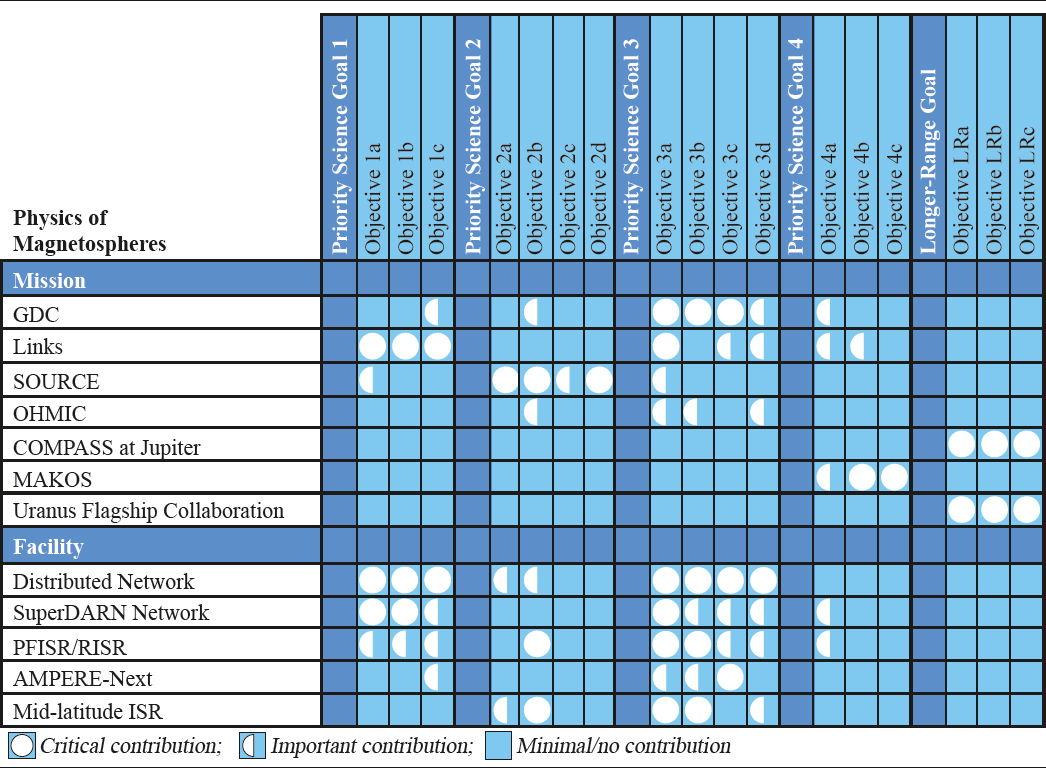
NOTE: Acronyms are defined in Appendix H.
- Expanded opportunities for data analysis from NASA missions no longer in operation, non-NASA missions, or ground-based assets.
- Increased resources for theory and modeling efforts to support utilizing new computational tools, including AI and ML methods, and to support exascale supercomputer architectures.
- Expanded opportunities for the space physics research community to study other planetary magnetospheres and atmospheres—through modeling, theory, and data analysis.
- Cooperation between the NASA Heliophysics Division and Planetary Science Division to ensure that future planetary missions include appropriate space physics instrumentation when feasible.
The panel eagerly looks forward to the implementation of a program addressing many of these goals.
C.7 REFERENCES
Baker, D.N., S.G. Kanekal, V.C. Hoxie, M.G. Henderson, X. Li, H.E. Spence, S.R. Elkington, et al. 2013. “A Long-Lived Relativistic Electron Storage Ring Embedded in Earth’s Outer Van Allen Belt.” Science 340:186–190. https://doi.org/10.1126/science.1233518.
Burch, J.L., R.B. Torbert, T.D. Phan, L.-J. Chen, T.E. Moore, R.E. Ergun, J.P. Eastwood, et al. 2016. “Electron-Scale Measurements of Magnetic Reconnection in Space.” Science 352(6290):aaf2939. https://doi.org/10.1126/science.aaf2939.
Burch, J.L., H.U. Frey, S.B. Mende, W. Lotko, and R.E. Ergun. 2023. “Observatory for Heteroscale Magnetosphere–Ionosphere Coupling (OHMIC).” White paper submitted to the Decadal Survey on Solar and Space Physics. National Academies of Sciences, Engineering, and Medicine.
Clark, G., P. Kollmann, J. Kinnison, D. Kelly, W. Li, A.N. Jaynes, L. Blum, et al. 2023. “Comprehensive Observation of Magnetospheric Particle Acceleration, Sources, and Sinks (COMPASS): A Mission Concept to Jupiter’s Extreme Magnetosphere to Address Fundamental Mysteries in Heliophysics.” White paper submitted to the Decadal Survey on Solar and Space Physics. National Academies of Sciences, Engineering, and Medicine.
Cohen, I.J., C. Arridge, A. Azari, C. Bard, G. Clark, F. Crary, S. Curry, et al. 2023. “The Case for Studying Other Planetary Magnetospheres and Atmospheres in Heliophysics.” White paper submitted to the Decadal Survey on Solar and Space Physics. National Academies of Sciences, Engineering, and Medicine.
Gabrielse, C., M. Gkioulidou, S. Merkin, D. Malaspina, D.L. Turner, M.W. Chen, S.-I., Ohtani, et al. 2023. “Mesoscale Phenomena and Their Contribution to the Global Response: A Focus on the Magnetotail Transition Region and Magnetosphere–Ionosphere Coupling.” Frontiers in Astronomy and Space Sciences 10:1151339. https://doi.org/10.3389/fspas.2023.1151339.
Goldstein, J., P. Molyneux, D. Gallagher, M. Davis, B. Larsen, W. Kurth, R. Chappell, et al. 2023. “Synchronized Observations of Upflow, Redistribution, Circulation, and Energization (SOURCE) Mission Concept.” White paper submitted to the Decadal Survey on Solar and Space Physics. National Academies of Sciences, Engineering, and Medicine. https://baas.aas.org/pub/2023n3i132/release/1.
Goodrich, K., S. Schwartz, L. Wilson III, I. Cohen, D. Turner, A. Caspi, K. Smith, et al. 2023a. “The Persistent Mystery of Collisionless Shocks.” White paper submitted to the Decadal Survey on Solar and Space Physics. National Academies of Sciences, Engineering, and Medicine.
Goodrich, K.A., L.B. Wilson III, S. Schwartz, I.J. Cohen, D.L. Turner, P. Whittlesey, A. Caspi, R. Rose, and K. Smith. 2023b. “Multipoint Assessment of the Kinematics of Shocks (MAKOS): A Heliophysics Mission Concept Study.” White paper submitted to the Decadal Survey on Solar and Space Physics. National Academies of Sciences, Engineering, and Medicine.
Henderson, M.G., L. Kepko, H.E. Spence, M. Connors, J.B. Sigwarth, L.A. Frank, H.J. Singer, and K. Yumoto. 2002. “The Evolution of North-South Aligned Auroral Forms into Auroral Torch Structures: The Generation of Omega Bands and Ps6 Pulsations via Flow Bursts.” 6th International Conference on Substorms. University of Washington, Seattle. https://doi.org/10.13140/RG.2.1.4976.9688.
Mende, S.B., S.E. Harris, H.U. Frey, V. Angelopoulos, C.T. Russell, E. Donovan, B. Jackel, M. Greffen, and L.M. Peticolas. 2008. “The THEMIS Array of Ground-Based Observatories for the Study of Auroral Substorms.” Space Science Reviews 141(1–4):357. https://doi.org/10.1007/s11214-008-9380-x.
NASA’s (National Aeronautics and Space Administration’s) Scientific Visualization Studio. 2015. “Magnetospheric Reconnection – July 2012.” Frame 0855. https://svs.gsfc.nasa.gov/4279.
NASA’s Scientific Visualization Studio. 2017. “Mapping Particle Injections in Earth’s Magnetosphere.” https://svs.gsfc.nasa.gov/4595.
NASEM (National Academies of Sciences, Engineering, and Medicine). 2020. Progress Toward Implementation of the 2013 Decadal Survey for Solar and Space Physics: A Midterm Assessment. The National Academies Press. https://doi.org/10.17226/25668.
NASEM. 2023. Origins, Worlds, and Life: Planetary Science and Astrobiology in the Next Decade. The National Academies Press. https://doi.org/10.17226/27209.
Nénon, Q., A. Sicard, and S. Bourdarie. 2017. “A New Physical Model of the Electron Radiation Belts of Jupiter Inside Europa’s Orbit.” Journal of Geophysical Research: Space Physics 122.5:5148–5167. https://doi.org/10.1002/2017JA023893.
Nénon, Q., A. Sicard, P. Hollmann, H.B. Garrett, S.P.A. Sauer, and C. Paranicas. 2018. “A Physical Model of the Proton Radiation Belts of Jupiter Inside Europa’s Orbit.” Journal of Geophysical Research: Space Physics 123.5:3512–3532.
NRC (National Research Council). 2013. Solar and Space Physics: A Science for a Technological Society. The National Academies Press. https://doi.org/10.17226/13060.
Sarris, T.E. 2019. “Understanding the Ionosphere Thermosphere Response to Solar and Magnetospheric Drivers: Status, Challenges and Open Issues.” Philosophical Transactions of the Royal Society A: Mathematical, Physical and Engineering Sciences 377(2148):20180101. https://doi.org/10.1098/rsta.2018.0101.
Sorathia, K.A., V.G. Merkin, E.V. Panov, B. Zhang, J.G. Lyon, J. Garretson, A.Y. Ukhorskiy, S. Ohtani, M. Sitnov, and M. Wiltberger. 2020. “Ballooning-Interchange Instability in the Near-Earth Plasma Sheet and Auroral Beads: Global Magnetospheric Modeling at the Limit of the MHD Approximation.” Geophysical Research Letters 47(14):e2020GL088227. https://doi.org/10.1029/2020GL088227.
Yamauchi, M. 2019. “Terrestrial Ion Escape and Relevant Circulation in Space.” Annales Geophysicae 37(6):1197–1222. https://doi.org/10.5194/angeo-37-1197-2019.
Zhang, H., Q. Zong, H. Connor, P. Delamere, G. Facskó, D. Han, H. Hasegawa, et al. 2022. “Dayside Transient Phenomena and Their Impact on the Magnetosphere and Ionosphere.” Space Science Review 218(40). https://doi.org/10.1007/s11214-021-00865-0.


