Use of Automatic Vehicle Monitoring, Vehicle Health Monitoring, and Diagnostic Systems by Transit Agencies (2025)
Chapter: 5 Summary of Findings, Conclusion, and Need for Additional Research

CHAPTER 5
Summary of Findings, Conclusion, and Need for Additional Research
Current State of Technology Adoption
The transit industry has adopted the technology discussed throughout this report using a variety of methods and timelines. Most survey respondents reported using at least one form of AVM or VHM system. The extent and utility of VHM systems was higher in agencies that also utilize AVM. It was found that engines and aftertreatment systems are the types of subsystems that are most typically monitored by VHM, although there are a wide variety of subsystems being monitored. Some agencies utilize PMT in their maintenance practices. Incorporating PMT into an agencyʼs fleet requires innovation because of the financial investment and other challenges regarding the integration of technology. Challenges specific to PMT include aging fleets and the number of technicians able to use the technology.
The survey also showed that agencies that have BEBs in their fleet use VHM to monitor the BEBsʼ energy storage system health while also supporting charging management systems. This VHM use as related to BEBs has been adopted rapidly as compared with other types of predictive and monitoring systems, and even more agencies are interested in adopting this technology. The survey findings showed that there is great interest in the use of predictive maintenance systems to extract preventive maintenance guidance from VHM databases using machine learning or other AI technology, but the quantified general benefits are still emerging.
In the coming years (parallel to the retirement of many experienced mechanics), technology will be deployed to help with troubleshooting complex vehicle systems, with the goals of saving on labor hours for analyzing the data from AVM and of finding the root causes of maintenance issues and failures. AVM, VHM, and PMT will be the next level of tools required to efficiently maintain and repair the various vehicle systems.
Insights from Industry Experience
The insights gathered from transit operators that have adopted these technologies provided valuable information for the industry about how to better utilize the technologies.
Transit operators noted that this technology is still evolving. APTA is encouraging the use of PMT and is currently assisting small and medium-sized transit agencies to do so through its Standard Bus Procurement Guidelines (SBPG). These guidelines reference a wide range of sensors, requiring buses to integrate with sensor technologies. The guidelines also require compliance with SAE J1939 for the communication protocol (SBPG TS 39.1) (APTA 2025).
Additionally, results from the survey showed that agencies tend to assess and validate a stand-alone system within the agency first and to integrate the technology with its bus procurement process later. This shows a typical process that an agency may follow when it comes to integrating
this technology. Such processes can be modeled by other agencies that are interested in evaluating the technology.
Each case example provided lessons learned. PSTA noted that this type of technology is ever-changing, so it is necessary to build a solid foundation from day one. This includes properly training employees and staying up to date on the latest advancements and software updates. MTS noted that if an agency is facing an issue with the various technologies in their fleet, especially with respect to the communication between the different types of technology, it is important to advocate for the agency to ensure that the technology is communicating properly and that it is able to be utilized to its full capabilities. CDTA explained that it would conduct its pilot study in a more controlled manner on one or two types of vehicles in the transit fleet because doing so would be quicker and less costly. Each lesson learned by the case example agencies can be an example to agencies that are looking to begin using these technologies in their fleets or those that wish to expand on technology that they have already integrated. Because the sharing of proprietary information from the OEMs has proved to be a challenge, the study team stresses the need to develop an open and shared cloud platform in order to successfully promote this type of technology and to realize its full benefits.
Challenges and Benefits
There are many benefits for transit agencies that use this technology, including proactive maintenance (which is more cost-effective) and a decrease in MDBF and transit delays caused by breakdowns while vehicles are actively on their routes. These provide not only financial benefits for the agency, but also operational benefits for the riders because of the lower prevalence of delays. There are also a variety of challenges that come with integrating this technology into an agencyʼs maintenance practices. These include the following:
- Up-front costs (e.g., hardware and software, installation)
- Subscriptions (cost to continue to access the software)
- Cost of training workers
- Integration of the new technology with existing systems
- OEM proprietorship
- Skepticism among technicians in a maintenance department
These challenges might prevent a transit agency from integrating additional technology and systems into its fleet. Case examples and pilot studies are two ways to help overcome these challenges. The former can show an agency what worked well for other agencies of similar size, geographic location, user socioeconomics, or fleet composition, or with other similarities. It can also share lessons learned by another agencyʼs experience so that similar issues can be avoided when adopting the technology. Case examples can serve as a lower-cost “test run” to help determine which manufacturers, software, technological capabilities, and other factors would work best for the agency and to help it to decide which systems to add to which vehicles in its fleet. There have also been numerous benefits seen by agencies that have adopted this technology; these benefits could ease skepticism and concerns about the challenges. The benefits of using AVM, VHM, and PMT can be placed into four categories, as seen in Table 5.
Need for Additional Research
Due to the ever-evolving nature of AI, there will likely be a continued need for ongoing research as related to its integration with transit agencies. The survey found that transit agencies have a significant interest in the use of AI. However, the quantified general benefits are still emerging.
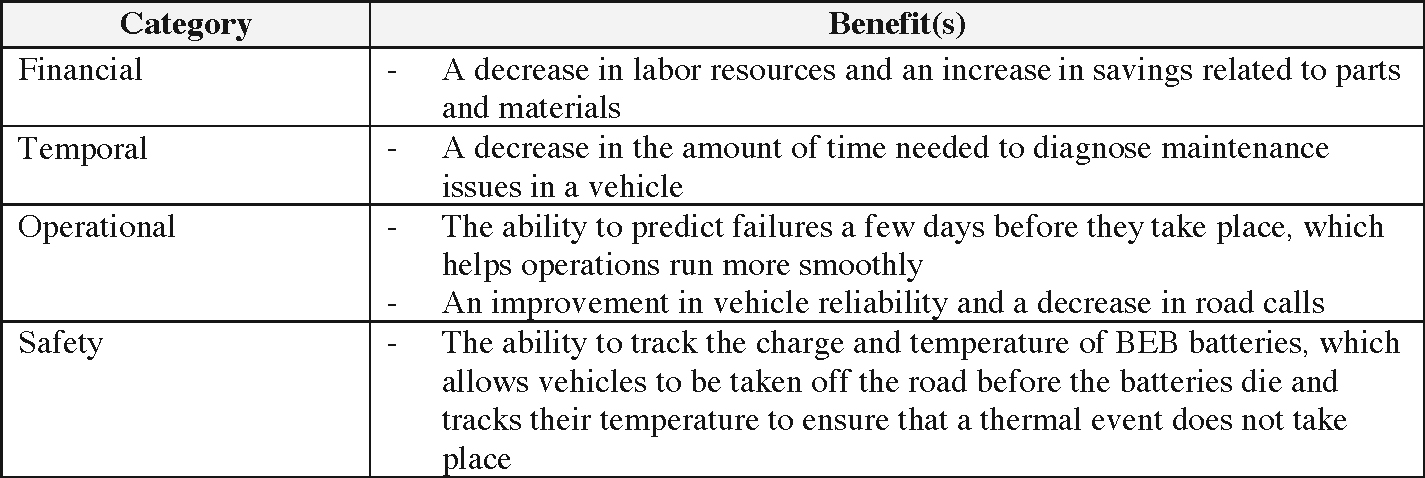
Long Description.
The table shows two columns with headers Category and Benefit(s), and four rows. The data shown are as follows: Row 1: Financial: A decrease in labor resources and an increase in savings related to parts and materials. Row 2: Temporal: A decrease in the amount of time needed to diagnose maintenance issues in a vehicle. Row 3: Operational: The ability to predict failures a few days before they take place, which helps operations run more smoothly. An improvement in vehicle reliability and a decrease in road calls. Row 4: Safety. The ability to track the charge and temperature of BEB batteries, which allows vehicles to be taken off the road before the batteries die and tracks their temperature to ensure a thermal event does not take place.
Additional research could take a more quantifiable approach. The following are areas that could be explored in greater detail:
- How these technologies have benefited transit agencies as related to service reliability, safety, and cost savings
- The reduction in capital investment (e.g., replacing vehicles, facility size) because of the use of AVM, VHM, and PMT
- The impact of PMT on the current spare ratio
- How PMT can be integrated with other emerging technologies
- Whether PMT can be used to practice on-demand part ordering
- How this technology and the information it produces can be used for the behavioral modification of bus operators (such as providing them with the information needed to help prevent a bus from breaking down)
- Data dictionaries for all the components and systems as requested by transit operators
- How interface systems can be made more effective in order to promote a more straightforward adoption of the technology
- The potential for intersystem databases across multiple public transportation agencies (or to include trucking or other automotive databases)
- The demand for a third-party analyzer of the PMT data points being gathered


