Use of Automatic Vehicle Monitoring, Vehicle Health Monitoring, and Diagnostic Systems by Transit Agencies (2025)
Chapter: Appendix C: Survey Questionnaire

APPENDIX C
Survey Questionnaire

Long Description.
Appendix C. Survey Questionnaire
Survey: Use of Automatic Vehicle Monitoring (AVM) and Vehicle Health Monitoring/Diagnostic Systems by Transit Agencies
The Transit Cooperative Research Program (TCRP) of the Transportation Research Board has commissioned AECOM to conduct a nationwide survey of transit operators for the J-07 SA-56 "Use of Automatic Vehicle Monitoring (AVM) and Vehicle Health Monitoring/Diagnostic Systems by Transit Agencies" synthesis study. This study is detailed here: httP-s://aP-P-S.trb.org/cmsfeed/TRBNetProjectDisP-IsY..asP-?ProjectlD=5367.
The objectives of this study are to:
1. Document the current practices in adopting comprehensive vehicle monitoring and health diagnostic systems.
2. Understand the perceived and experienced benefits of using such technology.
3. Identify effective practices and lessons learned in implementing the technology and integrating it with existing vehicle maintenance systems and procedures.
4. Identify obstacles and challenges in adopting the technology.
5. This survey is being distributed to approximately 100 transit operators across the country. The survey is short and easy to complete. It should take you no more than 20 minutes. We encourage you to obtain information from multiple departments within your organization, if necessary (e.g., bus maintenance, procurement, information technology, bus operation, etc.)
Please provide your response to this survey by September 22, 2023. Your response to the survey is critical to the success of this research. If you have any questions about the survey or the research in general, please contact Tess Williams or Mariela Garcia-Colberg, TCRP Senior Program Officer, by email.
Thank you for your support of this study. Your timely response is much appreciated.
*Indicates required question

Long Description.
1) Please provide the following information about yourself and your transit agency.
1. Name:*
2. Affiliation (please indicate the relevant transit agency if you are an employee of a contractor):*
3. Title/Position:
4. Email:*
5. Phone:*
2) Opening Question
6. Does your transit agency currently use any automatic vehicle monitoring (AVM), vehicle health monitoring and diagnostic systems, or predictive maintenance technologies? *
Mark only one oval.
( ) Yes Skip to question 7
( ) No Skip to question 54
3) Automatic Vehicle Monitoring (AVM) System Integrated with the Automatic Vehicle Location (AVL) System
7. Does your transit agency currently use an Automatic Vehicle Monitoring (AVM) system integrated with the Automatic Vehicle Location (AVL) system? *
Mark only one oval.
( ) Yes
( ) No (please skip this section and click "Next" at the bottom of the page)
Skip to question 15
8. Is this system provided by individual component suppliers, or comprehensive systems that are procured separately for maintenance purpose?
Mark only one oval.
( ) Provided by individual component suppliers
( ) Procured separately
( ) Other:
Long Description.
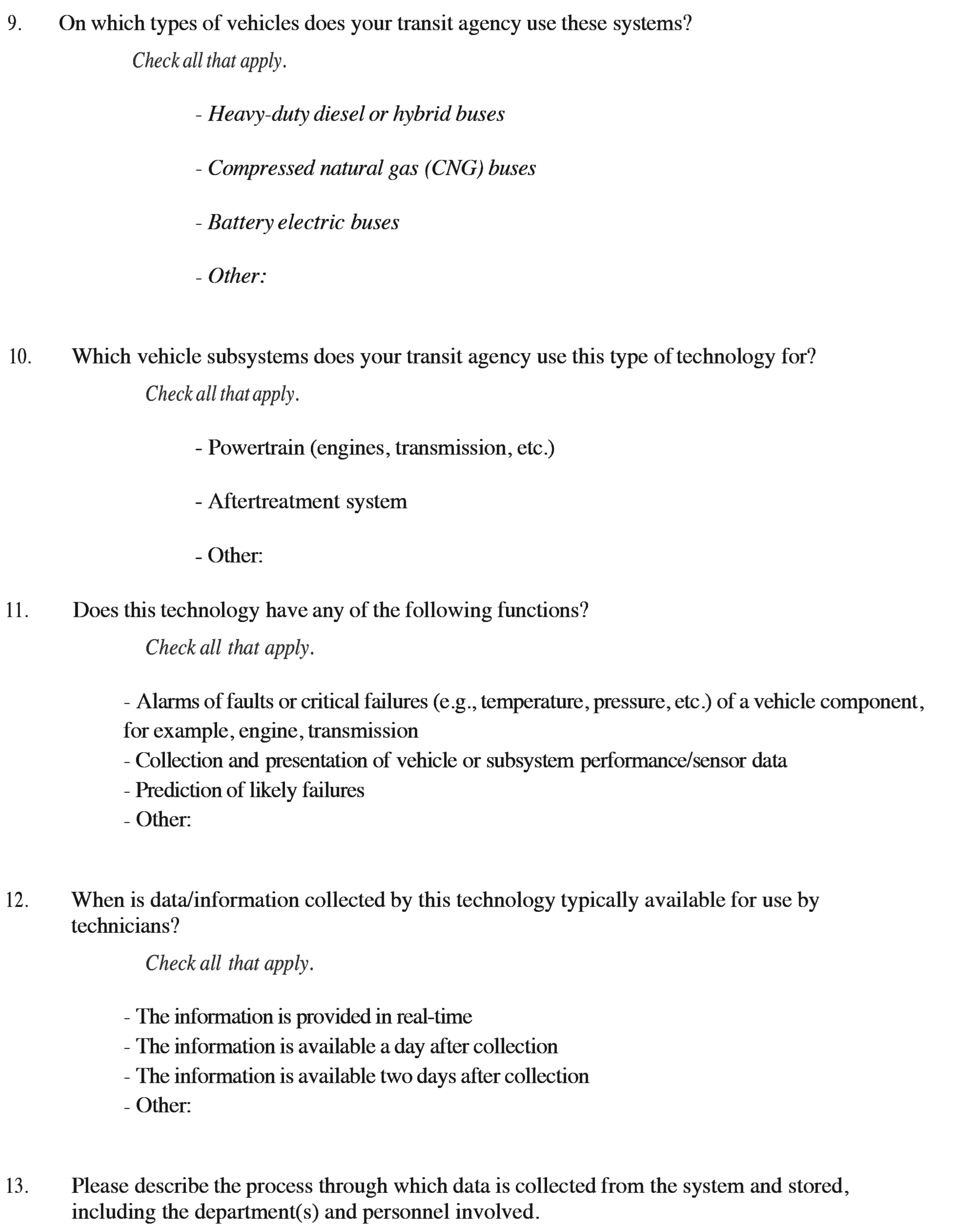
9. On which types of vehicles does your transit agency use these systems?
Check all that apply.
- Heavy-duty diesel or hybrid buses
- Compressed natural gas (CNG) buses
- Battery electric buses
- Other:
10. Which vehicle subsystems does your transit agency use this type of technology for?
Check all that apply.
- Powertrain (engines, transmission, etc.)
- Aftertreatment system
- Other:
11. Does this technology have any of the following functions?
Check all that apply.
- Alarms of faults or critical failures (e.g., temperature, pressure, etc.) of a vehicle component, for example, engine, transmission
- Collection and presentation of vehicle or subsystem performance/sensor data
- Prediction of likely failures
- Other:
12. When is data/information collected by this technology typically available for use by technicians?
Check all that apply.
- The information is provided in real-time
- The information is available a day after collection
- The information is available two days after collection
- Other:
13. Please describe the process through which data is collected from the system and stored, including the department(s) and personnel involved.

Long Description.
14. How is the data analyzed?
4) Comprehensive Vehicle Monitoring, Diagnostic, and Reporting System Integrated with the Maintenance System
15. Does your transit agency currently use a comprehensive vehicle monitoring, diagnostic, and reporting system integrated with the maintenance system? *
Mark only one oval.
( ) Yes
( ) No (please skip this section and click "Next" at the bottom of the page)
Skip to question 23
16. Is this system provided by individual component suppliers, or comprehensive systems that are procured separately for maintenance purpose?
Mark only one oval.
( ) Provided by individual component suppliers
( ) Procured separately
( ) Other:
17. On which types of vehicles does your transit agency use these systems?
Check all that apply.
- Heavy-duty diesel or hybrid buses
- Compressed natural gas (CNG) buses
- Battery electric buses
- Other:
18. Which vehicle subsystems does your transit agency use this type of technology for?
Check all that apply.
- Powertrain (engines, transmission, etc.)
- Aftertreatment system
- Other:
Long Description.
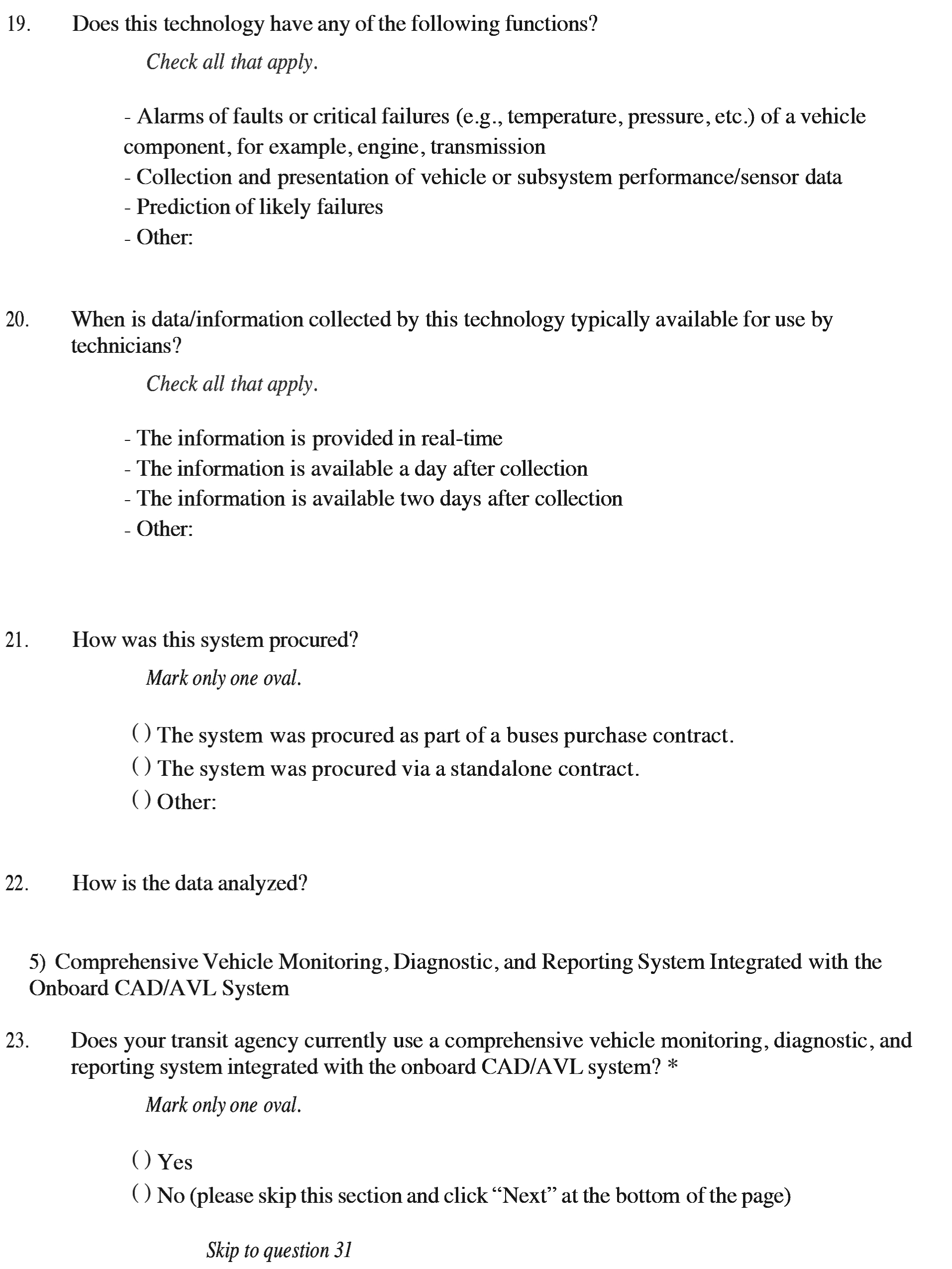
19. Does this technology have any of the following functions?
Check all that apply.
- Alarms of faults or critical failures (e.g., temperature, pressure, etc.) of a vehicle component, for example, engine, transmission
- Collection and presentation of vehicle or subsystem performance/sensor data
- Prediction of likely failures
- Other:
20. When is data/information collected by this technology typically available for use by technicians?
Check all that apply.
- The information is provided in real-time
- The information is available a day after collection
- The information is available two days after collection
- Other:
21. How was this system procured?
Mark only one oval.
( ) The system was procured as part of a buses purchase contract.
( ) The system was procured via a standalone contract.
( ) Other:
22. How is the data analyzed?
5) Comprehensive Vehicle Monitoring, Diagnostic, and Reporting System Integrated with the Onboard CAD/AVL System
23. Does your transit agency currently use a comprehensive vehicle monitoring, diagnostic, and reporting system integrated with the onboard CAD/AVL system? *
Mark only one oval.
( ) Yes
( ) No (please skip this section and click “Next” at the bottom of the page)
Skip to question 31
Long Description.
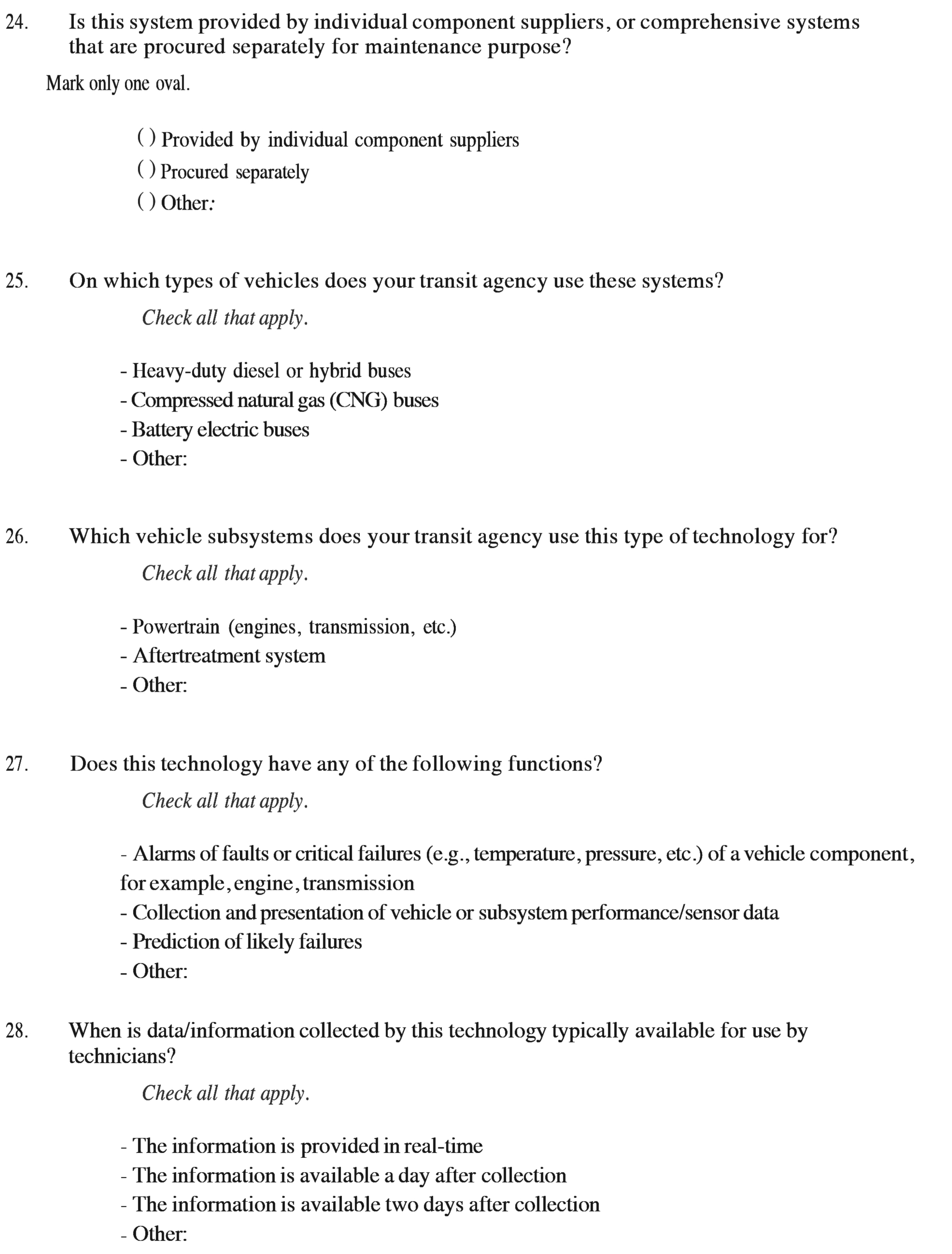
24. Is this system provided by individual component suppliers, or comprehensive systems that are procured separately for maintenance purpose?
Mark only one oval.
( ) Provided by individual component suppliers
( ) Procured separately
( ) Other:
25. On which types of vehicles does your transit agency use these systems?
Check all that apply.
- Heavy-duty diesel or hybrid buses
- Compressed natural gas (CNG) buses
- Battery electric buses
- Other:
26. Which vehicle subsystems does your transit agency use this type of technology for?
Check all that apply.
- Powertrain (engines, transmission, etc.)
- Aftertreatment system
- Other:
27. Does this technology have any of the following functions?
Check all that apply.
- Alarms of faults or critical failures (e.g., temperature, pressure, etc.) of a vehicle component, for example, engine, transmission
- Collection and presentation of vehicle or subsystem performance/sensor data
- Prediction of likely failures
- Other:
28. When is data/information collected by this technology typically available for use by technicians?
Check all that apply.
- The information is provided in real-time
- The information is available a day after collection
- The information is available two days after collection
- Other:
Long Description.
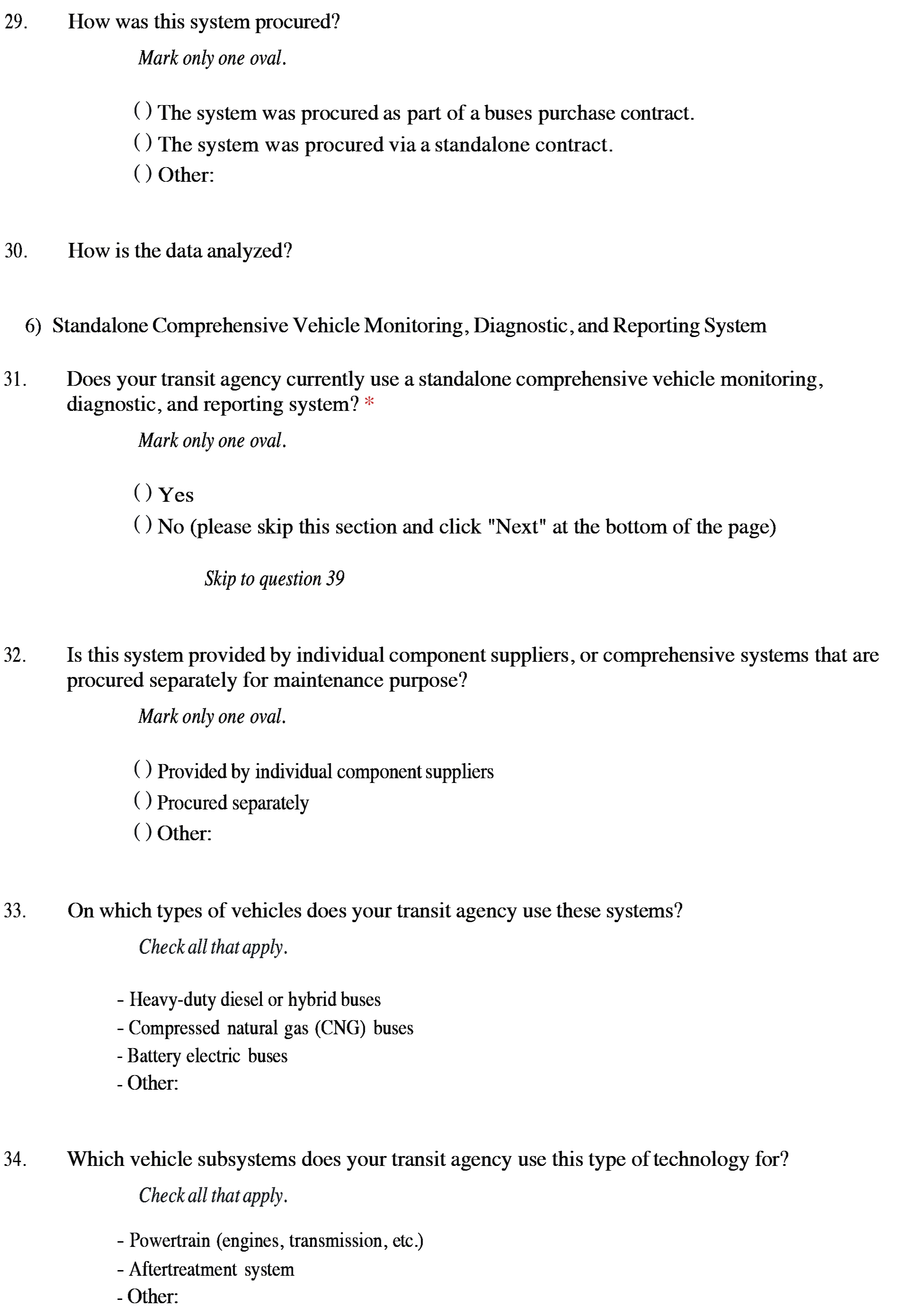
29. How was this system procured?
Mark only one oval.
( ) The system was procured as part of a buses purchase contract.
( ) The system was procured via a standalone contract.
( ) Other:
30. How is the data analyzed?
6) Standalone Comprehensive Vehicle Monitoring, Diagnostic, and Reporting System
31. Does your transit agency currently use a standalone comprehensive vehicle monitoring, diagnostic, and reporting system? *
Mark only one oval.
( ) Yes
( ) No (please skip this section and click "Next" at the bottom of the page)
Skip to question 39
32. Is this system provided by individual component suppliers, or comprehensive systems that are procured separately for maintenance purpose?
Mark only one oval.
( ) Provided by individual component suppliers
( ) Procured separately
( ) Other:
33. On which types of vehicles does your transit agency use these systems?
Check all that apply.
- Heavy-duty diesel or hybrid buses
- Compressed natural gas (CNG) buses
- Battery electric buses
- Other:
34. Which vehicle subsystems does your transit agency use this type of technology for?
Check all that apply.
- Powertrain (engines, transmission, etc.)
- Aftertreatment system
- Other:
Long Description.
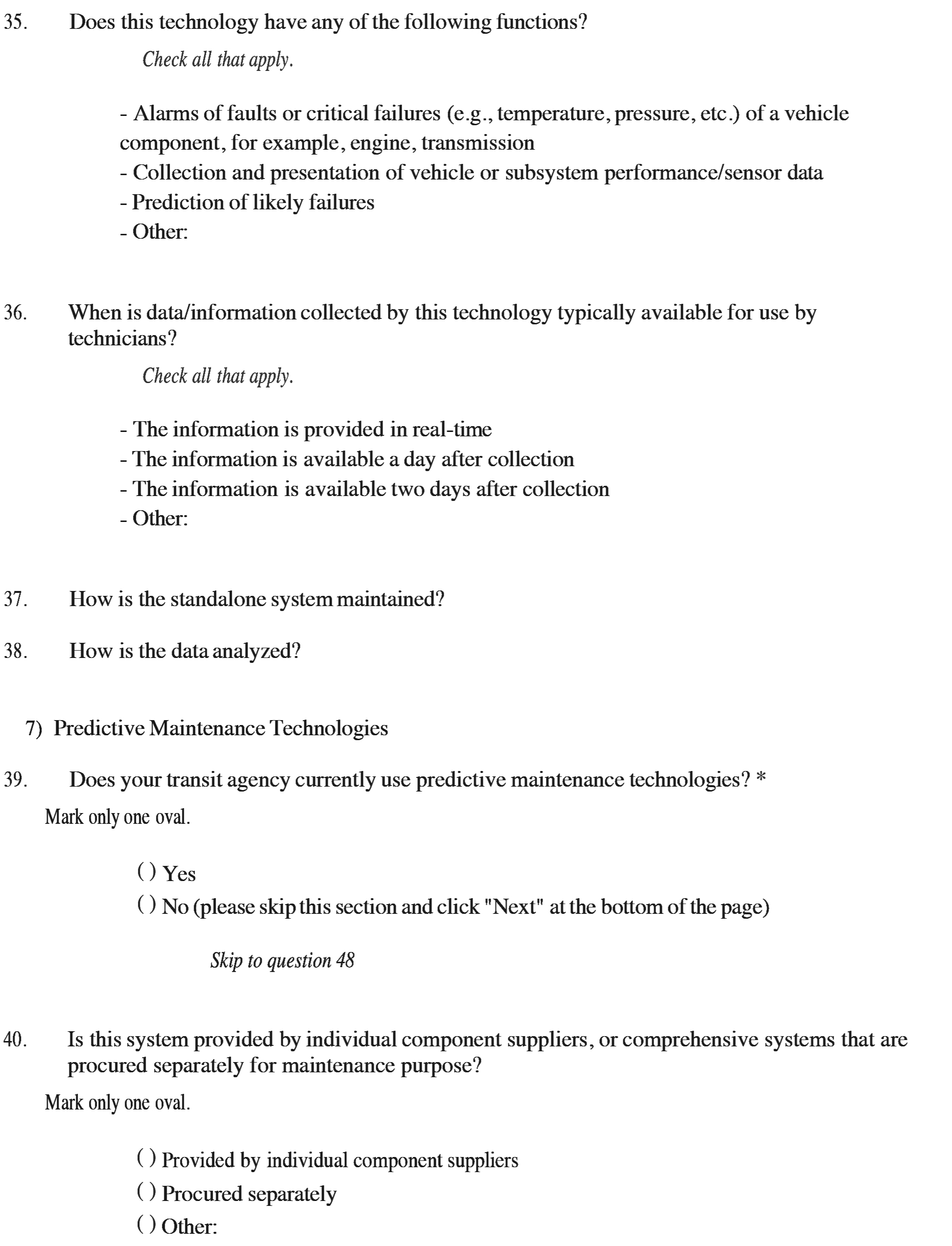
35. Does this technology have any of the following functions?
Check all that apply.
- Alarms of faults or critical failures (e.g., temperature, pressure, etc.) of a vehicle component, for example, engine, transmission
- Collection and presentation of vehicle or subsystem performance/sensor data
- Prediction of likely failures
- Other:
36. When is data/information collected by this technology typically available for use by technicians?
Check all that apply.
- The information is provided in real-time
- The information is available a day after collection
- The information is available two days after collection
- Other:
37. How is the standalone system maintained?
38. How is the data analyzed?
7) Predictive Maintenance Technologies
39. Does your transit agency currently use predictive maintenance technologies? *
Mark only one oval.
( ) Yes
( ) No (please skip this section and click "Next" at the bottom of the page)
Skip to question 48
40. Is this system provided by individual component suppliers, or comprehensive systems that are procured separately for maintenance purpose?
Mark only one oval.
( ) Provided by individual component suppliers
( ) Procured separately
( ) Other:
Long Description.
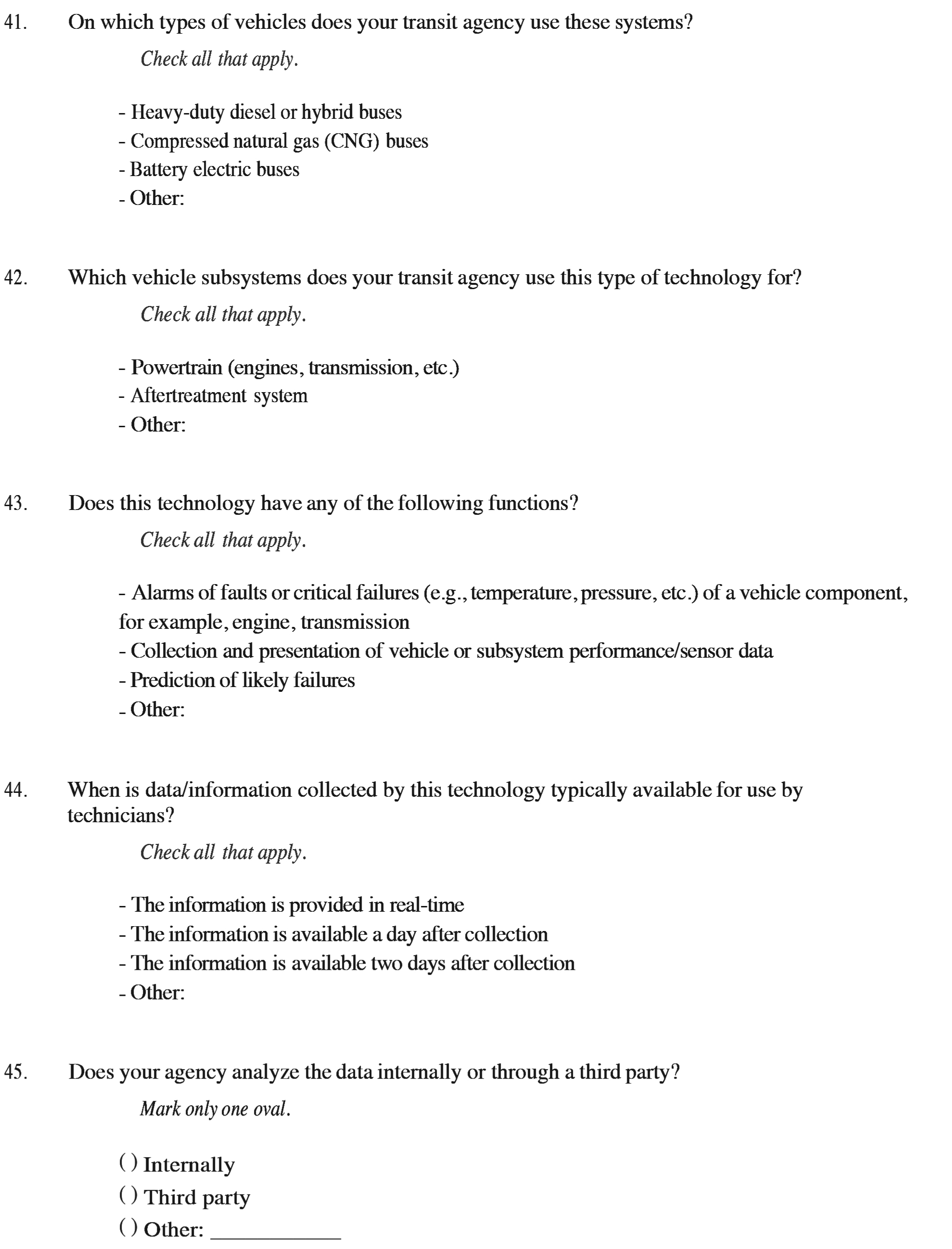
41. On which types of vehicles does your transit agency use these systems?
Check all that apply.
- Heavy-duty diesel or hybrid buses
- Compressed natural gas (CNG) buses
- Battery electric buses
- Other:
42. Which vehicle subsystems does your transit agency use this type of technology for?
Check all that apply.
- Powertrain (engines, transmission, etc.)
- Aftertreatment system
- Other:
43. Does this technology have any of the following functions?
Check all that apply.
- Alarms of faults or critical failures (e.g., temperature, pressure, etc.) of a vehicle component, for example, engine, transmission
- Collection and presentation of vehicle or subsystem performance/sensor data
- Prediction of likely failures
- Other:
44. When is data/information collected by this technology typically available for use by technicians?
Check all that apply.
- The information is provided in real-time
- The information is available a day after collection
- The information is available two days after collection
- Other:
45. Does your agency analyze the data internally or through a third party?
Mark only one oval.
( ) Internally
( ) Third party
( ) Other: ___________

Long Description.
46. If you use a third party, how do you work with a third party for data analysis?
47. If you use a third party, by what method is the collected data shared with the third party?
8) Questions on the Collected Data
48. Where is the collected data stored?
Check all that apply.
- On-premise with its own database
- Private cloud
- Public cloud
- Other:
49. Which department of your agency maintains the onboard system?
Check all that apply.
- Bus Maintenance
- Engineering
- I T
- Other:
50. How have the systems used changed the maintenance procedures of your transit agency?
Check all that apply.
- Vehicle maintenance planning has become more data-driven and customized to the duty cycles specific to your transit agency
- Reduction in troubleshooting time
- Improved knowledge of technicians in troubleshooting and repairs
- Other:
51. Has your transit agency observed any of the following benefits after adopting this new technology?
Check all that apply.
- Reduction in mechanical service interruptions
- Increase in mean distance between failures (MDBF)
- More efficient use of maintenance resources, including more productive use of maintenance staff
- Longer vehicle useful lives
- Lower lifecycle costs for vehicles
- Other:

Long Description.
9) Additional Functions and Comments
52. Are there additional functions or efficiencies that you would like existing automatic vehicle monitoring (AVM), vehicle health monitoring, or diagnostic systems to do that aren't currently supported?
53. Do you have any additional comments regarding your agency's use of automatic vehicle monitoring (AVM), vehicle health monitoring, or diagnostic systems? If so, please note them below:
10) Agency does not use AVM
54. Does your transit agency plan to start using the technology in the near future?
Mark only one oval.
( ) Yes
( ) No
55. If you answered "No," please provide the rationale.


