Design Options to Reduce Conflicts Between Turning Motor Vehicles and Bicycles: Conduct of Research Report (2024)
Chapter: 3 Summary of Design Guidelines
CHAPTER 3
Summary of Design Guidelines
This section provides a summary of the current design guidance available in the United States. In this chapter, the current state and national resources related to bikeway treatments at intersections with a focus on treatments managing conflicts between bicyclists and turning vehicles are reviewed. It also includes a review of three resources commonly referenced by practitioners and summarizes the design principles or objectives, typical applications for treatments, and any thresholds for treatment applications in each. A summary of the guidance currently available on sight distance for bicyclists and conflicts with turning vehicles, and the state of knowledge regarding the relationship between motorist turning speeds and effective radii is provided.
State and National Resources Overview
Current design documents generally provide detailed guidance for markings, signs, and geometric elements to implement various intersection treatments, but lack clear information on the expected differences in safety performance or thresholds (e.g., volume, speed, context) for selecting treatments nor do they provide direction on how to evaluate safety or operational tradeoffs between various treatments. Below is a brief summary of state resources followed by general descriptions of several of the most prominent resources available to practitioners published by FHWA, American Association of State Highway and Transportation Officials (AASHTO), National Association of City Transportation Officials (NACTO), and NCHRP.
Snapshot of State Resources
Most states provide basic definitions and guidance related to bikeway design; however, not all provide information related to more advanced solutions like separated bike lanes. A review of state DOT bicycle facility design guides (conducted in early 2020) found that 36 DOTs provide specific design guidance for separated bike lanes. Of those that provide specific design guidance, 13 provide guidance for selecting a bikeway and 34 define separated bike lanes (or protected bike lanes). Of the agencies that define separated bike lanes, six provide protected intersection guidance and 14 provide mixing zone guidance. Our findings revealed that if an agency provided guidance on protected intersections, they also provided guidance on mixing zones. In addition, regardless of whether the agency provides guidance on separated bike lanes, there were often references to FHWA, AASHTO, MUTCD, and NACTO guidance in the text – all of which provide guidance on separated bike lanes and newer design treatments. In the interviews conducted for this research project, many agencies stated that they rely on the MassDOT Guide for design guidance related to intersection treatments.
Summary of National Resources
Below are general descriptions of several national design guide resources that cover intersection treatments.
FHWA Achieving Multimodal Networks (2016)
This guide focuses on flexibly applying design standards to incorporate multimodal facilities with reduced conflicts. Design topics related to intersection design include intersection geometry, signalization, turning vehicle conflicts, and separated bike lanes (mixing and protected intersections).
FHWA Bikeway Selection Guide (2019)
The FHWA Bikeway Selection Guide is a resource to help transportation practitioners consider and make informed decisions about tradeoffs relating to the selection of bikeway types based on design speed, motor vehicle volumes and contextual factors (primarily urban vs. rural land use). Mixing zones and protected intersections are discussed as they relate to achieving performance characteristics based on the five core elements of the Dutch Sustainable Safety program.
FHWA Separated Bike Lane Planning and Design Guide (2015)
The guide documents the process of designing separated bikeways, including detailed intersection design guidance. Intersection design guidance includes different time and space separation techniques for both motor vehicle and bicycle turning movements, pavement markings, and signalization strategies and phasing.
FHWA Traffic Analysis and Intersection Considerations to Inform Bikeway Selection (2021)
This resource supplements the FHWA Bikeway Selection Guide and is intended to inform trade-off decisions associated with bikeway selection at intersections. It discusses common performance metrics, spatial needs of bikeways at intersections, safety and equity focused design principles, and operational traffic analysis tradeoffs and assumptions.
AASHTO Guide for the Development of Bicycle Facilities (forthcoming)
The AASHTO Guide for the Development of Bicycle Facilities provides guidance on bicycle facility planning, design, and operations. Intersections are addressed in each of the facility design chapters as applicable to each facility type. There is a separate chapter on signals – “Traffic Signals and Pedestrian Hybrid Beacons (PHB)” – which covers all aspects of signalization in depth, including the use of bicycle signal faces.
NACTO Don’t Give Up at the Intersection (2019)
This guide focuses on design strategies and tools for safer accommodation of bicyclists through intersections. The design strategies covered are protected intersections, dedicated intersections, and minor street crossings. Design tools discussed include bikeway setbacks, recessed stop lines, bike-friendly signal phasing, turn wedges, vertical separation elements, and raised bike crossings.
NACTO Global Street Design Guide (2016)
The guide provides recommendations for street design in urban areas. It addresses a variety of street typologies and design elements for various contexts around the world. Intersection treatments such as protected intersections, bike boxes, and signalization considerations are described.
NACTO Urban Bikeway Design Guide, 2nd Edition (2014)
This guide includes direction for street design that is safe and comfortable for bicycling that was developed based on designs implemented by member cities. As of this writing, the guide refers readers to NACTO’s ‘Don’t Give Up at the Intersection’ for more in-depth information on intersection design treatments.
NACTO Urban Street Design Guide (2013)
The guide provides an overview of the principles that cities are using to create streets that are safe and comfortable for all users. Bicycle design treatments are not as prevalent in this guide as in other NACTO resources; however, they are included in the example street conversions that are provided within the document.
NACTO Designing for All Ages and Abilities (2017)
This document builds upon NACTO’s Urban Bikeway Design Guide and provides guidance for practitioners as they select bikeway facilities, notably to meet the needs of all ages and abilities of people bicycling. Contextual factors such as vehicular speed and volume, operational uses, and bicycle stress are discussed.
NCHRP Report 926: Guidance to Improve Pedestrian and Bicyclist Safety at Intersections (2020)
This report outlines a process and includes a list of countermeasures that practitioners can use to improve the safety performance of intersections for people walking and biking. Information on the treatments include crash types that are influenced, applicable contexts, complementary countermeasures, considerations, estimated cost, systemic safety potential, potential effects on travel modes, and alternative treatments. The report provides direction for how to select optimal bicyclist and pedestrian safety treatments, given common budget, geometric, and other constraints. It concludes with an appendix of safety treatment cut-sheets that identify safety benefits, expected crash reduction (CMF), and other engineering characteristics of identified countermeasures.
NCHRP Report 948: Guide for Pedestrian and Bicyclist Safety at Alternative and Other Intersections and Interchanges 2021)
The report includes a discussion of the overall characteristics and potential benefits of alternative intersections and interchanges (A.I.I.). It details multiple aspects of pedestrian and bicyclist safety and accessibility considerations, including their basic characteristics (e.g., walking speeds, spatial needs, people with disabilities, and the walking experience), traversing, wayfinding, crossing, bicycle facility types and selection, and design principles. The guide also includes a discussion of facility design selection, quantitative performance measures, and operational analysis, as well as design performance measures for pedestrian and bicyclist safety.
Table 3 provides a summary of major national resources and the design guidance they provide for various treatment types, and the context they cover.
Table 3. National resources, design guidance, context, and intersection design process
| Title of Resource | Intersection Design Guidance | Context | |||||||
|---|---|---|---|---|---|---|---|---|---|
| Protected | Signalization | Bike Lane (right side of travel lane) | Pocket/Keyhole Bike Lane | Mixing Zone | Shared Lane | Urban | Suburban | Rural | |
| FHWA Achieving Multimodal Networks | X | X | X | X | X | X | |||
| FHWA Bikeway Selection Guide | X | X | X | X | X | ||||
| FHWA Separated Bike Lane Planning and Design Guide | X | X | X | X | X | N/A | N/A | N/A | |
| FHWA Intersection Supplement | X | X | X | X | X | N/A | N/A | N/A | |
| AASHTO Guide for the Development of Bicycle Facilities (4th Edition, 2012) | X | X | X | X | X | X | X | X | |
| AASHTO Guide for the Development of Bicycle Facilities (5th Edition, Expected 2022) | X | X | X | X | X | X | X | X | X |
| NACTO Don’t Give Up at the Intersection | X | X | X | ||||||
| NACTO Global Street Design Guide | X | X | |||||||
| NACTO Urban Bikeway Design Guide | X | X | X | X | X | ||||
| NACTO Urban Street Design Guide | X | X | X | ||||||
| NACTO Designing for All Ages & Abilities | X | X | |||||||
| NCHRP Report 926: Guidance to Improve Pedestrian and Bicyclist Safety at Intersections | X | X | X | X | X | X | |||
| NCHRP Report 948: Guide for Pedestrian and Bicycle Safety at A.I.I. | X | X | X | X | |||||
Design or Treatment Selection Processes
In this review, three guidelines were found to provide some general design processes or treatment selection processes. For this summary, an intersection design process was defined as a step-by-step description for practitioners to follow that would aid in determining the appropriate design treatment for an intersection.
FHWA’s Separated Bike Lane Planning and Design Guide
This guide describes a four-step design process to aid in the design of separated bikeways. Step 4 of the process specifically relates to developing intersection designs. This step of the design process provides many types of intersection design treatments that are possible and describes the considerations that accompany each treatment. Treatments include signalization (e.g., bike signals, phasing, coordination), lateral shift, mixing zone, bend-in and bend-out (e.g., a protected intersection), and descriptions of intersection markings that are appropriate to incorporate.
NCHRP Report 926: Guidance to Improve Pedestrian and Bicyclist Safety at Intersections
This report includes a step-by-step process to support practitioners in selecting intersection safety treatments based on site conditions, effectiveness, level of public process, and the treatment’s potential to reduce certain common pedestrian and bicycle crash types. The process has the following seven steps: Frame the Process, Identify and Collect the Data for Analysis, Analyze Intersection Safety and Identify Issues, Identify Treatment Options for Creating Safer Intersections, Refine the Countermeasure Options, Evaluate Priorities and Assess Tradeoffs and Viability, and Final Countermeasure Selection. The detailed description of each countermeasure provided in the appendix of this report provides information to practitioners on the application, tradeoffs, considerations, effectiveness, cost, context, and alternatives.
NCHRP Report 948: Guide for Pedestrian and Bicyclist Safety at Alternative Intersections and Interchanges
This report has a performance-based process for practitioners to evaluate the pedestrian and bicycle design elements in the context of a two-stage intersection control evaluation (ICE) process. As summarized in this report, “the [ICE] process centers around identifying intended outcomes (design objectives and principles), establishing geometric design decisions with those objectives in mind (developing the design based on those principles), evaluating how well a design meets those objectives (performance assessment), and iterating as needed to produce a desired design (balance tradeoffs).” The “existing ICE tools do not include techniques to evaluate pedestrian or bicyclists’ operations or safety” (NCHRP Report 948 page 1-7), therefore strategies are provided that can be included in Stage 1 and Stage 2 of the ICE process to evaluate the operations and safety of pedestrians and bicyclists. A detailed description and example of the performance measure assessment (referred to as a Design Flag Assessment) is provided in this guide and, although this guide is specifically addressing A.I.I.s, the process and principles can be applied to conventional intersections (page 1-2).
Additional Details for Key Resources
While most of the design guidance does not provide explicit direction regarding how to choose between the intersection treatments being studied, it does provide design principles or objectives to frame decisions that practitioners make when designing intersections. Most guidance also provides typical applications for treatments, or scenarios where appropriate, although thresholds (e.g., for motor vehicle volumes, bike volumes, turning speeds) are lacking for when to implement a specific treatment apart from guidance
regarding bicycle signal phases. Below are additional details on design principles or objectives, typical applications, and thresholds available in four resources that are commonly referred to by practitioners.
Design Principles or Objectives
Many design resources provide practitioners with design principles to manage conflicts between turning motor vehicles and bicyclists at intersection. Table 4 shows the consistency and complementarity in the design principles in the key resources reviewed.
Table 4. Design principles for key resources
| Design Guidance | Design Principles |
|---|---|
| FHWA Bikeway Selection Guide (2019) |
|
| FHWA Traffic Analysis and Intersection Considerations to Inform Bikeway Selection (2021) | |
| NACTO Don’t Give Up at the Intersections (2019) |
|
| MassDOT Separated Bike Lane Planning and Design Guide (2015) |
|
Typical Applications
Many design resources also provide details on when treatments are appropriate and what is preferred from a bicyclist comfort standpoint. Examples of typical applications are provided below.
NACTO Don’t Give up at the Intersections (2019)
This resource provides typical applications for three strategies:
- Protected intersections can be applied on any street where enhanced bike comfort is desirable and are most found on streets with parking-protected bike lanes or buffered bike lanes.
- Dedicated intersection (Figure 3 below) geometry should be considered where there is not enough space to set back the bikeway from mixed traffic at the intersection (often when protected bike lane runs close to mixed traffic lanes without a parking or loading lane between them).
- Raised bikeways crossing should be considered at crossings of minor streets, neighborhood streets, driveways, and other small streets to provide unambiguous priority to bikes in the intersection.
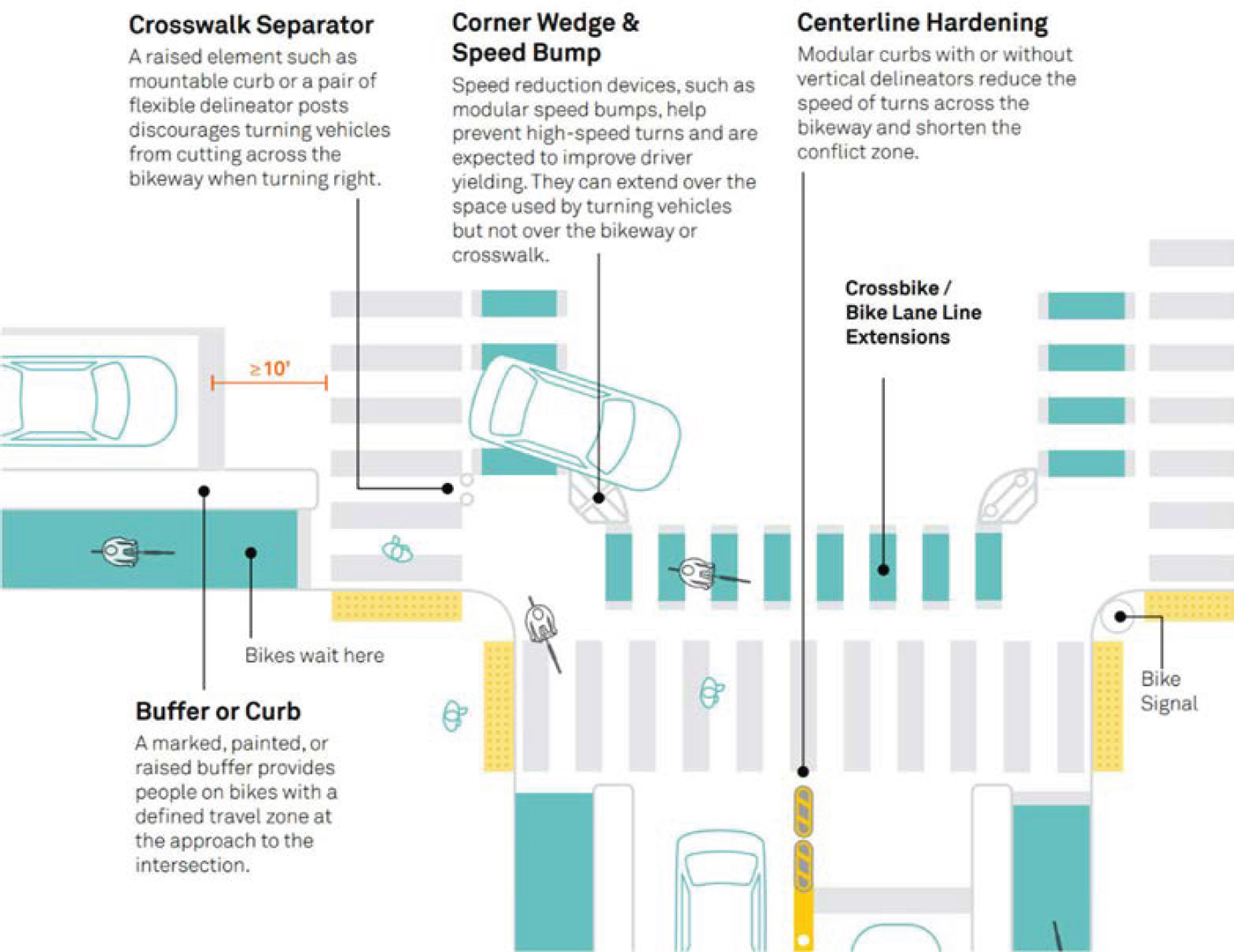
MassDOT Separated Bike Lane Planning and Design Guide (2015)
This resource describes the difference between applications for protected intersections and mixing zones in the following way: “Protected intersections are preferable to mixing zones. Mixing zones are generally appropriate as an interim solution or in situations where severe right-of-way constraints make it infeasible to provide a protected intersection. Mixing zones are only appropriate on street segments with one-way separated bike lanes. They are not appropriate for two-way separated bike lanes due to the contra-flow bicycle movement.”
Thresholds
There is limited use of thresholds in existing design guidance for determining treatment selection. The MassDOT Separated Bike Lane Planning and Design Guide does not provide thresholds for providing specific intersection treatment types (e.g., protected intersections vs. mixing zones), but does provide thresholds for turning motor vehicles in varying contexts (e.g., type of bikeway, number of through lanes on street) to determine if signal phase separation should be considered. These thresholds, which are based on European research and guidance, do not consider additional contextual factors (e.g., speed, intersection design) (Madsen and Lahrman, 2017). NACTO’s Don’t Give Up at the Intersection provides guidance on phase separation for a dedicated intersection treatment depending upon adjacent motor vehicle lane configuration, the type of turn (left or right), and the number of lanes on the street.
Guidance Related to Bicyclist Comfort
Comfort and how the design of a street or intersection influences this feeling in an individual who is riding a bicycle are important considerations in selecting a bikeway and choosing intersection treatments. In design guidance, the topic of comfort is often referenced as a design objective along with safety. While many design guides may not explicitly identify design treatments that directly influence comfort, this performance measure is often referenced in conjunction with safety to justify certain geometry changes (e.g., widths of bikeways, size of buffers), separation type, exposure conditions, and delays (e.g., stopping and dwelling).
Some design guides, such as NACTO’s Designing for All Ages & Abilities, emphasize designing for comfort by focusing on bikeway designs that are comfortable for people of all ages and abilities. The all ages and abilities framework recognizes that not all bicyclists’ levels of confidence and comfort are the same and focuses on bikeway designs that reflect this variation. For example, a conventional bike lane on a higher speed, higher volume street may be comfortable for confident, adult male bicyclists, but it is likely uncomfortable for a school-age child, senior, or someone who is new to bicycling. Bikeway designs that follow this framework tend to focus on reducing driver speeds and overall traffic volumes and providing greater separation between people bicycling and people driving. Specific designs may include traffic calming treatments and/or a combination of lateral separation (e.g., painted buffer distance) and vertical separation (e.g., flex posts or curbs).
Some design guidance references unmet demand for bicycling because many environments are not comfortable for bicycling (FHWA Bikeway Selection Guide), or it identifies comfort as an important part of attracting more people to bicycle as a mode of travel (MassDOT). The MassDOT guide goes further to identify the following measures to improve the comfort of people riding bicycles:
- Provide horizontal separation from motor vehicle traffic.
- Ensure that delay is reasonable for bicyclists and balanced with other users, particularly at intersections.
- Minimize exertion and energy loss of starting and stopping.
- Minimize exposure to traffic noise and pollution.
- Accommodate side-by-side riding and passing movements.
- Provide smooth transitions.
The FHWA Bikeway Selection Guide references comfort and frames design decisions around the application of Dutch Sustainable Safety (Safe Systems) principles. The FHWA’s Traffic Analysis and Intersection Considerations to Inform Bikeway Selection categorizes the functionality (comfort) of several bikeway intersection types (see Table 5 below). The table also shows the tradeoffs between intersection design strategies from a safe systems perspective. The table does not provide contextual information, though, such as motorist volume, speed, or bike volumes, and the influence these factors have on safety/risk.
Table 5. Sustainable safety considerations for bikeway intersection types (FHWA 2021)
| BIKEWAY INTERSECTION TYPE | |||||
|---|---|---|---|---|---|
| Protected Intersection | Bike Lane (Righi Side or Travel Lane) |
Pocket/Keyhole Bike Lane (Left Skit of Righi Turn Lane) |
Mixing Zone | Shared Lane | |
| Functionality (Comfort) – Roads can be categorized by their function | |||||
| Perceived comfort based on separation from traffic and constrained entry/confict point | High | High to Moderate | Moderale to Low | Moderate to Low | Low |


