Design Options to Reduce Conflicts Between Turning Motor Vehicles and Bicycles: Conduct of Research Report (2024)
Chapter: 10 Decision Tool and Guidelines Summary, Implementation and Training
CHAPTER 10
Decision Tool and Guidelines Summary, Implementation and Training
Decision Tool and Design Guidelines Content Overview
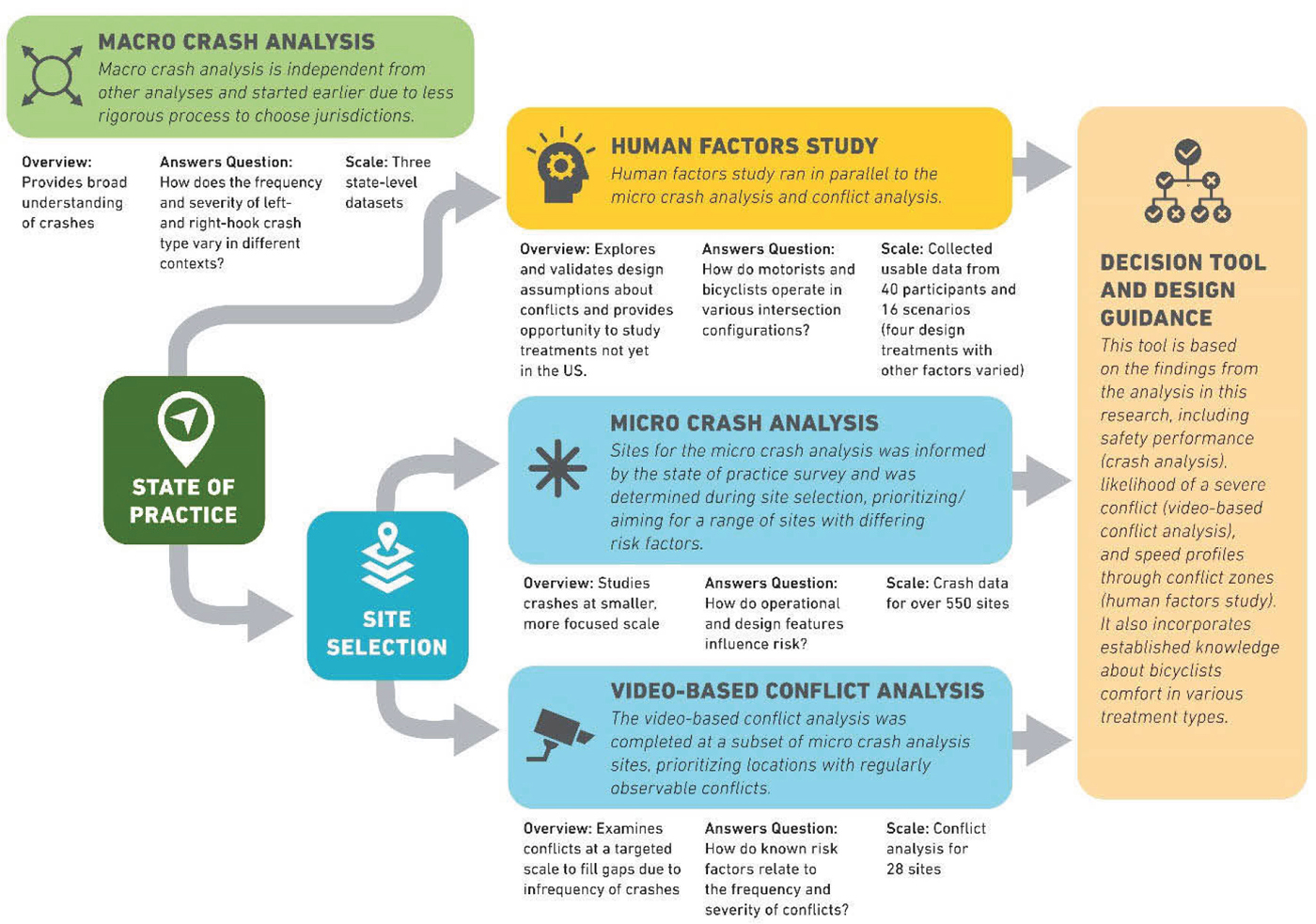
The Decision Tool and Design Guidelines, which is a stand-alone document, was developed based on the findings from the State of the Practice and from the research completed as a part of NCHRP 15-73 (i.e., crash analysis, conflict analysis, and human factors study). It incorporates the context variables that were found to be significant in the research completed as a part of this project and research from the established body of knowledge. Conflicts between bicyclists and right-turning motorists was the focus of the original research, so right-turn conflicts are also the focus of this decision tool. The document acknowledges the significance of left-hook crashes and includes references to the existing body of knowledge and state of the practice for managing left-turn conflicts. It includes five sections:
- Introduction explains that the purpose of the document is to provide practitioners an expanded framework for decision making and assessment of tradeoffs for various treatments based on the relative safety performance of intersection treatments. It also summarizes the project process, describes the safety analysis methods, and provides a high-level summary of research findings.
- Decision-Making Principles reviews three overarching principles to consider when applying the decision tool and implementing designs. The principles are a Safe System Approach, Considering Bicycle Design User in Design Decisions, and Design Flexibility and Engineering Judgement.
- Intersection Bikeway Design Decision Tool presents a flow chart graphic, a step-by-step guide for the flow chart, and supporting materials. The primary decision criteria in the flow chart are motor vehicle turning volumes and bicycle total volumes because these were the risk factors prominent in the research. The supporting materials include strategies for reallocating space and additional considerations for phase separation (i.e., heavy vehicles, intersection skew, and presence of transit).
- Supplemental Design Guidelines provides recommendations for mitigating known safety concerns for each intersection treatment, including shared lane, conventional bike lane at intersection, mixing zone, pocket bike lane, separated bike lane at intersection, and protected corner.
- Summary includes a brief description of how the document was developed and how the Decision Tool and Design Guidelines relate to the project final report.
To use the tool, practitioners should have the following information available for use with the decision tool:
- Motor vehicle daily volumes (i.e., either a recent 24-hour count or Average Annual Daily Traffic)
- Motor vehicle hourly right-turning volumes (i.e., peak hours at a minimum, additional hours are preferred)
- Heavy vehicle volumes and/or percentages
- Existing or anticipated hourly bicycle through volumes (through and turning volumes combined)
- Motor vehicle design speed/operating speed/target speed
- Street geometry, specifically street widths and intersection skew
- Bus stop locations
Interpretation and Application of Research
The decision tool was developed by combining interpretations of the findings from this research project with previous research on comfort of different treatment types. Figure 54 illustrates the project process, including the research used to explore the safety performance of intersection treatments for bicycles at intersections and how these analyses relate to each other. Each research method is robust and produced valuable information, however, the differing scale, focus, and limitations of each method means that synthesizing the results requires interpretations and judgement. The macro-level crash analysis and video-based conflict examined both left-turn and right-turn conflicts, the micro-crash analysis studied total bicycle crashes on the approach, and the human factors study evaluated right-turn conflicts only. The decision tool used findings and interpretations from the research to provide guidelines for practitioners on the relative safety performance of treatments and design-related thresholds.
Safety Performance Categories
The decision tool primarily considered findings from the original research completed as a part of NCHRP 15-73 related to crash performance, likelihood of a severe conflict, and speed at conflict point, which are each described as follows. It also incorporated previous research related to bicyclist comfort.
Crash performance
Crashes are a direct measure of safety, so this is an important consideration in the decision tool. However, there were some limitations to relying solely on crash data and analysis in this research. First, while the crash analysis accounted for bicycle volumes (i.e., exposure), the models used to estimate network volume may not fully account for bicyclists preferring separated bikeways and, as a result, underestimate the actual volumes. In this way, the crash rates in the analysis may be higher on higher-comfort bikeways because of the volume underestimation. Second, it is likely that more confident bicyclists are the predominant user on streets with higher-stress bikeways and intersection types, and these bicyclists are often more comfortable and capable navigating the intersection. The decision tool and supplemental design guidelines relied primarily on findings related to crashes per 1,000 bicyclists by treatment type (Table 24 for Austin, Minneapolis, Seattle and Table 25 for New York City) as well as the statistical model results (Statistical Model Results (Austin, Minneapolis, and Seattle only) and Table 38). These results were used in combination with other results from this research and previous works.
Likelihood of severe conflict
Conflicts between users are surrogate safety measures that are used to overcome the limitations of crash data pertaining to under-reporting, rarity, and the limited information they provide of behavioral and environmental aspects of crashes (Laureshyn et al. 2010); all of which is particularly relevant for bicycle crashes. The video-based conflict analysis in this project identified the predicted number of severe conflicts based on both hourly bicycle and hourly turning vehicle volumes for each of the intersection treatments studied. The decision tool relied heavily on these findings because the analysis had a high number of data points (i.e., conflicts) and provided observed bicycle and vehicle volumes rather than estimated exposure models used in the crash data.
The team used the conflict analysis to determine the likelihood of a severe conflict indicating the need for additional mitigation – either fully phase separated or a leading bicycle interval. A threshold of two conflicts per hour on the Figure 23 “Predicted Frequency of Severe Conflicts for Volume Ranges” charts for Signal Phasing Thresholds was used to determine scenarios where full phase separation may be beneficial. The threshold for a leading bicycle interval was based on half the bicycle volume for the full phase separation. This is based on the assumption that half of the bicyclists will proceed during the leading bike interval allowing bicyclists to enter and start clearing the intersection before motorists get the green light, thus reducing the vehicle-bicycle conflicts by half. Practitioners should consider whether this assumption of half the bicyclists benefiting from the leading bike interval is appropriate based on signal progression timing for bicyclists and adjust the volume of bicyclists accordingly.
Speed at conflict point
Speed has a direct relationship to crash severity, it impacts the visibility between users, and it can influence driver reaction times and bicyclist comfort. A fundamental goal in intersection design is to reduce speeds and make intersections more predictable. The simulator study provides valuable insight into speed and travel path of motorists as they approach and travel through the intersection treatments studied. The decision tool and supplemental design guidelines relied on this information to either prioritize an
intersection treatment (i.e., protected corner) or deprioritize a treatment (i.e., pocket bike lanes) in the flow chart.
Bicyclist comfort
The sites with protected corners and separated bike lanes at intersection in this research had the highest volumes of bicyclists, which indicates that people biking value separation from traffic. Additionally previous research (Monsere et al, 2020) indicates that interested but concerned riders are the least comfortable in mixing zones and lateral shift designs (i.e., pocket bike lanes) and twice as comfortable at an intersection with signal phase separation or a protected corner design. Because previous research shows people on bikes prefer separation – either physical or in time – separated bike lanes at intersection and protected corners, without or with phase separation, were the preferred treatments recommended in the decision tool. Mixing zones, bike lanes, and shared lanes were also included, but they are identified as treatments that would compromise comfort.
Key Findings by Treatment Types and Risk Factors
Treatment Types
The key findings by treatment type incorporate findings and interpretation of the original research from NCHRP 15-73 and conclusions on bicyclist comfort from previous research. Below are the key findings for each of the treatment types studied and how the findings were incorporated into the decision tool. This research focused on five different intersection treatments listed below. These treatments are focused on the design at the intersection and the intersection treatment can be combined with various bikeway types on the segment (e.g., a conventional bike lane along a segment could transition to a separated bike lane at intersection treatment or it could transition to a mixing zone at the intersection). There are additional intersection treatments that are available for practitioners to implement at intersections that were not studied as part of this project, including bikeways with two-way bicycle traffic (e.g., two-way separated bike lanes and shared use paths), raised crossings, left-turn phasing, bicycle boxes, two-stage bicycle turn boxes, and roundabouts.
Conventional Bike Lane at Intersection
In this research, conventional bike lanes at intersection had the second highest crash rate and second highest predicted conflict frequency in the conflict analysis. By comparison, separated bike lanes at intersection had almost half the number of severe conflicts. Additionally, the conflict analysis showed that severe conflicts at conventional bike lanes at intersection were more sensitive to increases in bike volumes compared to other treatments (i.e., conventional bike lanes at intersection are more likely to result in severe conflicts as bicycle volumes increase). Based on these safety findings and the fact that bicyclists prefer separation, conventional bike lanes at intersection are only recommended in the decision tool once practitioners have made every effort to find space to provide a separated bike lane treatment at the intersection. If conventional bicycle lane at intersection are used, the supplemental design guidelines emphasizes the need to reduce corner radii, add pavement markings, or even shift bicyclists to sidewalk level prior to the intersection.
Mixing Zones
Although mixing zones had the lowest crash rates next to protected corners and had the lowest predicted number of crashes, it is likely that more risk-tolerant bicyclists (i.e., those comfortable interacting with motor vehicle traffic) were the majority of users at these intersections. Based on the analyses’ findings and previous research on bicyclist comfort that confirms bicyclists are the least comfortable in mixing zones,
mixing zones were only recommended if right-turning volumes were high and there was not space to maintain a separated bike lane at the intersection. The flow chart in the tool indicates that providing a mixing zone may decrease comfort for bicyclists.
Pocket Bike Lane
Note: The Decision Tool and Design Guidelines uses the term “pocket bike lane”. Within in the body of this report, the term “pocket bike lane” and “keyhole bike lane” are used interchangeably and refer to the same treatment. Crash data suggested that pocket bike lanes were relatively safer than conventional bicycle lanes at intersection as they were associated with fewer crashes. However, the conflict data shows higher-severity conflicts and higher motorist speeds, and the simulator data shows movements that degrade the benefits of the treatment type. Based on these safety findings and previous research on comfort, the decision tool only recommends use of the pocket bike lane in limited situations (i.e., where right-turning volumes are high, bicycle volumes are less than 20 bikes per hour, and a space for bicyclist to by-pass queued motor vehicles is provided).
Separated Bike Lane at Intersection
The separated bike lane at intersection had similar crash performance to conventional bike lanes at intersection because it has a limited buffer width that creates a similar right-hook conflict at the intersection similar to a bike lane. Separated Bike Lane at Intersection safety was noticeably worse than protected corners, particularly as the volumes of right-turning motorists increases. The decision tool recommends separated bike lane treatment at the intersection where there is not space to provide a protected corner. The tool also recommends full or partial phase separation at lower volumes than full or partial phase separation is recommended for a protected corner.
Protected Corner
The Decision Tool and Design Guidelines uses the term “Protected Corner” which refer to the treatment of one intersection approach with elements of a protected intersection. In the body of this report, the term “Protected Intersection” and “Offset Intersection” are used to refer to the same treatment. The protected corner treatment had low crash rates, a low potential for conflicts (particularly as right-turning motorist volumes increase), and the most consistent low-speed conflict point. It is also a treatment type that rates high for bicyclist comfort. For these reasons, the decision tool recommends this treatment for any locations where the FHWA Bikeway Selection Guide recommends a bike lane or separated bike lane where space can be reallocated to provide a protected corner.
Risk Factors
Below are the key findings for several risk factors and how the findings were incorporated into the decision tool.
Heavy Vehicles
The conflict analysis was the only analysis that evaluated the effects of heavy vehicles. The conflict analysis found that a conflict was more likely to be severe if it involved a large vehicle (i.e., articulated truck, box truck, or bus). In previous research, right-hook-style crashes have been identified as a common truck - bicycle crash scenario, and a higher number of large vehicles turning at intersections was associated with a higher likelihood of conflicts (Liang et al. 2020). It also found crashes involving trucks or buses are about twice as likely to result in severe injury for the bicyclist (Asgarzadeh et al. 2017; Moore et al. 2011). The decision tool recommends additional mitigation in locations where a higher proportion of heavy
vehicles are expected. These include full or partial phase separation strategies, designs that provide physical separation at the intersection and reduce the area of the right-hook crashes (i.e., protected corners, or, alternatively maintaining a separated bike lane at intersection), improving the visibility of the large vehicles to approaching bicyclists and vice versa, and using truck aprons to control speeds of turning motorists while still accommodating larger vehicles.
Skew
The micro-level crash analysis found that intersection approaches at skewed angles were associated with more crashes than non-skewed approaches and the crash risk increases at locations with a more substantial skew angle. This was likely because turning motorists can navigate the turns more quickly. Intersection designs that position conflict points in advance of the intersection (e.g., mixing zone and pocket bike lane) should be avoided at skewed intersections. The decision tool recommends prioritizing protected corners and separated bike lane intersection at intersection treatments at locations with intersection skew, as well as countermeasures to control the turning speeds of motorists and full or partial phase separation.
Transit
Interactions between buses and bicycles present unique challenges, and where relatively frequent transit headways occur, they will often result in interactions that negatively impact bicyclists’ level of comfort and safety. As noted in FHWA’s Separated Bike Lane Planning and Design Guide (2015), options for minimizing conflicts with transit include creating floating bus stops that transition a conventional bike lane to a separated bike lane through the bus stop area, placing a bike lane or separated bike lane on the left side of a one-way street (out of the way of transit stops along the right side), or choosing to install a bikeway on a nearby parallel corridor away from transit. Floating bus stops can typically be incorporated into protected corners designs to eliminate conflicts between the transit vehicle and bicyclists and are a preferred design where space permits. On one-way streets, left side bike lanes performed slightly worse in the crash data analysis but provided more consistent transit operations by removing conflicts with buses. Protected corners and left side bike lanes also eliminate the leapfrog effect that occurs when a bicyclist passes a bus stopped to board and alight passengers, and the bus later passes the bicyclist further along the corridor, then stops again in front of the bicyclist, and so on.
Implementation and Training
The Implementation of Research Findings and Products Memorandum, which is a brief stand-alone document, addresses the research-to-practice gap. It focuses on effective implementation of the Decision Tool and Design Guidelines and training materials. Specifically, it covers the following: (a) recommendations on how to best put the research/products into practice, (2) possible institutions that might take leadership in applying the research findings/products, (3) potential issues affecting implementation of the findings/products and recommends possible actions to address these issues, and (4) recommended methods of identifying and measuring the impacts associated with implementation of the findings/products. The memorandum outlines a detailed training plan for a range of training options, including webinars hosted by organizations such as the Association of Pedestrian and Bicycle Professionals and Institute of Transportation Engineers (ITE), in-person presentations and workshops at established national conferences (e.g., NACTO Designing Cities Conference ITE Annual Meeting and Exhibition), as well as regional conferences (e.g., Penn State Transportation Engineering and Safety Conference, Northwest Transportation Conference).


