Suggested Citation:
"2 Business Drivers of Concessions Programs." National Academies of Sciences, Engineering, and Medicine. 2025. Framework and Tools for Incorporating Technologies into Airport In-Terminal Concessions Programs. Washington, DC: The National Academies Press.
doi: 10.17226/29145.
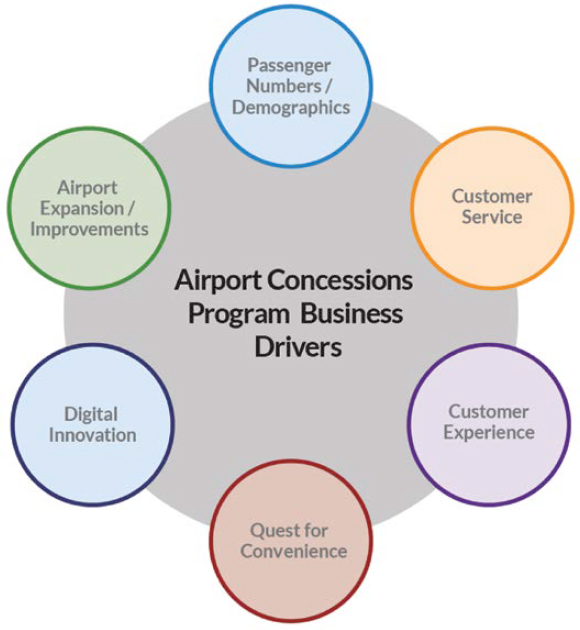
As shown in Figure 3, there are several factors that drive the performance of concessions programs at airports. The foremost of these, as in any other commercial environment, is having strong footfall—in this case, passengers, and, more specifically, enplaning (departing) passengers. The following are the primary business drivers of top-line concessions sales:
Airport expansion/infrastructure improvements. The redevelopment of airports is, in recent times, completed with concessions programming as part of the planner’s thought process. The process often includes concessions planning specialists to allow for the creation of the optimal amount of space in the right places to meet passengers’ demands. Airport expansions also attempt to prioritize concessions locations and often place concessions in centralized neighborhoods where passenger footfall is highest. Unlike what was done in the past, concessions are no longer relegated to the spaces left once holdrooms and restrooms are planned. Infrastructure improvements are increasingly considering back-of-house requirements to allow for future advances in technology solutions for concessions beyond a robust communications infrastructure. The integration of point-of-sale data with the airport revenue management system and the use of a customer relations management (CRM) system to capture passenger trend data are of much interest to airport operators.
Passenger numbers and passenger demographics. Commercial programs benefit from increasing passenger numbers. As more people travel, there is a higher demand for food and beverage, retail, and services within airports, all of which leads to the aforementioned airport expansion requirements. Additionally, different passengers will require different services (see the discussion of passenger personas in Section 4.4).
Customer service. By consistently delivering exceptional service, restaurants and stores increase the number of transactions per customer and extend their value to businesses over time. Paying attention to customer preferences over time permits the retailer and restauranteur to better cater to customers’ needs. A continuous commitment to customer service not only benefits passengers but also affects a brand’s reputation and long-term success.
Customer experience. Creating memorable and outstanding customer experiences leads to enhanced concession sales and customer experiences (Coll 2019). Airports that create pleasant shopping and dining environments with diverse product and restaurant choices that resonate with the airport’s passenger mix and provide convenient services tend to attract more customers, enhance the end-to-end passenger journey—from car park to jet bridge—and boost sales.
Quest for convenience. Passengers have come to want what they want, how they want it, and when they want it. This grew out of experiences during the COVID-19 pandemic when everyone, seemingly at the same moment, realized just how powerful a cell phone or iPad was as a commercial device. It then became expected that all people could receive this level of service and immediate attention in all shopping environments (Future Travel Experience 2022). This sentiment creates a demand for technologies that allow passengers to curate their own experiences.
Suggested Citation:
"2 Business Drivers of Concessions Programs." National Academies of Sciences, Engineering, and Medicine. 2025. Framework and Tools for Incorporating Technologies into Airport In-Terminal Concessions Programs. Washington, DC: The National Academies Press.
doi: 10.17226/29145.
Figure 3. Business drivers of airport concessions programs.
Digital innovation. As airports expand, restaurants and stores are beginning to adopt digital initiatives. These include virtual assistance, virtual queuing at table service concepts, chat-bots, mobile apps, and hyperpersonalized notifications for travelers navigating the airport (Airport Dimensions 2024).
Additional factors that drive concessions businesses include such things as inviting and exciting store and restaurant designs, brand loyalty programs, strong price/value relationships, and customer relationship management (engaging with passengers to understand their needs).
Suggested Citation:
"2 Business Drivers of Concessions Programs." National Academies of Sciences, Engineering, and Medicine. 2025. Framework and Tools for Incorporating Technologies into Airport In-Terminal Concessions Programs. Washington, DC: The National Academies Press.
doi: 10.17226/29145.
Suggested Citation:
"2 Business Drivers of Concessions Programs." National Academies of Sciences, Engineering, and Medicine. 2025. Framework and Tools for Incorporating Technologies into Airport In-Terminal Concessions Programs. Washington, DC: The National Academies Press.
doi: 10.17226/29145.
Sign in to access your saved publications, downloads, and email
preferences.
Former MyNAP users: You'll need to reset your password on your first
login to MyAcademies. Click "Forgot password" below to receive a reset
link via email. Having trouble?
Visit our FAQ page
to contact support.
Members of the National Academy of Sciences, National Academy of
Engineering, or National Academy of Medicine should log in through their
respective Academy portals.
Register
Register
Thank You
Thank You
Thank you for creating a MyAcademies account!
Enjoy free access to thousands of National Academies' publications, a
10% discount off every purchase, and build your personal library.
Forgot Password
Forgot Password
Enter the email address for your MyAcademies (formerly MyNAP) account to
receive password reset instructions.
Reset Requested
Reset Requested
We sent password reset instructions to
your email
. Follow the link in that email to create a new password. Didn't receive
it? Check your spam folder or
contact us
for assistance.
We sent a verification link to your email. Please check your inbox (and
spam folder) and follow the link to verify your email address. If you
did not receive the email, you can request a new verification link below