Framework and Tools for Incorporating Technologies into Airport In-Terminal Concessions Programs (2025)
Chapter: 1 Introduction to the Framework
CHAPTER 1
Introduction to the Framework
The Framework and accompanying Self-Assessment Tool are guides that airports can use to assess the introduction of new technologies into their terminal concessions program. To support the Framework, the subject of this report, the research team developed a self-assessment tool to provide airports with an automated method for determining their maturity level regarding adaptation of technology in an in-terminal concessions program. The Framework and Self-Assessment Tool were written and developed with consideration given to airport and customer requirements and preferences.
1.1 Goal of the Research
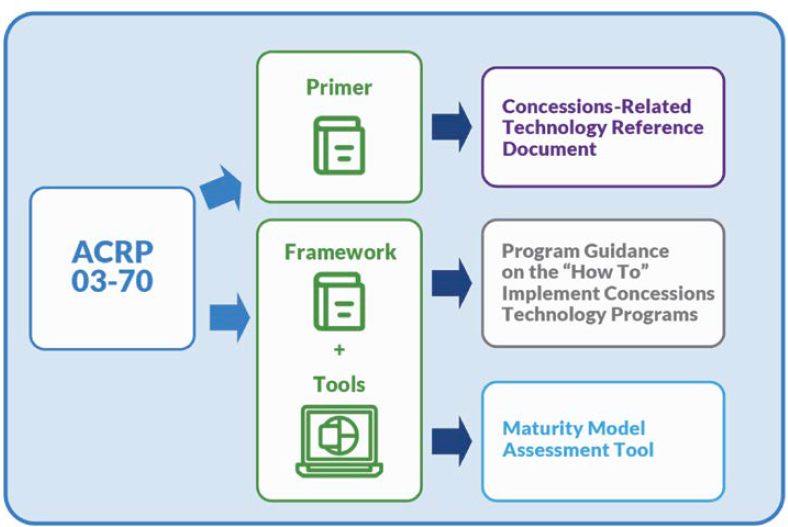
The goal of this research was to develop a Primer, Framework, Self-Assessment Tool, and case studies to help airports identify, evaluate, select, and incorporate appropriate technologies into their in-terminal concessions programs (Figure 1). The Primer is available on the National Academies Press website (nap.nationalacademies.org) by searching for as ACRP Web-Only Document 66: Incorporating Technologies into Airport In-Terminal Concessions Programs: A Primer. With regard to the Framework, the goal was to develop a document and tool that airports could use as a guide to assess the introduction of new technologies into their in-terminal concessions programs.
1.2 Overview
The Framework is presented as a practical, scalable, and adaptable set of guidelines to meet specific airport characteristics (e.g., size, governance) and needs. It addresses program-related topics of consideration relative to airport concessions and technology. These topics, which are referred to here as “challenge areas” or “domain areas,” should be assessed to ensure a successful program.
The Framework addresses not only technology and its application but also how to determine the application of such technology that is best for a specific airport according to several factors, such as the airport’s business model, customer profile, consumer buying habits, technology capacity, and staff skill sets. The recommendations included are based on research performed by the research team and reflect best practices, industry trends, and the team’s personal experience. The Framework is organized as follows:
- Chapter 1: Introduction to the Framework. Chapter 1 provides the reader with an overview of the goal of the research and the Framework and addresses the limitations of the research.
- Chapter 2: Business Drivers of Concessions Program. Chapter 2 provides an overview of the most common business drivers for a concessions program with which a technology program can be aligned.
- Chapter 3: Customer Journey: Application of Technology. Chapter 3 provides an overview of the various applicable technologies directly or indirectly related to airport concessions programs at key touchpoints.
- Chapter 4: Domain Areas to Consider for Successful Program Implementation. Chapter 4 provides the reader with an overview of key challenge areas that should be considered in planning a successful concessions technology program, including applicable program financial analysis to consider when planning a program.
- Chapter 5: Implementation Strategies. Chapter 5 provides an overview of key program implementation strategies, including continuous improvement strategies.
- Chapter 6: Technologies, Interoperability, and Risk Management. Chapter 6 provides an overview of identifying and evaluating emerging technologies for concessions addresses considerations regarding interoperability with existing and future technology infrastructure and discusses program risk management.
- Chapter 7: Self-Assessment Tool. Chapter 7 provides a narrative overview of the Self-Assessment Tool for assisting airports in evaluating their existing maturity model on the basis of the program domain areas discussed in this report.
- Appendices. Appendix A lists the airport codes used in the report, and Appendix B presents a summary of the results of the Air Passenger Survey.
Together with the Self-Assessment Tool, this Framework and the Primer, can assist airports in assessing and planning successful airport concessions technology programs.
1.3 Research Approach and Methodology
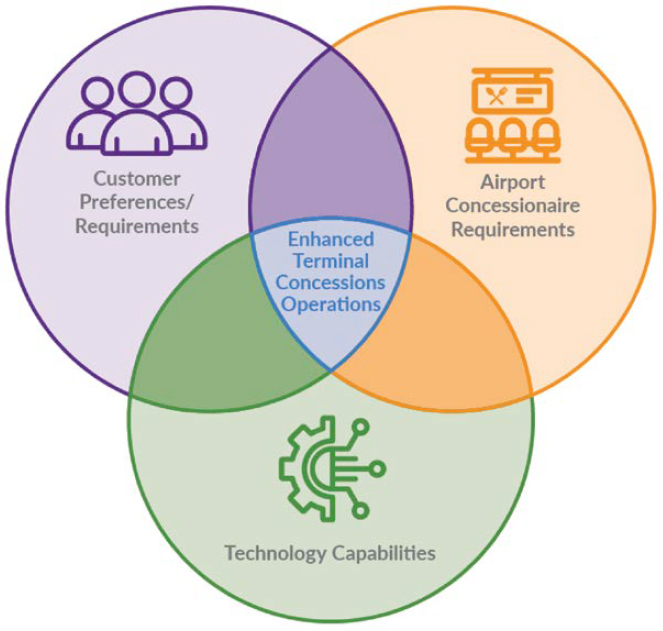
A multifaceted methodology was used to investigate the impact and integration of technology in airport concessions (Figure 2). The research provided a comprehensive perspective on the interplay between technology and airport concessions that fostered a nuanced understanding of their relationship. The research methodology included the following elements:
- Literature review. Before embarking on primary data collection, the research team conducted a comprehensive literature review of more than 75 resources to establish a solid theoretical
- foundation. This review encompassed a wide range of academic and industry publications, focusing on the evolution of airport technology, the dynamics of airport concessions, and the changing patterns of passenger behavior. It provided critical insight into existing studies that helped identify gaps in knowledge to shape the direction of subsequent data collection efforts.
- Airport Passenger Survey. The Airport Passenger Survey was a key component of primary data collection. Data were gathered in fall 2023 from a nonprobability panel of 1,200 individuals who flew at least twice during the past year. This approach ensured a diverse representation of air travelers. The survey captured both quantitative and qualitative data, offering insight into passenger habits, preferences, and experiences. The collected data were weighted to census demographics to enhance their representativeness. To analyze the data, the team utilized advanced statistical techniques in Stata (www.stata.com), including K-means cluster analysis. This method segmented travelers into distinct groups on the basis of shared characteristics and survey responses, which aided in the creation of four high-level traveler personas. These personas provide a nuanced understanding of different traveler types and their behaviors and preferences, especially in relation to airport technology and concessions.
- Interviews with airport and nonairport executives. To complement the Airport Passenger Survey, the research team conducted interviews with executives and managers from airports, concessionaires, and technology sectors globally. These interviews delved into the operational, strategic, and technological aspects of airport concessions. The insights from these interviews were invaluable, in that they offered real-world perspectives on the integration and impact of emerging technologies in airport environments.
- Airport Survey. Airport staff from various airports worldwide, differing in size, passenger volume, and management structure, were invited to participate in the Airport Survey. This survey aimed to gather firsthand information on the adoption, use, and economic impact of innovative technologies within airport in-terminal concessions. The responses provided a wide view of current industry trends, preferences, and perceptions.
More information on the research approach for and outcomes of this project can be found in Technical Report: Research Effort and Results, which is available on the National Academies Press website (nap.nationalacademies.org) by searching for ACRP Research Report 279 and looking under “Resources.”
1.4 Limitations of the Research
Given the smaller sample size used in this research, caution should be exercised in generalizing the results, and care should be taken not to draw conclusions beyond the research sample. This Framework’s commentary on the research is intended to assist the airport industry in understanding how technology can be incorporated into airport concessions. While the commentary cannot be generalized to the entire population of airports, the findings do highlight potential opportunities for airports and are broadly illustrative of different factors that airports can consider when utilizing technology in their concessions operations.
In addition, the research aims to provide an understanding not only of the available technologies, but also of how passengers, airport employees, and concessions operators may use these technologies to gain an understanding of relationships between airports, their stakeholders, and technology. However, the examples cited in the Framework are presented for illustrative purposes only and do not constitute an endorsement for use. Each airport needs to assess its own ability to enhance its technology programs in relation to its concessions programs and passengers.


