Strategies to Improve Pedestrian Safety at Night: A Guide (2025)
Chapter: 2 The Human Factor

CHAPTER 2
The Human Factor
Central to creating a safe system for pedestrians at night are understanding and working with the inherent vulnerability of the human body. Research has demonstrated that speeds of 20 mph or below are slow enough to prevent serious injury or death about 90% of the time, but that injury severity potential increases precipitously as speeds increase (Tefft 2013). This reality is due to the kinetic energy transfer that occurs in a collision, which is exponentially related to the velocity of an object (kinetic energy = 0.5 × mass × velocity2). Slower speeds are critical to lower kinetic energy transfer and safer outcomes.
Many factors influence speed, with transportation operations policies and goals and supporting roadway design being the primary factors. Driver behavior also plays a role, and drivers are themselves strongly influenced by roadway design and operations. Vehicle design is also related to pedestrian injury risk, although in a lower-speed system even higher-risk vehicles—namely, those with taller, boxier hoods—will cause far less injury, in addition to their drivers being more likely to avoid a collision in the first place. Similarly, any pedestrian behaviors or circumstances that may increase pedestrian exposure will be mitigated in a lower-speed environment in which drivers are more likely to expect pedestrians and better able to react in time to avoid a collision. Slower driver speeds and separation in time and space for pedestrians are even more critical at night, when dark conditions impair driver vision (the darkness impairment) and lengthen detection–reaction time. A Safe System Approach helps road users behave safely for themselves and others.
In this vein, the safe road users element of the Safe System Approach intends that road users behave safely and predictably on the roadway, to the best of their ability, supported by roadway operations, design, and policy that recognize that humans are vulnerable and make mistakes (FHWA 2024g). Because different groups are affected differently by transportation decisions, addressing variations between communities can help support this goal. This chapter describes how various factors, including the built environment (e.g., multilane roadway, presence or lack of a sidewalk), socioeconomic circumstances (e.g., lack of access to a car, night shift work), personal vulnerabilities (e.g., poor eyesight, older age), and behaviors (e.g., alcohol consumption, reckless driving), influence driver speed and pedestrian exposure to traffic risk. The chapter provides information on how practitioners can work to address pedestrian safety in darkness in recognition of these factors.
The Built Environmentʼs Influence on Behavior
This section elaborates on how the built environment, including the roadway design, supporting operations, and land use context, influences and creates the foundation for road user—and especially driver—behavior.
Several roadway design and operational elements that communicate and facilitate driver priority are disproportionately associated with pedestrian fatalities in darkness in urban and suburban areas (Sanders et al. 2022). For example, wide, multilane roadways designed for peak hour traffic allow for higher driver speeds, carry large amounts of vehicle traffic, and create long crossings for pedestrians—all of which increase risk for pedestrians seeking to cross the street or walking along the street, especially at night. Irrespective of the number of lanes, streets designed for and posted at higher roadway speeds make it harder for drivers to detect and react in time to avoid a crash and are strongly associated with increased severity of pedestrian injuries. Moreover, roadways designed for higher speeds often see drivers exceeding posted speeds, particularly at night, when drivers cannot see as well or as far and there is less vehicular traffic to help set prudent speeds and act as a barrier (see Figure 6). The risk of pedestrian injury is therefore compounded on roadways with higher design speeds and higher posted speeds.
Long distances between signalized intersections where drivers are required to stop reduce driver expectations of needing to stop or yield and leave pedestrians to choose between walking long distances to a safer crossing or crossing at a more convenient location where risk is higher. Similarly, a lack of safe and convenient pedestrian crossings, both at midblock locations along very long blocks and at unsignalized intersections along major thoroughfares, increases pedestrian risk and decreases driver expectancy for crossing pedestrians. A lack of safe crossing opportunities is particularly harmful in locations with destinations where pedestrians need and want to cross, including near transit stops, grocery stores, housing, and other pedestrian generators and attractors.
Roadway lighting is an important countermeasure to increase pedestrian visibility, but lighting alone is generally insufficient to prevent pedestrian fatalities in the face of other, more auto-dominant (and particularly higher-speed) design elements. Additionally, as Figure 7 shows, roadway lighting that is infrequent, only on one side of the road, behind a crossing, or ill-suited for lighting pedestrians does not serve pedestrians well; lighting needs to be scaled to the environment and provide sufficient coverage so that pedestrians can be detected.
Planning and land use regulations such as zoning and design codes also play an important role in reinforcing the priority of drivers or other roadway users, often to the detriment of people walking. For example, auto-oriented land uses that rely heavily on the roadway design characteristics described previously, communicate that drivers are the expected and priority roadway users, even when pedestrian activity is expected. The research team and other studies found that severe pedestrian crashes are disproportionately located near land uses such as high-density housing, convenience stores, grocery stores, liquor stores, and other pedestrian attractors, even when controlling for roadway type (Ferenchak and Abadi 2021; Lin et al. 2019; Dumbaugh et al. 2023). However, these locations often lack safe and comfortable pedestrian accommodations. The research teamʼs multicity case-control research found that less than 10% of either the locations where a pedestrian had been killed or seriously injured in darkness in the past 5 years or the matched controls had a pedestrian crossing countermeasure, despite the higher-risk nature of the roadways in the study.
Furthermore, this mismatch between pedestrian generators and attractors and lack of pedestrian accommodations is more prevalent in lower-income and BIPOC communities, where people often have less access to a vehicle and may be more likely to work shift work, and where some land uses, such as liquor stores, are disproportionately located (Lee et al. 2020; Sandt et al. 2016). Research has found that people will not walk far out of the way to reach enhanced crossings (Avelar and Cicchino 2024). Thus, roadways with pedestrian generators or attractors need to be designed or retrofitted for safe and convenient pedestrian access so that both drivers and pedestrians can conveniently behave safely within the system. This is especially true for roadways adjacent to transit service and high-density housing, such as large apartment complexes, and roadways that people walking need to use as a result of disconnected network planning.
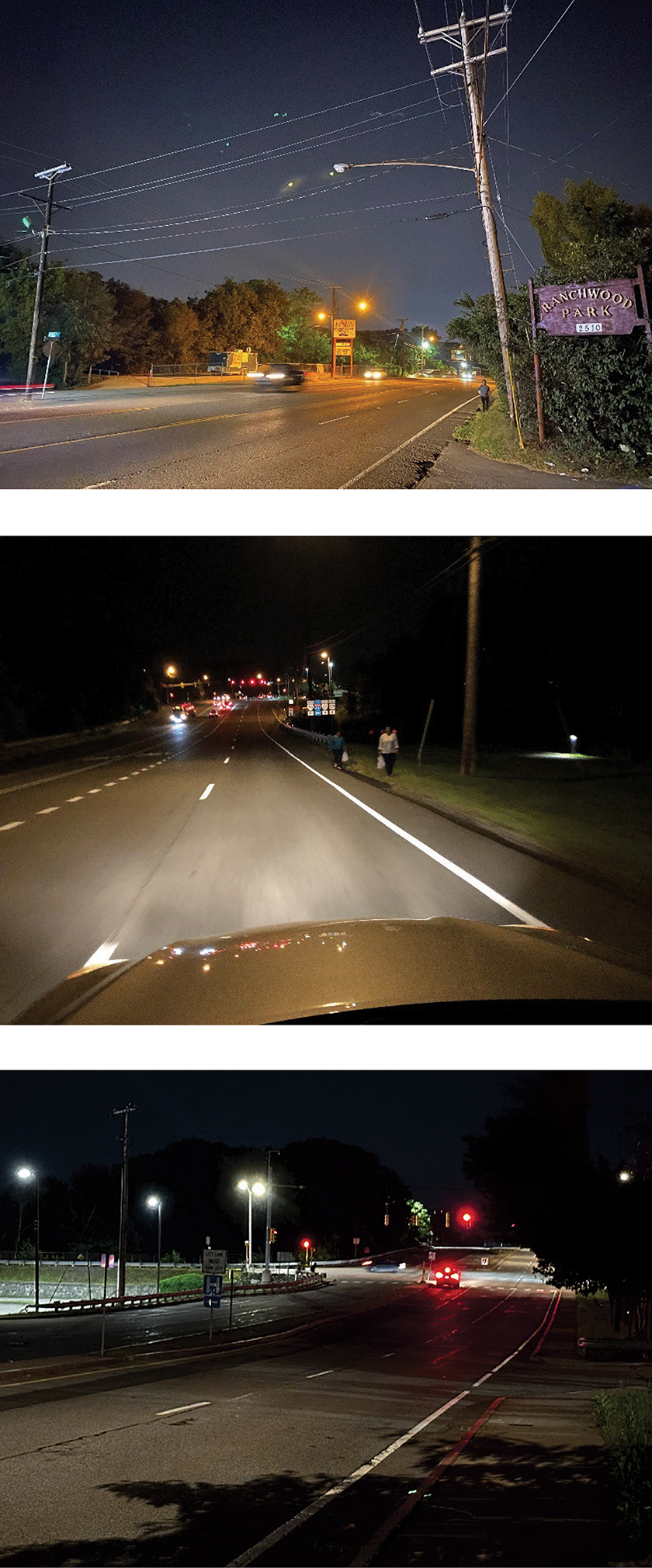
Long Description.
Three nighttime photos of arterial streets show different views of wide, multilane roads with different levels of street lighting. The top image displays a curved road with utility poles and a sign for a local community. The middle photo shows a driverʼs perspective of a dimly lit road with vehicles ahead and sparse roadside lighting. The bottom image features a wider intersection with red traffic lights and some overhead illumination. These images highlight visibility and safety challenges on arterial streets at night.
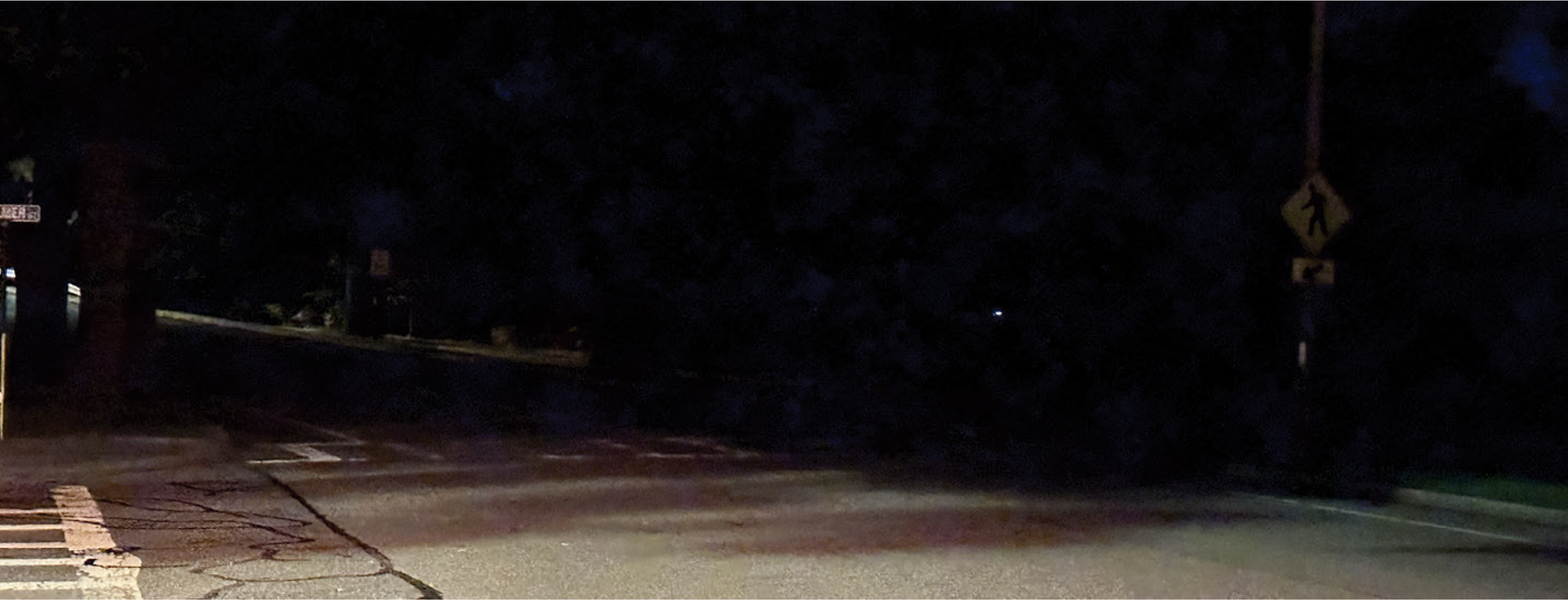
Long Description.
Faint crosswalk markings are visible on the road, but poor lighting hides the surrounding environment. A pedestrian crossing sign with a curved arrow is barely visible on the right side. The background shows trees and street elements blending into the darkness.
Roadway design and operations can also help mitigate the potential for pedestrians in adverse circumstances, whether as the result of impairment, mental health challenges, or other issues, to still be able to safely cross and walk along a street. While the built environment cannot alone address risky road user behaviors such as alcohol or drug impairment, research has found that the design of the environment influences driver behavior, with lower-speed, lower-risk roadways less likely to see speeding or reckless driving.
Research has found that the design of the environment influences driver behavior and that lower-speed, lower-risk roadways are less likely to see speeding or reckless driving.
Longer-term efforts to provide robust transit service will also reduce pedestrian exposure to risk and act as a countermeasure to impaired driving. As depicted in the Safe System Pyramid (Ederer et al. 2023), the built environment and latent safety measures play a crucial role in addressing the pedestrian safety crisis through roadway design and operations and related land use and transit planning that can support efforts at both the base of the pyramid and subsequent levels.
Demographic Factors
 A variety of demographic characteristics, including age, sex, ethnicity, and race, are associated with pedestrian crash risk in darkness. These demographic factors do not directly result in risk. Instead, behaviors, limitations, and environmental conditions that correlate with these demographic factors (e.g., lack of driving experience for young people, disproportionate exposure to higher-risk environments for certain groups) can contribute to dramatic differences in safety outcomes.
Age
Pedestrians between 16 and 64 years of age comprise the majority of victims of fatal and serious injury crashes at night. This group is more likely to be exposed at night because those outside that age range—children and older adults—are less likely to be walking at night. However, disparities exist by age regarding pedestrians and drivers involved in pedestrian fatalities at night. In particular, the research team found that younger people (aged 15 to 34) were more likely to kill pedestrians as drivers than to be killed as pedestrians in darkness (see Figure 8). These findings likely reflect both exposure as well as the reality that younger drivers (aged 15 to 20) have the highest fatal crash rates in the United States, followed by drivers aged 21 to 24 and then by those aged 25 to 34 (Kirley et al. 2023). Younger driversʼ high crash rates likely relate to their limited driving experience and may be related to other factors, such as substance use and distraction, all of which contribute to difficulty driving in dark conditions. At the other end of the age spectrum, older adult drivers have more difficulty detecting people on the street (Owens et al. 2007;
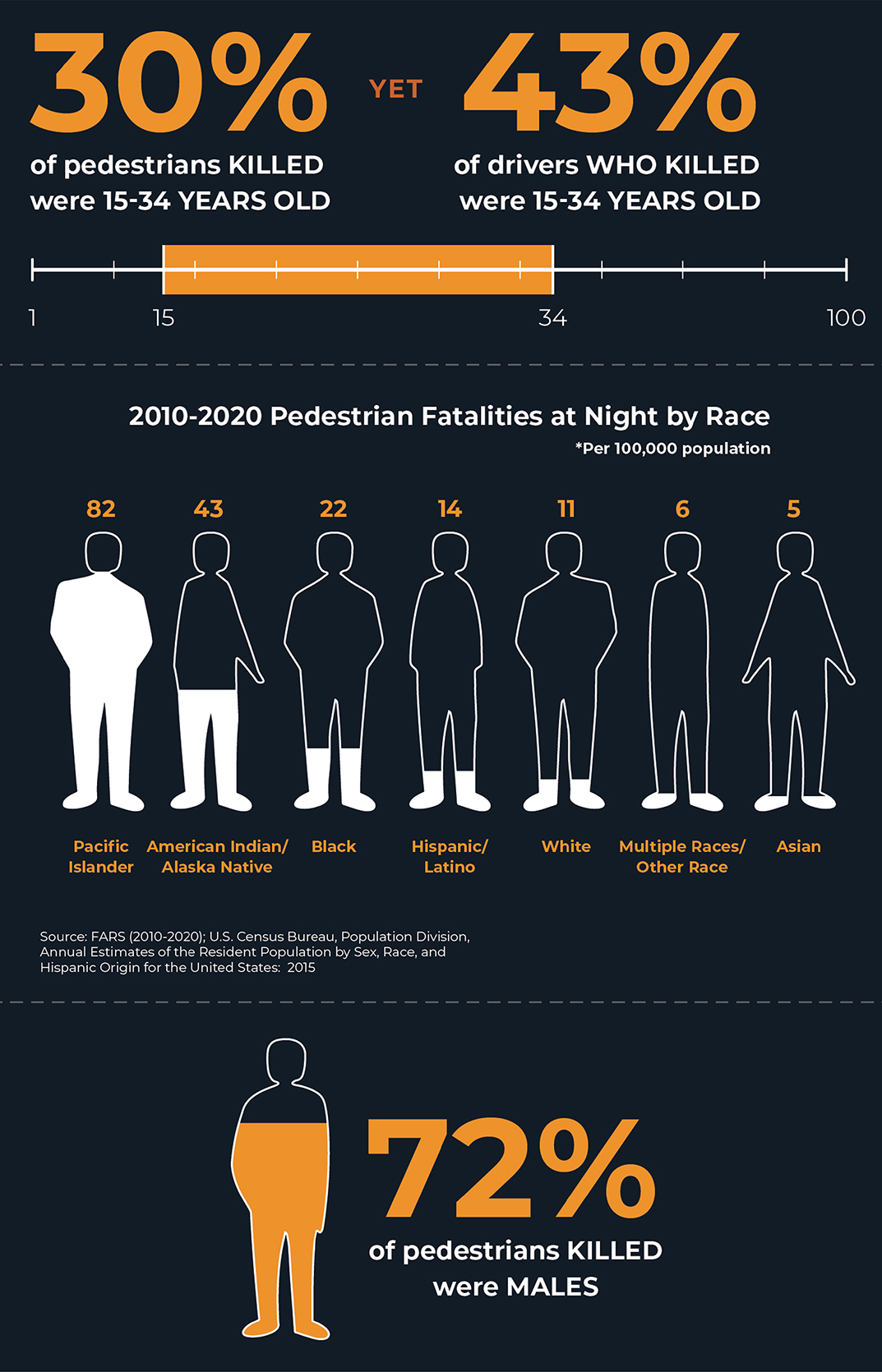
Source: FARS, 2010–2020 (NHTSA n.d.); U.S. Census Bureau 2015.
Long Description.
An illustration shows the demographics of pedestrians killed. The illustration has three sections. The first section shows a scale with the numbers 1, 15, 34, and 100, where the range of 15 to 34 is highlighted. The text reads, “30 percent of pedestrians killed were 15 to 34 years old. Yet 43 percent of drivers who killed were 15 to 34 years old.” The second section is labeled “2010 to 2020 pedestrian fatalities at night by race, per 100,000 population.” They are as follows: Pacific Islander: 82. American Indian or Alaska Native: 43. Black: 22. Hispanic or Latino: 14. White: 11. Multiple races or other race: 6. Asian: 5 [Source: Fatality Analysis Reporting System (2010 to 2020); U. S. Census Bureau, Population Division, Annual Estimates of the Resident Population by Sex, Race, and Hispanic Origin for the United States: 2015]. The third section reads, “72 percent of pedestrians killed were males.”
Tyrrell et al. 2009; Bullough et al. 2012; Sayer and Mefford 2008) and are more affected by glare (Dewar 2016) given that eyesight quality generally declines with age. That said, older drivers may also better understand and acknowledge their limitations and, as a result, actively avoid driving at night or be more cautious when doing so.
Race and Ethnicity
Research has established that pedestrians who are Native American, Black, and Hispanic/Latino are more likely to be killed while walking, especially at night (Long and Ferenchak 2021; Sanders et al. 2022; Dumbaugh et al. 2023; Smart Growth America 2024). Those who are Hispanic/Latino and those who are Native American walk more miles per person than other races except Asian people. Yet, despite Asian people walking more miles per person annually, Native American, Hispanic/Latino, and Black people are more likely to have severe crash outcomes (Raifman and Choma 2022; Sanders and Schneider 2022). Additionally, the research team found that these outcomes differed substantially by race, even among these racial and ethnic groups. While 74% of all pedestrian fatalities between 2010 and 2020 occurred in darkness, during that same time period 86% of Native American pedestrian fatalities occurred in darkness, compared with 80% of Black pedestrian fatalities, 72% of White pedestrian fatalities, 74% of Native Hawaiian/Pacific Islander pedestrian fatalities, and 56% of Asian pedestrian fatalities. Research has often combined data for people who are Asian or Native Hawaiian/Pacific Islander, but the clear differences in the pedestrian safety challenges facing each group on a per capita basis (see Figure 8) suggest that these groups would benefit from being studied separately.
Low-income communities and communities of color often experience poor-quality pedestrian facilities, poor maintenance of facilities, and poor connectedness in the walking network (Gibbs et al. 2012; Thornton et al. 2016). At the same time, past investment decisions often led to high-volume and high-speed arterials in and adjacent to low-income neighborhoods and communities of color, which caused traffic risk to increase due to exposure (Lin et al. 2019). High-speed roadways and a lack of pedestrian accommodations are also common through and around tribal communities. The research for this project found that fatal and severe pedestrian crashes in darkness were disproportionately associated with Black and Hispanic/Latino neighborhoods, even when land use and roadway design characteristics were controlled for. These neighborhoods are also disproportionately likely to be the site of pedestrian fatality hotspots (Schneider et al. 2021).
Even with the lack of a safe built environment, members of BIPOC communities often walk more, which increases their exposure to traffic risk. Black Americans in particular have increased exposure due to lower rates of car ownership, which increases their need to take transit and walk (Brumbaugh 2020). In addition, higher proportions of Black Americans than White Americans work at night, which increases their exposure to risk in darkness (Lieberman et al. 2020).
Investing in pedestrian infrastructure in neighborhoods that lack adequate pedestrian facilities can help reduce the likelihood and severity of crashes.
Two other factors—skin tone and driver behavior—may also contribute to increased fatality risks for BIPOC individuals at night. Studies yield mixed results on the impact of skin tone on conspicuity at night. Driving simulation research conducted for this study found that drivers take longer to detect pedestrians with darker skin in experimental conditions, but other research shows no evidence of skin tone affecting conspicuity in real-world conditions. Driver behavior may play a larger role in driver/pedestrian conflicts in BIPOC communities. Studies conducted in lit conditions showed that drivers were more likely to yield for White pedestrians than Black pedestrians, which resulted in longer wait times for Black pedestrians (Goddard et al. 2015; Coughenour et al. 2017; Kahn et al. 2017). This yielding behavior may lead to greater risk for Black pedestrians in multiple ways, including if they attempt to cross and expect the driver to yield, or if the increased wait time leads them to adopt more aggressive or risky crossing behaviors that may inadvertently increase their risk of a crash or a citation.
People of color and people with low incomes experience higher risk while walking. Investing in pedestrian infrastructure in neighborhoods that lack adequate pedestrian facilities can help reduce the likelihood and severity of crashes.
Sex
Men are more likely than women to be involved in fatal crashes as both drivers and pedestrians, no matter the time of day. The greater likelihood of involvement in fatal pedestrian crashes increases at night, which could be related to exposure. Men may be more likely to be out walking at night than women because they feel safer while doing so, especially in relation to personal security concerns (Chaney et al. 2024). When driving, men are 20% more likely to be involved in a pedestrian fatality at night. This could be a result of a variety of factors. Men typically drive more miles than women and they are more likely to participate in risky driving behaviors, such as driving fast or under the influence of drugs or alcohol (IIHS 2024).
Behavioral Factors
 This research included several focus groups that explored walking and driving behavior in darkness. The focus groups revealed a lack of trust that road users would behave correctly, whether they were driving or walking, thereby creating an unsafe roadway environment. Participants admitted
to behaving in incorrect ways (e.g., speeding, crossing midblock), because they believed they were making decisions that were the safest while accounting for othersʼ unsafe behaviors. This distrust in how the roadway functions can decrease predictability, consistency, and safety. Trust that the system will function as intended and that other roadway users will use the system predictably is essential to creating and maintaining the traffic safety norms that underlie a Safe System. At the same time, because humans make mistakes, it is important for a Safe System to reinforce desired behaviors (e.g., through self-enforcing roadway design and safe, conveniently spaced pedestrian crossings) and to contain elements of redundancy that mitigate the risk of a severe outcome. This section discusses behavioral factors that affect traffic safety to provide insights for practitioners seeking to address risk, enhance traffic safety culture, and create a Safe System. The behaviors discussed in this section could be successfully addressed, at least in part, via safe vehicles that use sensors or other tools to either adapt and respond (e.g., to pedestrian movements) or restrict harmful driver behaviors such as distraction and impairment. Safe vehicles are further discussed in Chapter 4.
Trust that the system will function as intended and that other roadway users will use the system predictably is essential to creating and maintaining the traffic safety norms that underlie a Safe System.
Movement
Pedestrian fatalities at night most often occur at nonintersection locations when pedestrians are crossing the street (Tefft et al. 2021; Sanders et al. 2022) and when pedestrians are traveling in the same direction as drivers (e.g., walking along the roadway) (Sullivan and Flannagan 2011; Hiratsuka et al. 2016). This prevalence differs from daytime crashes, which are more likely to be associated with turning vehicles traveling at slower speeds. The different types of crashes that occur at night need different countermeasures than those used to mitigate daytime crash risk. Whereas daytime countermeasures often focus on areas of high vehicle–pedestrian conflict and turning interventions, nighttime crash types indicate a need for countermeasures that decrease driver speed, increase the visibility of crossing pedestrians, separate pedestrians walking along the roadway from vehicles, and increase driver awareness.
Detection Ability and Perception
Research has shown that pedestrians may overestimate their ability to be seen by drivers (Shinar 1984; Tyrrell et al. 2004; Uttley and Fotios 2017) and have a harder time judging speed and distance of approaching vehicles at night (Balasubramanian and Bhardwaj 2018). In contrast, on the basis of prior experience related to a lack of lighting or general inattentiveness, the focus group participants in this projectʼs research assumed that drivers do not see them walking at night. Either perception (i.e., that pedestrians are more or less visible to drivers) may lead to increased caution for some people but behavioral adaptations for others. Yet when pedestrians cross in ways and places where they are using their own judgement (e.g., midblock when they see a gap in traffic) versus at crossing infrastructure (because they do not believe the driver will see them and react), they may inadvertently increase their traffic risk. If people do not trust crossing infrastructure to guarantee their safety at night because of reduced visibility or past experience with driver noncompliance, additional investment in pedestrian safety could help to create a Safe System.
Misperceptions are not unique to pedestrians—depth perception for motorists is also more challenging at night (and at higher speeds), which leads them to believe that they are farther from a pedestrian than they are (Yu et al. 2019). Drivers in this projectʼs focus groups claimed that they drove slower because of limited visibility so that they would have additional reaction time, if needed. Yet other research has found that drivers do not tend to drive more slowly at night, despite the challenge of reduced visual capacity. Additionally, driversʼ peripheral vision is affected at night, for a variety of reasons. Drivers have reduced detection distance on their side of
the vehicle at night (in the United States, the left side) (Luoma and Penttinen 1998), which makes detecting a pedestrian outside of their direct view even more challenging, especially on wider, multilane roadways. Furthermore, drivers tend to focus on the field of vision directly in front of them and in the range of their headlights at night (Olson et al. 1989). Focus group participants expounded on these factors, describing the need to increase their focus on the roadway at night to watch the lane (or edge) lines and avoid potholes, which can be challenging to see at night.
These research findings underscore that helping drivers understand nighttime limitations to vision and creating a system and traffic safety culture that supports slower driving and driver compliance at night are important areas for additional research and innovation.
High Speeds and Reckless Driving
Speeding and reckless driving have increased in the United States in the past few years (Tefft 2024). However, this research found that pedestrian fatalities at night are less likely to be associated with speeding and reckless driving (as reported in crash reports) than fatalities in the daytime (Sanders et al. 2025). There may be several reasons for this finding, including that it may be more difficult to tell whether someone is speeding in darkness, there may be fewer witnesses, and, in the case of a hit-and-run accident, the driver may never be caught. While addressing speeding and reckless driving is critical for the health of the overall transportation system, driving at high but legal speeds on roads signed at 35, 40, or 45 mph (or higher) creates enough kinetic energy to kill a pedestrian in the event of a collision. Indeed, this research and other studies have found that pedestrian fatalities are significantly more likely to have occurred in darkness than in daylight as posted speed limits increase above just 25 mph (Sanders et al. 2022, 2025). These findings underscore the importance of speed management as part of a Safe System, as described further in Chapter 3.
Driving at high but legal speeds on roads signed at 35, 40, or 45 mph (or higher) creates enough kinetic energy to kill a pedestrian in the event of a collision.
Distraction
Nearly all—97%—of Americans 18 or older own a cell phone, and 93% of those devices are smart phones (Pew Research Center 2024). Distracted driving is a well-known threat to roadway safety. Approximately 8% of fatalities in 2022 involved a known distracted driver, a likely underestimate given known underreporting related to distraction (NCSA 2024a), and one telematics company estimates that 34% of crashes happen within 1 minute of a driver interacting with their phone (Cambridge Mobile Telematics 2023). Even with known risks, people still often hold and use their phones to make a call, send a text, use navigation, or for online access while driving. On average, between 2% and 3% of drivers can be assumed to be manipulating a handheld device at any time, although there are notable differences in this percentage by age group. In 2022, an observational study showed 6.5% of 16- to 24-year-old drivers, 3% of 25- to 69-year-old drivers, and 0.8% of drivers aged 70 or older manipulating a cell phone (NHTSA 2022).
In a driver simulation, young drivers were asked to use their phones in both daytime and nighttime scenarios. The amount that the distracted drivers deviated from the lanes at night was greater than during the day, and distracted drivers were more likely to be driving faster on straightaways and on small-radius curves at night while distracted (Yan et al. 2022). This behavior is noteworthy because younger drivers use their phones while driving at night more than any other age group (Vivoda et al. 2008) and they have a higher probability of being involved in fatal and serious crashes at night. Additionally, vehicles increasingly contain other forms of distraction, such as infotainment systems, that may further distract drivers or create lighting contrasts between the vehicleʼs interior and exterior that negatively affect driver vision in darkness.
Countermeasures that reduce speeds may help decrease the risk of distracted driving because they allow for more reaction time for both the driver and pedestrian. Additionally, factors that
reduce speeds, such as fewer and narrower lanes and speed humps, require drivers to focus more on the roadway, which may decrease their confidence that they can use their phones or other potentially distracting devices when driving.
Impairment
Both pedestrians and drivers are more likely to be under the influence of drugs or alcohol at night. Operating a vehicle while intoxicated is illegal due to the potential harm it can cause. While walking under the influence is not illegal, it becomes more dangerous when the risks of the roadway itself are higher.
In 2021, alcohol impairment was 2.8 times higher in fatal nighttime crashes than fatal daytime crashes (NCSA 2023). In any light condition, alcohol and drugs affect the ability of road users to detect other road users and adequately assess risks. This ability is further decreased at night, when limited light makes visibility a greater issue. Key impairment countermeasures include robust transit service that provides an alternative to impaired driving and ignition interlocks that help prevent impaired driving (Kirley et al. 2023). However, another approach, popularized by Susan P. Baker, founder of the Johns Hopkins Center for Injury Research and Policy, is to design roadways assuming that people who are intoxicated will be using them and that the design will have enough protective factors to keep all users safe (Singer 2022). According to Baker, “The bottom line is if you make this world safe for drunks, you make it safe for everybody. If you focus on making the world safe for the average, reasonably smart, sober person, then the drunks, the sleepyheads, the guy who is worried about his childʼs operation and trying to get home in time for it, it is not going to be safe for them” (Singer 2022, p. 204).
In 2021, alcohol impairment was 2.8 times higher in fatal nighttime crashes than daytime crashes.
This sentiment aligned with findings from the research teamʼs focus groups, in which many participants noted how their walking and driving behaviors changed depending on the type of “entertainment center” or grocery store they were near, especially if there was a possibility of increased alcohol use or inebriation. Participants noted that they drive slower through the parts of town with many alcohol-serving establishments or near college campuses after large sporting events, because they assume that pedestrians have been drinking and may not make safe decisions when crossing the street. They also said that, when walking in these same areas, they assumed that drivers were under the influence and therefore took extra caution. These assumptions have also been shown in research—a study done in Albuquerque, NM, found that pedestrian crashes occurred at a disproportionately high rate (especially at night) in areas around alcohol establishments, followed by restaurants that served alcohol. The fatal and severe crash rates dropped significantly for commercial areas without these alcohol-serving establishments or restaurants and were the lowest in residential areas (Long and Ferenchak 2021).


