Uncrewed Aircraft Systems Operational Capabilities (2025)
Chapter: Appendix D: Stakeholder Feedback Workshop Plan
Appendix D: Stakeholder Feedback Workshop Plan
NCHRP 23-20 GUIDEBOOK FOR IMPLEMENTATION OF UAS OPERATIONAL CAPABILITIES
Stakeholder Feedback Workshop Plan
Prepared for
National Cooperative Highway Research Program
Transportation Research Board
of
The National Academies of Sciences, Engineering, and Medicine
WSP USA
1250 23rd Street NW, Suite 300
Washington, DC 20037
March 2024
Introduction
This document serves as the comprehensive plan that will be used to successfully execute the stakeholder feedback workshop regarding the Draft Guide. This plan provides clear direction with a purpose statement and expected outcomes. The workshop plan also provides the list of invitees, a draft agenda, list of additional materials, and outlines the roles of workshop moderators.
Purpose Statement
The purpose of this workshop is to collect comprehensive feedback on the Draft Guide from a broad range of stakeholders with expertise relating to Unmanned Aircraft Systems and AAM.
Expected Outcomes
Expected outcomes of the stakeholder feedback workshop on the Draft Guide are primarily focused on collecting feedback regarding where clarification is needed, where there is room for improvement, and if the Guide is meeting stakeholder needs.
- Clarification of Content: Stakeholders will be able to gain a clearer understanding of the content, purpose, and scope of the Guide. They will have the opportunity to ask questions and seek clarification on any areas that may be unclear or ambiguous. This in turn provides feedback on sections of the Guide that will need to be adjusted to be clearer.
- Identification of Strengths and Weaknesses: Stakeholders will provide feedback on the strengths and weaknesses of the Draft Guide. This feedback can help identify areas where the Guide is effective and areas where improvements or revisions are needed.
- Insight into Stakeholder Needs: The workshop will provide insight into if the Draft Guide is meeting the needs and priorities of different stakeholders. By soliciting feedback from a diverse group of stakeholders, we can help ensure that the Guide addresses the needs of its intended audience.
- Generation of Ideas for Improvement: Stakeholders may offer suggestions and ideas for improving the Guide. This could include recommendations for additional content, changes to existing content, or adjustments to the structure or format of the Guide.
List of Invitees
Below is the previously panel-approved list of invitees for the workshop.
| Name | Organization |
|---|---|
| Tarek Tabshouri | Caltrans |
| Adam Cohen | UC Berkley |
| Adrienne Lindgren | Supernal |
| Chris Starr | Tennessee DOT |
| Clint Harper | NASA |
| David Gallagher | Ohio DOT |
| Jason Leavitt | New Hampshire DOT |
| Joe Burgett | Clemson University |
| Jon Starr | Nebraska DOT |
| Name | Organization |
|---|---|
| Linn Smith | Michigan DOT |
| Marisa Walker | Arizona DOT |
| Paul Snyder | University of North Dakota |
| Riley Beaman | North Carolina DOT |
| Chris Bailey | Massachusetts DOT |
| Sergio Roman | Texas DOT |
Draft Agenda
The following draft agenda has been developed and is in the process of being finalized, as always, panel feedback is greatly appreciated.
Stakeholder Feedback Workshop Draft Agenda
May 21, 2024
8:00 AM - 4:30 PM
Keck Center, Room 106
600 5th Street NW, Washington, DC
| A. Welcome and Introductions | 8:00 AM – 8:30 AM |
B. Project Overview
|
8:30 AM – 8:50 AM |
| C. Industry and Technology Trends & Use Cases and Applications for UAS/AAM | 8:50 AM – 9:20 AM |
|
|
D. Impact and Opportunity Evaluations
|
9:20 AM – 10:05 AM |
| E. Break | 10:05 AM – 10:20 AM |
|
|
F. Framework and Tools for Coordinating Resources
|
10:20 AM – 11:05 AM |
G. Funding Considerations
|
11:05 AM – 12:00 PM |
|
|
H. Lunch
|
12:00 PM – 1:00 PM |
I. Outreach and Collaboration Strategies
|
1:00 PM – 1:45 PM |
| J. Roles and Responsibilities | 1:45 PM – 2:45 PM |
K. Break
|
2:45 PM – 3:00 PM |
| L. Workforce Qualifications and Training | 3:00 PM – 3:45 PM |
M. Takeaways & Next Steps
|
3:45 PM – 4:30 PM |
| N. Adjourn |
Workshop Materials
The project team is highly experienced in conducting impactful workshops and will come prepared with the following workshop materials that will contribute to successfully collecting feedback on the Draft Guide.
- Hard copies of the Draft Guide
- Exhibits summarizing sections of the Guide accompanied with question prompts
- Nametags
- Hard copies of the agenda
- Sign-in sheets
- Feedback forms
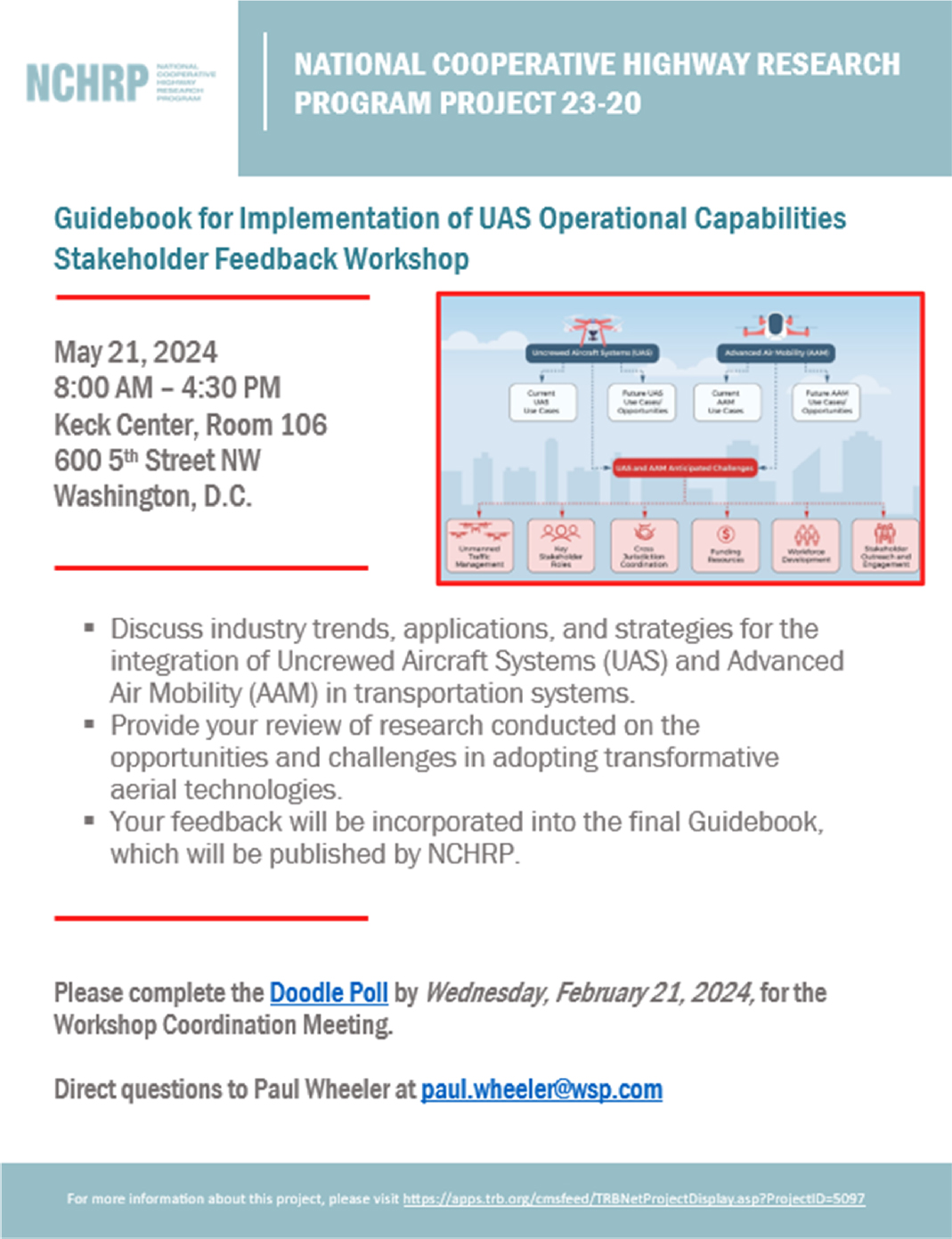
Other materials that have been used thus far in the workshop planning was the previously panel-approved workshop flyer included below:
Workshop Moderator Roles
There will be three workshop moderators there who will each play a crucial role in facilitating productive and meaningful discussions during the stakeholder feedback workshop. Paul Wheeler, PI, will serve as the lead moderator with two supporting moderators. Moderator roles involve various tasks and responsibilities aimed at ensuring that the workshop achieves its objectives effectively.
- Setting the Agenda: The moderators are serving as the workshop organizers to develop the workshop agenda. They determine the sequence of activities, allocate time for each agenda item, and ensure that the agenda aligns with the workshop's purpose and objectives.
- Facilitation of Discussions: Moderators are responsible for guiding discussions during the workshop. They ensure that conversations stay on topic, relevant to the objectives of collecting feedback on the Draft Guide, and respectful of all participants' perspectives.
- Creating a Safe Environment: Moderators foster an inclusive and safe environment where all stakeholders feel comfortable in openly sharing their thoughts, ideas, and concerns. They set ground rules for respectful communication and manage any conflicts that may arise during the workshop. Moderators will also facilitate various ways to provide feedback, allowing for participants to share their thoughts in ways they feel most comfortable.
- Encouraging Participation: Moderators actively encourage participation from all stakeholders, ensuring that everyone has an opportunity to contribute to the discussion. They may employ various techniques, such as asking open-ended questions, using interactive activities, and inviting quieter participants to share their perspectives.
- Managing Time: Moderators are responsible for managing time effectively during the workshop. They will keep discussions on track, ensure that agenda items are covered within the allocated timeframes, and adjust the agenda as needed to accommodate unforeseen circumstances.
- Soliciting Feedback: Moderators facilitate the opportunity to provide feedback and input on the topics under discussion. They ensure that feedback is captured accurately and encourage stakeholders to express both positive feedback and constructive criticism. Moderators will be taking notes throughout the workshop sessions to capture the feedback being provided, other means of feedback collection may be used such as polling or activities.
- Summarizing Discussions: Moderators summarize key points and themes that emerge during the workshop discussions. They highlight areas of consensus, identify areas of disagreement, and capture action items or next steps that need to be addressed after the workshop.
Overall, workshop moderators play a pivotal role in creating an engaging and productive environment where stakeholders can collaborate, share insights, and provide constructive feedback on the Draft Guide. Their effective facilitation helps to maximize the value of the workshop and promote meaningful outcomes for all participants.


