Innovating Scholarship of Teaching and Learning in Health Professions Education: Proceedings of a Workshop (2025)
Chapter: 4 Closing Session
4
Closing Session
Frost welcomed participants to the closing session of the workshop series, thanking sponsors, partners, and the planning committee. She introduced Dunleavy to provide an overview of the activities. Dunleavy reminded participants of the objective of the series, which was “to bring forth the critical value of the Scholarship of Teaching and Learning (SOTL) for health professions’ workforce development and patient outcomes by exploring what is unique about SOTL in the health professions from education to practice.” The preworkshop session, focus groups, and author videos informed the main workshop, which was attended by over 900 people both in person and virtually. The interest in the workshop illustrates the importance of the topic of SOTL across multiple countries and disciplines, said Dunleavy.
In the preworkshop session, speakers and participants discussed the origin and evolution of SOTL, including the historical works of Boyer, Glassick, and Shulman. The first panel covered a number of topics, said Dunleavy, with an emphasis on the scholarship to scholarly teaching continuum, value of faculty development for understanding and implementing SOTL, importance of grounding teaching practices in evidence and theories, and potential to use new methods and technologies for both teaching and dissemination of SOTL. Online participants added to the discussion by suggesting an examination of current trends in education, outcomes, and unintended consequences rather than simply adopting practices because they are the “newest and best.” Preworkshop participants were asked to identify critical priorities for building SOTL value and innovation, said Dunleavy, and based on that input, she extracted four areas: professional development, funding, promotion and
tenure, and outcome measures. Dunleavy also shared comments from the focus groups held in September. One of the main takeaway messages for her was the importance of elevating SOTL to be accepted as equal to other forms of research. Individual focus group participants also commented on how to structure SOTL to be responsive to changes in health professional education (HPE) and health care, the value of using and developing evidence-based teaching strategies, and the obligation to consider patient outcomes and societal impact along with student learning outcomes.
Huang gave an overview of the presentations and discussions at the main workshop. The ultimate goal of SOTL is to improve the health of patients and society, she said, requiring SOTL to be grounded in strong evidence and to effect practice change (see Figure 4-1). The first speaker, Chen, emphasized the value of shifting away from the biomedical paradigm and embracing the “messiness” of SOTL. Rather than looking for hard clinical outcomes in tightly controlled environments, SOTL uses systematic observation and replication and looks for outcomes that are educationally sensitive. Instead of randomized controlled trials (RCTs) and an emphasis on the rigor of evaluation, said Huang, SOTL leans on social science methods and values innovation and experimentation.
Workshop participants engaged in discussion on augmenting the value of HPE SOTL, said Huang, and covered a number of potential activities in different areas. Expanding and embedding SOTL within HPE may require the following:
- Skill development, including training, mentorship, and formal professional development;
- Advocacy for SOTL and widespread recognition of its value;
- Guidelines for evaluating SOTL work for promotion and tenure;
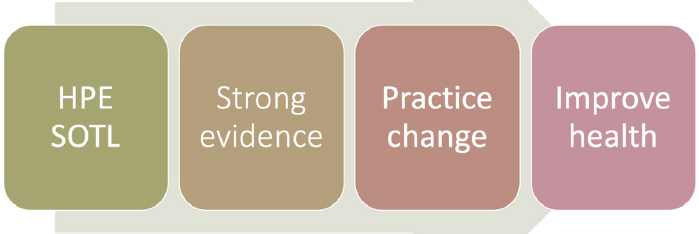
NOTE: HPE = health professional education; SOTL = Scholarship of Teaching and Learning.
SOURCE: Presented by Grace Huang on October 24, 2024.
- Interprofessional and interdisciplinary collaboration and communities of practice; and
- Support structures, funding, infrastructure, and resources.
The second day of the workshop focused on innovation in HPE SOTL, said Huang. After a presentation by O’Sullivan to lay the foundation, participants engaged in a group activity to brainstorm how to leverage innovations in SOTL to facilitate change. Some of the innovations that were identified included the following:
- Leveraging learning hubs to connect across professions and institutions,
- Developing SOTL faculty competencies and accreditation standards,
- Using electronic health record data to measure impact of SOTL,
- Leveraging technology to create individualized learning journeys, and
- Using artificial intelligence for foundational HPE training.
Huang shared a quote from an online participant, which she said summed up the message of the workshop: “Educate academic leaders about the validity and importance of SOTL and give researchers the support needed to do the work.” To advance HPE SOTL, said Huang, we must connect HPE with SOTL; this is a simple yet critical proposition for improving health outcomes.
DEFINING MECHANISMS FOR FACULTY DEVELOPMENT
From Jeffries’s perspective, one of the major points taken from the workshop series was the importance of faculty development for HPE SOTL. Jeffries reviewed the conversations on this topic and presented her six specific mechanisms that could leverage it. First, institutions could align their missions with the tenets of SOTL. Jeffries suggested that professional and health care organizations and academic institutions could offer grant funding for SOTL projects that are cross disciplinary and collaborative. Second, faculty could participate in team projects that bring together experts in HPE and experts in SOTL to develop initiatives to improve learning and outcomes. Third, faculty could consider longitudinal projects that evaluate new approaches for education in HPE by collecting data throughout the educational journey and post-graduation. Fourth, faculty development could happen via identifying resources and mentors in other departments and across professions. Jeffries noted the shared core competencies among different HPE disciplines, and faculty could work together across professions on SOTL projects related to these. Fifth, faculty could participate in community of practice activities, such
as brown bag discussions and group projects, so that interested faculty could share ideas, disseminate innovations, and develop projects. Such a community could be convened virtually, said Jeffries, to allow for participation of a broad group. Finally, faculty could seek out mentors and opportunities in professional associations and in other disciplines. Jeffries suggested that an organization could put out a call for SOTL mentors who could form a group to help others understand SOTL and promote SOTL opportunities.
ELEVATING HPE SOTL
To bring together all the input and discussions from the preworkshop session, focus groups, author videos, workshop, and online comments, Jensen, Huang, Nunez, and Okuda each described ideas that they believed would help elevate and progress HPE SOTL (see Box 4-1).
BOX 4-1
Highlights from the Presentations of Individual Speakers on Progressing Health Professions Education on the Scholarship of Teaching and Learning (HPE SOTL)
- Develop strategies that can address and overcome barriers to systemic change given the complexities of HPE SOTL, including professional silos, lack of widespread understanding, limited resources, and challenges in conducting research. (Jensen)
- Craft consensus-based guidelines for promotion and tenure committees and institutions on how to recognize the quality, value, and scholarly impact. (Jensen)
- Make a compelling case for the value of HPE SOTL within institutions and across professions that can be shared broadly as a unified message to disseminate information on and about it to stakeholders. (Huang)
- Create communities of practice and faculty development supports within institutions and professional associations and across interprofessional and global boundaries. (Nunez)
- Identify methods to support alternative forms of high-quality dissemination, such as blogs, media, and online materials. (Okuda)
- Generate strategies to create new funding mechanisms and infrastructure support for SOTL within and across institutions and professions. (Okuda)
- Explore creating a national center on SOTL or institute on development of teaching and learning and SOTL in HPE. (Nunez)
This list is the rapporteurs’ summary of points made by the individual speakers identified, and the statements have not been endorsed or verified by the National Academies of Sciences, Engineering, and Medicine. They are not intended to reflect a consensus among workshop participants.
Strategies to Addressing and Overcoming Barriers
Jensen led off with her ideas for developing strategies to address and overcome barriers to systemic change given the complexities of HPE SOTL, including professional silos, lack of widespread understanding, limited resources, and challenges in conducting research. She noted the lack of knowledge and understanding of SOTL, which impacts decision making and limits coordination and collaboration. This is the place to start in addressing the barriers to systemic change, she said, because knowledge and understanding are foundational steps for addressing any of the other barriers. To begin improving both, HPE professionals would need to work as a team with other stakeholders, including experts from within their own discipline, across the health professions, and in areas such as psychology, sociology, and education. “HPE SOTL is a team sport” and requires interprofessional partnership and collaboration, said Jensen. Those who have expertise in SOTL can partner with those who lack knowledge to share skills, learn, and publish, and communities of practice can cross disciplinary boundaries. Working within professional silos can result in incremental change, Jensen explained, but major systemic change will require all health professions to work together.
Developing Consensus-Based Guidelines for Promotion and Tenure
Her second idea for progressing HPE SOTL would be to develop consensus-based guidelines for promotion and tenure committees and institutions on how to recognize its quality, value, and scholarly impact. Promotion and tenure decisions often focus on quantity rather than quality, said Jensen, and lack an understanding of SOTL and what comprises quality SOTL work. To facilitate a shift, Jensen believes it is imperative to make the case that SOTL prepares future health professionals to provide safer, more effective, and more efficient care to patients. This will require evidence about the relationship between SOTL and patient outcomes, which is unlikely to come from RCTs; borrowing designs and methodologies from social science or implementation science can help generate quality evidence. Finally, said Jensen, shifting the way that promotion and tenure committees think about SOTL will require a culture change. Guidelines and formal rules are not sufficient; faculty and peers have to understand the importance of SOTL and embed it in their work. “The need to train learners and faculty is essential to get strong HPE SOTL promotion and tenure guidelines,” said Jensen.
Making a Compelling Case for the Value of HPE SOTL
A third suggestion for progressing HPE SOTL came from Huang, who said to make a compelling case for its value within institutions and across
professions that can be shared broadly as a unified message to disseminate information on and about it to stakeholders. Huang reflected on the many attendees at the workshop, representing learners, faculty, institutional leaders, patients, and society, who could benefit from learning about the value of HPE SOTL. While it may seem obvious that SOTL and quality teaching are necessary for quality health care, she said, there are a number of reasons why it is still necessary to argue for it. First, quality health care is taken for granted in some settings and not accessible in others. Second, health care is under threat due to issues such as unaffordability, health disparities, destabilization of the industry, and high operational and labor costs. Third, the stakes for individuals and public health are enormous—and universal. Finally, achieving quality, equitable health care is dependent on high-quality, evidence-based, disseminated training practices for health professionals. Huang emphasized that the message supporting HPE SOTL would ideally be unified across often-siloed HPE disciplines and that collective efforts would lead to a higher impact. Huang identified a number of potential activities that she believed would elevate and progress HPE SOTL:
- Simultaneously published journal editorials on it across health professions,
- A widely disseminated white paper written by a reputable supra-health professions entity,
- An interprofessional or interdisciplinary consensus statement posted on or linked from professional organizations’ websites,
- Infographic campaigns in advance of a major proposal or SOTL event, and
- Distribution of a memorable framework that serves as a typology of the SOTL business case for all health professions to refer to.
Creating Communities of Practice and Faculty Development Supports
The fourth idea was presented by Nunez, who suggested creating communities of practice and faculty development supports for HPE SOTL within institutions, within professional associations, and across interprofessional and global boundaries. The former, said Nunez, are typically intimate groups of faculty who meet a few times each semester to talk about teaching and learning best practices and challenges. These groups offer a unique faculty development opportunity by facilitating peer-to-peer learning and knowledge sharing among individuals with common interests or needs. They allow participants to solve problems, compare best practices, and collectively improve their skills by leveraging and sharing their different experiences and perspectives within a supportive environment. Those who could participate and benefit regarding SOTL include faculty, staff,
postdocs, and graduate students. One important aspect of a community of practice, said Nunez, is the participation of both subject-matter experts and novices to allow for shared learning opportunities.
Several initiatives could be duplicated, scaled up, or enhanced to create communities of practice for SOTL, added Nunez. These include programs within institutions, such as centers for teaching and learning, and SOTL mentorship programs (e.g., Georgia Southern University SOTL Mentorship Program). Professional associations have initiatives such as special interest groups, communities of practice, and learning communities. For example, said Nunez, the American Speech–Language–Hearing Association (ASHA) Learning Community for Teaching Foundational Communication Sciences was a program that combined a symposium on evidence-based educational practices with a year-long community of practice for participants to discuss and share their experiences implementing what they learned at it. Across professions, associations, and institutions, collaborations such as the Grant Writing and Mentorship in Education Research program exist. This program, Nunez explained, was started by the American Physical Therapy Association and its affiliated education and research organizations. After a few years, it became an interdisciplinary effort by adding the American Occupational Therapy Association and ASHA. At the first interprofessional workshop, 21 participants across the three professions received feedback and mentoring on their proposed research education projects and grants. By expanding or leveraging such initiatives, stakeholders can create communities of practice to build SOTL support, value, and innovation, said Nunez.
Supporting Alternative Forms of High-Quality Dissemination
Okuda described a fifth idea, identifying methods to support alternative forms of high-quality dissemination (e.g., blogs, media, online materials). A lot of great educational researchers are doing great work that often does not get disseminated to the end user who needs it, Okuda noted. In part, this is because SOTL research is disseminated to and consumed by other SOTL researchers rather than the health professions educators who could implement it. In addition, said Okuda, a lot of the information that is widely available in nontraditional forms (e.g., online) is not high quality. “High-quality dissemination requires high-quality work to disseminate,” he said. A perennial challenge, however, is achieving this with limited time and money. Okuda suggested that with limited resources, it may be appropriate to use outcome measures that look at incremental steps rather than trying to demonstrate the full impact from education to population health in one article. He noted that interprofessional education (IPE) has faced a similar challenge of being asked to prove that it has an eventual impact on patient care. A collection of high-quality research that demonstrates
impact on a smaller scale can eventually add up to showing large-scale impact, said Okuda. These incremental studies, however, may not be able to be published in peer-reviewed journals. Okuda encouraged researchers to use nontraditional means to get their findings out in “bite-size” pieces that are understandable and implementable by educators. It is important to strike a balance between providing information that is sufficient to make the work scholarly and potentially replicable by other educators but not so overwhelming that it is not picked up by busy health professionals and educators. Quality is at the foundation of any valuable research material, whether it is disseminated through a traditional article, or a blog, newsletter, or podcast. “Without quality,” said Okuda, “the choice of dissemination routes is really not important.”
Creating New Funding Mechanisms and Infrastructure Support
The sixth suggestion was also presented by Okuda and involved generating strategies to create new funding mechanisms and infrastructure support for SOTL within and across institutions and professions. The strategy for creating new funding mechanisms begins with building a business case, said Okuda. Ideally, all the stakeholders for HPE SOTL—faculty, learners, leaders, and patients—would buy into its value. However, it is important for people to see the direct benefits, or the likelihood of engaging is severely diminished, he said. For faculty, the benefits of SOTL might be more effective teaching methods that improve student learning. For students, it could lead to higher grades and improved competency. For leadership and institutions, embracing it could bring about diminished staff turnover, less stress and burnout, and higher student satisfaction. “It is up to each one of us,” said Okuda, to identify key players and find ways to demonstrate the value of SOTL for each person. Funding will follow if leaders are convinced of the value and return on investment (ROI). He shared an example from a colleague who used the Philips model to prove the business case for funding simulation-based central line training (Barsuk et al., 2020). Because he demonstrated the ROI of the training, leaders advocated to secure funding to maintain the simulation center. Similarly, getting funding for SOTL will require demonstration of the value for each party involved and the ROI for those making financial decisions. Okuda noted that demonstrating ROI can be challenging when there is a lot of space between the initiative or intervention and the eventual outcome and said that the closer the intervention is to patient outcomes, the easier it is to demonstrate ROI.
Nunez presented the seventh and final suggestion: exploring the creation of a national center on SOTL or institute on development of teaching and learning and SOTL in HPE. The former is a “moonshot,” acknowledged
Nunez, but a model can help identify a pathway. Two organizations for IPE, the National Center for Interprofessional Practice and Education and the Global Confederation for Interprofessional Education and Collaborative Practice, were created after a years-long process that brought together key individuals and groups and leveraged existing resources. Nunez shared the time line of the process for IPE as an example of how a similar journey for SOTL could proceed. An early step was creating a national framework and common language across health professions; efforts of the World Health Organization and the forum helped to accomplish this. Next, institutional or regional exemplars of IPE excellence were identified and shared as approaches that could be duplicated or scaled up, said Nunez. Core competencies were developed, and interprofessional conferences were held at the institutional, regional, national, and international levels. These efforts culminated in creating both national and global centers for IPE, which serve as change leaders to advance best practices, teaching and learning, scholarship, and advocacy across institutions as well as across nations. “What was a moonshot for IPE ultimately became a reality,” said Nunez, and a similar path could be explored to achieve the moonshot for an HPE SOTL national center. She urged stakeholders to consider what is already in place for SOTL, collaborate and coalesce their efforts, and identify potential next steps to build momentum toward achieving a national or international center on SOTL.
Perspectives on HPE SOTL Priorities
Dunleavy moderated a roundtable discussion with the speakers. A number of very thought-provoking options were presented, she said, before asking each presenter to share one or two of their highest priorities.
As dean of a nursing school, Jeffries said that she intends to promote more faculty development and create a community of practice for SOTL. It would not be restricted to her school, she said, but would include participants from across HPE and other schools at Vanderbilt to break down silos and promote faculty development. Jeffries noted that, as dean, she can advocate for SOTL and fund pilot projects. She encouraged workshop attendees to go to their leaders and administrators and ask how they can help incentivize HPE SOTL.
At ASHA, said Nunez, a critical priority is to expand the visibility and value of SOTL via the research and publishing mechanisms that are available. For example, she said, the association’s journal could issue calls for papers on SOTL so that readers can see that it has a place and is valued. The journal could also name section editors in HPE SOTL to demonstrate the editorial board’s experience and explicitly signal what is welcome in the journal. Finally, said Nunez, the association could work closely with SOTL
authors to help them with disseminating their work through other means, such as podcasts, and coordinate that with publication.
From the perspective of simulation-based education, Okuda said that a major priority will be identifying the best practices to implement, translating these into learner and patient outcomes, and disseminating this knowledge through avenues beyond traditional journals. Okuda and his colleagues in simulation education train people to advocate for its impact on learner outcomes and patient safety outcomes. In addition, they partner with like-minded organizations to advocate to broader organizations of influence (e.g., accreditors) and advocate to Congress about the importance of funding to support training and education. A health care workforce shortage is looming, especially in nursing, said Okuda, and using evidence-based simulations can make education more effective and efficient and ultimately impact patient outcomes.
As editor in chief of the open access journal MedEdPORTAL, Huang said that the workshop discussions reaffirmed its work. The journal has a “critical duality” of scholarship and dissemination and pushes scholars to truly add to the literature with innovative work. The workshop also affirmed that citations and other bibliometrics for journals do not tell the whole story about impact, she said. A priority would be to continue the good work of the journal in spreading the word and modeling HPE SOTL. Huang added that the workshop—and in particular the ideas of her colleagues on how to elevate and progress HPE SOTL (see Box 4-1)—influenced her identity as an educational researcher and her goal of doing work that demonstrates rigor. In her role as a faculty affairs leader talking with promotion and tenure committees, Huang said, she has a responsibility to share with others what makes SOTL unique and how to evaluate rigor, impact, and quality. Finally, on a personal level, Huang said that the workshop reminded her of the importance of bringing quality, evidence-based practices to the teaching and training of each individual learner in front of her.
CLOSING REMARKS
Huang encouraged workshop participants to “shout from the rooftops” about how HPE SOTL can improve learner outcomes and patient health. Okuda added that it is vital for people to talk about and advocate for SOTL within their own professional organizations. Many people still do not understand it, he said, and until they do, it will not make the impact that it could. Use your positions of leadership to “spread the word,” said Okuda. Nunez reiterated that good work has been done in HPE SOTL but said that it is critical to build on it, strengthen it, and advocate for it. The discussions and the ideas for how to elevate and progress HPE SOTL
stemming from this workshop series will help participants go back to their own institutions and play a role in advancing SOTL, she said.
Dunleavy thanked the workshop planning committee and participants and said that the energy around the workshop illustrates that people have a desire to move SOTL forward in HPE. Frost added her thanks to the planning committee and adjourned the workshop.
This page intentionally left blank.


