Emerging Hazards in Commercial Aviation—Report 2: Ensuring Safety During Transformative Changes (2024)
Chapter: Appendix A: Case Study Highlighting the Many Considerations in Defining and Implementing General Flight and Operating Rules
Appendix A
Case Study Highlighting the Many Considerations in Defining and Implementing General Flight and Operating Rules
To illustrate the many aspects of defining and implementing general flight and operating rules, consider the specifications for a Category II or III instrument approach to land as reflected in the regulations, corresponding specifications to pilots and air traffic controllers, and corresponding practices for defining routes of flight, approach paths, and many other aspects of airports. 14 CFR §91.175 Take-off and landing under IFR [Instrument Flight Rules]1 specifies that each person operating the aircraft must use a standard instrument approach procedures as defined in published charts, lists the required components required onboard and on the ground as part of an Instrument Landing System (ILS) and specifies the weather minimums in terms of visibility and runway visibility range (RVR) in which these approaches may be conducted. The regulation also authorizes the decision altitude or decision height [above ground] (DA/DH) beyond which the flight crew may continue the flight based on instruments alone, and specifies the conditions required for the flight crew to continue the approach beyond DA/DH, as highlighted in Box A-1.
This is further detailed from the pilot’s point of view in Aeronautical Information Manual (AIM)2 section 5-4-7 Instrument Approach Procedures, which refers to 14 CFR §91.175 and then elaborates on aircraft-specific aspects of the operation, including approach speeds, maneuvering considerations for bank angle, correcting for wind and pilot technique,
___________________
1 See https://www.ecfr.gov/current/title-14/chapter-I/subchapter-F/part-91/subpart-B/subject-group-ECFRef6e8c57f580cfd/section-91.175.
2 See https://www.faa.gov/air_traffic/publications/atpubs/aim_html.
BOX A-1
Regulations Governing Visual Reference Criteria by Which Pilots May Continue an Instrument Landing Approach Below Decision Altitude/Decision Height
(3) Except for a Category II or Category III approach where any necessary visual reference requirements are specified by the Administrator, at least one of the following visual references for the intended runway is distinctly visible and identifiable to the pilot:
- The approach light system, except that the pilot may not descend below 100 feet above the touchdown zone elevation using the approach lights as a reference unless the red terminating bars or the red side row bars are also distinctly visible and identifiable.
- The threshold.
- The threshold markings.
- The threshold lights. (v) The runway end identifier lights.
- The visual glideslope indicator. (vii) The touchdown zone or touchdown zone markings.
- The touchdown zone lights.
- The runway or runway markings.
- The runway lights.
SOURCE: 14 CFR §91.175.
rate of descent, and how to expect air traffic control to specify the name of the instrument approach procedure and provide clearance to conduct the approach.
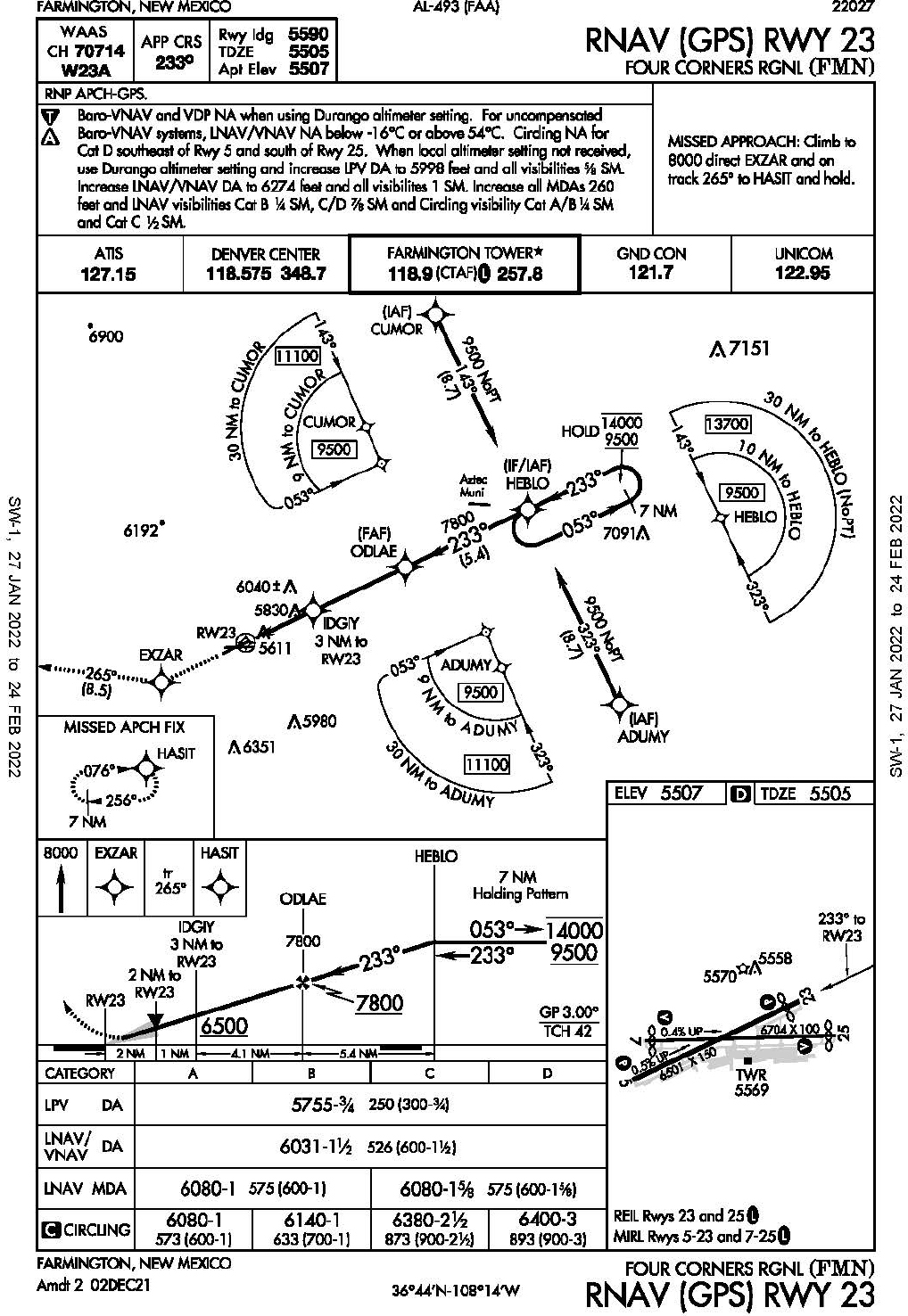
Many of these aspects are also shown in the Instrument Approach Plate for the approach, an example of which is provided in Figure A-1. The approach plate for an approach specifies its routes of flight and vertical profiles, which have been carefully vetted from the perspective of safety (e.g., terrain avoidance) as well as potentially reflecting community concerns such as flight paths mitigating community noise exposure. Pilots are expected to have in front of them the appropriate instrument approach plate throughout the approach, as it establishes a shared structure for everyone operating in the shared airspace, including aircraft that are on the same approach and identifying constraints on this approach that separate it from aircraft on different routes that might intersect or interact.
Likewise, this operation is detailed from the air traffic controller’s point of view in the Federal Aviation Administration (FAA) Order JO 7110.653 “Air Traffic Control,” which “prescribes air traffic control procedures and phraseology for use by personnel providing air traffic control services. Controllers are required to be familiar with the provisions of this order that pertain to their operational responsibilities and to exercise their best judgment if they encounter situations not covered by it.”
In 7110.65, Chapter 4 IFR [Instrument Flight Rules] Section 8 Approach Clearance Procedures details many aspects of the controller’s activities during instrument approaches (which must occur under air traffic control). One aspect is the exact phraseology that the air traffic controller must use when clearing an aircraft (verbally, over voice radio) for the approach, shown in Box A-2 to illustrate the specificity with which operations are defined. This section of 7110.65 also details the routing that the controller may/must give to an aircraft to steer it onto the approach, the conditions under which an aircraft may be then considered established on, and “cleared for” the approach, and contingencies for situations such as approaches into airports not served by an active tower or flight service station, missed approaches, and practice approaches by pilots that will not result in the aircraft landing and terminating its flight.
BOX A-2
Exact Phraseology for an Air Traffic Control Clearance to Conduct an Instrument Approach
- CLEARED (type) APPROACH.
- CLEARED APPROACH. (To authorize a pilot to execute his/her choice of instrument approach),
- CLEARED (specific procedure to be flown) APPROACH. (Where more than one procedure is published on a single chart and a specific procedure is to be flown),
- CLEARED (ILS/LDA) APPROACH, GLIDESLOPE UNUSABLE. (To authorize a pilot to execute an ILS or an LDA approach when the glideslope is out of service)
- CLEARED LOCALIZER APPROACH (When the title of the approach procedure contains “or LOC”)
- CANCEL APPROACH CLEARANCE (additional instructions as necessary) (When it is necessary to cancel a previously issued approach clearance)
SOURCE: FAA, 2024.
___________________
3 See https://www.faa.gov/air_traffic/publications/atpubs/atc_html.
In addition to these specifications for particular personnel, FAA Order 8260.3D “United States Standard for Terminal Instrument Procedures (TERPS)”4 serves to “[prescribe] standardized methods for design and evaluating instrument flight procedures (IFPs) in the United States and its territories…. These criteria are predicated on normal aircraft operations and performance.”
The TERPS provides detailed criteria for all instrument flight procedures according to the phase of flight and navigation source. The TERPS section 1-4-2 “Nonstandard IFPs” notes that in some cases the “standard” definition of an instrument flight procedure may not be possible due to “obstacles, navigation information, or traffic congestion.” In such cases, an extra step becomes necessary involving a special study: “nonstandard [instrument flight procedures] that deviate from these criteria may be approved, provided they are documented and an equivalent level of safety exists. A nonstandard IFP is not substandard; it has been approved after special study demonstrated that no derogation of safety is involved.”
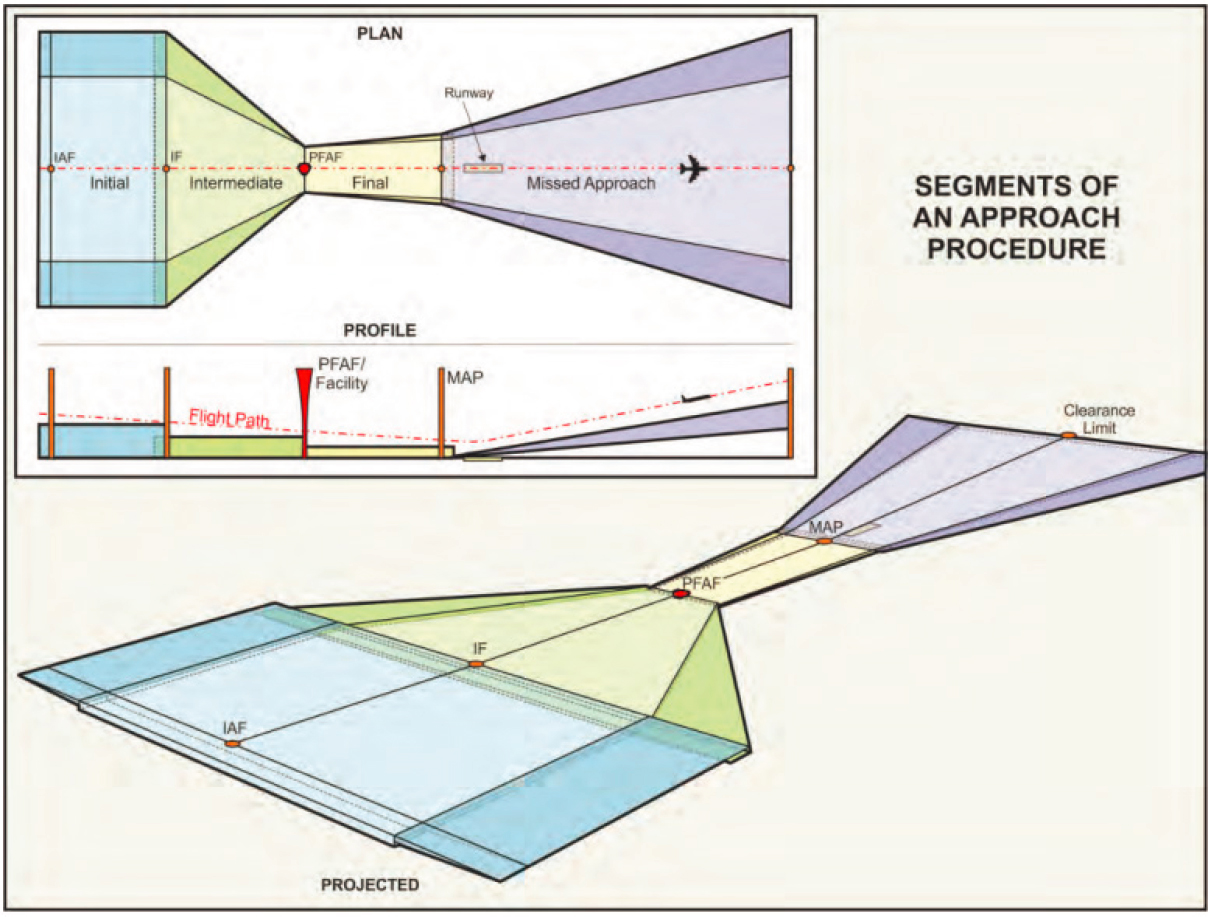
When defining a specific instrument approach, the TERPS require defining the geographic space within which the approach can be proven to be clear of terrain and through which other routes cannot cross, as shown in Figure A-2. The horizontal path may be somewhat offset from a straight-line with the runway for reasons such as terrain or other obstacles on the straight-line course, or directionality in the navigation aids. The lower bound of the vertical profile must provide sufficient clearance from terrain in the initial, intermediate and final approach segments; the upper bound then defines where other air traffic may be allowed, including other aircraft in the traffic pattern above and around the airport. The TERPS also call out important references back to 14 CFR §91—for example, TERPS section 2-1-10 notes, “Do not establish speed restrictions that require an aircraft to exceed the restrictions in 14 CFR Part 91.117 (a) and (c).”
The TERPS define the geographic space also based on the flight performance assumed of current vehicles. For example, section 2-6 “Final Approach” notes that in situations where precision vertical navigation is possible, “Use a standard 3.00 degree [glide path angle] GPA where possible. GPAs greater than 3.00 degrees but not more than the maximum [defined relative to aircraft speed, ranging from 3.10 for the fastest aircraft to 6.40 for the slowest] are authorized without approval when needed.”
These examples highlight the extent to which instrument approach procedures, and other instrument procedures and routes of flight, are defined within an elaborate, carefully constructed paradigm that structures the procedure and its route of flight to address many safety concerns. In this context, a request by an aircraft operator for a different procedure can be
___________________
4 See https://www.faa.gov/documentLibrary/media/Order/Order_8260.3D_vs3.pdf.
SOURCE: TERPS, 2018.
quickly examined by stepping through the analysis process defined by the TERPS if it complies with deeply embedded assumptions about “normal aircraft operations and performance.” However, requests for new procedures accommodating different vehicles with different performance may face two difficulties: (1) procedurally, they may require separate, special assessment and approval is not guaranteed, and (2) pragmatically, different vehicle performance may correspond to different flight profiles not covered by the TERPS, and potentially conflicting with other routes. For example, an aircraft designed for short, lower-altitude flights may be best suited by a steep descent angle on final approach; however, such a steep descent may conflict with the routes normally assumed free for aircraft crossing the airfield to join the traffic pattern.
This page intentionally left blank.


