Preparing Our Teachers: Opportunities for Better Reading Instruction (2002)
Chapter: 1. From Shopping Lists to Poetry: Forms and Functions of Written Language
1
From Shopping Lists to Poetry
Forms and Function of Written Language
The journey toward literacy begins early and covers diverse terrain. Long before children arrive at kindergarten, they find written language in the world around them. In early encounters—often in the warmth of a caretaker’s lap—a baby gets early impressions about how books operate: Pages turn, there are delightful pictures, Grandma’s finger moves along those squiggly black marks. The baby may also begin to notice that the language of books—when read aloud—sounds different from the talk of regular life. There is a certain music to it, a certain cadence.
The growing child becomes aware of print not just in books but everywhere in the world. Print comes on cereal boxes and menus. On television there are letters of the day featured on Sesame Street or Between the Lions. There they are again on the sign for a fast food restaurant or in the church newsletter that came in the mail. There is written language in toy advertisements, bus schedules, and shopping lists. Printed language provides many kinds of valuable information: what time the party starts, how to put the toy together, which foods to buy at the store.
Surrounded by written language, a child, for quite some time, can be vague about what is going on—not always certain that reading and writing differ from talking or drawing, not sure what it takes to do it like the grown-ups. The literacy journey has a few bumps in the road, a few surprising events, and, finally, the meeting with teachers who are prepared to help. At last the child takes purposeful strides toward a clear goal—independent reading and writing to meet demands and create opportunities in everyday life.
A big step for a future independent reader and writer comes when young children begin to play “let’s pretend.” The importance of play for young children is
|
Learning to Teach Through Play Debbie Johnson, Special Education Preschool Teacher, Minnieville Elementary School, Dale City, Virginia 
Twenty years ago I first went to school to become a kindergarten teacher. Back then we thought play was important for learning social skills. Now we know there’s much more to it. We know that the teacher might get in there and play with the kids, showing them how to role play and how to develop language skills. The teacher I worked under last year was really great at that. She would go into the housekeeping area and say, “Let’s have a tea party. Who’s going to help me? Who’s going to dress up?” She’d get kids to talk and build their literacy skills. Watching her, I learned how to do it myself. I became more comfortable reaching kids in this way. Sometimes you make things up as you go along depending on the child’s interest. Sometimes you are flexible with that plan, what kinds of materials to use—like taking tissue boxes and using them as skates on the floor. One workshop I went to stressed the importance of keeping a notepad and writing materials at each play center: the block center, the housekeeping center, the art center, the listening station, and the science center. This way the children can either draw a picture of something they did or integrate writing into their play—like writing a pretend letter if they’re playing post office, or making a shopping list, or drawing an animal or a plant. We have a butterfly garden, and the kids sometimes draw pictures of a caterpillar turning into a butterfly. They can write, if they know how to write, or dictate to a teacher what they know about it. I now do this in my class, and the kids really enjoy it. |
much overlooked. And yet play is crucial for a number of reasons. Playing at being a grown-up who reads and writes is a part of becoming a reader and writer. Besides that, any kind of pretend play accustoms the child to using symbols—to the idea in general that one thing “stands for” another. When little ones act out a pretend pirate scene, a rolled-up paper can stand for the telescope. Using letters as symbols is a central part of learning to read and write. For reading in a language like English, letters on a page “stand for” the sounds in spoken words—reading researchers call this the alphabetic principle.
Not enough teachers have a chance to learn about the early development of reading and writing. Preschool and kindergarten teachers, in particular, should be better prepared to nourish the growth of literacy that occurs before formal reading instruction. They should learn how to teach during different kinds of activities with children.
In too many preschools, literacy efforts focus exclusively on reading fiction to the large group once or twice a day and quizzing the group on the “letter of the day.” While these are undoubtedly essential elements of learning to read, such efforts are not enough to prepare children for the challenges ahead. Preschool teachers must give children opportunities to use play toward their literacy development. It is anything but child’s play for an expert teacher to teach through play.
From prekindergarten through the elementary grades, children must learn about the immense variety in written language—what it looks like and how it works. Teachers must help students become adept—as both readers and writers—with increasingly sophisticated and varied forms of written language. Increasing sophistication is experienced over time: The near tragedy of the Velveteen Rabbit; the travails of the “fourth-grade nothing”; the sadness but triumph of Sarah, plain and tall; the poignancy in the collection of O’Henry short stories—each book opens wider the door to the next.
But there are genres beyond the narrative. Teachers have to learn to teach beyond the stereotypes even for beginners. Expository prose should be used. A beautifully illustrated book with essays about frogs found in different parts of the world can augment knowledge gained from experience with a class aquarium. The same class might make a science notebook about the changes in the aquarium and reread parts as new entries are made each week. A current estimate is that, on average, less than 6 minutes a day is spent on information texts in first grades. This has to change.
playing with symbols
To become readers, children must understand that letters have the job of being symbols for sounds. But the first revolutionary accomplishment is engaging with any symbols at all. In play, children invent the symbols. They control them. They make the symbols work and change them as needed.
Well-prepared teachers understand how symbols work in play and how adults can teach children to sustain their symbolic play. The classic case is the broomstick that becomes a horse. The children know it is two things at once—the symbol is itself (a broomstick) and the thing it symbolizes (a horse). When it is a horse, certain rules apply. It can be ridden, it may be fed, it can even run away. The children agree to the meaning and use of the symbols in play.
While pretending, children even get to pretend about literacy. When children begin drawing and making other marks on paper, the results are quite idiosyncratic. The child knows it’s a picture of a favorite toy or that it is the phrase “big wheel,” even though no one else recognizes what the child has drawn or written. Even if the product requires an interpreter, the experience is nonetheless valuable. When
|
Hard at Play “What do you want?” asks 4-year-old Debra. It is playtime in Ms. Helen’s preschool class, and the housekeeping area has been transformed into a restaurant. There are menus, posters with blue plate specials, order pads, a phone, a message pad, miscellaneous writing materials, a chef’s hat, and dress-up clothes for the customers. “What do you want?” repeats Debra, impatiently. She is the waitress—order pad and pen in hand. Carefully scanning the menu left to right and top to bottom, Cecily says, “I’ll have a coke and fries to go. And some Eggos.” Debra promptly writes some squiggly marks in a column—a list—on her pad. She yells the order to the kitchen. Meanwhile, Cecily quietly puts a plastic pizza slice into her purse. Debra shouts, “You take that pizza out of your purse or you’ll never come to this restaurant again!” Cecily leaves indignantly. Debra, now alone, switches gears and begins to write on another pad. Ms. Helen visits the center but says nothing, as Debra fills the page with elaborate lines and circles, mumbling all the while: “Once upon a time, the lady…” and ending with “…the lady pays. The End.” A few moments later, Debra runs to the pretend telephone, which is evidently ringing. She answers it, “writes” a phone message, then overzealously hands both the phone and the message to Ms. Helen, saying “Here, it’s for you.” Ms. Helen thanks her. The message contains round curvey marks, but the only letter Debra uses is D, the one she knows and likes from her first name. 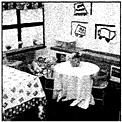
Years ago, when she first began as a preschool teacher, Ms. Helen may have been tempted to interrupt the play scenario with some one-on-one teaching, perhaps encouraging Debra to put more real letters in her writing. But now she sees things differently. Thanks to reading some |
writing their way or reading their way, children find that symbols give them the power to express and even make meaning. In this way they are learning what it means to become a reader and writer.
By the time preschool and kindergarten teachers are on the job, they should have an understanding of this aspect of child development and they should know how to engage children in play environments that form a path to literacy. Teachers should know how to provide materials and encouragement so that children learn about print in play. What does a pretend clinic need for a doctor to write a prescription while a patient reads the magazines in the waiting room? How can the teacher entice the pretend construction worker to make signs for the businesses and buildings she has made with blocks? Can a teacher help a superhero intercept a letter from a villain to a confederate?

articles with the lead teacher who stepped in as her mentor, Ms. Helen understands that it is quite usual for 4-year-old children to “write” without conventional letters and that this type of play, in and of itself, shows progress toward becoming readers and writers. Debra’s scribbles are longer and shorter depending on how much spoken language they are attached to—not yet the alphabetic principle, but a beginning connection between what’s written and what’s spoken. Indeed, for this moment in their development, Ms. Helen thinks the girls are doing splendidly as they weave reading and writing activities into their play scenarios. At the end of the day, Ms. Helen looks over Debra’s three writing products. Even with only the D as a recognizable letter, it’s clear that Debra has an excellent understanding of different kinds of writing. Debra knows that she can use literacy for many purposes: to remember, to organize, and to make transactions. Debra clearly understands that print carries meaning and is useful in daily activities. Debra may not use letters, but she uses literate conventions just the same. When taking an order at her restaurant, she knew to make a list, marking one little “word” under another. In contrast, when she worked on her story, she filled the page from edge to edge—left to right and top to bottom, showing knowledge of an important concept of print. And when taking a phone message, she attempted to use a cursive-like form. In each case, her writing changed to meet the task. During their free-play time, Ms. Helen will continue to encourage her students to pretend to do the things grown-ups see as ordinary activities. Playing out the roles and rules expected in a restaurant, a home or a hospital—these are chances to develop background knowledge that later reading and writing can take advantage of. Tomorrow, Ms. Helen will ask Debra to “read” back her page-long story. She is certain it will have a beginning, a conflict, and an end—as most good narratives do. What’s more, there will even be a moral to this story: Pay up! Do not just take pizza slices in restaurants! 
|
Play is also a way to work on understanding a story that has been read aloud to the children. Children might dedicate a particular scarf as the costume for a certain story, and every time they see that scarf they resurrect the story for days and days, increasing their familiarity with the language, realizing more about the meaning. All good early childhood teachers learn how to make sure children get the most out of a story by helping them act it out.
Teachers know, too, that playtime is a story waiting to be written. With the right materials and encouragement, a child becomes an author, writing as best as he or she can with crayons or markers or dictating to the teacher what happened to the pretend family in the housekeeping corner or to the truck drivers in the block corner. Sometimes the story is routine, sometimes exciting—but it’s always good to take home or to pin up on the bulletin board to be read again later.
Teachers should learn to expect and encourage very young children to mix drawing, writing, playing, and speaking and to mix the symbols of pretend and conventional writing along with “estimated” spellings. (See Chapter 3, pp. 94–95, on the relationship between estimated spelling and phonemic awareness.) Eventually, it is the teacher’s job to help children move toward conventional reading and writing, conforming by using only the letters of the alphabet and using them in the ways our spelling rules call for. An M may be the only attractive letter to a child named Margaret who loves Mom and likes mountains. But, after all, M cannot do the job that an O or an S can. The well-prepared teacher helps Margaret use “her” letter for writing but also helps her enlarge her letter knowledge.
Teachers must know how to arrange experiences so that children see the payoff for conformity to conventional use of the alphabetic symbol system. Through reading and writing we can communicate in many ways, over long periods of time and distances, with people we haven’t ever seen or heard. It is almost magic that a child can read what his mother wrote when she was a little girl! What’s more, a child can write a note so that her dad can find out what happened today even if he comes home so late everyone is asleep. And there are cousins far away who might respond to riddles written on a postcard.
Writing helps us remember, organize, conduct business, create, and appreciate imaginary worlds. And it all begins with symbols.
the workings of print
Teachers are often good at teaching basic concepts of print while reading to or with young children. They model and check on children’s awareness of left-to-right eye or finger movements, sweeps to the beginning of a new line, and page turning when the last bottom right word has been read. They make sure the children know when they are reading (and relying on letters) and when they are talking about the pictures that enrich the text. They occasionally pause and subtly call children’s attention to the spaces between words or point out punctuation marks or capitalization of letters. They readily take a moment to note the special size, alignment, and typefaces that set titles off from the rest of the page.
But what about print that doesn’t involve our familiar 26 letters? Dozens of writing systems are used for business and government in the world today. Some conventions require people to read from right to left. Some readers must first move vertically down a page, rather than horizontally across it. Sometimes words are not separated by spaces. Some systems require symbols to change their shape depending on which symbols are next to them or whether they are at the beginning, middle, or end of the word. Our system does this a little bit in most styles of cursive
|
CONCEPTS OF PRINT FOR THE WORLDLY WISE English is based on an alphabetic system. It relies on 26 letter symbols that represent more than three dozen phonemes, the smallest sound units in words. Spanish, French, and Italian are also alphabetic and rely on the same 26 signs (called the Latin alphabet), but writing these languages also calls for special symbols—called diacritics or accent marks. Russian readers and writers have 32 Cyrillic alphabetic symbols, some similar to the ones in the Greek alphabet. The Vietnamese writing system, Quoc Ngu, uses still other alphabetic signs. In other parts of the world, people read and write with different basic units, not letters symbolizing phonemes. For example, in southern India, children learning to read Tamil use 246 symbols in a syllabic writing system. The Cherokee syllabary has 84 symbols. In syllabic systems, there is one written symbol for each syllable, not each phoneme. Children from China are accustomed to a logographic system. In a logographic system there is one written symbol for each unit of meaning. In China, people need to recognize about 5,000 logographic characters to read a newspaper and about 30,000 to read literature. The same logographic characters can represent very different spoken words in the various languages used in China as well as Korea and Japan, which have adapted Chinese characters for their own use. Some languages are written with systems that have more than one type of symbol. Japanese, for instance, uses both syllabic and logographic symbols. |
writing. Some societies, like Norway, do not have conventionalized spelling—it’s up to each writer to decide how to spell a word!
With increasingly multicultural and multilingual cachement areas for their schools, teachers should be prepared to work effectively with children who have quite different concepts of print than they do. Teachers need to know that the very idea of an alphabet may be entirely new to children who first encounter English as a second language but know about reading and writing in another language. Teachers must understand when literacy at home or church introduces expectations that written English does not meet. They must find ways to help children transfer what they can for use in reading and writing English and to add the new concepts of print they will need for English. Most important, they must know that their way isn’t the only way
Teachers need to teach more sophisticated print concepts as children get older and encounter more challenging texts in the second, third, and fourth grades. It is difficult for many children at this age to read nonfiction if they do not understand the conventions involved in chapter headings, subheadings, graphs, tables, illustrations, captions, indexes, or glossaries. Teachers need to be skilled at introducing
these elements. Most important, teachers need be disposed to put these features into action in the daily life of the classroom.
Consider the concept of an index in a book, for example. Instead of saying, “Read pages 20 through 23 in the geography book,” the knowledgeable teacher says, “Read about the spiders we might find in the United States.” She then leads the class though problem solving that will show the difference (and different usefulness) between a table of contents and an index. They figure out whether to start with “spiders” or “United States.” They persist when “United States” is not there with “spiders” and realize that “North America” will do. Finally, “Spiders, North America, 20–23.” The result may be the same pages to read, but the bonus is an opportunity to practice an advanced print concept.
Teachers need to learn to introduce children to reference books and to remember to put them to work in the daily life of the classroom as well!
how texts vary
In addition to familiarity with different parts of a book or other written material, children must become familiar with different types of written material. In fact, children begin early to learn the conventions of different genres. “Once upon a time,” for example, is well known early on as the signal for a fairy tale.
But less appreciated subtle understandings of genre differences also begin to develop early. Take menus and shopping lists, for example. When we see the words pie and cake written under each other on a shopping list, we understand that we are to get both. When we see the same words under one another on a menu,

though, we know we should pick just one. The word “and” is not written on a shopping list; “and” is implied in the shopping list genre. The menu genre implies “or.” These two genres are seldom taught explicitly, but they are understood by young children.
Teachers need to know about the early accomplishments and build on them to expand the children’s repertoire—both about the signs to look for (like “once upon a time”) and the understanding of what is meant even though it is not written in so many words (like “and” for shopping lists and “or” for menus).
Children may not expect the differences that genre brings in other cases, though. The content and objective factual tone of a news report about a county fair may be surprising to a child who connects that topic with lively
stories of personal experiences. Descriptive passages from an omniscient viewpoint may similarly be unfamiliar to a child.
As children get into second grade and beyond, they spend more of their time reading to learn, rather than learning to read. For much of their educational lives, they will depend on informational expository texts—in science, social studies, all the different domains of learning. And yet, despite this reality, most of the reading time in the lower grades is spent on fiction and nonfiction narratives.
It is imperative that teachers have the opportunity to be prepared to do a better job teaching young children to read expository prose. Teachers should introduce and provide practice with useful procedures and techniques. Some are procedures that can be applied to many texts—teaching students to survey a whole chapter before reading to notice the main ideas organized by the subheadings, pictures, figures, or tables. Some techniques are more unusual—instructing students to make a glossary of their own by picking the terms in italics or bold print that indicate definitions.
Teachers need to apply what they know about reading different academic subjects. When we are able to read to learn we are fluent with the specialized written forms found in different subjects. Even in the lower elementary grades, textbooks and trade books have certain markers associated with, for example, history or science, that children can learn to rely on.
Children who have opportunities to work with print in a wide variety of forms and functions have the motives and means to succeed as readers. We know practice helps children become good readers. We also know that sometimes it is hard to get children motivated or to keep their attention during extended practice. But think about this immense variety of different forms of written language—here is an opportunity for multiple chances to practice. Here a news report, there a book of riddles, an essay, an invitation, a mystery, a poem—always new and different functions and forms and topics. But each passage provides practice with many of the same clauses, the same words, the same syllables, the same letter-sound correspondences. The variety means that practicing to full fluency need not be drill or dull.
oral and written language
Spoken and written language can be very different. Compare two reports of the same event:
-
He just wannenna chill ‘n jam and the dweeb ups ‘n disses ‘m!
-
Although the sole intent of the young man appears to have been to relax at a party, he was criticized to the point of being denied due respect. The criticism was issued, without warning or notice, by the person (introduced above) who is widely believed to be unaware of the social norms upon which we depend for probity.
While these are clearly caricatures, they call attention to the wide range of contrasts between spoken and written language. Both utterances are contemporary American English. The first is clearly an example of spoken language and gives a hint about the speaker’s youth. It is unlikely to be printed, except as a direct quotation. The vocabulary is colloquial: chill, jam, up and, diss, dweeb. Most teens can supply a translation. The past tense of the verb in the first clause slips into the “historical present” in the second. There are contracted pronunciations for prepositions, pronouns, and conjunctions—wannenna instead of wanted to, ‘n instead of and, ‘m instead of him.
The second example has vocabulary and phrases more common in written language, such as sole intent, due respect, and probity. We also find hallmarks of formal syntax: passive constructions (appears to have been and are widely believed to be), explicitly limited claims, and subordinate clauses (introduced by although, who, and which).
An astute reader might recognize that the before dweeb in the first example translates into the introduced above in the written version. Had a dweeb been used instead, we would take it for granted that the character had not previously been mentioned in the narrative.
With these and many other sorts of contrasts, it is no wonder that the transition from oral language to written language can be difficult for children. Teachers must prepare to help children become familiar with the subtleties, tone, vocabulary, styles, and other conventions of written language. In the talk of everyday life, so much can be easily conveyed with tone of voice, gestures, pregnant pauses, posture, and sheer physical closeness. We can even stop speakers and get them to help us understand.
Written language on a page must rely on other tactics instead. Precise word choice, unusual grammatical structures, lengthy descriptive passages may just sound “fancy” or formal to the new reader, but teachers have to know how to help students understand the ways that these features express meanings when face-to-face oral-language tactics are not available.
Teachers need to be prepared to uncover the subtleties of written language on the spot and prepare children to solve such problems themselves as they read independently.
writing—when children control the symbols
Readers have one viewpoint on literacy and written language. Writers see it from the other side. The concepts about written language that we rely on for reading are the very same ones we must execute as writers. Neither viewpoint on literacy is complete. Each helps develop the other. And doing one often leads to doing the other.
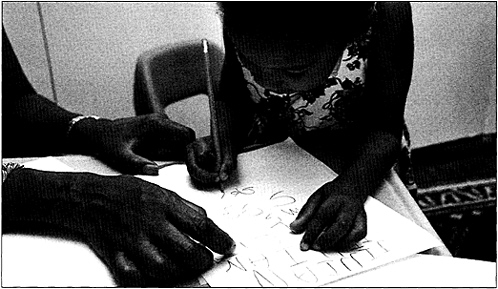
As astute observers of their students’ writing products, knowledgeable teachers find out a lot about where the students are as readers. But they must be well prepared to analyze this information. In preservice courses, teachers should obtain a good understanding about writing development in children and the appropriate demands to place on writing production for children of different ages.
Teachers also need to learn to develop good instructional plans for writing that support reading achievement. There are four features to take into account.
1. Writing as a Part of Daily Classroom Life
Teachers need to learn how to arrange writing practice during the school day, when they can prompt and motivate children, encourage them to stay on task, and give them the help they need to succeed. Effective teachers know that writing is not just for homework and that writing time is not necessarily quiet. Good writing can be part of a dynamic shared experience. A class writes a get-well letter to a sick peer. A pair of students brainstorm ideas for a science project. A team of writers collaborates to write, revise, and perform a play. Teachers also need to be prepared to manage a classroom so that space and time are available for the child whose writing blossoms in solitude.
2. Writing for a Reason and Purpose
Effective teachers know how to communicate to children that writing matters. A descriptive essay has a purpose if it describes the city zoo on a web site. A good short story deserves reading, and the author deserves the chance to promote it during an interview on a real or pretend TV talk show. Children notice that a lot of
things are unfair from their point of view; who better to write a persuasive letter to a storekeeper or a mayor? And who better to follow that up with a letter of protest if there is no response? Effective teachers have learned that if letters are assigned, they must be stamped and sent, and correspondents should be chosen according to the likelihood that they will return mail in a timely fashion. Poetry slams have captivated middle school and high school students, and fourth graders might find them a good venue for their efforts. E-mail and distance collaboration projects for science or geography are important for teachers to learn about.
Of course, teachers should provide high-quality feedback about the writing, noticing improvements or the need for them. But giving a child’s writing a grade or even extended commentary is not a substitute for arranging opportunities for purposeful writing.
3. Writing and the Teacher’s Influence
Teachers should know how to gear writing assignments to showcase a child’s accomplishments but should also pave the way for growth and improvement. Some moments are the right ones for a teacher to model good writing or to be a collaborator. Other times the teacher needs to stand back and let children write on their own. All along the way, he or she must make moment-to-moment judgments about what will be most helpful: to step in and closely direct children, to give them writing prompts or take dictation, to act as a word source, to point to a dictionary, to arrange peer writing groups, or to provider sample for children to work from when they are experimenting with a new genre. That there is one tried-and-true approach is a myth.
Teachers need to be well prepared with techniques that can help children navigate the whole writing process. They should be skilled in helping children prepare to write, organize their thoughts and ideas, and discover when and how to revise.
4. Writing in Different Genres
The earliest composing that a child does is often a report of an event that just happened, dictated to a teacher. A good teacher must encourage children to move from personal narrative toward third-person narrative, to fiction and poetry of different styles, and to expository prose that informs or persuades, gives instructions or directions.
There is a lot for teachers to master about the forms and functions of symbols and written language. The payoff for the effort is when the teacher chooses curricula, plans lessons, responds to the unexpected question of a child, helps a child around a stumbling block or through a hard task. To do the simple daily acts, an effective teacher has an ever-growing knowledge base and the disposition to act on it and with it.
Sample Activities for Teacher Learning
Child’s Play
To take professional development on play seriously and make it effective, a teacher study group is helpful. This activity is designed to move between discussion of publications about literacy and play, through collaborative planning, to implementation and reflection on the effectiveness of the attempt. A facilitator familiar with the literature and the classroom is a helpful resource for a teacher study group. A sample unit plan for such professional development follows:
|
|
Begin to discuss some background reading on the play/literacy connection with a group of teachers (from the same school or very close neighboring ones). |
|
|
Demonstrate the way reading and writing opportunities can enrich children’s pretend play if they are woven into the action. Use a class visit with a teacher interview or a videotaped or written case example. (For example, a classroom might feature a veterinary hospital setting for pretend play. An enterprising teacher would take students on a field trip. Books about animals and vets would be featured in the library corner and be read at story time. Visitors who deal with sick animals would be invited to show and tell what they do. The teacher would gather and set up props for animal patients, owners, vets, and vet techs. The play center would include sufficient writing materials to create file records, phone messages, and prescriptions. Don’t forget the magazines in the waiting room.) Refer back to the reading to discuss the demonstration. |
|
|
Model the ways that a teacher can help children become more adept at the roles and rules involved in this pretense. Point out strategies that make the play last, maximizing cooperation among the children and minimizing inattention and conflict. |
|
|
Have the teachers work in a few small groups to develop plans for other play opportunities that involve literacy. These plans should include not only the classroom setting, visit schedules, props, and writing and reading materials but also guidelines for the teacher’s interactions with the children. |

|
|
Have the whole group evaluate the plans for adequacy and practicality and then revise as needed. Use background reading on the play/literacy connection to guide the evaluation and revision. |
|
|
Choose one of the plans to “pilot test” in at least one classroom. Give the teachers the opportunity to see it in action and assess whether or not the children are playing with symbols and developing their literacy skills. |
|
|
Repair and share—adjust the pilot situation to emphasize more engaging or lengthier play or more literacy, as needed. Find ways to share preparation time and materials so the different play scenarios can be cycled among classrooms. |
Written English Is Alphabetic, BUT…
To evaluate curricula and materials and to interpret children’s responses and overall progress, teachers rely on technical knowledge about written English. A teacher educator can make the dry technical terms more memorable and stimulate more discussion by weaving in some problem solving.
This activity is a guide to teaching teachers about the fact that symbols in a writing system have two parts: the written signs and the units in the language that are to be represented. The kind of unit represented identifies the type of writing system: syllabic, logographic, or alphabetic. It begins with general thought-provoking demonstrations and leads to problem solving and practice.
-
English is alphabetic, representing phonemes with letters. But there are no relations to phonemes in a written “26” or “80” (even though the phonemes are represented by letters if we write out the words “twenty-six” and “eighty”).
|
|
Have the class find people who will read a list of numbers in Spanish, French, German, Russian, and any other languages in the neighborhood. Report the results to the class. Note that there are all sorts of different sounds, different phonemes! |
|
|
Get a French speaker to interview in the class. Have the speaker read “80” for the class and then provide the literal English translation of what is said. It isn’t like “eight”; it’s like Lincoln’s Gettysburg address—“four score!” |
|
|
Discuss the limited way in which English is a mixed system—mostly alphabetic, but we can think of our use of numbers as logographic. |
-
History, geography, politics, accident, and ease—all play a role in determining which writing system is actually used for a language. (In fact, the Serbs and Croats share a language, but each uses a different alphabet to write it.) Suppose English was written with a syllabary or a logographic system. How many symbols would we use to write some simple sentences?
|
|
Write the two following simple sentences on the board: |
|
|
|
I like radio. |
I hate ice cream. |
|
|
Ask the class to discuss how many symbols it would take to write each sentence if we wanted to use a syllabary In a syllabic system, there would be one sign for each syllable. |
|
|
|
Five signs for “I-like-ra-di-o” |
Four signs for “I-hate-ice-cream” |
|
|
Ask the class to discuss how many symbols it would take to write each sentence if we wanted to use a logographic system. In a logographic writing system, there would be one sign for each unit of meaning (technically called a morpheme). |
|
|
|
Three signs for “I+like+radio” |
Three signs also for “I+hate+ice cream” |
|
|
Expect some controversy here. Two words aside, “ice cream” is only one morpheme. Something like “heavy cream” has two morphemes; one refers to the basic substance—cream—and another limits the reference to a particularly dense type of cream. But “ice cream” is different; it is not just a kind of cream that is icy. (Thank heavens!) |
|
|
|
Ask the class to discuss how many symbols it would take to write each sentence if we wanted to use an alphabetic system. In an alphabetic writing system, there would be one sign for each phoneme (the smallest unit of sound). It is helpful to provide the students with a chart or table listing the phonemes of English with key words as a pronunciation guide. Be very clear that the task is to count the phonemes not the letters. |
|
|
|
Nine signs for /ay/ /I/ /ay/ /k/ /r/ /ey/ /d/ /iy/ /ow/ (I like radio) |
|
|
|
Ten signs for /ay/ /h/ /ey/ /t/ /ay/ /s/ /k/ /r/ /iy/ /m/ (I hate ice cream) |
|
|
|
Expect an uproar. Some students may still have trouble reporting how many phonemes there are in a word. It’s a good deal harder than for syllables. For others that’s not a problem, but they want the chance to complain about conventional spelling. |
|
|
|
There are only 26 letters in the alphabet that we use to write English, but spoken English has more than three dozen phonemes. Some doubling up with special orthography (spelling rules) is called for. English readers know that “silent e” influences the pronunciation of the first vowels in like and hate and that the digraph ea represents the single long vowel in the spoken word cream. |
|
|
|
An alphabetic system that has these complications is said to have a deep orthography. Some languages, like Spanish, have conventional spellings more directly connected to the surface sounds of the contemporary spoken language. |
|
|
|
Ask each student to make one sample sentence for practice on counting units. Pair them up to repeat what you just did with the whole class. Have half put their sentences in a bowl; have the others pick one and find the author, so they can work together on both samples. |
|
|
|
Reconvene the class to discuss samples the students disagree about or think are interesting. Taking the opportunity to note the growth of knowledge of the technical terms in action in teacher-to-teacher talk. |
|
Getting to Know a Reference Book
Using a reference book and being prepared to teach students to use it are quite different. A class or teacher study group can focus on one type of reference book and develop local expertise about it that can be available for teachers to design and implement lessons. The group will be better quipped to prepare lessons about other reference books, whether as a group or as individuals.
Divide the group into pairs or triplets and give each a thesaurus. Ask them to study the book and observe its features. What kinds of words are in boldface? Which words are in italics? How are numbers used? Are entries organized alphabetically or by subject? Is there an index?
Ask teachers to write their answers and then discuss them with the larger group. When agreement about the key features has been reached, brainstorm about introducing students to reference books and providing practice so they can use the key features effectively. Try out the ideas in role play, using appropriate age-level thesauruses, dictionaries, or encyclopedias.
Science Does…History Does…
Many teachers have had little chance to study how texts in different content areas are in fact different. How, then, can they help children apply and extend their reading skills across the curriculum?
A teacher study group can spend a year “attacking” academic subjects two at a time. The teachers can identify the special tricks for reading well in each subject area. They can determine when and how this information can become lessons with children. The following activity would span about 6 weeks:
|
|
Divide into pairs. Each pair takes three samples from a science book intended for third or fourth graders and three samples from a history book intended for the same audience. To be manageable and productive the samples should be about four or five pages long. |
|
|
Spend at least two weekly hour-long meetings studying the passages to find the elements that recur in the samples. Here are some issues to address: |
|
|
List features of layout and language that a reader can expect: Do the subheads seem to all work in the same way? Are there sidebars? Illustrations? Graphics and font differences? Tables and charts? Bulleted lists? Are definitions indicated? If so, how? Are examples indicated? If so, how? |
|
|
Make a generalized outline that just about always predicts the kind of information that will be presented at certain points in a chapter. |
|
|
List a set of questions that just about always get answered. |
|
|
Is there an argument structure that comes up again and again (similarities and differences, cause and effect, etc.)? |
|
|
How is evidence presented? Where do conclusions come in? What happens to uncertainties? |
|
|
What are the standard opening and ordinary closing for new topics? |
|
|
What’s taken for granted and thus seldom said? What sort of information is usually stated outright and what sort usually has to be figured out or looked up somewhere else? |
|
|
After the 2 weeks of collecting information on the samples, bring together the larger group for two meetings and pool the findings. Then sort them: What does science always do? Or almost always? Does history never do it? Or hardly ever? And vice versa. What features are shared by the disciplines? List the findings about science. List the findings about history. |
|
|
In the next meeting, consider the lists in light of the children and the curriculum demands. Should the information be used with the children? If so, specifically when and how? Should it be incidental teaching as opportunities or problems arise? Should it be intentional lessons? How can the teachers evaluate the plans and their implementation to see if they promote fluent reading and lasting comprehension of science and history texts? The group may decide to collaborate on lesson plans, pilot implementations, and evaluations and repairs of them. The group may decide to establish an archive of the information and plans to share with other teachers. |
|
|
Eventually, a similar study of two different curriculum areas can be undertaken. |
How Written Language Works
Teachers may be unprepared to bridge the gap between the language of conversations and written language. This activity gives them a chance to appreciate the features of written language that might be unfamiliar enough to become a stumbling block for some of their students.
Have teachers work in small groups. Give each group some children’s books of varying types—classics of children’s literature; easy readers; others that feature popular television, comic, or music characters.
Ask the teachers to identify the vocabulary, idioms, grammatical constructions, and stylistic devices that are unusual in spoken language but common in books.
Discuss (1) how to prepare children to understand a passage despite any unusual features and (2) how to engage children in thought about the unusual features of written language, so that they can handle similar examples when reading on their own.
Writing in Many Genres
Teachers, like other literate adults, can take for granted the knowledge they have about different genres of written language. This activity is meant to help them bring this knowledge to the surface and have it become a resource for their students.
-
Ask teachers to consider the ordinary experience of night turning into day. Then have them write accounts or explanations of this phenomenon in four different genres: a folkloric or oral tradition, a scientific explanation, a narrative description, and a poem describing any aspect of the phenomenon.
This activity should be lighthearted and fun. Have teachers pass their creations around the class or read them aloud to the class.
|
|
Ask teachers to brainstorm a list of features that characterize the genres they just worked with. |
|
|
Ask teachers to discuss ways to adapt this activity for use in their classrooms. |
-
Ask teachers to think about what genres are by transforming them!
|
|
Pair up the members of the class. Pass out copies of a local news story and copies of the lyrics from a currently popular song. |
|
|
Give them a half hour to make a song from the news report and a news report from the song. |
|
|
Pass around the “new genres.” Ask for volunteers to read their efforts aloud. Discuss what the teachers had to know about news reports and songs to do the task. |
|
|
Next ask the class to think about a favorite poem and a favorite novel. Discuss which aspects of a novel could be captured in a poem and which couldn’t. Are there any novels or poems that evoke similar responses in readers? Are there any themes or topics that would be especially unlikely to turn up in a novel or a poem? |
resources
Basic reviews of the knowledge base relevant to this chapter can be found in the following recent publications:
Kamil, M.L., Mosenthal, P.B., Pearson, P.D., & Barr, R. (Eds.). 2000. Handbook of Reading Research: Volume III. Mahwah, NJ: Erlbaum. (See especially the chapter by Yaden, Rowe, and MacGillivray on emergent literacy.)
National Reading Panel. 2000. Teaching Children to Read: An Evidence-Based Assessment of the Scientific Research Literature on Reading and Its Implications for Reading Instruction: Report of the Subgroups. Washington, DC: National Institute of Child Health and Human Development. (See especially Chapter 4, Part II, “Text Comprehension Instruction.”)
National Research Council. 1998. Preventing Reading Difficulties in Young Children. Committee on the Prevention of Reading Difficulties in Young Children, C.E.Snow, M.S. Burns, and P.Griffin, Eds. Washington, DC: National Academy Press. (See especially Part I, Chapter 2, and Part III.)
Neuman, S.B., & Dickinson, D.K. (Eds.). 2001. Handbook of Early Literacy Research. New York: Guilford Press. (See especially the chapter by Whitehurst and Lonigan on emergent literacy and the one by Dyson on writing and symbols.)
The sections of this chapter can be elaborated by consulting various other sources, including the following:
Playing with symbols:
Bloodgood, J.W. 1999. What’s in a name? Children’s name writing and literacy acquisition. Reading Research Quarterly, 34(3), 342–367.
Bodrova, E., Leong, D.J., Hensen, R., & Henninger, M. 2000. Imaginative, child-directed play: Leading the way in development and learning. Dimensions of Early Childhood, 28(4), 25–30.
Clay, M. 1975. What Did I Write? Auckland, New Zealand: Heinemann.
Dever, M.T., & Wishon, P.M. 1995. Play as a context for literacy learning: A qualitative analysis. Early Child Development and Care, 113, 31–43.
Dickinson, D. 1996. Emergent Literacy and Dramatic Play in Early Education. Albany, NY: Delmar.
Ferreiro, E., & Teberosky, A. 1982. Literacy Before Schooling. Exeter, NH: Heinemann Educational Books.
Gundlach, R. 1982. Children as writers: The beginnings of learning to write. Pp. 129–148 in M.Nystrand (Ed.), What Writers Know. New York: Academic Press.
Neuman, S.B., & Roskos, K. 1992. Literacy objects as cultural tools: Effects on children’s literacy behaviors in play. Reading Research Quarterly, 27, 202–225.
Pellegrini, A.D., & Galda, L. 1993. Ten years after: A reexamination of symbolic play and literacy research. Reading Research Quarterly, 28(2), 162–175.
Purcell-Gates, V. 1996. Stories, coupons, and the “TV Guide”: Relationships between home literacy experiences and emergent literacy knowledge. Reading Research Quarterly, 31(4), 406–428.
Strickland, D.S. 1991. Emerging literacy: How young children learn to read. Pp. 337–344 in B. Persky & L.H.Golubchick (Eds.), Early Childhood Education, 2nd ed. Lanham, MD: University Press of America.
Sulzby, E. 1985. Children’s emergent reading of favorite storybooks: A developmental study. Reading Research Quarterly, 20(4), 458–481.
Teale, W.H. 1987. Emergent literacy: Reading and writing development in early childhood. Pp. 45–75 in E.Readance and R.S.Baldwin (Eds.), Research in Literacy: Merging Perspectives. Thirty-sixth yearbook of the National Reading Conference. Rochester, NY: National Reading Council.
Teale, W.H., & Sulzby, E. (Eds.). 1986. Emergent Literacy: Writing and Reading. Norwood, NJ: Ablex.
Teale, W.H., & Sulzby, E. 1989. Emergent literacy: New perspectives. In D.S.Strickland and L.M.Morrow (Eds.), Emerging Literacy: Young Children Learn to Read and Write. Newark, DE: International Reading Association.
The workings of print
Coulmas, F. 1996. The Blackwell Encyclopedia of Writing Systems. Oxford: Blackwell.
Daniels, P.T., & Bright, W. (Eds.). 1996. The World’s Writing Systems. New York: Oxford University Press.
Sampson, G. 1985. Writing Systems. Stanford, CA: Stanford University Press.
How texts vary
Armbruster, B.B., & Anderson, T.H. 1984. Structures of explanations in history textbooks or so what if Governor Stanford missed the spike and hit the rail? Journal of Curriculum Studies, 16(2), 181–194.
Caswell, L., & Duke, N. 1998. Non-narrative as a catalyst for literacy development. Language Arts, 75, 108–117.
Doiron, R. 1994. Using nonfiction in a read-aloud program: Letting the facts speak for themselves. The Reading Teacher, 47, 616–624.
Duke, N. 2000. 5.6 minutes per day: The scarcity of informational texts in first grade. Reading Research Quarterly, 35(2), 202–225.
Hepler, S. 1998. Nonfiction books for children: New directions, new challenges. Pp. 3–17 in R.A.Bamford & J.V.Kristo (Eds.), Making Facts Come Alive: Choosing Quality Nonfiction Literature K-8. Norwood, MA: Christopher-Gordon.
Kamberelis, G. 1999. Genre development and learning: Children writing stories, science reports, and poems. Research in the Teaching of English, 33(4), 403–460.
Leal, D. 1993. Storybooks, information books, and informational storybooks: An explication of the ambiguous grey genre. The New Advocate, 6, 61–70.
Meyer, B.J. 1975. Identification of the structure of prose and its implications for the study of reading and memory. Journal of Reading Behavior, 7(1), 7–47.
Pappas, C., & Barry, A. 1997. Scaffolding urban students’ initiations: Transactions in reading information books in the read aloud curriculum. Pp. 215–236 in N.J.Karolides (Ed.), Reader Response in Elementary Classrooms: Quest and Discovery. Mahwah, NJ: Erlbaum.
Strickland, D.S., Ganske, K., & Monroe, J.K. 2002. Improving reading comprehension. Pp. 141–154 in Supporting Struggling Readers and Writers: Strategies for Classroom Intervention 3–6. Portland, ME: Stenhouse.
Oral and written language:
Biber, D., & Finegan, E. (Eds.). 1995. Sociolinguistic Perspectives on Register. New York: Oxford University Press.
Duke, N.K., & Kays, J. 1998. “Can I say ‘once upon a time’?”: Kindergarten children developing knowledge of information book language. Early Childhood Research Quarterly, 13(2), 295–318.
Kavanagh, J.F., & Mattingly. I.G. (Eds.). 1972. Language by Ear and by Eye: The Relationships Between Speech and Writing. Cambridge, MA: MIT Press.
Ochs, E. 1979. Planned and unplanned discourse. Pp. 51–80 in Discourse and Syntax. New York: Academic Press.
Roberts, B. 1992. The evolution of the young child’s concept of “word” as a unit of spoken and written language. Reading Research Quarterly, 27(2), 124–138.
Tannen, D. (Ed.). 1982. Analyzing Discourse: Text and Talk. Washington, DC: Georgetown University Press.
Writing: Because the emphasis here is on reading, our coverage of writing development and teaching is limited. The following publications are a few starting points for more adequate coverage:
Applebee, A.N. 1986. Problems in process approaches: Toward a reconceptualization of process instruction. Pp. 95–113 in A.R.Petrosky and D.Bartholomae (Eds.), The Teaching of Writing: Eighty-Fifth Yearbook of the National Society for the Study of Education, Part II. Chicago: University of Chicago Press.
Dyson, A.H. 1988. Unintentional helping in the primary grades: Writing in the children’s world. Pp. 218–248 in B.A.Rafoth & D.L.Rubin (Eds.), The Social Construction of Written Communication. Norwood, NJ: Ablex.
Graves, R.L. (Ed.). 1999. Writing, Teaching, Learning: A Sourcebook. Portsmouth, NH: Boynton/Cook.
Jensen, J.M. 1993. What do we know about the writing of elementary school children? Language Arts, 70, 290–294.
Pressley, M., Wharton-McDonald, R., Allington, R., Block, C.C., Morrow, L., Tracey, D., Baker, K., Brooks, G., Cronin, J., Nelson, E., & Woo, D. 2001. A study of effective first-grade literacy instruction. Scientific Studies of Reading, 5(1), 35–58.
Strickland, D.S., Ganske, K., & Monroe, J.K. 2002. Improving writing. Pp. 167–199 in Supporting Struggling Readers and Writers: Strategies for Classroom Intervention 3–6. Portland, ME: Stenhouse.