Preparing Our Teachers: Opportunities for Better Reading Instruction (2002)
Chapter: Introduction: Teachers of Young Children, the Agents and Champions of Literacy
Introduction
Teachers of Young Children
The Agents and Champions of Literacy
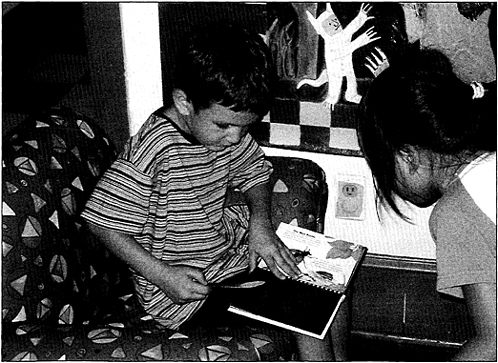
A class of young children sits around her—each with a different past and unknown potential, each with a unique yearning. Some are already beginning to read a few words or even sentences. For others the print in books is still a confusing jumble of letters—or merely squiggles—upon the page. From these varied beginnings the teacher’s goal is to give each child something he or she needs, something that changes a life: the ability to read and write.
During the gray days of February, the teacher is a coach who can inspire and motivate the most discouraged student. Sometimes she seems to be a mind reader, too, who sees inside children’s heads to figure out how they are progressing, when they get stuck, and what kind of practice or explanation they need to succeed. She gets each child to ask himself or herself the important questions that tease out meaning from the text.
At times she may be the fearless guide, ever ready to take her class on an illuminating detour. One day it’s the crazy fact that cave and have sound altogether different. She helps them remember about save and gave, delving into the rhyme and a reason, the regular pattern and the exception.
Another time she gets them into the long and short of it—this author’s “long hour” is no longer than the standard 60 minutes, and that other book’s “short two weeks” last a full 14 days. How can sense be made of that? The teacher reminds the class that last week at the zoo they were sure her watch was wrong; was it really 11:30 already? That seemed to be a short 3 hours, they agree, because they didn’t want it to end. They see that a writer chooses a word to show a feeling in a subtle way.
They learn to read not only between the lines through their background knowledge but also within, under, and around the words.
All along the way she is caring and sensitive to individual needs while able to maintain order in the classroom. She can build on the many cultural resources in her class, enthusiastic to learn about cultures and languages new to her. She discovers which boy or girl loves science, sports, cooking, or animals. She feeds them all sorts of reading matter—books, recipes, magazines, science experiments, and sports pages to incite curiosity, even passion, in the context of reading and print.
A master teacher is at times a consummate technician who relishes the chance to work on the nuts and bolts of written English, the expected sounds and the exceptional ones, the possible pitfalls and quirks—consonant digraphs, silent vowels, prefixes, suffixes, homophones, and homographs. At a moment’s notice she transforms into a dramatist who brings color and life to stories, plays, and poems—the literal, the implied, the metaphorical, the tone, the style, and the detail. Another quick switch and she is a brilliant conversationalist, drawing out even the shiest children and thus stretching their language skills and background knowledge.
To watch a master teacher in action is like watching an artist immersed in her discipline, drawing on an array of techniques, skills, and visions of beauty to create distinct pictures with each boy and girl.
|
THE HIGH SCHOOL CLASS OF 2011 BEGINS TO READ A long-term study is following the progress of 20,000 children who started kindergarten in 1998. The study’s current results show the enormous variety related to reading that teachers handle day by day:
SOURCES: http://www.nces.ed.gov/ecls West, J., & Denton, K. 2002. Children’s Reading and Mathematics Achievement in Kindergarten and First Grade. Washington, DC: National Center for Education Statistics. West, J., Denton, K., & Germino Hausken, E. 2000. America’s Kindergartners. Washington, DC: National Center for Education Statistics. West, J., Denton, K., & Reaney, L. 2001. The Kindergarten Year. Washington, DC: National Center for Education Statistics. |
This sketch barely touches the surface of all that a master teacher can do—from the annual, monthly, and daily plans, accountable to hundreds of “must-teach” skills, to the thousands of minute-to-minute actions, choreographed on the spot for the unpredictable needs of young and vulnerable children. By year’s end she has helped to create competent readers, as if wresting the spirit from the stone—some more advanced than others, but all most definitely on their way to literacy.
|
THE ESSENTIAL PROFESSION Eighty-nine percent of Americans say it is very important to have a well-qualified teacher in every classroom. Eighty-percent agree strongly that fully qualified teachers should be provided to all children, even if that means spending more money. Seventy-seven percent say it is a high national priority to develop the professional skills and knowledge of teachers throughout their careers. More of the public (60 percent) identifies investment in teachers as the most crucial of strategies for improving student learning, topping other strategies like setting academic standards and instituting testing programs. SOURCE: Haselkorn, D., & Harris, L. 2001. Belmont, MA: Recruiting New Teachers. |
No wonder we are sometimes tempted to believe that great teachers are born, not made. So great is the challenge. So important the job. So immense the bureaucratic obstacles.
“It all comes down to the teacher,” parents are notorious for saying—and for competing to get their own children into certain classes taught by the current stars of the school. It is hard to argue with them. Nothing in this world can replace the power of a great classroom teacher during a child’s formative years—not fancy computer labs, or great libraries, or after-school enrichment programs. Teaching, even in this technical and complex age, remains essentially a human operation. Every parent wants the best for each child. We need more quality to go around. We need more quality teachers to stay around.
Too often, though, effective teachers are enticed away from the classroom. Traditionally, the only way to advance on a teaching career path has been to become a guidance counselor, principal, curriculum supervisor, or superintendent. The career trajectory should celebrate greater mastery of and responsibility for classroom teaching, rather than movement out of the classroom. Such a trajectory, supported with excellent professional development, would provide momentum for quality classroom teaching.
If they are to excel in their craft and be satisfied with their careers, even the most talented and gifted individuals require a good foundation and apprenticeship, a life-time of challenging work environments, and ongoing education. Some great teachers may have been born with a special talent, but even they need professional preparation to develop their potential. And many more great teachers forge their skills step by step, learning about subject matter, about how to teach, about how to observe and assess children learning, and about how to improve their own instructional practices. They learn to teach through their entire working lives.
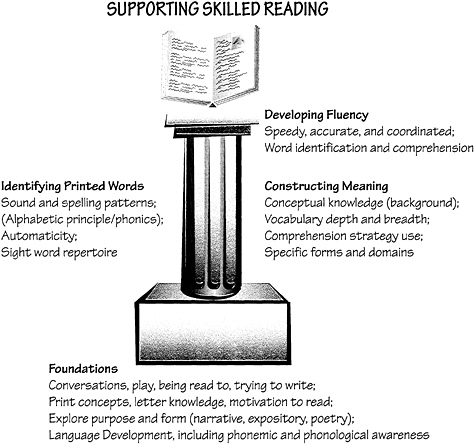
Most important, teachers learn how to get children to become good readers. They build on a firm foundation of language development and integrate three aspects of skilled reading: identifying printed words, constructing meaning, and developing fluency.
|
Professional Development Is the Job Anthony Alvarado, Chancellor for Instruction, San Diego (California) City Schools 
It’s a big mistake to think that teaching is what we do every day and professional development is an occasional seminar or workshop or institute. No! The job is professional development, and professional development is the job. SOURCE: American Federation of Teachers/National Education Association Conference on Teacher Quality, September 25–27, 1998, Washington, DC. Yolene Medard, Classroom Teacher, Grade 2, New York, N.Y. 
We have staff developers in our school. The most powerful have been the literacy developers. All the second-grade teachers meet weekly with Lisa. What’s great is that she comes into my classroom every week on Tuesday afternoon. Sometimes she gets up and models minilessons for me to learn from, and she watches me teach, too. I sit in with her while she conferences with a child and make note of what goes on, or sometimes I do the talking and she listens. That has been very effective. I can count on her. I know she’s in there 45 minutes once a week. The children develop a relationship with her. I have developed a relationship with her. When we sit down to meet, she gives me very specific feedback on my teaching strategies and approach. She is very positive and constructive—even when she’s telling me about things I need to change. Then she builds on what I’ve done and asks, “So what are you going to do next?” Formal classes help, too. Four years ago I went back to school to get a reading certificate. Even though I received a great education as an undergraduate, there were just some things I needed to know more about. I was teaching children who had few, if any, books at home, some whose parents didn’t graduate from high school, some whose parents didn’t speak English. Some had no one to help with homework; they were basically on their own. When I began teaching 10 years ago, I would never have led a group that just went over the “th” sounds or “wh” or “sh.” But now I do that with just the six kids who need it, not the other 20 who understand it. I’m very very explicit for some kids. I let them know we’re just going to work on this sound until they have it. Last year I went for certification through the National Board of Professional Teaching Standards. It taught me a lot. It was a year of looking critically at what I did in the classroom and changing to reach more of the kids more of the time. |
To provide the best instruction for children learning to read, there is no question that teachers should be provided with far more and far better preservice and inservice education. Universities, colleges of education, schools, school districts, state education agencies, politicians, parents, teachers, and researchers—everyone must
pull together to meet the challenge of better preparing our teachers, not only at the beginning of their careers but throughout their professional lives.
This book is about that challenge. It is also about our firm belief that teachers are the agents and the champions of literacy.
how this book came to be
We, the authors, are committed to improving children’s reading instruction. This book follows up on the findings of a landmark study undertaken by some of the nation’s leading reading researchers.1 Four out of five of us were part of that project, which was carried out under the auspices of the National Academy of Sciences from 1995 to 1999. Our goal then was ambitious. We reviewed current
|
1 |
See the Notes at the end of this chapter for those involved with the original committee and those who assisted with this book. |
research to answer questions about which children are at risk of reading difficulties; what the process of skilled reading looks like; and which individual, family, social, school, and classroom factors are related to success in reading. We examined the methods and results of prominent approaches to reading instruction and intervention for reading difficulties. And we met with teachers, principals, and remediation specialists from all over the country.
In the end we offered a plan for how the nation could prevent reading difficulties, emphasizing that good classroom instruction is the primary prevention. The group discovered considerable consensus and concluded that there was little life left in the infamous “Reading Wars”—the contentious and overly simplistic ideological struggles well known nowadays to the public in the form of “whole language versus phonics.” Our conclusions were published by the National Academy Press in an academic report called Preventing Reading Difficulties in Young Children.
The study was widely covered in the news media. The New York Times, Boston Globe, Los Angeles Times, and the Today Show all reported on the study’s findings. Newsday described it as “the largest study of its kind ever attempted, which tackles some of the most explosive issues in education.” Spanish and Chinese editions of the report were published. We were pleased that people responded to our call for a careful, complex, and integrated approach to early reading instruction rather than a single magic bullet or an eclectic, compromised mélange.
Because so much was at stake, we strove to reach a larger audience of nonacademics who impact children’s lives each and every day. The result was Starting Out Right: A Guide to Promoting Children’s Reading Success, which included techniques and activities for both the classroom and the home, from birth to third grade. We hoped to reach a fair number of parents, in-service teachers, day care providers, school board members, and policymakers by relating the research results directly to practical information.
To our delight and surprise, Starting Out Right has sold more than 150,000 copies. The success of these two books has motivated us to go a step further and now speak directly about teacher preparation. Arguably, this is our most important project yet. Research on education is not worth much if teachers do not have the support they need to put it to work in classrooms.
In this project we have been joined by a faculty member from Bank Street College of Education—one of the nation’s most prestigious teacher preparation institutions. We call ourselves the New Brunswick Group because it was in New Brunswick, New Jersey, that we came together to begin brainstorming, sharing our ideas, our research, and our enthusiasm for this project. Our collaboration has been supported by a prominent membership association of educators and a private foundation heavily committed to improving education.
We knew that, in the years since our earlier books were published, reading in the early grades had been the topic of a great deal of state and federal policy initiatives and many widely distributed publications. Acrimony again arose about how to teach reading. The focal point for controversy has been phonics—patterns of links between letters and sounds—and phonemic awareness—knowledge about the sounds within spoken words.
Our earlier books take a clear position on the relationship among the different aspects of reading and we still stand behind it: According to the best-available knowledge, all children should have the opportunity for high-quality instruction that integrates printed word identification, meaning, and fluency. That is what prevents reading difficulties, and that is what starts children out right.
Too often, though, the message gets lost in the move to legislative mandates, executive initiatives, published curricula for teachers or children, or interpretations of research. Sometimes policymakers or writers overemphasize one part of the complicated reading process, claiming it is a redress for past neglect. Other times the emphasis is not intended or may be merely in the eyes of a partisan beholder. However originated, the loss of an integrated whole creates a vacuum that more controversy about reading instruction rushes in to fill.
Worry about time is the fuel for these controversies. Do we have time for instruction in phonemic awareness and phonics, which can improve word identification,
without giving up the other aspects of skilled reading? If we agree to work on those topics, will we have too little time for other matters that children also need?
Happily, we can report that good news has been published since our earlier books came out. The news comes from the National Reading Panel, mandated by Congress to examine the state of research about early reading instruction. The panel undertook a metanalysis to examine differences among existing studies and to see if the results are consistent enough to guide practice and policy.
Overall, the panel reports that phonemic awareness and phonics instruction show consistently positive, small-to-moderate effects on children’s word-reading outcomes. The analysis also shows that spending more and more time on phonemic awareness and phonics is not necessarily better. In fact, the best effects from phonemic awareness instruction were found with programs that used between 5 and 18 hours total in the course of a school year—a pittance if we remember that the number of school hours per year is about 1,080! Nor do phonemic awareness and phonics instruction need to be dragged out or done over and over throughout the elementary grades. It is time in kindergarten and first grade that has the real payoff. We need not consume time essential for other aspects of reading instruction—and all the other important matters that children meet in the early years of schooling. (See the Resources at end of this chapter for references to basic reviews of learning to read, including the National Reading Panel report.)
As we began this project, we knew, too, that there were requirements and suggestions, legislated standards, and detailed proposals about what one should know and be able to do in order to teach reading in the early grades. Various lists come from agencies, organizations, and associations in the government and private sector. Most begin with what children need to know and do and backtrack from that to what teachers need to learn; many have useful technical details. Some change from time to time, and new ones crop up. (See the Resources at end of this chapter for sample references about standards for teachers.)
Despite the considerable amount of activity, there are no clear answers about what needs to be done in teacher education and professional development. In an ideal world, studies would examine the path from teacher education programs through teacher learning to improved school practice to student learning and progress. That is a long and windy road and one that is difficult to study. Reviews of the literature attest to the vigor of inquiry about teacher education and professional development in general, and a few studies directly address teacher preparation regarding the teaching of reading in the early grades. (See the Resources at end of this chapter for sample references about teacher education and professional development.)
It seems as if disputes outnumber solutions when it comes to the content, contexts, and processes in teacher education programs and professional development
plans. When, if ever, should teachers, as learners, “sit and get” information, “make and take” classroom materials, “see, try, and tinker” with the practices of master teachers, “reflect and react” on student data and research findings? Should teachers of teachers be lecturers, coaches, facilitators, mentors, peer groups, or all of the above? Will the technologies of distance learning and video- and computer-based cases fit into productive programs? Is it correct to think of teacher learning as an individual matter or is it best thought of as a coordinated school or district matter? Can someone teach and learn to teach at the same time? Can teacher education and

professional development be vehicles for school and curricular reform? Can new curriculum materials and district or state mandates have a positive impact on teacher education programs and professional development plans? What is the relationship between teacher education and professional development on the one hand and retention and mobility of the work force on the other? Although sometimes the rhetorical tides run high, current evidence and argument are too fragmented and scanty to settle the issues.
Our contribution is about the content of teacher preparation for teaching early reading. It is the common ground that can be interpreted in a variety of contexts for teacher learning. For effective action to improve teaching and for research on teacher education and professional development, such common ground is needed. The content we call for can be addressed with whatever modes prove effective for teaching adults so that they are able and disposed to use what they learn in their daily work life.
Our framework is not based on the components coming out of a task analysis of individual skilled reading. Nor is it a refinement of the curricula and syllabi of teacher certification programs, although the five elements in it can be related to traditional disciplines in such programs (see, for example, pp. 285–287 in Preventing Reading Difficulties).
We looked instead for a perspective with a close tie between children’s achievement and teacher education and professional development. Make no mistake; we understand that the effectiveness of teacher education and professional development is mediated by, sometimes overwhelmed by, practices in schools. Still, we
wanted to think about what teachers need to know and be disposed to do at the same time that we thought about why it matters for children—a perspective that would integrate the “what” and the “why” of the content of teacher education and professional development.
Recently, a case has been made for “opportunity-to-learn” standards that focus on whether schools are providing the conditions children need to succeed (see Darling-Hammond, 2000a). We have such a framework from our work on Preventing Reading Difficulties. There we summarized what children need in order to become accomplished readers:
-
opportunities to become familiar with the forms and uses of written language;
-
opportunities to develop the language and metacognitive skills required for reading comprehension success at every stage of literacy development;
-
opportunities to grasp how the words of the language are structured and are represented in print by the letters of the alphabet;
-
opportunities to become enthusiastic about learning to read and write;
-
opportunities, if at risk of reading failure, to be noticed early enough and to be offered enriched experiences and/or intensified instruction in school.
In Preventing Reading Difficulties we list six opportunities that should be provided for children, separating early prevention and early intervention. Because this book focuses on classroom teachers rather than the full range of school and community personnel involved with reading difficulties, we collapse those two and organize our thoughts around the resulting five major opportunities.
These opportunities are oriented to activities that teachers and schools should engage in. We contend that a good classroom teacher of reading learns to provide these five opportunities—better and better, more and more often, for each child. Teacher education and professional development can be judged by the extent to which both help teachers provide children with these crucial opportunities for becoming full members of our literate society.
We rely on these five major opportunities as the backbone of Chapters 1 through 5 of this book. In each chapter we discuss one aspect of what should be provided for children learning to read and offer concrete information about what teachers, in turn, must know and be disposed to do in order to provide that opportunity for each child in the classroom. To help demonstrate our vision, we supply several vignettes that dramatize prepared teachers in action. These are composites, based on our many collective years working with teachers in the field. In addition, sprinkled throughout the book are quotes from real-life teachers, masters and novices, who told us about their journeys toward better teaching.
To make our vision more specific, we provide samples of activities that teachers and teacher educators can use—in-service and preservice. Some activities are about teaching lessons or parts of lessons—planning, developing, observing, simulating, practicing, reflecting, and repairing when needed. Other activities are more about teacher learning—ways to develop understanding of concepts or practices. Some activities put teachers and teachers-to-be in the learner’s shoes—tasks designed to remind them of the complexity of (and complex emotions associated with) different aspects of learning to read.
In this book each chapter has a list of resources at the end to substantiate the issues raised in the chapter and to provide starting points to elaborate the topics beyond what can be covered here.
To make our vision complete, we need more. We need to instigate action. Policymakers, educators, school administrators, and the public need to provide the crucial opportunity for teachers—the opportunity for them to improve their practice. Teachers need resources, reasons, and protective settings so that they can see and use and test and improve, so that they can continuously reflect on what is working and what more is needed to teach children to read.
what’s at stake
A devastatingly large number of people in America cannot read as well as they need to for their own success and for the public good. Large numbers of school-age children, including children from all social classes, face significant difficulties in learning to read, but problems are especially likely among poor children, among children who are members of racial minority groups, and among those whose native language is not English. This is of grave concern to the entire nation. According to U.S. census data, nearly 40 percent of the nation’s children currently belong to racial minority groups. Seventeen percent live in poverty.
The National Assessment of Educational Progress—known as the nation’s report card—has found that two-thirds of all fourth graders tested fall below the level the federal government considers acceptable. Most disturbing is that despite decade-long efforts the test found a widening gap between the very best students and the very worst.
We must concern ourselves with the children in this country who do not read well enough to meet the demands of an increasingly complex world. To contribute to society in the twenty-first century, today’s children will need to reach a high literacy threshold. They will have to read far more challenging material than students of yesteryear. They will use printed matter to solve problems independently—even in the entry ranks of the work force. They need and deserve schools and classrooms
|
FOURTH-GRADE READING IN 2000—THE NATION’S REPORT CARD Only a third of the nation’s fourth graders read proficiently according to the 2000 National Assessment of Educational Progress: 
What is proficient reading in grade 4? “For example, when reading literary text, Proficient-level fourth graders should be able to summarize the story, draw conclusions about the characters or plot, and recognize relationships such as cause and effect. When reading informational text, Proficient-level students should be able to summarize the information and identify the author’s intent or purpose. They should be able to draw reasonable conclusions from the text, recognize relationships such as cause and effect or similarities and differences, and identify the meaning of the selection’s key concepts.” SOURCE: U.S. Department of Education. Office of Educational Research and Improvement. National Center for Education Statistics. 2001. The Nation’s Report Card: Fourth-Grade Reading 2000, by P.L.Donahue, R.J.Finnegan, A.D.Lutkus, N.L.Allen, & J.R.Campbell. Washington, DC: Author. |
where 100 percent of the children are literate and deep levels of literacy are the norm. They need teachers who know how to provide them with the opportunity to learn to read proficiently.
what are teacher education and professional development?
There has been some concern about whether a teaching career attracts less able college students, but a recent study shows that teachers are as able as those who go into, for example, law, medicine, engineering, and accounting. Applicants for teacher education should be expected to have a good liberal arts and sciences education. Some basic courses in the behavioral, cognitive, and social sciences are crucial for preeducation students, just as biology and chemistry courses are for premed students.
Schools, departments, or programs of teacher education are responsible for specialized courses. Across the country, teacher education requirements vary
|
HOW TEACHERS COMPARE As a group, teachers score relatively high in literacy.
SOURCE: Bruschi, B.A., & Coley, R.J. 1999. The Prose, Document, and Quantitative Skills of America’s Teachers. Princeton, NJ: Educational Testing Service. |
considerably. In some states, teacher credentials are available after a four-year bachelor’s degree that includes a set of prescribed courses in an accredited college or university. In other states, teachers must have an additional year, some with, some without, a master’s degree. Provisional certification may be a first step, with permanent or recertification requirements that include passing additional formal courses and/or assessments of knowledge and classroom practice. Some states use formal sit-down tests as part of the credentialing process.
Whatever the technical and legal requirements, a classroom teacher’s preparation should be viewed along a continuum—a lifelong journey of professional development that does not end with a teaching degree or state certification.
State and local education agencies or individual schools are responsible for professional development for teachers. Professional development may take the form of a mandatory annual workshop or an optional summer institute. It may include seminars that a principal arranges to study findings from newly published reading research or to introduce a new resource for children’s literature. It may be a series of meetings to help teachers learn about the literacy practices of an ethnic group recently arrived in the school cachement area. Or it may be regularly scheduled school-site sessions in which colleagues work to coordinate curriculum objectives across grade levels. Mentoring for novice teachers is another part of a professional development program. Professional development means staying up to date with current research and may include partnerships for contributing to the research base. For part of their continuing education, individual teachers may enroll in night or summer courses or advanced degree programs at a college or university.
Valued professional development sessions are not costly lectures by outside experts or the frequently provided “off-the-shelf” training from publishers of children’s textbooks. For the report Teacher Quality: A Report on the Preparation and Qualifications of Public School Teachers, the National Center for Education Statistics asked teachers about the relative values of different professional development activities. They credited some activities with improving teaching a lot. The activities
|
PHASES IN A TEACHING CAREER Clinical: Still enrolled in formal teacher education, novices observe classes and may tutor in a supervised program as part of their course work. At the apex of the clinical phase is the student teacher, supervised by an expert classroom teacher. In most states, teachers are eligible for entry-level certification after they perform well in this on-the-job experience. Intern: These teachers are in their first year or two as the paid full-time head teacher of a class. Interns sometimes participate in school district-sponsored induction programs, which may lead to a higher-level teaching certificate or a masters degree. Residency: At this stage, a teacher is a developing professional in his or her third through seventh year of teaching. He or she has limited but growing responsibility to mentor student teachers in their clinical phase. Mentor: Expert teachers are able to function as instructional leaders, coaches, and/or organizers of professional development in a school or district. The essential feature of a mentor teacher is more than some arbitrary number of years of experience. The essential feature is teaching expertise, recognizable by peers, attested in practice and student outcomes, and used to guide and support teachers in the clinical and intern phases. |
that rose to the top were team planning periods, mentoring by another teacher, and regular collaboration with others.
There is a good deal of current research on the forms and processes of teacher learning to assess which activities have the best results for both teacher learning and children’s achievement. Our expertise is about the content rather than the form or process of teacher education and professional development. We expect that much of the content can be done well (or poorly) in a variety of ways. The activities we provide are samples, examples that we and our colleagues have found useful in our teaching of teachers.
The studies of teacher learning are beginning to tease apart the value of the different roles of those available to help teachers learn—professor, mentor, coach, facilitator, staff developer in the school or from an outside source, assistant principal for instruction, curriculum supervisor. We believe that people filling any of these roles and working on the teaching of reading need a firm grounding in the content we describe and the disciplines behind it. Activities like the ones we provide require depth and breadth of knowledge by those teaching teachers.
An especially important issue about the processes of teacher learning is the relationship between the more abstract presentations and the more practical work—the
|
PROFESSIONAL DEVELOPMENT CAN TAKE MANY FORMS The trick is to have close ties to the specific problems that participants face in their classrooms and to have connections to the wider world of policy and research. The school or district may provide a facilitator to organize and sustain efforts like the following: Group study: Teachers meet in grade-level teams once a week to discuss solutions they have tried; relevant readings; or input from mentors, coaches, or supervisors. The same topic can span weeks, even months, of the group study. A topic like estimated or invented spelling may lead to a study of articles about phonemic awareness and decoding. Case study and chat rooms: Meeting over the Internet, a teachers’ group studies practice problems or cases that challenge the problem-solving abilities of groups. They learn to identify and define teaching and learning problems in situations that approach the complexities of actual classrooms. They evaluate alternate solutions from numerous angles. After considering prepared cases, individuals “case” their own classrooms and focus the group effort for maximum utility. A topic like comprehension may narrow to focus on how to teach children to use summarizing and prediction strategies together. Focused observations and action research: Pairs or small groups of teachers collaborate with a researcher to identify a question about Instructional practice. They develop a system to document observations in their classrooms. They observe each other’s classrooms and then examine the data and develop plans for improved practice that call for a new round of observations. Starting with a question about fluctuations in fluency during oral reading, they may try varying the kinds of materials to increase successful practice. Mentoring: A more experienced teacher works with one or more novices. Mentors teach model lessons and follow up with notes about the plan and the happenstance, the success, and how to repair the parts that went awry. Mentors observe novices’ regular classroom practice and provide detailed feedback. Mentors consult about Instruction for specific students. Mentors get coaching and information through ties with district personnel and teacher educators. Mentors say they learn as they teach teachers. |
practicum, laboratory sections, classroom observation, tutoring, clinical experience, student teaching or internship, classroom intervisitation, professional development schools, coaching. More abstract material in lectures, discussions, and readings gets a true comprehension test when put into action with children. Reciprocally, actions with children can mount as teacher expertise if they are subject to public discussion and interpretation in the light of theory and evaluation of outcomes. Teacher preparation that uses teaching cases provides practice, vocabulary, and routines that
teachers can apply to learn deeply from the “case” of their own practical experience. The important question is how and when to best manage integration of the abstract and the practical. (For more discussion, see Clandinin and Connelly, 1996, and Hoffman and Pearson, 2000, listed in the Resources.)
a firm footing for learning to teach reading in the early grades
Because reading touches all content areas—from sciences and social studies to literature and philosophy—good teachers benefit from being well read themselves and knowledgeable in many disciplines. Information and values, procedures and approaches, dispositions and inspiration—the yield of a good education—are what effective primary grade teachers rely on every day. We are concerned that even before teachers-to-be declare their education majors in college, they may not be getting the sort of foundation they need.
As part of a solid liberal arts and sciences education, we believe it is useful for future teachers to study a language that is not their native one. Like any student, they can enjoy new worlds in the literature and culture that a new language presents to them. Most important, as teachers-to-be grapple with learning to speak, read, and write in a new language, they can develop empathy for students they will meet for whom English is a new language. Foreign-language study is not currently a universal requirement in liberal arts and science programs, but we think it is a valuable part of a well-rounded education and is especially useful for those preparing to teach a diverse student body.
Education courses should rest on a solid bedrock of knowledge. In an education program, department, or school, there are bodies of knowledge and skill that transcend our specific concern with teaching reading in the early grades. We believe educators of reading teachers should be able to take the more general knowledge, skills, and dispositions for granted. Until the preeducation and education courses are operating in this sort of ideal world, though, preservice curricula and professional development plans must take the time to develop the resources to augment several kinds of fundamental knowledge. Such foundations support good teaching practice in general. While they are not specific to preparation and development for effective teaching of reading, they are crucial for it.
Knowledge in the Behavioral and Cognitive Sciences
Those who want to teach young children in preschool and the primary years need to learn how reading, writing, and language develop in young children. Preschoolers not only talk to express meaning but also use symbols, drawings, pretend stories, and many forms of play. These activities provide starting points for
reading. Teacher candidates should take at least one course in child development that includes language and literacy development.
In their daily lives, early childhood educators will grapple with many questions about what makes a person do one thing and not another or find some things easy and others hard. They will want to know how children think and approach problems, what leads to misunderstandings, what memory is and how it works. They will wonder at what point youngsters are ready to “pay attention.” They will constantly ask themselves how they can motivate children to achieve and to pursue their own curiosities in books. We strongly recommend that early childhood educators take at least an introductory course in psychology to help prepare themselves for these challenges.
Knowledge in the Social Sciences
More than ever, classroom teachers will want to be worldly. As immigration and demographic shifts continue, teachers will encounter greater numbers of children who come from non-English-speaking families. For this reason they’ll want to be prepared to treat home-language and culture differences as the assets they can be, not just for the individual child but for everyone. They should learn about the social and cultural issues relevant to the children in their regions. They will want to learn how different populations use writing and speaking, how education is viewed, how literature is used and shared by other cultures. At least one course in local sociology, anthropology, or regional American studies is a must.
Knowledge of Language and Literature
Elementary school teachers should be lovers (or at least admirers) of language itself, not only books. In addition to the literature and rhetoric of a good liberal arts education, we recommend that all preservice teachers take a basic course on the structure, history, and variability of the English language. This is currently not very common. Yet a kindergarten teacher should know the difference between phonemes and phonics. A first-grade teacher must be able to tell a dialect pronunciation from a mistake in reading. A fourth-grade teacher should understand the value of pointing out cognates—words that are similar in two languages—to the children who speak both English and Spanish. Only teachers who understand the nuts and bolts of the English language—oral and written components—will be able to get inside children’s heads to find out where a student is going wrong and to provide the right help when needed.
Every teacher of young children should be wise in the ways of excellent children’s literature. The problems, the triumphs, the silliness, and the depth—this body of work resonates with children’s lives. Good authors have always served society in this way; their work tells us about ourselves and each other. Teachers need to have ways to connect with children emotionally and intellectually. Sharing
good children’s literature is both a place to start and a culmination. Teachers need to know what is out there and what makes some of it so good.
Knowledge of Assessment, Management, and Family Involvement

As part of foundation knowledge, teachers must be prepared to understand, choose, use, and interpret a variety of assessment tools. They need techniques to screen for potential problems and determine individual strengths and weaknesses. With these skills they can tailor instruction according to individual needs and evaluate when to stay the instructional course and when to begin searching for alternatives.
They will also want to learn how to structure the learning environment using a wide range of materials, technologies, and intervention programs. They should be able to run emotionally, physically, and socially safe classrooms. Good teachers should also be taught the best techniques for coordinating with families. They will want to know how to draw on school and community resources, making referrals and coordinating with follow-up services.
Knowledge of Standards
A final part of the foundation of good teaching is another that is seldom adequately focused on in teacher education. Course time needs to be spent on standards—the state or district mandates about the topics and skills to be covered in school subjects. Some states tell classroom teachers exactly what to teach every 6 weeks. Others simply tell them what must be learned by the end of each year or every several years. Some distinguish reading skills from writing and spelling; others lump reading into a broad array of language arts skills. Standards are often tied to student testing and assessments, often with high political and perhaps personal stakes attached to them.
Teachers need to know where the standards are to be found, what they mean, and how they apply, and teachers need to solve problems about teaching in the context of standards. To be well prepared to teach reading, educators need to know how well those standards align with the reading programs they are using and the tests their students will take. They will want to take the standards into account as they are making decisions about curriculum, activities, and materials and as they are reviewing their successes or failures for a given year. We cannot leave it to
novice practitioners to make the bridge between the ideas about reading in education courses and the mandates about reading in the law.
With these foundations in place, aspiring teachers are ready to profit from courses and professional development particularly dedicated to preparing them to teach reading in the primary grades. While many will arrive for pre- and in-service education without some of this firm footing, we must go for the gold and help aspiring teachers build the rest as we go along.
who this book is for
This book is for parents and other citizens who need a better understanding of what underlies good reading instruction by classroom teachers. It is a basis for conversations between teachers as learners and those providing resources for their learning. It can be a touchstone to examine where the needs are in a particular school, grade, or individual.
It is also for the people who prepare teachers-to-be during their undergraduate and graduate years. The content we specify can be used to stimulate a search for the forms and means of instruction that will provide the best learning opportunities
for teachers. It is for government officials who must arrange the proper conditions for good teacher preparation as well as professors and committees in schools and departments of education.
This book is for absolutely anyone who can make a positive impact, small or large, on the professional development of teachers during their in-service years. It is for school, district, and state employees who administer professional development programs as well as researchers, educators, and publishers’ agents who provide professional development sessions.
Often the most influential decisionmakers are principals, school board members, and officials from local and state education agencies who provide the vision, time, and money necessary for in-service courses. Parents can, and should, participate in this process, such as the active PTA (parent-teacher association) members who raise private funds for teachers who want to take continuing education classes.
Finally, this book is for teachers themselves—from preschool through grade 4—who are committed to
doing the best for their students and who are seeking the enriching programs and on-the-job experiences that will help them do it. It can be a prompt for study groups, a source of ideas to work through with facilitators, or a source of questions for coaches and mentors. In the increasingly competitive job market, when good teacher candidates are asked, “What inducements do you need to come to our school?,” this book can help form the answer. At a minimum, teachers should request preparation and professional development to support them in their teaching of reading to every child in their charge.
we must do it, and we can2
We must act now to improve the education opportunities for teachers wherever they learn—in formal courses or through less formal professional development.
One reason is remedial. Many of the nation’s colleges of education are simply not providing sufficient high-quality preparation, and they are the first to attest to their limitations. One researcher found that most teachers of the primary grades took an average of only 1.3 courses in the teaching of reading. A more recent survey indicates a mean of 2.2 courses. Teacher educators want more. The survey found a considerable discrepancy between the importance that faculty attaches to more reading courses and the ratings they give their current programs. Even with the slight increase, the total time spent on preparing to teach reading is entirely inadequate.
|
TEACHERS WANT TO BE BETTER PREPARED
SOURCE: L.Lewis, B.Parsad, N.Carey, N.Bartfai, E.Farris, & B.Smerdon, 1999. Teacher Quality: A Report on the Preparation and Qualifications of Public School Teachers. Washington, DC: U.S. Department of Education, National Center for Education Statistics. |
|
2 |
For detailed studies and reports related to this section, see the Resources concerning the link between teaching resources and student achievement. |
Considering the number of children at risk for reading failure in America, it is crucial that colleges and universities do a better job.
The picture is no better for in-service teacher education. On the job, teachers do not feel well prepared. We know how to define high quality in professional development. But the percentage of teachers who participate in such quality sessions is
|
WE NEED TEACHERS Over the next decade the nation’s schools will need to hire 2.2 million teachers, over half of whom will be first-time teachers. Many schools already face shortages of qualified teachers, especially in high-poverty communities and in subjects such as math and science. We must do more to attract talented Americans of all ages into teaching. SOURCE: U.S. Department of Education, Teacher Quality Initiative. Available online at www.ed.gov/inits/teachers/archive-recruit.html. |
too low. For example, only half of teachers surveyed reported participation in professional development experiences to deepen their content knowledge. But that’s good news compared to the dismal rates for other quality indicators: less than a quarter of the teachers spent enough time, or learned with the people they teach with, or had classroom follow-up via study groups, mentors, or internships. Worst case is not just a scenario: Only 5 percent reported that their professional development engaged them in active analysis of teaching and learning.
Specifically about reading, the first results from a new longitudinal survey show that about a third of our second- and third-grade teachers are participating in multiyear professional development in reading, and a quarter more had the chance for ongoing activity at least throughout the 1999 school year. But between a quarter and a third are still getting one-shot sessions passing as professional development for the teaching of reading. That is not quality. And this in the face of mounting evidence that quality professional development improves classroom practices.
Calls for urgent action come from the new challenges in the classroom. Teachers have to succeed with populations of students who come from cultures they do not understand and who speak languages they do not know. More knowledge can help teachers do a better job. Better professional development may attract more teacher recruits who are born into the communities that give them the culture and language knowledge that today’s classrooms call for.
The current political climate of accountability provides further impetus. If teachers are going to help their students do better on high-stakes tests, the teachers need to understand achievement in important domains like reading and how to ensure student success without simply teaching to the test.
Finally, unless we act to provide high-quality professional development for teachers, we will lose them to other workplaces. Opportunities for continued learning help teachers stay engaged, function as real professionals, and avoid
burnout. If we are going to retain the millions of new teachers who will be recruited over the next 10 years, we had better ensure they are feeling effective and supported.
Better teacher education and professional development are costly up front. We know that school districts spend only 1 to 3 percent of their resources on professional development, as compared to much higher expenditures for on-the-job training in most corporations and in schools in other countries. There’s another false economy in personnel costs when schools hire so few teachers that they must create work schedules that allow most elementary school teachers only 8.3 minutes of preparation time for every hour they teach. Some of the best forms of professional development involve team planning and reflective evaluation or coached planning. How can that be done with such a time budget?
Enhancing teacher quality is an investment in human capital that yields real and lasting results. The effect is even greater on students who are at risk of low achievement than it is on other students. One recent study of more than 1,000 school districts concluded that every additional dollar spent on more highly qualified teachers netted greater improvements in student achievement than did any other use of school resources.
By strengthening our nation’s instruction system, we make the right commitment. By strengthening our teachers, we give children the chance they need to succeed. There is no reason why reading achievement should be inadequate in the United States. The good news is that change is possible and within our grasp.
notes
Background for the book: The Carnegie Corporation of New York awarded a grant to Dorothy Strickland and Catherine Snow to develop a consensus document and work with professional development institutes. They convened the rest of the New Brunswick Group—M.Susan Burns, Peggy McNamara, and Susan Neuman—to develop the document. When Susan Neuman accepted an appointment as an assistant secretary of the U.S. Department of Education, she reduced her involvement in the group and felt that her participation was too minimal to be listed as an author. We thank her for her early contributions and enthusiasm. Within the New Brunswick Group, Peg Griffin took on major responsibility for prodding contributors and drafting prose.
The work was also supported by the American Education Research Association through a grant to Catherine Snow, M.Susan Burns, and Peg Griffin to work on the issue of teacher preparation in reading for classroom teachers of the early grades with Dorothy Strickland, Jean Clandinin, Linnea Ehri, Claude Goldenberg, and Annemarie Sullivan Palincsar. Laura Schenone worked with us on the development of this book,
bringing the skills of a professional writer and the perspective of a concerned citizen and parent of young children. We appreciate her expertise and help. Jean Clandinin, Claude Goldenberg, and Annemarie Sullivan Palincsar reviewed a draft of the manuscript and gave us feedback for revision, as did Victoria Purcell Gates, Judith Green, Carol N.Dixon, and Sabrina Tuyay. We are grateful for their kind attention and absolve them of any responsibility for our failing to follow their advice on some points.
We also thank the teachers who informed us of their experiences and lent us their wisdom as well as their voices: Joan Gottesman, Bernadine Hansen, Debbie Johnson, Kia Martin, Yolene Medard, Ruth Nathan, Patrick Proctor, and Debra Weck.
The other members of the original Committee on the Prevention of Reading Difficulties in Young Children are Marilyn J.Adams, Barbara T.Bowman, Barbara Foorman, Dorothy Fowler, Claude N.Goldenberg, Edward J.Kame’enui, William Labov, Richard K.Olson, Annemarie Sullivan Palincsar, Charles A.Perfetti, Hollis S. Scarborough, Sally Shaywitz, Keith Stanovich, Sam Stringfield, and Elizabeth Sulzby. They continue to work toward improving children’s reading achievement in different venues. Although they are not responsible for this book, their earlier work with us influenced it and we appreciate that and them.
resources
Basic reviews of the knowledge base relevant to learning to read in early childhood can be found in the following recent publications:
Kamil, M.L., Mosenthal, P.B., Pearson, P.D., & Barr, R. (Eds.). 2000. Handbook of Reading Research: Volume III. Mahwah, NJ: Erlbaum.
National Reading Panel. 2000. Teaching Children to Read: An Evidence-Based Assessment of the Scientific Research Literature on Reading and Its Implications for Reading Instruction. Washington, DC: National Institute of Child Health and Human Development.
National Research Council. 1998. Preventing Reading Difficulties in Young Children. Committee on the Prevention of Reading Difficulties in Young Children, C.E.Snow, M.S. Burns, and P.Griffin, Eds. Washington, DC: National Academy Press.
National Research Council. 1999. Starting Out Right: A Guide to Promoting Children’s Reading Success. Committee on the Prevention of Reading Difficulties in Young Children, M.S. Burns, C.E.Snow, and P.Griffin, Eds. Washington, DC: National Academy Press.
Neuman, S.B., & Dickinson, D.K. (Eds.). 2001. Handbook of Early Literacy Research. New York: Guilford Press.
Partnership for Reading. 2001. Put Reading First: The Research Building Blocks for Teaching Children to Read. Washington, DC: National Institute for Literacy, National Institute of Child Health and Human Development, and U.S. Department of Education.
Standards for teachers are discussed from a variety of perspectives and change over time. Developing Educational Standards (http://edstandards.org/StSu/Teaching.html) is a web site
maintained by Charles Hill and the Wappingers Central School District in New York. The site has links to standards proposed by professional organizations (e.g., http://www.reading.org/advocacy/standards for the International Reading Association) and those proposed by different states (e.g., for California, http://www.ctc.ca.gov/profserv/progstan.html). Organizations addressing novice and more advanced teachers both track and influence developments about standards related to the teaching of reading (National Board for Professional Teaching Standards, http://www.nbpts.org; Interstate New Teacher Assessment and Support Consortium, http://www.ccsso.org/intaspub.html). See also:
Darling-Hammond, L. 2000a. Transforming Urban Public Schools: The Role of Standards and Accountability. Paper presented at a conference entitled “Creating Change in Urban Public Education,” December 7, The Joblessness and Urban Poverty Research Program, Harvard University. Available online at www.ksg.Harvard.Edu/juprp/Sitepages/UrbanSeminar/UrbanEd/standards.pdf.
The link between teaching resources and student achievement is investigated in such publications as the following:
Anderson, L., Evertson, C., & Brophy, J. 1979. An experimental study of effective teaching in first-grade reading groups. Elementary School Journal, 79, 193–223.
Darling-Hammond, L. 2000b. Teacher quality and student achievement: A review of state policy evidence. Educational Policy Analysis Archives, 8(1), 1–42.
Garet, M., Birman, B., Porter, A., Desimone, L., & Herman, R. (with K.Y.Soon). 1999. Designing Effective Professional Development: Lessons from the Eisenhower Program. Washington, DC: U.S. Department of Education, Planning and Evaluation Service.
Greenwald, R., Hedges, L. & Laine, R. 1996. The effect of school resources on student achievement. Review of Educational Research, 66, 361–396.
Porter, A., Garet, M., Desimone, L., Soon, K.Y., & Birman, B. 2000. Does Professional Development Change Teaching Practice? Results from a Three-Year Study. Washington, DC: U.S. Department of Education, Planning and Evaluation Service.
Roller, C.M. (Ed.) 2001. Learning to Teach Reading: Setting the Research Agenda. Newark, DE: International Reading Association. (See especially pp. 32–37).
Sanders, W.L., & Rivers, J.C. 1996. Cumulative and Residual Effects of Teachers on Future Student Academic Achievement. Knoxville: University of Tennessee, Value-Added Research and Assessment Center.
Wharton-MacDonald, R., Pressley, M., & Hampston, J.M. 1998. Literacy instruction in nine first-grade classrooms: Teacher characteristics and student achievement. The Elementary School Journal, 99, 101–128.
Teacher education and professional development are the topics of an ever-growing body of literature. While there are few absolutely compelling studies, some recent overviews can be consulted. The first is an attempt at a metanalysis specifically about preparation for teaching reading. The second and third are about studies of teacher learning but not specific to reading.
National Reading Panel. 2000. Teacher Education and Reading Instruction. In Teaching Children to Read: An Evidence-Based Assessment of the Scientific Research Literature on Reading and Its Implications for Reading Instruction: Report of the Subgroups. Washington, DC: National Institute of Child Health and Human Development.
Wilson, S., & Berne, J. 2000. Teacher learning and the acquisition of professional knowledge: An examination of research on contemporary professional development. Review of Research in Education, 24, 173–209.
Wilson, S.M., Floden, R.E., & Ferrini-Mundy, J. 2001. Teacher Preparation Research: Current Knowledge, Gaps, and Recommendations. Seattle, WA: Center for the Study of Teaching and Policy.
Organizations with different perspectives have addressed teacher preparation. The first two publications below specifically concern the teaching of reading:
Learning First Alliance. 2000. Every Child Reading: A Professional Development Guide. Baltimore: Association for Supervision and Curriculum Development.
Moats, L. 1999. Teaching Reading IS Rocket Science: What Expert Teachers of Reading Should Know and Be Able to Do. Washington, DC: American Federation of Teachers.
Other examples not specifically about reading include:
American Federation of Teachers. 2000. Building a Profession: Strengthening Teacher Preparation and Induction. Report of the K-12 Teacher Education Task Force. Washington, DC: Author.
Darling-Hammond, L. (Ed.). 2000c. Studies of Excellence in Teacher Education. Washington, DC: National Commission on Teaching and America’s Future, American Association for Colleges of Teacher Education.
Fideler, E., & Haselkorn, D. 1999. Learning the Roles: Urban Teacher Induction Practices in the United States. Belmont, MA: Recruiting New Teachers.
Finn, C.E., Jr., Kanstoroom, M., & Petrilli, M.J. 1999. The Quest for Better Teachers: Grading the States. Washington, DC: Thomas B. Fordham Foundation.
Fullan, M., Galluzzo, G., Morris, P., & Watson, N. 1998. The Rise and Stall of Teacher Education Reform . Washington, DC: American Association of Colleges for Teacher Education.
Grossman, P., Thompson, C., & Valencia, S. 2001. District Policy and Beginning Teachers: Where the Twain Shall Meet. Seattle, WA: Center for the Study of Teaching and Policy.
Hirsch, E., Koppich, J.E., & Knapp, M.S. 2001. Revisiting What States Are Doing to Improve the Quality of Teaching: An Update on Patterns and Trends. Seattle, WA: Center for the Study of Teaching and Policy.
National Alliance of Business. 2001. Investing in Teaching. Washington, DC: Author.
National Commission on Teaching and America’s Future. 1996. What Matters Most: Teaching for America’s Future. New York: Author.
Wenglinsky H. 2000. How Teaching Matters: Bringing the Classroom Back Into Discussions of Teacher Quality. Princeton, NJ: Educational Testing Service.
Handbooks and yearbooks include overviews from a variety of perspectives on teacher preparation:
Darling-Hammond, L., & Sykes, G. (Eds.). 1999. Teaching as the Learning Profession: Handbook of Policy and Practice. San Francisco: Jossey-Bass.
Griffin, G. (Ed.). 1999. The Education of Teachers: Ninety-Eighth Yearbook of the National Society for the Study of Education. Chicago: University of Chicago Press.
Iran-Nejad, A., & Pearson, P.D. (Eds.). 1999. Review of Research in Education, Vol. 24. Washington, DC: American Educational Research Association.
Kamil, M., Mosenthal, P., Pearson, P.D., & Barr, R. (Eds.). 2000. Handbook of Reading Research, Vol. 3. Mahwah, NJ: Erlbaum.
Murray, F. (Ed.). 1995. The Teacher Educator’s Handbook. San Francisco: Jossey-Bass.
Richardson, V. (Ed.). 2001. Handbook of Research on Teaching, 4th Edition. Washington, DC: American Educational Research Association.
Sikula, T, Buttery, J., & Guyton, E. (Eds.). 1996. Handbook of Research on Teacher Education, 2nd Edition. New York: Macmillan.
Edited collections also address the issue of teacher preparation:
Cohen, D., McLaughlin, M., & Talbert, J. (Eds.). 1993. Teaching for Understanding: Challenges for Policy and Practice. San Francisco: Jossey-Bass.
Guskey, T.R., & Huberman, M. (Eds.). 1995. Professional Development in Education: New Paradigms and Practices. New York: Teachers College Press.
Lagemann, E.C., & Shulman, L.S. (Eds.). 1999. Issues in Education Research: Problems and Possibilities. San Francisco: Jossey-Bass and the National Academy of Education.
McLaughlin, M., and Oberman, I. (Eds.). 1996. Teacher Learning: New Policies, New Practices. New York: Teachers College Press.
Osborn, J., & Lehr, F. (Eds.). 1998. Literacy for All: Issues in Teaching and Learning. New York: Guilford.
Richardson, V. (Ed.). 1994. Teacher Change and the Staff Development Process: A Case in Reading Instruction. New York: Teachers College Press.
Richardson, V. (Ed.). 1997. Constructivist Teacher Education: Building New Understandings. Washington, DC: Falmer Press.
Roth, R. (Ed.). 1998. The Role of the University in the Preparation of Teachers. New York: Routledge Falmer Press.
Articles and policy briefs that address controversies, theories, evidence, and approaches about teacher preparation include the following:
Ballou, D., & Podgursky, M. 1998. The case against teacher certification. The Public Interest, 132, 17–29.
Ballou, D., & Podgursky, M. 2000. Reforming teacher preparation and licensing: What is the evidence? Teachers College Record, 102, 28–56.
Borko, H., & Putnam, R. (1996). Learning to teach. Pp. 673–708 in D.Berliner & R.Calfee (Eds.), Handbook of Educational Psychology. New York: MacMillan.
Clandinin, D.J., & Connelly, F.M. 1996. Teachers’ professional knowledge landscapes: Teacher stories—stories of teachers—school stories—stories of schools. Educational Researcher, 25(3), 24–30.
Cochran-Smith, M. 1991. Learning to teach against the grain. Harvard Educational Review, 61, 279–310.
Cochran-Smith, M., & Fries, M.K. 2001. Sticks, stones, and ideology: The discourse of reform in teacher education. Educational Researcher, 30, 3–15.
Corcoran, T.B. 1995. Helping Teachers Teach Well: Transforming Professional Development. Philadelphia: University of Pennsylvania.
Darling-Hammond, L. 2000d. Reforming teacher preparation and licensing: Debating the evidence. Teachers College Record, 102, 5–27.
Feiman-Nemser, S. 1998. Teachers as teacher educators. European Journal of Teacher Education, 21(1), 63–78.
Ferguson, P., & Womack, S.T. 1993. The impact of subject matter and education coursework on teaching performance. Journal of Teacher Education, 44, 55–63.
Garet, M.S., Porter, A.C., Desimone, L., Birman, B.F., & Yoon, K.S. 2001. What makes professional development effective? Results from a national sample of teachers. American Educational Research Journal, 38, 915–945.
Grossman, P.L. 1991. Overcoming the apprenticeship of observation in teacher education coursework. Teaching and Teacher Education, 7, 345–357.
Hoffman, J., & Pearson, P.D. 2000. Reading teacher education in the next millennium: What your grandmother’s teacher didn’t know that your granddaughter’s teacher should. Reading Research Quarterly, 35(1), 28–44.
Huberman, M. 1989. The professional life cycle of teachers. Teachers College Record, 91(1), 31–57.
Joyce, B., & Showers, B. 1996. Staff development as a comprehensive service organization. Journal of Staff Development, 17(1), 2–6.
Lampert, M. 1985. How do teachers manage to teach? Perspectives on problems in practice. Harvard Education Review, 55(2), 178–194.
Le Fevre, D., & Richardson, V. 2000. Staff Development in Early Reading Intervention Programs: The Facilitator. Ann Arbor: University of Michigan.
Little, J.W. 1993. Teacher’s professional development in a climate of educational reform. Educational Evaluation and Policy Analysis, 15(2), 129–151.
Richardson, V. 2001. Alexis de Toqueville and the dilemmas of professional development. Paper prepared for the Center for the Improvement of Early Reading Achievement at the University of Michigan, Ann Arbor. Available online at www.ciera.org.
Showers, J., Joyce, B., & Bennett, B. 1987. Synthesis of research on staff development: A framework for future study and a state-of-art analysis. Educational Leadership, 45(3), 77–87.
Wildman, T., Niles, J., Magliaro, S., & McLaughlin, R.A. 1989. Teaching and learning to teach: The two roles of beginning teachers. The Elementary School Journal, 89(4):457–479.
Zeichner, K. 1999. The new scholarship in teacher education. Educational Researcher, 28(9):4–15.