Applying Neurobiological Insights on Stress to Foster Resilience Across Life Stages: Proceedings of a Workshop (2025)
Chapter: 1 Introduction and Background
1
Introduction and Background
Stress is the body’s physiological and psychological response to internal and external pressures, challenges, or demands, triggering a complex interplay of hormonal and neurological reactions that influence overall well-being (McEwen and Akil, 2020). Over time, excessive or chronic stress can remodel the brain, disrupting cognitive function, emotional stability, and physical health (Akil and Nestler, 2023; McEwen and Akil, 2020). The detriments of stress have gained considerable attention, with the COVID-19 pandemic underscoring its profound effects on mental and physical health (Akil and Nestler, 2023; COVID-19 Mental Disorders Collaborators, 2021; Saad, 2025; Turner et al., 2023; Zhu et al., 2023). This growing awareness has sparked discussions about its long-term consequences and the crucial role resilience plays in mitigating its harms (Akil and Nestler, 2023).
Resilience—the ability to adapt to adversity—is shaped by biological, environmental, and social factors, and its development varies across individuals (Akil and Nestler, 2023; McEwen and Akil, 2020). While some individuals demonstrate strong coping mechanisms, others remain vulnerable, particularly in times of heightened stress (Akil and Nestler, 2023). Moreover, resilience is not a fixed trait; it fluctuates across the lifespan, influenced by neurobiological mechanisms, early life experiences, and environmental factors (Akil and Nestler, 2023; Nestler and Russo, 2024; Rutter, 1985). A comprehensive understanding of these variations could better inform resilience-building interventions and underscores the need for continued research.
Recognizing the growing effects of stress-related disorders and the need for a deeper understanding of resilience mechanisms, on March 24–25, 2025, the National Academies of Sciences, Engineering, and Medicine’s Forum
on Neuroscience and Nervous System Disorders, in collaboration with the Forum on Mental Health and Substance Use Disorders, hosted a workshop1 to explore the current knowledge on stress and resilience mechanisms and provide a foundation for translating research into practical applications. In her opening remarks, Margarita Alegría, chief of the Disparities Research Unit at Massachusetts General Hospital and professor in the Department of Psychiatry at Harvard Medical School, underscored the importance of bridging scientific insights with actionable solutions to foster resilience across diverse populations. Setting the tone for the workshop, Huda Akil, Gardner Quarton Distinguished University Professor of Neuroscience and Psychiatry at the Michigan Neuroscience Institute at the University of Michigan, reinforced this urgency, noting there is still much to learn in the science of resilience. With contributions from leading experts in neuroscience, mental health, and related disciplines—including representatives from academia, industry, patient advocacy, and policy—the workshop provided a multidisciplinary platform to address these pressing issues.2
STATE OF SCIENCE ON STRESS AND RESILIENCE
Stress has become a pervasive challenge in contemporary society, reflecting the convergence of rapid societal transformations, technological advancements, and enduring global crises. These stressors have been further compounded by the far-reaching consequences of the COVID-19 pandemic, which acted as a catalyst for what Akil and Eric Nestler, Nash Family Professor of Neuroscience at the Icahn School of Medicine at Mount Sinai, have termed a “second pandemic” (Akil and Nestler, 2023). Akil and Nestler use this metaphor to describe the widespread surge and spread of mental health issues—such as stress, anxiety, depression, and other stress-related disorders—that emerged in the wake of the COVID-19 crisis (Akil and Nestler, 2023).
Most notably, there has been a sharp increase in stress-related disorders, a broad class of conditions shaped by various causes such as genetic predispositions, traumatic experiences, family stress, and even shifts in health. These
___________________
1 To learn more about the workshop, see https://www.nationalacademies.org/event/43074_03-2025_applying-neurobiological-insights-on-stress-to-foster-resilience-across-the-lifespan-a-workshop (accessed May 28, 2025).
2 The planning committee’s role was limited to planning the workshop, and the Proceedings of a Workshop was prepared by the workshop rapporteurs as a factual summary of what occurred at the workshop. Statements, recommendations, and opinions expressed are those of individual presenters and participants; are not necessarily endorsed or verified by the National Academies of Sciences, Engineering, and Medicine; and should not be construed as reflecting any group consensus.
disorders can emerge in diverse forms: from major depression and bipolar disorder to anxiety, post-traumatic stress disorder, and substance use disorders. Within the first year of the COVID-19 pandemic, the world saw 76 million new cases of anxiety disorders and 53 million new cases of major depressive disorders diagnosed, pointing to the profound and ongoing impact of stress on mental and physical well-being (COVID-19 Mental Disorders Collaborators, 2021). While there is a growing perception that the days of the pandemic are over, the current data on its prolonged impact indicate a significant cause for concern. The Mental Health America report of 2024 showed that in the previous year, 23 percent of adults had experienced a mental illness, 13 percent of youth had contemplated suicide, about 20 percent of adolescents (one in five) had a major depressive episode, and 18 percent of adults had a substance use problem (Reinert et al., 2024). The Gallup poll of March 2025 showed that the COVID-19 pandemic disproportionately affected the mental health of specific groups, with certain populations, such as young women between the ages of 18 and 29, experiencing significantly higher levels of stress, anxiety, and other psychological challenges (Saad, 2025).
Stress responses and adaptability vary across individuals, with no single reaction being universal. While some individuals exhibit heightened susceptibility to stress, others demonstrate remarkable resilience (see Figure 1-1). Resilience is broadly conceptualized as the capacity to adapt and maintain positive functioning in the face of adversity (Akil and Nestler, 2023; McEwen and Akil, 2020; Nestler and Russo, 2024). However, resilience in the face of chronic adversity—such as seen in the phenomenon of John Henryism (further discussed in Chapter 3)—can come at a physiological cost, revealing that sustained effort to cope is not always adaptive. In her opening remarks, Alegría emphasized that resilience is not a static trait but rather a dynamic quality that evolves across the lifespan (Akil and Nestler, 2023). She explained that early life experiences, neuroplasticity (the brain’s ability to reorganize itself), and the interplay between biological predispositions and environmental influences play significant roles in shaping an individual’s ability to respond to stress (Akil and Nestler, 2023; McEwen and Akil, 2020).
For instance, a healthy stress response engages a finely tuned pathway between the brain and endocrine system. Akil said that when stress occurs, the pituitary gland releases a hormone called the adrenocorticotropic hormone (ACTH), prompting the adrenal glands to produce cortisol, which in turn quickly signals a shutdown of ACTH. As she noted, this fast but balanced cycle enables moderate levels of cortisol to enhance synaptic function and neuroplasticity, offering opportunities for learning and coping. On the other hand, Akil stated, excessive stress can lead to an exaggerated or diminished cortisol response, disrupting that balance and reducing the ability to learn and cope. She narrated that on the furthest end of the spectrum, chronic stress—
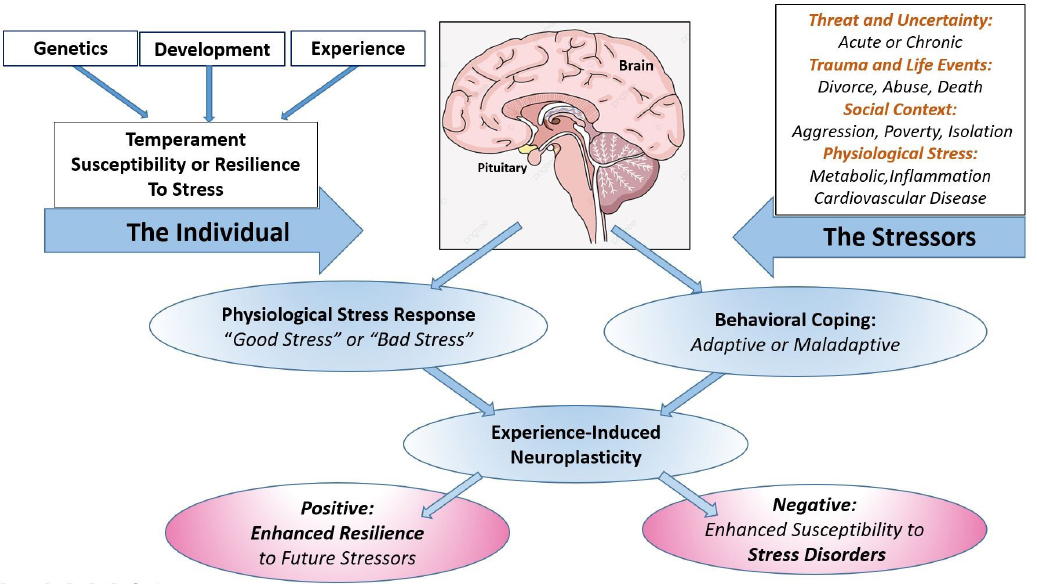
NOTE: The brain’s ability to adapt and reorganize by forming new connections in response to lived experience (neuroplasticity) is mediated by physiological and behavioral responses and ultimately influence an individual’s reaction to future stressors.
SOURCES: Presented by Huda Akil on March 24, 2025; adapted from McEwen and Akil. ©2020. CC-BY 4.0.
often described as allostatic load, which refers to the wear and tear on the body caused by prolonged and repeated stress—can lead to physiological changes in the hippocampus and impair behavior, decision making, and judgment, pushing individuals into survival mode (see Figure 1-2).
To counteract these harmful effects, understanding the biology of resilience is important. Resilience is built through a dynamic interplay of growth factors and neuroplasticity that shapes how people handle stress from infancy through old age (Aurbach et al., 2015; Evans et al., 2004; Turner et al., 2012). However, resilience is not solely a biological process—it is also shaped by environmental and social factors. In a research study with college freshmen at the University of Michigan, Akil recalled that initially, genetic markers offered only a modest forecast of who might develop depression, but as the pandemic unfolded, the real differentiator was the perception of social support (Turner et al., 2023). She added that even those with low genetic risk were not immune when the comforting effects of genuine support faded. Akil reflected that this study revealed that there are multiple types of resilience, genetic and nongenetic, and that psychosocial factors such as social support matter.
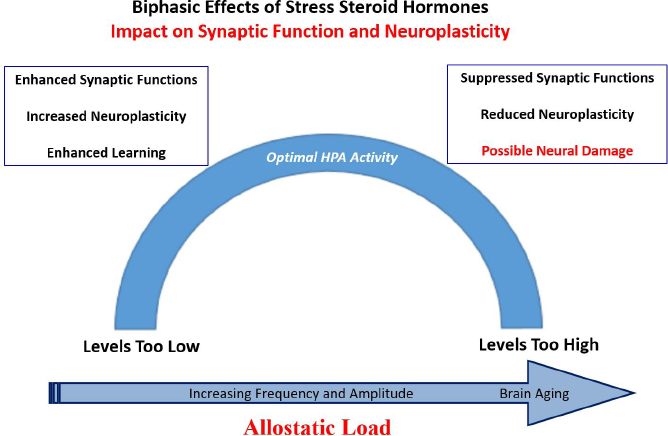
NOTES: In response to stress, hormones like glucocorticoids and key signaling molecules serve a dual role. In balanced amounts, they help the brain adapt and learn. However, when these chemicals are produced in excess or in an imbalanced way, they can undermine resilience and even cause harm. When the natural ability to recover is compromised—as is often seen in mood disorders—additional support or treatment may be needed to restore balance.
SOURCES: Presented by Huda Akil on March 24, 2025; adapted from McEwen and Akil. ©2020. CC-BY 4.0.
Akil underscored the importance of preventing stress disorders, but prevention requires the ability to predict susceptibility and resilience in a given individual as a prelude to intervention. The Michigan Freshmen Study on Stress and Resilience showed that prediction is indeed possible (Turner et al., 2023). Akil coined the term “stress fitness” to define the essential process of building a healthy stress response, emphasizing that resilience can be trained and developed throughout life just like physical fitness—even in old age. By understanding and actively improving stress management, individuals can foster a healthier response to life’s challenges.
WORKSHOP OBJECTIVES
The workshop aimed to address the rising prevalence of stress-related disorders and explore how resilience research can be strengthened through neurobiological insights (see Box 1). It included five sessions that spanned foundational topics such as the biological mechanisms of resilience and stress, as well as applied discussions on public health interventions and translational science. Personal resilience narratives from two individuals with stress-related disorders transformed abstract scientific discussions into tangible real-world insights.
In summary, this workshop provided a unique platform to advance scientific understanding and inspire new avenues for addressing the pressing challenges of stress and resilience. Emerging insights from research, such as the identification of biological markers of resilience and the benefits of perceived social support, underscored the potential for science to illuminate pathways toward fostering resilience in diverse populations, including children, adolescents, parents, and historically marginalized groups, and in varied contexts, including homes, communities, and workplaces.
ORGANIZATION OF PROCEEDINGS
This Proceedings of a Workshop is designed to summarize the discussions and presentations delivered throughout the workshop. Chapter 2 presents the narratives of two individuals who have demonstrated resilience in overcoming stress-related disorders, thereby grounding the discussion in authentic, real-world insights. Chapter 3 examines the neurobiological mechanisms of stress and resilience, setting a scientific foundation for the narrative. Chapter 4 then focuses on the importance of timing across the lifespan, while Chapter 5 explores other bodily manifestations of stress and resilience. Chapter 6 discusses clinical and public health interventions that translate these insights into actionable interventions, and Chapter 7 offers a comprehensive exploration of opportunities for promoting resilience. The references are provided in Appendix A and the workshop agenda in Appendix B.
BOX 1-1
Statement of Task
A planning committee of the National Academies of Sciences, Engineering, and Medicine will host a 1.5-day public workshop that brings together leaders and experts across sectors and disciplines (e.g., neuroscience, psychology, neurodevelopment, public health, medicine, and education) to explore the application of neurobiological insights on stress for building resilience.
Invited presentations and discussions may:
- Review scientific evidence on the global rise of stress, differences among populations, and the relationship between stress and development of systemic disorders (e.g., psychiatric, neurological, metabolic, cardiovascular, and autoimmune), highlighting specific examples.
- Examine recent discoveries illuminating the neurobiological mechanisms of stress susceptibility, distinct mechanisms of resilience, and individual differences in response to stress and building resilience.
- Consider the role of both childhood neurodevelopment and neuroplasticity across the lifespan in building early life and lifelong resilience (as opposed to stress susceptibility) and discuss effective approaches for optimizing resilience during critical and sensitive periods of neurodevelopment.
- Explore how these findings could inform public health programs and education to promote resilience to stress.
- Discuss research gaps and opportunities for studying resilience across research, clinical, and public settings.
A planning committee will develop the agenda for the workshop, select and invite speakers and discussants, and moderate the discussions. Following the workshop, proceedings of the presentations and discussions will be prepared by a designated rapporteur in accordance with institutional guidelines.
This page intentionally left blank.


