Use of Sustainable Materials for Erosion and Sediment Control Practices (2025)
Chapter: 4 Case Examples
CHAPTER 4
Case Examples
4.1 Introduction
This chapter documents approaches, drivers, challenges, and forward-looking plans for selected state DOTs that are reducing or eliminating the use of plastic-based products in ESC measures. The case examples of selected state DOTs document insightful information regarding details of their programs and progress in finding alternative products.
4.2 Selection of Case Examples
Data collected from the literature review and the survey questionnaire were used to identify state DOTs for more analysis using the following criteria:
- State DOTs that have had at least some experience using alternatives to plastic-based ESC measures
- State DOTs that have had experience developing specification, standard details, or other guiding documents for incorporating plastic-free ESC measures into their projects
- State DOTs that have successfully developed a policy requiring the use of natural materials for ESC measures
- At least one state DOT from each AASHTO region
- Willingness of state DOT survey respondents (28 of 42) to participate in a follow-up interview
Table 4.1 provides a summary of key details used to select states for case example interviews. Six case example interviews were conducted with the following state DOTs: Colorado, Georgia, Minnesota, North Carolina, Vermont, and Washington State. Case example interviews were conducted via Zoom video conference during the spring of 2024. Drafts of the case example summaries were reviewed and approved by participating state DOTs to ensure information presented is accurate.
4.3 Colorado DOT
Colorado DOT indicated in their survey response that they are actively reducing the use of plastic-based materials for temporary ESC practices. The DOT indicated they are currently in the process of developing specifications to reduce their dependence on plastic-based products. They reported the following challenges: product costs, product availability, development of design guidelines and specifications, product evaluation and approval processes, and performance and longevity of materials. The highest-ranked motivating factor for reducing the use of plastic-based products was wildlife entanglement, followed by an interest in reducing the agency’s carbon footprint. They list both erosion control and sediment control practices in their APL/QPL and consider both makeup of materials and country of origin when reviewing applications. To evaluate the
Table 4.1. Selection criteria for state DOTs included in case examples.
| State DOT | AASHTO Region | Primary Drivers & Motivation | Primary Challenge | Guidelines Provided to Contractors | Type of Materials or Origin Consideration | Involved in Related Research |
|---|---|---|---|---|---|---|
| Colorado | R4 | Wildlife entanglement | Several noted | None | Both | Yes |
| Georgia | R2 | Regulatory | Increased cost | Specifications & contractual requirements | Country of origin | No |
| Minnesota | R3 | Wildlife entanglement | Product evaluation & approvals | Specifications & contractual requirements | Type of materials | Yes |
| North Carolina | R2 | Wildlife entanglement | Performance, longevity, durability of materials | Specifications & contractual requirements | Country of origin | No |
| Vermont | R1 | Regulatory | Availability | None | Type of materials | Yes |
| Washington State | R4 | Microplastics | Several noted | Contract language | Type of materials | Yes |
performance of practices included in the lists, they rely on independent third-party testing, field evaluations, review of product specifications, and other internal review criteria.
4.3.1 Drivers and Motivation
Colorado DOT is moving away from the use of plastic-based ESC products primarily due to the known negative consequences associated with plastic-based waste, including micro- and nanoparticles. Another major driver in abandoning the use of plastic-based materials is associated with concerns about wildlife entanglement. In-house Colorado DOT ESC training programs discuss the known risk of wildlife entanglements in plastic nettings, primarily of amphibians, snakes, and other reptiles. There is also evidence of deer and elk pulling up newly placed ECBs as they walk across the netting. A third concern is entanglements to mowers and string trimmers.
Regulations are not driving Colorado DOT to move away from plastics; rather, the DOT has recognized that plastics in ESC measures could be replaced with more environmentally friendly and equally effective practices. Viable plastic-free options have been identified and sourced for ECBs; however, many other categories of ESC products do not have a viable plastic-free alternative. Alternatives to netting on erosion control logs and long-lasting plastic-free TRMs are examples the Colorado DOT has not been able to identify. The DOT has a strong interest in identifying biodegradable alternatives, since photodegradability does not work well for Colorado DOT due to tall grasses throughout Colorado.
4.3.2 Alternatives
Of the most used plastic-based ESC practices, ECBs and silt fence were identified by Colorado DOT as those that have the most negative impact on the environment or on wildlife. ECBs are associated with wildlife entanglements and plastic waste left on-site to degrade. Silt fence can inhibit overland travel of wildlife, especially small mammals and amphibians. The two practices are also susceptible to high winds that carry off materials that linger beyond their useful life. TRMs and erosion control logs were also identified as having a negative impact, primarily because of the amount of plastic they can contain and because they are not removed after installation.
Colorado DOT has used alternatives to plastic-based ESC products. ECBs can be manufactured using natural materials such as 100% natural weave jute with straw, coconut, or wood
excelsior. Observations by the DOT have indicated that these alternative blankets have generally performed as well as plastic-based ECBs. It was noted that logs composed of natural materials, such as jute, tend to fall apart when lifted to be replaced. Logs filled with compost have the advantage that the netting can be cut and that the materials can be left behind on-site to decompose. Wood strand mulch has also been used as an alternative to plastic-based products. When possible, Colorado DOT specifies the use of erosion control logs in lieu of silt fence sediment barriers. However, the project contractor commonly designs and selects ESC products based on preference and costs; consequently, plastic-free products may not be prioritized. Interestingly, the DOT noted a shift toward plastic-based track-out control mats in lieu of rock-based construction exit pads due to their portability and ability to be reused.
4.3.3 Challenges Faced and Experience Gained
Colorado DOT has not reported any additional installation oversight or maintenance requirements when using plastic-free alternatives. The only challenge encountered is ensuring that the proper materials specified have been installed. The DOT has experimented with wooden stakes for pinning RECPs; however, they reported that, while wooden stakes are biodegradable, they remain in the ground for extended periods and can become a trip hazard and maintenance burden. Steel sod staples and pins have been preferred for installation.
The DOT reported that several natural-based alternatives for ECBs and wattles are available on the market. It has no knowledge of challenges associated with sourcing these plastic-free ESC alternatives; however, identifying suitable plastic-free alternatives to silt fence and TRMs has been challenging.
As other state DOTs seek to move away from plastic-based ESC materials, the Colorado DOT offers considerations based on their experience. They suggest that DOTs educate themselves about driving issues such as wildlife entrapment, mower entanglements, and other negative consequences associated with plastic-based products. Based on experience, ECBs are the easiest plastic-free products to implement. Many natural-based alternatives are available, which can be installed, inspected, and maintained in the same way as plastic-based ECBs.
Colorado DOT indicated interest in having a better understanding of the types of materials and dyes used in hydraulic-based mulches. As additional plastic-free ESC product alternatives become available on the market and tested, Colorado DOT is interested in incorporating their use.
4.4 Georgia DOT
Georgia DOT indicated in their survey response that they are actively reducing the use of plastic-based materials for temporary ESC practices. They currently have a formal policy and informal guidelines or preferences in the selection of plastic-free ESC products. They reported product costs, product knowledge, materials performance, and longevity as their greatest challenges regarding the use of alternative, plastic-free options. The highest-ranked motivating factor for reducing the use of plastic-based products was policy from regulatory agencies, followed by wildlife entanglement. They list both erosion control and sediment control practices in their APL/QPL and consider country of origin when reviewing applications. To evaluate the performance of practices included in the lists they rely on independent third-party testing, field evaluations, materials property evaluations, and reviews of product specifications.
4.4.1 Drivers and Motivation
In 2014, Georgia DOT began moving away from the use of plastic-based products, primarily ECBs. This trend was driven by requirements associated with work within the proximity of the
endangered Indigo snake species. Concerns over their entanglement within ECBs was a primary driver. Unlike in other states interviewed, plastic-based waste was not a primary driver for plastic-free alternatives. Georgia DOT does not have a target date to be 100% plastic-free in their ESC measures. The Georgia Stormwater Manual encourages avoiding the use of inorganic materials along waterways and areas directly adjacent to waterways; however, the governing state regulatory agencies, the Georgia DNR, and the Georgia Environmental Protection Division have not created regulatory requirements to move away from plastic-based products.
4.4.2 Alternatives
Of the most used ESC products, Georgia DOT reported that RECPs have the most observable negative impact on the environment or wildlife. Snake, lizard, and bird entanglements have been observed by the agency. In addition, the DOT has reported mower entanglement with RECPs.
In certain projects in which the Indigo snake species is present, Georgia DOT eliminates the use of plastic-based nettings. They require contractors to use plastic-free nettings or hydraulic-based products, such as their Type II Bonded Fiber Matrix. At a pre-construction conference, contractors are made aware of cases in which alternatives are required.
Georgia DOT finds it difficult to definitively indicate whether plastic-free alternatives have performed in the same way as their traditional plastic-based counterparts. They noted that areas subjected to heavy rain and wind may experience more washout and blowing of loose materials compared to plastic-based netting products with better anchoring. The DOT uses hydraulic-applied materials together with polyacrylamide to help anchor loose materials. To pin RECPs, Georgia DOT has experimented with wood stakes, which have not performed well. They require metal pins for anchoring.
Observations indicate that wood fiber products have outperformed 100% synthetic products, especially in TRM applications within channels. These products have faster germination rates.
4.4.3 Challenges Faced and Experience Gained
No additional installation, oversight, or maintenance items were identified by Georgia DOT. The department has an existing requirement that the inspection of every product used on a jobsite must be inspected within 7 days of installation to ensure the product is installed per the specifications and that an approved product is used.
The DOT did not report any challenges identifying plastic-free ESC products. The DOT’s QPL provides a list of the various products and manufacturers approved for use. The DOT indicated that contractors sometimes have difficulty sourcing products, especially in rural southern areas of the state, where the Indigo snake is primarily found.
Georgia DOT attributed success in their use and adoption of plastic-free alternatives to having a well-organized and well-vetted QPL. In investigating other alternatives, Georgia DOT has limited the use of slash mulch berms, but together with, rather than in lieu of, a silt fence. They noted a limitation in not being able to use slash mulch berms near water bodies, since they are prohibited from using fill materials in those areas.
4.5 Minnesota DOT
Minnesota DOT indicated in their survey response that they are actively reducing and moving toward eliminating the use of plastic-based materials for temporary ESC practices. Minnesota DOT indicated they currently have existing details, specifications, and formal guidelines for the selection of plastic-free ESC products. They reported the following as their greatest challenges
regarding the use of alternative, plastic-free options: product evaluation and approval; understanding performance, longevity, or durability of materials; and best management practice (BMP) additions and modifications by industry without a full understanding of benefits. The highest-ranked motivating factor for reducing the use of plastic-based products was wildlife entanglement concerns, followed by equipment entanglements. The DOT lists both erosion control and sediment control practices in their APL/QPL and considers makeup of materials when reviewing applications. To evaluate the performance of practices included in the lists, they rely on independent third-party testing, field evaluations, and property evaluations of materials.
4.5.1 Drivers and Motivation
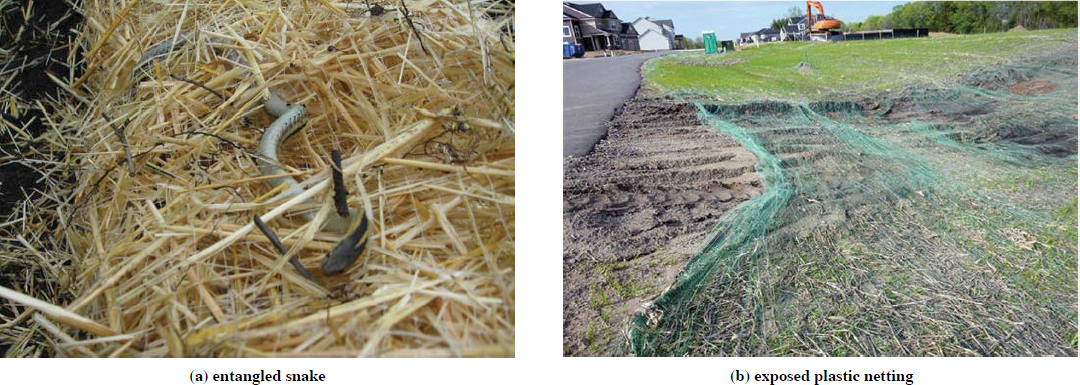
Minnesota DOT began exploring the use of non-plastic-based ESC products in 2003, stemming from pressure from the Minnesota DNR to move away from plastics used in ECBs and hydromulch. One of the early drivers for reducing the use of plastics in ESC practices was trapped snakes and salamanders [see Figure 4.1(a)]. In addition, evidence exists of birds using plastic netting in nests. In the early 2000s, Minnesota DOT maintenance crews damaged two mowers because plastic nettings from ECBs damaged bearings on the blades. ECBs are subjected to tenting when an improper anchoring pattern or inadequate staking is used [see Figure 4.1(b)], which can lead to entanglements and equipment fouling. As a result of those incidents, Minnesota DOT banned the use of plastic-based nettings in urban areas subjected to regular mowing activities. In 2014, Minnesota DOT adopted a standard specification that bans the use of plastic-based, temporary ESC products.
Minnesota DOT does not allow plastic in RECPs when alternatives are available. Plastic-based TRMs are allowed as a permanent practice with no viable, long-term, non-plastic alternative. In addition to RECPs, Minnesota DOT does not allow synthetic fibers in hydromulch, although they recognize that the fibers enhance product performance. In addition to banning plastics in temporary ESC products, Minnesota DOT does not allow malachite green dye in hydromulch. The dye is categorized as a cationic triphenylmethane that is carcinogenic and genotoxic.
The recent version of the Minnesota Pollution Control Agency’s CGP highly recommends the use of natural-based netting (see Appendix D for language). Minnesota DOT predicts that, within the next several years, the state regulatory agency will enforce a full ban on plastic-based products.
4.5.2 Alternatives
Based on their observations, Minnesota DOT perceives ECBs to have the most negative impact on the environment or wildlife, primarily due to plastic netting causing the entrapment of wildlife. They noted that quantification of entrapment mortality can be difficult, since larger prey may harvest trapped wildlife before they are discovered by staff during inspection activities.
Minnesota DOT has had success with plastic-free erosion prevention products including coconut coir and other natural materials. They rely on wood fiber (excelsior) for armoring ditches and blown straw for slopes with no loss in performance. Practices using natural materials have not shown a loss in performance; in fact, observations have shown that these practices have a higher level of performance compared to their plastic counterparts. Specifically with the use of ECBs, the agency has noted superior adhesion to the soil, even when fewer staples or improper anchor patterns are used. The natural-based products better form to the ground topography, thereby providing more intimate contact. Plastic-based ECBs “tent” more easily than natural-based alternatives. Minnesota DOT has observed a better outcome with natural blankets installed incorrectly than with plastic-based ECBs installed correctly. While no side-by-side testing has been conducted, observations indicate better performance.
Minnesota DOT reported higher initial costs of natural-netting products. However, as demand increased for these products, manufacturers increased supply and availability; as a result, costs were reduced. Products with natural netting are cheaper than their plastic counterparts within the state.
4.5.3 Challenges Faced and Experience Gained
Minnesota DOT faced initial challenges as they made their transition away from plastic-based ESC products. Most notably, a major ESC manufacturer based in Minnesota was reluctant, primarily because it did not want to lose a major market sector.
Minnesota DOT noted that additional installation oversight or inspections have not been needed for non-plastic products. Even when not installed correctly, natural materials continue to function adequately. Natural materials are more resilient; they outperform plastic-based products when improperly installed. Like many other state DOTs, Minnesota DOT is experiencing staffing shortages and great pressure to stretch resources. The push toward natural-based products is perceived to save time in inspection burden. Minnesota DOT has not faced many challenges identifying or sourcing plastic-free ESC products.
Minnesota DOT attributed their success in their shift from plastic-based materials to their approach of starting with ECBs, the “low hanging fruit.” This product category has the greatest selection of alternatives available on the market. Minnesota DOT noted costs were not a concern, since the market would adjust as demand increased and more competition was introduced. The additional advantage in starting with ECBs was that installation and maintenance did not change, but remained identical to plastic-based counterparts.
As Minnesota DOT uses more natural-based products, they are interested in moving away from imported materials such as coconut. They are uneasy about the use of unfair labor practices in the countries of origin, as well as concerns about invasive species, such as spiders, that can be transported during the importation process. Minnesota DOT is considering domestic-grown hemp fibers as a potential product to replace coconut-based products. In addition, hemp fiber could be used in the sleeves and netting of wattles and sediment logs. Several domestic ESC product suppliers are already producing products using hemp, which is touted as farm-based, natural-based, and made in the United States. Additional concerns about plastic materials in other ESC-related items include plastics in slow-release fertilizers.
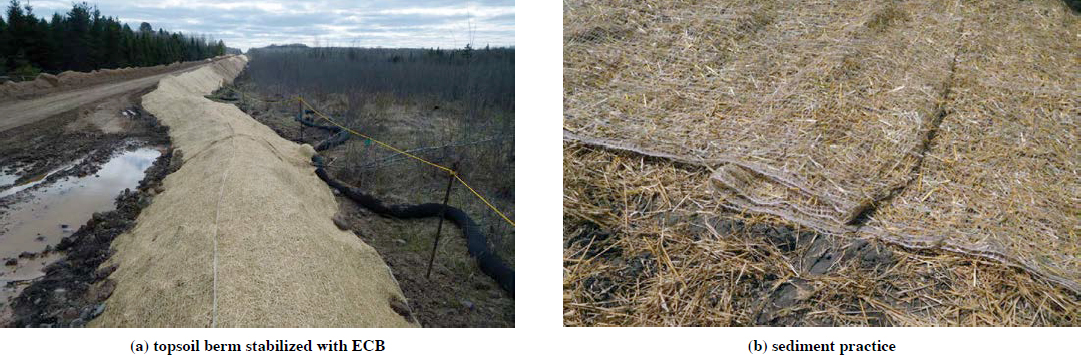
Minnesota DOT has been innovative in their move away from plastics. For example, they rely more on natural-based features such as site topography and grading to better manage stormwater runoff. They also rely on non-traditional practices such as topsoil berms, muck berms, and slash mulch berms. These practices can be used together with ECBs, hydromulch, and weirs to provide erosion control and controlled release of overflows [see Figure 4.2(a)]. Minnesota DOT has also experimented with innovative practices, including the “sedimat,” which consists of rolling ECBs within a channel to create folds that reduce velocity and promote sedimentation, as shown in Figure [4.2(b)]. Minnesota DOT has also used ECBs at the edge of pavement, anchored with a tackifier or bonded fiber matrix to reduce reliance on traditional sediment barriers.
Minnesota DOT has submitted internal research proposals to investigate methods to retrofit roadside channels and other stormwater features to capture plastic waste and other hazardous waste (e.g., medical and sharps) before discharge from the right of way.
4.6 North Carolina DOT
North Carolina DOT indicated in their survey response that they are actively reducing and working toward eliminating the use of plastic-based materials for temporary ESC practices. They currently rely on informal policies for reusing plastic-based materials but have no other guiding documents for the selection of plastic-free ESC products. They reported understanding longevity or durability as their greatest challenge regarding the use of alternative plastic-free options. The highest-ranked motivating factor for reducing the use of plastic-based products was wildlife entanglement concerns, followed by regulatory permit requirements. North Carolina DOT lists both erosion control and sediment control practices in their APL/QPL and considers country of origin when reviewing applications. When considering products to be included in the lists, they rely on independent third-party testing, in-field demonstrations and evaluations, property evaluations of materials, and property specifications of materials.
4.6.1 Drivers and Motivation
North Carolina DOT started moving away from plastic-based ESC products between 2010 and 2015 due to a desire to remove plastic nettings from jobsites. Since the initial movement, the DOT has eliminated the use of most plastic-based nettings, starting with RECPs in riparian areas. Some plastic-based netting is used today, but to a limited degree. The DOT is continuing
to slowly move toward more plastic-free ESC products. They recognize that, although temporary in nature, it is not uncommon for ESC devices to be left out past their intended duration. These devices rarely decompose and often become a source of waste. To date, North Carolina DOT policies have been driven by compliance requirements with permits and regulations. According to the interviewees, the reduction of plastic-based products was initiated by the state regulatory agency after input from public environmental groups within the region. While the DOT is gradually moving away from plastic-based products, there is no specific target date to be 100% plastic-free.
4.6.2 Alternatives
North Carolina DOT perceives that plastic-based netting products are the most obvious and commonly used plastic-based ESC products with negative consequences for the environment and wildlife. Unlike other ESC practices and products, netting-based materials (e.g., ECBs and wattles) are not commonly removed from the jobsite at the end of construction activities. Netting-based products can lead to wildlife entanglements, commonly with snakes and birds, and also become damaged and torn by mowers, thereby allowing the product to degrade enough to break free and end up in stormwater systems. Silt fences were also identified as a problematic product, since it is frequently used on construction sites and commonly left behind. Currently, the DOT relies heavily on stone-based practices; however they desire to move away from these due to cost and need of materials.
North Carolina DOT has developed specifications for materials and design that allow for a wide variety of products to be used on jobsites. A variety of plastic-free alternatives has been used by the DOT, including cotton-based products, coir mattings, and other natural materials. These materials have been used for many different practices, including RECPs and wattles.
The DOT reported that, for most applications, plastic-free alternatives seem to be working adequately compared to their plastic-based counterparts. One difficulty that was encountered early on involved original cotton-based products. Weaving commonly became loose, thereby leading to inadequate ground cover and encapsulation of wattles. More recent product iterations, including those that have incorporated leno weave patterns, are performing better. For vegetative establishment on slopes, the DOT has experienced performance comparable to that of plastic-based products. In areas with high shear and high velocity, such as channels, the DOT relies more on structural-based practices. Alternatives to RECP anchors have been investigated, namely wood and corn-based plastics; however, they have not performed adequately. Metal 6-inch landscape staples continue to be used.
4.6.3 Challenges Faced and Experience Gained
North Carolina DOT did not report any specific additional requirements for installation oversight, inspection, and maintenance of plastic-free ESC products. Across the board, ESC installations are always a problem, but not attributed specifically to makeup of materials. The DOT reported that plastic-free ESC products are installed the same way as are traditional plastic-based products, and their maintenance is also similar.
North Carolina DOT has experienced some challenges identifying plastic-free alternatives. This challenge has been primarily due to inconsistencies in terminology regarding generic performance-based specifications. Cost limitations have also restricted a contractor’s ability to select plastic-free products. Innovative plastic-free products that have entered the market have been difficult to source. For example, the DOT has experimented successfully with wattles filled with miscanthus and switch grass as alternatives to excelsior and coir; however, these alternatives are not widely available.
The DOT indicated that challenges in their shift away from plastic materials have not been many. However, they noted that the agency relies many different materials for ESC practices and that a complete switch to plastic-free might put a strain on supply. The DOT has experienced the expected initial resistance from contractors reluctant to adopt the use of alternative products and those willing to place blame on new products for failures.
North Carolina DOT attributed their success in adopting plastic-free alternative measures to their incremental approach. According to interviewees, the DOT relies on input from regulators and environmental groups. The gradual shift in policy has allowed the agency to gradually enter new product sectors, which has facilitated a steady transition. The DOT recognizes that a substantial amount of plastic-based materials remain in use and that opportunities are available for continuous improvement. They noted that a suitable alternative to silt fence does not exist. The DOT plans to continue with the same general approach in their transition from plastic-based products until an outside driver changes course.
North Carolina DOT has a delegated environmental program from the North Carolina Department of Environmental Quality, which allows them to approve plans and conduct their own inspections. This flexibility and latitude facilitates innovation and the ability to develop unique designs and use products that may not have been allowed in other areas due to risk of failure.
4.7 Vermont Agency of Transportation
The Vermont Agency of Transportation indicated in their survey response that they are actively reducing and working toward eliminating the use of plastic-based materials for temporary ESC practices. They rely on existing details and specifications for the reduction of plastic-based ESC products. They reported as their greatest challenge the availability of plastic-free alternatives to perimeter control measures such as silt fence and barrier fence. They list both erosion control and sediment control practices in their APL/QPL and consider makeup of materials when reviewing applications. When considering products to be included in the lists, they rely on independent third-party testing, property evaluations of materials, and property specifications of materials.
4.7.1 Drivers and Motivation
The Vermont Agency of Transportation began moving away from plastic-based products in 2008. They started with ECBs, primarily due to wildlife entanglement, particularly with snakes. Although state DOTs are aware of environmental concerns associated with plastic-based waste and microplastics, they are not as urgent as wildlife concerns. The move toward plastic-free ESC products was initiated by the Vermont Agency of Transportation; however, the agency worked closely with the Vermont Department of Environmental Conservation to coordinate the development of guidelines, which included plastic-free ECBs. The state regulator incorporated the same plastic-free requirements for ECBs when the agency adopted their plastic-free specification changes. The agency does not accept any plastic-based ECBs on their jobsites. Wattles with plastic netting are allowed only if they are removed from the site before the project is turned over to the agency. The DOT does not have a target date to be 100% plastic-free with their ESC practices.
4.7.2 Alternatives
Of all the products used for temporary ESC, the Vermont Agency of Transportation perceives RECPs to be the most detrimental to the environment or to wildlife. Silt fence practices and wattles were also noted as problematic, primarily if they are not removed after construction and discarded after a single use.
The agency has relied on natural-fiber ECBs composed of cotton or jute nettings. The plastic-free alternatives have been reported to perform well, provided they are installed properly. ECBs sometimes do not provide good ground contact. Anecdotal observations have indicated that loose mulch seems to provide better seed germination and growth compared to matting materials.
No additional installation oversight, inspections, or maintenance burdens were reported by the Vermont Agency of Transportation when using plastic-free products. The alternative products are installed in the same way as are plastic-based counterparts, and no additional oversight has been needed due to changes of materials.
4.7.3 Challenges Faced and Experience Gained
The Vermont Agency of Transportation is not aware of any challenges identifying or sourcing plastic-free ECB materials or products. The agency noted that plastic-free materials were common industry offerings from most of the major ESC product producers, thereby making the transition easier. Initially, costs were slightly higher than for plastic net matting. Currently, materials are readily available, and the agency does not receive complaints from contractors or encounter any additional issues related to establishing vegetation. The agency’s APL is a valuable tool to ensure contractors have options when selecting the appropriate type of matting for site conditions. The DOT has an interest in using more compost on jobsites, although it is not widely available at scale in Vermont.
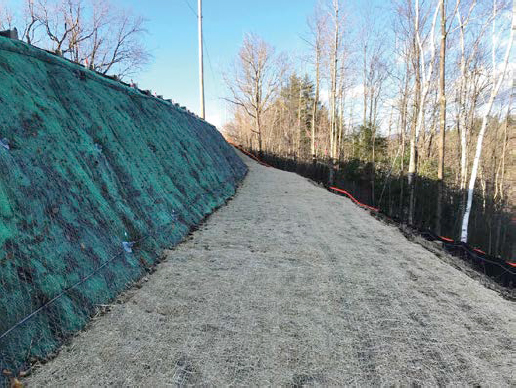
The Vermont Agency of Transportation allows the use of plastic-based RECPs for TRMs in locations where vegetation will not sustain expected flow conditions or provide sufficient long-term erosion protection, since a suitable plastic-free alternative does not exist (Figure 4.3). During design, the agency specifies the practices (temporary versus permanent) to be used; the decision is not left to the contractor. Silt fence continues to be widely used; however, the agency reviews projects in design to ensure that, when silt fence is called for, it is used in appropriate locations and not unnecessarily. The agency prefers to use wattles and wood chip berms (e.g., slash mulch berms) where appropriate in lieu of silt fence practices.
4.8 Washington State DOT
Washington State DOT indicated in their survey response that they are actively reducing and working toward eliminating the use of plastic-based materials for temporary ESC practices. The DOT indicated that they currently rely on existing details and specifications for the reduction of plastic-based ESC products. They reported as their greatest challenges the availability of plastic-free alternatives, development of details and specifications, product knowledge, and product evaluation and approval; notably, all challenges were ranked as moderate. The highest-ranked motivating factor for reducing the use of plastic-based products was related to microplastic waste concerns, followed by wildlife concerns. A key goal of the DOT is to prevent microplastics and fragments of intact netting materials from entering surface waters. They list both erosion control and sediment control practices in their APL/QPL and consider type of materials when reviewing applications. When considering products to be included in the lists, they rely on independent third-party testing, property evaluations of type, property specifications of materials, and a compliance certification signed by an executive authority.
4.8.1 Drivers and Motivation
Washington State DOT first started amending specifications to move away from plastic-based ESC products in 2016. This process included coordination with manufacturers, distributors, and other state DOTs to collectively move toward more sustainable ESC practices in the interest of creating a “united front” to inspire the industry to make more sustainable and affordable products available. Initial interests focused on eliminating the use of plastic netting commonly used in ESC products, including ECBs, compost socks, and wattle encasements. The DOT used a process of updating specifications to eliminate plastics in ESC, which was published in 2017.
A major catalyst and the “tipping point” toward reducing and eliminating the use of plastic-based products was driven by violation notices received on sites where netting encased products were found on a wetland mitigation site several years after construction activities had been completed. Although the netting materials used for the project had been marketed as photodegradable, the site had been stabilized for approximately 3 years, and plastic netting was present. Upon inspection by the state regulator, the DOT was held accountable for the present netting materials, which led to substantial rework and costs to the DOT associated with removal and re-planting of the mitigation site.
Washington State DOT indicated that they have experienced situations in which the validity of the term “biodegradability” used in ESC products marketing carries little weight [see Figure 4.4(a)]. Current biodegradability testing methods are based on landfill conditions, which are substantially different than conditions experienced along a roadside environment. In addition to biodegradability concerns, Washington State DOT experienced wildlife entrapments within netting [see Figure 4.4(b)]. The waste generated by microplastics was also a growing concern.
As Washington State DOT reworked their standard specifications, they amended language to indicate materials had to be manufactured from natural plant-based materials. Specifications require that materials be made from natural plant fibers unaltered by synthetic materials. The DOT requires that ESC products used on projects perform effectively to manage erosion until vegetation is established, which allows for some product degradability as long as the practice continues performing its function. The DOT does not have a current target deadline for a complete ban of ESC products. They emphasized their interest in using natural alternatives to plastic materials. They welcome innovative ideas and encourage industry to bring new ideas to the table.

4.8.2 Alternatives
The DOT identified RECPs as most detrimental to the environment or wildlife. In addition, the improper use of plastic sheeting can have negative consequences. Plastic is often used to provide immediate cover and protection from raindrop impact; however, it can also increase the amount and velocity of runoff. If used for long periods, plastic can become brittle, break down, and be transported into water bodies. Silt fence was also identified as a problematic practice, because it is frequently not installed or maintained properly and can lead to increasing flows that accelerate soil loss and sediment transport into receiving water bodies and adjacent areas.
Washington State DOT has adopted plastic-free and synthetic-free product requirements for most temporary ESC practices, including compost socks, ECBs, and hydromulch. No viable alternatives have been found for silt fence sediment barriers. The DOT strongly advocates for earth berms, compost socks, and slopes that drain away from sensitive areas and surface waters during grading to limit reliance on silt fences. For instances in which silt fences are used, the DOT requires their complete removal, along with all non-biodegradable materials, before permit termination.
The DOT has not encountered any difference in performance using plastic-free products. In some cases, the alternatives have outperformed their plastic counterparts. Some cotton-based RECPs have been observed to break down more quickly and are difficult to store and stage on jobsites before their implementation. Coir and burlap products have been found to be more effective than plastic-based measures regarding durability and shelf life during staging before installation on-site. Natural-based RECPs have been observed to better conform to the contours and make effective ground contact.
No additional installation oversight, inspection, and maintenance burdens have been observed by the DOT when using plastic-free alternatives. The installation of practices is similar to that of plastic-based counterparts, and no updates to standard details have been needed for plastic-free alternatives. Interestingly, the DOT has experienced cost savings due to a reduction in
maintenance and removal. With plastic-free products, measures can be left in the field to decompose and do not need to be removed prior to permit termination, thereby leading to cost savings. No long-term issues have been reported with maintenance; furthermore, natural materials benefit from the lack of netting entangled in mowers. The DOT encourages project personnel to work with their region maintenance program to ensure materials left in place will not pose challenges. In some cases, when longer term protection is needed, additional products may need to be applied to provide protection.
4.8.3 Challenges Faced and Experience Gained
Washington State DOT indicated that the greatest challenge moving toward plastic-free ESC options was overcoming resistance to change. The pandemic contributed to supply-chain issues and made it difficult to source plastic-free products. International conflicts and other importation issues have made procurement challenging at times. The DOT noted that most manufacturers now have a natural net option due to increasing demand. Washington State DOT’s local contractors have indicated plastic-based products are becoming less common.
As Washington State DOT moves forward reducing their reliance on plastic-based ESC products, they are emphasizing domestically sourced materials. The DOT has interests in seeing hemp used more due to its high degree of durability. Washington State DOT recognizes it has significant influence on the industry, since many municipalities adopt their specifications.


