Identifying Midlife Social Exposures That Might Modify Risks of Cognitive Impairment Associated with Early Life Disadvantage: Proceedings of a Workshop (2025)
Chapter: 3 Life Course Models of Cognition and Risk of Dementia
3
Life Course Models of Cognition and Risk of Dementia
This session was directed at answering three questions: What are the most important midlife social and institutional pathways through which early life social disadvantages create risk for later life cognitive decline and dementia? What datasets and methodologies will be most important? And, what are the most important data and methodologic needs for the field to advance?
DATA LINKAGES AND NOVEL METHODOLOGIES
Yang Claire Yang, Alan Shapiro Distinguished Professor at the Department of Sociology and the Lineberger Comprehensive Cancer Center and Fellow of the Carolina Population Center and Carolina Center for Population Aging and Health at the University of North Carolina at Chapel Hill, started by providing a general overview of how risk and protective factors across the life course affect late life cognitive decline, as shown in Figure 3-1. Cognitive decline’s trajectory over time is affected by both social-structural and individual factors and through both social and physical pathways.
Yang identified two major research gaps. First, though cognitive aging is viewed as lifelong, the characterization of change over the full lifespan is lacking; instead, studies are focused mainly on older adults. The brain and cognitive reserve hypothesis implies that AD-related pathophysiology has early life origins, but the hypothesis rarely has been tested empirically. Longitudinal studies of cognitive changes, including timing, course, and slope of changes, have shown power in predicting the longitudinal risk of dementia, but Yang said the studies are mostly focused on older adults and
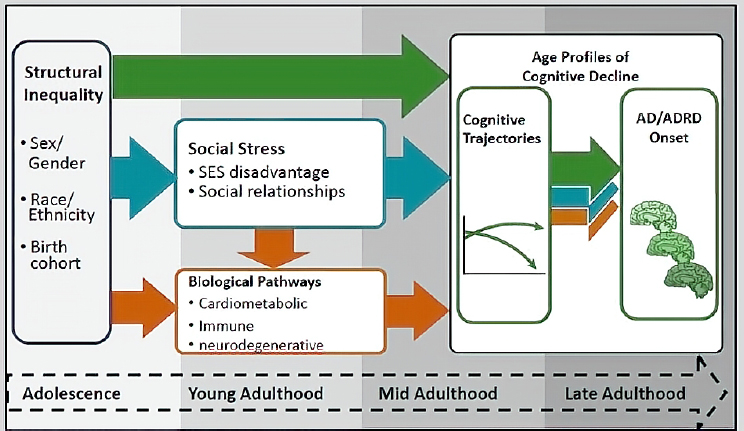
SOURCES: Presented to the panel by Yang Claire Yang on August 29, 2024; adapted from https://www.cpc.unc.edu/research-themes/projects/life-course-process-of-alzheimers-disease-sex-difference-and-biosocial-mechanisms/
that risk should be investigated by studies of adults of all ages. Second, social inequities in cognitive aging are not fully documented or understood; the results are based largely on older adults and are mixed in what they show. The linkage between early life social disadvantage and later life cognitive trajectory has not been consistently established.
Yang said the largest barrier is that there is no single nationally representative study in the United States that has observed the full life course beginning in the early life period and extending through old age. There is also a lack of data on early and midlife exposures and risks. Studies often have been limited to small, nonrepresentative samples and cross-sectional or short-term longitudinal analyses within a single life stage, such as old age. These studies often suffer from confounding of aging and cohort effects.
Yang said these challenges can be met through three linkage and modeling approaches across multiple databases, with the exact approach depending on whether and how the databases overlap. The first approach combines multiple longitudinal cohort studies across the full life course. Ideally, the databases overlap, though each study may start with a different age cohort, allowing a testing of both interindividual changes within cohorts and intraindividual variations across cohorts. A more complex situation arises when databases do not overlap in measures and/or age. Then one can combine the databases while using a synthesized-cohort sequential design. This is
done by using integrative data analysis (IDA), using either a coordinated IDA that fits parallel models to separate samples and compare results across studies (usually for studies that do not overlap in measures and/or age) or a pooled IDA that combines datasets from separate samples using the synthesized-cohort sequential design for overlapping measures (Yang et al., 2016). Not only does this approach meet both challenges, but it also allows the modeling of heterogeneity across studies to enhance population-based inference.
Yang presented results based on integrating data from four national population-based cohort panels from Add Health, HRS, MIDUS, and the Americans’ Changing Lives study, which resulted in a total analytic sample of more than 50,000 individuals over 25 years (Figure 3-2; Yang et al., 2023). They used linear mixed-effect growth-curve models and conducted both pooled IDA of episodic memory measures and coordinated IDA of overall cognitive ability. Memory was found to peak between ages 25 and 35, and then declined at an estimated one standard deviation of the standardized memory score per decade of life. Disparities associated with sex, race, and education originated early in life, with women, White people, and the most educated showing the highest scores and with fewer cognitive returns from higher education found among racial/ethnic minorities
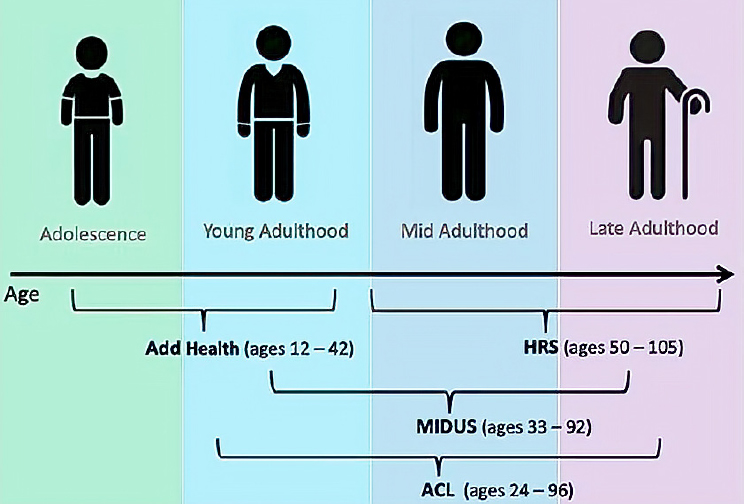
SOURCES: Presented by Yang Claire Yang on August 28, 2024; taken from Yang et al., 2023.
(see Figure 1-1). Furthermore, successively later-born cohorts had higher average memory scores and slower rates of decline than their predecessors, but in more recent cohorts social disparities increased within the cohorts. These disparities included higher advantages for women over men and larger racial gaps. The improvements seen in later cohorts suggest that there were positive sociocultural influences, most notably including advances in educational attainment. Yang said the increased divergence across cohorts suggests the need to reduce inequalities in more recent post-baby boomer cohorts.
The second approach links longitudinal trajectories earlier in life to time-to-event data in late life. Yang presented an illustrative example and results on the progression of cognitive decline using data from the Aging Demographic and Memory Study (ADAMS), a random sample from HRS 2000 and 2002 with comprehensive evaluation and diagnosis of dementia between 2001 and 2009, linked to HRS starting in 1996 and with up to 12 years of follow-up (Walsh et al., 2022). The study used a joint latent class mixed modeling method. That is, it first integrated a joint modeling approach for simultaneous analysis of longitudinal changes in a marker and the time to an event of interest, and next used a latent class mixture modeling approach to detect population heterogeneity and identify underlying classes with distinct characteristics of longitudinal change. The researchers identified three age profiles each showing different trajectories of decline: rapid cognitive decline, moderate progression, and optimal cognitive aging. Yang commented that it is important to formally account for the strong dependency between various age-related processes (cognitive decline, the occurrence of dementia, and death) to produce unbiased estimates.
A third approach is to link survey data to validated external data for enhancing key measures of midlife socioeconomic status. Yang used this approach to construct measures of occupation-related cognitive stimulation using Add Health (Stebbins et al., 2022; Zhang & Yang, 2024). They linked measures of analytic skill, social interaction, and job inflexibility from the Occupational Information Network (O*NET) to complement the measure of job freedom provided by Add Health. They found that higher early life SES is significantly associated with jobs that involve more analytic skills, social interactions, job flexibility, and job freedom. Adjusting for adult education mediated these associations, but the effects remained significant for all job characteristics except for job freedom. Next, looking at memory scores, they found that jobs requiring more analytic skills and social interaction and providing more job freedom are significantly associated with higher memory scores, adjusting for prior cognitive ability and early life SES. In sum, improvements in cognitive health in midlife may be achieved through changes in workplace, regardless of early life SES background.
Yang concluded with a few comments about data and methods needs. First, Yang said the heterogeneity of cognitive measures across studies creates a huge challenge for data harmonization. The standardization method may lead to bias if the construct is not the same across measures and datasets. Second, Yang said additional longitudinal follow-ups are needed for the young to mid-adulthood age ranges, where the data are the thinnest. Third, Yang said causal pathways could not be examined with current data. Future research is needed to include assessments of structural measures of disparities and assess potential cultural bias in survey-based cognitive measures that may disadvantage minority older adults. Other explanatory factors of individual differences in cognitive decline (biological, behavioral, and psychosocial) also need to be included. Fourth, the ADAMS database is small, particularly for Black people, and Yang said there is a need for larger and younger samples with more years of follow-up. Fifth, the occupational data are cross-sectional, and Yang said there is a need for longitudinal data on both employment and cognitive function throughout midlife until retirement. Finally, Yang said future research is needed to expand multidimensional meso-level SES measures by including additional domains of occupational constraint, resources, and demands, taking into account the increasing prevalence of work precarity and those jobs that produce chronic work-related stress.
SOCIAL AND INSTITUTIONAL PATHWAYS TO DEMENTIA
Adina Zeki Al Hazzouri, Assistant Professor of Epidemiology at Columbia University, started by noting that much of the prior work on modifiable risk factors for dementia prioritized clinical and lifestyle risk factors, and not the social determinants. The social epidemiology of dementia has shied away from complex concepts such as economic volatility and financial security in peak working and earning years or in midlife. Persistent SES inequalities mean that many working-age Americans will enter retirement in worse financial standing than people did in prior decades. And there are straightforward ways of addressing financial security and well-being, including unemployment wage insurance, earned income tax credit, and the SNAP.
Based on data from the Coronary Artery Risk Development in Young Adults Study (CARDIA), Zeki Al Hazzouri described finding relationships between the experiences of sustained poverty and income volatility and brain health indicators such as declines in total brain volume, verbal memory, processing speed, and executive function (Zeki Al Hazzouri & Yaffe, 2017). CARDIA does not use a nationally representative cohort, but similar findings appeared using data from the National Longitudinal Survey of Youth 1979 (NLSY79), which uses a national cohort (Colvin & Zeki Al
Hazzouri, in progress). Also, data from the HRS show that workers with sustained low-wage exposure experience about one excess year of memory aging per 10-year period compared to those who are never low-wage workers (Kezios & Zeki Al Hazzouri, 2022).
Zeki Al Hazzouri said food insecurity (inadequate and unreliable access to food) is often experienced by people of low SES or who are living in poverty. Based on findings from HRS, food insecurity is associated with 0.67 excess years of cognitive aging over a decade as compared with people who are food secure (Lu et al., 2023a). SNAP is one of the largest social safety net programs targeted at food insecurity, but less than half of those who are eligible for SNAP sign up. Reasons for eligible individuals not enrolling in SNAP may include factors such as stigma and the paperwork burden involved in signing up. Lu et al. (2023b) found that among SNAP-eligible people, SNAP non-users had about two excess years of cognitive aging over a 10-year period compared with users; however, little is known about use versus non-use at different ages, such as midlife versus older age. Hector González raised the question whether the issue is food insecurity or nutrition, given the importance of nutrition to the developing brain of a child.
Zeki Al Hazzouri discussed the datasets she used. Key advantages of CARDIA and NLSY79 are that they offer rich data on social and financial determinants in young adulthood and into midlife. Relatedly, the key advantages of HRS are that it is rich in social and financial determinants of health, especially for people close to retirement, and also has long follow-up in later life with detailed cognitive assessments.
The following are some of the methodological needs and challenges, according to Zeki Al Hazzouri.
- One key challenge of aging cohorts is the limited data from the midlife exposure period. Taking the example of HRS, Zeki Al Hazzouri said there is only financial information from midlife on, even though the health effects of financial standing (e.g., wage earning) across the entire working life course are important, especially in peak working and earning years (which begin before age 50). This is a common challenge: datasets do not often have both the exposure information and the outcome information of interest. As such, researchers find themselves trying to impute exposure values at unobserved timepoints based on individuals in other cohorts. Zeki Al Hazzouri’s team is actively contributing to this field of life course cohort pooling or synthetic cohorts (Kezios et al., 2024).
- Data reporting and accuracy of financial data—Zeki Al Hazzouri said both subjective and objective measures of financial well-being
- and financial hardships are needed, but self-reports, for example of household income, often use categories rather than actual values. As such, it is important to consider other sources or data linkages that may provide more accurate data.
- Building causal evidence—Zeki Al Hazzouri said researchers should embrace trial emulation and the use of quasi-experimental and econometric methods, such as instrumental variables, difference in differences, and regression discontinuity.
- Need to acknowledge structural causes of social determinants and financial standings—these include immigration, wealth-generating mechanisms, and discrimination. For example, Zeki Al Hazzouri said the event of immigration influences social mobility and socioeconomic trajectories across the life course.
MIDLIFE PATHWAYS AFFECTING HEALTH
Rebeca Wong, Professor of Population Aging and Hispanic Health at the University of Texas Health San Antonio, focused on four major midlife pathways affecting later health: employment, leisure time, sleep quality, and loss of sense function with a focus on hearing. She mentioned that another key midlife pathway is caregiving, but it was too large a topic to handle in this presentation.
Wong described a study (Rodriguez & Saenz, 2022) that, working with Mexican Health and Aging Study data, found that cognitive decline increases when people age 50 or older stop working, but the effect varies depending on the occupation: there is a benefit associated with working for production workers and educators but not for domestic workers. What appears to be important is the level of cognitive demand placed on workers; there is no benefit and there may be faster decline among those whose work provided low levels of cognitive demand.
Wong also described the work of Robertson et al. (2023), also working with the Mexican Health and Aging Study, who examined the association between leisure activities and cognitive decline. They found great heterogeneity depending on the types of activities and cognitive impairments considered. All the listed activities were associated with lower levels of learning and memory impairment (but with different levels of association), but the findings were more mixed with regard to perceptual-motor function impairment and temporal dislocation.
Wong commented that the ability to stay active depends on health, and that hearing and vision impairment in particular limit work and leisure activities. Untreated hearing loss is associated with loneliness, social isolation, mortality (Holge et al., 2023), and lower cognitive function (Croll et al., 2021). Hearing loss is greater among men than among women, possibly
due to occupational exposures. Hearing loss is also associated with other characteristics, such as lower levels of education and income. A reason to focus on hearing as a possible point of intervention is that hearing loss is harder and more expensive to fix than vision impairments.
According to Wong, another important health issue is quality of sleep. Sleep problems are common, usually starting in young adulthood, with problems increasing among middle age and older adults. Childhood SES is related to sleep difficulties in older age for women. For men, it is current SES that seems to influence sleep problems. Robbins et al. (2020) found that the association with cognitive decline varied depending on the nature of the sleep problems, with greater cognitive decline among those experiencing frequent trouble in initiating sleep or with early morning awakenings, smaller decline among those experiencing difficulties in waking feeling rested, and little or no difference among those experiencing nocturnal awakenings as compared with those with no sleep difficulties.
Referring to an article by Infurna et al. (2020), Wong commented that it may be impossible to find one data source that includes all the arenas of interest. To acquire the needed data may require self-reports, informant reports, semi-structured interviews, and performance measures. The use of dyads may also be useful, such as collecting data from one spouse about the other spouse. Given the length of time involved in moving from early life to midlife and then to older ages, using self-reported retrospective data may be a good substitute over long-term longitudinal studies.
Wong said the large number of factors that potentially affect cognitive decline also creates a need to prioritize what data to collect. Employment appears to be a key topic because of the large fraction of our lives spent working and because the type of work results in exposures and characteristics that determine later life health. Wong said there is also a need for more data on these dimensions across racial and ethnic groups. Addressing reverse causality or bidirectionality is also of great interest. Another challenge is that the same underlying factors are important for childhood and midlife, making them difficult to separate. Analyses tend to look at one factor at a time, such as employment or leisure, but Wong said there is a need to look at simultaneous modeling of how midlife adults spend their time.
DISCUSSION
In follow-up discussion, speakers noted the importance of early-childhood factors (including nutrition) and the benefit of integrating such data into longitudinal studies, which typically start at older ages. Studies at early ages tend to have relatively small numbers of participants, making it difficult to produce stable extrapolations of the data. However, Eric Grodsky (Professor of Sociology and Educational Policy Studies
at the University of Wisconsin–Madison) later mentioned that the Early Childhood Longitudinal Studies program includes the following cohorts: a kindergarten cohort that was fielded in 1998, with the participants now about 30 years old, and a birth cohort (nine-month-old babies) that was fielded in 2000.
Jacqueline Torres, Associate Professor, University of California, San Francisco, commented that multiple important social, economic, and other exposures often co-occur. However, interventions are often targeted at a specific component, so special methods are required to isolate the impact of a single social exposure while accounting for co-occurring (and highly correlated) parallel exposures. Torres noted that there were analogous issues in the field of environmental epidemiology and that scholars in that field have developed methods appropriate for the modeling of multiple correlated exposures. Jennifer Weuve, Professor of Epidemiology at the Boston University School of Public Health, suggested that mixture analyses might be useful.
This page intentionally left blank.


