Airport Practices for Onboarding a New Passenger Airline (2024)
Chapter: 5 Survey Results

CHAPTER 5
Survey Results
In total, staff from 22 airports responded to the online “Airport Survey on New Airline Onboarding.” The survey participants generally represented Air Service Development or Finance departments. A response to each question was not required and some participants may have skipped questions, resulting in varying response rates per question. The results of the survey are presented in this chapter.
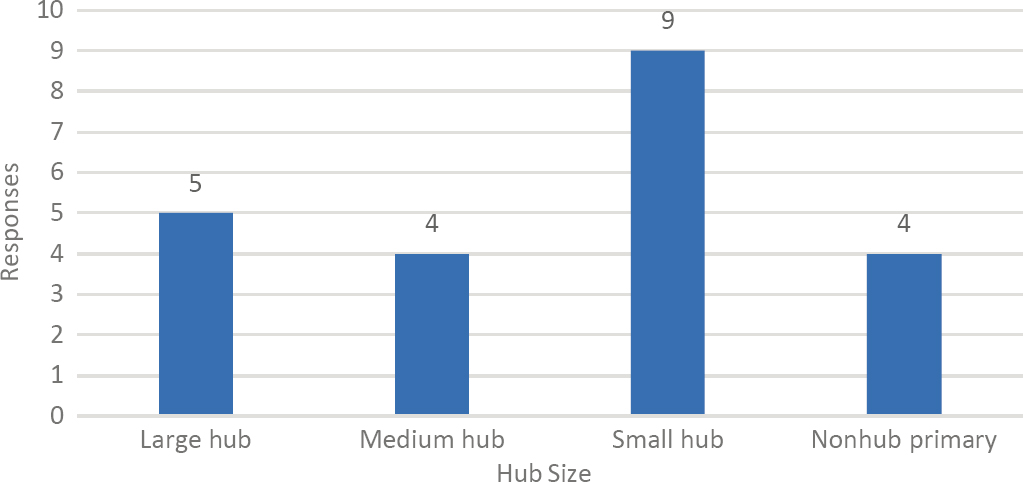
As presented in Figure 1, nine airports were designated as small hub. Large hub, medium hub, and nonhub primary airports also participated in the survey effort.
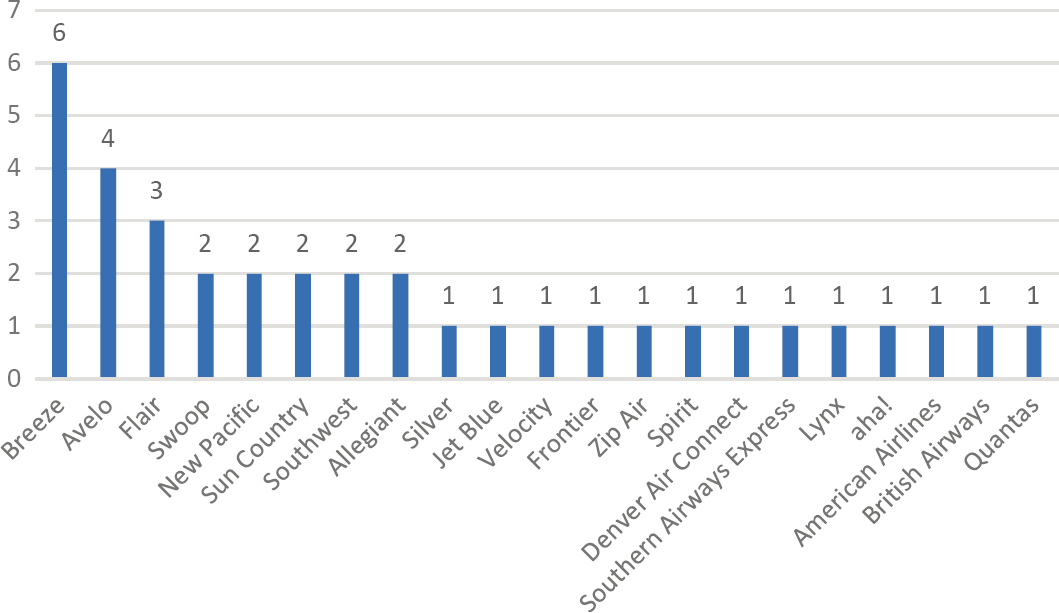
The airlines most often onboarded at airports during the past 3 years are new entrants Breeze and Avelo. Twenty-one new airlines were onboarded (Figure 2).
When asked which airport staff member traditionally assumes the primary role for airline onboarding, participating airports most often indicated either the Director of Airline Affairs (4 survey responses) or the Airport Director (4 survey responses). Often, this is dependent on the size of the airport. Larger airports commonly require the Director of Airline Affairs or Air Service Development Manager to assume the lead role, while the Airport Director/Manager commonly assumes the primary role at smaller airports.
Other responses were the Director of Properties (2 survey responses), Assistant/Deputy Airport Director (2 survey responses), Director of Commercial Development (1 survey response), Director of Marketing (1 survey response), and Manager of Business Development (1 survey response.)
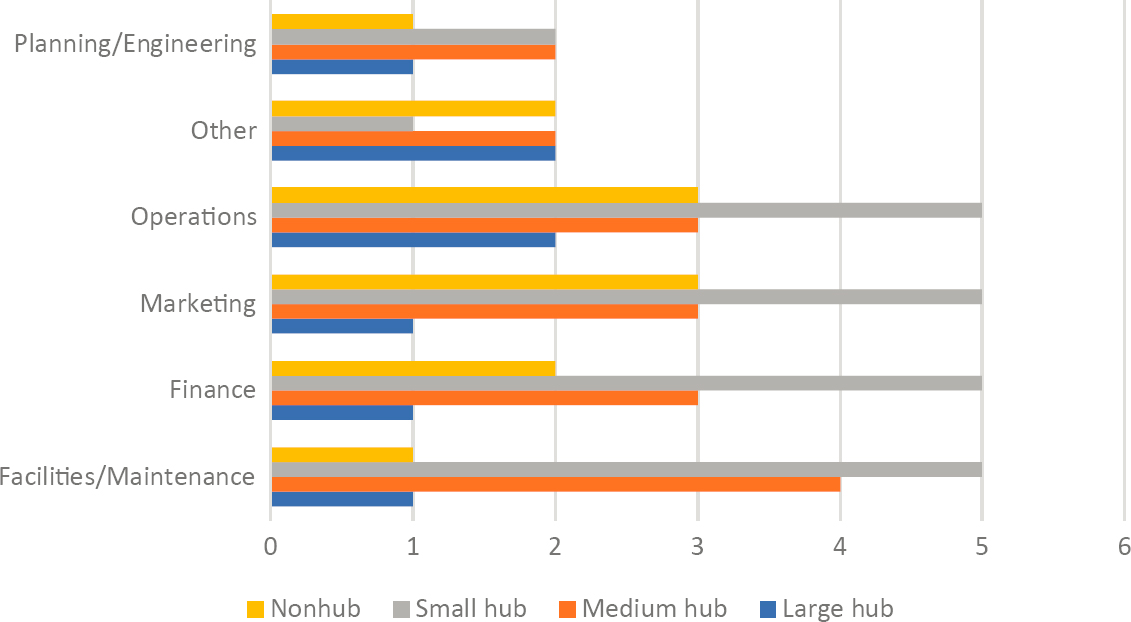
Given the dynamics of airline onboarding, multiple airport departments often play a role. The survey data show that some departments are more active in this role than others (Figure 3). Presented by airport hub size, Operations, Marketing, Finance, and Facilities/Maintenance are the most common additional airport departments involved with airline onboarding. The “Other” category typically referred to the Airport Director or Deputy Director.
Participating airports were asked about the highest priority areas/items that their airport must address when onboarding a new airline. Themes included the following:
- Information Technology (IT). Connectivity and support, which can include configuring airport-owned IT infrastructure (e.g., FIDS, gate scheduler, fuel system), and integration with existing IT systems for common use, paging, and phones.
- Finance and Administration. Finance and administration requirements, which can include lease agreements, operating agreements, certificates of insurance, incentive memorandums of understanding, and financial bonds.
- Operations. Operations requirements, which can include aircraft type, flight schedules, gates, ramp safety, and deicing.
- Facilities. Facilities requirements can include the physical locations of gates, ticket counters, and supporting office space; exclusive leaseholds; wayfinding; and Federal Inspection Stations (FIS).
- Training. Training requirements can include training new station managers on airport policies and processes; badging and training new airline employees; and Safety Management System (SMS) reporting procedures.
- Public Relations (PR) and Marketing. Public relations and marketing can include PR processes (e.g., new airline announcements, coordinating inaugural flight events, and ensuring community awareness).
Participating airports were asked how they address specific areas when onboarding a new airline. Although specific airport practices may not align with expected industry standards, themes, and comments in each area include the following:
- Gate space and aircraft parking
- Dependent on operating agreement
- Signatory – preferential use
- Non-signatory – common use
- Airport gate tour with airline representatives to discuss needs
- Airline flight schedule affects gate use
- Dependent on operating agreement
According to one airport, “Gates are common use but need to be wired in for new airline. Gates are selected based on flight schedule and availability. A gate scheduling software is provided to the airline and all flights must be listed on the gate schedule. Signatory carriers can bump non-signatory carriers outside two weeks of the scheduled flight. This is overseen by the Deputy Airport Director.”
- Above-wing support
- Airline is provided a list of vendors currently on airport with off-airport vendors permitted
- Ensuring airport-provided IT systems are configured and functioning (e.g., phone system, PA system, and FIDS)
An airport explained, “The airline communicates who they will contract with, and our Commercial Use Permit (CUP) team will follow up and ensure the provider has a permit.”
- Below-wing support
- Airline is provided a list of vendors on airport with off-airport vendors permitted
- Access is provided for the GSE fueling facility, deicing pad, lavatory dump, and so forth
- Positions on the ramp and baggage makeup area are assigned for the staging and storage of airline GSE
- Airport FBO can offer below-wing services at some airports
- International operations
- FIS area
- Coordinated with Customs and Border Protection (CBP)
As one airport shared, “The primary staff members responsible are the Common Use team and Airside Operations. If they are an International Carrier, then we ensure that Customs and Border Protection (CBP) are involved.”
- Terminal/roadway signage
- Engineering and/or Facilities updates static signs on ticketing curb
- All directional and wayfinding signage is managed by the Maintenance/Facilities department
An airport explained, “We have bi-weekly meetings to discuss all aspects of onboarding with the airline and all of the internal/external stakeholders. The primary staff members responsible
are the Facilities team Sign Shop for any static signage and our Technology team for any digital signs such as our Dynamic Roadway signs.”
- IT support, such as the FIDS and check-in kiosks
- Operations and IT work with the airline to integrate them into the common-use platform
- Airport Operations coordinates airline live training prior to launch
As one airport shared, “New airlines must be added to the FIDS system. This is a simple process of notifying the provider and supplying a jpg file of the airline logo and flight number for the first arriving flight. Check-in and gate equipment is proprietary to the airline including kiosks. Airport IT department will assist the airline IT department with establishing their own network and setting up their equipment.”
- Gate holdroom availability
- Holdroom coincides with the gate
- New airline may be asked to flex the flight schedule outside of peak hours to alleviate capacity issues
One airport noted, “Signatory airlines get preferential gates and non-signatories are on shared common use counters assigned 1-hour slots based on their flight schedule.” This is handled by Airport Operations.
- Ticket counter space
- Assigned by airport administration during the lease process
- Signatory airlines typically have preferential counters, while non-signatories may share common-use counters
An airport’s survey response noted, “The new airline is assigned an available common use ticket counter. This is often based on which company is ground handling the carrier. An attempt is usually made to arrange airlines along the ticket counter in a manner that keeps ground handlers together. This is not always achievable as some counters are exclusively leased by other airlines. This is handled by the Deputy Airport Director.”
- Baggage claim devices
- Baggage claim devices may be assigned or common use (i.e., first-come, first-served)
- Facilities, Baggage Handling system team is involved and completes any maintenance, understanding load capacity, and complete bag tag testing
As expressed in one survey response, “There are two common use bag claim devices that are shared by all the airlines. The use of a gate scheduling paradigm helps alleviate congestion by incentivizing carriers to decompress their flight schedule. While the gates are scheduled, bag claim devices are first-come. Operational issues are handled by airport operations.”
- Baggage service office (BSO) space
- Airlines may be allowed to use a mobile BSO podium in bag claim due to lack of BSO space available
- Due to limited space, carriers with limited service primarily use the ticket counter for delayed/damaged baggage claims
- Airport Operations confirms schedules and locations
- Ticket counter office
- Airport Operations confirms schedules and locations
An airport survey response stated, “Low-cost carriers (i.e., non-signatory) will generally avoid leasing an ATO [Airline Ticket Office]. However, they are required to lease storage space for equipment they leave onsite. Should they request an ATO, either one will be assigned or additional space in the terminal will be developed into an ATO. The development department handles
planning and design, maintenance will construct the space, the Deputy Airport Director will negotiate the arrangement and oversee the process, finance will configure the operating agreement to account for the exclusive space, and the Airport Director will execute the agreement.”
- Operations office
- Will either engage a lease for exclusive space or airline can work with their ground handler
- Operating agreement
- Airline is required to sign either a signatory or non-signatory agreement
- Landing fees
- Determined by the Airport.
- All airlines pay a landing fee. Signatory carriers pay a reduced rate. Fees are adjusted annually based on budgeted airport operating costs.
- Airport Air Service Development and Finance team explain charges and incentives for new airlines.
One airport response stated, “The primary staff members responsible are the airlines as the Landing Fees are self-reported. For the City the Finance Divisions, Accounts Receivable processes the payment and then invoices for anything that was reported and remains outstanding or has not been paid and the Business and Properties, Airline Affairs team is responsible for ensuring the language is in the agreement and the tenant is aware of the fee/s.”
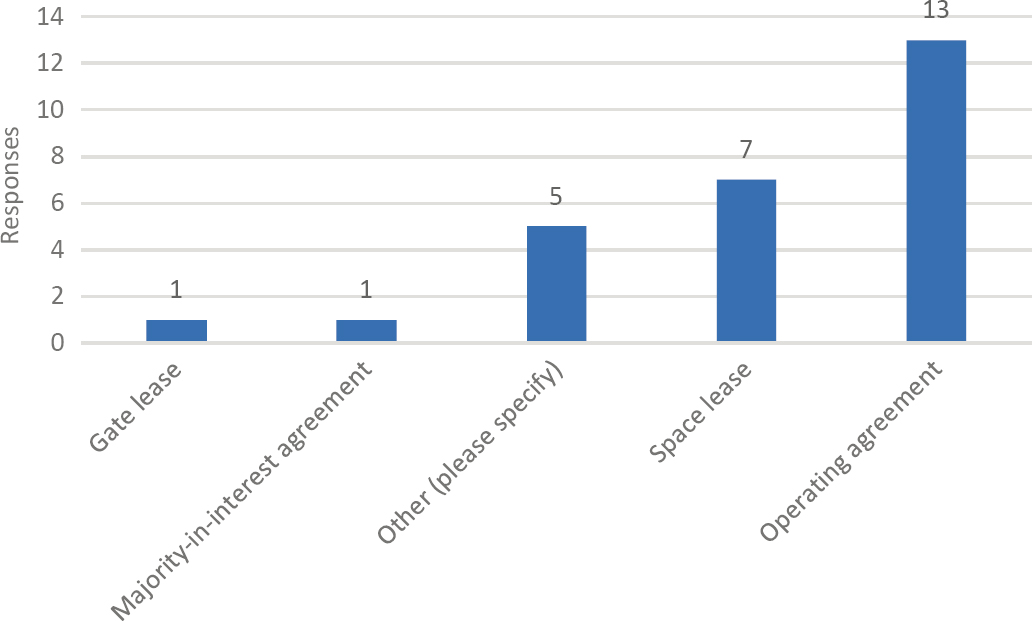
Participating airports were also asked about the type of lease agreements that new airlines are required to sign. As presented in Figure 4, an operating agreement is common at more than 80% of airports. A space lease is also common. Often the specific type of agreement is determined by airline needs and airport requirements. All airlines enter into some form of agreement prior to beginning service at an airport. “Other” responses typically reference some form of combined operating and space/gate lease agreements.
To further understand the dynamics associated with airline expectations, participating airports were asked, “What airline needs or expectations must your airport address?” Themes included the following:
- Sufficient gate/ramp/RON/slots/counter/baggage claim space to support the airline’s intended operations
- Safe and secure airport operating environment, including SIDA badging, knowledge of curfew information, emergency plan, airfield familiarization, spill and deicing procedures, and emergency response
- Robust IT infrastructure to support the airline’s needs
- Capable and sufficient ground handlers, including above- and below-wing
- Active public relations and marketing efforts to inform the local community of the airline’s plans and to plan the launch day activities and celebration.
As noted in one airport’s survey response, “Airline needs are generally operational in nature and tend to focus on IT-related infrastructure. This is particularly true for station startup. The airport will need to mediate the relationship between the airlines as it relates to sharing common use space/facilities. They will also need help making their announcement and establishing contacts with local contractors and service providers.”
Some airports are space-constrained, making accommodation of new airlines with sufficient space a challenge. As shared by one participating airport, “We are a rapidly growing airport, and our team is working diligently to address space constraints to allow continued growth by our airline partners.”
Given the dynamics of the airline industry (e.g., consolidation, mergers, and bankruptcies), participating airports were asked if any new entrant airlines within the past 5 years had ceased operations at their airport. Two-thirds of participating airports, or 15 survey responses, indicated that a new entrant airline had failed during this period. This supports both the importance of proper airline onboarding and the need for airports to remain flexible to evolving dynamics in the airline industry. Common-use space is one response by airports to account for these dynamics.
Finally, participating airports were asked if there were any lessons learned about airline onboarding that could be shared with other airports. Responses include the following:
- “Learn what the long lead time items are and start with those first. For us, it is always IT related items.”
- “A common use system has been key to us being able to facilitate multiple new carriers into ticketing and gates at a relatively inexpensive cost to the carrier.”
- “It’s important to communicate expectations and boundaries set forth in the operating agreement. Airports should be hyper aware of what precedents they are setting with their existing airlines prior to onboarding a new one. The op tempo [operations tempo] of a station startup is generally much faster than an airport may be used to, so be ready to adapt. Be creative in finding solutions to an airline’s challenges, when it can be done without giving favoritism. Take an active role in managing stakeholder relations with one another.”
- “We have a dedicated ‘Station Startup Kit’ that we provide to airlines to make the onboarding process easier. This allows the airline to see everything that the airport needs easily, in one document. Providing something similar would be our largest recommendation in addition to keeping your airport departments abreast of airline requests and plans throughout the onboarding process as it truly does take the work of many different departments to be successful.”
- “It involves everyone in the airport.”
- “The biggest lessons learned, is be prepared for the unexpected. While many airlines have OAG and SITA, there are some that do not and understanding other options we/the airline can use and how long it will take to implement those is important. We start our process early, but making sure you leave enough time to work out any kinks is important. In addition, make sure you communicate how long it could take to go through badging, especially for any of the service providers that the airline contracts with later in the process that have not previously operated at the airport. In addition, if they operate out of the international concourse explaining
- “Need a comprehensive plan well in advance of airline entry.”
- “Make a checklist, even if it’s just one person that handles it.”
- “Initially we start with one point of contact, then that contact brings in the other team members.”
- “Airport staff communication is key to successful onboarding of new airline entrant. Ensure to have monthly calls with airline rep, to check on service performance, ensure community will support route.”
- “Start early.”
that the CBP [Customs and Border Protection] seal process adds additional time to that process. While we have an amazing team at our airport and everyone is invested in making sure the airline has a successful start, it adds a layer of stress to all parties involved when these unexpected items come up and everyone is scrambling to find and implement a solution.”
The data reveal similarities and differences among airports. One finding is that Air Service Development staff are involved in airline onboarding even once the typical air service development functions are complete. The relationships these personnel have built with airline staff can continue to benefit the airport during the onboarding process. Next, some airports have common use, while others do not. Thus, specific space allocations, for example, will vary by airport. Third, IT is a significant aspect of airline onboarding. Given the robust digital platforms at many airports, this process can be the most time consuming of the onboarding process. Finally, aircraft servicing (both above- and below-wing) is commonly the discretion of the airline, although airport staff will support the airline decision-making process in this regard.
Information from the 22 airports can prove insightful for airports seeking their first airline service or for those airports with existing airline service. Learning from the experiences of other airports is a well-established method. Specific airport examples are presented via 12 case examples in Chapter 6.


