Transporting Freight in Emergencies: A Guide on Special Permits and Weight Requirements (2024)
Chapter: 6 Tools and Resources for Implementation During Emergencies
CHAPTER 6
Tools and Resources for Implementation During Emergencies
Introduction
This chapter lists tools and resources that can be leveraged by state permitting offices or decision-makers to harmonize and coordinate special permits during emergencies. It captures tools and resources discussed in previous chapters and provides additional resources, including several notable resource documents. This listing is not intended to be comprehensive and is not a substitute for federal and state laws, regulations, and declarations issued for a given disaster.
CVSA Emergency Declarations Portal
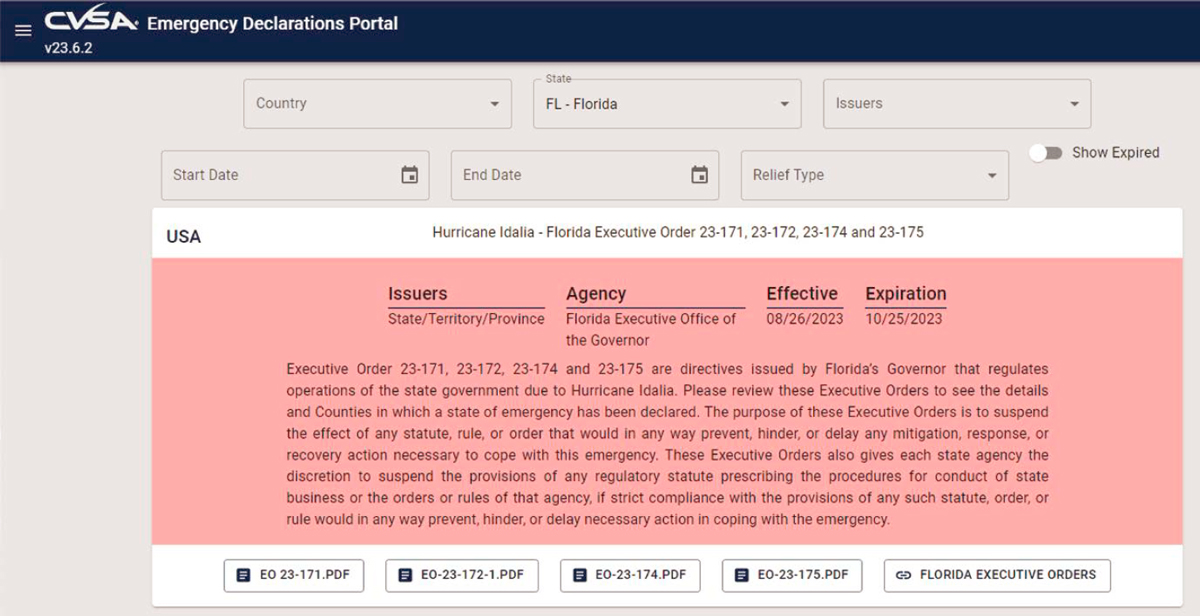
Description: As stated in Chapter 5, the CVSA Emergency Declarations Portal facilitates the harmonization and coordination of special permits during emergency situations and disaster declarations. It benefits not only state truck permitting offices but also enforcement staff, who rely on it for verifying emergency declarations and ensuring their validity. As noted, the effectiveness of the CVSA Emergency Declarations Portal depends on the timeliness and accuracy of information provided by state permitting offices and the adherence to standardized language. Within the portal, users can utilize the map (see Figure 13) to select specific states to view active declarations. Figure 14 demonstrates a screen capture of an active declaration. As seen in the image, users can use the drop-down menus to refine the search or create a new search.
Tool location: https://www.cvsaemergencydeclarations.org/map.
FMCSA Emergency Declarations, Waivers, Exemptions, and Permits Website
Description: This FMCSA website lists emergency declarations and provides links to additional information. The emergency declarations include the following:
- Declarations by FMCSA.
- Federal emergency declarations by FMCSA service centers.
- Federal Notice of Enforcement Discretion Determination.
- Canadian emergency declarations.
- State emergency declarations by state.
Resource location: https://www.fmcsa.dot.gov/emergency-declarations.
AASHTO Committees
Designated AASHTO committees and AASHTO regional associations are focused on harmonization of regulations and coordination among partnering states to move permitted loads more efficiently, including during emergency events.
AASHTO Special Committee on Freight
Description: The AASHTO Special Committee on Freight develops policies regarding legislation, regulation, and other matters related to the safe and reliable movement of goods, according to the AASHTO website dedicated to the special committee. The successor of the AASHTO Subcommittee on Highway Transportation, the Special Committee on Freight, has a specific goal to advance state-to-state harmonization of freight-related regulations that inhibit efficient freight movement between states, such as permitting (AASHTO 2018).
Resource location: https://transportation.org/freight/.
AASHTO Committee on Transportation System Operations (CTSO) Subcommittee on Freight Operations
Description: The AASHTO CTSO Subcommittee on Freight Operations is also interested in issues related to permitting and harmonization. The subcommittee sponsored a permit data harmonization project, resulting in the Permit Data Harmonization Model Permit & Best Practices (Athey Creek Consultants 2022) report that provides ideas for agencies to consider when updating their permits to be more harmonized with other states.
Resource location: Subcommittee on Freight Operations (https://transportation.org/systemoperations/about-us/subcommittee-on-freight-operations/); Permit Data Harmonization Model Permit & Best Practices (https://transportation.org/systemoperations/wp-content/uploads/sites/2/2023/01/Permit-Data-Harmonization-Best-Practices-Report-01312022-002.pdf)
MAASTO Subcommittee on Highway Transport
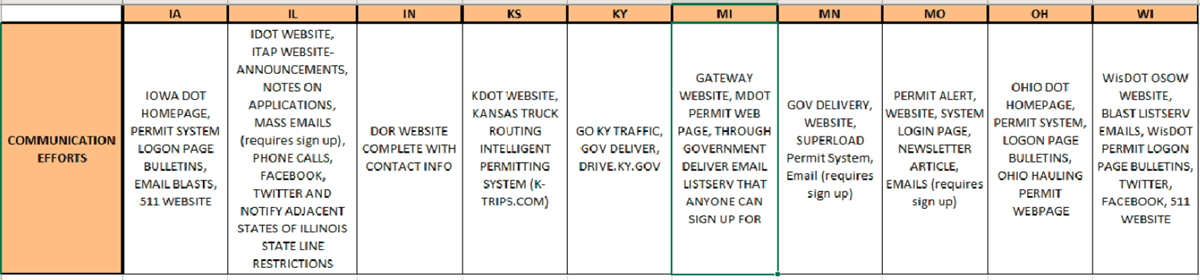
Description: The MAASTO Subcommittee on Highway Transport advocates for OS/OW transportation issues by partnering with industry to promote uniformity of laws and regulations to allow for the efficient movement of goods while providing uninterrupted traffic flow and a safe transportation system among member states, according to their mission statement. The subcommittee’s dedicated website contains member-state resources, including links to state road restrictions, state regulations, state reports, and permits. The resource page contains a link to download a matrix of important OS/OW permit information per state, such as maximum widths and heights, nighttime travel, and superloads. Figure 15 provides a sample screen capture from the matrix.
Resource location: http://www.maasto.net/scoht/index.html.
Western Association of State Highway and Transportation Officials (WASHTO) Committee on Highway Transport (COHT)
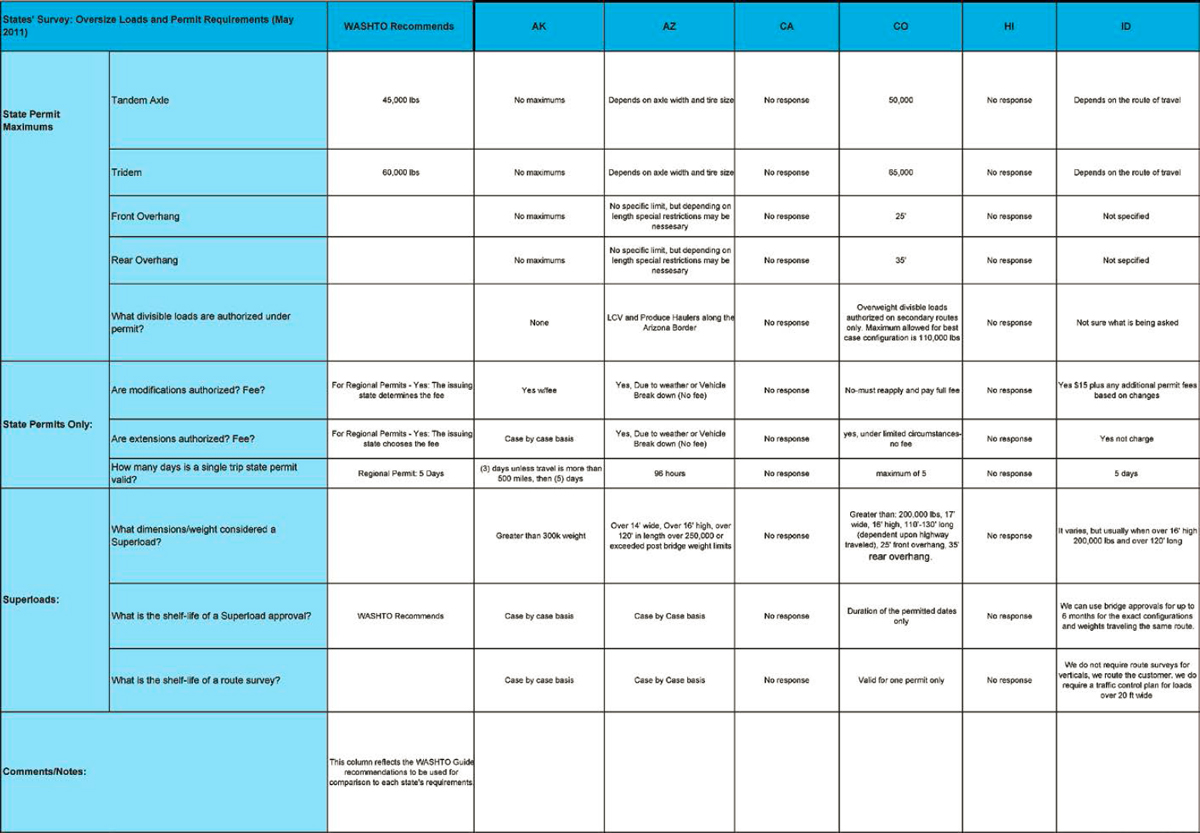
Description: The WASHTO COHT strives to promote uniform laws, regulations, and practices in partnership with the motor carrier industry. The COHT website identifies the committee members from each participating jurisdiction and maintains a section on permitting, restrictions, and state requirements, which includes links by state and a matrix of state permit requirements (see Figure 16 for matrix sample screen capture). It also provides several publications, surveys, and state reports.
Resource location: https://www.washto.org/committees/highway-transport-committee/.
Additional Resource Documents
- FHWA’s “Truck Size and Weight” web page: https://ops.fhwa.dot.gov/freight/sw/index.htm.
- “Transportation Emergency Response Factsheet 2—Regulatory Relief.” (U.S. DOT 2020).
- FHWA-HOP-17-061: Best Practices in Permitting Oversize and Overweight Vehicles—Final Report (Schaefer and Todd 2018).
- Emergency Route Working Group (ERWG) Report of Recommendations to the Secretary of Transportation (ICF 2018).
- NCHRP Research Report 931: A Guide to Emergency Management at State Transportation Agencies (Frazier et al. 2020).
- NCHRP Web-Only Document 378: Emergency Response: Organizational and Operational Models Used by State DOTs (Matherly et al. 2023).
- NCHRP Report 830: Multi-State, Multimodal, Oversize/Overweight Transportation (CPCS, Perkins Motor Transport, Inc., and Portscape, Inc. 2016).
Regulatory Relief of Commercial Vehicle Weight Requirements for Emergency Transportation of Critical Commodities—Final Report
Description: The complement to this guide, NCHRP Web-Only Document 397: Developing a Guide for Transporting Freight in Emergencies: Conduct of Research (Sharma et al. 2024), documents the research undertaken during the project and contains additional details related to regulations, literature, and best practices. It also contains the vital information received during stakeholder surveys, interviews, and workshops.


