Thriving on Our Changing Planet: A Midterm Assessment of Progress Toward Implementation of the Decadal Survey (2024)
Chapter: 3 Assessing Progress Toward the Decadal Survey Vision
3
Assessing Progress Toward the Decadal Survey Vision
To assess progress toward the decadal survey vision, the committee invited the National Aeronautics and Space Administration (NASA), the National Oceanic and Atmospheric Administration (NOAA), and the U.S. Geological Survey (USGS) to provide updates on their current plans and programs related to Earth observation from space. This chapter includes a summary of the agencies’ current programs and plans and an assessment of progress on the 2017 Earth science and applications from space decadal survey (NASEM 2018) priorities. Chapter 4 will then present the committee’s recommendations to maximize progress on decadal survey priorities through the rest of the decade.
NATIONAL AERONAUTICS AND SPACE ADMINISTRATION
The decadal survey’s recommendations to NASA were designed to all fit within the stipulated available budget for flight program investments in decadal survey priorities through 2027 while maintaining portfolio balance. As no large-scale changes were recommended to the program’s balance, funding for new flight program priorities was limited to what would become available as missions in the Program of Record transitioned from development to operations. Such funding was expected to first become available starting in fiscal year (FY) 2020. (See the orange “Future Missions Wedge” in Figure 3-1.)
Figure 3.5 in the decadal survey (see Figure 3-2) further shows how the Program of Record and decadal survey flight program recommendations could be phased to fit within the combined resources of the Earth Systematic Missions and Future Missions Wedge (gray and orange wedges in Figure 3-1) while also ensuring only modest carryover into the next decade. Together with the report’s recommendations to ensure “no flight program element is compromised by overruns in any other element,” the community provided a carefully crafted and implementable plan for the decade.
However, owing to a variety of external circumstances (as discussed in Chapter 2) and growth in other program elements, what had been stipulated to be the Future Missions Wedge that would support decadal survey flight program priorities, was essentially consumed. While it is clear that the COVID-19 pandemic, supply chain, inflation, and other financial problems since the decadal survey could not have been antici-
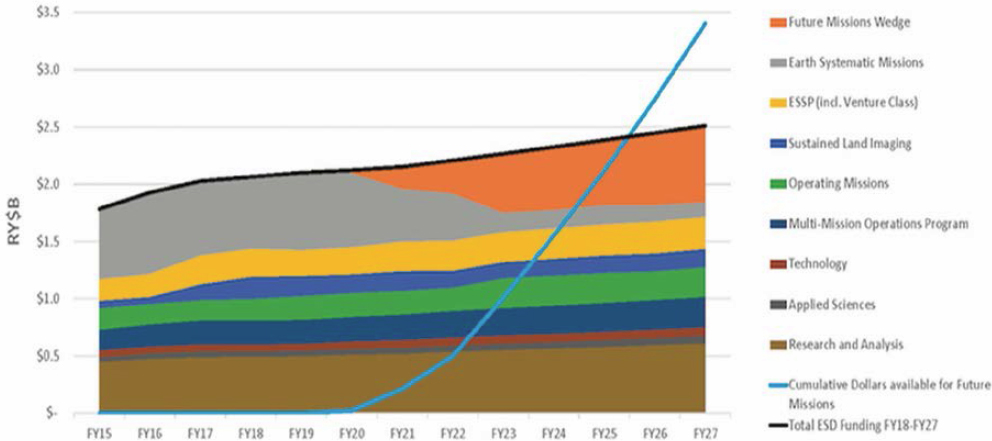
NOTES: Labels shown in the legend refer to budgetary components within NASA’s Earth Science Division (ESD). ESAS = Earth science and applications from space; ESSP = Earth System Science Pathfinder; FY = fiscal year; POR = Program of Record.
SOURCE: NASEM (2018).
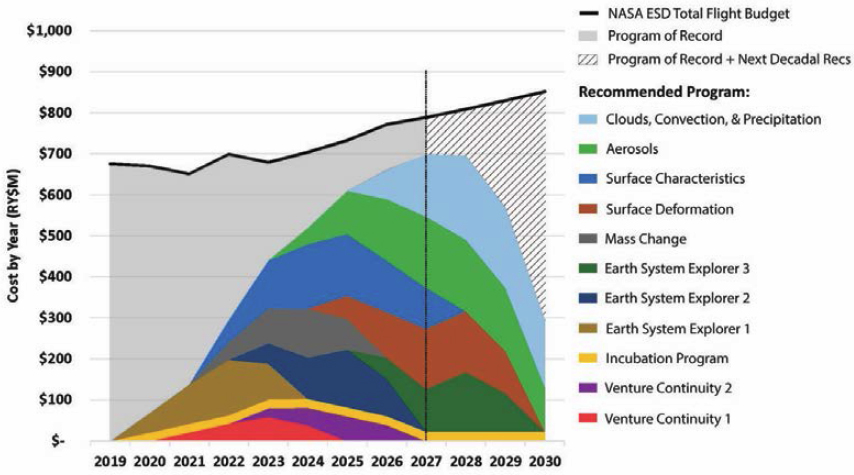
SOURCE: Figure 3.5 from NASEM (2018).
SOURCE: Based on NASA data.
pated, the decadal survey did include specific recommendations of how to make decisions in response to different financial scenarios. NASA has not consistently followed these recommendations.
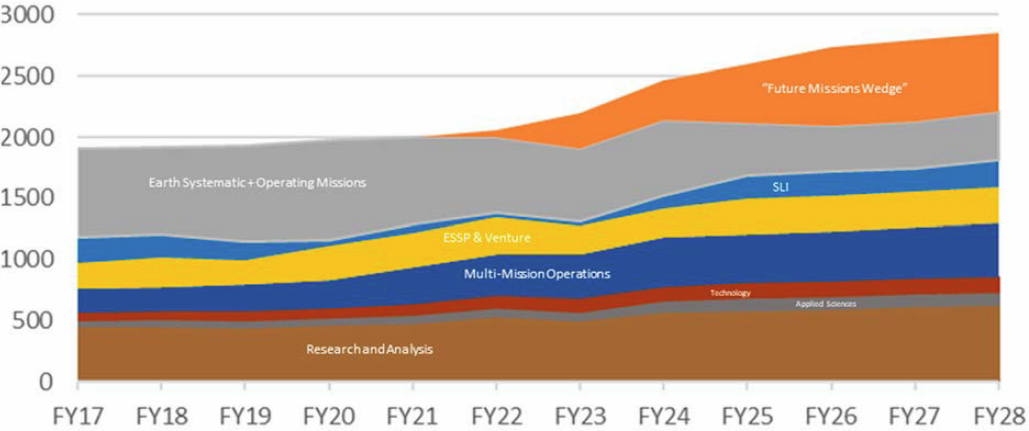
Budget data provided by NASA (see Figure 3-3) shows that funding for the Program of Record did not roll off as fast as anticipated, and the Multi-Mission Operations budget wedge (now called Earth Science Data Systems) grew.1 As is also evident in Figure 3-3, the SLI wedge has grown to include plans for Landsat Next compared to the flat funding called for in the decadal survey’s Recommendation 4.14.
Finding: Growth in individual program elements, without top-line budget growth, does not support the healthy programmatic balance called for in the decadal survey.
Recommendation: Consistent with the 2017 Earth science and applications from space decadal survey (NASEM 2018) and the Earth System Observatory Independent Review Board recommendations (ESO IRB 2022; NASA 2022, response 23),2 NASA’s Earth Science Division should seek advice from the National Academies’ Committee on Earth Science and Applications from Space prior to adding or substantially modifying individual program elements to ensure appropriate consideration of program balance and decadal survey priorities.
___________________
1 Details in the president’s fiscal year (FY) 2024 budget submission suggest that a portion of the Multi-Mission Operations growth is attributable to the commercial SmallSat data initiative and data system evolution, with additional forward-looking growth proposed for the open science data initiative.
2 From NASA’s response to the IRB report: “23. Deviations from decadal survey (DS) recommendations should use the Committee on Earth Science and Applications from Space (CESAS) as the community input for recommended changes. An example could include assessing a continuity gap with Mass Change (MC) or applicability of short duration missions.”
NASA Response: “Concur; NASA will ask CESAS to review the current status of mission plans compared to DS recommendations as part of the upcoming midterm review.” https://www.nasa.gov/wp-content/uploads/2022/11/eso_irb_documents.pdf.
NASA’s plan through the end of the decadal period, as shown in Figure 3-4, shows several key differences from the decadal survey’s recommended plan. Individual program elements are discussed in detail in the sections below, however a few overarching points are noted here:
- NASA’s plan shows minimal allocations to any new mission starts resulting from decadal survey mission priorities prior to FY 2023, a full 5 years following the decadal survey report’s release.
- A significant and rapid increase in funding is required in FY 2024 onward to achieve the plan as shown. However, the FY 2024 budget passed by Congress did not provide any significant increase suggesting implementation will shift further to the right (i.e., to the future).
- Several program elements are shown as having funding requirements peaking at the same time, which is something that the decadal survey recommended the program should largely avoid to ensure that the program could be implemented without requiring significant and rapid top line program funding changes. While the committee acknowledges there are benefits associated with particular missions flying together, the typical and more robust approach is considered to be implementing large missions in a staggered/phased approach to ensure overall program health, even if it means less optimal overlap between missions—consistent with the decadal survey’s priorities on Earth system science and programmatic balance rather than individual missions or requirements.

SOURCE: Courtesy of NASA.
NASA’s plans, as presented to the committee, do not yet appear to successfully integrate the various program elements into a comprehensive and balanced plan for Earth system observation. While the general concept for an Earth System Observatory is good, the committee notes that a healthy and ongoing observing system which accounts for both beginnings and projected ends of missions (rather than launching several large missions simultaneously) is required to enable Earth system science and to maintain a healthy workforce and community.
The decadal survey recommended that NASA implement its space-based observing priorities through five distinct program elements: Program of Record, Designated, Earth System Explorer, Incubation, and Earth Venture. Each program element was recommended to be managed so that development costs of each element, and for each project within the Designated element, would not impact other elements or projects. The committee’s summary assessment of NASA’s presented plans for each of these elements is provided below.
NASA has been both slow and uneven in its response to decadal survey recommendations. In developing its program plan to fit within lower than anticipated budgets to date, NASA has not adhered to the recommendations and decision rules3 put forth in the decadal survey, nor has it sought guidance from the National Academies’ Committee on Earth Science and Applications from Space on handling budget challenges that exceed those contemplated by the decadal survey (as called for in Chapter 4 of the decadal survey, and again in the recent Independent Review Board [IRB] report).
Finding: NASA has been uneven in its response to decadal survey recommendations and has not followed the decadal survey’s decision rules regarding how to respond to budget pressures.
Rather than implement those portions of the program that can be accomplished within the resources available, decisions have been delayed and made contingent on budgets which have not been realized. Failure to make timely decisions, even if difficult, however, serves to further increase costs and delay progress. Such delays have direct impacts on community health, threaten the workforce, imperil continuity of key measurements, and forego the intended societal benefits of improving our understanding of the Earth system. International, inter-agency, and commercial Earth observation providers, too, are impacted. A well-defined and executable program of record is essential to enable coordination, protect against critical observation gaps, and encourage complementary rather than duplicative investment.
Finding: Lacking resources to implement the recommended program in its entirety, NASA ESD has remained in analysis and evaluation mode rather than having made timely decisions to enable progress on what is implementable.
Recommendation: NASA’s Earth Science Division should take full advantage of its meetings with National Academies’ Committee on Earth Science and Applications from Space to seek feedback on its implementation plans to facilitate more timely decisions and maintain alignment with the Earth science and applications from space decadal survey recommendations, even as its budget fluctuates from year to year.
___________________
3 Recommendations 3.2 and 4.6 refer to decision rules in Chapter 4 of the 2017 decadal survey report (NASEM 2018), which provide guidelines on how to allocate funding and ensure various aspects of balance in the program’s overall budget.
Program of Record
The decadal survey recommended that missions already in implementation prior to the decadal survey be completed as planned, subject to a cost cap. NASA has made progress on many of the missions in the Program of Record, although it has not remained within the recommended cost cap for this program element (decadal survey Recommendation 3.2).
Designated
The decadal survey recommended a set of five cost-capped medium- and large-size missions to address specific decadal survey priority observables considered essential to the overall program. These missions were to be managed within cost caps so as to not impact other elements of the flight program. After the report’s release, NASA organized study teams for each Targeted Observable assigned to the Designated program element. Representatives from each study team presented a summary of progress to the committee. NASA also chartered the Earth System Observatory (ESO) IRB in 2022 to review progress on four of the Designated program element mission studies. Waleed Abdalati, IRB co-chair, presented a summary of the IRB findings to the committee.
The IRB reviewed NASA’s plans for the Designated missions and made recommendations regarding risk and suggestions for descoping if recommended cost caps could not be met. The IRB found that “baseline mapping to decadal survey is inconsistent among missions and threshold mapping to decadal survey is unclear” (ESO IRB 2022). In particular, the IRB found that Surface Biology and Geology (SBG) and Mass Change met the baseline requirements and were aligned with the minimum decadal survey recommendations but that Atmospheric Observing System (AOS; NASA’s conglomeration of the Aerosols and Clouds, Convection, and Precipitation Targeted Observables), exceeded them. The IRB also found that the collective cost estimates for the Designated missions exceed both the projects’ budgets and, in some cases, decadal survey recommended cost caps.
Finding: Neither the decadal survey nor the IRB recommendations have been consistently implemented across the Designated program element.
While progress on each of the Designated mission studies is described below, all teams appear to have examined a wide trade space of implementation options including potential collaboration with international partners including, but not limited to, the European Union, Italy, Germany, Japan, and Canada. In addition to enabling implementations within the recommended cost caps, international collaborations have supported numerous scientific and applications activities.
Finding: Consistent with decadal survey recommendations, NASA has worked effectively with international partners to explore implementation of Designated program element priorities.
At the highest level, however, most of the Designated mission studies (with the notable exception of GRACE-C [Gravity Recovery and Climate Experiment-Continuity]) have remained in “analysis and evaluation” mode, and NASA’s delayed decisions on each Designated mission have further increased costs and delayed progress on decadal survey priorities. Some missions that are (and were) at a higher readiness level have not been advanced, even when their budget is relatively low (e.g., the SBG VSWIR [Visible to ShortWave InfraRed]). Others were allowed, if not encouraged, to consider wide open trade spaces without adequate attention to cost caps that are essential to enabling programmatic balance and timely
implementation. By deferring decisions on missions that are ready for implementation within recommended resources, ESD is missing an opportunity to better phase funding requirements into a more achievable budget profile, avoiding the upcoming peak (still unfunded) budget years shown in the current ESD plan (see Figure 3-4).
Surface Biology and Geology
The decadal survey recommended NASA develop a mission to address the SBG Targeted Observable with a maximum NASA development cost of $650 million (FY 2018). Furthermore, based on relative cost and risk, the decadal survey suggested it be the first of the three larger Designated missions implemented. While NASA chose to implement SBG in two parts, addressing the decadal survey SBG Targeted Observable, which is linked to one or more Most Important or Very Important science objectives from each panel and feeds into the three decadal survey integrating themes, requires implementation of both parts.
Finding: Progress on the SBG Targeted Observable has been promising overall. The success of EMIT4 (VSWIR) and ECOSTRESS5 (Thermal Infrared [TIR]) onboard the International Space Station have demonstrated the promise of SBG, and NASA is proceeding to address the decadal survey’s SBG recommendation through two missions: SBG-VSWIR and SBG-TIR. The latter is to be implemented as a partnership with the Italian space agency (Agenzia Spaziale Italiana [ASI]). SBG-TIR is proceeding while SBG-VSWIR is being delayed. It would be more cost-effective and maximize science benefits to proceed with both SBG-VSWIR and SBG-TIR missions without further delay.
Finding: While the IRB noted the benefit of overlap between SBG and AOS-P and AOS-I and recommended that NASA investigate opportunities for aligning launch dates, an unnecessary delay in the launch of SBG-VSWIR will be detrimental to SBG objectives that need both VSWIR and TIR data. The relative benefit of aligning launch dates between AOS and SBG is insufficient to justify delay of SBG.
Aerosols
The decadal survey recommended that NASA develop a mission to address Aerosols (TO-1 and TO-2 Targeted Observables) with a maximum NASA development cost of $800 million (FY 2018). The decadal survey indicated there would be substantial synergies if overlap was possible with the Clouds, Convection, and Precipitation Targeted Observable; however, it also noted the primary mission focus should be to meet the aerosol science objectives as described and remaining within the cost cap. The decadal survey suggested that if the Aerosol objectives could not be met within the cost cap, then both TO-1 and TO-2 should be made eligible observables for Earth System Explorer opportunities rather than proceeding with a higher cost implementation.
Clouds, Convection, and Precipitation
The decadal survey recommended NASA develop a mission to address Clouds, Convection, and Precipitation (TO-5 Targeted Observable) with a maximum NASA development cost of $800 million (FY 2018). It was envisioned to be addressed by a stand-alone observatory with dual-frequency radar observations and
___________________
4 EMIT is NASA’s Earth Surface Mineral Dust Source Investigation mission.
5 ECOSTRESS is NASA’s Ecosystem Spaceborne Thermal Radiometer Experiment on Space Station mission.
Doppler capability at one frequency. The decadal survey indicated there would be substantial synergies if overlap was possible with the Aerosols Designated mission. The decadal survey suggested specific descopes if needed to remain under the recommended cost cap, specifically reverting to a single frequency Doppler radar. The decadal survey also noted that the technology existed already and advances in miniaturization might be able to reduce the overall development cost below the recommended maximum.
Atmospheric Observing System
Recognizing the close relationship between aerosols, clouds, and precipitation and to optimize science and application benefits, NASA developed the AOS mission to respond to both the Aerosols (addressing TO-1 and TO-2) and the Clouds, Convection, and Precipitation (addressing TO-5) Targeted Observables. Rather than consider the two relatively narrow and specific decadal survey recommendations individually, NASA chartered the AOS study team to consider a trade space of numerous related community priorities, including those identified in the previous 2007 decadal survey (NRC 2007). The AOS study team includes several NASA centers, universities, and international partners (Japan Aerospace Exploration Agency [JAXA], the Centre National D’Études Spatiales [CNES], the Canadian Space Agency, and the German Aerospace Center [DLR]) and reported considering well over 100 mission concepts as part of its efforts. The currently proposed architecture involves two large missions, AOS-Storm and AOS-Sky, which together address objectives beyond those described in the decadal survey.
Finding: The AOS baseline capabilities exceed those required to meet the decadal survey recommendations, resulting in higher costs to the program which could negatively impact other decadal survey priorities.
Mass Change
The decadal survey recommended NASA develop a mission to ensure continuity of the Mass Change Targeted Observable with a maximum NASA development cost of $300 million (FY 2018). The decadal survey indicated that staying below this cost cap was expected to entail down-selecting to a single measurement technology, similar to what had been used for the original GRACE mission. It also encouraged NASA to seek an international partner for the mission.
By the time of this midterm assessment, NASA had established an international partnership with Germany (DLR/German Research Centre for Geosciences [GFZ]) to implement GRACE-C, a follow-on to GRACE-FO, to address the Mass Change Targeted Observable. Rather than downgrade to GRACE-like performance, however, GRACE-C will leverage the Laser Ranging Interferometer instrument demonstrated on GRACE-FO to retain its significant performance improvement over the GRACE microwave instrument. To stay within available funding constraints, the IRB found the mission was taking on “high risk for a mission of [its] cost” and noted concerns regarding the potential for accelerometer failure (ESO IRB 2022).
Finding: Costs for GRACE-C are higher than the maximum decadal survey recommended investment for the Mass Change Targeted Observable. Some cost growth was driven by increased performance demands from stakeholders owing to the mission’s large number of applications and others by IRB recommendations to reduce risk.
Surface Deformation and Change
The decadal survey recommended that NASA develop a mission to provide measurements of surface deformation and change post-NISAR (NASA-Indian Space Research Organisation [ISRO] Synthetic Aperture Radar [SAR]), with a maximum recommended NASA development cost of $500 million (FY 2018). The decadal survey recognized this funding level would not provide continuity through re-flight of a NISAR-like mission, and instead recommended NASA consider international partnerships, reduced spatial resolution in favor of improved temporal resolution, and innovative implementation approaches.
NASA addressed the Surface Deformation and Change (SDC) Targeted Observable recommendation by forming a SDC study team in 2018. This team initially considered a wide range of architectures, including NISAR-2; constellations of small, inexpensive Interferometric Synthetic Aperture Radar (InSAR) satellites; civil partnerships; and piggybacking reception-only small satellites as a contribution to a new Sentinel line of L-band InSAR satellites called ROSE-L (Radar Observing System for Europe in L-band).
At this time, NASA has indicated that it is expecting to put off decisions related to this Targeted Observable until the next decadal survey. The SDC study team will continue reviewing options until September 2025 when there is expected to be enough data from the yet-to-be-launched NISAR mission to provide a more solid framework for assessing future needs. The study team noted that deferral of a follow-on mission plan could lead to loss of measurement continuity if NISAR’s mission were to end prior to 2033, as experienced in the case of GRACE/GRACE-FO. As planned, the NISAR baseline mission is 3 years with consumables lasting 5–10 years, so it is unlikely that there will be continuity in L-band deformation measurements from the follow-on mission.
According to the study team, the only option explored that fits within the cost cap is to use NASA resources to augment the planned Copernicus international mission, Sentinel ROSE-L. The study team noted that although small satellites co-flying with ROSE-L could meet the cost cap, NASA would be a junior partner with no control over the primary mission. Moreover, without a mission of its own, NASA could lose significant technical expertise to develop future InSAR missions.
Finding: The mission architecture for addressing the SDC Targeted Observable following the NISAR mission remains undefined because no options identified to date meet the cost cap while also addressing the decadal survey’s priority science and applications objectives.
Earth System Explorer
The decadal survey recommended a new Earth System Explorer program element consisting of competitive opportunities for cost-capped, medium-size instruments and missions to address specific decadal survey priority observables. Three Earth System Explorer solicitations were recommended over the 2017–2028 decade, each addressing one or more of seven priority observables identified in the report. The Earth System Explorer program element was designed to improve programmatic responsiveness over the decadal timescale. Each selection would be based on competitive peer review and in the context of the international program of record at the time of selection, with selections envisioned to occur roughly every 3 years.
The decadal survey, in Chapter 4, further states that in the context of limited budgets, it places the “highest priority on continuity of critical measurements, followed by competitive opportunities in the Earth System Explorer and Earth Venture lines, followed by the large missions.” It continued, “should continuity be threatened, the cadence of medium-size competitive missions should be reduced but not to fewer than two competitions in the decade” (NASEM 2018, pp. 197–198).
NASA has, however, been slow to implement the Earth System Explorer program element, and the NASA budget shows no funding allocated to an Earth Explorer mission or instrument to date. NASA’s current plan includes only a single solicitation with two planned selections in the decadal survey decade,6 which is insufficient to realize the intended benefits of the Earth System Explorer program element in improving programmatic responsiveness, maximizing the role of competition in implementing flight recommendations, encouraging innovation, and driving engagement across the scientific community.
Finding: The cadence of NASA’s Earth System Explorer solicitation opportunities is not consistent with decadal survey recommendations. Instead of three solicitations spaced throughout the decade, NASA is planning to select two missions from a single solicitation.
Incubation
In recognition that some Targeted Observables, despite their high priority, lacked sufficient maturity to be ready for low-risk flight implementation, the decadal survey recommended a new Incubation program element. For each Targeted Observable in the Incubation program element, the report calls for “a coordinated program of strategic investments in technology, research, modeling, or data system development would be developed by NASA toward maturing the overall measurement concepts” (p. 150). Three observing system priorities were recommended for Incubation: Planetary Boundary Layer (PBL), Atmospheric Winds (which is also recommended as an observable for the new Earth System Explorer flight program), and Surface Topography and Vegetation (STV). Of the three Targeted Observables recommended for incubation, NASA included two (PBL and STV) in its Incubation program. NASA chose to allow the third (Atmospheric Winds) to compete in Earth System Explorer solicitations immediately rather than later in the decade following Incubation efforts as recommended in the decadal survey.
Finding: Incubation programs for the PBL and STV Targeted Observables are worthwhile and working well overall, facilitating coordination among the associated science and applications communities, improving understanding of related measurement and modeling needs and priorities, and advancing related technologies.
Planetary Boundary Layer
Fourteen members from the PBL-related technology, science, and application communities were selected competitively for the initial PBL Incubation study team. Through community input and team discussions, this team produced a white paper in 2021 that identified methods and activities for improving the understanding of, and advancing the maturity of, the technologies applicable to the PBL Targeted Observable and their associated science and applications priorities (Teixeira et al. 2021). In particular, the white paper proposed four science goals related to PBL: convection and extreme weather, cloudy PBL, PBL and land surface interaction, and PBL modeling, mixing, and air quality. It also identified essential spaceborne components of a future global PBL observing system: differential absorption lidar and differential absorption radar in low Earth orbit (LEO), high horizontal resolution hyperspectral infrared (1 km) and microwave (5 km) sounders in LEO, radio occultation, geostationary hyperspectral infrared sounding, and modeling and data assimilation. The
___________________
6 The first Earth System Explorer solicitation was released in 2023 with NASA intending to make two selections in 2025 for launch in ~2031 and ~2033, with one selection for Phase A study, according to ESD, reserved specifically to address greenhouse gases. The next solicitation, based on the latest program schedule shared with the committee, is not until 2029 with a projected launch in the 2037 timeframe.
PBL incubation study focuses on the vertical profiles of temperature and humidity in the PBL and the PBL height, with the PBL winds to be covered by an atmospheric winds mission. Following this white paper, a new team was selected competitively in 2022 to continue the PBL Incubation study.
Overall, the PBL Incubation program has closely followed the decadal survey recommendation, with steady progress and strong community involvement in the past few years. In the next few years, the PBL Incubation program is expected to support the continued maturation of individual technologies, airborne demonstration of the synergy of various technologies, and the modeling and data assimilation development that will enable the synergistic use of spaceborne, surface-based and airborne measurements of the PBL to address science and application questions.
Surface Topography and Vegetation
The decadal survey recommended the STV Incubation program to advance the ability to obtain high-resolution global topography, including bare-surface land topography, ice topography, vegetation structure, and shallow water bathymetry. An STV study team was competitively selected and has held five meetings (workshops, breakouts, and an American Geophysical Union town hall), starting in 2020 and issued a detailed 199-page report (NASA’s Surface Topography and Vegetation Incubation Study Team Report, June 2021). The study team anticipates that lidar, radar, and stereophotogrammetry deployed on a wide range of platforms will be necessary to accomplish the intended science application goals. In addition to supporting the STV study program, NASA has funded 17 projects focused on various aspects of advancing technical maturity of STV Targeted Observable. Among these projects is the CASALS (Concurrent Artificially Intelligent Spectrometry and Adaptive Lidar System), which aims to address five of the Targeted Observables: ecosystem structure, ice elevation, snow depth and water equivalent, topography and 3D vegetation, and the atmosphere boundary layer. This 4-year program is currently scheduled to end in June 2024. There is a new call for STV Incubation funding that will continue this program through June 2028.
Overall, the Incubation support of STV has succeeded in both leading to advances in technology and in developing a community across diverse disciplines which is strongly engaged in optimizing observational needs and opportunities.
Venture
The Venture program element was reviewed in 2022 (NASEM 2022b) and found to be working fairly well. However, recently announced plans to reduce the number of solicitations and wait to define them until closer to solicitation time provides programmatic flexibility but does not serve to provide the community with either regular, frequent open call opportunities or an ability to plan ahead. The lack of opportunity to compete for Earth Venture and Earth System Explorer missions in 2024 and 2025 also makes it difficult to sustain a culture of innovation and creativity among the Earth observations from the space community.
In September 2023, NASA ESD’s presented solicitation schedule included five competitive calls in 2024–2027 (two Earth Venture Class [EVC], one Earth Venture Instrument [EVI], one Earth Venture Mission [EVM], and one EVS) for which selections would be made by 2028. EVS and EVM were to be solicited approximately every 4 years, EVI every ~3 years, and EVC every ~3 years.
In December 2023, NASA announced that in response to budget shortfalls, the frequency of Venture solicitations will be reduced and that the types of Venture solicitations will remain to be determined until closer to each solicitation. The targeted frequency of solicitation releases, as of December 2023, is presented as Earth Venture Suborbital (EVS) every ~4 years and EVX (Earth Venture orbital instrument, mission, or continuity) every 2 years. No competitive solicitations are envisioned until 2026.
Finding: Reducing the number of solicitations and waiting to define them until closer to solicitation time provides programmatic flexibility but does not serve to provide the community with either routine, frequent open call opportunities, or an ability to plan ahead. The lack of opportunity of competing for Earth Venture and Earth System Explorer missions in 2024 and 2025 also makes it difficult to sustain a culture of innovation and creativity among the Earth observations from the space community, as recommended in the decadal survey.
Sustainable Land Imaging (NASA and USGS)
Through the Sustainable Land Imaging (SLI) program, NASA and USGS partner to ensure continuity of the 50-year Landsat record for research and operational users. Under the partnership agreement defined in a signed inter-agency memorandum of understanding, NASA is responsible for developing space and launch segments, and USGS is responsible for collecting user needs, developing and maintaining ground systems, processing and distributing science data to users, and operating on-orbit spacecraft. USGS is currently operating Landsat 7, 8, and 9 and producing related operational science products.
Consistent with decadal survey recommendations, USGS has engaged with international partners. The Copernicus Sentinel-2 constellation of satellites provides Landsat-quality imagery at 2–3 times better spatial resolution and a 5-day cadence but with slightly different spectral bands than Landsat, so it does not meet all user continuity needs.
Following a multiyear user engagement activity in which Landsat users, stakeholders, and the USGS/NASA Landsat science team provided their observation improvement priorities to meet emerging needs, the SLI program put forth its plans for Landsat 9’s successor, dubbed “Landsat Next.” Landsat Next, as envisioned, will continue to provide optical and thermal data on the same platform, with more than twice as many spectral bands as Landsat 8/9 with spatial resolution improved by a factor of two and 6-day repeat coverage with three satellites in orbit. The simultaneous VSWIR and TIR observations are useful for ecosystem applications concerned with temperature variability—for example, evapotranspiration and water consumption, and for improved cloud masking (see Box 3-1).
This increase in performance, however, comes at significantly increased cost both to NASA for mission development and to USGS, owing to the associated increased demands on ground system development. Because there was no top-line funding increase to accompany this increased SLI performance, other program elements at NASA and USGS are impacted. As shown earlier in Figure 3-1, for NASA, the SLI program was recommended to remain within its flat funding allocation (decadal survey Recommendation 4.14) rather than significantly increase.
The committee acknowledges the significant challenge of balancing the needs and priorities of users of an operational Landsat program with the priorities of the Earth system science and applications community as a whole. The latter is represented in the decadal survey, whereas the former is the community whose needs and priorities were solicited in developing the concept for Landsat Next. When such substantial increases to one program element are not accompanied with an overall budget increase, the result is a significant impact on the rest of the program. Yet, NASA’s decision to proceed with the Landsat Next program was made without advice from the National Academies or other appropriate organizations on how to best address its impact on programmatic balance and other decadal survey priorities.
Finding: Communication of Landsat’s importance and budget priority is not well coordinated with communication of the larger NASA Earth science program’s importance or budget. This can significantly and negatively impact other elements within NASA’s Earth science program when Landsat’s budget is directed to increase without an increase in the NASA ESD top-line budget.
BOX 3-1
AN ABUNDANCE OF LAND IMAGERY
Landsat-9 was launched at the end of the third quarter of 2021 and has an expected 5-year life. It is a copy of Landsat-8, now 10 years old, and therefore it is likely to have an extended mission beyond the planned launch of Landsat-10 in 2030.
The harmonized Landsat-8 and Sentinel-2 data have been highly successful in meeting data frequency demands by the research community, indicating users have adopted use of heterogeneous data to meet their higher frequency acquisition schedule needs. The next generation of Program of Record Sentinel-2 instruments, 2C and 2D, are expected to be launched in 2024 and 2025 for 7-year missions, with plans for 2E and 2F in development.
The current schedule for the decadal survey hyperspectral Surface Biology and Geology (SBG)-Visible to Short Wavelength Infrared (VSWIR) launch is in early 2028 into the Landsat orbit. SBG-VSWIR provides about 220 optical bands compared to 21 optical bands and 4 thermal bands planned for Landsat Next.
The Sentinel Expansion Mission includes the Copernicus Hyperspectral Imaging Mission for the Environment (CHIME), which will have two satellites with a similar spectral resolution and wavelength resolution (8.5 nm/band, 400 nm to 2500 nm) to SBG-VSWIR. CHIME is planned for launch into the Sentinel-2 orbit in 2028 and 2030, coinciding with the expected SBG mission, thus allowing the VSWIR to participate in a three-instrument constellation with the CHIME instruments.
A second Sentinel Expansion Mission, the Land Surface Temperature Mission (LSTM), with two satellites, will be launched into the morning Sentinel orbit in 2028, concurrent with VSWIR and CHIME.
All Sentinel and SBG-VSWIR instruments will have 30 m instantaneous field of view, thus acquiring data at the Landsat spatial scale.
There is and has been significant planning and coordination between NASA SBG (VSWIR and Thermal Infrared [TIR]) and the Copernicus CHIME and LSTM missions to maximize the scientific benefits from the three programs, which is particularly important given their expected overlapping flight schedules. Coordination has been extensive between the SBG-VSWIR and CHIME teams to coordinate instrument, orbits, timing, calibration, validation, and algorithms. Similar coordination has occurred between SBG-TIR, LSTM, and TRISHNA (Thermal InfraRed Imaging Satellite for High-Resolution Natural Resource Assessment, a Centre National D’Études Spatiales [CNES]/Indian Space Research Organisation thermal imager) that will benefit all data users. Their designs are strongly complementary because VSWIR and CHIME have high spectral resolution in more than 200 imaging spectrometer bands but no thermal bands, while TIR, TRISHNA, and LSTM have only 3–6 optical bands but 4–18 TIR bands. Even with different nodal crossing times, the optical bands on each of the TIR imagers can be statistically linked to allow them to be used together to measure evapotranspiration and other combined data uses. The additional vegetation inputs from SBG-VSWIR and CHIME can be used to characterize physiological functioning and improve evapotranspiration estimates compared to the thermal sensors alone. The coordination between the science and engineering teams at each agency has prepared for synergistic applications between these instruments, which would provide near daily high-spatial-resolution data for evapotranspiration measurements between the three spectrometers and four thermal instruments.
Recommendation: NASA’s Earth Science Division should pursue funding needed to cover the increase in Landsat Next’s scope and budget that was not anticipated at the time of the 2017 Earth science and applications from space decadal survey (NASEM 2018). Otherwise, the increased Landsat Next budget substantially limits resources available to achieve the Earth science vision laid out in the 2017 decadal survey plan.
NASA’s Nonflight Program
The nonflight component of NASA’s ESD budget is critical for exploiting satellite data to advance scientific knowledge through research and to benefit society through applications. These elements include the following:
- Research and Analysis (R&A) Program that uses satellite and other measurements and computer modeling to turn measurements into understanding about the Earth system and interaction between processes.
- Applied Sciences Program that works with institutions and individuals to help people around the world use NASA Earth science data to inform crucial decision-making about the environment, food, water, health, and safety.
- Earth Science Technology Office (ESTO) that takes on the technical challenges of Earth observations by funding, developing, and demonstrating new technologies (e.g., sensors, instruments, information systems) for future Earth science measurements and missions.
- Earth Science Data Systems (ESDS) Program that oversees the life cycle of NASA Earth science data using open-source science principles. Besides the Earth Science Data and Information System (ESDIS), ESDS also includes Commercial Smallsat Data Acquisition.
- The Global Geodetic Observing system provides the global terrestrial reference frame, and precise orbital information, needed to achieve centimeter-accuracy altimetry and deformation measurements required by many decadal survey observables.
The decadal survey made several recommendations regarding NASA’s nonflight program elements. NASA has largely been responsive to such recommendations, in most cases maintaining the relative size of the various program elements roughly consistent with their long-term averages. In the case of the Global Geodetic Observing system, the decadal survey recommendation to complete improvements during the first half of the decade was not met, although the modernization should be completed during the decade.
Investment in new technology is essential to enable the next generation of satellite missions. There is a persistent and understandable temptation to cut back on these non-mission activities when the mission component at the core of ESD is facing financial pressures. The decadal survey insisted on the need to resist that temptation and maintain the non-mission component at the current fraction of the ESD budget, plus a growth of the technology component from 3 percent to 5 percent of the budget.
Investment in R&A is essential to engage a large number of scientists within NASA and from universities to use NASA measurements to develop understanding and knowledge and to maintain and develop enabling capabilities, such as a fleet of aircraft and associated systems, high-end computing systems for Earth science, modeling and data assimilation systems, and surface-based measurements that support and complement NASA’s satellite measurements. This investment is also critical for the development of the next generation of scientists at the nation’s universities. Its budget, as a relative percentage of the ESD budget is 24–28 percent for FY 2017 to FY 2028, which is appropriate and should be maintained for future years.
Investment in Applied Science enables NASA to bring the power of its Earth observations to making better decisions in a variety of areas, such as capacity building, disasters, water resources, agriculture, air quality and health, and ecological forecasting. Its budget, as a relative percentage of the ESD budget, now about 4 percent, has been appropriate, but it is projected to increase faster than R&A in the next few years (based on an ESD presentation to the committee).
Investment in ESDS helps maximize the scientific return from NASA’s missions and experiments by expanding participation in the scientific process and accelerating scientific discovery using open-source science principles. Its budget, as a fraction of the ESD budget, increased more than recommended by the decadal survey, partly because of the addition of the commercial satellite data-buy. It is imperative, however, to continuously monitor the fraction of the ESD budget for each element and maintain the appropriate balance. For instance, it is inappropriate to increase the fraction of the ESD budget for ESDS at the expense of R&A, because R&A is the primary element to demonstrate and realize the value of the commercial data-buy.
ESD has initiated several new important non-mission activities over the past few years. Purchase of the B777-200ER aircraft in replacement of the retired DC-8, for example, will enhance the capabilities of the airborne program with increased flying range, ceiling, and capacity. The NASA-led U.S. Greenhouse Gas Center and the multiagency Earth Information Center will allow high-level access and processing of satellite data by stakeholders.
The environment for high-end computing and data management has been changing rapidly in recent years. With the substantial increase of data volume, data access and discovery become a challenge. For example, NISAR is expected to produce up to 85 TB data daily (Smith 2024) and up to 50 PB data annually (Albinet et al. 2018), and 140 PB over its 3-year life (Albinet et al. 2018; Smith 2024). To appreciate the magnitude of the data volume, the total data volume in NASA’s Earth Observing System (EOSDIS) archive was ~115 PB at the end of February 2024 (Smith 2024). The SBG-VSWIR and TIR instruments together are expected to produce 10–15 TB data per day (Jenkins et al. 2021). They are estimated to produce between 3–5 PB per year, optimized by onboard filtering of “unusable” data (e.g., cloud filtering). The seamless integration and use of diverse data sets are even more challenging, but they are required for interdisciplinary research. NASA is moving data storage to the cloud, thus enabling NASA investigators to conduct computing on the cloud (bringing compute to data), but it is not clear how investigators will be supported to undertake research and processing in the cloud (from software to computing environments, and processing budgets), or what protocols will be put in place for preserving the integrity of the data.
NASA has emphasized continued advances in global modeling in most ESD programs (e.g., flight programs, EVS, R&A ROSES solicitations). The development of instrument simulators for global models helps facilitate the “apples-to-apples” comparison of global models with satellite observations. However, among the four major Earth system models (ESMs) in the United States used for climate projection,7 NASA provides the lowest funding level and the lowest high-end computing resources to support in-house capabilities. NASA’s strategy in supporting the combined evolution of Earth system modeling and high-end computing is unclear, and the connection between flight programs and ESMs has not happened to the extent recommended in the decadal survey. One approach is to better integrate satellite data with ESMs (see Figure 3-5 as an example). Earth observing system design studies can also benefit from quantitative input and design partnership from U.S. Earth system models development centers.
___________________
7 The four Earth system models are from the NASA Goddard Institute for Space Studies, the National Science Foundation/National Center for Atmospheric Research (Community Earth System Model), the Department of Energy (E3SM), and the NOAA Geophysical Fluid Dynamics Laboratory.
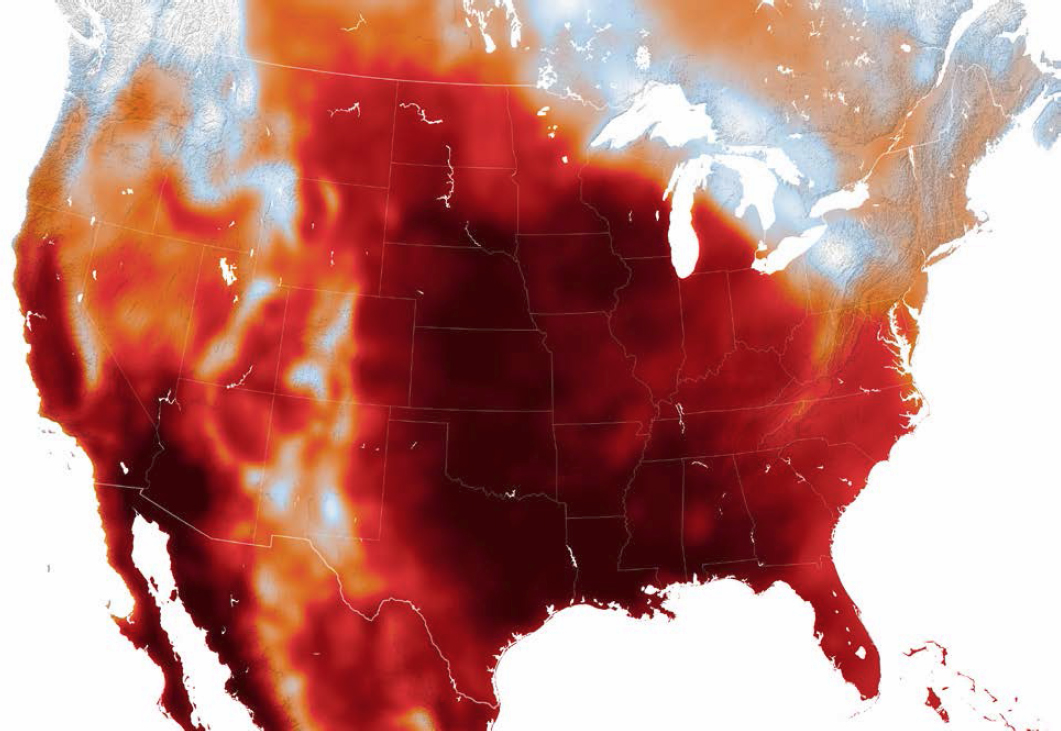
SOURCE: NASA Earth Observatory image by Lauren Dauphin using GEOS-5 data from the Global Modeling and Assimilation Office at NASA GSFC, https://earthobservatory.nasa.gov/images/151751/heat-dome-descends-on-central-us.
Finding: Strengthening the interaction between the flight planning, satellite data analysis, and Earth system modeling communities would enhance the use of satellite data for model assimilation and evaluation, inform the improvement of model parameterizations, and facilitate the development of high-resolution digital replicas of the Earth system to support applications.
NATIONAL OCEANIC AND ATMOSPHERIC ADMINISTRATION
In the context of civil Earth observation from space, NOAA has typically been associated with its operational weather mission through constellations of spacecraft in LEO and geostationary orbit (GEO). There have also been examples of successful collaboration across agencies. For example, after the success of the Tropospheric Emissions: Monitoring of Pollution (TEMPO) mission, first flown as a NASA EVI, NOAA is planning for a TEMPO-like instrument, called ACX (Atmospheric Composition Instrument), in GEO providing observations over the central United States.8 NASA is also developing the Libera instrument scheduled to fly on the fourth NOAA Joint Polar Satellite System (JPSS-4) satellite to ensure continuity of important Earth radiation budget measurements. Plans presented to the committee, however, suggest that NOAA is rethinking its strategy in terms of both scope and implementation.
While there is clear synergy between NOAA and NASA’s current Programs of Record, it is still too early to know or assess the details of NOAA’s future plans or identify potential future gaps. However, future NOAA mission plans as described to the committee will, in general, favor a disaggregated architecture with emphasis on atmospheric composition, climate, and space weather and place increased emphasis on leveraging partner and/or commercial data sources. It remains unclear which elements of its future architecture would be funded or implemented directly by NOAA versus other agency, international, or commercial partners. As it becomes increasingly reliant upon external data sources, NOAA will need to ensure its stakeholders remain aware of the need to support those partners accordingly. Clear communication and close coordination between NOAA, external data source providers, and related stakeholders will be critical to ensuring mutual advocacy and appropriate budget priority.
___________________
8 See NOAA. “GeoXO Atmospheric Composition Instrument (ACX).” https://www.nesdis.noaa.gov/our-satellites/future-programs/geoxo/geoxo-atmospheric-composition-instrument-acx.


