Paratransit Fleet Configurations (2024)
Chapter: Chapter 4 - Case Examples
CHAPTER 4
Case Examples
The TTI study team recommended the five transit agencies shown in Table 3 for case examples. The recommendations were based on the transit agencies’ experiences with changing fleet configurations over the last five years, different goals and motivations for doing so, lessons learned, and willingness to participate as a case example. The study panel concurred with TTI’s recommendations.
After developing an interview guide, the team conducted case example interviews with each contact person. Drafts of the respective case examples were then sent to each agency. Agency feedback and additional data collected were incorporated into the final versions.
Table 3. Case example agencies.
| Location | Agency | Service Name | Eligibility | 2022 Ridership | Fleet Size |
|---|---|---|---|---|---|
| Broward Co., FL | Broward County Transit | TOPS | ADA/Other | 784,552 | 337 |
| Portland, OR | Tri-County Metropolitan Transportation District | LIFT | ADA Para | 437,924 | 268 |
| San Diego, CA | San Diego Metropolitan Transit System | Access | ADA Para | 198,228 | 121 |
| Pinellas Co., FL | Pinellas Suncoast Transit Authority | PSTA Access | ADA Para | 89,412 | 58 |
| Ann Arbor, MI | Ann Arbor Area Transportation Authority | A-Ride | ADA Para | 71,956 | 34 |
Broward County Transit – Transportation Options (TOPS)
| Case Example Overview: Broward County Transit’s TOPS | |
|---|---|
| Transit Agency | Broward County Transit |
| Location | Broward County, Florida (Fort Lauderdale) |
| Service Name | Transportation Options (TOPS) |
| Service Description | Paratransit for ADA paratransit-eligible riders plus transportation disadvantaged (TD) riders |
| FY 2022 Ridership | 784,552 passenger trips |
| Case Example Overview: Broward County Transit’s TOPS | |
|---|---|
| Dedicated Fleet |
337 vehicles – 78% accessible
42 cutaways with lift – 10 seats, 2 wheelchair (w/c) positions 221 Ford Transits with lift – 8 seats, 2 w/c positions 74 sedans – 2–3 seats |
| Overflow Provider | None |
| Alternative Service | Rider’s Choice Program |
| Fleet Changes | Prior to 2023, the dedicated fleet consisted of 65 cutaways, 228 Ford Transits, and 44 sedans. Prior to acquiring the sedans, the fleet also included MV-1s, which were largely replaced with a combination of sedans and Ford Transits. Since 2015, the dedicated WAV fleet has had different-sized vehicles. |
| Reason for Change | Vehicle type availability to replace retiring vehicles |
| Benefits | Improved flexibility and cost efficiency |
Summary
Transportation Options (TOPS) is the paratransit service provided by Broward County Transit (BCT) in Florida. TOPS serves as BCT’s ADA paratransit service. It also provides (non-ADA paratransit) trips sponsored by Florida’s Transportation Disadvantaged (TD) Program. From 2010 until 2020, TOPS’s service model consisted of a call and control manager and two operations contractors. In 2020, the number of operations contractors was reduced to one, but they were operating out of two facilities. As a result of the severe flooding that occurred in April 2023, one of the facilities was rendered unrecoverable. Under the operations contract(s), BCT has been providing the fleet of dedicated revenue vehicles for TOPS, purchasing vehicles off the FDOT vehicle provision. Of the current 337 vehicles, and with a peak pullout of 287 vehicles (reflecting a 15% spare vehicle ratio), the fleet is subdivided into 42 wheelchair-accessible cutaways, 221 wheelchair-accessible Ford Transits, and 74 sedans, all of which are fueled with propane. Switching to propane has saved BCT millions of dollars, with an average cost of 90 cents per gallon and great fuel economy.
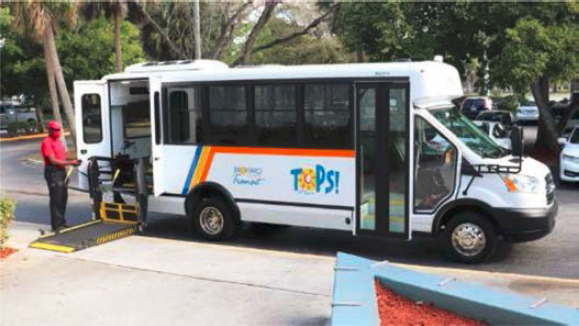
The purchase of sedans, reflecting 22% of the fleet, which followed the retirement of the discontinued MV-1s, was done because sedans were more readily available than WAVs were. The decision was also based on the composition of the TOPS ridership. BCT reports that sedans are less expensive to purchase and operate, but they have shorter lifespans. BCT also reports that the more recent purchases of Ford Transits rather than cutaways has been a success for the agency because the Ford Transits are narrower and nimbler than cutaways, providing greater location access, and can hold an equivalent number of riders using wheelchairs, and further that the additional two seats offered by cutaways are rarely needed. Ford Transits and cutaways have equal lifespans, and the differences in purchase and operating costs are negligible. BCT is likely to replace its cutaways with Ford Transits as the remaining cutaways are retired. At the same time, the fleet mix split (78%/22%) appears to be working well.
TOPS’s Client and Trip Eligibility
BCT’s TOPS is the paratransit service providing shared-ride services to both ADA paratransit customers and to customers whose trips are sponsored by BCT’s state-funded Transportation Disadvantaged paratransit Door-to-Door Program (TD program).
The state-funded TD program is a “last resort” program for individuals who need transportation and who do not have access to any other transportation resource. Florida Statute 427.011 defines the Transportation Disadvantaged population to be “persons who because of physical or mental disability, income status, or age are unable to transport themselves or to purchase transportation and are, therefore, dependent upon others to obtain access to health care, employment, education, shopping, social activities, or other life-sustaining activities, or children who are handicapped or high-risk or at-risk as defined in s. 411.202.”
The trips that are sponsored by the TD program include trips made by ADA paratransit customers that are beyond the ¾-mile fixed-route transit corridors that circumscribe the ADA paratransit service area and beyond the ADA paratransit service hours. Such TD trips may be made to anywhere in Broward County. The TD trips also can include trips made by TD program-eligible persons (see earlier) who are not eligible for ADA paratransit service. Also, some ADA paratransit-eligible customers are dually eligible for the TD program due to low income and cannot afford the ADA paratransit fare. ADA paratransit trips and TD-funded paratransit trips can be commingled on TOPS vehicles.
TOPS Service Policies
TOPS service is provided Monday through Saturday from 4:40 a.m. to 12:40 a.m. and on Sunday from 6:45 a.m. to 10:15 p.m., and customers may contact the Call Center during the same period. Reservations can be made from one to three days in advance, noting that next-day reservations must be completed before 5:00 p.m. Same-day service is also available but on a space-available basis only and is not guaranteed. Also accepted are subscription trips, defined as two or more trips per week to the same location and at the same time for a minimum four consecutive week period. While most customers choose to call the TOPS call center to book their trips, approximately 10% book their trips through the TOPS online trip scheduling portal.
Through an interactive voice recognition (IVR) system, confirmation calls with specific 30-minute pick-up windows are placed to customers the evening before the trip (typically made between 5:00 and 9:00 p.m.). The pick-up window for determining when a vehicle is on time is 0/+30. Additionally, an “imminent-arrival” call is also placed to customers when the vehicle is approximately 10 minutes away from the pick-up location. Door-to-door driver assistance is the standard level of driver assistance.
Standard ADA paratransit rider fares on TOPS are $3.50. ADA paratransit customers who are also honorably discharged veterans are charged half-fares of $1.75, but only to VA clinics in Broward County. In addition, other veterans may take trips on TOPS to the VA’s Kling Clinic at half-fare. TOPS service connects to other paratransit services in neighboring Palm Beach County and Miami-Dade County. Via transfers, all customers may continue traveling on paratransit in neighboring counties.
BCT’s TOPS Service Model and Contracts
BCT contracts out its call and control center functions and operations functions separately. Inktel Government BPO Services performs reservations, scheduling, and dispatching assistance. Having served as BCT’s call and control center manager since 2010, Inktel is currently in the
second year of a five-year contract (a three-year base contract with two one-year option years). Formerly, payment to Inktel was based on a flat per-service-hour rate. The current contract payment structure has a fixed monthly administrative fee covering fixed costs and a per-hour rate for variable costs.
Up until 2020, the primary dispatching and operational functions were performed by two contractors, First Transit and Transportation America, operating two separate fleets of dedicated vehicles provided by BCT, each serving about half of the trips. The two dedicated fleets were operated out of two different facilities provided by the two contractors. With the reduced demand caused by the pandemic, First Transit opted not to renew its option year in 2020. Transportation America became the sole operator of TOPS, operating out of both its own facility and First Transit’s former facility. However, when Broward County experienced severe flooding in April 2023, the operations facility near the airport was completely ruined. In response, TransAmerica moved its entire fleet to the other facility—a tight fit but doable. Transportation America is paid based on a fixed monthly fee covering fixed costs, as a per completed customer trip rate covering variable costs, noting there are different rates for ambulatory trips and trips requiring wheelchair-accessible vehicles. The providers’ payment is also tied to performance incentives and disincentives. In addition to the revenue vehicles, BCT also provides the scheduling software (StrataGen’s ADEPT system) and the propane fuel.
TOPS Ridership, Productivity, and Cost per Passenger Trip
As shown in Table 4, TOPS fiscal year (FY) 2019 ridership totaled 814,372 trips at a cost of $27.95 per trip. Its productivity was 1.57 passenger trips per RVH. During the pandemic, direct (exclusive ride) trips were instituted to promote safety through social distancing on the vehicle, which is the underlying reason for the decrease in productivity. As of FY 2022, ridership at 784,552 has rebounded to 96% of its pre-pandemic ridership.
BCT’s Alternative Service: Rider’s Choice
BCT also offers another service called Rider’s Choice, which indirectly impacts the number of rides (mostly ambulatory) on TOPS, and hence the TOPS fleet mix. A description of this alternative service may be found in TCRP Research Report 239: The Provision of Alternative Services by Transit Agencies: The Intersection of Regulation and Program (Ellis et al., 2023), in which BCT’s Ride Choice appears as a case example.
While BCT does not collect data on how many of these trips require a sedan versus an accessible taxicab, BCT management guesses that most of these trips are taken by ambulatory riders (and indeed, all 23 riders who participated in the study’s focus group were ambulatory). If this
Table 4. FY 2019–2022 TOPS ridership, productivity, and cost per passenger trip.
| Fiscal Year | Ridership | Productivity (Passenger Trips/RVH) | Cost per Passenger Trip |
|---|---|---|---|
| 2019 | 814,372 | 1.57 | $27.95 |
| 2020 | 525,244 | 1.36 | $34.95 |
| 2021 | 505,020 | 1.32 | $41.74 |
| 2022 | 784,552 | 1.47 | $45.93 |
Source: NTD data, SB-38 survey, and BCT staff.
is the case and if most of the trips taken on Rider’s Choice would have otherwise been taken on TOPS, then the existence of the alternative service likely results in a higher percentage of TOPS trips that require a wheelchair-accessible van.
TOPS’s Fleet Configuration
Under the current contract with Transportation America, BCT provides a fleet of dedicated revenue vehicles. All vehicles are purchased through the Florida DOT (FDOT) vehicle provision. The current fleet consists of 337 vehicles with a peak pullout of 287 vehicles, reflecting a 15% spare vehicle ratio. As shown in Table 5, the fleet is subdivided into 42 wheelchair-accessible cutaways, 221 wheelchair-accessible Ford Transits, and 74 sedans, all of which, including the sedans, are fueled with propane.
BCT’s Reasons for Changing Fleet Configurations
Paul Strobis, BCT’s Director of Paratransit, reported that up until recently, the TOPS fleet was 100% accessible, composed of cutaways and accessible minivans (MV-1s). With the production of MV-1s ceasing in 2016, there was no longer a “production” wheelchair-accessible minivan. Meanwhile, the production turn-around time for wheelchair-accessible cutaways has increased. With delays exacerbated by supply-chain issues involving certain parts, the current turn-around time for wheelchair-accessible cutaways is approximately 18 months to two years.
The solution for BCT was to order a mixture of sedans, which have been comparatively more readily available, and the newer Ford Transits, with a capacity of eight seats and two wheelchair positions that were relatively close in capacity to the cutaways. From the initial set of 44 sedans, BCT has since increased its sedan fleet to 74 sedans, which reflects 22% of the TOPS fleet. Mr. Strobis had experience using sedans during his time as Assistant Manager of The RIDE in Boston, when sedans comprised about 30% of the fleet. While technically, the seating capacity for sedans is three, the sedan capacity in the scheduling software is set at two as the front seat is not used, and fitting three adults in the back seat can be a tight squeeze. And while FDOT’s retirement age for sedans is five years and 200,000 miles, compared to seven years or 300,000 miles for both the Ford Transits and cutaways (which requires BCT to switch the sedans out more frequently), the purchase and operating costs of sedans are comparatively lower, and the sedans can be acquired more quickly.
Comparing the Ford Transits, which now represent 66% of the TOPS dedicated fleet, Mr. Strobis noted that the Ford Transits and cutaways are both midsized WAVs with equal lifespans (FDOT’s retirement age, as addressed earlier) and that the differences in purchase and operating costs between the two vehicle types are negligible. Features of the Ford Transits that Mr. Strobis noted as positives include the following: (1) they have a shorter delivery time; (2) an analysis of cutaway use found that the additional two seats in the cutaways were rarely needed;
Table 5. BCT’s TOPS dedicated fleet (2023).
| Vehicle Type | Number of Revenue Vehicles | Number of Seats | Number of Wheelchair Positions | Accessibility Features | CDL Required? |
|---|---|---|---|---|---|
| Cutaway | 42 | 10 | 2 | Lift | No |
| Ford Transits | 221 | 8 | 2 | Lift | No |
| Sedans | 74 | 2–3 | 0 | None | No |
| Total | 337 | – | – | – | – |
Source: Interview with BCT staff and SB-38 survey response. Note: – = not applicable.
and (3) the Ford Transit is narrower than the cutaways (which are built on Ford E-450 chassis) and has a tighter turning radius, adding to its flexibility. In summary, the decision to have a fleet consisting of three different sizes was largely based on necessity and availability but also on operational flexibility.
Lastly, BCT is somewhat unique in that its entire paratransit fleet is propane-fueled, including the sedans, which need gasoline to start up. However, once running, they operate on propane. The underlying motivation to go with an all-propane fleet was to improve the cost efficiency of the fleet and overall cost savings. Switching to propane, which is currently 90 cents per gallon, has saved BCT millions of dollars.
Benefits and Challenges Associated with Changing Fleet Configurations
BCT reports that sedans are better suited to serve certain locations and low-demand times and are less expensive to purchase and operate. BCT also uses sedans for “shooters” (floaters) for customers experiencing long wait times, for re-emerging no-show customers, or for a trip on a later-running vehicle to get that vehicle back on schedule. In addition, many sedans are used to serve the significant number of TOPS trips going to congregate meal sites.
BCT also reports that the more recent focus on Ford Transits versus cutaways has been an unqualified success, as the Ford Transits are narrower and nimbler than cutaways, can hold an equivalent number of riders using wheelchairs, and have a shorter production/delivery time as compared to cutaways.
With respect to using propane-fueled vehicles, there were some problems early on with vehicles stalling out (while stationary at a red light, for instance) while the Rausch air-conditioning system was running full blast, but the manufacturers developed a solution.
Future Vehicle Purchasing Decisions
As the cutaways in the TOPS fleet are retired, BCT will likely replace them with more Ford Transits, meaning that eventually, the TOPS fleet will consist of Ford Transits and sedans.
Lessons Learned
Mr. Strobis also advises, “Make sure your customer information can track nuances in individual mobility as not all customers can use smaller sedans. With that distinction, the scheduling software can match vehicle types to individuals’ mobility requirements.”
Portland, OR – Tri-County Metropolitan Transportation District of Oregon (TriMet) – LIFT
| Case Example Overview: TriMet’s LIFT | |
|---|---|
| Transit Agency | Tri-County Metropolitan Transportation District (TriMet) |
| Location | Portland, Oregon |
| Service Name | LIFT |
| Service Description | ADA Paratransit |
| FY 2022 Ridership | 437,924 passenger trips |
| Case Example Overview: TriMet’s LIFT | |
|---|---|
| Dedicated Fleet |
268 vehicles – 100% accessible (lifts)
186 cutaways – 10 seats, 3 w/c positions 82 Ford Transits – 8 seats, 2 w/c positions |
| Overflow Provider | Broadway, UZURV, and Big Star |
| Fleet Changes | Prior to 2023, TriMet had a mix of cutaways, Ford Transits, and converted minivans. The minivans were sold to Broadway Cab. |
| Reason for Change | Increasing reliance on Ford Transits as a more flexible and usable approach to a mixture of cutaways and minivans |
| Benefits | Improved scheduling efficiency, dynamic scheduling enhanced |
Summary
Tri-County Metropolitan Transportation District (TriMet) is the public transit agency that serves the Greater Portland, Oregon, metropolitan area; its name reflects the three counties of Multnomah, Clackamas, and Washington. TriMet operates a fleet of 688 on a network of 79 bus routes. TriMet also operates the MAX light rail system, which consists of five color-coded rail lines, the City of Portland–owned two-line Portland Streetcar, and the WES commuter rail service. Its ADA paratransit service is called LIFT.
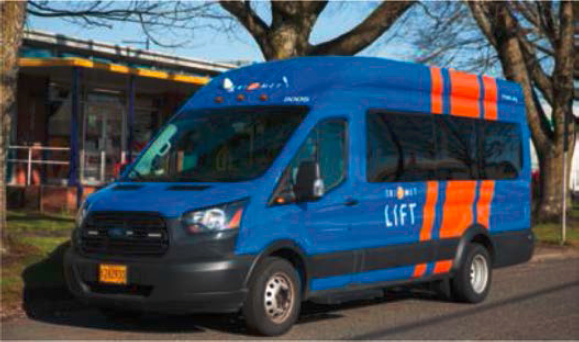
For years, TriMet has contracted out LIFT, including contracting with a call and control center manager (performing the functions of reservations, scheduling, dispatching, and handling customers’ service-day calls) and separate contracts for zoned operations. Until 2020, there were three such zones. With the reduction in demand caused by the pandemic, TriMet consolidated the three zones into a two-zone (east and west of the Willamette River) design under one contract, noting that direct service (no transfers) is provided between the zones. Currently, both the call and control center contract and the operations contract are with the same company, Transdev. Also, for years TriMet has contracted with a local taxi company, Broadway Cab, for overflow service.
Currently, the dedicated LIFT fleet operated by Transdev totals 268 wheelchair-accessible vehicles, which include 186 cutaways with 10 seats and three wheelchair positions and 82 Ford Transits with eight seats and two wheelchair positions. Until recently, the fleet also included 15 ramped Caravan minivan conversions, but these were sold to Broadway Cab. At about the same time, TriMet added UZURV (able to take only ambulatory trips) and Big Star (a WAV provider) as overflow providers. Currently, about 88% of LIFT trips are served by Transdev, while 12% of the trips are assigned to one of the overflow providers.
One of the ongoing problems has been that many of the LIFT cutaways were bought in 2011, 2014, and 2016. Virtually all of them are well past their retirement age. They have been expensive to maintain, and parts are difficult to obtain. Delays in getting new cutaways as a result of supply-chain issues motivated TriMet to purchase Ford Transits beginning in 2017. These had proven to be flexible and useful before the COVID-19 pandemic. However, capacity limits and social distancing requirements have made their use difficult during the COVID-19 era. TriMet intends to focus on cutaways in the future.
LIFT Service Policies
LIFT’s service area days and hours correspond to the ADA required 3/4-mile route corridors and hours of service but is generally available seven days a week from 3:30 a.m. to 2:30 a.m. Riders have a choice between curb-to-curb service or door-to-door service. LIFT also offers “hand-to-hand service” for customers who require this additional level of service.
LIFT customers may place reservations for LIFT up to 5 p.m. the day before the trip and up to three days in advance. Such requests can be placed by phone on weekdays from 9:00 a.m. to 5:00 p.m. and on Saturdays and Sundays from 10:00 a.m. to 5:00 p.m. Subscription trip requests may also be accommodated. Upon booking a trip, a customer is given a 30-minute pick-up window.
In addition, riders can request service via Pass Web, an interface that works with the Trapeze scheduling/dispatching system. For such bookings, customers are provided with a confirmed pick-up window on the day before the trip date after the scheduling process has been completed. Calls are made through an interactive voice recognition (IVR) system (PASS-IVR). The IVR system is also used to send imminent arrival texts/calls to riders approximately 15 minutes before the vehicle arrives, as well as prior day reminder calls for trips booked two or three days in advance (no reminder calls for trips booked the day before trips).
Up to one personal care assistant (PCA) and one or two companions may accompany the rider, with each companion paying a fare. The LIFT fare is $2.50, which can be paid in cash or with the personalized Hop Fastpass card.
LIFT Service Models and Contracts
TriMet contracts with Transdev to manage and operate the call and control center functions and operations. Fleet maintenance is handled under a separate contract with Penske Fleet Services.
TriMet provides the facilities (call and control center and the operations facility in each zone), the revenue vehicles, the in-vehicle communication equipment (driver tablets and cameras), the wireless communication linkages (between the drivers and dispatchers), the Trapeze paratransit scheduling system and all related technology, and the telecommunications equipment at each of the facilities.
For the call and control center contract, TriMet pays Transdev based on straight reimbursement for actual costs incurred. For the operations contracts, TriMet pays Transdev based on a split structure—a monthly fixed fee that covers fixed costs and a rate per RVH that covers variable costs. The operations contract additionally ties payment to on-time performance as well as trip productivity. Note that within the service area, there are different collective bargaining agreements, so TriMet defers to the most stringent standard for the service.
With TriMet contracting directly with the non-dedicated overflow providers, separate contracts provide for separate reimbursement rates. All are distance-based, with Broadway Cab’s rate based on its city-regulated meter rate, noting that Broadway Cab has a separate base rate for the sedan and WAV trips, with the WAV base rate being $15.00 higher than the sedan rate. However, the per-mile rate is the same. The Penske Fleet Maintenance contract is based on monthly vehicle miles traveled.
LIFT Ridership, Productivity, and Cost per Passenger Trip (FY 2019–2022)
As shown in Table 6, LIFT’s FY 2019 (pre-pandemic) ridership totaled 962,215 passenger trips, operated at the cost of $43.21 per trip and at a productivity of 2.0, which reflects the
Table 6. FY 2019–2022 LIFT ridership, productivity, cost per passenger trip.
| Fiscal Year | Ridership | Productivity (Passenger Trips/RVH) | Cost per Passenger Trip |
|---|---|---|---|
| 2019 | 962,215 | 2.0 | $43.21 |
| 2020 | 722,565 | 1.8 | $51.02 |
| 2021 | 268,316 | 1.4 | $83.79 |
| 2022 | 437,924 | 1.6 | $72.70 |
Source: NTD data, SB-38 survey, and TriMet staff.
“combined” productivity of dedicated service (at 1.9 passenger trips per RVH) and non-dedicated service (at 2.5 passenger trips per RVH). Note that revenue vehicle hours for dedicated vehicles and non-dedicated vehicles are measured differently, with the non-dedicated RVHs equating to live passenger time only; hence, there is higher productivity for non-dedicated service. During the pandemic, in-vehicle social distancing to promote safety and the decrease in demand, in general, led to a dramatic decrease in productivity and a significant increase in operating cost per passenger trip. As of FY 2022, ridership had rebounded somewhat to 437,924 but was only 46% of its pre-pandemic ridership, while the increase in productivity to 1.6 reflects the higher ridership. Also relevant is the percentage of trips assigned to overflow providers. In 2019, of the 962,215 LIFT trips, 108,056 trips (or 11%) were assigned to Broadway Cab. In 2022, this percentage had increased to 12%.
LIFT’s Fleet Configuration
As shown in Table 7, the LIFT fleet includes 186 lift-equipped cutaways and 82 lift-equipped Ford Transits. The cutaways can accommodate up to three wheelchairs, and the Ford Transits can accommodate up to two wheelchairs. Until recently, the fleet also included 15 ramped Caravan minivan conversions. However, these were sold to Broadway Cab, one of the overflow providers, as the minivans were well past their retirement age. At about the same time, TriMet added UZURV (able to take only ambulatory trips) and Big Star (a WAV provider).
TriMet’s Reasons for Changing Fleet Configurations
One issue related to the fleet has been the aging cutaways. Of the current 186 cutaways, 84 were purchased in 2011, 76 in 2014, and 26 in 2016 and are well past the Oregon Department of Transportation’s (ODOT’s) minimum retirement age of five years and 150,000 miles (according to TriMet management). Penske has had issues with keeping this fleet of cutaways running, especially with supply problems affecting the manufacture and availability of parts. Exacerbating
Table 7. TriMet LIFT dedicated fleet (2023).
| Vehicle Type | Number of Revenue Vehicles | Number of Seats | Number of Wheelchair Positions | Accessibility Features | CDL Required? |
|---|---|---|---|---|---|
| Cutaways | 186 | 10 | 3 | Lift | No |
| Ford Transit | 82 | 8 | 2 | Lift | No |
| Total | 268 | – | – | – | – |
Source: SB-38 survey. Note: – = not applicable.
the issue is that new cutaways are not being manufactured at the same pace as they were a decade ago. So when TriMet’s cutaway vehicles were ready to be retired, there were no new cutaways available to replace them. This problem was not specific to TriMet; the problem exists industry wide.
Because of this lack of availability for replacement cutaways, TriMet sought another answer for a vehicle that could accommodate at least two wheelchair riders and multiple ambulatory riders. In addition, Transdev found that the 15 accessible minivans had only limited usefulness and used them more as floater vehicles than in the peak pullout rotation. In 2017, TriMet sold these minivans to Broadway Cab.
With the prospect of having a significant number of cutaways unavailable, TriMet began augmenting the fleet with Ford Transits, purchasing 15 in 2017, 40 in 2018, and 42 later in 2018. The decision to purchase Ford Transits was born of necessity as they were available and had a reasonable seating capacity for paratransit work. As discussed later, the Ford Transits have done a good job for LIFT.
ODOT’s retirement standard for the Ford Transits is four years and 100,000 miles, compared to other states, such as the Florida DOT, where the retirement age and mileage of the Ford Transit are identical to those of the cutaways.
Benefits and Challenges Associated with Changing Fleet Configurations
Eileen Collins, TriMet’s Director of Accessible Transportation Programs, under which the LIFT service falls, stated that having a 100% accessible, dedicated fleet was key to serving their riders who use wheelchairs, as there is never an issue of sending a non-accessible vehicle by mistake. While the issues with the aging cutaways, as discussed earlier, remain, the Ford Transits have become the workhorse of the LIFT fleet. She noted that the comparatively low LIFT ridership (at less than half the pre-pandemic level) has allowed this focus to happen.
Ms. Collins observed that with a more uniform fleet of WAVs, there are fewer unscheduled trips on the day before the service and higher productivity, especially as ridership levels creep back to pre-pandemic levels. Ms. Collins also stated that she believes the uniform fleet results in a higher on-time performance because there have been fewer mechanical disruptions and fewer complaints, which she attributes to a smoother ride.
Future Vehicle Purchasing Decisions
Ms. Collins reported that TriMet will return its focus to acquiring cutaways—and not Ford Transits—for LIFT, possibly to include different fuel types. And while TriMet is considering diversifying fuel types, Ms. Collins has real concerns about the ramifications of accidental mis-fueling. She also reported that TriMet is strongly considering a pilot that utilizes electric vehicles.
Lessons Learned
Ms. Collins advises, “If you are using grant funding from your state to purchase vehicles, be cognizant of the ramifications of right-sizing your fleet. Once you migrate from one vehicle class and size down to a smaller vehicle class, you may encounter state policy obstacles to returning to a large size. In Oregon, for example, doing so is considered a fleet expansion and not a vehicle replacement.”
She added, “Diversifying fuels for revenue vehicles can be a really useful tool in case of fuel shortages, power outages, extreme cold, etc. [that] affect certain types of vehicles but not others. However, the flip side is the potential cross contamination of fuels such as diesel in a gasoline powered vehicle or vice versa, especially when the two different vehicles are used similarly.” With vehicles of different sizes, Transdev has had to use a wet hose fueler to fuel vehicles at the two operations facilities because the different sizes of vehicles require different fuel nozzles.
San Diego MTS – Access
| Case Example Overview: MTS’s Access | |
|---|---|
| Transit Agency | San Diego Metropolitan Transit System (MTS) |
| Location | Central, South, Northeast, and Southeast San Diego County, California |
| Service Name | Access |
| Service Description | ADA Paratransit |
| FY 2022 Ridership | 198,228 passenger trips |
| Dedicated Fleet |
121 vehicles – 100% accessible
107 cutaways with lifts – 14 seats, 4 w/c positions 14 Caravan/Braun conversion with ramp – 4 seats, 2 w/c positions |
| Overflow Provider | Yellow Taxi and UZURV (26%), several NEMT providers were added during the First Transit Work Stoppage (April 26–June 27, 2023) |
| Fleet Changes | Prior to 2021, the dedicated fleet consisted of 100% cutaways Accessible minivans added in 2021 |
| Reason for Change | To reduce capital and operating costs and allow for non-CDL drivers |
| Benefits | Reduced costs and a larger pool of drive candidates |
Summary
The San Diego Metropolitan Transit System (MTS) is the public transit agency that serves Central, South, Northeast, and Southeast San Diego County, California. The MTS’s ADA paratransit service is called Access.
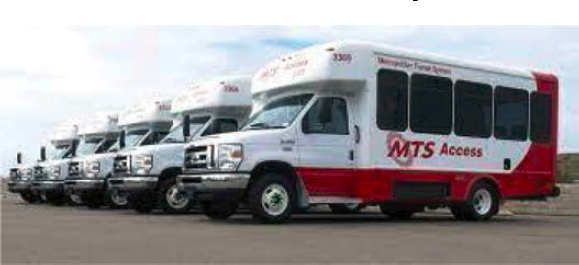
Access is provided primarily through a turnkey contract with First Transit (now Transdev). First Transit handles all day-today call and control functions, service delivery, road supervision, vehicle maintenance, and so forth, with MTS providing First Transit with revenue vehicles for Access’s dedicated fleet, the operations facility, and the Trapeze paratransit scheduling/dispatching software. Pre-pandemic, First Transit also utilized an overflow provider, Yellow Group Taxi, which was assigned 19% of the trips in FY 2019. In 2023, and before First Transit began a labor strike in late April, UZURV was added as an overflow subcontractor. As a result of the labor strike, which was settled two months later, on June 27, 2023, MTS added several NEMT providers to help with wheelchair trips.
Historically, the Access fleet consisted of accessible propane-fueled cutaways. In 2021, several gasoline-powered Caravan/Braun conversion ramped minivans (currently 14 to go with the 107 cutaways) were purchased because they were less expensive to buy and operate and because they could be driven by operators who did not have CDLs, thereby broadening the pool of driver applicants, an important benefit in this era of driver shortages.
While the Access fleet is currently oversized—the pre-strike spare vehicle ratio was 40% as a result of ridership rebounding to only 55% of its pre-COVID-19 level. But moving forward, MTS management has indicated that it wishes to focus new vehicle purchases on “tweener” vehicles that can hold two wheelchairs but have fewer seats and don’t require CDL drivers. With a preference for propane-fueled vehicles because of the low cost of propane (under $1.00 per gallon), MTS is currently exploring propane-fueled Ford Transits as a possible solution.
Access’s Service Model
MTS’s service model for Access may best be described as a turnkey contractor with subcontracted overflow providers. First Transit, the turnkey contractor, performs all day-to-day functions, including reservations, scheduling, dispatching, handling customers’ service-day calls, and all operations and maintenance functions. Meanwhile, MTS provides the operations/maintenance facility, the revenue vehicles that compose the dedicated fleet, and the paratransit scheduling/dispatching system, Trapeze.
First Transit has also had an overflow subcontract with Yellow Group Taxi since 2018. In August 2022 (pre-strike), they entered into another overflow subcontract with UZURV. While both Yellow Group Taxi and UZURV served only ambulatory trips, they handled 26% of the Access trips (pre-strike). Since the strike, the overflow providers have been handling a higher proportion of the trips because First Transit is only able to pull a handful of Access vehicles. In response, First Transit entered into subcontracts with six local NEMT providers, all of whom have wheelchair-accessible vehicles.
Access service connects to other ADA paratransit services to the north (North County Transit District) and is currently operated by MV Transportation. The transfer connections going in both directions are performed at two transfer points. The transfer policy for Access customers is that riders have a choice: they can (1) opt to stay in the vehicle until the connecting vehicle arrives or (2) choose to wait in the transfer facility (which has restrooms).
MTS’s Contract
MTS’s turnkey contract with First Transit is based on a common split structure with fixed costs bundled into a monthly fixed fee and variable costs paid based on revenue vehicle hours supplied by the dedicated fleet. The contract also includes performance-based incentives and penalties. The cost of the trips that First Transit incurs in assigning trips to its overflow subcontractors is passed through to MTS along with a “reservations fee.”
Access Policies
Access service is provided when the MTS fixed route service operates. Generally, service is available Monday through Friday from 4:30 a.m. to 11:30 p.m. and Saturday and Sunday from 5:00 a.m. to 11:00 p.m.; service hours vary based on the local bus service hours in each route corridor. The fare is $5.00.
Access customers may place reservations up to two days in advance and up to 5:00 p.m. the day before a trip. The call center is open daily from 8:00 a.m. to 5:00 p.m. Customers may also make reservations via the MTS EZ Access app 24/7 under the same reservation policies. MTS management reports that approximately 10% of trips are requested via the EZ Access app. MTS also accepts requests for subscription trips.
Up to two spaces may be reserved in addition to the rider. These can be two companions or a PCA and a companion, with the PCA riding free and each companion paying a fare (children under five may also ride free).
Table 8. FY 2019–FY 2022 Access ridership productivity and cost per passenger trip.
| Fiscal Year | Ridership | Productivity (Passenger Trips/RVH) | Cost Per Passenger Trip |
|---|---|---|---|
| 2019 | 576,663 | 2.5 | $33.95 |
| 2020 | 343,960 | 2.0 | $43.51 |
| 2021 | 107,193 | 1.5 | $64.44 |
| 2022 | 198,228 | 1.8 | $59.56 |
Source: NTD data, SB-38 survey, and BCT staff.
Confirmed 30-minute pick-up windows are transmitted to the customer through the Trapeze IVR system via a phone call or text (depending on customer preference) by 5:00 p.m. the day before the trip date. Trips may be requested based on a requested pick-up time or based on an appointment time (or requested drop-off time). The default level of driver assistance is curb-to-curb. Door-to-door service may be requested by customers requiring a higher level of assistance.
Access Ridership, Productivity, and Cost per Passenger Trip
Table 8 shows Access service and cost statistics. With a significant decline in ridership as a result of the pandemic, productivity declined while cost per passenger trip increased. Ridership in 2022 has not rebounded from the 2019 level as other transit agencies have experienced. The 2022 ridership level is only 33% of the 2019 ridership, while many other transit agencies have been reporting ridership levels between 60% and 80% of their pre-pandemic levels. Nevertheless, with the increase in ridership from FY 2021 to 2022, Access saw a 20% increase in productivity and an 8% reduction in operating costs per passenger trip.
Current Fleet Configuration
Between 2018 and 2021, the Access dedicated fleet, operated by First Transit, was composed of propane-fueled, lift-equipped cutaways with a seating capacity of 14 seats (max) and two wheelchair positions, noting that some of the 14 seats reflect flip seats. Currently, MTS has 107 such cutaways. All of these vehicles are purchased through CalACT’s vehicle provision contract.
In 2021, MTS added several gasoline-powered Caravan/Braun conversion ramped minivans and has added to this fleet over the last two years, bringing the total number of minivans to 14. The 14 minivans were purchased because they were less expensive to buy and operate and because they could be driven by operators who did not have CDLs, thereby broadening the pool of driver applicants, which is an important benefit in this era of driver shortages. Together, the cutaways and minivans provide a 100% accessible fleet of 121 vehicles of the current fleet (see Table 9).
Table 9. San Diego MTS’s Access fleet (2023).
| Vehicle Type | Number of Revenue Vehicles | Number of Seats | Number of Wheelchair Positions | Accessibility Features | CDL Required? |
|---|---|---|---|---|---|
| Cutaways | 107 | 14 | 4 | Lift | Yes |
| Caravan/Braun minivans | 14 | 8 | 2 | Ramp | No |
| Total | 121 | – | – | – | – |
Source: SB-38 survey. Note: – = not applicable.
Pre-pandemic, the Access fleet allowed for a 20% spare vehicle ratio. In 2023, pre-strike, the spare ratio was around 40%, as the 2023 ridership has rebounded only to about 55% of the 2019 ridership level.
During the labor strike (April–June 2023), only about five vehicles in the dedicated fleet were being used to provide Access service, as there were a handful of drivers who were crossing the picket line. Consequently, First Transit was also outsourcing its reservation duties because its reservationists were also on strike. It was assigning as many trips as possible to its overflow providers, Yellow Group Taxi and UZURV, while also entering an agreement with six local non-emergency medical providers that have wheelchair-accessible vehicles to provide “overflow” WAV trips. Ridership during the strike averaged about 1,100 passenger trips per month or about 50% of the pre-strike level.
MTS’s Reasons for Changing Fleet Configurations
Jay Washburn, MTS’s Manager of Paratransit and Minibus, reported that the pre-COVID-19 composition of the fleet was directly impacted by the service model, which included an overflow provider at that time. In FY 2019, for example, 69,263 (or 12%) trips—all ambulatory—of the 576,663 trips were served by Yellow Group Taxi.
That said, over time, Mr. Washburn assessed that the size of the larger cutaways, which was 100% of the dedicated fleet at that time, was not really needed. Rarely were all 14 seats and four wheelchair positions full. While the propane fuel positively affected the cost of the operation, these cutaways were expensive and cumbersome to operate. They required a CDL driver, which limits the pool of driver applicants and is counter to good business practices in this era where paratransit services (and really all transportation services) are having difficulty recruiting and retaining drivers. In addition, Mr. Washburn mentioned the delays in procuring cutaways. While MTS can take advantage of CalACT’s vehicle procurement contract, the order-to-delivery time now takes 18 months to two years.
With these shortcomings in mind, MTS in 2019 ordered 14 accessible Dodge Caravan minivans (Braun conversion) under the premise that these vehicles would be less costly to purchase and operate—and would be nimbler and more flexible to operate—as compared to the larger cutaways. Mr. Washburn stated that ideally, he would have preferred a “tweener” vehicle, such as the paratransit vehicles that used to be built on the Ford E-250 chassis; however, the converted Caravans provided a solution and could be acquired more quickly.
Benefits and Challenges Associated with Changing Fleet Configurations
Mr. Washburn reported that accessible minivans indeed have been less costly to purchase and operate than the larger cutaways, despite the differences between the cost of gasoline and the cost of propane, which Mr. Washburn said is currently available for 85 cents a gallon. Mr. Washburn also reported that the smaller vehicles are particularly helpful in responding to will-call riders, as well as riders re-emerging from no-showed or missed trips, and otherwise serving as “floaters” that can be used, for example, to serve an upcoming trip for a late-running vehicle to get it back on time, especially if the overflow providers are at capacity. Overall, Mr. Washburn reported that the Caravans have a limited capacity and the cutaways are oversized for MTS’s needs.
Future Vehicle Purchasing Decisions
Mr. Washburn is actively looking for that “tweener” vehicle, noting that he has been looking at the Ford Transits, with their seating configuration of eight (or fewer) seats and two wheelchair
positions. Mr. Washburn also wishes to return to an all-propane dedicated fleet, if possible. In essence, this ideal “tweener” type of vehicle would have a seating capacity that better reflects MTS’s needs for Access while providing a narrower (and more flexible) vehicle with the same or lower operating cost as a cutaway. Most important, though, is that the vehicle does not require a CDL driver.
A prospective stumbling block for Mr. Washburn was that the Ford Transits he had been researching were not propane-fueled. He has since learned, though, with information provided by Broward County Transit, that Ford Transits can be converted to run on propane. Thus, Mr. Washburn indicated that the Ford Transit might indeed be an ideal solution to replace the aging cutaways in his fleet and noted that Ford Transits have the same life spans as those cutaways.
In addition, Mr. Washburn noted that the size and composition of his dedicated fleet will be greatly impacted by post-strike ridership levels and the extent to which the new NEMT providers are continued as an overflow resource.
Lessons Learned
Mr. Washburn advises examining the applicability of the paratransit vehicles; for example, larger vehicles may be a waste if they are never filled as a result of scheduling practices and policies and the lack of group trip demands. That said, the actual deployment of two smaller vehicles where one larger vehicle would be more efficient presents a counter-argument if such events happen frequently.
Mr. Washburn also pointed out the strategic relationship between service mix and fleet mix, noting that the relationship between the dedicated fleet configuration and the use of overflow providers (and the availability and capacity of ambulatory trips versus WAV providers) needs to be examined before deciding on the configuration of the dedicated fleet. “Don’t assume that doing it yourself is the best cost model.”
Pinellas County, FL – PSTA Access Service
| Case Example Overview: PSTA Access | |
|---|---|
| Transit Agency | Pinellas Suncoast Transit Authority (PSTA) |
| Location | St. Petersburg, Florida |
| Service Name | PSTA Access |
| Service Description | ADA Paratransit |
| FY 2022 Ridership | 153,278 passenger trips |
| Dedicated Fleet |
58 vehicles – 100% accessible (lifts)
5 cutaways – 4 seats, 6 w/c positions 53 Ford Transits – 5 seats, 2 w/c positions |
| Overflow Provider | UZURV and Bay Area Metro/United Taxi (46% of trips) |
| Fleet Changes | Prior to July 2021, PSTA retained a turnkey contractor who provided/operated a dedicated fleet of 66 WAVs and 54 sedans. From July 2021 on, First Transit/Transdev has operated a dedicated WAV fleet, with ambulatory trips sent by PSTA staff to the local taxi company (first) and then to UZURV. |
| Reason for Change | To reduce scheduling restrictions and group more trips requiring WAVs |
| Benefits | Improved scheduling efficiency, dynamic scheduling enhanced |
Summary
Pinellas Suncoast Transit Authority (PSTA) is the public transit agency serving Pinellas County, which straddles Tampa Bay off Florida’s Gulf Coast. The two largest cities in Pinellas County are St. Petersburg, where PSTA is based, and Clearwater. Its ADA paratransit service, formerly branded DART, is now called Access.

Prior to July 2021, PSTA had been using a local turnkey contractor who provided and operated a mix of 66 uniform WAVs and 54 sedans, all operated in a dedicated fashion with the exception of a few private-pay trips. In July 2021, PSTA migrated to a new service model in which the reservations function was brought in-house. PSTA retained First Transit (now Transdev) to provide, schedule, and operate a fleet of 53 wheelchair-accessible Ford Transits and five wheelchair-accessible cutaways.
Under the new service model, a local taxi company under contract to PSTA and UZURV under contract to Transdev serve most ambulatory trips. Together, these overflow providers for ambulatory trips serve 46% of the total trips.
The overflow providers enable a 100% accessible, dedicated, and relatively uniform fleet. With a 100% dedicated fleet, PSTA has noticed improvements in the productivity of the dedicated fleet. With each WAV being able to accommodate two wheelchairs, there is ample opportunity for group wheelchair trips.
Access Service Policies
Access operates seven days a week, roughly from 5:00 a.m. to 11:00 p.m. A unique aspect of the PSTA Access service area is that PSTA has doubled the size of its ADA minimally required 3/4-mile corridors, expanding the service area to a one-and-a-half-mile corridor. The default level of driver assistance is door-to-door.
PSTA Access customers may call for reservations between one and six days in advance of the service date but no later than 5:00 p.m. the day before the service date. Subscription trip requests may also be accommodated. Telephone operators are available to take reservations on weekdays between 8:00 a.m. and 5:00 p.m. and on Saturdays from 9:00 a.m. to 5:00 p.m. In addition, riders with smartphones can also use an app to reserve a trip 24 hours in advance, a customer convenience implemented in August 2022.
A PCA and up to two companions may accompany the rider, with each companion paying a fare. The fare is $4.50, which can be paid with a debit or credit card (as of May 2023). Upon booking a trip, a customer is given a 30-minute “be ready” window. Advance cancellations may be made without penalty as long as the cancellation is made at least two hours prior to the start of the “be ready” window.
Access Service Models and Contracts
From July 2016 to July 2021, PSTA retained a local contractor, Care Ride, to provide all day-to-day functions under a turnkey contract. This contract included Care Ride providing and operating its own fleet. During FY 2021, Care Ride operated a dedicated fleet that consisted of 66 wheelchair-accessible cutaways and 54 sedans (while there were two different types of WAVs,
their seating/wheelchair capacity was essentially the same). PSTA’s contract with Care Ride provided for a rate per trip, with a higher rate for wheelchair trips.
In July 2021, PSTA migrated to a new service model in which:
- PSTA took on the reservations/brokering function.
- First Transit (now Transdev) was retained to schedule, dispatch, and operate its own fleet of 58 wheelchair-accessible vehicles (which consisted of 53 wheelchair-accessible Ford Transits and five wheelchair-accessible cutaways).
- PSTA retained Bay Area Metro/United Taxi to serve ambulatory trips assigned to the taxi company by PSTA staff. This contract prescribed a certain guaranteed minimum number of trips; this task was performed first to fill the taxi company’s quota.
- PSTA staff also assigned other ambulatory trips that did not fit well on Transdev’s dedicated fleet to UZURV, Transdev’s subcontractor. Of note, the ambulatory trips assigned to UZURV come from PSTA staff and not from Transdev.
- As a key element to the new service model, PSTA also licensed Spare Labs’ technology to support PSTA’s access reservations, scheduling, and dispatching functions.
PSTA pays Transdev a monthly fixed fee covering fixed costs plus a rate per RVH covering variable costs. PSTA pays Transdev a flat per-trip rate for each trip the agency assigns to UZURV. PSTA pays Bay Area/United Taxi a flat per-trip rate.
Access Ridership and Cost per Passenger Trip (FY 2022)
FY 2022 ridership and cost statistics for Access are presented in Table 10. First Transit/Transdev served 82,324 people on its dedicated fleet or about 54% of the total trips. On the dedicated fleet, 63,886 (or 78%) of the trips required a WAV. The remaining 18,438 ambulatory trips were trips that were not assigned by PSTA staff to UZURV or Bay Area Metro/United Taxi. Wheelchair trips compose 63,886 (or 42%) of the 153,278 total trips, which is in contrast to most ADA paratransit services, for which the percentage typically falls between 20% and 30%. This is because many of the ambulatory riders are taking PSTA’s on-demand microtransit service, Mobility on Demand (which uses Lyft and Uber), instead of using PSTA Access.
The cost per passenger trip of serving the passenger trips on non-dedicated providers is $19.35 on Bay Area/Metro/United Taxi and $21.53 on UZURV. The difference in cost between serving these trips with non-dedicated service providers (NDSPs) versus a dedicated fleet operated by
Table 10. FY 2022 Access passenger trips and cost per passenger trip.
| Provider – Service Type | FY 2022 | |
|---|---|---|
| Passenger Trips | Cost per Passenger Trips | |
| First Transit – Wheelchair | 63,886 | $72.83 |
| First Transit – Ambulatory | 18,438 | $72.83 |
| UZURV Ambulatory | 28,165 | $21.53 |
| Bay Area Metro Ambulatory | 42,809 | $19.35 |
| Subtotal – Ambulatory Trips | 89,412 | $33.73 |
| Total | 153,278 | $50.43 |
Source: NTD data, SB-38 survey, and PSTA staff.
First Transit/Transdev led to the decision to use these two NDSPs first and up to the capacities they can handle. Once the assignments of ambulatory trips to the NDSPs have been completed, the remaining ambulatory trips are then scheduled to the dedicated fleet operated by First Transit. Because of the difference in costs between the dedicated fleet and the NDSPs, and with paratransit driver shortages resulting in a reduced pull-out of vehicles, this strategy has proved to be a more cost-effective approach than the more traditional approach of scheduling ambulatory trips around the wheelchair trips on the dedicated fleet, and then sending the remaining ambulatory trips to the non-dedicated overflow providers.
PSTA’s Alternative Service: Mobility on Demand
In 2018, PSTA also implemented an on-demand alternative service for its ADA paratransit customer called Mobility on Demand. While many such alternative services across the United States are designed to allow riders to arrange service with participating service providers directly (Ellis et al., 2023), a unique aspect of this service is that customers do not call the participating carriers (Uber, Lyft, Lyft’s WAV subcontractor, and Bay Area Metro/United Taxi) to arrange service. Instead, customers call PSTA, which then brokers the trips to the rider’s carrier of choice. Another aspect of this service is that it has a flat $3.50 fare, $1.00 less than the $4.50 fare of PSTA Access. In contrast to many such alternative services across the United States, Mobility on Demand has no trip cap. However, a trip cap is currently under consideration.
The consequence of this service is that many of the trips that would otherwise have been taken on Access had the Mobility on Demand service not been in place are no longer being made on Access, and most of these trips are ambulatory. Hence, the percentage of Access trips that require WAVs is higher than it would have been had the Mobility on Demand service never been implemented.
Access’s Fleet Configuration
Table 11 shows that Transdev is supplying a 100% accessible fleet of 58 WAVs. The fleet includes 53 Ford Transits that can accommodate two wheelchairs and five cutaways that can accommodate up to four wheelchairs. The reasoning for the seating configuration of the cutaways would appear to be to accommodate shared or group trips of three to six riders using wheelchairs. In contrast, if the Ford Transits were used, Transdev would need to dispatch two or three vehicles instead. These instances are probably infrequent, given the preponderance of Ford Transits.
PSTA’s Reasons for Changing Fleet Configurations
The flat per-trip rates that PSTA had negotiated with Care Ride for PSTA Access were advantageous financially to PSTA, but not so for its contractor Care Ride, which was losing money. At the end of the contract term, Care Ride went out of business. BayCare, which was Care Ride’s
Table 11. FY 2023 PSTA Access vehicles.
| Vehicle Type | Number of Revenue Vehicles | Number of Seats | Number of Wheelchair Positions | Accessibility Features | CDL Required? |
|---|---|---|---|---|---|
| Cutaways | 5 | 4 | 6 | Lift | No |
| Ford Transit | 53 | 1 | 2 | Lift | No |
| Total | 58 | – | – | – | – |
Source: SB-38 survey. Note: – = not applicable.
parent company, was interested in continuing to operate the service. That interest was based on getting a sole source contract from PSTA, which PSTA could not do because of federal procurement requirements. BayCare opted not to submit a proposal, which left PSTA seeking a new provider and re-designing the service model.
PSTA’s Request for Proposal was written in a way that vested the responsibility for providing the dedicated WAV fleet. Rather than dictate the WAV vehicle types and seating configurations, it was left up to the proposers to identify the WAVs that could be acquired in time for the start of the contract. Putting this on the proposers was a purposeful decision on the part of PSTA in recognition of the delays in WAV production and availability. Because of its national ability to procure vehicles, Transdev was able to secure 53 new Ford Transits, configured to include two wheelchair positions (with flip-down seats) along with five new accessible cutaways accommodating up to six wheelchair positions.
Meanwhile, PSTA hoped that the new service model’s bolstered non-dedicated sedan fleet (UZURV and taxis) in combination with the Mobility on Demand program would allow for a smaller dedicated WAV fleet (reduced from 66 cutaways to 53 Ford Transits and 5 cutaways) with increased productivity.
Benefits and Challenges Associated with Changing Fleet Configurations
Bonnie Epstein, Director of Mobility Services of PSTA, reports that moving most of the ambulatory trips to non-dedicated service providers (80% in 2022) and reducing the volume of trips scheduled onto the dedicated fleet has resulted in lower productivity of the dedicated fleet.
In addition, changes in productivity may also have been a result of a new paratransit scheduling/dispatching system (Spare Labs) that was implemented in December 2021 and later modified in March 2023 to improve service efficiency. Thus, it has been difficult to identify the impacts attributable solely to changes in the fleet mix.
Otherwise, Ms. Epstein reports that the local Transdev staff likes the current, mostly uniform fleet mix. At the same time, the riders appear to have adapted to the new vehicles as well, as there has been no effect on the complaint frequency ratio.
Some of the cost benefits that would normally have accrued from the service mix and fleet mix that were hoped for did not materialize because Transdev’s cost is significantly higher than the cost of Care Ride. However, Ms. Epstein points out that the financial advantages of the service mix and fleet mix tempered the increased costs.
Future Vehicle Purchasing Decisions
Ms. Epstein reported that PSTA would likely continue to require that the contractor provide the revenue vehicles in future contracts. In particular, she mentions that any cost savings that would otherwise accrue from a higher federal (80/20) match of capital purchases versus paying for the vehicles as operating expenses (50/50) as they do now must be weighed against the nimbleness of the contractors’ dynamic right-sizing of the fleet—where the contractor can rightsize the fleet during the contract term with ridership changes, as a result of the Mobility on Demand program.
The underlying reasoning behind leaving this decision with the contractor is that the contractor will make the right decisions concerning the uniformity, usefulness, flexibility, and maneuverability of the fleet in order to render their proposed rate more competitive.
Lessons Learned
Ms. Epstein advises transit agencies to make sure that any future fleet decisions “accommodate the needs of the riders.” While pleased with the performance of the Ford Transits, she noted that she wasn’t sure whether the six-wheelchair capacities of the cutaways were being utilized, adding that she has asked Transdev to monitor this with respect to future seating configurations of larger vehicles.
Ann Arbor, MI – AAATA’s A-Ride Service
| Case Example Overview: AAATA’s Access | |
|---|---|
| Transit Agency | Ann Arbor Area Transportation Authority (AAATA) |
| Location | Ann Arbor, Michigan |
| Service Name | A-Ride |
| Service Description | ADA paratransit (formerly consolidated with senior transportation) |
| FY 2022 Ridership | 71,956 passenger trips |
| Dedicated Fleet |
34 vehicles – 100% accessible
14 cutaways with lift – 14 seats, 3 w/c positions, CDL 8 Ford Transits with lift – 10 seats, 2 w/c positions 12 accessible minivans (ramp) – 3 seats, 1 w/c position |
| Overflow Provider | None (currently) |
| Fleet Changes |
Prior to 2020, the fleet consisted of dedicated cutaways and sedans
From 2020 on, the fleet has been 100% accessible Since 2015, the dedicated WAV fleet has had different-sized vehicles |
| Reason for Change | To reduce scheduling restrictions and group more trips |
| Benefits | Improved scheduling efficiency, dynamic scheduling enhanced |
Summary
The Ann Arbor Area Transportation Authority (AAATA), branded TheRide, is the public transit agency serving the Ann Arbor/Ypsilanti communities in southeastern Michigan, including the Ann Arbor–based University of Michigan. Its ADA paratransit service is called A-Ride.
AAATA has changed the service model for A-Ride several times over the last decade. These changes included (1) a turnkey contractor that operated WAVs provided by AAATA and sedans provided by the contractor; (2) a transitional model in which call center functions and operation of WAVs versus sedans were split between AAATA and its contractor; (3) a split structure in which AAATA performed reservations and scheduling and in which the turnkey contractor operated a mix of WAVs and sedans; (4) another transitional service model, in which AAATA operated the entire service with WAVs; and (5) the current service in which AAATA performs reservations and scheduling and the operations contractor also performs dispatching, service delivery, road supervision, and fleet maintenance and operates a 100% accessible fleet.
Throughout most of this decade, AAATA’s counterpart transportation service for older adults, GoldRide, was consolidated with A-Ride. However, GoldRide was suspended during the pandemic. When it was resumed, AAATA procured a separate contractor to provide this service.
Thus, with all of these changes, AAATA’s fleet mix migrated from a fleet mix of WAVs and sedans, which reflected the combined rider mix of ADA paratransit customers and older adults, to a 100% WAV fleet (during the pandemic when the trips for older adults were temporarily dropped and were later re-installed as its own service). During that time, the WAV fleet migrated from a uniform set of cutaways to a fleet that also included Ford Transits and minivans. This fleet reconfiguration largely occurred because of the availability of the smaller vehicles and the delays in getting cutaways. AAATA management has indicated that moving forward, it will strive to achieve a more uniform fleet of WAVs, citing driver and mechanic familiarity and a streamlined parts inventory.
Description of A-Ride
A-Ride operates seven days a week. Its operating hours are weekdays, from 6:30 a.m. to 11:45 p.m.; Saturdays, from 7:30 a.m. to 10:45 p.m.; and Sundays, from 8:00 a.m. to 7:45 p.m. Its service area corresponds to the ¾-mile fixed route corridors minimally required. A-Ride is also available to ADA paratransit residents of Ypsilanti, Pittsfield, and Superior Township on weekdays between 6:30 a.m. and 6:30 p.m. The default level of driver assistance is door-to-door.
A-Ride customers may call for reservations between one and seven days in advance of the service date. Subscription trip requests may also be accommodated. Up to one PCA and up to one companion may accompany the rider, with the companion paying a fare. The A-Ride fare is $3.00. Upon booking a trip, a customer is given a 30-minute “be ready” window. For will-call returns, the “be ready” window is 45 minutes from the time when the trip has been requested. Advance cancellations may be made without penalty as long as the cancellation is made at least 30 minutes prior to the start of the “be ready” window.
Different Paratransit Service Models/Fleet Configurations (2004–2021)
AAATA’s ADA paratransit service, A-Ride, has utilized several different service models and fleet configurations over the years. Historically, A-Ride was widely lauded as one of the few ADA paratransit services for which riders could regularly request service on the day of travel (premium service). For well over a decade, AAATA served A-Ride trips and trips for older adults (as part of its transportation service for older adults, GoldRide) on the same service platform with ADA paratransit trips and older adult trips commingled.
From a fleet configuration perspective, A-Ride has seen a number of changes over the years. From 2004 to 2014, AAATA had a turnkey operations contract with a taxi company called Select Ride to provide A-Ride and GoldRide trips. For this contract, AAATA provided a uniform fleet of 11 rear-loading wheelchair-accessible cutaways (10 seats max with three wheelchair positions) to Select Ride. In contrast, the contractor provided a fleet of 20 sedans. AAATA’s contract with Select Ride specified that both the WAV fleet and the sedan fleet were to be operated in a dedicated fashion; however, it became clear to AAATA that Select Ride was using the sedan fleet for other trips in violation of the contract. As of 2014, the service was providing 119,000 A-Ride trips and 10,000 GoldRide trips.
In 2014, contractor performance issues resulted in the termination of the contract with Select Ride. AAATA installed an emergency transitional service model that brought in-house the operation of the 11 WAVs that it had previously provided to Select Ride. At that time, AAATA also took on the reservations function for all trips as well as same-day reservations and handled
service-day calls from WAV trip riders while also performing the scheduling and dispatching for the AAATA-operated WAV fleet. Meanwhile, AAATA hired a new contractor, RideCorp (a division of Blue Cab), to operate same-day service with its fleet of 20 dedicated sedans. RideCorp also took on the responsibility for same-day reservations and dispatching for the sedan trips while also handling service-day calls from sedan riders. This emergency service model essentially divided the service into (1) a WAV service for riders who required a wheelchair-accessible vehicle and (2) a sedan service for riders who didn’t require WAVs. The function of road supervision was also split, with AAATA road supervisors overseeing the WAV service and contractor road supervisors overseeing the sedan service.
During 2014–2015, the fleet mix consisted of 11 dedicated WAVs operated by AAATA and 20 dedicated sedans operated by RideCorp, essentially replicating the fleet mix that SelectRide operated. However, the big difference was that under the Select Ride contract, some ambulatory trips were served on WAVs. During this year, a total of 97,800 A-Ride/GoldRide trips were served, 18,300 trips with AAATA’s dedicated WAV fleet, and 79,500 trips with RideCorp’s dedicated sedan fleet.
From 2015 to 2020, AAATA installed yet another service model for the combined A-Ride/GoldRide service, with RideCorp retained as its contractor. This service model had AAATA directly performing the intake and scheduling of all reservations and the scheduling function for all reservation trips needing WAVs while assigning ambulatory trips that could not fit onto the WAV runs onto a “taxi run” that was transmitted to RideCorp. RideCorp also took on the responsibility for same-day reservations, operating the fleet of WAVs and sedans (all of which were operated in a dedicated fashion), all dispatching functions, handling service-day calls from all riders, and road supervision. So, during this period, while various call and control functions were split, the dedicated fleet of WAVs and sedans was operated by one entity, RideCorp. In 2019, pre-pandemic, a total of 153,000 A-Ride/GoldRide trips were served.
In March 2020, largely due to the COVID-19 pandemic, the GoldRide program was suspended, and same-day service for new trips (versus will-calls) was discontinued. By doing this, the service platform was refocused to provide only ADA paratransit service on a next-day and advanced reservation basis. As a result of the significant drop in ridership, however, RideCorp dissolved when the contract ended in July 2020. The following month (in August 2020), AAATA brought the entire service in-house, operating the WAV fleet that it had previously provided to RideCorp.
Current Paratransit Service Description and Fleet Configuration
During this time, AAATA ran a procurement process for a new operations contractor. In August 2021, a new contractor, MV Transportation, was hired, with AAATA continuing to perform reservations and scheduling and with MV Transportation performing dispatching, service delivery, road supervision, fleet maintenance, and operating the WAVs that AAATA had been operating during the transitional year.
As part of the MV Transportation contract, AAATA is now supplying 34 WAVs to MV Transportation, with a peak pullout of 26 vehicles and nine vehicles serving as spares (for a spare ratio of 26%). The entire fleet is wheelchair accessible and operated in a dedicated fashion. Similar to the preceding five years, the WAV fleet consists of vehicles of different sizes and seating capacities, as shown in Table 12. Three of the body-on-chassis vehicles have lifts that accommodate oversized wheelchairs. One issue that has cropped up is that parts for this lift are no longer being made. Hence, AAATA may soon be in the position of coming up with a different solution, such as a separate contract with an NEMT provider, to transport these riders.
In comparison with the former fleet configuration, sedans were no longer part of the fleet mix as the former fleets were supporting older adult trips, many of which were ambulatory. In August 2021, as ridership was making a post-pandemic comeback, the GoldRide program was
Table 12. FY2023 AAATA’s A-Ride vehicle configuration.
| Vehicle Type | Number of Revenue Vehicles | Number of Seats | Number of Wheelchair Positions | Accessibility Features | CDL Required? |
|---|---|---|---|---|---|
| Body on chassis | 14 | 14 | 3 | Lift | Yes |
| Ford Transits | 8 | 10 | 2 | Lift | No |
| Minivans | 12 | 3 | 1 | Ramp | No |
| Total | 34 | – | – | – | – |
Source: SB-38 survey.
Note: – = not applicable.
reinstated with its own contractor, Golden Limousine, retained via a competitive procurement. Thus, GoldRide has not been re-combined with A-Ride.
Paratransit Ridership, Productivity, and Costs
Table 13 shows ridership, productivity, and cost-per-passenger trip statistics from 2019 to 2022.
AAATA’s Reasons for Changing Fleet Configurations
Roger Williams, AAATA’s Manager of Mobility Services (under which A-Ride falls), stated that the primary reason for going with a 100% accessible fleet was tied to giving the scheduling optimization engine (Trapeze) fewer restrictions, thereby giving more resources for scheduling/dispatching a trip requiring a WAV. With fewer restrictions and more flexibility, AAATA management reasoned that a 100% accessible fleet would also improve the service/cost efficiency of the system by being able to share and group more trips.
The decision to have a fleet consisting of three different sizes was largely based on necessity, as AAATA needed WAV vehicles, and Ford Transits and minivans were more available with less lead time than body-on-chassis vehicles. Had all else been equal, AAATA staff stated that they probably would have gone with a more uniform fleet of WAVs, citing driver and mechanic familiarity and a streamlined parts inventory.
Benefits and Challenges Associated with Changing Fleet Configurations
Moving to a 100% WAV fleet has improved the efficiency of scheduling and dispatching. For A-Ride, AAATA employs dynamic scheduling, a strategy discussed in TCRP Synthesis 168:
Table 13. FY 2019–FY 2022 A-Ride/GoldRide passenger trips, productivity, cost per passenger trip.
| Calendar Year | A-Ride Passenger Trip | GoldRide Passenger Trips | Total Passenger Trips | Productivity | Operating Cost/Passenger Trip |
|---|---|---|---|---|---|
| 2019 | 136,710 | 16830 | 153,000 | 1.4 | $37.71 |
| 2020 | 70,740 | 3391 | 74,131 | 1.3 | $60.41 |
| 2021 | 66,031 | 0 | 66,031 | 1.4 | $67.32 |
| 2022 | 71,956 | 0 | 71,956 | 1.6 | $55.34 |
Source: NTD data, SB-38 survey, and AAATA staff.
The Impacts of Continuous Dynamic Scheduling on ADA Paratransit Services (Rodman and Blume, 2023), and management reports that having a 100% WAV fleet presents significantly fewer restrictions on this process and results in more efficient service delivery. Mr. Williams reports that there has been a 20% increase in shared rides as ridership has rebounded since the pandemic, adding that this increase would likely have been much lower with a mixed fleet of WAVs and sedans. He also reported that having a 100% WAV fleet had virtually eliminated the incidence of wrong vehicles being sent to customers, adding that when vehicle incompatibilities did happen, the delays resulting from having to re-dispatch a more appropriate vehicle significantly impacted service.
The minivan purchase was executed due to a shortage of supplies needed to produce enough cutaways to meet demand. The added benefit was that it also provided a vehicle type that could better maneuver through certain areas throughout the city. Moreover, AAATA management reports that smaller vehicles have lower operating and capital costs. On the negative side, the vehicles with 30- to 34-inch ramps cannot accommodate many larger wheelchairs.
The elimination of sedans and the purchase of minivans have led to a flood of reasonable modification requests for vehicle exclusions. As a result, AAATA’s eligibility staff have had to navigate whether a request not to have a specific vehicle is a preference for a more comfortable vehicle or is driven by a medical need. In response to such reasonable modification requests, the staff is pursuing a medical professional’s concurrence that the suspension system shortcomings of large vehicles have an acute impact on the rider’s ability to ride in larger vehicles. AAATA has granted reasonable modifications for medically related reasons but has not granted such requests based on preference.
When weighing the Ford Transits over the cutaways, the advantages have been that the gas-fueled Ford Transits are easier to fuel as compared to the diesel-fueled cutaways. On the other hand, AAATA staff state that Ford Transit parts can be more difficult to obtain, which may affect future purchasing decisions favoring smaller vehicles. Otherwise, staff state that while Ford Transits are less expensive to acquire, the operating costs are nearly equivalent. In addition, the smaller vehicles may have operators who have a chauffeur’s license versus a CDL, which opens up the applicant pool and partially addresses driver recruitment issues.
Future Vehicle Purchasing Decisions
Mr. Williams reports that AAATA has decided to continue with a 100% accessible fleet and to strive toward fleet uniformity, most likely by focusing on Ford Transits because they are more maneuverable than cutaways and have a seating capacity that provides greater scheduling flexibility and more ridesharing possibilities than minivans. Mr. Williams also adds that streamlined maintenance, increased driver familiarity, and a reduction of reasonable modification requests also entered into the calculus of striving toward a uniform fleet.
Lessons Learned
While smaller WAV vehicles do not require drivers with CDLs, AAATA tasked its contractor with having a minimum of 80% of their drivers equipped with a minimum CDL class C to ensure that a lack of CDL drivers would not inhibit meeting the need for cutaways on any particular day. Mr. Williams reports that approximately 88% of the contractor’s drivers do indeed have CDL class C licenses, noting that such drivers with such certifications have higher wage rates. Mr. Williams also adds, “A 100% WAV fleet will maximize the scheduling effectiveness of a dynamic scheduling process, and a more uniform fleet will streamline maintenance.”


