Developing an Agenda for Population Aging and Social Research in Low- and Middle-Income Countries (LMICs): Proceedings of a Workshop (2024)
Chapter: 3 Conceptual and Methodological Barriers
3
Conceptual and Methodological Barriers
Ayaga Bawah (University of Ghana, workshop planning committee member) moderated the second session of the workshop focused on identifying new conceptual, theoretical, methodological, and data investments that are needed to move from purely descriptive cross-national analyses to more causal analyses, in order to create a better understanding of how inequality, environmental exposures, and changing family structures affect health and well-being at older ages in low- and middle-income countries (LMICs).
IMPACT OF EARLY CONDITIONS AND BIOLOGICAL CLOCKS
Hiram Beltrán-Sánchez (University of California, Los Angeles) focused his remarks on two methods of research: using cohort studies to look at the impact of early conditions on older adult outcomes and using blood samples to study “biological clocks” in evaluating aging. He used data from Latin American countries to illustrate his points but emphasized that these methods of research would be relevant in many LMICs.
Impact of Early Conditions
Child mortality in Latin American countries has dropped dramatically over the last 100 years, said Beltrán-Sánchez: see Figure 3-1. There were medical, social, and economic changes that occurred during this period that contributed to the decline, but the changes happened at different times and affected different birth cohorts. People born prior to 1935 in Latin America lived in a time with very little medical or public health infrastructure. Between the mid-1930s and the mid-1980s, birth cohorts benefited from the deployment of medical technology and public health campaigns, such as vaccinations and antidiarrheal disease interventions. People born prior to the 1970s were born into families with an average size of 5 or 6 children. In the 1970s, there was a massive decline in fertility, with families shrinking to about two children per woman. Finally, economic improvement occurred in Latin American countries in the late 1980s and early 1990s; birth cohorts born during and after this period benefited from increased economic well-being.
Looking at the later-life outcomes for birth cohorts from different time periods, said Beltrán-Sánchez, allows one to examine whether and how growing up in different conditions affects aging and health outcomes. There are two potential approaches that one could use to examine these data: macro-aggregate research and Mendelian randomization. Macro-aggregate research cannot be used to make causal inferences, but it can allow one to examine descriptively a birth cohort’s early conditions and later outcomes. For example, some research shows that improved early conditions may be linked with an increase in morbidity and mortality later in life, as a result of milder mortality selection pressures (Beltrán-Sánchez et al., 2022). In order to understand the causal relationship between an event and health outcomes, it is necessary to conduct micro-level research using individual-level data, said Beltrán-Sánchez. Individual-level data can be used to conduct randomized controlled trials, to use natural experiments to look at the
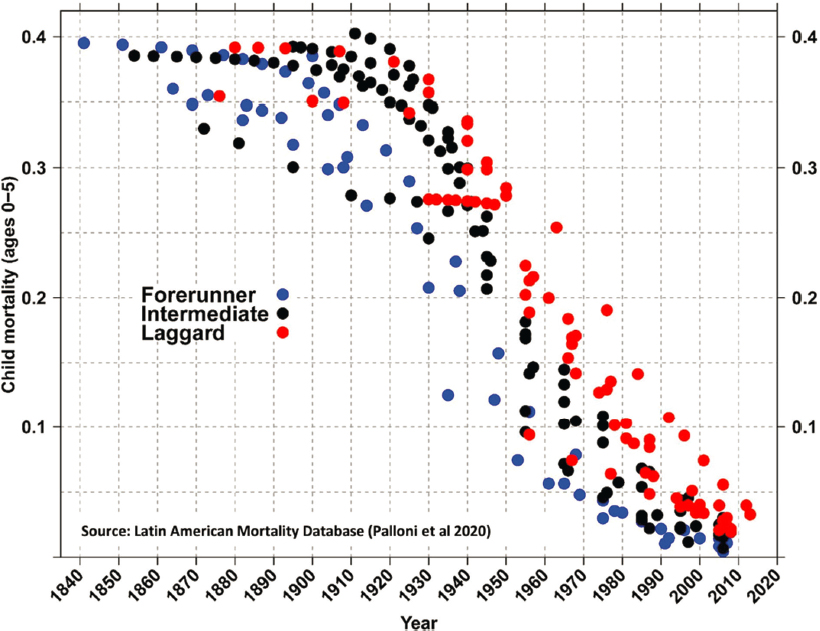
NOTES: Forerunners (blue): Argentina, Costa Rica, Cuba, Uruguay; Laggards (red): Bolivia, El Salvador, Guatemala, Honduras, Nicaragua, Paraguay, Peru; Intermediate (black): Chile, Colombia, Dominican Republic, Ecuador, Mexico, Panama, Venezuela.
SOURCE: Workshop presentation by Hiram Beltrán-Sánchez. Created from data in the Latin American Mortality Database 2, University of Wisconsin System: https://www.ssc.wisc.edu/cdha/latinmortality2/
impact of an event on later outcomes, or to utilize Mendelian randomization1 to examine the causal effect of an exposure.
Mendelian randomization, he said, is an “extremely exciting and hopefully very useful” approach. It has been more commonly used in epidemiological studies rather than in nationally representative studies, but with the increasing collection of biological data, research can be done that takes account of genetic variation. Beltrán-Sánchez shared an example of his research that used natural experiments to study the impact of events on health outcomes. In 1918, Puerto Rico experienced the worldwide flu pandemic and also had an earthquake-caused tsunami that affected a certain region of the country. Using the variation across regions, Beltrán-Sánchez and his colleagues looked for causal effects of fetal and postnatal exposure to the flu, the tsunami, or both (Palloni et al., 2020).
Biological Clocks
Biological clocks are generally defined as “indicators of accumulated age‐related latent physiological change computed with the aid of a battery of biological markers of major physiological domains,” said Beltrán-Sánchez. One type of biological clock, the “epiclock,” uses epigenetic markers and chronological age (CA; first-generation epiclocks) or may also incorporate blood biomarkers or health behaviors, such as smoking (second-generation epiclocks). Researchers in New Zealand are conducting a cohort study that uses data to compute the “pace of aging,” or the rate at which underlying physical deterioration is occurring. These tools can be used to assess how fast people are aging, whether aging is different among populations, and whether the pace is changing over time. Comparing a person’s biological age (BA) with their CA can identify individuals with “accelerated aging.” That is, individuals whose BAs are older than their CAs are aging faster. Accelerated aging is associated with excess mortality and shorter life expectancy; in contrast, individuals whose BAs are “younger” than their CAs show an increase in life expectancy. Beltrán-Sánchez emphasized that these associations on a population level are not causal but are relevant markers worth examining. In order to find causal determinants of the differences between BA and CA, it would be necessary to collect repeated measures of biological markers from individuals. Collecting biomarkers in the field is “not an easy task,” he said, and it is very expensive. Currently, the assays for epigenetic clocks are expensive, but he is hopeful they will become more affordable over time.
___________________
1 This term, and its applications, are discussed in detail at https://www.cdc.gov/genomics/events/precision_med_pop.htm
In order to conduct this kind of research, Beltrán-Sánchez said, there is a need for multidisciplinary researchers who understand biology, can make connections with indicators, and are capable of using tools that can determine causation. He emphasized that while individual-level data are important in order to understand causation, “we should not lose sight” of macro-aggregates that are equally important for understanding the connections between life events and health outcomes.
INVESTING IN DATA FOR AGING
All work conducted at the interface of high-income countries and LMICs is “being done against a background of the history we share—colonialism, slavery, exploitation,” said Sam Clark (The Ohio State University). Researchers working in this area should keep this in mind and should lean on the work of people in other fields engaging with these topics. Clark gave several examples of work that he recommends:
- When People Come First: Critical Studies in Global Health (Biehl & Petryna, 2013);
- Critical Epidemiology and the People’s Health (Breilh, 2021);
- Epidemiological Accountability: Philanthropists, Global Health, and the Audit of Saving Lives (Reubi, 2018);
- Time to Take Critical Race Theory Seriously: Moving Beyond a Colour-Blind Gender Lens in Global Health (Yam et al., 2021); and
- Decolonizing Global Health: What Should Be the Target of this Movement and Where Does It Lead? (Kwete et al., 2022)
Clark explained that his background and training are in biology, engineering, and demography. Earlier in his career, he worked on health and demographic surveillance sites in Africa, with an emphasis on data collection, data management, and data analysis. More recently, he has been working to develop a new method for estimating under-5 mortality; UNICEF now uses this method for their global estimates. Currently, he said, he has been developing a “verbal autopsy” to estimate the population burden of disease.2 This process has involved developing global standards, creating new statistical methods for automated analysis of the data, and working to move verbal autopsy out of the research setting and into the normal infrastructure of ministries of health and national statistical systems. A new component, he said, has been adding minimally invasive tissue samples to a
___________________
2 For a definition of verbal autopsy and current uses, see https://www.who.int/standards/classifications/other-classifications/verbal-autopsy-standards-ascertaining-and-attributing-causes-of-death-tool
verbal autopsy and building a reference death archive in order to use these data to calibrate machine learning methods.
When trying to determine cause and effect in aging and health outcomes, there are multiple influences on outcomes and different data sources and methods for each of them. Diseases are complicated, and they are affected by biology, behavior, the environment, and society; each of these influences also interacts with the others. Biology interacts with behavior and environment over the life course, in the context of society, to create disease outcomes. Clark then discussed each of these areas in turn, looking at the objective of the research, what specifically is being studied, and how cause and effect can be determined.
Research on biology aims to find biological mechanisms to explain how molecules affect one another, eventually resulting in outcomes at the cellular, organ, or person level. This research can be conducted by looking at molecules, individual humans, or population-level genetics. Cause and effect are established through experiments, although Clark noted that most experiments are conducted on cell lines or animal models, rather than humans. Research on biology is largely generalizable and transferable because biological mechanisms are generally deterministic and predictable. One example of biological research in the aging space, said Clark, is research on alleles of the apolipoprotein E gene and how they contribute to Alzheimer’s risk.
Behavioral research seeks to determine how individual behaviors increase or decrease the risk of disease, its progression, and the outcomes. This research looks at individual humans and groups of humans and establishes cause and effect through observational studies and various forms of randomized studies. Clark said that evidence from behavioral research is sometimes generalizable and transferable since some humans share behaviors, but there are nuanced differences. Measurement of behavior can be challenging, he said; it is affected by circumstances and the quality of interactions (e.g., interviews, participant observation). Clark noted that measuring behavior in LMICs can be particularly challenging: researchers and participants each come to the work with their own view of the world and their understanding of how things happen. Each party may be “operating with quite a different cognitive structure,” which can affect how questions are asked, what participants say, and how researchers understand what is said.
Research on environmental factors, whether at the biological or sociocultural level, is very important, said Clark. While “environment” can be defined in many different ways, Clark focused on the physical environment. This type of research would look at how the physical environment (e.g., pollution) affects disease dynamics and individual disease outcomes. Cause and effect are established through a combination of observational
studies and experiments, both intentional and accidental. Accidental—or natural—experiments such as natural disasters can present excellent opportunities to learn more about cause and effect. Measurement can be both deterministic and precise, he said, and also use statistical estimates involving distributions, uncertainty, and confidence. The generalizability of this research depends on the nature of the environmental factor, said Clark: biological factors in the environment are more generalizable than sociocultural factors.
Population-level epidemiology is a type of research that seeks to provide population-level descriptions of the burden of disease, disease dynamics, and cause and effect. The subject of such research is well defined, generally covering large populations of human beings, and essential measures include the prevalence and incidence of disease. Cause and effect can be established through observational or randomized studies. Epidemiology describes or infers how many people are affected, where they live, when they are affected, and who they are, said Clark. This work can be done at various levels of granularity, although in some areas, there is a lack of even population-level data, let alone the ability to disaggregate further. Epidemiological evidence is usually population and circumstance specific, so it is difficult to generalize. Findings are most often statistical in nature—for example, estimates of distributions and uncertainty.
Clark then described each of these types of research in the context of the state of research in LMICs and what is needed. Biological research can largely be “borrowed” from high-income countries, he said, but there is a need to replicate these findings in LMICs to ensure that they hold across contexts. In addition, there is a need to develop and expand the ability to conduct research with biomarkers, animal models, and cell lines in these settings. Unlike biological research, behavioral research is largely not generalizable, and much work needs to be done in LMICs. Behavior is contextual and cultural, thus research must be done in LMIC settings and in a way that accounts for the sociocultural and contextual circumstances of LMICs. Clark emphasized that cultures and languages must be handled carefully, and Western medical concepts cannot be directly transferred to many LMIC contexts.
Most environments in LMICs have not been described or investigated with respect to diseases of aging, including Alzheimer’s. This is particularly true, he said, for people who live in rural areas or informal urban areas (e.g., settlements on the periphery of cities). There is much to do in the area of environmental research, said Clark, such as setting up environmental monitoring stations and linking this information with survey and other data. Like environmental research, epidemiological research is lacking in rural and informal urban areas. In many LMICs, the burden of diseases of
aging has not been directly measured, other than in special populations. There are a number of research needs in this area:
- describing the basic burden of disease;
- increasing coverage to whole populations;
- creating measurement systems with the ability to operate at fine(r) levels of granularity;
- longitudinal surveillance; and
- routine, population-scale, continuous monitoring.
Clark closed by identifying ways that research in LMICs can be improved and increased. First, he said, there is a need to train researchers in these countries. A lack of trained individuals is the “number one impediment” to improving research, he said. Training is needed in a variety of areas, including surveys, trials, and research design; electronic data capture; data management; data ethics; Bayesian statistics, machine learning, and general (frequentist) statistics; sample design; and longitudinal research design. Second, global health needs to be decolonized; this will lead to better, “more context-relevant research that has a higher chance of driving meaningful change,” he said. Third, there is a need for public, open-access funding for researcher-initiated projects and to facilitate partnerships between scientists in high-income countries and those in LMICs. It is important, he said, to avoid foundation-driven work that narrowly adheres to the foundation’s view of what should be done. Finally, Clark said, new data, methods, and approaches are needed that are adapted to LMIC settings. Work in this area could include:
- building basic surveillance into routine administrative systems;
- leveraging existing data and finding new ways to use them;
- building on health and demographic surveillance systems; and
- designing and building longitudinal monitoring systems that use vital statistics, surveys, and health and demographic surveillance data.
All of this work, said Clark, will require cross-trained individuals and interdisciplinary teams. Building capacity within LMICs to design, conduct, analyze, and translate research is an essential part of improving understanding of aging and health in these countries.
GLOBAL AGING DATA
Hans Peter Kohler (University of Pennsylvania) began his presentation by noting that there is tremendous variation within and across LMICs, in
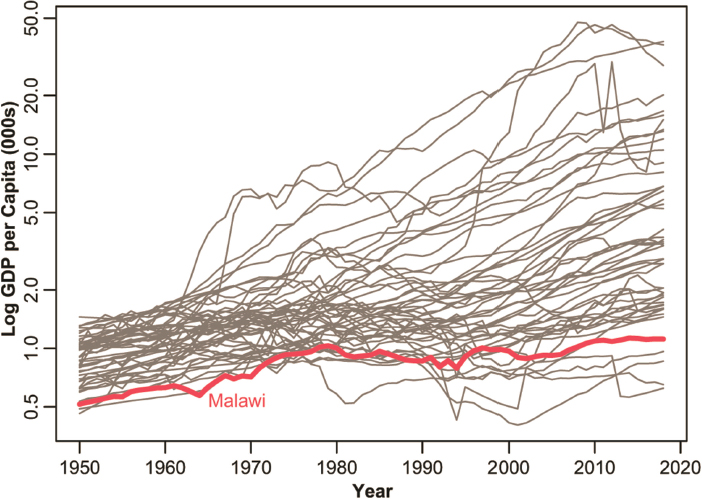
economic development, mortality patterns, and demographics, among other characteristics. Understanding aging across these contexts requires identifying and acknowledging the major contextual differences within and across LMICs. For example, among the countries that were the poorest in the 1950s, some have developed rapidly and are now relatively affluent; others have developed more slowly; and others, such as Malawi, have remained quite poor, he said: see Figure 3-2. In addition, individuals age against a backdrop of disease and mortality that affects survival; when we study older individuals, “we study survivors.”
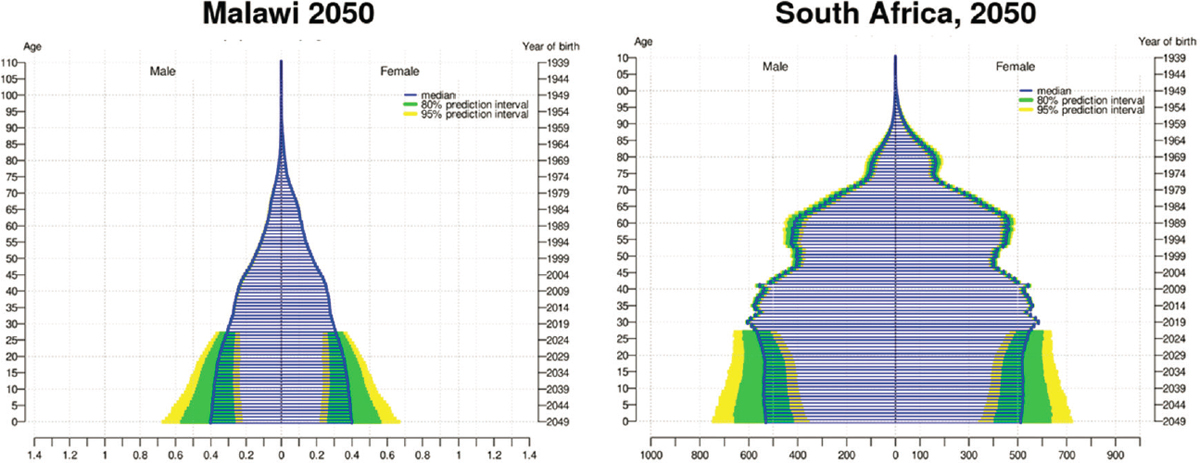
Kohler noted that there have been major shifts in mortality within and across LMICs. For example, under-5 mortality in Malawi was around 35% in 1950, and the HIV epidemic raised mortality for adults. Today’s older adults are “very resilient,” having survived high mortality across the life course. The patterns and shifts in mortality have an impact on many of the outcomes that aging researchers are interested in. Demographically, the populations of LMICs are aging at different rates, which affects the context in which individuals age. For example, Malawi and South Africa have very different population pyramids, with projections showing a larger proportion of older South Africans by 2050: see Figure 3-3. Within and across LMICs, individuals are aging in “strikingly different contexts,” and researchers need to make the effort to identify and understand these differences and to capture the diversity of aging.
Most of the current knowledge about aging comes from research in high-income countries, said Kohler. One question is whether this knowledge is generalizable to LMICs and whether patterns observed in high-income countries hold for LMICs. A related question, he said, is whether there are things that can be learned about successful aging in LMICs that could shed light on the challenges of aging in high-income countries. Furthering understanding of aging in LMICs has the potential to inform interventions, policies, and programs in both LMICs and high-income countries.
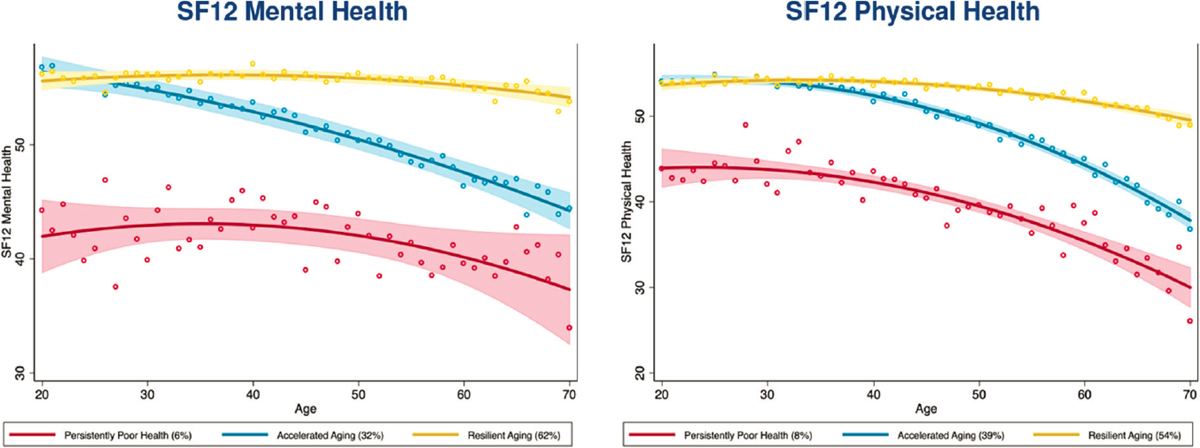
Kohler shared additional data from Malawi to illustrate how research on aging in a low-resource environment might be useful in other contexts. In Malawi, there is a great deal of heterogeneity in health and aging, but individuals can be categorized into three subsets: one subset has had persistently poor mental and physical health through adulthood and into older age; another subset had good health during adulthood but their health rapidly declined as they reached older ages; and one small subset has maintained good health throughout adulthood and into older age: see Figure 3-4. In other contexts, said Kohler, one might assume that the third subset had better access to resources than others, but this study population was uniformly poor. The individuals who maintained better health, he said, tended to be “very resourceful in utilizing the knowledge, the resources, and the health care access” they needed in order to accomplish relatively
SOURCE: Ciancio et al. (2023, Figure 1a). Reprinted with permission.
SOURCE: Workshop presentation by Hans Kohler based on data from U.N. World Population Prospects: http://population.un.org/wpp/. Data reused under Creative Commons license 3.0 IGO: http://creativecommons.org/licenses/by/3.0/igo/
successful aging. Similar patterns have been seen in cognitive aging, with a small group of individuals being more resilient to decline. Understanding this variation and teasing apart the driving factors of resiliency is critical to understanding the aging process in both LMICs and other countries.
One factor that is somewhat unique to LMICs, said Kohler, is the widespread exposure to early-life adversity. People in LMICs experience many more shocks—such as famines, wars, and natural disasters—than people in high-income countries. A number of researchers have studied whether these early-life shocks have later-life effects, and what these effects are. For example, birth cohorts that were affected in utero by a 1949 famine in Malawi have slightly better cardiovascular health in older ages. Kohler noted that this is contrary to other research that has found negative effects from early-life adversity. Kohler and his colleagues are looking for mechanisms by which adversity can translate into better health outcomes; they theorize that adversity may have epigenetic effects on resilience.
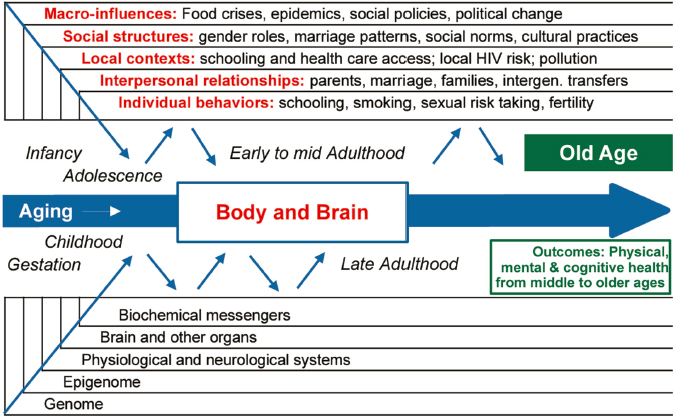
Given the complexities of aging and the variety of contexts in which people age, Kohler said that it is critical to create conceptual frameworks that facilitate integration of findings across different contexts. He shared a framework that guides him and his colleagues in their work in Malawi: see Figure 3-5. The framework contains a number of innovations that allow the researchers to measure and study a wide range of factors, including the genome, epigenome, physiological and neurological systems, the brain and other organs, and biochemical messengers. These biological mechanism data can be integrated with information about social context and individual risk factors in order to better understand aging and why some individuals age “faster” or “slower.” Kohler noted that it is important to design studies that allow for causal inference when appropriate. However, he cautioned, researchers must be cognizant of the context in which they are working and aware of their impact. For example, a study conducted in 2004 examined whether mortality was affected by knowledge of one’s HIV status. All participants were tested for HIV status but only those who chose to learn the result were told of their status. Those who learned in the course of the study that they were HIV positive were less likely to survive the next few years. “Telling individuals that they have a fatal disease” at a time and place that antiretroviral treatment was not available produced behaviors that reduced their survival, said Kohler.
SOURCE: Hoang et al. (2023, Figures 3a and 3b). Reprinted with permission.
SOURCE: Hoang et al. (2023, Figure 2). Reprinted with permission.
Kohler closed by offering his ideas of what data and methods innovations are needed in order to expand and improve research on aging in LMICs:
- creating innovative global aging data that capture diverse aging contexts across and within LMICs;
- allowing life-course analyses that include family and community contexts;
- capturing biological, social, and behavioral aspects of aging;
- allowing comparative analyses via harmonization of key outcomes and exposures, while recognizing limitations of doing so across LMICs;
- capturing changing environmental, social, and economic contexts;
- aspiring to be nationally representative, while utilizing special datasets (e.g., existing longitudinal cohort studies, demographic and health surveillance sites) that offer unique opportunities;
- documenting distinctive and common aging trajectories across the socioeconomic development spectrum;
- leveraging diversity of global aging contexts to enhance understanding of aging processes;
- planning research design to allow for causal analyses while recognizing the ongoing need for insightful descriptive analyses; and
- building strong partnerships and inclusive research teams.
DISCUSSION
Continuing the question-and-answer discussion from the previous session (see Chapter 2), panelists and participants considered approaches for building researcher capacity in LMICs. Jennifer Ailshire (University of Southern California) said that in her work with predoctoral and postdoctoral students, a major challenge is that many of the students interested in studying aging are foreign students who are ineligible to be included in training grants from the National Institutes of Health (NIH). While changing the training grant system may not be possible, Ailshire suggested that there could be a system for supplementing NIH training grants to allow for these foreign students. There are “phenomenal training opportunities in the United States,” and there is a need to work with global partners to enhance the support available to students from LMICs, she said.
Nikkil Sudharsanan (Technical University of Munich) added that in Germany, there are a number of government programs designed explicitly to bring researchers from LMICs to Germany for training. These programs are “transformative,” and it would be great if the United States could do something similar.
Rebeca Wong (University of Texas Medical Branch at Galveston; planning committee chair) said that while she supports the idea of programs for LMIC scholars, it is important to ensure that these efforts do not “crowd out” scholars in the United States. She added that improving support for LMIC scholars should be done on a high, country-to-country level, rather than through individual efforts. For example, national science organizations could work together to provide scholarships and incentives for researcher training.
Mary Ganguli (University of Pittsburgh; workshop planning committee member) shared a training model that could serve as an example to follow. The Global Brain Health Institute sponsors fellows from around the world; fellows are paired with a mentor and spend a year in Dublin or San Francisco learning about brain health and dementia. The idea of the program, she said, is that the fellows will return to their home countries to work. Interestingly, the most difficult thing has been finding housing that students from poorer countries can afford. Ganguli also mentioned the importance of aligning training with the incentives and timelines in the trainees’ home countries. For example, she said, potential trainees in India turned down a training opportunity because they would pass the age of eligibility for government service if they participated. “We have to think about the career opportunities and career tracks within the countries when we offer these things,” she said.


