Effects of Human-Caused Greenhouse Gas Emissions on U.S. Climate, Health, and Welfare (2025)
Chapter: 1 Introduction
1
Introduction
In 1896, Svante Arrhenius made a bold hypothesis: If gases that absorb heat energy are added to Earth’s atmosphere, then science could quantify how much the average temperature of the Earth would increase (Arrhenius, 1896). This hypothesis was based on earlier laboratory experiments showing that carbon dioxide (CO2) and water molecules absorb energy, specifically at wavelengths typically emitted as heat from the Earth’s surface (Foote, 1856; Tyndall, 1863). Gathering evidence to test the quantification of planetary-scale effects of changing the composition of the atmosphere would be much more challenging.
Climate records from weather stations and ship logs extend back to the 1700s, but it was not until the late 1950s, during the International Geophysical Year, that multiple scientific disciplines came together to more fully observe the Earth system (McCahey, 2025). The first continuous monitoring of atmospheric CO2 began at this time (Keeling et al., 2001). Since then, an expanding array of increasingly sophisticated evidence, spanning many aspects of the climate system and the natural environment, has enabled the scientific community to test Arrhenius’ hypothesis.
An upward trend in atmospheric CO2 was documented by the early 1960s, confirming expectations that human activities during the industrial era were changing the concentration of CO2 in the atmosphere (Keeling et al., 2001). Nonetheless, recognizing the large variability inherent to the climate system, scientists made sure that the long-term trend was robust before drawing conclusions about the potential global impact of increases in CO2. For example, the National Research Council first addressed the topic in a 1979 report, 20 years after atmospheric CO2 measurements were available (NRC, 1979).
These early climate change studies discussed the many uncertainties and unknowns that have been the subject of research over the intervening years. At the same time, these reports called attention to the potentially critical implications for people and the environment of changing climate and stressed the importance of science to inform policy decisions. The foreword to the 1979 NRC report stated that its conclusions might be “disturbing to policymakers,” noting that “a wait-and-see policy may mean waiting until it is too late.”
This report provides an updated overview of the scientific evidence related to emissions of long-lived greenhouse gases (GHGs) to the atmosphere, how the changing atmospheric composition is affecting the climate system, and the impacts on human health and welfare. It is intended to inform policymakers, and the public more generally, as they navigate many climate-sensitive decisions.
1.1 STUDY CHARGE
On August 1, 2025, the U.S. Environmental Protection Agency (EPA) issued a notice titled “Reconsideration of 2009 Endangerment Finding and Greenhouse Gas Vehicle Standards,” which proposed rulemaking to rescind its prior findings that GHG emissions endanger human health and welfare (see Box 1.1) and invited public comments on its proposal (EPA, 2025i). The “Endangerment Finding” was made by the EPA Administrator in 2009 (EPA, 2009b) and was informed by a Technical Support Document that reviewed scientific evidence available at the time (EPA, 2009a). Recognizing that significantly more is known today, the National Academies launched this study to review newly available scientific evidence. To best inform EPA’s decision process, the study was completed during the public comment period.
The current study committee was charged to review the latest scientific evidence on whether GHG emissions are reasonably anticipated to endanger public health and welfare in the United States (see Box 1.2). The report focuses on evidence gathered by the scientific community since the publication of the Endangerment Report’s Technical Support Document (EPA, 2009a) and describes supporting evidence, the level of confidence, and areas of disagreement or unknowns.
This report does not address other factors that EPA considers in determining whether to regulate emissions. The question raised in the proposed rulemaking of whether EPA has authority to regulate GHGs to address climate change under section 202(a) of the Clean Air Act is outside the scope of the report. The committee addresses the question of whether future emissions could cause or contribute to future harm but does not consider specific scenarios in detail. Quantifying how emissions from new motor vehicles or engines (as well as other non-vehicle sources) might cause or contribute to future GHG emissions requires information about future technology developments and regulatory scope, which is unavailable to the committee. Addressing the feasibility of reducing emissions from motor vehicles and other sources is outside the scope of this report but has been considered by other National Academies studies (e.g., NASEM, 2021a, 2024a). Finally, the committee did not take up the question of whether proposed regulations impose an undue economic burden. Such an assessment would require more detailed information about proposed regulations and considerable further analysis of economic implications.
BOX 1.1
The “Endangerment Finding”
The U.S. Supreme Court’s 2007 decision in Massachusetts v. Environmental Protection Agency (549 U.S. 497, 2007) held that carbon dioxide (CO2) and other greenhouse gases (GHGs) fall within the statutory definition of an “air pollutant” in the Clean Air Act (CAA). As a result, EPA was required to determine whether GHGs endanger public health or welfare, whether emissions from mobile sources cause or contribute to that endangerment, and if so, whether those emissions should be subject to regulation.
In 2009, EPA released “Endangerment and Cause or Contribute Findings for Greenhouse Gases Under Section 202(a) of the Clean Air Act,” (74 FR 66496, referred to as the Endangerment Finding). In this finding, the EPA Administrator concluded that “six greenhouse gases taken in combination endanger both the public health and the public welfare of current and future generations” and that “the combined emissions of these greenhouse gases from new motor vehicles and new motor vehicle engines contribute to the greenhouse gas air pollution that endangers public health and welfare under CAA section 202(a).” These conclusions were based on a review of available scientific literature, summarized in a companion Technical Support Document (EPA, 2009a). The conclusions highlighted in the Executive Summary of EPA (2009a) are included in Appendix C of this report.
BOX 1.2
Statement of Task
This fast-track study will review evidence for whether anthropogenic emissions of greenhouse gases to the atmosphere are reasonably anticipated to endanger public health and welfare in the United States. The study will focus on updates since the Environmental Protection Agency finalized the Endangerment Finding in 2009, examine how current understanding compares to the 2009 Endangerment Finding, and provide explanation for any changes. The study will develop conclusions that describe supporting evidence, the level of confidence, and areas of disagreement or unknowns.
1.2 REPORT STRUCTURE
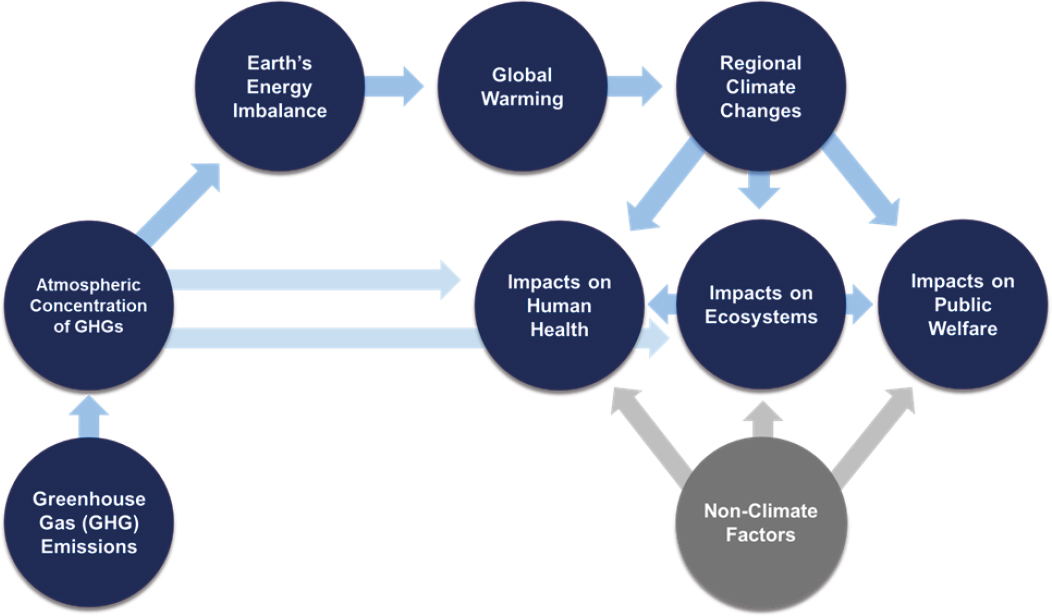
The causal chain from GHG emissions through impacts on human health and public welfare is shown in Figure 1.1. Assessing the impact of human-caused GHG emissions requires examining the evidence for each step in this causal chain, as well as understanding the mechanisms that link the steps. The report is organized to examine the evidence as follows:
- Chapter 2 examines observed changes in natural and human-caused GHG emissions, how those emissions are changing the atmospheric concentration of GHGs, and the impact of those changes on the energy imbalance at the surface of the Earth;
- Chapter 3 examines observed changes in climate conditions at the global and regional scales and the attribution of those climate changes to changes in human-caused GHG emissions;
- Chapter 4 addresses potential impacts of changes in GHGs on future climate, informed by the evidence discussed in Chapters 2 and 3;
- Chapter 5 addresses the impacts of changes in GHGs and changing climate conditions on human health; and
- Chapter 6 addresses the impacts of changing climate conditions on public welfare.
While this report focuses on the pathway by which changes in GHGs affect human health and public welfare, many other non-climate factors also influence the impacts, as illustrated in Figure 1.1. Non-climate factors can include changes in technologies or practices, changes in human systems (e.g., infrastructure, land use), changes in other environmental stressors (e.g., pollution), and other factors that exacerbate or mitigate the impacts of human-caused GHG emissions. The committee discusses non-climate factors, where significant, in examining impacts of changes in climate in Chapters 5 and 6.
1.3 COMMITTEE’S APPROACH
This report summarizes the changes in evidence since 2009 for each step in the causal chain shown in Figure 1.1, recognizing that the nature of the evidence and uncertainty varies across the different links in this causal chain and for different impacts. The committee considered the science detailed in EPA’s Technical Support Document (2009a) as the state of the science that informed EPA’s 2009 Endangerment Finding (2009b). Recognizing that EPA (2009a) covered a wide array of topics, the committee focused on those topics highlighted in the Executive Summary of the document (see Appendix C). In addition, the committee identified other topics, including those covered in the body of EPA (2009a) but not highlighted in its Executive Summary, for which new lines of discovery or impacts have emerged. The selection of topics to highlight was informed, in part, by reviewing submissions to a public Request for Information (RFI).
In developing the conclusions of this report, the committee relied upon multiple sources of evidence and considered conclusions to be stronger if there is broad agreement among independent lines of evidence. The specific type of evidence relevant and available for each conclusion varies. The committee weighed most heavily observational evidence, which includes direct measurements of physical, chemical, or biological quantities; observations from space-based platforms and other instruments that remotely sense the atmosphere, ocean, and biosphere; surveys of ecological variables; and inventories and records of human systems (e.g., emissions data from industrial sources or epidemiological studies). The committee also evaluated evidence from computational climate models that simulate the Earth system. These models are an important line of evidence considered in this report. That said, the climate system is complex, and climate models are imperfect tools; therefore, the committee relied more heavily on observational evidence.
To prepare this report, the committee considered (1) widely available datasets that provide information about GHG emissions, changes to the climate system, and human health and public welfare impacts; (2) a broad range of peer-reviewed literature and scientific assessments; and (3) more than 200 comments submitted in response to a public RFI and through the standard feedback channels for National Academies’ activities. In keeping with the study charge, the committee focused on literature published since 2009 and on impacts to public health and welfare in the United States.
The committee examined scientific papers in the peer-reviewed literature, focusing on areas where there have been significant new contributions that have changed or expanded understanding. Where available, the committee drew on scientific assessments and reports by the National Academies that have been prepared by large teams
of scientists, incorporate mechanisms for broad public input, and are subject to additional layers of peer review. These large-scale efforts provide periodic updates on the state of knowledge. The committee tried to strike a balance between directly citing original studies and drawing upon assessments, recognizing that both types of analyses provide useful information. Published assessments, reports, and scientific papers provided useful input; however, it is important to note that the committee then made its own determinations about how the evidence and understanding have changed since 2009 in the key messages and conclusions of this report.
The EPA notice of proposed rulemaking cited a document, “A Critical Review of Impacts of Greenhouse Gas Emissions on the U.S. Climate,” authored by a Climate Working Group assembled by the Secretary of Energy.1 This document was made available in draft form on July 29, 2025, at which point the U.S. Department of Energy invited public comment and indicated that it would be revised. Because this document was not available in its final form and may change in response to comments received, the committee does not cite it. Nonetheless, there is significant overlap in the topics addressed and in some of the literature cited in the document and this committee’s report. For example, the committee addresses the direct impacts of CO2 on the environment in a discussion of ocean heat and chemistry in Chapter 3 and in a discussion of the drivers of ecosystem change in Chapter 6.
1.4 GEOGRAPHIC FOCUS OF THE REPORT
The climate varies significantly across the United States, ranging from tropical to Arctic temperatures and a wide range of precipitation regimes. Observed changes in the climate system similarly exhibit regional variability. The factors that influence human health and welfare also vary across regions, reflecting the differing geographies, ecosystems, infrastructures, economic activities, and recreation activities found across the country. This report highlights selected regional differences in climate effects and provides examples of regionally specific impacts, but it does not include a comprehensive assessment of climate impacts in specific regions.
The committee focused on impacts to human health and welfare in the United States, similar to the scope of EPA (2009a). The Clean Air Act requires the EPA Administrator to take actions to safeguard the American people. Thus, this report focuses on the risks to the U.S. population, who are most directly affected by changes in climate conditions within its borders. In addition, the committee considered changes to global oceans and the effects of these changes on U.S. coasts and fisheries.
EPA (2009a) includes a section on impacts in other world regions, but the committee did not address these impacts in detail. Even so, it is worth noting that changes to climate conditions in other parts of the world do affect Americans. Many U.S. businesses are multinational, some with climate-sensitive operations (e.g., supply chain agreements, shipping, agriculture). Many Americans live in other parts of the world—in U.S. territories, as members of the armed forces and Foreign Service, and as part of a large American expatriate population—and these places face their own climate risks. A growing body of research has examined how climate stresses in other parts of the world can indirectly affect U.S. national security (e.g., increasing migration pressures or creating political instability) (DOD, 2021; NASEM, 2023).
1.5 HUMAN HEALTH AND PUBLIC WELFARE IMPACTS CONSIDERED
Climate affects human health and welfare in a multitude of ways, influencing everything from how land is used for agriculture to how and where buildings are constructed to the diseases and other health risks prevalent in different locations. As a result, the potential scope for the effects of GHGs on welfare is particularly vast. The Clean Air Act identifies many effects that fall under “welfare” and leaves open applications to other areas, as well. Section 302(h) of the Act (42 U.S.C. § 7602[h]) states: “All language referring to effects on welfare includes, but is not limited to, effects on soils, water, crops, vegetation, man-made materials, animals, wildlife, weather, visibility, and climate, damage to and deterioration of property, and hazards to transportation, as well as effects on economic values and on personal comfort and well-being.”
___________________
1 See https://www.federalregister.gov/documents/2025/08/01/2025-14519/notice-of-availability-a-critical-review-of-impacts-of-greenhouse-gas-emissions-on-the-us-climate.
Given the very broad definition of welfare in the Clean Air Act and the broad scope covered in EPA (2009a), an exhaustive review of the rapidly growing body of literature on potential effects was not feasible in this short report. In the discussion of impacts in Chapters 5 and 6, the committee chose to focus on potential impacts with (1) more direct attribution to changes in climate conditions, and (2) more direct impacts on human health and well-being. This choice is not intended to minimize the numerous more complex or indirect ways that changing climate conditions affect people and nature. Rather it reflects the committee’s determination that the evidence presented for this subset of impacts is sufficient to support their conclusions regarding endangerment.
This report highlights examples of economic analyses but does not attempt an exhaustive review of the growing body of literature related to economic impacts of GHGs or climate changes. Furthermore, studies on future economic impacts are not included. Predicting potential future economic impacts requires assumptions about many factors unrelated to climate that affect society and markets.
Similar to EPA (2009a), this report does not consider the potential of adaptation measures to limit future impacts on public health and welfare. In making a finding of endangerment, the Clean Air Act requires only scientific determination of risk of harm, without speculation of potential actions that might be taken to limit that harm. Predicting the efficacy of potential future adaptation actions to limit that risk requires assumptions about human behavior, government policies, technological advances, and many other factors unrelated to climate.
Finally, the last century has been a time of rapid population growth, urbanization, increases in per capita consumption, and technological innovation. This report describes a range of factors, as illustrated in Figure 1.1, that significantly affect human health and welfare, recognizing that the impacts of changing climate occur in combination with other changing conditions. For example, trends in economic damages from extreme weather events depend on changes in the frequency, severity, or location of extreme weather in combination with changes in where people live and the value of property located in vulnerable places. This report draws on the large body of research examining impacts from climate change in the context of other changes.


