Simplifying Research Regulations and Policies: Optimizing American Science (2025)
Chapter: 1 Introduction and Context
1
Introduction and Context
The American scientific, engineering, and biomedical enterprise has long been viewed as among the best in the world, and researchers have come from almost every country to study and work in the United States. Although U.S. scientific efforts have yielded significant advances in technology, health, security, safety, and prosperity, there is the concern that excessive, uncoordinated, duplicative, and inconsistent policies and regulations are hampering progress in science.
It is imperative that scientific research conforms to the highest professional standards. Not only do high standards promote good stewardship of taxpayer dollars by ensuring accountability, transparency, ethical conduct, security, and safety, but they also promote good science that is rigorous, reliable, and reproducible (NASEM, 2016; OSTP, 2025). Appropriate research regulations and oversight play an important role in promoting research excellence, but the current regulatory system also produces many unintended consequences that can hinder research and place undue and costly burdens on the research enterprise, which have increased as regulations have proliferated over the past several decades.
Unfortunately, federal regulations, policies, requirements, and requested reports1 have grown to such an extent that they can encumber
___________________
1 The committee acknowledges that some states have also added regulations, policies, and requested reports that further add to the burden imposed on researchers and their institutions. However, addressing state regulatory activities is outside the scope of this report’s Statement of Task (see Box 1-1).
the research enterprise, hinder innovation, and divert time, resources, and expertise away from research and toward administrative tasks that do not directly benefit research subjects or enhance research outcomes (FDP, 2020; NASEM, 2016). This reduces both research productivity and the time available for training and educating the next generation of investigators (NASEM, 2016). Therefore, within appropriate bounds for accountability and oversight, improving regulatory efficiency and reducing administrative workload are critical goals for fostering innovation and productivity in the U.S. research enterprise. As the burden of complying with increasingly complex regulations and administrative requirements can now outweigh their intended benefits, identifying strategies to streamline operations has become crucial to ensuring more of our nation’s investments in scientific discoveries are directed toward research, not “bureaucratic box checking,” as Michael Kratsios, director of the White House Office of Science and Technology Policy, noted in a recent address to the National Academies of Sciences, Engineering, and Medicine (The White House, 2025a).
CURRENT SYSTEMIC CHALLENGES
The Cost of Regulations
In today’s world, global competitiveness in science is imperative and tied intrinsically to economic, military, and health leadership. However, estimates by the Federal Demonstration Partnership (FDP) suggest the typical academic researcher in the United States spends more than 40 percent of their research time on administrative and regulatory matters rather than actually conducting research (FDP, 2020; Rockwell, 2009). FDP surveys also show that satisfying growing regulatory demands is challenging research institutions and requiring them to use diminishing resources to hire more staff. The United States needs to address this long-standing issue so that researchers can spend their time and resources more effectively on generating the scientific advances that have powered the nation’s economy for the past eight decades.
In addition to the time spent complying with administrative and regulatory requirements, there is a monetary cost involved. Data from the Fiscal Year 2020 U.S. National Science Foundation (NSF) Higher Education Research and Development Survey showed that the 116 U.S. institutions receiving more than $100 million in federal research funds in 2020 estimate spending an average of $444,008 in 1 year of complying with
research security disclosure requirements; institutions receiving less than $100 million a year estimate spending an average of $100,202 annually (COGR, 2022; NCSES, 2021). A 2022 survey by the Council on Governmental Relations (COGR) found the cost of complying with the National Institutes of Health (NIH) Policy for Data Management and Sharing was estimated to be nearly $1.4 million a year for institutions receiving more than $100 million in federal research funds and just over $1 million a year for smaller institutions (COGR, 2023). Addressing this issue can reduce overhead costs at research institutions at a time when they are operating under tightening budgets.
Researchers, administrators, and compliance officers at academic institutions are not the only ones affected by an increasing administrative workload. Federal agency staff who oversee and manage research funding also face growing administrative demands. Consequently, addressing and reducing burden is all the more imperative in the current context of a reduced federal workforce—and particularly a reduced federal research funding workforce. While the committee’s task was to focus on reducing administrative workload for researchers, efforts to streamline, harmonize, modernize, and reduce duplicative requirements will, even with certain upfront costs in implementing change, ultimately serve all parts of the research ecosystem.
Regulatory Implementation
Some of the most significant regulatory challenges stem from concurrent and disparate implementation of regulations and requirements across different federal funding agencies, as well as differences in oversight implementation (GAO, 2016). This lack of harmonization across agencies gives rise to issues that include duplicative efforts, inconsistencies, and even direct contradictions in requirements, all of which consume time that would otherwise be devoted to conducting research.
The current system encompasses variations in how federal regulations affect different agencies, as well as in agency-level policies, reporting requirements, proposal submission processes, conflict of interest requirements, and training (COGR, 2025; NSF and NSB, 2014). For example, two main agencies regulate animal research—the U.S. Department of Agriculture (USDA) under the Animal Welfare Act and Animal Welfare Regulations, while the Office of Laboratory Animal Welfare (OLAW) maintains statutory authority under the Health Research Extension Act, which
incorporated into law the Public Health Service (PHS) Policy that OLAW interprets. In some cases, USDA and PHS requirements may conflict with one another. Depending on the circumstances, research may be subject to both sets of requirements, leading to confusion, redundancy, and extra work (NIH OLAW, 2024). In addition, past reports have argued that when requirements are inconsistent or duplicative, the natural result is for academic institutions to create additional requirements of their own to manage the complexity and risk of noncompliance stemming from regulatory complexity. As noted in the next section, adding to the complexity and increased administrative work are additional regulations and requirements enacted by some states and even the institutions themselves (NASEM, 2016).
Finally, research regulations and requirements can be unduly burdensome for researchers when the requirements and systems needed to remain compliant are difficult to navigate. Federal policies and requirements are not always updated sufficiently to reflect changes in the way research is done or the impact of new technologies and consequently do not meet the needs of either researchers or those with oversight responsibilities (NASEM, 2009a, 2025). Forms and systems used to share necessary data or information may be challenging to navigate, vary across agencies, or require multiple systems to perform one similar task, such as preparing annual reports and various registrations (GAO, 2016). Researchers are therefore left with additional work peripheral to their scientific training to determine how potentially out-of-date guidelines apply to their current work or how to manage confusing paperwork or technology systems.
Growth of Regulations
Rather than moving toward a more streamlined approach, however, the administrative workload has increased during the past decade, with added regulations and requirements consuming even more time that should be—and used to be—dedicated to conducting research. As Figure 1-1 shows, 62 percent of regulations and policies that have been adopted or substantially modified and changed since 1991 were issued between 2014 and 2024.
In 2016, the National Academies, at the request of Congress, issued a report, Optimizing the Nation’s Investment in Academic Research: A New Regulatory Framework for the 21st Century. This report concluded that “the continuing expansion of federal regulations and requirements is diminishing the effectiveness of the U.S. research enterprise and lowering the return on the federal investment in basic and applied research by diverting inves-
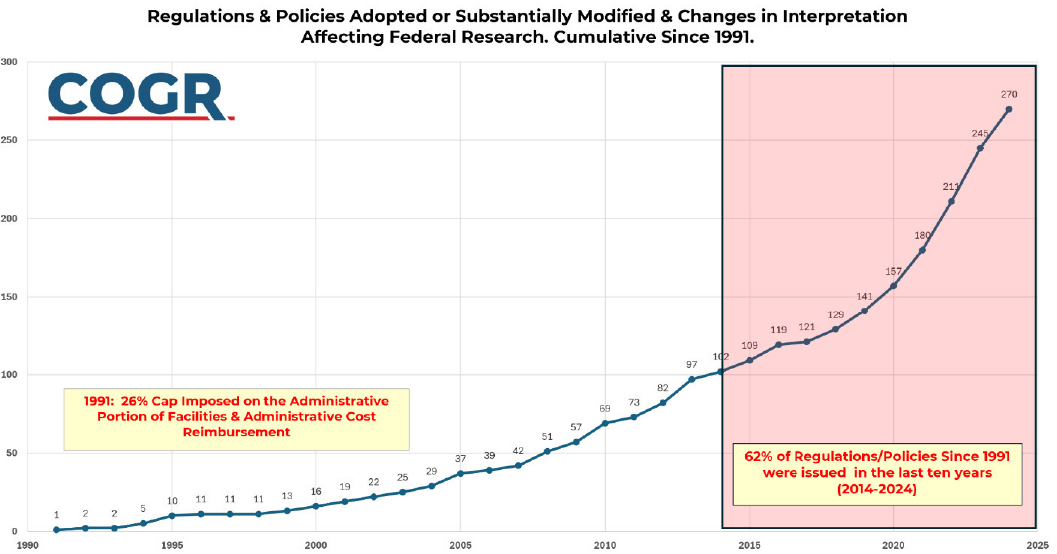
SOURCE: Presented to the committee by Matt Owens on May 21, 2025.
tigators’ time and institutional resources away from research and toward administrative and compliance matters,” while also acknowledging that “effective regulation is essential to the overall health of the research enterprise.” To address this problem, the committee who authored the report recommended steps to improve regulatory efficiency and reduce administrative workload for the nation’s academic research enterprise (NASEM, 2016). However, while a few recommendations were adopted, such as employing a single Institutional Review Board (IRB) for studies involving multiple institutions, many of the 2016 report’s recommendations remain only partially addressed, and in 2025, compliance burdens placed on researchers remain a significant concern while regulatory burden has continued to compound (CRS, 2017; FDP, 2020; GAO, 2021).
For example, regulations continue to proliferate in the realm of research security. National Security Presidential Memorandum-33 (NSPM-33), issued January 2021, instituted broad requirements for disclosure and established a research security infrastructure focused on cybersecurity, foreign travel security, research security training, and export control training (NSTC, 2022) for recipients of federal research and development funds that exceed $50 million annually. NSPM-33 directed federal agencies to create common forms for the disclosure of foreign affiliations, appointments, and funding sources. Several agencies have made research security resources available. In 2024, the NSF released the Trusted Research Using Safeguards and Transparency framework to help with institutional evaluations of risk related to foreign ties (NSF, 2024). This framework includes standardized training modules and resources for institutions and researchers to access and adapt. Working with the research community through cooperative agreements, NSF, NIH, Department of Defense, and Department of Energy made research security training modules available and more recently endorsed a condensed version of the training developed by the Safeguarding the Entire Community in the U.S. Research Ecosystem (SECURE) framework.
Recent government directives have introduced additional compliance requirements, placing significant focus on “conflicts of commitment”—a new concept for institutions when first introduced (COGR, 2021). Conflicts of commitment occur when a researcher dedicates time to personal activities in excess of institutional policy or that may detract from their professional responsibilities (ORI, n.d.). This has led institutions to develop and implement conflict of commitment programs. The ambiguity of some of the requirements has led to variation in how institutions are developing
their infrastructure to comply with the requirements and how internal policies affect researchers and trainees at different institutions.
Attempts to regulate Controlled Unclassified Information (CUI) also vary across agencies, and recent requirements for training allow for unequal implementation and standards across and within institutions. While allowing for varied implementation can streamline regulations and reduce burden by ensuring requirements are not unnecessarily strict, other challenges can emerge when requirements are unclear or introduce uncertainty about how they should be applied. Additional and ambiguous requirements have added a significant cost burden for institutions as they reconcile conflicting definitions to develop the infrastructure needed to comply with requirements related to policies governing export control, such as controlled items and restricted party lists, as well as with safeguards for CUI, such as implementing access control and encryptions. Smaller, less resourced institutions are affected disproportionately.
In addition to the relatively new research security requirements, the federal government has an extensive export control regulatory regime, which has long needed regulatory reform, to protect U.S. trade and national security (NASEM, 2009b, 2022). Academic institutions have experienced significant challenges fully adopting existing federal export control framework requirements given the expansive research areas within academia that require a broad knowledge of regulations, compared to industry where organizations focus on a smaller number of technologies. To meet the demands of complying with both export controls and research security regulations and requirements, institutions have had to find ways to identify and coordinate resources needed to increase their efforts for coming into compliance and centralizing activities within the institution (COGR, 2022). They have also had to address the necessary training for personnel across the institution.
As a final example, new regulations for research misconduct from the U.S. Department of Health and Human Services (HHS) were recently enacted2 (CITI, 2024; ORI, 2024), but it is unclear what effect these may have on the regulatory environment for misconduct. The committee discusses the potential here for efforts to review the effectiveness and efficiency of these revisions on a clearly delineated timeline.
This year, significant federal actions and policy changes, some of which have come quickly without sufficient implementation guidance and consid-
___________________
2 Public Health Service Policies on Research Misconduct, 42 C.F.R. Part 93 (September 17, 2024).
eration of their effects on the scientific enterprise,3,4 have added administrative workloads and created uncertainty, especially for research universities (Dorgelo and Leibenluft, 2025; EAB, 2025). As national research priorities and policies are changed, it is important that any actions taken recognize the associated effects on administrative workload and the efficiencies of scientific research—not only for the administrative offices and researchers of the performing organizations but also for federal research sponsors.
Balancing Oversight and Efficiency
In addition to the growth in regulations and requirements and a lack of harmonization and the problems it creates, another challenge is the difficulty balancing needed regulation and efficiency. Accountability, safety, security, and transparency in research are important, but there are times when regulations can be so stringent and inflexible that they unnecessarily regulate lower-risk research activities. Reports from the National Academies, the U.S. Government Accountability Office (GAO), and others have argued that overly stringent regulations that do not provide flexibility for lower-risk situations can increase workload without improving outcomes (COGR, 2017; GAO, 2016; NASEM, 2016). Ultimately, in a setting where regulations are not calibrated to risk, researchers can spend time and effort on compliance for low-risk activities that could be better used for conducting research and giving greater attention to higher-risk work.
Concern about regulatory or administrative workload, however, does not mean that federal oversight of research is inappropriate. With taxpayer funds supporting U.S. scientific research, the enterprise must ensure full transparency and that research adheres to the highest standards of integrity. Furthermore, careful oversight is necessary to ensure the safety of human research participants, welfare of research animals, protection of intellectual property, and safeguarding of the public and the environment. Developed effectively, regulations provide a framework for conducting research that embodies the shared values of the federal government, research institutions, researchers, and the public.
___________________
3 Association of American Universities v. National Science Foundation, Civil Action Number 1:25-cv-11231-IT (D. Mass. 2025).
4 National Association of Diversity Officers in Higher Education v. Donald J. Trump, Case Number 1:25-cv-00333-ABA (D. Md. 2025).
STATE AND INSTITUTION-LEVEL REQUIREMENTS
Although numerous challenges exist within the current federal regulatory ecosystem, other factors affect the time and resource requirements researchers face. The Statement of Task for this report focused the efforts of the committee on possible actions to be taken at the federal level. However, state governments and academic institutions also play a role in increasing researcher administrative workload. State-level requirements sometimes duplicate or complicate federal regulatory requirements, and while tackling this issue is out of scope for this report, the committee acknowledges that this issue exists and needs to be addressed.
Along with the potential complications of additional state regulations, academic institutions also develop their own policies and processes to ensure compliance. Institutions are often risk-averse and respond to uncertainty in the regulatory environment as well as their own concerns about the potential for noncompliance by interpreting policies in the strictest manner, even when they could apply a more lenient standard and still be compliant (NASEM, 2016). Some institutions, in particular small- to medium-sized institutions, may adopt zero or near-zero risk-tolerance strategies for research compliance, resulting either in extraordinarily burdensome processes that may entail multiple additional layers of institutional bureaucracy or declining to participate in research with even a slight risk (COGR, 2022; Jager, 2023). Institutions have also been hesitant at times to fully adopt new and more streamlined processes because of risk concerns (Burr et al., 2022).
In addition, while all research institutions navigate the compliance of federal regulations, their impact is not equal. Larger and better-resourced institutions dedicate significant administrative infrastructure and personnel to manage growing compliance demands, which can strain even their more substantial resources. The large administrative workforces needed to manage risk and compliance can further increase bureaucracy and time spent navigating internal processes. For smaller institutions, as well as under-resourced institutions that often have less money for research and are more likely to serve disadvantaged and low-income student populations, the consequences can often be more pronounced, as they may lack the personnel, infrastructure, or expertise to adequately address the increasing volume of regulatory and other requirements. In some cases, this prohibits their participation in research for which they are otherwise well qualified.
Ultimately, this report focuses on the federal government. Nonetheless, greater coordination and cooperation across federal, state, and institutional
levels would benefit regulatory optimization and limit unnecessary administrative impact on the researcher.5
MANY RECOMMENDATIONS FOR CHANGE
In general, reform is a challenging process with many potential barriers. In large institutions, change can be hindered by multiple veto points that can derail action: investing time and resources into systems developed based on past decisions that become baked into institutional structures; cultural and normative barriers; and individual actors pushing against the upset reform can cause (Bannink and Resodihardjo, 2006). Moreover, any efficiencies that are realized have largely been offset by new requirements.
Thus, despite many expert groups calling for change over the past couple of decades, there has been little progress in reducing regulatory burden. For example, the National Academies’ 2016 report included four overarching recommendations that formed the basis of its 40 specific recommended actions. First, that committee called on Congress, the administration, federal agencies, the Office of Management and Budget (OMB), and research institutions to take collective action to critically reexamine and recalibrate the regulatory regime. That committee also recommended establishing a new entity, a Research Policy Board, to provide a public-private forum through which to engage the development and harmonization of research regulations. The 21st Century Cures Act, passed in 2016, directed OMB to establish a Research Policy Board, but OMB never created the board, and authority for the board expired in September 2021. In addition, the committee recommended strong action by universities, in partnership with the proposed Research Policy Board, to ensure institutional and individual integrity in scientific research and to hold institutions accountable for failure to uphold such integrity. Finally, the committee recommended adjusting the responsibilities of inspectors general to balance the need to weed out waste, fraud, and abuse with ensuring economy, efficiency, and effectiveness in research.
Other groups, including COGR, FDP, GAO, the Institute for Responsive Government, the Association of American Medical Colleges, the Association of American Universities, and the Association of Public and
___________________
5 Though this is out of the scope of this report, one possible model might be the NSF-funded SECURE Center that works with the research community to identify, prioritize, and collaboratively design and develop the research security resources and tools needed.
Land-grant Universities, have also highlighted the challenges researchers face, with many offering their own recommendations to reduce the regulatory burden (AAMC, 2020; AAU, 2017; APLU, 2024; COGR, 2025; FDP, 2014; GAO, 2016; Institute for Responsive Government, 2025; NSF and NSB, 2014). In 2020, OMB completed a major rulemaking on this subject after reviewing thousands of comments from public and government sources. Commenters reported that “grants managers ... [were] spending a disproportionate amount of time using antiquated processes to monitor compliance” and navigating duplicative and ineffectual requirements.6
Most recently, COGR released a set of “Actionable Ideas to Improve Government Efficiency Affecting the Performance of Research” (COGR, 2025). This document addressed 18 topic areas of research regulations, including research project proposal development, financial conflicts of interest, data management and sharing, animal and human subjects research, and cybersecurity. Overarching themes of the COGR recommendations stressed the need to develop single systems and consistent processes across many areas of research regulations, allow risk-tiered variation in regulations, and update and revise critical definitions, including the definitions of clinical trials, gifts, and fundamental research.
There is significant overlap across the recommendations from COGR’s 2025 report, the 2016 National Academies’ report, and many of the other reports cited above. These reports have called for agencies to adopt harmonized and centralized mechanisms for reporting and oversight and ensure there are usable and up-to-date systems and definitions that provide clarity to researchers, all while more appropriately balancing the need for oversight with ensuring that scientific work remains efficient and effective. The themes in these calls for action align with the greatest challenges of the present regulatory system.
There has been some uptake and implementation of previous recommendations for reducing regulatory burden. In 2024, for example, OMB updated the Uniform Guidance for grants management and financial oversight to increase the audit threshold to $750,000, reducing burden on smaller institutions. In addition, HHS and NIH instituted policies to simplify the peer review process through updates to 2025 grant applications. However, as Chapter 2 discusses in more detail, multiple areas of regulation need similar types of changes to truly address the magnitude of the problem. An improved regulatory environment requires increased harmonization,
___________________
6 Guidance for Grants, 85 Fed. Reg. 49506 (August 13, 2020).
greater adoption of approaches tiered to risk, and user-friendly technology to simplify processes. These principles are repeated consistently throughout the specific policy options detailed in Chapter 2.
THE CURRENT PUSH TO REDUCE REGULATIONS
Shortly after taking office in 2025, President Trump issued an Executive Order requiring federal agencies to repeal at least 10 existing rules, regulations, or guidance documents for every new rule, regulation, or guidance they propose (The White House, 2025b). As part of this effort, OMB issued a Request for Information soliciting ideas for rules and regulations that could be rescinded to reduce administrative and regulatory burdens.7 These actions, combined with budget pressure at the federal and institutional levels, the wealth of proposed solutions available to addressing this problem, and the availability of technologies that can shoulder some of the workload, have created an environment in which the current administration is welcoming proposals to increase regulatory efficiency and reduce administrative workload.
For example, the rapid advancement and potential of artificial intelligence (AI) has created opportunities to reduce the time and monetary costs of satisfying regulatory requirements and completing administrative tasks. Proposed uses of AI to reduce administrative tasks include assisting with the preparation of application materials, generating financial reports for grant management, and creating reports needed for regulatory compliance. AI also has the potential to make the use of publicly funded research far more valuable if research reports are presented in a uniform manner, which in turn is more conducive to the use of AI to mine those reports for additional insights.
At the same time, since January 20, 2025, the federal government and federal funding agencies have renewed their interest in improving government efficiency and reducing federal outlays. With federal research agencies facing billions of dollars in budget cuts and reductions in staffing, there is not only the opportunity but also the necessity to optimize the nation’s investment in academic research by allocating more time and money to conducting research and reducing the time and money spent on administrative tasks. Several federal agencies have also proposed capping indirect
___________________
7 Request for Information: Deregulation, 90 Fed. Reg. 15481 (April 11, 2025).
cost reimbursements,8 though these caps are currently the subject of multiple legal challenges. This environment has made it even more necessary to thoughtfully and carefully consider how to best use researchers’ limited time and institutions’ limited budgets while preserving an appropriate level of regulatory oversight.
Given the current emphasis on reducing federal discretionary spending and maximizing the return on the funds allocated for research, as well as the well-documented administrative workload currently facing the nation’s researchers, the National Academies recognized this as an opportune time to revisit the topic of how to improve regulatory efficiency and reduce the administrative workload imposed on the nation’s academic research enterprise with the goal of strengthening the competitiveness and productivity of U.S. research. With the support of the Ralph J. Cicerone and Carole M. Cicerone Endowment for NAS Missions and Simons Foundation International, the National Academies’ Committee on Science, Engineering, Medicine, and Public Policy, in collaboration with the Board on Higher Education and Workforce, convened an ad hoc committee to conduct an expedited study to identify strategies and actionable options aimed at streamlining regulatory processes and administrative tasks, reducing or eliminating unnecessary administrative work, and removing policies and regulations that were ill conceived or have outlived their purpose while maintaining necessary and appropriate integrity, accountability, and oversight (see Box 1-1 for the committee’s Statement of Task).
By addressing these challenges, the committee’s report aims to provide a roadmap for establishing a more agile and resource-effective regulatory framework. Such a framework can liberate researchers from unnecessary administrative tasks, empower them to focus on research and training the next generation, and enable U.S. science and technology to accelerate and thrive. American leadership in science and technology is important, but it is slipping (ASPI, 2024). By leading the scientific enterprise, the United States has control over the outcomes produced and can promote the values that underpin the application of those outcomes, such as the ethical use of AI.
___________________
8 Indirect cost reimbursements are the funds research universities use to pay for the facilities, equipment, systems, compliance boards, certifications, and staffing necessary to conduct the research and meet federal regulatory and administrative reporting requirements.
BOX 1-1
Statement of Task
Over the past two decades, questions have continued to arise about the cost of research in the United States, and whether the growing number of federal regulations increase the monetary and time costs to individual researchers and their institutions. Several recent reports have identified ways to reduce the regulatory burden, but many of those recommendations have not been implemented. A committee of the National Academies of Sciences, Engineering, and Medicine will review and prioritize federal actions that could improve regulatory efficiency and potentially reduce costs in the academic research environment, particularly for the academic researcher.
The committee will undertake an expedited effort to describe the impacts of administrative workload and current regulations on research productivity; analyze federal research regulations in light of the 2016 National Academies report Optimizing the Nation’s Investment in Academic Research: A New Regulatory Framework for the 21st Century to determine whether the report’s recommendations for regulatory change have been implemented; and examine other recommendations from reports developed by such groups as the Association of American Universities, Association of Public and Land-grant Universities, and Council on Governmental Relations, and others on the impacts of federal regulations on researcher and institutional workload.
The committee will produce a brief report that presents a menu of prioritized options for federal actions to improve regulatory efficiency affecting researchers and their institutions, including initiatives by the White House and executive agencies or Congress. The options presented will describe the anticipated impacts on reducing different types of administrative workload, noting potential unintended consequences, while minimizing risk to accountability and research performance. Finally, the committee will describe, to the extent possible, new developments, such as the application of new technologies like artificial intelligence, that could improve administrative efficiency.
COMMITTEE APPROACH TO THE REPORT
In this report, the committee outlines a set of steps and options the federal government might take to create a system that better allows researchers to focus on what they do best—conducting scientific research—while also meeting the need to conduct their research responsibly, ethically, and with appropriate stewardship of taxpayer-provided funding. Rather than make explicit recommendations for what the federal government should do to achieve these goals, as previous reports have done, the committee is providing a set of options, from which policymakers and other key actors can weigh pros and cons to choose the best approach to achieve these goals, accompanied by discussions of important factors to consider before undertaking any of the options. Although the committee did not tier the options, some options presented could be acted on expeditiously, whereas others may require congressional action and time. These considerations are noted in the pros and cons of each option. While the scope of the committee’s efforts was limited to the academic research enterprise, many of the options presented here could serve to reduce regulatory workload across the U.S. research ecosystem more broadly.
The administrative workload of complying with research requirements is a result of actions originating over time in many sectors, including federal agencies, academic research institutions, and state governments. Therefore, reducing that workload will require all participants to work together to create lasting improvements. However, because the charge to the committee is limited to “federal actions to improve regulatory efficiency,” the committee is providing policy options that only apply to the federal government.
Given the urgency to better align regulatory and oversight processes with the need to responsibly maximize quality research, the committee was asked to conduct its work in a compressed 4-month time frame and produce a report that is shorter and therefore less comprehensive than many National Academies’ reports. Consequently, the options presented in this report are considered by the committee to provide the greatest potential impact, but they do not represent an exhaustive list of all the actions that could be taken to improve regulatory efficiency. While the options are presented generally in the order of likely effectiveness, the committee acknowledges that these rough estimates are difficult to assess without a more robust evaluation. In many cases, the options presented differ enough from one another that it is challenging to determine which would produce the greatest improvement, and others may argue for a different ordering. Therefore, the committee is
not suggesting that options stated earlier are inherently preferred to those stated later. Implementing even a few of these options could go a long way toward improving regulatory efficiency and decreasing administrative workload for both federal agencies and researchers.
The committee also addresses many unique and specific challenges facing different areas of regulation resulting from updates to the regulatory environment, legal changes or provisions, and specific guidance. For example, within human subjects research, adopting a previous National Academies’ recommendation to establish a single IRB9 for studies with multiple sites resulted in unintended consequences (NASEM, 2016). While the intent of this recommendation was to allow multi-institutional projects to use a single IRB process, thereby streamlining review, mandatory adoption has created its own distinct challenges that the committee seeks to address with options that can improve this structure.
This report is organized in two chapters. This chapter provides an overview of the major problems with the current research regulatory framework that require attention, the current situation and push for reducing regulations, and previous approaches to regulatory changes. The second chapter highlights key issues with current regulations on each of several specific topics, potential approaches to and options for addressing those issues, and potential positive and unintended consequences of each approach. It concludes with closing thoughts from the committee and a look to the future of regulating the U.S. scientific enterprise.
REDUCING BURDEN AND OPTIMIZING SCIENCE
This chapter paints a picture of a system operating under a heavy regulatory workload that hinders science without sufficient gains in transparency and integrity. The challenges of the current system are captured in the experiences of researchers navigating this complex landscape: it is in the stories of researchers that it becomes clear how much overly complex and duplicative regulations can cause problems for science as a whole. The committee concludes the chapter with a look into the ways in which excessive regulatory workload hinders science in the day-to-day lives of researchers. As an example, consider the case of Dr. Linh Tran, a hypothetical researcher facing many of the common challenges seen in the current regulatory environment (see Box 1-2).
___________________
9 Cooperative Research, 45 C.F.R. 46 114(b)(1) (January 19, 2017).
BOX 1-2
Illustrative Case of the Current Regulatory Environment
Dr. Linh Tran, an associate professor of robotics at an emerging research university, is a rising star. When she was young, her sister was in an accident and lost the use of her arm. As a young girl, Linh was convinced that science and medicine could help people like her sister, and she committed herself to science and to developing artificial limbs.
Dr. Tran had made breakthroughs in brain-computer interfaces and was on her way to developing highly functional, lifelike prosthetics. With her new work to incorporate artificial intelligence into her prototypes, she was confident she could develop devices that were more responsive and could ultimately be controlled by an individual’s thoughts.
Dr. Tran received the trifecta of funding: a grant from the U.S. National Science Foundation (NSF), a contract from the U.S. Department of Defense (DOD), and a research sponsorship from an established robotics company. Dr. Tran was excited. But she was also exhausted. Simply applying for the funding had taken months. Her ideas were well formulated, but she needed to draft lengthy proposals that included much more than her science. She navigated different NSF and DOD submission portals and processes, often submitting the same information about herself and her team, her funding sources, institution, budgets, plans for compliance, and more, all in different formats for the two funding agencies.
As the projects kicked off, Dr. Tran updated her financial conflict of interest (FCOI) disclosures. The university had developed a single annual disclosure form, but each sponsor had a different definition of what counted as a “significant” financial interest, prompting a number of follow-up questions. Dr. Tran did not need a formal FCOI management plan, but this review prompted an additional research security and export control review, ultimately requiring her to develop a technology control plan, particularly for the advanced actuator that was needed for her prototype to make physical movements. This came with additional training modules for Dr. Tran and her team to complete before research could begin.
One of the postdocs on Dr. Tran’s team was a brilliant biosystems engineer from South Korea who sought to test new prototypes on human research participants. Including the postdoc on the DOD project triggered a lengthy foreign national approval
process, a delayed visa approval, and an additional export control review. Despite arriving late, the postdoc was still ready to go. His Institutional Review Board (IRB) protocol was approved in about 4 months, but it needed an additional approval from a DOD IRB, which resulted in small but significant changes in the consent forms, prompting a second approval by the university’s IRB and adding further delays.
Dr. Tran felt demoralized. After a year of funding she felt like her team had barely gotten to the actual research.
Dr. Tran’s experience is not purely hypothetical, however. As part of its information-gathering efforts, the committee sent out a request for information on May 6, 2025, seeking input from the scientific community on how to improve regulatory efficiency. Within a few weeks, the request had amassed nearly 200 responses with detailed discussions of the ways in which the current system not only frustrates researchers and institutions but also takes away crucial time from scientific discovery. Across many different respondents, the committee heard similar refrains:
One of our biggest challenges has been navigating the complex and fragmented landscape of federal compliance requirements. . . . The administrative burden of reporting, matching fund requirements, and indirect cost negotiations often diverts time and personnel from core innovation activities.
Some published estimates of administrative burden place this as high as 40% of faculty [research] time . . . so in that context the administrative burden means that faculty have very little time left for the research itself.
One major hurdle is the lack of standardized protocol forms. . . . This lack of uniformity not only creates unnecessary administrative burden but can also slow down the start of important research projects. (Request for Information responses, emphasis added)
As these responses highlight, time spent managing overwhelming regulatory variation and complexity is time spent away from scientific discovery and training the next generation. Each duplicative form, uncertain requirement, and outdated reporting system chips away at the work done to advance our understanding of the world around us and diverts critical federal funding away from discovery and innovation.
REFERENCES
AAMC (Association of American Medical Colleges). 2020. Aamc conflicts of interest metrics project - measuring the impact of the public health service regulations on conflicts of interest. https://www.aamc.org/media/50386/download (accessed June 12, 2025).
AAU (Association of American Universities). 2017. Policy recommendations: Research regulatory reform. https://www.aau.edu/sites/default/files/AAUFiles/KeyIssues/ResearchAdministration%26Regulation/AAU-Regulatory-Reform-Policy-Recommendations.pdf (accessed June 12, 2025).
APLU (Association of Public & Land-Grant Universities). 2024. Letter to the chairwoman of the energy and commerce committee from aplu. https://www.aplu.org/wp-content/uploads/APLU-EC-NIH-letter-2024-signed.pdf (accessed June 24, 2025).
ASPI (Australian Strategic Policy Institute). 2024. ASPI’s two-decade critical technology tracker: The rewards of long-term research investment. https://www.aspi.org.au/report/aspis-two-decade-critical-technology-tracker/ (accessed July 22, 2025).
Bannink, D., and S. Resodihardjo. 2006. The myths of reform. In Reform in Europe, 1st ed., edited by L. Heyse, S. Resodihardjo, T. Lantink, and B. Lettinga. New York: Routledge. Pp. 1–32.
Burr, J. S., A. Johnson, A. Risenmay, S. Bisping, E. S. Serdoz, W. Coleman, et al. 2022. Demonstration project: Transitioning a research network to new single IRB platforms. Ethics & Human Research 44(6): 32–38. https://doi.org/10.1002/eahr.500149.
CITI (Collaborative Institutional Training Initiative). 2024. HHS finalizes rule on research misconduct to strengthen research integrity. https://about.citiprogram.org/blog/hhs-finalizes-rule-on-research-misconduct-to-strengthen-research-integrity/ (accessed July 15, 2025).
COGR (Council on Governmental Relations). 2017. Reforming animal research regulations: Workshop recommendations to reduce regulatory burden. https://www.cogr.edu/sites/default/files/Animal-Regulatory-Report-October2017.pdf (accessed June 24, 2025).
COGR. 2021. Principles for evaluating conflict of commitment concerns in academic research. https://www.cogr.edu/sites/default/files/Final%20for%20publication%20COC%20Principles%20Document%20V%202%20Sept%2021%202021.pdf (accessed July 15, 2025).
COGR. 2022. Research security and the cost of compliance phase I report. https://www.cogr.edu/sites/default/files/Version%20Dec%205%202022%20research%20security%20costs%20survey%20FINAL.pdf (accessed July 11, 2025).
COGR. 2023. Data management and sharing (DMS) and the cost of compliance. https://www.cogr.edu/sites/default/files/DMS_Cost_of_Compl_May11_2023_FINAL%20%281%29.pdf (accessed July 11, 2025).
COGR. 2025. Actionable ideas to improve government efficiency affecting the performance of research. https://www.cogr.edu/sites/default/files/Actionable Ideas to Improve Gov Efficiency COGR_0.pdf (accessed June 12, 2025).
CRS (Congressional Research Service). 2017. Federally funded academic research requirements: Background and issues in brief. https://sgp.fas.org/crs/misc/R44774.pdf (accessed June 23, 2025).
Dorgelo, C., and J. Leibenluft. 2025. DOGE interference in federal grantmaking adds burden, uncertainty, and risk. Center on Budget and Policy Priorities. https://www.cbpp.org/sites/default/files/5-28-25bud.pdf (accessed August 19, 2025).
EAB (Education Advisory Board). 2025. Responding to federal policy shocks: What we learned from nearly 50 higher ed institutions. Higher Education Strategy Blog, June 10, 2025. https://eab.com/resources/blog/strategy-blog/responding-federal-policy-shocks-higher-ed-institutions/ (accessed August 19, 2025).
FDP (Federal Demonstration Partnership). 2014. 2012 faculty workload survey: Research report. https://thefdp.org/wp-content/uploads/fws_2012_final_rpt.pdf (accessed June 12, 2025).
FDP. 2020. Faculty workload survey: Primary findings. https://thefdp.org/wp-content/uploads/FDP-FWS-2018-Primary-Report.pdf (accessed June 12, 2025).
GAO (U.S. Government Accountability Office). 2016. Federal research grants: Opportunities remain for agencies to streamline administrative requirements. https://www.gao.gov/products/gao-16-573 (accessed June 12, 2025).
GAO. 2021. Federal research grants: OMB should take steps to establish the Research Policy Board. https://www.gao.gov/assets/gao-21-232r.pdf (accessed June 23, 2025).
Institute for Responsive Government. 2025. Reducing administrative burdens - the U.S. Federal government framework. https://digitalgovernmenthub.org/wp-content/uploads/2025/02/20250115-Reducing-Administrative-Burdens-6.pdf (accessed June 24, 2025).
Jager, B. 2023. Building a culture of compliance at liberal arts colleges and predominantly undergraduate institutions. Journal of Research Administration, 54(1), 66-86.
NASEM (National Academies of Sciences, Engineering, and Medicine). 2009a. Ensuring the integrity, accessibility, and stewardship of research data in the digital age. Washington, DC: The National Academies Press.
NASEM. 2009b. Beyond ‘Fortress America’: National security controls on science and technology in a globalized world. Washington, DC: The National Academies Press.
NASEM. 2016. Optimizing the nation’s investment in academic research: A new regulatory framework for the 21st century. Washington, DC: The National Academies Press.
NASEM. 2022. Protecting U.S. technological advantage. Washington, DC: The National Academies Press.
NASEM. 2025. Artificial intelligence and the future of work. Washington, DC: The National Academies Press.
NCSES (National Center for Science and Engineering Statistics). 2021. Higher education research and development: Fiscal year 2020. https://ncses.nsf.gov/pubs/nsf22311 (accessed July 15, 2025).
NIH OLAW (National Institutes of Health Office of Laboratory Animal Welfare). 2024. Animal Welfare Act and regulations (administered by USDA). https://olaw.nih.gov/policies-laws/animal-welfare-act (accessed June 12, 2025).
NSF (National Science Foundation). 2024. Trusted research using safeguards and transparency (TRUST). https://nsf-gov-resources.nsf.gov/files/NSFOCRSSPTRUSTPolicyMemo.pdf (accessed June 24, 2025).
NSF and NSB (National Science Board). 2014. Reducing investigators’ administrative workload for federally funded research. https://nsf-gov-resources.nsf.gov/pubs/2014/nsb1418/nsb1418.pdf?VersionId=O0PSt6QhRdM4mTWI6j6jSTCEuD4EZghu (accessed June 24, 2025).
NSTC (National Science and Technology Council). 2022. Guidance for implementing National Security Presidential Memorandum-33 (NSPM-33) on national security strategy for United States government supported research and development. https://bidenwhitehouse.archives.gov/wp-content/uploads/2022/01/010422-NSPM-33-Implementation-Guidance.pdf (accessed August 5, 2025).
ORI (Office of Research Integrity). n.d. Conflicts of commitment. https://ori.hhs.gov/education/products/rcradmin/topics/coi/tutorial_4.shtml (accessed July 16, 2025).
ORI. 2024. ORI final rule. https://ori.hhs.gov/blog/ori-final-rule (accessed August 6, 2025).
OSTP (Office of Science and Technology Policy). 2025. Agency guidance for implementing gold standard science in the conduct and management of scientific activities. https://www.whitehouse.gov/wp-content/uploads/2025/03/OSTP-Guidance-for-GSS-June-2025.pdf (accessed July 15, 2025).
Rockwell, S. 2009. The FDP faculty burden survey. Research Management Review 16(2):29–44.
The White House. 2025a. Remarks by Director Kratsios at the National Academy of Sciences. https://www.whitehouse.gov/briefings-statements/2025/05/remarks-by-director-kratsios-at-the-national-academy-of-sciences/ (accessed June 12, 2025).
The White House. 2025b. Fact sheet: President Donald J. Trump launches massive 10-to-1 deregulation initiative. https://www.whitehouse.gov/fact-sheets/2025/01/fact-sheet-president-donald-j-trump-launches-massive-10-to-1-deregulation-initiative/ (accessed June 12, 2025).
This page intentionally left blank.


