Implementing Data Governance at Transportation Agencies: Volume 2: Communications Guide (2024)
Chapter: 2 Change Management for Data Governance
2. Change Management for Data Governance
“People don’t resist change. They resist being changed!”
‒ Peter Senge
Overview
Change management is an established discipline employed in many transportation agencies to facilitate introduction of new technologies, systems, or business processes. Data governance, by its very nature, introduces changes to how agencies manage and use data. Change management techniques can be employed to make sure that these changes are successfully implemented and sustained.
Communications – the primary topic of this Guide – is a critical component of a change management process. This chapter reviews different change management frameworks and highlights the role of communications. Then, it identifies the kinds of changes needed for different data governance implementation activities, providing a context for the more focused guidance on communications in section 2.
Change Management Frameworks
There are several different organizational change management (OCM) frameworks available. This chapter reviews three frameworks to provide an understanding of how and where communications activities occur within change management. This Guide does not recommend any particular framework, but does reference Prosci™ in later sections to provide a convenient and useful vocabulary.
Prosci™ Change Management Framework
Prosci’s three phase change management framework is summarized below.
-
Preparing for Change (Awareness and Desire)
- Define Success – what are we trying to achieve?
- Define Impact – who has to do their jobs differently and how?
- Define Approach – What will it take to achieve success?
-
Managing Change (Knowledge and Ability)
- Plan and Act – What will we do to prepare, equip and support people?
- Track Performance – How are we doing?
- Adapt Actions – What adjustments do we need to make?
- Reinforcing Change (Reinforcement)
This change management methodology integrates the ADKAR model [1] as part of this three phased approach.
ADKAR is an acronym which stands for the five outcomes needed for a change to be successful:
- Awareness of the need for change
- Desire to support the change
- Knowledge of how to change
- Ability to implement the change
- Reinforcement to sustain the change.
Phase I of the framework addresses the Awareness and Desire elements of the ADKAR model by defining what needs to be changed and why. Phase II addresses the Knowledge and Ability elements of the ADKAR model by planning and carrying out training and support activities to help people adjust to the change. Phase III addresses the Reinforcement element of the ADKAR model, focusing on how to sustain the change over time. Phase I is where the communications strategy is developed and materials are created describing the “what and why” of the change. However, communications activities continue through subsequent phases to execute the strategy.
Prosci also defines several key roles within a change management process:
- Change Practitioners – dedicated professionals who apply an established change management methodology, develop strategies and plans, and support other roles.
- Sponsors – leaders who actively support the change, influence others to support it, and communicate directly with impacted employees.
- Project Managers – managers responsible for the technical design of the change itself who ensure that change management activities are integrated within the project plan.
- People Managers – supervisors of affected employees who communicate with their direct reports to explain the change and serve as liaisons with the project team.
- Change Agent Network – individuals enlisted to extend the reach and influence of the change effort through communication, implementation support, training, and modeling behaviors.
These roles have important communications responsibilities and will be discussed further in Section 2 of this Guide.
Kotter’s 8-Step Change Framework
John Kotter, a Harvard Business School professor, developed an eight step framework [2] for leading change efforts. These steps are shown below:
- Create a Sense of Urgency – create awareness and a shared understanding of the need for change. Have leaders communicate the reasons for change, the risks of not changing and the benefits that the change will bring.
- Build a Guiding Coalition – form a team of influential individuals to lead the change effort with the credibility, skills and power to drive the change forward.
- Form a Strategic Vision and Initiatives – develop a clear and compelling vision for the future. Articulate what the organization will look like after the change is implemented. Identify key initiatives and strategies to achieve this vision.
- Enlist a Volunteer Army – Engage employees at all levels to actively participate in the change process. This helps in overcoming resistance and creating a momentum for change.
- Enable Action by Removing Barriers – Identify and eliminate obstacles that might hinder the progress of the change; may involve restructuring, realigning processes, or addressing cultural issues.
- Generate Short-Term Wins – Celebrate early successes to build momentum and boost confidence; use to demonstrate the effectiveness of the change initiative, win over skeptics and encourage continued commitment from employees.
- Sustain Acceleration – Reinforce the new behaviors, systems, and practices introduced during the change.
- Institute Change – Integrate new processes, practices and behaviors into the organization’s ongoing operations.
Communication is integral to steps 1 and 3 in the Kotter framework, but other steps require communications activities as well – for example, step 6 might involve celebrating early successes involves developing and delivering messages about what has been accomplished. Note that the coalition formed in step 2 and the volunteer army enlisted in step 4 are the people delivering the communications messages.
The Nudge Approach to Change
Behavioral economists Cass Sunstein and Richard Thaler developed the Nudge approach for influencing people to make certain choices through small, subtle actions [4]. While not strictly a change management framework, this approach may provide a useful tool in the change management toolbox for data governance. Rather than designing the change and then working to build understanding and adoption of the change, this approach creates a “choice architecture” that motivates or makes it easier for people to act in the desired way. Actual choices are not constrained, but people are steered in a particular direction. For example, rather than telling employees what energy conservation measures are required, one might set thermostats low by default (but allow them to be overridden), provide feedback on current energy consumption or highlight how others in the organization have taken steps to reduce their energy consumption.
When employing a Nudge approach, communications will focus not on telling people what they must do, but rather on presenting options and providing information to help employees make different choices.
Florida DOT’s OCM Process for Technology Projects
The Florida Department of Transportation (FDOT) has established an OCM office that carries out a change management process for new technology projects. Their process is illustrated in Figure 1. It has many similar elements to the change management frameworks presented above. It is included here as an example of a practical application of OCM in a state DOT that can provide a model for others to follow.
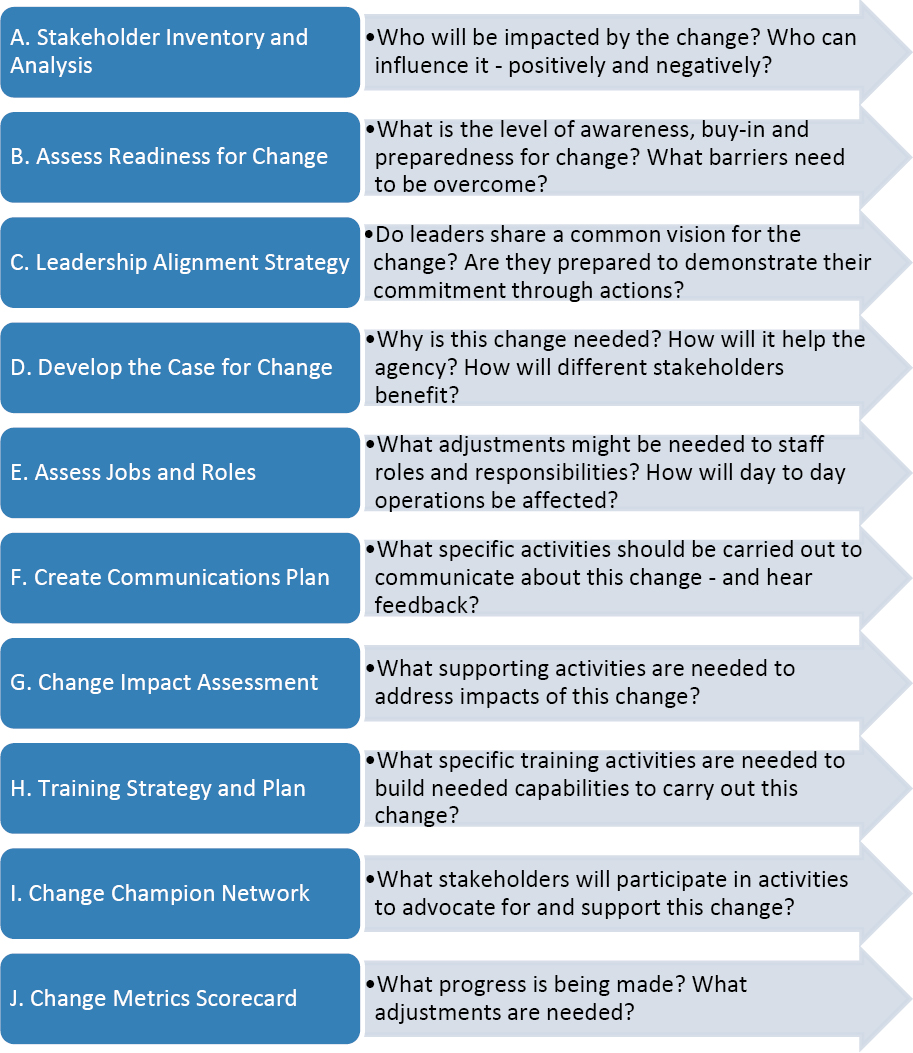
FDOT’s OCM process involves an explicit step to create a Communications Plan (step F). However, communication is integral to several other OCM activities [3]:
- Identifying Stakeholders (step A) identifies the target audiences for communications activities.
- Assessing Readiness for Change (step B) informs development of communications message by providing insight into how well people understand the change being proposed and what concerns they have.
- Leadership Alignment Strategy (step C) involves communications activities to ensure that leaders share a common understanding of what is to be done and why.
- Developing the Case for Change (step D) is where the core communications messages are created to explain the “why” of the change in language that will resonate with different stakeholders.
- Change Champion Network (step I) identifies individuals who will be asked to participate in communications activities.
- Change Metrics Scorecard (step J) involves communicating progress to sponsors and stakeholders.
Data Governance and Organizational Change
Applying Change Management for Data Governance
In applying a change management framework for data governance, it is best to view implementing data governance not as a single project but rather as an ongoing endeavor requiring multiple initiatives and cycles of change. Initially, there might be an emphasis on establishing goals and adopting principles for data governance. Once this is accomplished, attention would shift to setting up data governing bodies and defining their roles. This would be followed by a series of other activities to get stewardship roles defined, identify data assets, develop policies, and so on. For each data governance activity or initiative, agencies will need to conduct change management and associated communication activities that are tailored to the specific changes being introduced.
 See the Data Governance Implementation Guide, Chapter 6-Change for a discussion of strategies to address the challenge of getting people to follow new data governance policies and procedures.
Types of Changes Needed for Data Governance
Implementing data governance involves creating new oversight, decision making, and communication mechanisms and putting standards in place to improve data interoperability, efficiency, and consistency. These types of changes disrupt the status quo. Writing new policies and designing new processes are the tip of the iceberg for data governance implementation; change management to help people adapt represents the lion’s share of the work.
People who are designated as data stewards or who become members of new data governance bodies will need to adjust to and embrace their new roles. Managers who are accustomed to autonomy in making data purchases or responding to data requests may need to follow new procedures designed to ensure coordination and minimize duplication. Existing steering committees or oversight groups for specific data programs (such as GIS, safety data, and asset data) may need to adjust their processes and engage new players. Standard IT project development processes may require adjustment to consider new data element and metadata standards. More broadly, fully realizing the goals of data governance may require every employee in the agency to have a basic level of data literacy so that they know how to find data, critically assess data, recognize sensitive data, and understand when and how it should be shared.
Table 1 provides specific examples of different data governance initiatives and target outcomes that would be needed from change management and communications activities. (The relevant section of the Data Governance Implementation Guide is noted in the first column.)
Section 2 will cover how to develop a communications plan to achieve these outcomes.
Table 1. Change Management for Data Governance - Examples
| Data Governance Initiative | Target Outcomes from Change Management & Communications Activities |
|---|---|
|
Set up new data governance bodies See Implementation Guide chapter 4 |
Agency executives – understand the intended role and function of new data governance bodies and their relationship to other decision making or advisory groups; understand how they will help the organization; understand what information will be provided to monitor their activities and results; feel motivated to serve as sponsors and advocates. New governing body members – understand their roles and what decisions they can make; feel motivated to actively participate; feel comfortable acting in their new roles. Affected managers – understand changes to their pre-existing roles and authorities; understand why these changes are needed; feel confident that any concerns they have are heard and will be addressed. All employees – understand the intended role and function of new data governance bodies; understand how they will help the organization; understand what kinds of issues can be brought to them; know who the members are and who to contact with issues or questions. |
|
Designate data stewards See Implementation Guide chapter 4 |
New data stewards – understand expectations; understand the value of what they are being asked to do; know where and how to get support; feel confident that their supervisors will help to manage competing demands on their time. Data steward supervisors – understand new responsibilities and associated time requirements for data stewards; understand and appreciate the value to the organization and the business unit; feel confident that their concerns have been heard and that there is an open communication channel to address future issues that arise. |
|
Establish a review process for new data acquisition See Implementation Guide chapter 5 |
Affected employees (anyone involved in data collection or purchases) – understand why the new process is being implemented; understand the mechanics of the new process including steps, participants, and criteria; feel confident that any concerns they have will be heard and addressed. |
|
Create and maintain a data catalog See Implementation Guide chapter 5 |
Data owners/stewards – understand the purpose of the data catalog including its intended users and uses; understand expectations for what information they need to provide to the catalog and how often it needs updating; appreciate the value the catalog will bring to the agency; appreciate the value of the catalog to them personally (e.g., more visibility about their data sets). Data users – be aware of the data catalog, how to access it, and what information it offers; understand how the catalog is updated; feel confident that the information is accurate and up to date; know who manages the catalog and feel comfortable and motivated to provide feedback and suggestions for improvement. |
|
Create a data element standard See Implementation Guide chapter 5 |
Database designers/developers and system owners/managers – be aware of the data element standard; understand why the standard is needed and how it benefits the agency (e.g., improving data interoperability); know how to request an exception; know who to go to for technical questions about how and when it should be applied, concerns, or suggested changes. |
Summary
Key points from this chapter are as follows:
- Communications for data governance should be viewed in the context of a broader change management process that includes identifying affected employees; learning about their readiness for change; developing communications, training, and other interventions to support change; monitoring progress; and adjusting interventions as needed.
- Data governance implementation will require multiple cycles of change management activities to be successful, with each cycle designed around the specific elements of data governance being put in place.
- Change management activities, including communications, need to be tailored to different target stakeholders, who may have very different reactions to change based on their current responsibilities, backgrounds, experiences, and personalities.
- Communications needs to cover the “what”, “why” and “how” of specific changes being made.
- Communications is a two-way activity, providing an opportunity not only to deliver messages but also to have conversations and learn about barriers or sources of resistance to change that will need to be addressed.
- A key part of change management is enlisting people in the organization to support the change and participate in change management activities. People are needed at all levels of the organization – including leaders to serve as sponsors and champions, and staff to serve as change agents who can extend the reach of the change management activities and communicate directly with affected employees. An important activity for the change management team is to support these sponsors, champions, and change agents.


