Views of the U.S. National Academies of Sciences, Engineering, and Medicine on Agenda Items at Issue at the World Radiocommunication Conference 2027 (2025)
Chapter: 2 Views of the U.S. National Academies of Sciences, Engineering, and Medicine on Selected WRC-27 Agenda Items
2
Views of the U.S. National Academies of Sciences, Engineering, and Medicine on Selected WRC-27 Agenda Items
The following pages provide a discussion of the committee’s consensus opinions on the potential impact and relevance of certain agenda items at the upcoming 2027 World Radiocommunication Conference (WRC-27). For quick reference, Figure 2-1 illustrates the bands under consideration for each agenda item along with a brief (one- or two-word) summary of the topic and/or services each agenda item is considering.
Regulatory documents referred to below—Radio Regulations (RRs), WRC resolutions, and International Telecommunication Union (ITU) recommendations—are referenced in Appendix D.

NOTE: Acronyms are defined in Appendix C.
SOURCE: Data from International Telecommunication Union, “Radio Regulations,” http://handle.itu.int/11.1002/pub/8229633e-en, accessed February 10, 2025.
AGENDA ITEM 1.1: AERONAUTICAL/MARINE EARTH STATIONS IN MOTION AROUND 50 GHz
Agenda Item 1.1 considers “the technical and operational conditions for the use of the frequency bands 47.2-50.2 GHz and 50.4-51.4 GHz (Earth-to-space), or parts thereof, by aeronautical and maritime earth stations in motion communicating with space stations in the fixed-satellite service and develop regulatory measures, as appropriate, to facilitate the use of the frequency bands 47.2-50.2 GHz and 50.4-51.4 GHz (Earth-to-space), or parts thereof, by aeronautical and maritime earth stations in motion communicating with geostationary space stations and non-geostationary space stations in the fixed-satellite service, in accordance with Resolution 176 (Rev. WRC-23).”
Bands under consideration in Agenda Item 1.1 are illustrated in Figure 2-2, along with bands allocated to (or afforded footnote protection for) the radio astronomy service (RAS) and/or Earth exploration-satellite service (EESS), and bands afforded RR 5.340 “all emissions prohibited” protection.
Resolution 176 (Rev. WRC-23) invites the development of technical conditions for the operation of maritime Earth stations in motion
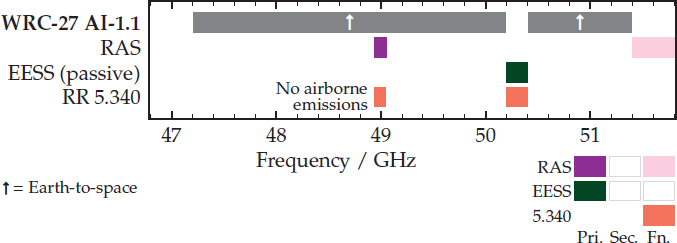
NOTE: AI, agenda item; EESS, Earth exploration-satellite service; RAS, radio astronomy service; RR, Radio Regulation; WRC-27, 2027 World Radiocommunication Conference.
SOURCE: Data from International Telecommunication Union, “Radio Regulations,” http://handle.itu.int/11.1002/pub/8229633e-en, accessed February 10, 2025.
(M-ESIMs) and aeronautical Earth stations in motion (A-ESIMs) communicating with satellite networks in geostationary orbit (GSO) or satellite networks in other orbits (non-GSO) and the development of regulatory provisions for their operation, taking into account the results of studies defined in the resolution. The resolution further invites the ITU to take regulatory action, provided these studies are complete and agreed by the ITU study groups.
The resolution acknowledges protections for and potential impacts upon radio astronomy and Earth remote sensing. In particular, the primary allocation to RAS in 48.94–49.04 GHz (per RR 5.555) and the primary allocations to EESS (passive) and space research service (SRS) (passive) in 50.2–50.4 GHz are noted. Additional footnote protections are acknowledged, with the frequency bands 49.7–50.2 GHz, 50.4–50.9 GHz, and 51.4–52.6 GHz protected as described in Resolution 750 (Rev. WRC-19) and with provisions noted in RR 5.338A, 5.340, and 5.340.1 also applying. The resolution also notes that, in the frequency band 48.94–49.04 GHz, administrations are urged to take all practicable steps to protect RAS from harmful interference, per RR 5.149. Specific flux-density limits already in place to protect RAS are also noted in the resolution, which points out that the power flux-density (pfd) in the frequency band 48.94–49.04 GHz produced by any GSO space station in the fixed-satellite service (FSS, space-to-Earth) operating in the frequency bands 48.2–48.54 GHz and 49.44–50.2 GHz shall not exceed −151.8 dB(W/m2) in any 500 kHz band at the site of any radio astronomy station (per RR 5.555B).
The resolution fails to note that RR 5.340 provides additional “all emissions prohibited” protection for the band 48.94–49.04 GHz for the specific case of airborne stations. However, it does acknowledge the particular sensitivity of RAS to such transmitters.
Radio Astronomy Service
The key RAS application in the bands under consideration in this agenda item is observation of carbon monosulfide (CS) and its isotopologues in the local Milky Way Galaxy. These observations are protected by the footnotes noted above covering the narrow band from 48.94–49.04 GHz. CS is an important probe of the physical conditions in dense star forming molecular clouds, and the abundance ratios of the principal isotopologues C32S, C33S, and C34S provide data on stellar nucleosynthesis and the star formation history of our galaxy.
The greatest concern presented by this agenda item, relative to the continued ability of RAS to use this band, is from A-ESIMs. Although the application under consideration is the Earth-to-space uplink, sidelobe or backlobe radiation from airborne transmitters could affect RAS observatories anywhere within their radio horizon, which is approximately 400 km for a commercial airliner cruising at 10 km altitude. This concern becomes even greater for uplinks to non-GSO satellites, which will occur over a wide and variable range of direction and vertical elevation.
A minimum starting point for protecting RAS observations of CS would be to require that ESIMs adhere to the RR 5.555B limits already in place for space-to-Earth transmissions in the FSS—mentioned in noting (j) of Resolution 176 (Rev. WRC-23). Studies related to Agenda Item 1.1 need to also consider that, for the special case of airborne transmitters, RR 5.340 “all emissions prohibited” protection applies in the 48.94–49.04 GHz band, further justifying stringent protective limits. Rules for the use of this band need to ensure that the combination of out-of-band emission (OOBE) limits and transmitter antenna sidelobe suppression requirements is sufficient to achieve the needed protection, whether at the existing levels set in RR 5.555B, or at possibly more stringent levels that may emerge from the studies called for under this agenda item.
Earth Exploration-Satellite Service
The 47.2–50.2 GHz and 50.4–51.4 GHz (Earth-to-space) bands under consideration are directly adjacent (on both sides) to the EESS (passive) 50.2–50.4 GHz band. This frequency band has a primary allocation to EESS (passive) and is protected under RR 5.340 (“all emissions prohibited”). This band is also associated with mandatory limits, stated in ITU-R Resolution 750 (Rev. WRC-19), governing the level of unwanted emissions from FSS Earth-to-space links. Studies are needed to determine whether these current limits are still sufficient to accomplish the degree of protection required in Recommendation ITU-R RS.2017-0 in light of the expected proliferation of new transmissions in the bands under consideration in this agenda item.
The 50.2–50.4 GHz oxygen absorption band is critical for lower atmospheric temperature profiling and surface emission characterization. It also provides crucial surface characterization for precipitation intensity at the surface (liquid or solid). The 50.2–50.4 GHz frequency band is an essential component of the 50–60 GHz temperature sounding spectral region, which is crucially important for numerical weather prediction (NWP) forecast accuracy and climate assessment.
This 50.2–50.4 GHz passive EESS band has a very long history for operational observations, beginning in 1978 with the Microwave Sounding Unit (MSU) launched on the National Oceanic and Atmospheric Administration (NOAA) TIROS-N (Television and InfraRed Observation Satellite) and extending to the present. Multiple international space agencies have planned continuity missions that include this frequency band, extending out through at least 2032. These represent a substantial international investment in satellites that include this 50.2–50.4 GHz frequency band.
Weather and climate observations have an effective usable “lifespan” far beyond their initial use in numerical weather analysis and forecasting applications. They are used in Earth system “reanalyses,” multi-decade runs of an Earth system model that includes assimilation of data from various sensors, including many EESS (passive) instruments. Examples of such reanalyses include the National Aeronautics and Space Administration (NASA) Modern-Era Retrospective analysis for Research and Applications, version 2 (MERRA-2) or the latest European Centre for Medium-Range Weather Forecasting (ECMWF) Reanalysis, version 5 (ERA-5), which enhance understanding of Earth system processes and are used for long-term climate studies. As such, the “value” of a particular frequency band or set of observations is not ephemeral but endures forever forward in time.
The committee’s primary concerns are associated with OOBE, because the frequencies to be studied are immediately adjacent to (i.e., with no intervening guard band) the frequencies needed for lower troposphere temperature sounding and for characterization of surface emissions. Loss of this frequency band would directly lead to degraded weather forecasts and ability to monitor Earth’s climate. Observing and understanding the atmospheric boundary layer (the lowermost region of the atmosphere) was identified as a “most important science and application priority” in the 2017–2027 National Academies of Sciences, Engineering, and Medicine’s Earth Science and Applications from Space Decadal Survey.1 Various concepts for hyperspectral microwave sounders are under development that focus on observing and understanding the atmospheric boundary layer.
Numerous current and planned EESS (passive) microwave sensors use the adjacent frequency bands (see Table 2-1).
___________________
1 National Academies of Sciences, Engineering, and Medicine, 2018, Thriving on Our Changing Planet: A Decadal Strategy for Earth Observation from Space, The National Academies Press, https://doi.org/10.17226/24938.
TABLE 2-1 Past, Current, and Planned Satellite Missions Utilizing 50.3 GHz Within the 50.2–50.4 GHz Passive Microwave Frequency Band
| Satellite | Agency | End of Life | Service | Bandwidth (MHz) | Polarization |
|---|---|---|---|---|---|
| Past | |||||
| DMSP- F16 | DoD | 2013* | SSMIS | 380 | H or RC |
| Current | |||||
| DMSP-F17, -F18 | DoD | >2025 | SSMIS | 380 | H or RC |
| NOAA-15, -18, -19 | NOAA | >2024 | AMSU-A | 180 | H or V |
| SNPP | NOAA | >2028 | ATMS | 180 | QH |
| NOAA-20, -21 | NOAA | >2027 | ATMS | 180 | QH |
| FY-3D | CMA | >2024 | MWTS-2 | 180 | QH |
| FY-3E | CMA | >2029 | MWTS-3 | 180 | QV |
| FY-3F | CMA | >2032 | MWRI-2 | 400 | H&V |
| FY-3G | CMA | >2029 | MWRI-RM | 400 | H&V |
| Future | |||||
| OceanSat-3A | ISRO | >2030 | MATHS | 180 | N/A |
| Metop-SG-A1, -A2 | EUMETSAT | >2040 | MWS | 180 | H or V |
| Metop-SG-B1, -B2, -B3 | EUMETSAT | >2048 | MWI | 180 | H&V |
| AWS PFM | ESA | >2029 | MWR | 180 | QV |
| Sterna-1, -2, -3 | EUMETSAT | >2042 | MWR | 180 | QV |
| FY-3H | CMA | >2031 | MWTS-3 | 180 | QV |
| FY-3H | CMA | >2031 | MWRI-2 | 400 | H&V |
| FY-3I | CMA | >2032 | MWRI-RM | 400 | H&V |
* The 50–60 GHz band on DMSP-F16 SSMIS failed in 2013. The rest of the instrument/spacecraft is still operating at the time of writing.
NOTE: Acronyms are defined in Appendix C.
SOURCE: Courtesy of World Meteorological Organization OSCAR (Observing System Capability Analysis and Review Tool), n.d., “Satellite Frequencies for Earth Observation, Data Transfer and Platform Communications and Control,” https://space.oscar.wmo.int/satellitefrequencies, accessed December 12, 2024.
The committee notes that the RosHydroMet/Roscosmos Meteor-M N2 satellite series (with six planned missions extending beyond 2031) with a passive microwave imaging/sounding radiometer has a window channel at 48.0 GHz (with a 400 MHz bandwidth). This frequency band is located directly within the proposed 47.2–50.2 GHz frequency band. As noted above, Resolution 176 (Rev. WRC-23) fails to note that RR 5.340 provides additional “all emissions prohibited” protection for the band 48.94–49.04 GHz for the particular case of airborne stations.
New uplink transmissions authorized under this agenda item would not be confined to those directed toward fixed points in the GSO equatorial plane, with Earth stations tracking non-GSO satellites constantly changing positions across the sky. This significantly increases the potential for associated OOBE emissions into the EESS (passive) temperature sounding channels that could contaminate measurements made viewing toward these Earth stations with main beam or near sidelobe coupling.
Findings and Recommendations
Finding: The existing mandatory OOBE emissions limits in Resolution 750 (Rev. WRC-19) may not be adequate to protect the essential 50.2–50.4 GHz oxygen absorption band from ESIMs.
Recommendation: Groups undertaking studies and considering new regulations under Agenda Item 1.1, related to protection of the 50.2–50.4 GHz frequency band from transmissions in the adjacent 47.2–50.2 GHz and 50.4–51.4 GHz (Earth-to-space) bands, should
- Consider realistic environmental conditions, similar to current operational use—for example, by varying latitude, surface type, and weather conditions.
- Assess the potential for out-of-band emissions (OOBE) as a function of orbital observing configurations—for example, polar and equatorial orbits, cross-track and conical scanning techniques, microwave imagers and sounders, varying Earth incidence angles and instantaneous field of view, low Earth orbit, and potentially geostationary orbit (GSO).
- Ensure that the OOBE limits and/or provision of additional guard bands are sufficient to meet Recommendation ITU-R RS.2017-0 limits as a function of sensor bandwidth and polarization.
- Ensure aggregate OOBE from aeronautical Earth stations in motion (A-ESIMs) into the critical RR 5.340 band from 48.94–49.04 GHz do not exceed levels set in RR 5.555B.
- Take into account, in all sharing and compatibility studies, the impact of future aggregate interference and OOBE, including emission from harmonics, that exceed the Recommendation ITU-R RA.769-2 interference thresholds.
Finding: Wider bands than are primarily allocated to RAS are required to fully realize the scientific potential of radio astronomy.
Recommendation: Administrations should use local coordination—for example, through radio quiet zones—to protect radio astronomy observatories, taking into account not only terrestrial emitters but also spaceborne emitters.
AGENDA ITEM 1.2: FIXED SATELLITE UPLINKS IN 13.75–14 GHz
Agenda Item 1.2 considers “possible revisions of sharing conditions in the frequency band 13.75-14 GHz to allow the use of uplink fixed-satellite service earth stations with smaller antenna sizes, in accordance with Resolution 129.”
The band under consideration in Agenda Item 1.2 and a nearby band allocated to scientific use are illustrated Figure 2-3.
Resolution 129 (WRC-23) invites the ITU Radiocommunication Sector (ITU-R) to provide studies on the technical and operational limitations regarding the minimum antenna size and associated power limitations of geostationary orbit (GSO) and non-GSO fixed-satellite service (FSS) Earth stations in the 13.75–14 GHz (Earth-to-space) frequency band.
The resolution considers a growing need for more uplink spectrum in the 13–15 GHz range that could be used by smaller Earth-station antennas to complement the downlink capacity in the 10–13 GHz range. It further considers congestion in the GSO and an increasing need for new satellite systems in non-GSO. Worldwide, the 13.75–14 GHz band is allocated to the radiolocation service (RLS), with stipulations of minimum antenna sizes and power flux-density (pfd) given in RR 5.502. The resolution considers that enhancement of the operating conditions within this band would help to meet the growing needs of FSS, providing more efficient and rational use of Earth-to-space and space-to-Earth frequency bands.
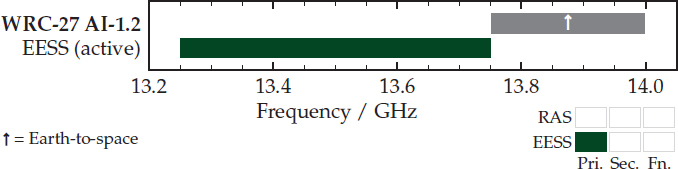
NOTE: AI, agenda item; EESS, Earth exploration-satellite service; WRC-27, 2027 World Radiocommunication Conference.
SOURCE: Data from International Telecommunication Union, “Radio Regulations,” http://handle.itu.int/11.1002/pub/8229633e-en, accessed February 10, 2025.
Finally, the resolution invites studies to ensure the protection of the RLS and space research service (SRS) using power limitations stated in RR 5.502 and RR 5.503.
Earth Exploration-Satellite Service
The band between 13.25 GHz and 13.75 GHz, adjacent to the band under consideration in Agenda Item 1.2, is used for EESS (active) remote sensing with altimeters, scatterometers, and precipitation radar. Primary mission objectives for altimeters are sea-ice elevation, sea-ice thickness, geoid and ocean dynamic topography (currents), and significant wave height. The primary mission objectives for scatterometers are ocean-surface wind speed and wind vectors, with secondary objectives including soil moisture, freeze/thaw mapping, biomass, plant growth and phenology, sea-ice type, and snow cover.
Ocean surface winds are a critical component of coupling between the ocean and the atmosphere, driving oceanic circulation and waves. Those same atmosphere/ocean interactions also exert a momentum drag on the atmosphere. Surface winds strongly influence the fluxes of heat, gas, and momentum across the air–sea interface. In the short term, these processes have a significant impact on weather and significant waves, which, in the long term, affect regional and global climates. Similarly, sustained measurements of sea-ice elevation, sea-ice thickness, and ocean currents are important for understanding and predicting longer-term variations in atmospheric and global circulations.
Altimeters generally use a center frequency around 13.5 GHz with bandwidths of 320–350 MHz. Some next-generation altimeters planned for launch employ 500 MHz for improved measurement precision. Scatterometers operate around 13.25 GHz, with 100 MHz bandwidth being sufficient to meet the desired measurement resolution requirements.
The Joint Altimetry Satellite Oceanography Network missions, JASON-2 (2008–2019) and JASON-3 (2016–present), for example, both utilize two frequencies, 5.3 and 13.58 GHz, to provide primary information on the geoid of Earth using multi-temporal analysis of radar altimetry data. These measurements are highly relevant for studies of coastal sea level, ocean dynamic topography, and significant wave height. Both frequency ranges are needed to correctly account for the impacts of ionospheric effects on the radar-return signals, and this ionospheric delay is also used for remote sensing of integrated ionospheric electron density below the satellite.
Operational products include ocean topography, significant wave height, and wind speed, with near-real-time (3–5 hours) operational geophysical data records of surface wind speeds and waves and first estimates of sea-surface height anomaly, together with interim geophysical data records (1–2 days).
For precipitation radars, the primary mission objectives include the measurement of the effective radii of cloud ice particles and cloud liquid water droplets, total atmospheric column amounts of cloud ice and cloud liquid water, as well as near surface precipitation (rain and/or snow) intensity. Precipitation radars operate near 13.6 GHz and need a total of 20–40 MHz bandwidth to achieve their desired measurement objectives. The selected frequencies are key to observing precipitation (rain or snow) particles in three dimensions (horizontal and vertical). This information is critical for understanding cloud structures and improving weather and climate forecasting models. While the U.S./Japan Tropical Rainfall Measurement Precipitation Radar (1997–2015) utilized 13.8 GHz, the current U.S./ Japan Global Precipitation Measurement (GPM) Dual-frequency Precipitation Radar Ku-band radar operates between 13.597 and 13.603 GHz. The recently launched Chinese FY-3G utilizes a lower Ku-band frequency at 13.35±0.01 GHz. Continuity of these precipitation measurements is ongoing with the FY-3I Precipitation Measurement Radar planned for 2026–onward and the planned Japan Aerospace Exploration Agency (JAXA) Precipitation Measuring Mission Doppler Radar, 2028–onward, also operating at 13.6 GHz. Crucially, these measurements are key for providing information on precipitation processes that impact weather and climate—for example, the formation of precipitation and the interaction of precipitation with aerosols. Furthermore, these measurements are used as calibration and as a reference standard to ensure consistency of measurements for observations made by passive microwave radiometers. Report ITU-R RS.2068-2 provides more information on these uses and further characteristics of the systems employed.
The ability to generate scientific and operational products that are of sufficiently high quality for all of the crucial applications outlined above is dependent on the ability to collect reliable data that are of sufficient quality. Out-of-band emissions (OOBE) by the proposed adjacent services in the 13.74–14.00 GHz band may adversely affect the signals received by the existing EESS satellites mentioned above, both as direct-path signals from the proposed Earth-based transmitters and as indirect signals scattered or reflected by other objects. Such scenarios may have adverse effects such as saturating the receivers of the existing satellites and/or contaminating the true
signals that the existing satellites are seeking to observe. In either case, such OOBE into these critical frequencies would seriously hamper the generation of their products. OOBE from Earth-to-space transmissions would be particularly concerning in this regard. Considerations related to the OOBE adjacent to 13.75 GHz are given in Recommendation ITU-R RS.1166-5, with summaries provided in Tables 1 and 2 of that document.
Recommendation
Recommendation: Groups undertaking studies on the technical and operational limitations regarding the minimum antenna size and associated power limitations under Agenda Item 1.2 should include consideration of out-of-band emissions that could affect the current Earth exploration-satellite service (active) use in the adjacent band from 13.25–13.75 GHz. The methodology and thresholds detailed in Recommendation ITU-R RS.1166-5 should also be applied when devising restrictions on transmissions from Earth stations in the fixed-satellite service.
AGENDA ITEM 1.3: FIXED UPLINKS TO NON-GEOSTATIONARY SATELLITES AT 51.4–52.4 GHz
Agenda Item 1.3 considers “studies relating to the use of the frequency band 51.4-52.4 GHz to enable use by gateway earth stations transmitting to non-geostationary systems in the fixed-satellite service (Earth-to-space), in accordance with Resolution 130 (WRC-23).”
Figure 2-4 illustrates the band under consideration in this agenda item, along with other bands allocated to and/or afforded protections for scientific use.
Resolution 130 (WRC-23) invites the ITU Radiocommunication Sector (ITU-R) to consider the possible revision of the conditions related to the fixed-satellite service (FSS) in the frequency band 51.4–52.4 GHz with a view to enabling its use by non-geostationary orbit (non-GSO) FSS gateway Earth stations on a primary basis. The resolution also invites consideration of any other related regulatory provisions.
The resolution acknowledges that the protection of the Earth exploration-satellite service (EESS, passive) in the adjacent frequency bands 50.2–50.4 GHz and 52.6–54.25 GHz is vital to weather
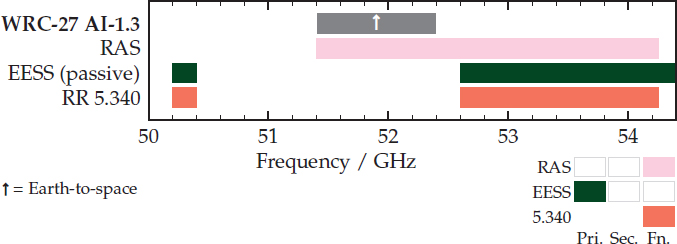
NOTE: AI, agenda item; EESS, Earth exploration-satellite service; RAS, radio astronomy service; RR, Radio Regulation; WRC-27, 2027 World Radiocommunication Conference.
SOURCE: Data from International Telecommunication Union, “Radio Regulations,” http://handle.itu.int/11.1002/pub/8229633e-en, accessed February 10, 2025.
prediction and disaster management and that all emissions are prohibited in these bands per RR 5.340, with practical limits defined in Resolution 750 (Rev. WRC-19).
With respect to radio astronomy, the resolution notes that in the frequency band 51.4–54.25 GHz, radio astronomy observations are carried out under national arrangements, as indicated in RR 5.556, and that appropriate measures may have to be defined to protect the radio astronomy service (RAS). The cited footnote RR 5.556 states, in its entirety, that “In the bands 51.4–54.25 GHz, 58.2–59 GHz, and 64–65 GHz, radio astronomy observations may be carried out under national arrangements.”
Radio Astronomy Service
For RAS, the three RR 5.556 bands cited in the resolution were likely associated with proposals to carry out simultaneous radio astronomical observations of multiple lines, sampling a broad range of excitation temperatures, in the 60 GHz molecular oxygen band. These observations would need to be carried out from space, as absorption by oxygen in the terrestrial atmosphere would completely block ground-based observations within the two higher-frequency bands of these three. In contrast, in the lowest RR 5.556 band, which overlaps with the FSS band under consideration in this agenda item, ground-based observations would be feasible from high-altitude sites. However, no observatory is currently using this band to the committee’s knowledge. For example, the current Atacama Large Millimeter/submillimeter Array (ALMA) band 1 receivers cover 35–50 GHz.
The proposed expanded use of this band for non-GSO FSS uplinks would likely be compatible with any ground-based RAS observations that might be carried out in this band in the future, both because of the Earth-to-space propagation direction of the FSS uplink, and because of the shielding afforded by horizontal atmospheric attenuation, which ranges from about 0.5–2.5 dB/km across this band at sea level. Space-based RAS observations would not significantly benefit from atmospheric attenuation of the uplink radiation, but such uplinks would be directed away from Earth and thereby avoid main beam coupling. Moreover, a space-based telescope would likely be designed to minimize sidelobe coupling to Earth’s thermal emission, minimizing sidelobe coupling to uplink transmissions as well.
Earth Exploration-Satellite Service
The band 51.4–52.4 GHz is proximate (on both sides) to the 50.2–50.4 GHz and 52.6–54.25 GHz oxygen absorption bands that are critical for atmospheric temperature profiling and surface emission characterization. The importance of the 50.2–50.4 GHz oxygen absorption band is discussed in more detail in the committee’s views on Agenda Item 1.1.
The 52.6–54.25 GHz oxygen absorption band is critical for lower atmospheric temperature profiling in nearly all weather conditions, and it is an essential component of the 50–60 GHz temperature sounding spectral region, which is crucially important for numerical weather prediction (NWP) forecast accuracy and climate assessment.
Numerous current and planned EESS (passive) microwave sensors use the adjacent 52.6–54.25 GHz oxygen absorption bands that are critical for atmospheric temperature profiling (see Table 22). These frequencies are protected by RR 5.340 (all emissions prohibited).
The 52.6–54.25 GHz passive EESS band also has a very long history for operational observations, beginning in 1978 with the Microwave Sounding Unit (MSU) launched on the National Oceanic and Atmospheric Administration (NOAA) TIROS-N (Television and Infra-Red Observation Satellite) and extending to the present. Multiple international space agencies have planned continuity missions that include this frequency band, extending out through at least 2042. These represent a substantial international investment in satellites that include this 52.6–54.25 GHz frequency band.
As noted in the committee’s views on Agenda Item 1.1, weather and climate observations have an effective usable “lifespan” far beyond their initial use in numerical weather analysis and forecasting applications. They are used in Earth system “reanalyses,” multi-decade runs of an Earth system model that includes assimilation of data from various sensors, including many EESS (passive) instruments. Examples of such reanalyses include the National Aeronautics and Space Administration (NASA) Modern-Era Retrospective analysis for Research and Applications, version 2 (MERRA-2) or the latest European Centre for Medium-Range Weather Forecasting (ECMWF) Reanalysis, version 5 (ERA-5), which enhance understanding of Earth system processes and are used in long-term climate studies. As such, the “value” of a particular frequency band or set of observations is not ephemeral, rather, it endures forever forward in time.
TABLE 2-2 Current and Planned Satellite Missions Utilizing the Proximate 52.6–54.25 GHz Passive Microwave Frequency Band
| Satellite Series | Space Agency | End of Life | Service |
|---|---|---|---|
| Past | |||
| DMSP-F16 | DoD | 2013* | SSMIS |
| Current | |||
| DMSP-F17, -F18 | DoD | >2025 | SSMIS |
| NOAA-15, -18, -19 | NOAA | >2025 | AMSU-A |
| SNPP | NOAA | >2028 | ATMS |
| NOAA-20, -21 | NOAA | >2030 | ATMS |
| FY-3D | CMA | >2024 | MWTS-2 |
| FY-3E, -3F | CMA | >2032 | MWTS-3 |
| Meteor-M N2-(2-4) | RosHydroMet | >2029 | MTVZA-GY |
| Future | |||
| NOAA-JPSS-3, -4 | NOAA | >2039 | ATMS |
| Metop-SG-A1, -A2, -A3 | EUMETSAT | >2047 | MWS |
| AWS PFM | ESA | >2029 | MWR |
| Sterna-1, -2, -3 | EUMETSAT | >2042 | MWR |
| OceanSat-3A | ISRO | >2030 | MATHS |
| FY-3H | CMA | >2031 | MWTS-3 |
| FY-3I | CMA | >2032 | MWRI-RM |
| Meteor-M N2-(5-6) | RosHydroMet | >2031 | MTVZA-GY |
* The 50–60 GHz band on DMSP-F16 SSMIS failed in 2013. The rest of the instrument/spacecraft is still operating at the time of writing.
NOTES: This oxygen band is used for temperature sounding. The satellite missions listed below often utilize multiple frequencies in this band, with bandwidths ranging from 180–400 MHz, and with H, V, QV, or RC polarization. Acronyms defined in Appendix C.
SOURCE: Courtesy of World Meteorological Organization OSCAR (Observing System Capability Analysis and Review Tool), n.d., “Satellite Frequencies for Earth Observation, Data Transfer and Platform Communications and Control,” https://space.oscar.wmo.int/satellitefrequencies, accessed December 12, 2024.
As with Agenda Item 1.1, new uplink transmissions authorized under this agenda item would no longer be confined to those directed toward fixed points in the GSO equatorial plane, with Earth stations tracking non-GSO satellites constantly changing positions across the sky. This significantly increases the potential for associated out-of-band emissions (OOBE) into the EESS (passive) temperature sounding channels that could contaminate measurements made viewing toward these Earth stations with main beam or near sidelobe coupling.
Finding and Recommendation
Finding: For radio astronomy, no current observations would be impacted by the proposed expansion of FSS uplinks in this band to non-GSO satellites, and impact on future observations in the bands identified in footnote RR 5.556 would be manageable.
Recommendation: For Earth remote sensing observations, groups undertaking studies of the 50.2–50.4 GHz and 52.6–54.25 GHz oxygen absorption bands under Agenda Item 1.3 should
- Assess the necessary out-of-band emission (OOBE) limits for uplink transmissions that satisfy Recommendation ITU-R RS.2017-0 criteria for sensors with characteristics described in Recommendation ITU-R RS.1861-1.
- Consider realistic environmental conditions, similar to current operational use—for example, by varying by latitude, surface type, and weather conditions.
- Assess the potential for OOBE as a function of orbital observing configurations—for example, polar and equatorial orbits, cross-track and conical scanning techniques, microwave imagers and sounders, varying Earth incidence angles and instantaneous field of view, low Earth orbit, and potentially geostationary orbit (GSO).
- Assess whether current Resolution 750 (Rev. WRC-19) limits provide adequate protection from aggregated GSO and non-GSO emissions.
AGENDA ITEM 1.4: FIXED SATELLITE DOWNLINKS IN 17.3–17.8 GHz
Agenda Item 1.4 considers “a possible new primary allocation to the fixed-satellite service (space-to-Earth) in the frequency band 17.3-17.7 GHz and a possible new primary allocation to the broadcasting-satellite service (space-to-Earth) in the frequency band 17.3-17.8 GHz in Region 3, while ensuring the protection of existing primary allocations in the same and adjacent frequency bands, and to consider equivalent power flux-density (epfd) limits to be applied in Regions 1 and 3 to non-geostationary-satellite systems in the fixed-satellite service (space-to-Earth) in the frequency band 17.3-17.7 GHz, in accordance with Resolution 726 (WRC-23).”
Figure 2-5 details the frequency band under consideration in Agenda Item 1.4 along with the adjacent band allocation to the Earth exploration-satellite service (EESS, active).
Resolution 726 (WRC-23) notes inconsistencies between ITU Radiocommunication Sector (ITU-R) regions in allocations to the above bands in the fixed-satellite service (FSS), with both Earth-to-space and space-to-Earth transmission in 17.3–17.7 GHz allowed in Regions 1 and 2, but Region 3 being restricted to Earth-to-space only. Regions 1, 2, and 3 correspond, roughly speaking, to Europe/Africa, the Americas, and Asia/Oceania, respectively. The resolu-

NOTE: AI, agenda item; EESS, Earth exploration-satellite service; WRC-27, 2027 World Radiocommunication Conference.
SOURCE: Data from International Telecommunication Union, “Radio Regulations,” http://handle.itu.int/11.1002/pub/8229633e-en, accessed February 10, 2025.
tion also notes that epfd2 limits for non-geostationary orbit (non-GSO) spaceborne FSS transmitters in Region 2 have been defined previously and are not expected to be modified. Accordingly, the resolution invites sharing and compatibility services for new FSS space-to-Earth allocations in Region 3, including consideration of suitable epfd limits.
Earth Exploration-Satellite Service
Knowledge of snow water equivalent (SWE), or how much water is contained in the snow mass, is of major importance in the local, regional, and global studies of the water cycle, water availability, ecosystem services, and for monitoring climate change and operational applications such as hydrological modeling and runoff prediction. Some of the priority questions that need to be answered concern (1) the total amount of water stored in the form of snow and its variations on seasonal and interannual scales and (2) impacts of such stores and dynamics on the water and energy cycles and freshwater availability. Despite its critical importance, SWE/snow mass remains poorly observed on multiple spatial and temporal scales. Radar remote sensing observation concepts that could lead to the quantification of SWE and snow mass are, however, being developed and have shown success in several proof-of-concept demonstrations. These observations are most effectively performed at two distinct frequencies that can provide sensitivity to both the SWE and the snow microstructure, thus allowing the retrieval of both types of information simultaneously. One of the two frequencies needs to be in the Ku-band range, with 17.2–17.3 GHz being the frequency band of choice for radar, EESS (active), operations. The other frequency can be lower—for example, 13.5 or 9.5 GHz. These specific frequencies are needed due to the microstructure of snow (frozen water particles and air) and the specific scattering interactions with coincident microwave frequencies. Frequencies that are much lower would not be sensitive to SWE, especially if snow thickness is small. Frequencies that are much higher will not penetrate the snow layer and therefore will not provide the needed information about the total snow mass.
Several studies are currently ongoing for development of such dual-frequency radar systems for SWE and snow mass observations,
___________________
2 See the footnote to the definition of equivalent power flux-density (epfd) in Appendix C for brief explanation of the epfd concept and references to its definition in International Telecommunication Union documents.
including some bistatic radar approaches. The National Aeronautics and Space Administration (NASA) is, to the committee’s knowledge, supporting several multi-frequency airborne radar developments, including that of SnowSAR (9.55–9.65 GHz and 17.2–17.3 GHz), SNOWII (5.4 GHz, 13.64 GHz, and 17.24 GHz), a dual-frequency Ka-band radar for snow (13.5 GHz and 17.2 GHz), the Wideband Instrument for Snow Measurements (9.5 GHz and 17.2 GHz), and ground-based radar observations in the same frequency bands used during the SnowEx series of experiments.
The frequency band 17.2–17.3 GHz is, therefore, a critical band for snow cover and SWE observations. Any adjacent services need to be designed to protect this band for future airborne and spaceborne EESS operations for this Earth system variable.
Recommendation
Recommendation: Groups undertaking studies of new allocations and associated equivalent power flux-density limits under Agenda Item 1.4 should include consideration of the potential for of out-of-band emissions that could affect the current Earth exploration-satellite service (active) use in the adjacent band. The thresholds for interference defined in ITU-R RS.1166-5 should be the starting point for such considerations.
AGENDA ITEM 1.5: LIMITING UNAUTHORIZED NON-GEOSTATIONARY GROUND STATION OPERATIONS
Agenda Item 1.5 considers “regulatory measures, and implementability thereof, to limit the unauthorized operations of non-geostationary-satellite orbit earth stations in the fixed-satellite and mobile-satellite services and associated issues related to the service area of non-geostationary-satellite orbit satellite systems in the fixed-satellite and mobile-satellite services, in accordance with Resolution 14 (WRC-23).”
Given that this agenda item seeks to devise measures for enforcing the existing regulatory framework, rather than seeking changes to the regulations that might impact scientific use of the spectrum, the committee has no views on this agenda item.
AGENDA ITEM 1.6: EQUITABLE ACCESS TO FIXED SATELLITE SERVICE IN SELECTED BANDS
Agenda Item 1.6 considers “technical and regulatory measures for fixed-satellite service satellite networks/systems in the frequency bands 37.5-42.5 GHz (space-to-Earth), 42.5-43.5 GHz (Earth-to-space), 47.2-50.2 GHz (Earth-to-space) and 50.4-51.4 GHz (Earth-to-space) for equitable access to these frequency bands, in accordance with Resolution 131 (WRC-23).”
Figure 2-6 illustrates the bands under consideration in this agenda item, along with overlapping and nearby bands identified for scientific usage.
As described in Resolution 131 (WRC-23), the scope of this agenda item is limited to studies related to promoting “equitable access to these frequency bands by fixed-satellite service (FSS) satellite networks/systems … without adversely affecting those services, specifically the operation of the satellite networks and systems in the bands … [and] without changing measures to protect terrestrial services from unacceptable interference.”
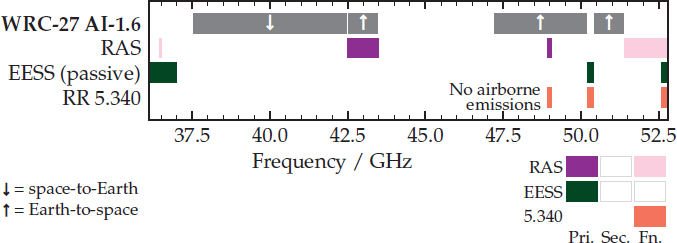
NOTE: AI, agenda item; EESS, Earth exploration-satellite service; RAS, radio astronomy service; RR, Radio Regulation; WRC-27, 2027 World Radiocommunication Conference.
SOURCE: Data from International Telecommunication Union, “Radio Regulations,” http://handle.itu.int/11.1002/pub/8229633e-en, accessed February 10, 2025.
While the committee supports the motivation around equitable access to frequency, especially for developing countries, the committee notes that many major radio astronomy facilities with significant U.S. involvements have been built in remote locations (e.g., the Square Kilometer Array, SKA-mid in South Africa’s Karoo region, SKA-low in Western Australia, and ALMA in the Atacama desert in Chile) specifically to take advantage of the radio quiet skies.
Recommendation
Recommendation: Those undertaking studies of increased equitable access to specific bands under Agenda Item 1.6 should consider the potential implications for radio astronomy facilities hosted in lightly populated radio-quiet (and thus potentially underserved) areas.
AGENDA ITEM 1.7: ALLOCATIONS TO INTERNATIONAL MOBILE TELECOMMUNICATIONS
Agenda Item 1.7 considers “studies on sharing and compatibility and develop[s] technical conditions for the use of International Mobile Telecommunications (IMT) in the frequency bands 4 400-4 800 MHz, 7 125-8 400 MHz (or parts thereof), and 14.8-15.35 GHz taking into account existing primary services operating in these, and adjacent, frequency bands, in accordance with Resolution 256 (WRC-23).”
Figure 2-7 details the bands under consideration in this agenda item along with bands identified for scientific usage.
Resolution 256 (WRC-23) invites studies of the “technical, operational, and regulatory” effects of IMT in the above-listed frequency bands to flesh out the characteristics and deployment scenarios of terrestrial IMT systems in these bands. The resolution also invites sharing and compatibility studies seeking to protect services with primary allocations in these bands, without imposing additional regulatory or technical constraints on those services and also on services in adjacent frequency bands.
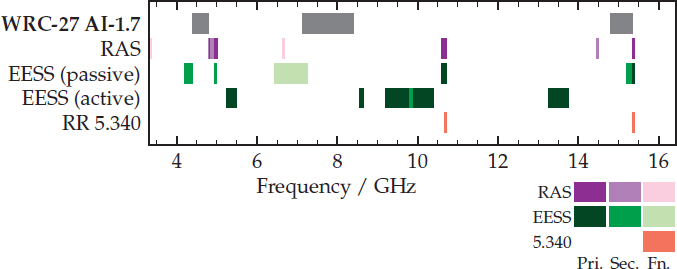
NOTE: AI, agenda item; EESS, Earth exploration-satellite service; RAS, radio astronomy service; RR, Radio Regulation; WRC-27, 2027 World Radiocommunication Conference.
SOURCE: Data from International Telecommunication Union, “Radio Regulations,” http://handle.itu.int/11.1002/pub/8229633e-en, accessed February 10, 2025.
Adjacent to the 4400–4800 MHz band under consideration in Agenda Item 1.7, the Earth exploration-satellite service (EESS, passive) may be authorized in the band 4200–4400 MHz on a secondary basis (RR 5.437), also discussed later in this chapter under Agenda Item 1.19, which considers a new primary allocation to EESS (passive) in that band. In the bands from 4800–5000 MHz, the radio astronomy service (RAS) has both primary and secondary allocations (with the primary allocations being region-dependent below 4990 MHz). RR 5.149 urges administrations to take all practicable steps to protect RAS in these bands.
As shown in Figure 2-7, the band 7125–8400 MHz overlaps the band from 7075–7250 MHz within which RR 5.458 notes that passive remote sensing observations are carried out. The 15.2–15.35 GHz band also under consideration in Agenda Item 1.7 has a secondary allocation for EESS (passive) under RR 5.339. The directly adjacent 15.35–15.4 GHz band has primary allocations to RAS and EESS (passive) and is afforded “all emissions prohibited” protection under RR 5.340.
As a general consideration, applicable to all proposed new frequency allocations, care is needed to assess the impact on incumbent RAS and EESS (passive) bands, including those listed in footnote RR 5.149. While RAS bands can be protected regionally by limiting emissions within a certain radius of a facility, this is not the case with EESS (passive) observations, which are typically satellite-based and global in nature. The detrimental interference levels for continuum RAS observations are approximately −243 dB(W/(m2 Hz)) at 4800 MHz and −234 dB(W/(m2 Hz)) at 14.8 GHz, based on interpolation of the values in Table 1 of Recommendation ITU-R RA.769-2. Meanwhile, the detrimental interference level for spectral line RAS observations at 4800 MHz is −230 dB(W/(m2 Hz)), based on the value at 4830 MHz given in Table 2 of Recommendation ITU-R RA.769-2. For EESS (passive), the interference thresholds for these bands, according to Recommendation ITU-R RS.2017-0, are −166 dBW at 4.4 GHz and 7.25 GHz (in a 200 MHz reference bandwidth) and −169 dBW at 15.2 GHz (in a 50 MHz reference bandwidth). Care needs to be taken that out-of-band emission (OOBE) levels leaking into bands with allocations to RAS and EESS do not exceed these detrimental power levels.
Radio Astronomy Service
The 4830 MHz rest frequency of the spectral line of formaldehyde (H2CO), one of the most common molecules in the cold
interstellar medium, is directly adjacent to a band considered in this agenda item. Formaldehyde is an important and sensitive probe of the coldest, densest gas in the universe, which is the fuel for star and planet formation. While many studies of this important molecule are carried out in the Milky Way Galaxy at the line’s rest frequency, revealing where and how stars form, there is also great promise of detecting formaldehyde all the way out to high redshift and the early universe. At cosmological distances, the spectral line will be redshifted to lower frequency, and it will often appear in the band under consideration in this agenda item, 4400–4800 MHz.
The 15.35–15.40 GHz (2 cm) band, which is adjacent to the 14.8–15.35 GHz band to be studied for IMT under this agenda item, is an important band for continuum observations and very long baseline interferometry (VLBI) observations. In particular, this band has been used for extensive high-resolution VLBI studies of the structure and kinematics of jets launched by active galactic nuclei. This band is protected under RR 5.340 (with interference criteria defined in Recommendation ITU-R RA.769-2), which has the effect of imposing tight constraints on OOBE from the IMT band.
The bands under consideration in this agenda item are also opportunistically used by RAS to detect other red-shifted spectral lines and obtain sensitivity to radio continuum emission (which requires large bandwidths). These observations capitalize on remote observatory sites and local coordination to make a best practical effort to detect faint radio emission from the cosmos outside of allocated bands. Data obtained in the bands under consideration here, for example, have critically contributed to the detection of synchrotron emission from a newly launched, relativistic jet upon the merger of two neutron stars. These frequencies are also ideal for tracing star formation and accreting black holes at high redshift, and unlike observations at ultraviolet, optical, and infrared wavelengths, observations at these frequencies are not affected by enshrouding dust, enabling a complete census of star formation and accretion activity across cosmic time.
Although radio observatories are generally located at remote sites, signal attenuation in the bands under consideration in this agenda item is relatively small, and most of the attenuation is due to the inverse-square dependence on distance. Radio astronomy observatories are also vulnerable to interference due to OOBE from mobile devices. Full consideration of the impact of new allocations necessarily requires the possibility of OOBE and the aggregate emissions from numerous devices. Detailed consideration of radio frequency interference (RFI) to RAS sites needs to also include analysis
appropriate to the geographic location of the observatory. In the United States, observatories that operate in frequency ranges considered include the Karl G. Jansky Very Large Array (VLA, New Mexico), the Robert C. Byrd Green Bank Telescope (GBT, West Virginia), Owens Valley (California), the Allen Telescope Array (California), and the 10 sites included in the Very Long Baseline Array. Internationally, they include the Australia Telescope Compact Array in Australia; the African Very Long Baseline Interferometry Network telescope in Ghana; the Hartebeesthoek Radio Astronomy Observatory in South Africa; the 100-m Radio Telescope in Effelsberg, Germany; the 10 stations of the European VLBI Network (EVN), including Medicina, Noto, and Sardinia in Italy, Torun in Poland, and Yebes in Spain; the RATAN-600 telescope in Russia; and the future Qitai Radio Telescope in China. This list of observatories that operate at the frequencies under consideration in this agenda item is intended to be illustrative of the wide use of these frequencies by RAS, and it is not intended to be comprehensive.
In addition, very high-resolution radio astronomy observations enable unique and unrivaled monitoring of Earth orientation parameters (EOP) through the science of geodesy, which is critical for maintaining the International Celestial Reference Frame and linking it to the International Terrestrial Reference Frame. The worldwide VLBI Geodetic Operating System (VGOS) performs these observations at frequencies from 2–14 GHz. High precision of celestial and terrestrial reference frames is necessary for accurate tracking and navigation of spacecraft, improving location accuracy on Earth beyond what global navigation satellite systems (GNSS) currently provide, and tracking tectonic plates. Of particular importance, these geodetic observations build on a 40-year legacy of monitoring distant radio galaxies at 8200–8950 MHz, and the continuation of high-precision measurements of EOP requires ongoing access to this band using the very sensitive, and very vulnerable to man-made emissions, radio telescopes described above.
Earth Exploration-Satellite Service
The frequency band 6425–7250 MHz has been used by EESS (passive) to measure sea-surface temperature (SST) on a global scale as noted in RR 5.458. The measurement of SST is important for detecting and forecasting meteorological events that drastically impact the safety and security of administrations and the populations of their countries. These measurements also provide an essential resource for monitoring and understanding climate variability
and climate change. Passive microwave observations, with certain frequency bands conveying unique information on physical characteristics, remain the only means of obtaining all-weather daily and global measurement of SST. Current measurements of SST within the 6425–7250 MHz bands are hindered by RFI, particularly near coasts where accurate SSTs have the greatest impact on the local population.
The only band with a primary allocation to EESS (passive) that is adjacent to a band under consideration in Agenda Item 1.7 is 15.35–15.40 GHz. However, the committee is not aware of any ongoing or planned uses of this band for Earth remote sensing. Similarly, the committee is unaware of any current or planned use of the 4200–4400 MHz band identified in RR 5.437, although Agenda Item 1.19 considers a new allocation to EESS (passive) in this band.
Finding and Recommendations
Recommendation: In considering new mobile use of the 4.4–4.8 GHz band in response to Agenda Item 1.7, administrations should take all practicable steps (e.g., radio quiet zones and/or other coordination approaches) to protect the radio astronomy service in the adjacent 4.8–5.0 GHz band, and Earth exploration-satellite service (passive) in the 4.2–4.4 GHz band for which a new primary allocation is considered under WRC-27 Agenda Item 1.19.
Recommendation: Groups undertaking studies of new or revised allocations to the 14.8–15.35 GHz band under Agenda Item 1.7 should
- Explicitly consider the impact to the radio astronomy service (RAS) and Earth exploration-satellite service (EESS, passive) to which the 15.35–15.4 GHz band is allocated on a primary basis.
- Specify out-of-band emission (OOBE) masks and/or guard bands to ensure that the Recommendation ITU-R RA.769-2 and Recommendation ITU-R RS.2017-0 interference thresholds, for RAS and EESS (passive), respectively, are not exceeded in these bands. Special consideration should also be given to keeping aggregate interference below this threshold.
- Take into account in all sharing and compatibility studies the impact of future aggregate interference and OOBE, including emission from harmonics that exceeds the ITU-R RA.769-2 interference thresholds.
Finding: Wider bands than are primarily allocated to RAS are required to fully realize the scientific potential of radio astronomy.
Recommendation: Administrations should use local coordination—for example, through radio quiet zones—to protect radio astronomy observatories, taking into account not only terrestrial emitters but also spaceborne emitters.
Recommendation: Groups undertaking studies related to Agenda Item 1.7 should examine the potential for International Mobile Telecommunications usage in the lower portion of the 7125–8400 MHz band to interfere with Earth exploration-satellite service (passive) observations made over oceans. If necessary, administrations should restrict usage of all or part of this band to inland regions.
AGENDA ITEM 1.8: RADIOLOCATION FROM 231.5–700 GHz
Agenda Item 1.8 considers “possible additional spectrum allocations to the radiolocation service on a primary basis in the frequency range 231.5-275 GHz and possible new identifications for radiolocation service applications in the frequency bands within the frequency range 275-700 GHz for millimetric and sub-millimetric wave imaging systems, in accordance with Resolution 663 (Rev.WRC-23).”
Figure 2-8 illustrates the broad spectral range under consideration in this agenda item, along with the bands allocated for scientific usage in 231.5–275 GHz, and bands identified for scientific use above 275 GHz per RR 5.565 (note that the region above 275 GHz does not currently include any specific frequency allocations).
Resolution 663 (Rev. WRC-23) notes the potential radiolocation service (RLS) uses of the millimetric and submillimetric region of the spectrum for stand-off detection of concealed objects, benefiting public safety, and for ranging and imaging associated with transportation safety. Both active and passive systems are described, with active systems requiring bandwidths up to 30 GHz for range resolution and passive systems expected to require even greater bandwidth based on signal-to-noise ratio. The resolution goes on
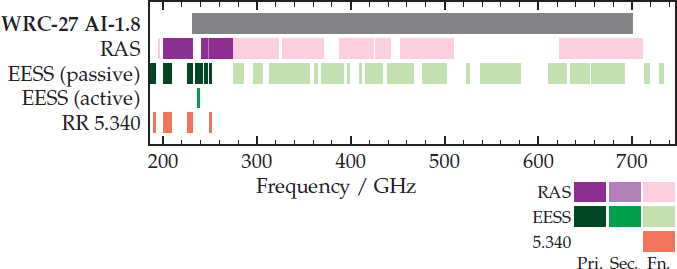
NOTE: AI, agenda item; EESS, Earth exploration-satellite service; RAS, radio astronomy service; RR, Radio Regulation; WRC-27, 2027 World Radiocommunication Conference.
SOURCE: Data from International Telecommunication Union, “Radio Regulations,” http://handle.itu.int/11.1002/pub/8229633e-en, accessed February 10, 2025.
to note incumbent uses of the spectrum above 231.5 GHz, including both Earth remote sensing and radio astronomy, noting various footnote protections in the bands under consideration. It also recognizes that active uses of the spectrum from 275–1000 GHz should take all practicable steps to protect passive services from harmful interference, pending future formal allocations at these frequencies. Finally, the resolution requests ITU Radiocommunication Sector (ITU-R) to study (1) the technical characteristics of potential active and passive RLS-systems; (2) globally harmonized spectrum possibilities for RLS, particularly above 231.5 GHz; (3) sharing and compatibility studies for RLS and other services in the 231.5–275 GHz band; (4) sharing and compatibility studies (in band and adjacent band) specifically between RLS and Earth exploration-satellite service (EESS, passive), space research service (SRS, passive) and the radio astronomy service (RAS) applications in 275–700 GHz; and (5) sharing and compatibility studies (both in band and adjacent band) for fixed and mobile applications in 275–450 GHz. Following this, the Resolution invites WRC-27 to determine new allocations to RLS in the 231.5–275 GHz and 275–700 GHz bands.
The 231.5–275 GHz range includes primary allocations to EESS (passive) in 235–238 GHz, and 250–252 GHz, the latter protected by RR 5.340 (all emissions prohibited). RR 5.563A notes that ground-based passive atmospheric sounding is performed in bands including 235–238 GHz, 250–252 GHz, and 265–275 GHz. RR 5.563B notes a narrow allocation to EESS (active) for spaceborne cloud radars at 237.9–238 GHz. This region includes primary allocations to RAS in 241–248 GHz and 250–275 GHz, with the intervening 241–250 GHz band benefiting from RR 5.149 protection whereby administrations are urged to take all practicable steps to protect RAS.
Radio Astronomy Service
Radio astronomy in the millimeter/submillimeter band at issue in this agenda item has become an indispensable tool for studying the universe, and the importance of these bands for astrophysics and cosmology continues to grow. Large investments have been made in major observatories operating at these frequencies. Recommendation ITU-R RA.314-11 documents the key astrophysical emission mechanisms targeted by these observatories.
Rotational lines of numerous low-mass molecules populate this spectral region. Abundant species such as carbon monoxide (CO) serve as universal tracers of structure and physical conditions in the Milky Way and external galaxies. Spectral lines of numer-
ous hydrides such as SiH, SH+, and HCl—fundamental building blocks of interstellar chemistry—are observed in this band. Indeed, thousands of spectral lines across this band (Figure 1-2 offers but one example) from hundreds of molecular species and their isotopologues reveal the astrochemical processes that have shaped the material composition of the universe and enabled the development of life itself. In addition, while detecting a given molecular species in a single line can provide basic information on abundance as well as line-of-sight motion via Doppler shift, by observing multiple spectral lines from the same species, typically spread across a wide range of frequency, it is possible to probe local physical conditions such as temperature and the collisional environment.
In addition to molecular line observations, millimeter/submillimeter continuum observations are used to image sources ranging from cool dusty clouds and protoplanetary disks to the intense emission from active galactic nuclei (AGN). The recent images of the black holes at the center of the nearby galaxy M87 and our own Milky Way, seen as shadows against a background of AGN emission, were made by a world-wide array of radio telescopes observing millimeter-wave broad-band continuum emission near 230 GHz, and advanced observations are now targeting 345 GHz as well (cf. Report ITU-R RA.2508-0). Beyond their scientific value as tests of the predictions of general relativity under the extreme conditions surrounding a supermassive black hole, these visually striking images had a significant cultural impact as well.
Finally, cosmological telescopes use millimeter/submillimeter continuum observations to map the cosmic microwave background (CMB) radiation. This is the hot radiation that filled the early universe, cooled by its subsequent expansion to an effective temperature of 2.7 K. Tiny fluctuations in the intensity and polarization of this radiation across the sky record the state of the universe when it became transparent to light only around 400,000 years after the Big Bang, and they carry the imprint of the physics that drove its earlier evolution. Current and planned experiments to produce detailed maps of these fluctuations are placing increasingly stringent constraints on Big Bang cosmology. Moreover, by making simultaneous maps in multiple broad bands across the millimeter/submillimeter band, it is possible to separate the primary CMB radiation from the changes resulting from its propagation across the universe, opening a window on nearly the entire volume of the observable universe. The CMB observation bands extend up to approximately 315 GHz. These bands, and the characteristics of the bolometric detectors used in CMB observations, are documented in Report ITU-R RA.2512-0.
At the high frequencies at issue in this agenda item, propagation is essentially line-of-sight in nature, and attenuation of building materials is high. This means the risk of interference to RAS from indoor applications such as security screening is minimal. Sensors on road vehicles pose a greater, but potentially manageable, risk in the immediate environment of RAS observatories. In contrast, airborne applications, including portable devices carried on board aircraft, pose a significant risk to radio observatories given that the radio horizon from commercial aircraft at cruising altitude extends to hundreds of kilometers. For this reason, the committee recommends that broadband radiolocation applications in this band be limited to ground-based use.
Earth Exploration-Satellite Service
The 231.5 GHz and higher regions of the radio spectrum convey valuable unique information on atmospheric composition and high-altitude cirrus ice clouds. Atmospheric composition observations are made by limb-sounding instruments (viewing the atmosphere “edge on”). Species measured include ozone, water vapor, and long-lived trace gases such as N2O (nitrous oxide) that provide information on atmospheric circulation, and chlorine- and bromine-containing species such as HCl (hydrogen chloride), ClO (chlorine monoxide), and BrO (bromine monoxide), which are central to chemical destruction of stratospheric ozone. The ongoing recovery in stratospheric ozone resulting from the cessation in production of ozone-depleting substances under the Montreal Protocol is the subject of sustained scientific study, for which spaceborne microwave limb observations are a unique resource. The limb-viewing geometry and high opacity of the lower atmosphere render such observations largely immune to ground-based radio frequency interference (RFI). However, airborne (and space-borne) transmissions have the potential to interfere with these observations and need to be avoided.
Cloud ice observations are made in both limb and conical (slant)-viewing geometry. Observations at these frequencies provide information unavailable from other radio frequencies or from observations in the infrared or visible spectral regions, specifically the characteristics and size distribution of cirrus ice particles, given the similarity of the particle sizes to the observing wavelength. The role of such cirrus clouds in the climate system is poorly understood, and planned new observations, including from the planned conically scanning European Space Agency (ESA) Ice Cloud Imager (ICI), are expected to resolve outstanding scientific questions. The
conical viewing geometry for such observations reduces path length through the atmosphere compared to limb viewing, increasing sensitivity to RFI. Accordingly, protection is needed for all the bands identified for such observations (those identified for nadir and/or conical scanning in ITU-R RS.2017-0). A particular focus is needed on cases where nominally horizontally oriented ground-based transmissions are redirected toward an orbiting sensor following reflections off Earth’s surface, structures, vehicles, cloud particles, etc.
Table 2-3 lists all the ICI bands in the frequency range under consideration in this agenda item.
TABLE 2-3 Spectral Regions Observed by the European Space Agency Ice Cloud Imager (ICI) Instrument
| Channel | Frequency (GHz) | Bandwidth (MHz) | NEDT (K) | Bias (K) | Polarization | Footprint Size at 3dB (km) |
|---|---|---|---|---|---|---|
| ICI-1 | 183.31±7.0 | 2 × 2000 | 0.8 | 1.0 | V | 16 |
| ICI-2 | 183.31±3.4 | 2 × 1500 | 0.8 | 1.0 | V | 16 |
| ICI-3 | 183.31±2.0 | 2 × 1500 | 0.8 | 1.0 | V | 16 |
| ICI-4 | 243.2±2.5 | 2 × 3000 | 0.7 | 1.5 | V, H | 16 |
| ICI-5 | 325.15±9.5 | 2 × 3000 | 1.2 | 1.5 | V | 16 |
| ICI-6 | 325.15±3.5 | 2 × 2400 | 1.3 | 1.5 | V | 16 |
| ICI-7 | 325.15±1.5 | 2 × 1600 | 1.5 | 1.5 | V | 16 |
| ICI-8 | 448±7.2 | 2 × 3000 | 14 | 1.5 | V | 16 |
| ICI-9 | 448±3.0 | 2 × 2000 | 1.6 | 1.5 | V | 16 |
| ICI-10 | 448±1.4 | 2 × 1200 | 2.0 | 1.5 | V | 16 |
| ICI-11 | 664±4.2 | 2 × 5000 | 1.6 | 1.5 | V, H | 16 |
NOTES: Channels ICI-1 to ICI-3 are included for completeness though they are not in the range considered under Agenda Item 1.8. Acronyms defined in Appendix C.
SOURCE: ©EUMETSAT, 2023, “Metop-SG ICI L1b Data Guide,” https://user.eumetsat.int/resources/user-guides/metop-sg-ici-l1b-data-guide, accessed February 13, 2025.
Recommendations
Recommendation: Groups undertaking studies and considering new allocations under Agenda Item 1.8 in the bands from 231.5–700 GHz should
- Limit allocations to the radiolocation service (RLS) in bands from 231.5–275 GHz to ground-based or maritime use only, with no airborne or spaceborne transmissions permitted. Similarly, identifications for RLS transmission in 275–700 GHz should be limited to ground-based or maritime usage only.
- Identify criteria needed to ensure that RLS transmissions do not result in exceedance of the thresholds given in Recommendation ITU-R RS.2017-0 for any Earth exploration-satellite service (EESS, passive) bands in the frequency ranges under consideration in this agenda item.
- Consider impacts of aggregate emissions.
- Consider impacts of reflections off land surfaces, structures, vehicles, and clouds, any of which can redirect nominally horizontally oriented transmissions skyward toward an orbiting EESS (passive) sensor.
- Identify criteria, such as separation distance, needed to ensure that outdoor applications, such as vehicle sensors and personal devices, do not exceed the thresholds given in Recommendation ITU-R RA.769-2, adopting the continuum spectral power flux-density limits at 270 GHz for use at higher frequencies.
Recommendation: Noting the importance of radio quiet zones and other steps taken to protect radio astronomy service observations, administrations should require future applications of radiolocation service technology to be engineered with the capability for the user to disable transmissions when necessary.
AGENDA ITEM 1.9: UPDATING APPENDIX 26 FOR MODERNIZATION OF AERONAUTICAL HIGH FREQUENCY SPECTRUM USAGE
Agenda Item 1.9 considers “appropriate regulatory actions to update Appendix 26 to the Radio Regulations in support of aeronautical mobile (OR) high frequency modernization, in accordance with Resolution 411 (WRC-23).”
Figure 2-9 illustrates the bands under consideration in Agenda Item 1.9, along with a nearby band having a primary allocation to the radio astronomy service (RAS).
Resolution 411 (WRC-23) invites studies on the introduction of new technologies that enhance performance to the aeronautical mobile (OR) service systems in the frequency ranges considered in Appendix 26 of the RRs; namely, 3025–3155 kHz, 3900–3950 kHz (Region 1 only), 4700–4750 kHz, 5680–5730 kHz, 6685–6765 kHz, 8965–9040 kHz, 11.175–11.275 MHz, 13.200–13.260 MHz, 15.010–15.100 MHz, and 17.970–18.030 MHz. The studies shall define “relevant technical and operational characteristics and conduct sharing and compatibility studies with existing aeronautical mobile (OR) service systems and with other incumbent services that are allocated on a primary basis in the same or adjacent frequency bands” and should identify any potential modifications to RR Appendix 26.
Of concern to the science services is the allocation to RAS at 13.36–13.41 MHz, which is a small distance away from one of the bands under consideration. To avoid interference with RAS, out-of-band emission (OOBE) levels need to conform to the detrimental
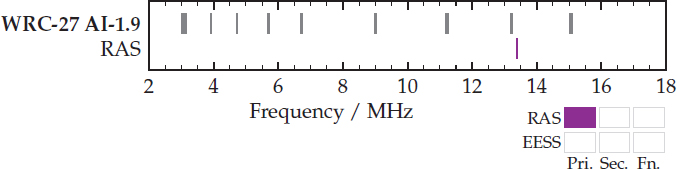
NOTE: AI, agenda item; RAS, radio astronomy service; WRC-27, 2027 World Radiocommunication Conference.
SOURCE: Data from International Telecommunication Union, “Radio Regulations,” http://handle.itu.int/11.1002/pub/8229633e-en, accessed February 10, 2025.
power level threshold in Recommendation ITU-R RA.769-2, which is −248 dB(W/(m2 Hz)) at 13.385 MHz.
Radio Astronomy Service
The RAS primary allocation at 13.36–13.41 MHz is the lowest frequency of all RAS allocations. Observations in this band are particularly important for understanding the nature of steep-spectrum radio sources, such as pulsars, a type of rapidly spinning neutron star. Observations in this band also quantify the radio emissions from the Sun, important for understanding the solar activity cycle. Jupiter is another source of very-low-frequency radio emission, and this band has also recently been used to investigate radio emission from Jupiter-like extrasolar planets. This band can also be used to track radio emission from meteor trails and in ionospheric research (e.g., tracking lightning).
RAS facilities in the United States that operate in this band include stations of the Long Wavelength Array in New Mexico and at Owens Valley Radio Observatory in California; the Low Frequency All Sky Monitor, with deployments in four U.S. locations: Port Mansfield, Texas; Socorro, New Mexico; and Green Bank, West Virginia; and the National Aeronautics and Space Administration (NASA) Goldstone Deep Space Communication Complex. Globally, facilities include, among others, the Low Frequency Array (LOFAR) with central stations in the Netherlands and outlying stations in several other European countries, the Giant Ukrainian Radio Telescope, the Ukrainian T-shaped Radio telescope, New Extension in Nançay Upgrading LOFAR (NenuFAR, France), and the Nançay Decameter Array (France).
Radio emissions from aeronautical mobile (OR) stations can be particularly challenging for RAS as they come from high altitude and can propagate long distances. Furthermore, emissions near the ionospheric cutoff can reflect off the ionosphere and ground and propagate even beyond the horizon. The ionospheric cutoff frequency depends on many factors including propagation angle, location, time of day, season, and solar cycle, but is frequently at or above the RAS-protected allocation for low-propagation angle high-frequency (HF) signal paths on the order of 3000 km in length during daytime conditions at all solar cycle points, and for nighttime conditions near solar maximum.
Ionospheric Remote Sensing
Ionosondes are a widely used fundamental ground-based remote sensing tool providing space weather information on electron density structure and dynamics in Earth’s upper atmosphere. Ground-based ionosondes transmit a swept radio signal at HF frequencies from ~0.5 to 15 MHz and sometimes higher depending on ambient conditions, receiving delayed echoes that are processed to yield electron density profiles up to the ionospheric F region, typically between 250 and 350 km in altitude. Report ITU-R RS.2456-1, Section 2.3.3, gives details of the technique, with Table 12 of that report listing globally deployed ionosonde networks. The increased use of aeronautical mobile (OR) service systems in bands up to 13.26 MHz proposed for addition to RR Appendix 26 is of concern as it would provide an additional significant interference source for ionospheric remote sensing.
Findings and Recommendations
Finding: Ground-based radio astronomy observations are difficult below 13.36 MHz owing to the nature of the ionosphere.
Recommendation: Groups performing studies under Agenda Item 1.9 should bear in mind potential interference into radio astronomy observations in the 13.36–13.41 MHz band.
Finding: For ground-based Earth observations, new transmissions below 15 MHz could cause interference to ionosonde-based active remote sensing of the ionosphere for space weather applications.
Recommendation: Groups undertaking studies under Agenda Item 1.9 should examine potential compatibility issues between anticipated new services and the ionosonde-based active remote sensing technique.
AGENDA ITEM 1.10: POWER LIMITS FOR SATELLITE SERVICES IN 71–76 AND 81–86 GHz
Agenda Item 1.10 considers “developing power flux-density and equivalent isotropically radiated power limits for inclusion in Article 21 of the Radio Regulations for the fixed-satellite, mobile-satellite and broadcasting-satellite services to protect the fixed and mobile services in the frequency bands 71-76 GHz and 81-86 GHz, in accordance with Resolution 775 (Rev.WRC-23).”
Figure 2-10 illustrates the bands under consideration in Agenda Item 1.10, along with overlapping and/or adjacent bands identified for scientific usage.
Resolution 775 (Rev. WRC-23) considers that WRC-2000 made various allocations to the 71–76 GHz (notably for space-to-Earth) and 81–86 GHz (for Earth-to-space) bands without fully developing corresponding sharing criteria owing to a lack of information on characteristics of planned services at the time. Since then, much more information on these characteristics has become available. The resolution notes that these bands are also allocated to other communication services as well as to radio astronomy. Protection of radio astronomy was addressed in WRC-12, while rules for protection of Earth exploration-satellite service (EESS, passive) receivers in adjacent bands are detailed in Resolution 750 (Rev. WRC-19). Accord-

NOTE: AI, agenda item; EESS, Earth exploration-satellite service; RAS, radio astronomy service; RR, Radio Regulation; WRC-27, 2027 World Radiocommunication Conference.
SOURCE: Data from International Telecommunication Union, “Radio Regulations,” http://handle.itu.int/11.1002/pub/8229633e-en, accessed February 10, 2025.
ingly, Resolution 775 (Rev. WRC-23) invites WRC-27 to consider new limits on power flux-density (pfd) and equivalent isotropic radiated power for fixed, mobile, and broadcast satellite services in these bands, based on studies to be conducted prior to WRC-27.
The radio astronomy service (RAS) has a primary allocation spanning from 76–77.5 GHz (directly adjacent to the lower band considered under Agenda Item 1.10), as well as a primary allocation from 79–94 GHz (both overlapping and adjacent to the second Agenda Item 1.10 band), with secondary allocations in the intervening 77.5–79 GHz. The band from 86–92 GHz is also allocated to EESS (passive) on a primary basis and subject to RR 5.340 “all emissions prohibited” protection. RR 5.149 (urging administrations to take all practicable steps to protect RAS) applies from 76–86 GHz.
In the 86–92 GHz band subject to RR 5.340 protection, Recommendation ITU-R RA.769-2 sets the threshold for detrimental interference to radio astronomy at −228 dB(W/(m2 Hz)) for continuum observations and –208 dB(W/(m2 Hz)) for spectral line observations. Recommendation ITU-R RS.2017-0 requires that interference into EESS (passive) sensors in the 86–92 GHz band be less than −169 dBW in 100 MHz with exceedances of this threshold only being tolerable for 0.01 percent of any 24-hour period (equivalent to ~8 seconds) over 2 million square kilometers of Earth.
Note that WRC-27 Agenda Item 1.18 specifically considers protection for RAS and EESS (passive) in the bands noted above (and others at higher frequencies) from transmissions in adjacent bands in the fixed-satellite, mobile-satellite, and broadcasting-satellite services.
Radio Astronomy Service
The bands under consideration in this agenda item both lie in the atmospheric spectral window from approximately 70–116 GHz, bounded at each end by strong oxygen absorption. The low atmospheric attenuation in this window, particularly at high-altitude observing sites, makes it a critical band for ground-based radio astronomy and experimental cosmology and motivates the allocations and footnote protections noted above. As described in Recommendation ITU-R RA.314-11, the neighborhood of the 81–86 GHz band under consideration in this agenda item is particularly rich in molecular lines used by radio astronomers to observe a wide range of astrophysical phenomena including star formation and astrochemistry in molecular clouds. One important example is the fundamental rotational transition observed in four different iso-
topologues of HCO+ (formylium): DCO+ at 72.039 GHz, HC18O+ at 85.162 GHz, HCO+ at 89.189 GHz, and H13CO+ at 86.754 GHz. Observation of this group of lines supports the study of isotopic fractionation in cold molecular clouds. Also noteworthy is a pair of vibrationally excited rotational transitions of the silicon monoxide molecule at 86.2 GHz and 86.8 GHz, respectively. These lines are seen in maser (microwave amplification by stimulated emission of radiation) emission in the neighborhood of asymptotic giant branch (AGB) stars, and they serve as probes of the physical conditions in the surroundings of these cool red stars. Because these lines lie near the lower bound of the 86–92 GHz primary allocation protected by RR 5.340, just above the 81–86 GHz Earth-space band under consideration in this agenda item, observations of these lines would be particularly sensitive to out-of-band sidelobe radiation from these uplink transmissions. As another example, the carbon chain molecules CnH, n = 2 .. 8 have all been observed in this band in molecular clouds and circumstellar envelopes, where their relative abundances provide clues into carbon chemistry.
Recommendation ITU-R RA.314-11 also notes that the entire band from 76–116 GHz is a preferred band for continuum observations used for imaging astrophysical objects and tracing out their spectral energy distributions.
Finally, as noted in Report ITU-R RA.2512-0, the interval from 72–118 GHz is an essential band for broadband bolometric observations of the cosmic microwave background (CMB). Extremely precise measurements of the subtle spatial anisotropy across the sky of the primary CMB and its polarization provide fundamental insights into Big Bang cosmology and the high-energy physics governing the thermodynamics of the early universe. Additionally, via weak spectral distortions of the CMB caused by its interaction with matter as it has traversed the volume of the observable universe—most importantly the Sunyaev–Zeldovich effect associated with scattering off of energetic free electrons in galaxy clusters—the formation and evolution of the large-scale structure of the universe can be traced across cosmic time. Current and planned CMB observations employ telescopes hosting thousands of cryogenic detectors that achieve the sensitivity that makes these observations feasible through a combination of wide fractional bandwidths of order 25 percent, background-limited noise performance at the world’s highest, driest observing sites, and total integration times of several years. The wide observing bands of these detectors cannot be feasibly channelized to enable RFI excision, meaning that these experiments rely critically on the opportunistic use of unallocated spectrum at the
remote, radio-quiet locations of these observatories. Although the focus of this agenda item is protection of terrestrial active-service incumbents from growing use of the 71–76 GHz and 81–86 GHz bands to support non-terrestrial networks, the impact on cosmological observations only possible through the opportunistic use of these bands from a small number of unusually high, dry, and remote geographic locations nonetheless needs to be recognized.
Earth Exploration-Satellite Service
The 86–92 GHz band, directly adjacent to the 81–86 GHz band under consideration in this agenda item, is a region where the atmosphere is relatively transparent, compared to frequencies above and below that are characterized by strong absorption by oxygen and/or water vapor. Accordingly, measurements in this band convey information on clouds and precipitation that are important not only in their own right, but for quantifying cloud and precipitation contributions to signals observed in other bands. Interference into observations in this band detracts from the value of observations in many other EESS (passive) bands. Additionally, measurements in this band provide information on sea ice and on-land snow cover. This band is in widespread use, with sensors on more than 60 past, current, or planned satellite missions observing in this spectral range.
Recommendations
Recommendation: Groups studying modifications to spaceborne services under Agenda Item 1.10 should
- Ensure that out-of-band emission (OOBE) masks for the 71–76 GHz space-to-Earth band are sufficient to protect radio astronomy observations in the adjacent 76–77.5 GHz band, which is allocated to the radio astronomy service (RAS) on a primary basis, to within the detrimental interference thresholds identified in Recommendation ITU-R RA.769-2.
- Ensure that power flux-density and equivalent isotropic radiation power limits, and OOBE masks for the 81–86 GHz Earth-to-space band are sufficient to protect passive observations in the 86–92 GHz band allocated to RAS and Earth exploration-satellite service (EESS, passive) on a primary basis, and subject to RR 5.340. Masks should be sufficient to ensure that interference into RAS and EESS (passive) observations remains
- below the detrimental interference thresholds identified in Recommendations ITU-R RA.769-2 and ITU-R RS.2017-0 for RAS and EESS (passive), respectively.
- Ensure that the cited thresholds are met including in the case of aggregate emissions from realistic levels of deployment of orbiting and ground-based transmitters.
- Ensure that actions taken are consistent with those taken under WRC-27 Agenda Item 1.18, which considers protection of RAS and EESS (passive) observations in a range of bands above 76 GHz, including those noted above.
Recommendation: Administrations should ensure that the aggregate sidelobe emissions from ground stations transmitting in the Earth-to-space direction in the 81–86 GHz band, which is shared with the radio astronomy service (RAS) and covered by RR 5.149, do not exceed the thresholds identified in Recommendation ITU-R RA.769-2 at any RAS observatory site.
The above recommendation would also help ensure protection of RAS observations in the bands adjacent to the 81–86 GHz band.
Recommendation: Administrations should note the critical importance of the opportunistic use of the 71–76 GHz band, together with the contiguous primary and secondary allocations to the radio astronomy service above 76 GHz, for deep cosmological surveys carried out from specific remote locations. They are urged to facilitate coordination of such observations with active uses of the bands.
AGENDA ITEM 1.11: SPACE-TO-SPACE TRANSMISSIONS IN 1.5–2.5 GHz
Agenda Item 1.11 considers “the technical and operational issues, and regulatory provisions, for space-to-space links among non-geostationary and geostationary satellites in the frequency bands 1 518-1 544 MHz, 1 545-1 559 MHz, 1 610-1 645.5 MHz, 1 646.5-1 660 MHz, 1 670-1 675 MHz and 2 483.5-2 500 MHz allocated to the mobile-satellite service, in accordance with Resolution 249 (Rev.WRC-23).”
Figure 2-11 shows the bands under consideration in this agenda item along with bands allocated to radio astronomy use in the same spectral region.
Resolution 249 (Rev. WRC-23) invites studies of the technical and operational characteristics of potential space-to-space transmissions between non-geostationary (non-GSO) and geostationary orbiting (GSO) satellites in these bands. The bands in question already include allocations to mobile-satellite services (MSS) for space-to-Earth communications, and this agenda item seeks to expand the directionality of these communications to include space-to-space. The resolution also invites studies of sharing and compatibility with services primarily allocated in these bands, and notes that the radio astronomy service (RAS) has primary allocations within and adjacent to the bands under consideration. These primary allocations to RAS are at 1610.6–1613.8 MHz and 1660–1670 MHz, and those bands

NOTE: AI, agenda item; RAS, radio astronomy service; WRC-27, 2027 World Radiocommunication Conference.
SOURCE: Data from International Telecommunication Union, “Radio Regulations,” http://handle.itu.int/11.1002/pub/8229633e-en, accessed February 10, 2025.
are also explicitly protected by RR 5.149, which urges administrations to take all practicable steps to protect RAS.
In addition, Resolution 249 (Rev. WRC-23) recognizes that out-of-band emission (OOBE), signals due to antenna pattern sidelobes, and in-band unintentional radiation due to Doppler shifts may impact services operating in the same and adjacent or nearby frequency bands. The resolution goes on to invite studies of the spectrum requirements, technical, and operational characteristics of potential non-GSO, low-data-rate MSS systems, and studies of sharing and compatibility between such systems and other services, with a view toward eventual regulatory actions in the bands discussed in the agenda item, to be considered at WRC-27.
Radio Astronomy Service
The primary allocations to RAS at 1610.6–1613.8 MHz and 1660–1670 MHz protect the bands around spectral lines of the molecule OH (hydroxyl), which have rest frequencies of 1612.2, 1665.4, and 1667.4 MHz. OH is an important molecule that is commonly found in the interstellar medium and stellar envelopes and was the first molecule detected in space. Emission in the spectral lines under consideration here is often observed to be amplified by masers (microwave amplification by stimulated emission of radiation)—stimulated emission that acts much like a laser except it is at much lower frequency. OH maser emission tends to be geometrically compact and narrow in frequency, providing exquisite signposts to measure precise geometries and kinematics of star formation regions and stellar outflows. OH is also detected in other galaxies, in cases of extremely dense and powerful bursts of star formation, where conditions are right for producing “megamasers” and even “gigamasers” (note that in many of these cases, the OH lines will be redshifted to lower frequencies by the expansion of the universe so that it moves outside of the RAS primary allocation).
Care needs to be taken that OOBE levels in the bands primarily allocated to RAS conform to the listed detrimental power levels in Recommendation ITU-R RA.769-2, −251 dB(W/(m2 Hz)) for continuum observations and −237 dB(W/(m2 Hz)) for spectral line observations at 1665 MHz. In addition, unwanted emission from harmonics of the 1610–1645.5 MHz, 1670–1675 MHz, and 2483.5–2500 MHz bands may lead to radio frequency interference (RFI) in the 3260–3267 MHz, 3345.8–3352.5 MHz, and 4950–5000 MHz bands respectively. The latter set of bands are listed in RR 5.149, which urges administrations to take all practicable steps to protect RAS.
The majority of major RAS facilities have sensitive receivers and routinely observe at the frequencies under consideration in this agenda item. Some examples in the United States include the Robert C. Byrd Green Bank Telescope (GBT, West Virginia), the Karl G. Jansky Very Large Array (VLA, New Mexico), the Very Long Baseline Array (an instrument with 10 discrete receiving stations spread across the United States), Owens Valley (California), the Allen Telescope Array (California), and the forthcoming next-generation Very Large Array (ngVLA, with the core array in New Mexico and stations across the United States) and Deep Synoptic Array (DSA-2000, Nevada). Globally, facilities include the MeerKAT telescope in South Africa, the Australian Square Kilometre Array (SKA) Pathfinder and Parkes 64-m in Australia, the Effelsberg radio telescope in Germany, the Five-hundred-meter Aperture Spherical Radio Telescope (FAST) in China, and future facilities such as the fully developed SKA.
Finding and Recommendations
Recommendation: Groups conducting studies of new or revised allocations in the 1610–1645.5 MHz, 1646.5–1660 MHz, and 1670–1675 MHz bands under Agenda Item 1.11 should
- Explicitly consider the impact to radio astronomy observations conducted the bands 1610.6–1613.8 MHz, which is allocated to the radio astronomy service (RAS) on a primary basis and the 1660–1670 MHz band, parts of which are allocated to RAS.
- Design thresholds for OOBE and spurious emissions to ensure that the Recommendation ITU-R RA.769-2 interference thresholds, −251 dB(W/(m2 Hz)) for continuum observations, and −237 dB(W/(m2 Hz)) for spectral line observations are not exceeded in these RAS bands.
- Consider the impacts of both out-of-band emissions and aggregate interference.
Finding: Wider bands than are primarily allocated to RAS are required to fully realize the scientific potential of radio astronomy.
Recommendation: Administrations should use local coordination—for example, through radio quiet zones—to protect radio astronomy observatories, taking into account not only terrestrial emitters but also spaceborne emitters.
AGENDA ITEM 1.12: MOBILE SATELLITE SERVICES FROM 1.4–2.025 GHz
Agenda Item 1.12 considers “[B]ased on the results of studies, possible allocations to the mobile-satellite service and possible regulatory actions in the frequency bands 1 427-1 432 MHz (space-to-Earth), 1 645.5-1 646.5 MHz (space-to-Earth) (Earth-to-space), 1 880-1 920 MHz (space-to-Earth) (Earth-to-space) and 2 010-2 025 MHz (space-to-Earth) (Earth-to-space) required for the future development of low-data-rate non-geostationary mobile-satellite systems, in accordance with Resolution 252 (WRC-23).”
Figure 2-12 illustrates the bands under consideration in this agenda item along with nearby bands identified for scientific use and/or assigned RR 5.340 “all emissions prohibited” protection.
Resolution 252 (WRC-23) discusses a need for low-data-rate mobile-satellite service (MSS) systems, and the potential for such services in bands below 5000 MHz. The resolution details various frequency band allocations in this region, including a note that that the frequency band 1400–1427 MHz is currently allocated to the

NOTE: AI, agenda item; EESS, Earth exploration-satellite service; RAS, radio astronomy service; RR, Radio Regulation; WRC-27, 2027 World Radiocommunication Conference.
SOURCE: Data from International Telecommunication Union, “Radio Regulations,” http://handle.itu.int/11.1002/pub/8229633e-en, accessed February 10, 2025.
Earth exploration-satellite service (EESS, passive), radio astronomy service (RAS), and space research service (passive) on a primary basis. Though not noted by the resolution, all emissions in this band are explicitly prohibited under RR 5.340.
Radio Astronomy Service
Neutral atomic hydrogen is the most abundant component of the neutral interstellar medium. It is detectable via its ground-state hyperfine transition at 1420.4058 MHz, observed in both emission and absorption. As the primary tracer of the density, kinetics, and temperature of the interstellar medium, this transition, colloquially known as the “21-cm line,” is one of the most important in all of astronomy. It is routinely exploited for radio astronomy carried out at observatories ranging from major national facilities to modest low-cost teaching telescopes. The fundamental importance of the 21-cm hydrogen line motivates the 1400–1427 MHz RAS primary allocation and RR 5.340 protection, intended to cover the range of Doppler shifts encountered in observations of the Milky Way Galaxy and local galactic group. (Additional RR 5.149 protection from 1330–1400 MHz covers more distant observations at moderate redshift.)
It is essential that out-of-band emissions (OOBE) into the RAS primary band protecting these observations be avoided, especially from a new active service operating in the space-to-Earth direction. The interference thresholds defined in Recommendation ITU-R RA.769-2 provide a minimum standard for setting OOBE masks and assessing compliance. One motivating application noted in Resolution 252 (WRC-23) is the small satellites described in Report ITU-R SA.2312-0. For these applications, use of an equivalent power flux-density (epfd3) methodology to account for aggregate emissions from the potentially large number of such satellites within simultaneous view of a RAS observatory may be necessary when establishing OOBE standards.
Although the potential for OOBE from the 1427–1432 MHz band into the adjacent RAS primary band is the greatest concern for radio astronomy under this agenda item, it should be noted that many major radio observatories routinely carry out opportunistic observations across the L- and S-bands, which contain the other proposed new allocations considered under this agenda item. These include continuum observations that are critical for understanding a range
___________________
3 See the footnote to the definition of epfd in Appendix C for brief explanation of the epfd concept and references to its definition in ITU documents.
of astrophysical processes that are observable through their nonthermal emission, including pulsars, fast radio bursts, and relativistic plasma jets ejected from active galactic nuclei (AGN). At present, the existing allocations that overlap with the proposed new ones are either terrestrial services or satellite services in the Earth-to-space direction, for which avoidance through geographic separation is often feasible. In contrast, the proposed new allocations in the space-to-Earth direction will add to the growing erosion of access to interference-free spectrum obtained through remote location or establishment of terrestrial radio quiet zones (RQZs). Examples of affected facilities in the United States include the Very Large Array (VLA), the Green Bank Telescope (GBT), the Allen Telescope Array, and the 10 stations of the Very Long Baseline Array, as well as future facilities such as next generation Very Large Array (ngVLA). Internationally, current facilities include the Nançay Radio Telescope (France), Jodrell Bank (United Kingdom), Multi-Element Radio Linked Interferometer Network (MERLIN, United Kingdom), the 100m Radio Telescope Effelsberg (Germany), the Westerbork Synthesis Radio Telescope (Netherlands), the stations of the European VLBI Network (EVN), Medicina Radio Observatory (Italy), the 64-m Parkes Observatory (Australia), Australia Telescope Compact Array (Australia), Australian Square Kilometre Array (SKA) Pathfinder (Australia), stations of the Australian Long Baseline Array (Australia), MeerKAT (South Africa), Five-hundred-meter Aperture Spherical Radio Telescope (FAST, China), the Russian Very Long Baseline Interferometry (VLBI) network (Russia), the RATAN-600 (Russia), ROT-54/2.6 (Armenia), and the Brazilian Decimetric Array (Brazil).
Earth Exploration-Satellite Service (Passive)
Earth observations in the 1400–1427 MHz band are currently used to provide estimates of sea-surface salinity, surface soil moisture, sea-ice thickness, vegetation water content, and land ice melt content and associated firn aquifers (melt water contained within ice sheets). Current spaceborne missions making radiometric measurements in this band include the European Space Agency’s (ESA’s) Soil Moisture Ocean Salinity (SMOS) mission and the National Aeronautics and Space Administration (NASA) Soil Moisture Active Passive (SMAP) mission. In this decade, the European Union’s Copernicus Imaging Microwave Radiometer (CIMR) will begin operational measurements in this frequency range, ensuring continuity with current measurements. Several other concepts for high-resolution
observations in this frequency range are being considered by both ESA and NASA.
The geophysical variables inferred from the observations in the protected 1400–1427 MHz band have direct applications to agriculture and food security as well as to assessing climate change impacts and detecting abrupt climate change. The retrieval of surface soil moisture and vegetation water content is widely used to assess crop status, food security and water-limitation impacts on ecosystem services. The U.S. Department of Agriculture (USDA), U.S. Forest Service, U.S. Geological Survey (USGS), Environmental Protection Agency (EPA), NASA, and National Oceanic and Atmospheric Administration (NOAA) missions in drought monitoring, food security, forest wild-fire hazards warning, flood prediction, numerical weather forecasting, and additional applications with societal impacts rely on soil moisture mapping from space.
The measurements of sea-surface salinity, sea-ice thickness, land ice melt content, and firn aquifers based on observations in the protected 1400–1427 MHz band are critical to tracking the state of the oceans, and, more importantly, to detecting and monitoring abrupt climate change. Sea-surface salinity changes lead to density variations that drive the circulation patterns in global oceans. Predicting how much of the extra heating associated with climate change is stored in the oceans is dependent on the knowledge of these circulations. Therefore, the measurements are key for global warming projections in the long term. The most imminent threat from global warming is abrupt melting of land ice that leads to sea-level rise and losses along coastlines. The observations in the protected 1400–1427 MHz band are critical to tracking the status of land ice in Greenland and Antarctica. The seasonal concentration of meltwater is tracked from season to season and under changing weather. The presence of meltwater increases heat transport into the ice masses inducing further melt. The meltwater accumulates over land below the ice mass in firn aquifer layers. The presence of melt water at the base of ice masses serves to accelerate their lateral movement and loss to the sea.
Interference into these measurements results from out-of-band emissions (OOBE), signals due to antenna pattern sidelobes, and in-band unintentional radiation due to Doppler shifts. The current SMAP and SMOS radiometers have detected wide-spread evidence for these types of interference with observations in the 1400–1427 MHz protected spectrum. The amount and type of interference is routinely documented and reported by the SMAP and SMOS missions. Investigations have revealed diverse types of interference
sources. In order to conserve the capability to deliver these important Earth system measurements, the community of spectrum users need to recognize not only the importance of the 1400–1427 MHz protected band but also the very real (as detected by SMOS and SMAP radiometers for many years) out-of-band, side-lobes and other leakage pathways of adjacent bands transmissions already documented.
In contrast with RAS uses of this band, there is no possibility to define “quiet-zones”—EESS (passive) measurements are made on a global basis. Spectrum-sharing and radio frequency interference (RFI) mitigation techniques employing radiometers with spectrally resolving digital back-ends and filters have proven to be ineffective in ensuring the integrity of the 1400–1427 MHz protected band.
The committee also notes the potential for spaceborne transmitters to contaminate views of cold space made for calibration purposes by orbiting EESS (passive) sensors. Such situations need careful study. Furthermore, the committee is concerned about the admittedly unlikely but potentially mission-ending scenario whereby transmissions from an orbiting transmitter couple directly into the calibration port of a nearby orbiting EESS (passive) sensor, overloading the passive receiver and causing permanent damage to the observatory. The potential for this scenario needs careful investigation.
Recommendation
Recommendation: Groups undertaking studies of new space-to-Earth and Earth-to-space mobile-satellite service transmissions in the 1427–1432 MHz band under Agenda Item 1.12 should ensure that
- Requirements for out-of-band emission (OOBE) masks are sufficient to ensure that the interference thresholds given in Recommendation ITU-R RA.769-2 and Recommendation ITU-R RS.2017-0, for the radio astronomy service and the Earth exploration-satellite service (EESS, passive), respectively, are not exceeded, including for the case where Earth-to-space transmissions fall within the portion of cold-space used by EESS (passive) sensors for radiometric calibration.
- These studies include consideration of aggregate emissions from multiple transmitters and consider incorporating information on interference from OOBE observed by the Soil Moisture Active Passive and Soil Moisture Ocean Salinity missions.
- Any revisions to the Radio Regulations urge administrations to ensure that the above thresholds are not exceeded in aggregate, through limitations of the number of licenses granted or by other regulatory mechanisms.
- The potential for permanent damage to EESS (passive) sensors from nearby active transmitters is assessed and any needed mitigation identified.
AGENDA ITEM 1.13: DIRECT SATELLITE TO CELLPHONE COMMUNICATIONS IN 694 MHz TO 2.7 GHz
Agenda Item 1.13 considers “studies on possible new allocations to the mobile-satellite service for direct connectivity between space stations and International Mobile Telecommunications (IMT) user equipment to complement terrestrial IMT network coverage, in accordance with Resolution 253 (WRC-23).”
Figure 2-13 details the 694–2700 MHz spectral range under consideration in this agenda item (given in the above-cited Resolution), along with bands specified in Recommendation ITU-R M.1036-7, which details frequency arrangements for IMT systems. Figure 2-13 also shows bands allocated to or identified for scientific use and/or afforded “all emissions prohibited” protection under RR 5.340 in this frequency range.
Resolution 253 (WRC-23) notes a shortfall of spectrum allocated to space-to-Earth and Earth-to-space for IMT, pointing to other ITU Radiocommunication Sector (ITU-R) documents detailing the needs
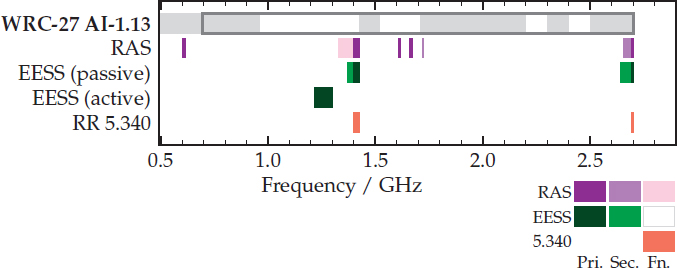
NOTE: AI, agenda item; EESS, Earth exploration-satellite service; RAS, radio astronomy service; RR, Radio Regulation; WRC-27, 2027 World Radiocommunication Conference.
SOURCE: Data from International Telecommunication Union, “Radio Regulations,” http://handle.itu.int/11.1002/pub/8229633e-en, accessed February 10, 2025.
of such systems along with those providing details and protection criteria for other services, including the radio astronomy service (RAS), operating in the relevant bands. The resolution then invites studies of possible new allocations to the mobile-satellite service (MSS) in the frequency range between 694/698 MHz and 2700 MHz as well as studies on the spectrum requirements and technical, operational, and regulatory matters related to the implementation of direct satellite-to-cellphone services. The resolution further invites studies on sharing and compatibility between incumbent services, ensuring their protection under the RR, and studies on measures needed to ensure that new MSS operations do not cause harmful interference to (or claim protection from) stations in the mobile service.
As the frequency range considered under the agenda item is particularly broad, so are the range of allocations to both RAS and the Earth exploration-satellite service (EESS), both active and passive. Resolution 253 (WRC-23) itself notes that Recommendation ITU-R RA.769-2 contains the threshold interference levels for bands allocated to RAS on a primary basis, and that Recommendation ITU-R RA.1513-2 provides the associated acceptable percentage-of-time-lost criteria. Primary allocations to RAS in this range of frequencies are 1400–1427 MHz, 1668.4–1670 MHz, and 2690–2700 MHz, with a secondary allocation in the 2655–2690 MHz band. Of these, 1400–1427 MHz and 2690–2700 MHz are subject to RR 5.340 (“all emissions prohibited”). In addition, the following ranges are listed in RR 5.149: 1330–1400 MHz, 1610.6–1613.8 MHz, and 1718.8–1722.2 MHz, where administrations are urged to take “all practicable steps to protect the radio astronomy service from harmful interference.”
For Earth remote sensing, primary allocations to EESS (passive) in the region under consideration include the RR 5.340 bands at 1400–1427 MHz and 2690–2700 MHz. These bands are flanked by secondary allocations from 1370–1400 MHz and 2640–2690 MHz (the 1370–1400 MHz band and 2640–2655 MHz sub-band secondary allocations detailed in RR 5.339). EESS (active) has a primary allocation from 1215–1300 MHz.
Radio Astronomy Service
This agenda item, opening a swath of spectrum for potential new allocations to strong space-to-Earth transmissions, presents a serious risk to a broad range of radio astronomy science across the spectrum from 694–2700 MHz. The following discussion summa-
rizes some of the numerous important RAS applications using the spectrum in this range.
The 1420 MHz line of atomic hydrogen is particularly important in RAS. Measurements of emission from the 1420 MHz line of atomic hydrogen in galaxies provide a wealth of information. In our own galaxy, observations of this line were used, along with the physics of the Doppler shift, to make the first maps of the Milky Way’s spiral structure. When observed in distant galaxies in the expanding universe, redshift caused by that expansion moves the line to lower frequencies. Ultimately, at great cosmological distance, the technique of “line intensity mapping” is used to map the aggregate emission from unresolved hydrogen-rich molecular clouds to trace the distribution of matter across the universe. For example, the Canadian Hydrogen Intensity Mapping Experiment (CHIME) observes the entire band from 400–800 MHz to map hydrogen emission at redshifts from z = 2.5 to z = 0.8. Upcoming major observatories that will similarly observe hydrogen at cosmological distances include the Square Kilometre Array (SKA) and SKA precursor facilities internationally, and the next generation Very Large Array (ngVLA) and the California Institute of Technology’s Deep Synoptic Array (DSA-2000) in the United States.
In addition, the band surrounding the 1420 MHz hydrogen line is a particular focus of SETI (Search for Extra-Terrestrial Intelligence) surveys, since it is hypothesized that any extra-terrestrial intelligence would expect other intelligences to be observing in this band. SETI also scans across the complete 1–10 GHz band, of which the region under consideration in Agenda Item 1.13 is a significant fraction.
Maser (microwave amplification by stimulated emission of radiation) emission can be generated from the 1612 MHz and 1667 MHz lines of the molecule OH (hydroxyl). Observations of this emission, often redshifted by the expanding universe to lower frequencies, are used to measure the masses of supermassive black holes at the centers of galaxies (including our own), and to provide highly accurate distances to external galaxies. These measurements have been crucial for quantifying the rate of expansion of the local universe. Those same OH lines, and additional ones at 1665 and 1720 MHz, can be used to measure magnetic field strengths in the Milky Way Galaxy. Among other things, these magnetic fields have important consequences for the formation of stars from clouds of gas.
Pulsars (rapidly rotating neutron stars) emit most strongly in the range 50–2000 MHz. Pulsars provide a laboratory for physics at extreme densities and magnetic fields and are also used as
extremely accurate clocks by projects like the North American Nanohertz Observatory for Gravitational Waves (NANOgrav) to measure the gravitational wave background of the universe.
In addition, geodetic measurements use observations of very distant bright radio sources (quasars) from a global network of radio observatories. These observations are important for the continued functionality of global navigation satellite systems (GNSS), monitoring of global changes such as sea-level rise, and other applications. In particular, the VLBI Global Observing System (VGOS) performs these observations at a wide range of frequencies from 2–14 GHz. (See Agenda Item 1.7 for more on this economically important use case.)
The core radio astronomy concern is protection of the bands allocated to RAS on a primary basis (particularly the two afforded RR 5.340 “all emissions prohibited” protection), as well as the bands having a secondary allocation to RAS, and those protected under RR 5.149. In addition to ensuring protection against any in-band emission, the committee notes that out-of-band emissions (OOBE) and spurious emissions, including harmonics, into both 1400–1427 MHz and 2690–2700 MHz are a major concern. The committee also notes the need to protect broader frequency ranges, enabling sensitive continuum observations and measurements of redshifted spectral lines outside of allocated bands in nationally or internationally recognized RQZs.
RQZs are defined in Report ITU-R RA.2259-1 as “any recognized geographic area within which the usual spectrum management procedures are modified for the specific purpose of reducing or avoiding interference to radio telescopes, thereby maintaining the required standards for quality and availability of observational data.” In the United States, the National Radio Quiet Zone (NRQZ) is a rectangular area of land approximately 13,000 square miles (or equivalent of about 34,000 square kilometers) in area across parts of Virginia and West Virginia. It contains the Green Bank Observatory, a RAS facility that hosts several large RAS telescopes, including the 110 m × 100 m Robert C. Byrd Green Bank Telescope (GBT), and it is frequently used for development of new facilities that benefit from testing in a radio quiet environment. The area is also home to facilities associated with national security interests that benefit from the interference-free environment. The GBT’s S-band receiver is sensitive to emissions across 1.73–2.60 GHz, and the new Ultra-Wide Band Receiver (UWBR) is sensitive across 0.7–4 GHz. UWBR was developed to take advantage of the NRQZ quiet environment and open a wide bandwidth useful for high-precision pulsar timing, where
the wide bandwidth enables precise measurement and correction of interstellar medium effects. UWBR is also useful for observations of broadband transient sources (such as fast radio bursts) and regions that are rich in molecular lines over frequencies of 0.7–4 GHz. A permanent 2.30–2.36 GHz notch filter is already installed to block known sources of human-generated emissions. Additional bright emissions from satellites would impact the operation of this and other receivers designed to benefit from the NRQZ low-emissions environment at all frequencies, and even very-narrow-band space-Earth emissions can impact large swaths of frequency if they are at a significant power level.
The critical scientific research undertaken by RAS observers cannot be performed without access to interference-free spectral bands and protected, remote geographic locations such as RQZs (including the U.S. NRQZ and other locations around the world). Notably, the emissions that radio astronomers receive are extremely weak—a radio telescope receives less than 1 percent of one-billionth of one-billionth of a watt (10−20 W) from a typical cosmic object. Because radio astronomy receivers are designed to pick up such remarkably weak signals, radio observatories are particularly vulnerable to interference from in-band emissions, spurious emissions, and OOBE from licensed and unlicensed users of neighboring bands, and emissions that produce harmonic signals in the RAS bands, even if those human-made emissions are weak and distant. A comparison of the NRQZ environment to typical emission strengths of satellite services, and of the proposed direct-to-cell emissions, is shown in Figure 2-14. As is clear from the figure, the power levels at Earth’s surface resulting from direct satellite-to-cell transmissions (taken from estimates provided by potential direct-to-cell service providers, see caption) are some 30–50 dB higher than levels from existing spaceborne services given in RR Table 21-4, which are already some 20–40 dB above the least restrictive of the interference thresholds established for RAS observations under Recommendation ITU-R RA-769-2. Given this disparity, additional steps will clearly need to be taken to ensure protection of RAS from these potential new spaceborne transmissions.
Ensuring continued protection of RAS observations in RQZs demands sustained work by RAS facility operators, acting in close partnership with local authorities and local infrastructure, including electrical utility providers, and with local business entities requiring or providing radio communication services in the area. These ongoing activities represent decades of effort and substantial economic expenditure. The payoff for this investment is interference-
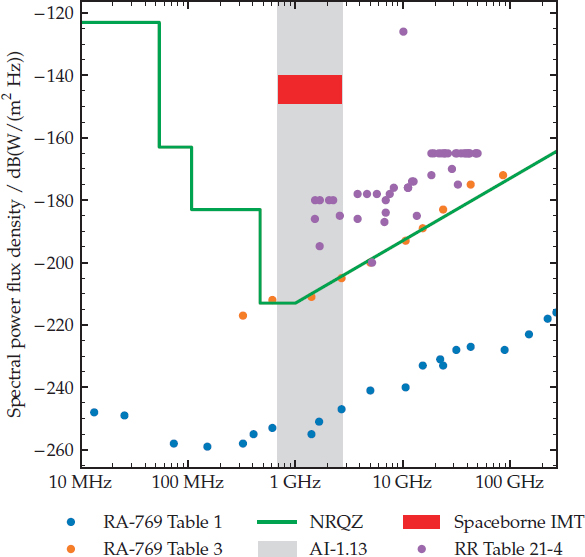
NOTE: EESS, Earth exploration-satellite service; RR, Radio Regulation.
SOURCE: Figure adapted from National Radio Astronomy Observatory (NRAO), 2024, “Comments on Single Network Future: Supplemental Coverage from Space,” FCC GN Docket No. 23-65, https://www.fcc.gov/ecfs/search/search-filings/filing/1052542577868; data for direct-to-cell surface PFD estimates from SpaceX, 2023, “Response to Technical Questions in GN Docket No. 23-135,” ICFS File No. SAT-MOD-20230207-00021, https://www.scribd.com/document/785956319/0cb9c344-f219-4b75-809b-d92a3e7451e7; data for NRQZ PFD requirements from NRAO, n.d., “National Radio Quiet Zone,” https://science.nrao.edu/facilities/gbt/interference-protection/nrqz, accessed October 13, 2024.
free access to regions of the radio spectrum not accessible from other locations, including spectral regions not afforded protection through primary or secondary allocations, or through footnotes in the RR. This access has led to the discoveries outlined above, and many more can confidently be expected if such protections continue. However, unless properly managed, the new direct satellite-to-cellphone capability under consideration in this agenda item has the potential to completely undermine all the work to date that ensures this unique capability.
Thankfully, the potential exists for ensuring meaningful coexistence between the new services under consideration and RAS facilities. Direct communications between satellites and IMT handsets requires highly directional beams that need to be synthesized through in-orbit phased-array antenna systems. Just as these systems can direct “beams” of strong antenna gain to specific locations, they can be configured to specifically direct “beam nulls” to selected locations, including RAS facilities located in RQZs and elsewhere. The committee urges studies under Agenda Item 1.13 that specifically address this capability. Evaluation of whether this approach—in isolation or combined with other approaches—ensures that the thresholds identified in Recommendation ITU-R RA.769-2 are not exceeded is paramount. Pending results of this investigation, further studies need to evaluate routes to implementation of this approach. Such implementation would necessarily involve sustained coordination between spaceborne IMT service providers and RAS facilities (including those both within RQZs and elsewhere).
The committee recognizes that a goal of this agenda item is to ensure access to IMT communications in underserved areas and acknowledges that some RAS facilities are themselves located in such areas. The provision of emergency communications in such areas is an important public safety need. Measures to serve that need in the vicinity of a RAS facility could include provision of satellite services with minimized spectral occupancy or installation of coordinated terrestrial infrastructure in IMT bands selected to minimize interference with RAS observations. Such measures would involve close technical coordination between the IMT provider and the RAS facility.
Earth Exploration-Satellite Service
As noted in the discussion of Agenda Item 1.12, the 1400–1427 MHz band is extensively used in Earth remote sensing, providing information on sea-surface salinity, soil moisture, sea-ice thick-
ness, vegetation water content, and land ice melt content. Missions currently observing in this band include the European Space Agency’s Soil Moisture Ocean Salinity (SMOS) satellite and the National Aeronautics and Space Administration’s (NASA’s) Soil Moisture Active Passive (SMAP) observatory. The European Union’s next-generation Copernicus Imaging Microwave Radiometer (CIMR) will provide continuity with current measurements in this band, and concepts for high-resolution observations in this frequency range are under consideration.
The measurements made in these bands directly benefit societal needs including agriculture and food security, in addition to supporting research into climate change. Oceanic measurements in this band are central to understanding the role played by the ocean system in climate change, while measurements of ice sheets provide unique information on the formation and roles of glacial meltwater. The provision of direct satellite-to-cell communications has the potential to increase cases where spaceborne transmissions reflect off Earth’s surface and are observed by EESS (passive) sensors, corrupting critical observations. In contrast with transmissions from satellites in geostationary orbit (GSO), the cases resulting from new allocations under Agenda Item 1.13 will involve far more variable transmitter-surface-observer geometries, further complicating the task of identifying and excising cases of radio frequency interference (RFI).
The band 2690–2700 MHz is allocated to EESS (passive) on a primary basis, and this allocation is flanked by secondary allocations from 2640–2690 MHz (including per RR 5.339). Although the committee is unaware of any current or planned use of this band by orbiting sensors, future technology advances, changes to RFI in the preferred 1400–1427 MHz band, and/or possible changing science objectives could make this band important for future missions. Accordingly, continued protection of EESS (passive) in this band is needed.
Finding and Recommendations
The committee views Agenda Item 1.13 to be particularly and immediately consequential and urges the adoption of recommendations in this section.
Finding: Active beam synthesis (e.g., adaptive nulling) is a key enabling technology for IMT base stations in orbit.
Recommendation: Groups undertaking compatibility studies under Agenda Item 1.13 should evaluate the ability of active beam synthesis to be leveraged to ensure continuous avoidance and nulling of transmissions toward specific locations, including, but not limited to, radio astronomy service facilities within radio quiet zones and beyond. Such studies should also follow the methodology outlined in Recommendation ITU-R RA.769-2 when identifying thresholds for the degree of antenna gain minimization in the direction of the avoidance location, as well as for out-of-band emissions and spurious emissions.
Recommendation: Administrations should require coordination agreements between spaceborne International Mobile Telecommunications (IMT) operators and radio astronomy service (RAS) facilities. In addition to formalizing arrangements for steering of beam nulls, discussed above, these agreements should include (potentially time-dependent) coordination of spectral occupancy, aimed at providing an agreed minimum level of IMT network access in the neighborhood of key RAS facilities while retaining as much scientific capability as feasible.
Recommendation: Groups considering new allocations under Agenda Item 1.13 should
- Not adopt new allocations to the mobile-satellite service (MSS) in the 1427–1518 MHz International Mobile Telecommunications band identified in Recommendation ITU-R M.1036-7, given the adjacency to the 1400–1427 MHz band that is a cornerstone for both radio astronomy and Earth remote sensing observations, and that is afforded RR 5.340 “all emissions prohibited” protection.
- Not adopt new allocations to MSS in the 2640–2700 GHz bands allocated to the radio astronomy service and/or Earth exploration-satellite service (passive).
AGENDA ITEM 1.14: MOBILE SATELLITE SERVICE IN 2.0–2.2 GHz
Agenda Item 1.14 considers: “possible additional allocations to the mobile-satellite service, in accordance with Resolution 254 (WRC-23).”
The committee has no views on this agenda item.
AGENDA ITEM 1.15: COMMUNICATIONS IN THE LUNAR ENVIRONMENT
Agenda Item 1.15 considers “studies on frequency-related matters, including possible new or modified space research service (space-to-space) allocations, for future development of communications on the lunar surface and between lunar orbit and the lunar surface, in accordance with Resolution 680 (WRC-23).”
Figure 2-15 details the bands under consideration in Agenda Item 1.15, along with bands allocated to, or identified for, the scientific services in the same region.
Resolution 680 (WRC-23) invites studies of the spectrum needs of systems that would be used for communications on the lunar surface. Such systems would be operating as part of the space research service (SRS). Specific bands identified for attention in the resolution are 390–406.1 MHz, 420–430 MHz, and 440–450 MHz, which would all be limited to operations outside the shielded zone of the Moon (SZM), and 2400–2690 MHz, 3500–3800 MHz, 5150–5570 MHz, 5570–5725 MHz, 5575–5925 MHz, 7190–7235 MHz, 8450–8500 MHz, and 25.25–28.35 GHz. The resolution also invites studies of the technical
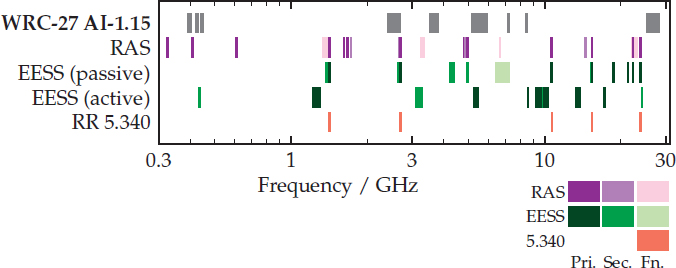
NOTE: AI, agenda item; EESS, Earth exploration-satellite service; RAS, radio astronomy service; RR, Radio Regulation; WRC-27, 2027 World Radiocommunication Conference.
SOURCE: Data from International Telecommunication Union, “Radio Regulations,” http://handle.itu.int/11.1002/pub/8229633e-en, accessed February 10, 2025.
and operating characteristics of these systems, the criteria needed to protect radio astronomy sensors on the lunar surface or in lunar orbit, and the propagation characteristics of systems operating in lunar orbit or in the lunar surface environment in the bands listed. The resolution further invites studies to ensure protection of radio astronomy facilities operating on Earth and in the SZM in the listed bands and adjacent bands. The resolution then invites the 2027 World Radiocommunication Conference (WRC-27) to consider new allocations to SRS in the listed bands or some portion thereof in the vicinity of the Moon based on the results of these studies.
Radio Astronomy Service
Radio astronomy observations comprise both measurement of spectral line intensities, which arise from quantum mechanical transitions of atoms and molecules, and of continuum emission, which arises from a variety of processes, including thermal and synchrotron radiation.
A significant fraction of the radio spectrum is inaccessible from Earth to radio astronomers due to (1) the intensive use of the radio spectrum for non-astronomical purposes; (2) absorption at a number of atmospheric spectral lines—for example, molecular oxygen (O2), water (H2O), and others—above ~20 GHz; and (3) reflection of radio waves from the ionosphere, below ~20 MHz (the actual cut-off frequency is a function of a large number of variables—for example, day/night, seasonal variations, etc.
Spectral lines occur at frequencies dictated by nature, but they may be observed at very high redshifts within our own galaxy or in external galaxies. For example, one of the most prominent emission lines is the one that arises due to the spin flip of neutral hydrogen at a rest frequency of 1420.4058 MHz. Because hydrogen is ubiquitous in the universe, observations of this emission line provide the opportunity to probe the structure of the universe from the present day to the very distant past. Due to the expansion of the universe, more distant cosmic radiation is redshifted relative to its rest-frame emission frequency (the redshift, z, is calculated as (femit − fobs)/fobs). Thus, scientific observations of the neutral hydrogen line range from observations close to its rest frequency to below 65 MHz.
The spectral lines of greatest interest to radio astronomy at frequencies below 275 GHz are listed in Table 1 of Recommendation ITU-R RA.314-11. The same table lists suggested minimum bandwidths that, in most cases, correspond to the widths of these lines, Doppler shifted within our own galaxy. Not even these minimum
bandwidths are, however, allocated or protected for radio astronomy uses on Earth in every case. Furthermore, just as for the neutral hydrogen line, many of the other lines of great astrophysical interest can be observed at far higher redshifts in external galaxies.
Table 3 of Recommendation ITU-R RA.314-11 lists the frequency bands allocated to the radio astronomy service (RAS) on Earth for continuum observations. In many cases, particularly for bands under 70 GHz, the allocations are much narrower than would be desirable to observe all but the strongest cosmic radio sources.
Scientific drivers to build radio telescopes on the Moon therefore include the possibility to observe cosmic sources in spectral regions that are not accessible from Earth, either due to atmospheric absorption or due to human-made transmissions that overwhelm the extremely faint natural emissions of cosmic sources. The SZM, an area somewhat less than half of the lunar surface, is a zone in which passive observations remain unhindered by interference because this part of the Moon’s surface is always facing away from Earth and is therefore shielded from Earth-based radio signals, as well as from signals from satellites in Earth orbit.
Articles 22.22–22.25 of the RR spell out the protections afforded to RAS and to the Earth exploration-satellite service (EESS, active and passive) in the SZM, as well as to the space research service, the radiolocation service (RLS) using spaceborne platforms, and space operation services, that are required for the support of space research, radio astronomy observations, as well as for radiocommunications and space research transmissions within the lunar-shielded zone.
Recommendation ITU-R RA.479-5 provides guidance on the protection of frequencies for radioastronomical measurements in the SZM. Annex 1 of the recommendation includes an extensive discussion of the astronomical uses of frequency bands from 30 kHz to 1 THz. Annex 2 addresses frequency bands to be used for radiocommunications in the lunar environment proposed by the Commissions of Radio Astronomy and the Protection of Astronomical Sites of the International Astronomical Union. As noted in the recommendation, all frequencies below 2 GHz in the SZM should be accessible to radio astronomy, and frequency bands above this range should consider both spectral line and continuum observations.
Agenda Item 1.15 is of paramount importance to radio astronomy, as the SZM provides a unique resource that allows observation of the entire radio spectrum. The committee believes that, in order to realize its full potential for radio astronomy observations and research, the lunar environment, and particularly the environment
of the SZM, needs to be developed with the utmost care. As a general principle, the committee notes that frequency allocations on the Moon need not necessarily match terrestrial allocations. In the specific case of the SZM, the bands used for communications need to be allocated by considering the requirements of RAS first and foremost. The most heavily used bands by the active services on Earth may be those of most interest to RAS, as they are inaccessible on Earth for radio astronomy observations.
Resolution 680 (WRC-23) lists the bands that are being studied for data transmission on the lunar surface and between the lunar surface and satellites in lunar orbit. The committee believes that the bands 390–406.1 MHz, 420–430 MHz, and 440–450 MHz, extensively used in point-to-point terrestrial radio communications, may be appropriate to use for lunar communications limited to outside the SZM and supports their study for that purpose.
Annex 1 to Recommendation ITU-R RA.479-5 details some of the radio astronomy observations expected to be carried out in various frequency ranges. In the 3–20 GHz range, the most important lines in astrophysics that have been observed until the present are the methylidyne (CH) lines at 3.2638 GHz, 3.3355 GHz and 3.3492 GHz; the formaldehyde (H2CO) lines at 4.8297 GHz and 14.488 GHz; the methanol (CH3OH) lines at 6.7 and 12.2 GHz; and the ciclopropenyledine (C3H2) line at 18.3 GHz. None of these lines fall within the 2400–2690 GHz, 3500–3800 MHz, 5150–5570 MHz, 5570–5725 MHz, 7190–7235 MHz, and 8450–8500 MHz bands that are proposed to be studied for lunar communication purposes, and therefore the committee supports study of those bands for lunar communications. The committee notes that the band 2400–2690 MHz is adjacent to the 2690–2700 MHz passive band and that lunar communications applications need to take care to avoid exceeding the harmful interference levels to radio astronomy in the 2690–2700 MHz radio astronomy band, so that comparisons with terrestrial observations made in this band can be carried out. Furthermore, the committee believes that any lunar communication system needs to be developed with sufficient built-in redundancy, so that if phenomena of interest to radio astronomers (e.g., a yet unknown spectral line) are discovered in a band used for communication purposes, the system may operate using an alternative frequency band.
Resolution 680 (WRC-23) also proposes to study the 25.25–28.35 GHz band for lunar communications. The committee supports study of this band for such purposes. Wide-band communication channels will be needed to relay and process data that may be
generated by data-intensive observations—for example, Very Long Baseline Interferometry (VLBI) observations on the SZM.
The committee notes that it is highly likely that even the 25.25–28.35 GHz band will provide insufficient bandwidth for data transmission from the SZM. The committee also notes that, wherever practicable, optical wavelengths be used for communications, either by fiber or by free space links. In fact, the use of optical technology needs to be explored before making use of the radio spectrum for communications in the SZM, whenever possible. Besides the obvious advantage that it relieves pressure on the radio spectrum, tight-beam optical communications provide additional benefits over radio communications including that
- Multiple reuse of the spectrum is easy,
- More communication bandwidth is available on optical links, and
- Optical links may be more energy efficient than radio.
The committee supports the studies listed in Resolves 2–5 of Resolution 680 (WRC-23). With regard to the protection criteria to be applied for the protection of RAS on the Moon, particularly in the SZM, the committee notes that, while the methodology for calculating the detrimental interference levels for radio astronomy on the Moon needs to remain identical to those in Recommendation ITU-R RA.769-2, the detrimental levels may be much more restrictive for the following reasons:
- The bandwidths employed in calculating the detrimental levels may be much wider, since within the SZM the entire radio spectrum is reserved for RAS.
- Although some observations may use shorter integration times, much longer integration times should also be possible in the SZM than the typical 2000 second integration times used in Recommendation ITU-R RA.769-2.
- Because of the lack of atmosphere, which adds significantly to the system noise of many terrestrial radio astronomy bands, the system noise of receiver systems may sometimes be significantly lower than in systems on Earth. Furthermore, the ground temperature is lower than on Earth during lunar nighttime, so any spillover radiation into antennas may be less.
The protection criteria developed for RAS on the lunar surface need to be taken into account in studies between RAS and active lunar communication services.
The committee strongly supports beginning research on spectrum that may be needed in the future for communications between Earth, lunar-orbiting spacecraft, and the lunar surface, and whether future radiocommunications in the vicinity of the Moon can be accommodated within existing space radiocommunications services. The committee believes that the regulatory provisions of the RR are likely to be insufficient for lunar communications, as the electromagnetic environment is expected to be very different from the terrestrial environment. The committee believes also that such studies need to be carried out while keeping in mind the protections for radio astronomy in Section V of Article 22 of the RR (as per noting a of Resolution 680, WRC-23) and the contents of Recommendation ITU-R RA.479-5 (as per noting b). In particular, it is important that these studies not be limited to the frequency bands that may be used for communications between Earth, lunar orbiting spacecraft, and the lunar surface, but include the study of compatibility between radio astronomy and communication systems, paying attention to possible interference to Moon-based radio astronomy systems by out-of-band emissions and spurious emissions, including harmonics, possibly up to the third or fourth harmonic, on a case-by-case basis.
Finding and Recommendations
Recommendation: In regard to Agenda Item 1.15, administrations should develop lunar communications systems with sufficient redundancy to be able to retune to avoid specific bands should those bands prove to contain phenomena of interest to radio astronomy.
Finding: The use of communications in optical wavelengths would enable relaying of the extremely high rates of data that observations in the SZM are likely to produce.
Recommendation: Wherever practicable, administrations should preferentially use optical wavelengths for communications to, from, and within the lunar environment.
Recommendation: Groups undertaking studies of communications in the lunar environment under Agenda Item 1.15 should
- Pay particular attention to the potential for interference into the 2690–2700 MHz radio astronomy band to permit comparisons with terrestrial observations made in this band.
- Follow the methodology described in Recommendation ITU-R RA.769-2 when quantifying harmful levels of interference into radio astronomy observations in the lunar environment. The thresholds that result from this methodology may be more restrictive than those for terrestrial radio astronomy due to the wider bandwidths, longer integration times, and the differences in the operating environment that are possible in the shielded zone of the Moon.
- Take into account the protections afforded to the radio astronomy service (RAS) in Section V of Article 22 of the Radio Regulations.
- Focus in particular on impacts of out-of-band emissions and spurious emissions on RAS observations.
AGENDA ITEM 1.16: PROTECTION OF RADIO QUIET ZONES
Agenda Item 1.16 considers “studies on the technical and regulatory provisions necessary to protect radio astronomy operating in specific Radio Quiet Zones (RQZs) and, in frequency bands allocated to the radio astronomy service on a primary basis globally, from aggregate radio-frequency interference caused by non-geostationary-satellite orbit systems, in accordance with Resolution 681 (WRC-23).”
Resolution 681 (WRC-23) invites studies of both single-transmitter and aggregate interference from non-geostationary orbit (non-GSO) satellite transmissions into radio astronomy observations in specific bands having a primary allocation to radio astronomy in the range between 10.6 and 134 GHz. These radio astronomy bands, along with the adjacent bands allocated or otherwise identified for active space service use, are illustrated in Figure 2-16 and listed in Table 2-4. The resolution further calls for studies of the potential recognition of two potential new radio quiet zones (RQZs),
- The Square Kilometre Array Observatory (SKAO) in South Africa and
- The Atacama Large Millimeter/submillimeter Array (ALMA) in Chile.
These studies would be based on the characteristics of these facilities and on the results of prior studies. The studies would include consideration of aggregate interference from single and multiple non-GSO systems as well as examination of methods used to compute necessary separation distances between gateways of non-GSO systems operating in bands adjacent or near to radio astronomy service (RAS) allocations and RAS facilities within RQZs.
In Table 2-4, all bands in the first column are allocated to RAS on a primary basis. The sub-band 10.68–10.7 GHz and the bands 100–102 GHz and 114.25–116 GHz are passive bands to which the footnote RR 5.340 (“all emissions are prohibited”) applies, while the other primary bands are covered by RR 5.149, which urges administrations to take all practicable steps to protect radio astronomy observations from harmful interference and states that emissions from spaceborne or airborne stations can be particularly serious sources of interference to radio astronomy. In addition, RR 5.551H and RR 5.551I limit
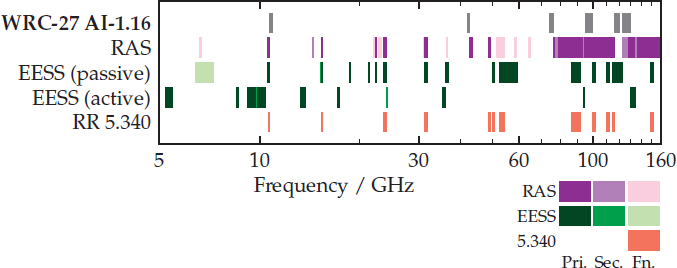
NOTE: AI, agenda item; EESS, Earth exploration-satellite service; RAS, radio astronomy service; RR, Radio Regulation; WRC-27, 2027 World Radiocommunication Conference.
SOURCE: Data from International Telecommunication Union, “Radio Regulations,” http://handle.itu.int/11.1002/pub/8229633e-en, accessed February 10, 2025.
the equivalent power flux-density (epfd4) that stations in a non-GSO satellite system operating in the 42.0–42.5 GHz band, or a GSO station operating in the same band, respectively, may radiate into the 42.5–43.5 GHz band, with certain exceptions.
Footnote RR 5.562A warns of potential damage that cloud profiling radars may cause to radio astronomy receivers and urges coordination between the operators of such radars and of radio astronomy stations.
Radio Astronomy Service
Traditionally, RAS facilities (such as those listed in Table 2-5) have been situated in remote locations, far from major population centers to mitigate the impact of radio frequency interference (RFI). With the rise of large non-GSO satellite constellations, the satellite-borne transmission in bands adjacent and/or near to the bands allo-
___________________
4 See the footnote to the definition of epfd in Appendix C for brief explanation of the epfd concept and references to its definition in International Telecommunication Union documents.
TABLE 2-4 Frequency Bands Allocated to the Radio Astronomy Service (RAS) to Be Studied Under Agenda Item 1.16 and the Corresponding Active Services to Be Included in Those Studies
| Active Space Service | Detrimental Interference spfd Threshold | ||||
|---|---|---|---|---|---|
| RAS Frequency Band | Operating in Adjacent or Nearby Frequency Band Space-to-Earth | Scope | RAS Continuum Observationa (dB(W/(m2 Hz))) | RAS Spectral Line Observationb (dB(W/(m2 Hz))) | |
| 10.6–10.7 GHz | 10.7–10.95 GHz | FSS | Resolves etc. 1 and 2 | −240 | −225 |
| 42.5–43.5 GHz | 42–42.5 GHz | FSS | Resolves etc. 2 | −227 | −210 |
| 76–77.5 GHz | 74–76 GHz | FSS, MSS | Resolves etc. 2 | −228 | −208 |
| 94.1–95 GHz | 95–100 GHz | RNSS, MSS | Resolves etc. 2 | −228 | −207 |
| 100–102 GHz | 95–100 GHz | RNSS, MSS | Resolves etc. 1 and 2 | −227 | −207 |
| 114.25–116 GHz | 116–119.98 GHz | ISS | Resolves etc. 1 and 2 | −226 | −206 |
| 130–134 GHz | 123–130 GHz | FSS, MSS, RNSS | Resolves etc. 2 | −225 | −205 |
a Table 1 ITU-R RA.769-2.
b Table 2 ITU-R RA.769-2.
NOTE: Acronyms are defined in Appendix C.
SOURCE: Data from International Telecommunication Union (ITU), 2023, “Resolution 681 (WRC-23),” https://www.itu.int/dms_pub/itu-r/oth/0c/0a/R0C0A0000100016PDFE.pdf, and ITU, 2003, “Recommendation ITU-R RA.769-2,” https://www.itu.int/dms_pubrec/itu-r/rec/ra/RREC-RA.769-2-200305-I!!PDF-E.pdf.
cated to RAS invalidates the current protection framework since, by design, no location is too remote for global satellite networks. Resolution 681 (WRC-23) recognizes that existing approaches and procedures do not provide adequate protection for RAS from unwanted emissions of non-GSO satellite systems. Many major RAS facilities, including the SKA and ALMA observatories, are equipped with receivers that cover the allocated RAS bands within their observing range, as well as bands allocated to active services, including satellite services, operating nearby and adjacent to the allocated RAS bands (see Table 2-5). These facilities comprise both single-dish telescopes and interferometer arrays that conduct a wide range of fundamental astronomical investigations with high spatial, spectral, and temporal resolutions.
The Square Kilometre Array Observatory (in South Africa)
The SKA will consist of two telescopes, one covering 50–350 MHz, to be built in Australia (SKA-low) and the other covering approximately 8.3–24 GHz (see Table 2-5), built in South Africa (SKA-mid). Only the second of these telescopes observes in spectral bands under consideration in Agenda Item 1.16.
Science objectives of the SKA telescope include making surveys that cover large areas of the radio sky from the southern hemisphere, mapping the cosmos with the goal of discovering new classes of astronomical objects. Viewing a wide area of sky enables the SKA to more effectively capture transient events that can easily be missed by an instrument with a smaller field of view. The SKA’s extreme sensitivity will enable detection of fainter transients than has been possible in the past, helping to understand the phenomena and astrophysical mechanisms that produce them. Known classes of transient events range in time scales from less than a nanosecond (one billionth of a second) to several years, which is still a short period of time in the cosmological context. One of the fastest-developing areas of transient science, so far unique to radio astronomy, is the search for millisecond bursts of radio waves, called fast radio bursts (FRBs). FRBs have only been detected at radio wavelengths so far, and their origin is unknown. The SKA telescopes will use wide area sky surveys to discover these mysterious bursts, detecting more and fainter bursts than previously possible. An interference-free environment is essential for these observations of very high sensitivity and time resolution.
Another SKA goal is observing planets emerging from discs of dust and gas swirling around young stars. Astronomers believe that,
TABLE 2-5 A Selection of Receiver Bands Equipped on Current and Proposed Radio Astronomy Service (RAS) Facilities That Cover the Frequency Bands Relevant to Agenda Item 1.16
| RAS Facility | Location | Receiver Bands |
|---|---|---|
| Green Bank Telescope (GBT) | Green Bank, West Virginia, United States | X (7.8-12 GHz) Q (39.2–50.5 GHz) W (67–93 GHz) Argus (74–116.0 GHz) Mustang (80–100 GHz) |
| Effelsberg 100-m Radio Telescope | Bad Münstereifel, Germany | S28mm (10.3–10.6 GHz) S7mm (33.5–50 GHz) P3mm (84–95.5 GHz) |
| Nobeyama 45-m Telescope | Minamimaki, Nagona, Japan | 1–150 GHz |
| Very Large Array (VLA) | Socorro, New Mexico, United States | X (8–12 GHz) Q (40–50 GHz) |
| Atacama Large Millimeter/submillimeter Array (ALMA) | Atacama Desert, Chile | Band 1 (35–50 GHz) Band 2 (67–116 GHz) Band 3 (84–116 GHz) Band 4 (125–163 GHz) |
| Arizona Radio Observatory (ARO) 12-m Telescope | Kitt Peak, Arizona, United States | 4 mm (66–90 GHz) 3 mm (84–116 GHz) 2 mm (129–180 GHz) |
| Square Kilometre Array Observatory (SKA) (Planned) | SKA1-Mid, Karoo Region, South Africa | Band 5b (8.3–15.4 GHz) Band 6 (>15 GHz) |
| Next Generation Very Large Array (ngVLA) (Proposed) | Socorro, New Mexico, United States (Core array) | Band 2 (3.5–12.3 GHz) Band 5 (30.5–50.5 GHz) Band 6 (70–116 GHz) |
SOURCES: Data for GBT—National Radio Astronomy Observatory Dynamic Scheduling System, “GBT Receiver Summary,” https://dss.gb.nrao.edu/receivers/summary; Effelsberg—Effelsberg 100m Telescope Wiki, “Receivers for the Effelsberg 100-m Telescope,” https://eff100mwiki.mpifr-bonn.mpg.de/doku.php; Nobeyama—NAOJ, “Nobeyama 45-m Radio Telescope,” https://www.nao.ac.jp/en/research/telescope/45m.html; VLA—NSF NRAO, “VLA Frequency Bands and Tunability,” https://science.nrao.edu/facilities/vla/docs/manuals/oss2016A/performance/bands; ALMA—ALMA Observatory, “Receivers,” https://www.almaobservatory.org/en/about-alma/how-alma-works/technologies/receivers; ARO—Arizona Radio Observatory, “UArizona ARO 12-meter Telescope,” https://aro.as.arizona.edu/?q=facilities/uarizona-aro-12-meter-telescope; SKA-Mid—SKA Observatory, “SKA Telescope Specifications,” https://www.skao.int/en/science-users/118/ska-telescope-specifications—all accessed December 12, 2024; and data for ngVLA from Next Generation Very Large Array, 2021, “ngVLA Performance Estimates,” https://ngvla.nrao.edu/page/performance.
to form planets, microscopic dust particles begin sticking together, much in the same way as a snowball becomes larger and larger—except in this case, over the course of many hundreds of thousands of years. Astronomers piece together information on the different stages of the planet formation process by observing discs around many young stars covering a range of ages. Unlike optical telescopes, radio telescopes can peer into the densest regions of the discs and intercept electromagnetic radiation emitted directly by the dust grains. Current telescopes do not possess the resolution or sensitivity to observe a key step in building a planet—growth from micron-sized interstellar dust particles into centimeter-size (and larger) pebbles. The SKA telescope will be able to observe this process in unprecedented detail.
The SKA will also study and quantify the weak magnetism that pervades the entire universe, with interstellar gas, planets, stars, and galaxies all showing the presence and influence of magnetic fields. Despite their importance, the origin of these magnetic fields is still not well known. Did significant primordial fields exist before the first stars and galaxies? If not, when and how were magnetic fields subsequently generated? What maintains the present-day magnetic fields of galaxies, stars, and planets? The SKA will bring us closer to answering these and many other questions, allowing astronomers to map the vast magnetic structure that connects the universe on the grandest scales, known as the cosmic web. The aim is to reveal how magnetic fields originated and how they shaped the universe we see today. State-of-the-art radio telescopes such as the SKA are especially well suited to studying cosmic magnetism thanks to the broad range of radio frequencies they cover and their high sensitivity—two key things required to study faint and distant objects. The SKA telescopes will provide a huge leap in capabilities, enabling magnetism studies which are more detailed than ever before.
The Atacama Large Millimeter/submillimeter Array
In the ~30–900 GHz frequency range covered by ALMA, measurements can penetrate through the optically opaque interstellar and intergalactic dust, allowing observers to conduct detailed analysis of the chemistry of young, still-forming stars and planets in the early universe far from Earth. Spectroscopic observations with ALMA reveal the narrow-band emission lines that are unique to the internal structure, ionization state, and excitation temperature of different atomic and molecular species. By enabling the study of the thermal and ionization evolutionary history of these species
through time, these important observations help to elucidate the origin of distant galaxies, stars, planets, and, indirectly, the origin of life. A few examples of significant discoveries made by ALMA and continuing science objectives include the following:
- Detecting complex molecules and organic compounds. For example, the simple sugar glyceraldehyde has been observed at ~30–50 GHz in a nearby young binary star system, IRAS 1629302422. Meanwhile, complex amino acids such as propionamide have been observed between 80–105 GHz in a spectral line survey conducted toward the Sagittarius B2 giant molecular gas cloud near the center of the Milky Way.
- Producing synthesized radio images with high spatial resolution and sensitivity sufficient to reveal minute details of high-density rings (with lower-density gaps) caused by planet formation in protoplanetary gas disks surrounding young stars, such as HL Tauri and TW Hydrae. A particularly striking finding is a moon-forming disc visible around planet PDS 70c orbiting the orange dwarf star PDS 70.
- Studying the formation and evolution of galaxies from the first billion years after the Big Bang to the present, using the red-shifted ladder of narrow-band rotational transitions of the pervasive carbon monoxide molecule, spanning a range of 20–120 GHz. Such studies can be used to constrain star formation and the evolutionary history of the fuel of star formation—molecular gas—through high-sensitivity, high-spatial-resolution observations of distant galaxies.
- Conducting high-time-resolution (sub-millisecond scale) surveys for pulsar searching and timing, along with detecting transient radio events.
Discussion
The committee appreciates that the administrations participating in WRC-23 recognized that, for protection of even remotely situated advanced radio astronomy facilities, the current spectrum allocation mechanism is inadequate to protect from global non-GSO satellite networks. The committee is generally supportive of all the studies proposed in Resolution 681 (WRC-23) “resolves to invite,” so long as the satellite operators can ensure their conformance to the limits on detrimental interference given in Recommendation ITU-R RA.769-2 using the methods described in ITU-R S.1586-1, among other related recommendations.
Specifically, the committee supports the calls for studies of how the interference from unwanted emissions (and aggregate interference) from a single (and multiple) non-GSO satellite operating in adjacent and nearby frequency bands listed in Table 2-4 (Table 1 of Resolution 681 (WRC-23)) affects the operation of RAS stations in the primary RAS frequency bands. The committee also supports the calls for studies on the possible recognitions of the RQZs around the SKA in South Africa and ALMA in Chile, based on their characteristics and existing ITU Radiocommunication Sector studies.
However, the committee has two specific concerns related to this agenda item. Firstly, the studies detailed in “resolves to invite…” item 3 of Resolution 681 (WRC-23) cover only two radio astronomy facilities worldwide (given in “considering” item k): ALMA and the SKA in South Africa (SKA-mid). This is an extremely reduced set of observatories, even if one considers only the most advanced facilities in existence, such as, but not exclusively, the VLA, the GBT (currently protected by the National Radio Quiet Zone only from terrestrial interference) and ngVLA (planned) in the United States; the Effelsberg radio telescope in Germany; and the Nobeyama Observatory in Japan (see Table 2-5 for operating frequency bands used by these telescopes). These and some other telescopes, operated by national administrations, also carry out essential research. The committee believes that it is important to add a mechanism that allows these and some other important radio telescopes to be covered by the protections that WRC-27 may provide to ALMA and SKA-mid. The committee is very concerned that, unless such a mechanism is provided, a two-tier system of worldwide radio telescopes will be created—those that are protected by an RQZ from non-GSO satellite emissions, and those that are not.
Secondly, the committee is concerned about the confined scope for studies of interference from non-GSO transmitters into RAS bands, specifically the limited number of bands under consideration (“Resolves to invite…” items 1 and 2). Roughly speaking these studies are confined to the range from 10–150 GHz, with the lowest band covered being 10.6–10.7 GHz. Many radio astronomy observations are made below 10 GHz. The most intensely observed band is that associated with neutral hydrogen, the most abundant constituent of the universe, at a rest frequency of 1420 MHz. Observations of neutral hydrogen are essential for galactic and extragalactic research, and for studying the structure of the universe. Moreover, most non-GSO systems currently operate at frequency bands below 10 GHz, for which the spaceborne transmissions, such as those envisioned under Agenda Item 1.13, are a particular concern, including in RQZs. The committee believes that the scope of the studies undertaken under Resolution 681 (WRC-23) needs to be extended to
include the radio astronomy bands below 10 GHz (particularly the 1400–1427 MHz band and its red-shifted extensions) and the most advanced radio telescopes observing in this frequency range—for example, SKA-low, the Dutch Low Frequency Array (LOFAR) telescope, the Chinese Five-hundred-meter Aperture Spherical Radio Telescope (FAST), the Indian Giant Metrewave Radio Telescope (GMRT), and the proposed California Institute of Technology Deep Synoptic Array (DSA-2000) in Nevada, United States.
Finding and Recommendations
Finding: There is no mechanism in place for the protection of even remotely situated advanced radio astronomy facilities from global non-GSO satellite networks.
Recommendation: Groups considering appropriate technical and/or regulatory measures based on the results of studies undertaken under Agenda Item 1.16 should consider coordination agreements with satellite network operators as a mechanism to protect radio astronomy operating within the radio quiet zones.
Recommendation: Groups undertaking studies under Agenda Item 1.16 should take into account both single and aggregate interference from non-geostationary orbit transmissions when computing detrimental interference into radio astronomy bands.
Recommendation: Groups considering appropriate technical and/or regulatory measures based on the results of studies undertaken under Agenda Item 1.16 should consider mechanisms that allow additional key radio astronomy service facilities (such as those listed in Table 2-5) to be afforded protections comparable to those that may be established for the Square Kilometre Array Observatory and/or the Atacama Large Millimeter/submillimeter Array as a result of 2027 World Radiocommunication Conference actions.
Recommendation: Groups undertaking studies of non-geostationary orbit interference into RAS facilities in radio quiet zones under Resolution 681 (WRC-23) “resolves to invite…” items 3 through 6 should consider continued protection for radio astronomy service observations across all bands, including those below 10 GHz, not just those identified under “resolves to invite...” items 1 and 2.
AGENDA ITEM 1.17: ALLOCATIONS FOR RECEIVE-ONLY SPACE WEATHER SENSORS
Agenda Item 1.17 considers “regulatory provisions for receive-only space weather sensors and their protection in the Radio Regulations, taking into account the results of ITU Radiocommunication Sector studies, in accordance with Resolution 682 (WRC-23).”
Figure 2-17 shows the bands under consideration in Agenda Item 1.17, along with bands allocated to, or afforded footnote protection for, the radio astronomy service (RAS) or Earth remote sensing. Resolution 682 (WRC-23) invites studies on spectrum needs, and appropriate protection criteria, for the specific class of receive-only space weather sensors, along with potential regulatory provisions and development of specific methods for administrations to register these sensors in an international frequency register database. Particular bands called out for compatibility studies under potential primary MetAid service assignment (without assumption of an extra protection from incumbent or adjacent current or future band users) are 27.5–28 MHz, 29.7–30.2 MHz, 32.2–32.6 MHz, 37.5–38.325 MHz, 73.0–74.6 MHz, and 608–614 MHz.
Radio regulatory protection is needed for space weather observation systems that are used operationally in the production of forecasts and warnings of space weather events. These adverse events can cause harm to important sectors of national economies and security, potentially resulting in loss of trillions of dollars, as well as posing significant impacts to human welfare. The importance of space
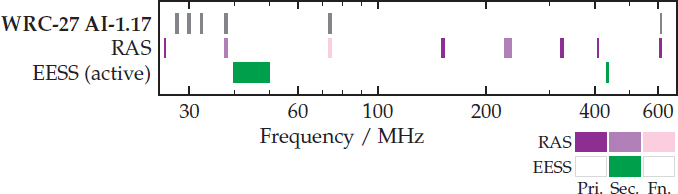
NOTE: AI, agenda item; EESS, Earth exploration-satellite service; RAS, radio astronomy service; WRC-27, 2027 World Radiocommunication Conference.
SOURCE: Data from International Telecommunication Union, “Radio Regulations,” http://handle.itu.int/11.1002/pub/8229633e-en, accessed February 10, 2025.
weather in radio communication applications has been stressed on multiple occasions by several international bodies, such as the World Meteorological Organization, the Intergovernmental Panel on Climate Change, the United Nations Office for Disaster Risk Reduction, the International Civil Aviation Organization, the United Nations Office for Outer Space Affairs, and the United Nations Committee on the Peaceful Uses of Outer Space. In the United States, the White House’s National Space Weather Strategy and Action Plan addresses space weather as fundamental to the security and resilience of space systems that support U.S. critical infrastructure.
Report ITU-R RS.2456-1 gives a description of globally deployed systems for operational space weather observations and summarizes spectrum-reliant space weather sensors. Of note, the bandwidth requirement for receive-only space weather sensors typically encompasses a minimum contiguous block. Table 12 of Report ITU-R RS.2456-1 provides a summary of space weather instruments and nominal bandwidths. Systems and frequencies are used in operational space weather applications for real time monitoring, near-real-time initialization of forecast models, and near-real-time verification of forecast results.
In the bands called out for compatibility studies, incumbent users exist, and space weather sensors operate opportunistically. Fixed/mobile services are allowed in the bands below 35.0 MHz cited, with RAS afforded protection through RR 5.149 (urging administrations to take “all practicable steps” for its protection) for frequencies above this value.
Radio Astronomy Service
RAS applications used by the community for receive-only space weather monitors include single antennas that observe the full Sun in selected frequencies, spectrographs for solar imaging over extended frequency ranges, and radioheliograph imagers that provide two-dimensional solar activity maps. Spectrographs observe solar radio bursts that are indicators of flares, coronal mass ejections, and other phenomena and work at a range of very high frequency (VHF) and higher frequencies, as detailed in Report ITU-R RS.2456-1. At VHF frequencies, interplanetary radio scintillation (IPS) systems measure intensity variations of radio waves from a distant, compact radio source produced by density disturbances included in the solar wind. IPS data yields valuable information on the progress and evolution of coronal mass ejections, interplanetary shocks, and scintillations as they leave the Sun and traverse the heliosphere and efficiently probe
fundamental solar wind properties (variability, density, speed). Solar emissions at frequencies ranging from 410 MHz to 15.4 GHz contain information on the dynamics of the Sun’s chromosphere, a region just below the corona with unique electromagnetic properties.
RAS facilities operating in these frequency bands are numerous. In the United States, they include stations of the Long Wavelength Array in Socorro, New Mexico, and the Owens Valley Long Wavelength Array in Big Pine, California. International facilities include individual telescopes in France, Greece, Canada, China, Japan, Belgium, Finland, and Korea. Multi-station/networked and large phased arrays include the Low Frequency Array (LOFAR) with central stations in the Netherlands and outlying European stations, the Murchison Widefield Array (MWA) in the western Australian desert, Nagoya’s Institute for Space-Earth Environmental Research multi-station system in Japan, the Daocheng Solar Radio Telescope in Sichuan, China, the Siberian Radioheliograph in Buryat, Russia, the worldwide Compound Astronomical Low cost Low frequency Instrument for Spectroscopy and Transportable Observatory (e-CALLISTO) system, the Mexican Array Radio Telescope in Michaocan, the Kilpisjärvi Atmospheric Imaging Receiver Array in Finland, and the Nancay Decameter Array and New Extension in Nançay Upgrading LOFAR (NenuFAR) system in France. The forthcoming large and internationally coordinated Square Kilometre Array (SKA)-low array will also operate at relevant frequencies.
Earth Exploration-Satellite Service
Earth exploration-satellite service (EESS) receive-only systems measure ionospheric space weather effects in several ways. Solar flare impacts can be monitored from Earth’s surface by riometers that measure D-region ionospheric opacity changes. Global ionospheric total electron content and sub-meter scintillation data are gathered by global networks, both space- and ground-based, receiving radionavigation-satellite service (RNSS) signals at L-band frequencies. At VHF frequencies, ground-based phased array systems measure ionospheric scintillation and fluctuations using wide-bandwidth observations of radio stars. Report ITU-R RS.2456-1 details the wide variety of these ionospheric and atmospheric sensors that are deployed globally. The committee notes in particular that development of these receive-only ground-based systems is moving toward fundamentally networked instruments in many physical locations, operating over blocks of contiguous frequencies.
Recommendations
The committee supports use of receive-only frequencies listed in Report ITU-R RS.2456-1 as MetAids, including opportunistic use in the already occupied bands of 27.5–28 MHz, 29.7–30.2 MHz, and 32.2–32.6 MHz.
Recommendation: In conjunction with and building upon the work under Agenda Item 1.17, the responsible International Telecommunication Union Radiocommunication Sector Study group(s) should continuously update the frequencies listed in Report ITU-R RS.2456-1 as appropriate.
Recommendation: Groups undertaking studies under Agenda Item 1.17 should examine the radio frequency needs of future receive-only space weather observing networks that will use distributed sensor architectures.
AGENDA ITEM 1.18: PROTECTION OF EESS (PASSIVE) AND RAS IN BANDS ABOVE 76 GHz
Agenda Item 1.18 considers “based on the results of ITU Radiocommunication Sector studies, possible regulatory measures regarding the protection of the Earth exploration-satellite service (passive) and the radio astronomy service in certain frequency bands above 76 GHz from unwanted emissions of active services, in accordance with Resolution 712 (WRC-23).”
Figure 2-18 shows the active service bands under consideration in this agenda item, along with bands allocated to the scientific services and/or afforded “all emissions prohibited” protection under RR 5.340.
Resolution 712 (WRC-23) considers that the 2000 World Radiocommunication Conference (WRC) resulted in new allocations to the Earth exploration-satellite service (EESS, passive) in bands above 71 GHz, and that many of these allocations and those to the radio astronomy service (RAS) are adjacent to various active satellite services, raising the potential for harmful interference. The resolution notes that provisions to protect EESS (passive) usage at 86–92 GHz
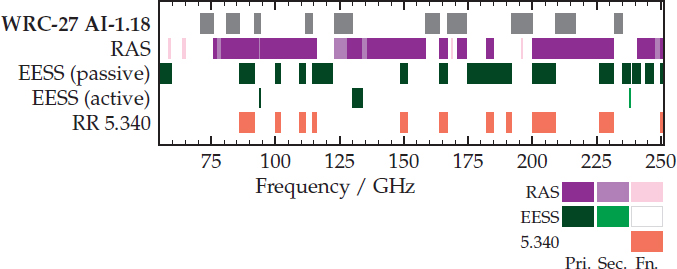
NOTE: AI, agenda item; EESS, Earth exploration-satellite service; RAS, radio astronomy service; RR, Radio Regulation; WRC-27, 2027 World Radiocommunication Conference.
SOURCE: Data from International Telecommunication Union, “Radio Regulations,” http://handle.itu.int/11.1002/pub/8229633e-en, accessed February 10, 2025.
from transmission in the fixed service are established in Resolution 750 (Rev. WRC-19), and there is no intention to change these. It also notes that Resolution 739 (Rev. WRC-19) establishes rules for unwanted emission levels needed to protect RAS from spaceborne transmissions in several bands, but not yet the bands under consideration under this agenda item. Based on this, the resolution invites compatibility studies between EESS (passive) and specific spaceborne services in the 81–86, 92–94, 111.8–114.25, 158.5–164, 167–174.5, 191.8–200, and 209–217 GHz bands and between RAS and select spaceborne services in the 71–76, 123–130, 167–174.5, and 232–235 GHz bands. Based on these studies, the resolution invites WRC-27 to update Resolutions 750 (Rev. WRC-19) and 739 (Rev. WRC-19) to include protection criteria for EESS (passive) and RAS, respectively.
This agenda item encompasses bands across a large frequency range (from 76–231.5 GHz), with each band under consideration either overlapping or adjacent to a band allocated to RAS and/or EESS (passive). Furthermore, many of the adjacent RAS and/or EESS (passive) bands are afforded “all emissions prohibited” protection under RR 5.340. RAS has primary allocations across much of the total spectral range under consideration, with secondary allocations in other regions. Among the parts of this spectral range without RAS allocations are two regions where atmospheric opacity is large (around the 118 GHz oxygen and 183 GHz water vapor lines) and EESS (passive) has primary allocations. Thresholds for acceptable interference into RAS observations are given in Recommendation ITU-R RA.769-2, while those for EESS (passive) are quoted in ITU-R RS.2017-0.
Radio Astronomy Service
As RAS has allocations across or adjacent to nearly all the spectrum under consideration, coordination will be essential for protection of RAS from spaceborne transmissions. As discussed above under Agenda Items 1.8 and 1.10, the millimeter/submillimeter band is a critical spectral region for radio astronomy and experimental cosmology because of the wealth of molecular emission lines and continuum emission that traces cool matter in the universe; because the short wavelengths enable continuum imaging of energetic sources such as active galactic nuclei (AGN) at the highest possible spatial resolution with global Very Long Baseline Interferometry (VLBI); and because it contains the peak of the cosmic microwave background (CMB). As noted there, Recommendation
ITU-R RA.314-11 documents some of the principal molecular species and transition frequencies observed, which motivate the many RAS allocations in this spectral region.
At issue under this agenda item are four RAS bands containing a mix of primary and secondary allocations, in addition to footnote protections, that lie adjacent to space-to-Earth active satellite allocations. Furthermore, in some cases, these active allocations include RAS footnote protection or secondary (primary under one administration) RAS allocations. For this reason, and given the particular sensitivity of radio astronomical observations to spaceborne transmissions, coordination with RAS will be essential. Here the committee considers in turn the four RAS bands listed in Table 2 of Resolution 712 (WRC-23).
The 76–81 GHz radio astronomy band, directly adjacent to the 71–76 GHz active satellite band, contains RAS primary allocations from 76–77.5 GHz and 79–81 GHz and RAS secondary allocations from 77.5–79 GHz, all subject to “all practicable steps” protection from harmful interference under RR 5.149. This band contains observed emission lines associated with key molecules such as deuterated water vapor (HDO), sulfur dioxide (SO2), and methanol (CH3OH), in addition to a wealth of identified lines emitted by more complex species that probe the detailed physical conditions throughout the interstellar medium. Measurements in this band elucidate the intricate processes of astrochemistry and their dependence on the local physical and chemical environment.
The RAS band from 130–134 GHz lies adjacent to the 123–130 GHz active satellite band. Moreover, the active band contains a RAS secondary allocation of which 128–130 GHz becomes a primary allocation in Korea (Rep. of) under RR 5.562D. All these RAS allocations are subject to RR 5.149 protection. Species in these bands include silicon monoxide (SiO), sulfur monoxide (SO), and sulfur dioxide (SO2); numerous organic molecules; and metal halides including sodium chloride (NaCl) and aluminum chloride (AlCl). (Although outside of the scope of this agenda item, RR 5.562A notes that RAS receivers in this RAS band are susceptible to damage from EESS (active) sensors operating from 133.5–134 GHz.)
The band from 164–167 GHz, adjacent to the 167–174.5 GHz active satellite band, is subject to “all emissions prohibited” protection under RR 5.340, primarily because of its importance as a key EESS (passive) band, but like the other RAS bands under consideration, it contains a large number of observed molecular lines, including from silicon carbide (SiC2), SO2, and aluminum monofluo-ride (AlF) as well as many more complex species. In addition, the
167–174.5 GHz active band includes portions covered by RR 5.149, which urges administrations to take “all practicable steps” to protect radio astronomy observations, and under RR 5.562D contains three narrow RAS primary allocations in Korea (Rep. of) that protect observations of multiple lines of SiO.
Finally, the band from 226–231.5 GHz is one of the most important in all millimeter/submillimeter radio astronomy. This band contains the 2→1 rotational transition of carbon monoxide (CO) at a rest frequency of 230.538 GHz. Because of its abundance and ubiquity, the CO molecule has been the most important tracer of the cool molecular universe since its discovery (in 1→0 rotational emission at 115 GHz) in 1970. Because of this, all millimeter wave observatories located at sites that support observations at 230 GHz are equipped with receivers that cover this band. It is for this reason that the world-wide VLBI networks used the 230 GHz band to recently image the black hole shadows at the center of the M87 Galaxy and the Milky Way Galaxy, mentioned above under Agenda Item 1.8.
Earth Exploration-Satellite Service
The allocations to EESS (passive) in the >76 GHz range under consideration in Agenda Item 1.18 encompass many bands that are central to atmospheric observations for weather forecasting, and research into climate and atmospheric chemistry. Notable among these are those bands around the 118 GHz oxygen and 183 GHz water vapor lines, which convey information on atmospheric temperature and humidity, respectively. These lines are very broad (multiple gigahertz) at Earth’s surface, narrowing with increasing altitude, thus decreasing pressure (e.g., hundreds of megahertz in the ~15 km region). This pressure-dependent line width enables information on different (broadly overlapping) altitude regions to be obtained by measuring closer to or further from the line center. However, this demands interference-free access to broad, contiguous bands for accurate results. Other bands adjacent to those under consideration in Agenda Item 1.18 are in less opaque “window regions” of the spectrum. These have multiple uses including measurement of surface properties (e.g., sea ice and snow). The window bands also convey information on clouds and precipitation that have a two-fold importance. Firstly, they provide valuable information on clouds and precipitation in their own right. Secondly, as clouds and precipitation impact signals observed across the spectrum, notably including in the oxygen and water vapor bands, the window measurements are essential for correcting (or in some cases excising)
observations of cloudy and/or precipitating regions in other bands. That said, in contrast to observations at shorter wavelengths (e.g., in the infrared or visible), at these frequencies the EESS (passive) measurements are responsive to the size of the cloud and precipitation particles, making them a unique resource for operational weather forecasting and Earth system research. The committee underscores that EESS (passive) observations act as a system. No one band provides unambiguous information on an Earth system variable. Rather, the various bands provide complementary information on different combinations of geophysical parameters. Only when measurements in multiple bands are considered in concert can sufficiently unambiguous geophysical information be obtained. Thus, interference into a single band undermines the value of the complete observing system.
A wide range of satellites from multiple agencies, countries, and regions routinely make daily global EESS (passive) observations across all these bands. An increasing number of such missions is planned going forward, including those under development by commercial entities. Notably, the 118 GHz oxygen band is receiving increased attention as it conveys much the same information as the “workhorse” 50–60 GHz band while requiring a smaller antenna for a given measurement footprint size. The limited number of sensors focused on atmospheric chemistry employ limb sounding (looking at the atmosphere edge-on) in the higher frequencies (e.g., 118 GHz and above), as opposed to the majority of other EESS (passive) observations that view in a nadir, cross-track, or conical-scanning geometry.
Table 1 of Resolution 712 (WRC-23) details, for each active service band under consideration, the specific services for which compatibility with adjacent EESS (passive) services is to be studied. The potential for interference arises from out-of-band emissions and spurious emissions, such as harmonics, from services in these or other bands, and special attention is needed on limits for these, particularly bearing in mind the potential for aggregate interference from multiple sources.
Emissions from fixed ground-based transmitters—in either the fixed or fixed-satellite (space-to-Earth) services—while strongly discouraged, are perhaps the most easily dealt with, as they can be most readily identified by virtue of their fixed nature and excised if needed. Interference from ground-based mobile transmissions is typically harder to identify and excise. Spaceborne transmissions present a different set of challenges. Firstly, there is the potential for an inter-satellite transmission to take place within the Earth-
observing beam of an EESS (passive) sensor. In the case of space-to-Earth transmission, special consideration of the potential for spaceborne transmissions to reflect off Earth’s surface (land or ocean) and impact EESS (passive) measurements is needed; such cases are well documented in the literature.
Importantly, many EESS (passive) sensors regularly view areas of cold space to obtain an essential “cold sky” calibration. These views are typically made through different optics and with broader beams than Earth measurements, with a single cold-sky view used to calibrate multiple Earth observations. Cases where a spaceborne transmitter lying within the calibration view transmits in the pass-band of the EESS (passive) sensor can be particularly hard to diagnose. Finally, attention is needed on the admittedly unlikely but mission-ending situation where a spaceborne transmitter is sufficiently close to an EESS (passive) sensor that permanent damage is caused to the sensitive microwave receivers through beam-to-beam coupling in either the Earth-viewing or cold-sky calibration views.
Recommendations
Noting that all of the radio astronomy bands considered under this agenda item are protected under RR 5.149 or RR 5.340, the committee supports the revision of Resolution 739 (Rev. WRC-19) Table 1 and Table 2 to add unwanted emission thresholds in a reference bandwidth produced at a radio astronomy station for the active satellite bands adjacent to these bands, using the methodology in ITU-R SM.2091-0.
Recommendation: Groups undertaking studies under Agenda Item 1.18 should establish masks for out-of-band emissions and spurious emissions such that unwanted emission thresholds using the methodology in ITU-R SM.2091-0 are met at radio astronomy service (RAS) observatories in adjacent RAS primary and RR 5.340 bands.
Recommendation: Given that portions of the 123–130 GHz and 167–174.5 GHz active bands are also covered by RR 5.149, administrations should undertake all practicable steps to implement spatiotemporal coordination that achieves interference levels consistent with ITU-R RA.769-2 during radio astronomy service observations.
Similarly, the committee supports the revision of Resolution 750 (Rev. WRC-19) Table 1 to add updated limits for unwanted emission power from the active bands under consideration into a reference bandwidth within the adjacent EESS (passive) band.
Recommendation: Groups undertaking studies under Agenda Item 1.18 should identify masks for out-of-band emissions and spurious emission such that the Earth exploration-satellite service (EESS, passive) interference thresholds given in ITU-R RS.2017-0 are not exceeded. The derivation of these masks should consider
- Impact of aggregate interference based on realistic expectations of the number of transmitters (ground based and spaceborne).
- Potential for interference through reflections of spaceborne transmissions off Earth’s surface.
- Potential for interference through transmission into the cold-sky calibration beams of an EESS (passive) sensor.
Recommendation: Groups undertaking studies under Agenda Item 1.18 should examine the potential for permanent damage to Earth exploration-satellite service (passive) sensors from nearby active transmitters and any needed mitigation should be identified.
AGENDA ITEM 1.19: ALLOCATIONS TO EESS (PASSIVE) IN 4.2–4.4 AND 8.4–8.5 GHz
Agenda Item 1.19 considers “possible primary allocations in all Regions to the Earth exploration-satellite service (passive) in the frequency bands 4 200-4 400 MHz and 8 400-8 500 MHz, in accordance with Resolution 674 (WRC-23).”
Figure 2-19 shows the frequency bands under consideration under this agenda item along with the 4200–4400 MHz band already noted for the Earth exploration-satellite service (EESS, passive) use under RR 5.437, and (not relevant for this agenda item) bands at 4950–4990 MHz noted in RR 5.339, and at 6425–7250 MHz in RR 5.458.
Resolution 674 (WRC-23) invites the ITU Radiocommunication Sector (ITU-R) to consider that the frequency band 6425–7250 MHz has been used by EESS (passive) to measure sea-surface temperatures (SSTs) on a global scale. Crucially, careful studies of complementary frequency bands are needed to improve radio frequency interference (RFI) mitigation within these SST measurements. The emission characteristics of the ocean surface make the 4–9 GHz frequency bands ideal for measuring SST. The possibility of a future allocation to EESS (passive) in the frequency bands 4200–4400 MHz and 8400–8500 MHz requires sharing and compatibility studies. Notably, the resolution states that any allocations resulting from this agenda item, even though they could be considered “primary” allo-

NOTE: AI, agenda item; EESS, Earth exploration-satellite service; RAS, radio astronomy service; WRC-27, 2027 World Radiocommunication Conference.
SOURCE: Data from International Telecommunication Union, “Radio Regulations,” http://handle.itu.int/11.1002/pub/8229633e-en, accessed February 10, 2025.
cations, would not include protection for EESS (passive) from existing services within these frequency bands and in adjacent bands.
Earth Exploration-Satellite Service
The frequency band 6425–7250 MHz has been used by EESS (passive) to measure SST on a global scale. (See Table 3-2 in Chapter 3 for more information.) The measurement of SST is important for detecting and forecasting meteorological events that drastically impact the safety and security of the worldwide population and key societal and economic infrastructure. These measurements also provide an essential resource for monitoring and understanding climate variability and climate change. Passive microwave observations, capitalizing on the unique physical characteristics of certain frequency bands, remain the only means of obtaining all-weather daily and global measurement of SST. Current measurements of SST within the 6425–7250 MHz bands are severely hindered by RFI, particularly near coasts where accurate SSTs have the greatest impact on the local population. This interference can be expected to increase following new allocations made to mobile services under the 2023 World Radiocommunication Conference, and as future WiFi-type systems proliferate. Crucially, generating SST measurements from different frequency channels should improve RFI mitigation, and careful studies of complementary frequency bands are needed to discern the optimal route to ensuring such capability. Additional observations in the two bands proposed under Agenda Item 1.19 will provide valuable improvements to the measurement of SST. The 4.2–4.4 GHz band is particularly sensitive to SST in cold-water regions, where current measurements have significant uncertainties. The higher-frequency 8.4–8.5 GHz observations provide improved spatial resolution for a given antenna size, enabling measurements to be made closer to coastlines.
At present, passive microwave sensor measurements of SST are carried out in the frequency band 6425–7475 MHz and are planned to be carried out in the frequency band 8400–8500 MHz. Other passive microwave sensor measurements include the frequency band 7075–7250 MHz in order to mitigate RFI contamination. Complementary bands need to be determined to ensure continuity of SST measurement by EESS (passive).
Recommendation
Recommendation: The International Telecommunication Union Radiocommunication Sector and administrations should rapidly enact the new proposed primary allocations to the Earth exploration-satellite service (passive) under consideration in Agenda Item 1.19.
This page intentionally left blank.


