Automated Applications for Infrastructure Owner-Operator Fleets (2024)
Chapter: 13 Automated Street Cleaning
CHAPTER 13
Automated Street Cleaning
13.1 Description of Automated Street Cleaning
Several manufacturers (primarily but not exclusively European) are developing autonomous street sweepers. For instance, the American Center for Mobility (ACM) is developing a street sweeper that has the technology to be fully automated (Szczepanski 2019). One vendor has developed a fully electric autonomous street sweeper (Trombia 2023), as shown in Figure 13-1, that has been piloted in Helsinki. The system uses an advanced combination of lidar and global navigation satellite system (GNSS) sensors to navigate and is able to navigate within 2 cm of accuracy. The system also uses lidar to detect obstacles. Another manufacturer is also developing an autonomous sweeper (B2 model) for large-scale and heavy-duty applications. The system is an electric, emission-free, large-scale robot that uses about 15% of the energy and a fraction of the water needed by conventional street cleaners. Because the system is quiet, it is able to be operated at night. The system was piloted along a busy street and along a bicycle path in Helsinki. The system has the capability of monitoring pedestrians and obstacles and stopping as needed (Wray 2021).
Singapore approved the use of autonomous sweepers on public roads, and trial operations are underway. Cleaning routes and times are set, and then the autonomous sweeper is monitored remotely through a teleoperation center, though a driver is also present during the trials. Once tests are completed, the autonomous sweeper will be used to clean alongside everyday traffic (Bucher Municipal n.d.).
13.2 Examples of Applications for Automated Street Cleaning
Information about how agencies have utilized automated street cleaning applications was gathered from a review of the literature and a survey of agencies.
13.2.1 Responses from the Survey and Results of the Literature Review
A survey was conducted to gather information about the automated processes that IOOs have implemented or are planning to implement, as described in Chapter 3. Agencies were asked about the automated processes that they have used or piloted and the processes that they thought could benefit from automation. None of the responding agencies noted that they have used automated street cleaning. Around 7% (n = 2) indicated that they are planning to use or evaluate the use of the technology.
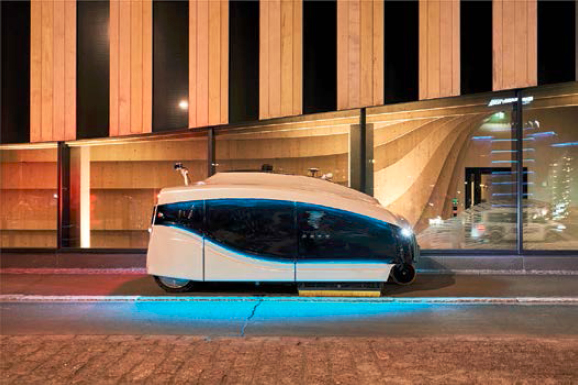
Figure 13-1. Autonomous street sweeper.
A review of the literature indicated that several international agencies have piloted the use of automated street cleaning. However, only one U.S. agency was found to have piloted the use of the technology.
13.2.2 New York
In 2023, the Port Authority of New York and New Jersey conducted trial runs of an autonomous street cleaner. The tested street sweeper costs $450,000 and can pick up 3,000 to 4,000 lb of debris before emptying. Using 3D lidar sensors for pedestrian and obstacle detection, the machine can travel at a speed of up to 2.5 mph. Being driverless, the street sweeper is able to work during the nights and weekends, providing work flexibility (Shaffrey 2023).
13.2.3 International Applications
An Italian company developed the Ariamatic 240, a fully electric street vacuum cleaner equipped with autonomous technology that enables the street sweeper to follow a human operator on its own. The operator manually handles the vacuum hose to collect litter from the streets, and the machine follows behind the operator. This street sweeper has the advantage of following the operator through busy streets (TSM 2018).
In 2019, another European vendor tested an autonomous street sweeper in the city of Darmstadt, Germany. A human-robot team consisting of humans and an autonomous street sweeper was deployed to improve the efficiency of street cleaning. One of the main goals of the test was to study the human-machine interaction between the human sweeper and the autonomous sweeper (ENWAY 2019).
13.3 Summary of Applications for Automated Street Cleaning
Only one U.S. agency was found to have piloted the use of automated street cleaning. Multiple international applications have occurred, but all are in the pilot stage.
13.3.1 Advantages
The autonomous street sweeper developed by a Finnish company is estimated to use 90% less energy and 95% less water than traditional street sweepers (Trombia 2023). The company also notes that several sweepers can be managed by one operator.
13.3.2 Disadvantages
Automated street cleaning technology is still in the pilot stages. As a result, advantages and disadvantages cannot be quantified more thoroughly at this time.
13.3.3 Costs
The street sweeper tested by the Port Authority of New York and New Jersey was estimated to cost $450,000.
13.3.4 Status of Street Cleaning
Several manufacturers (primarily but not exclusively European) are developing autonomous street sweepers. Only one U.S. agency was found to have piloted the use of autonomous street sweepers.


