Planning for Future Electric Vehicle Growth at Airports (2024)
Chapter: 8 Resiliency, Emergency Management, and Training
Chapter 8. Resiliency, Emergency Management, and Training
What is the impact of EV charging on resiliency planning?
The deployment of EVs and charging infrastructure has both positive and negative impacts on resiliency and emergency response planning. EVs require electricity to charge, which can pose a difficulty during grid failures. Because of the mission-critical nature of airport operations, the FAA requires 50 commercial service airports in the United States to have backup generation that is able to maintain the control tower, airport surveillance radar, approach-light system, instrument landing system, and runway lights on the primary runway for a period of at least four hours.76 in 2023, the Government Accountability Office (GAO) published a report finding that between 2015 and 2022, 321 commercial service airports reported electrical power outages of five minutes or more, 25% of which lasted for a period of over four hours.77
To mitigate the impacts of grid failure events and improve overall energy operations, airports have begun to deploy microgrids, backup generation, renewables, battery storage, and combined heat and power (CHP) systems. Adoption of EVs will have impacts on the total energy demands at airports that should be considered as new technologies are deployed. In addition to overall energy planning, airports can deploy specific technologies at scale specific to EV charging, which are described below.
Backup Generation
Permanent and mobile backup power generation—either diesel-powered or a battery energy storage system—can enhance resiliency of EV charging deployment. Generators present a common and widely used solution for bolstering the resiliency of critical infrastructure when the grid fails. Offering great variety in capacity, mobility, and fuel source, generators can be deployed to sites as needed or can be permanently installed in areas where grid reliability is of great concern or in situations where the infrastructure must always be powered. While modern generators can burn cleaner than their predecessors, they are not an ideal solution for resiliency and sustainability. Generators not only produce significant emissions, but also rely on fuel supply chains that are vulnerable to disruptions, especially during times of increased stress like grid failure.
Figure 30. Fixed Diesel Generator Powering an EV Charger
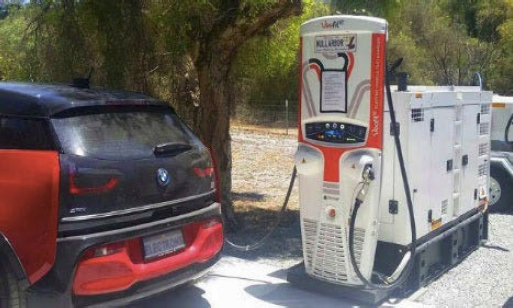
Source: thedriven.io
Distributed Renewable Generation
Integrating renewable power into new and existing EV charging locations can significantly improve the resilience of charging infrastructure. EV charging can be paired with on-site renewable energy generation, typically on-site solar energy systems, and in some cases batteries, either with or without
managed charging. This offers the opportunity for emissions-free EV operation, and when paired with energy storage, may enable vehicle operation without grid interconnection.
Solar generation offers flexible location and sizing, zero emissions, and grid independence, which reduces vulnerability and overall demand on the grid. Solar charging can readily support Level 2 EV charging, and adding features like battery storage and grid integration can improve capacity and power delivery. Grid integration also offers the benefit of bolstering overall power generation capability in the area where solar chargers are used.
Energy Storage
The ability to store energy is critical to future grid and charging station resilience. Stored energy not only ensures that stations can continue to charge EVs when grid power fails, it also improves grid stability by providing capacity during peak demand. Integration of energy storage with EV charging is gaining widespread adoption in the United States; for example, Electrify America has deployed battery energy storage systems (BESS) at over 150 EV charging stations across the United States, and deployed its first MW scale installation in 2022. Battery systems can also be used to lower the cost of EV charging at airports by consuming power when electricity costs are lowest (typically overnight) and using it during periods of peak demand. As noted in the section What is bidirectional charging? V2X technology may also offer the opportunity for EVs to serve as backup power during events when grid electricity is not available. When pooled together, EVs may be able to delivery electricity to meet airport operational needs during emergency events, such as grid failures, or to help meet demand that cannot otherwise be demand during times of peak consumption. This capacity may also serve to enhance the operations of microgrids at airports in the future if vehicles are parked for consistent periods and have the charging flexibility to charge and discharge while not in use.
Off-Grid Charging
While EVSE installations are primarily dependent upon a grid connection to receive electricity, the deployment of distributed energy resources (DERs) such as solar panels and battery systems can enable EV charging during a grid failure event or without a grid interconnection. Numerous projects throughout the United States pair solar panels with a charging location; however, most of these sites require a grid interconnection for operation. An integrated EVSE + solar + battery storage product can enable an EV charger to be deployed at any location without additional infrastructure requirements (Figure 31).

Source: Beam
Microgrids
At a larger scale, airports are beginning to deploy integrated systems for electricity generation and energy storage that can operate as a grid-connected or stand-alone system to serve their energy demands. Microgrids are groups of interconnected loads and DERs that act as single controllable entities. When disconnected from the main grid, a microgrid can generate, distribute, and store energy for a specific location—such as a hospital, campus, or airport—without a grid connection. For example, in 2021, Pittsburgh International Airport became one of the first airports to have a microgrid, a system that combines a natural gas generator and solar panels to deliver up to 22.5 MW. The airport saved $1 million in energy costs in year one of operations because of this effort.78
Microgrid systems are beginning to integrate charging infrastructure in non-airport applications. Planning for EV charging energy demand when designing microgrid systems is important to ensure that capacity is appropriately sized. A more detailed assessment of microgrids for airports can be found in ACRP Research Report 228: Airport Microgrid Implementation Toolkit.
What training is required for emergency response?
EVs present specific challenges to emergency responders, particularly in cases of battery fires. EVs are far less likely to catch fire than ICE vehicles; only 337 EV fires have been reported globally since 2010.79 However, EV fires can be long-lasting and severe, and may require specific fire suppression techniques. EV battery fires can be time- and resource-intensive and can pose safety risks from emission of toxic and flammable gases from damaged batteries and the unpredictability of thermal runaway and reignition.
Flooding, particularly from saltwater, presents specific challenges for the operation of EVs. Residual salt can form conductive bridges that can lead to short circuiting and self-heating of the battery, resulting in fires. The time frame in which a damaged battery can ignite has been observed from days to weeks. While these incidents are extremely rare and safety mechanisms are contained within battery systems, it is still important to follow specific protocols when dealing with EVs damaged by floods.
The National Highway Traffic Safety Administration (NHTSA) has published guidance related to flooding and fires for first responders and second responders, developed in collaboration with the U.S. Fire Administration and National Fire Protection Association (NFPA). The NFPA also provides online and in-person training for first responders for dealing with fires and other situations involving alternative fuel vehicles and technologies.


