Active Traffic Management Strategies: A Planning and Evaluation Guide (2024)
Chapter: 4 Assessing the Suitability of ATM

CHAPTER 4
Assessing the Suitability of ATM

Assessing the suitability of active traffic management (ATM) strategies is a crucial process in modern transportation planning and infrastructure development. It involves a comprehensive evaluation of various factors to determine whether the implementation of an ATM system is feasible and aligns with the goals of improving traffic flow, safety, and overall efficiency. This assessment encompasses several key components, starting with feasibility and screening, where initial analysis helps identify if an ATM system is a viable solution for a particular region. Subsequently, assessing policies and capabilities is essential to ensure that the necessary infrastructure and regulatory framework are in place to support the proposed ATM system. Identifying major roadway segments that would benefit from ATM interventions is another critical step, followed by prioritization of these segments based on factors like congestion levels and safety concerns. Estimating the potential benefits and costs associated with ATM implementation provides decision-makers with valuable insights into the economic viability of the project. Beyond these aspects, other important considerations exist, such as pilot deployments, arterial applications, and ATM integration with existing systems and legacy operations. All of these considerations contribute to the comprehensive evaluation of ATM suitability. In this complex and multifaceted process, careful analysis and planning are essential to make informed decisions that lead to more efficient and safer transportation systems.
Chapter Highlights and Objectives

ATM strategies have the potential to help transportation agencies operate existing facilities (both arterials and freeways) in the most efficient manner possible. Depending on the application, ATM strategies can support potential network improvements related to safety; mobility, accessibility, and equity; reliability; sustainability; and connectivity while helping support long-term system preservation. However, not every ATM strategy can work to address every possible network improvement. While not exhaustive, these potential improvements point to the overall benefits that ATM strategies can have on a network, thereby emphasizing the importance of assessing their suitability for a region.
This chapter focuses on providing information that agencies can use in assessing the suitability of ATM for a particular region and specific corridors. In conjunction with the strategy-specific information included in Chapter 2—“ATM Strategies,” Chapter 3—“Enabling ATM,” and Appendix B—“ATM Strategy Fact Sheets,” the information in this chapter helps link the transportation planning process with operations. It provides agencies with information about operational strategies that they may include in the regional transportation plan that have the potential to provide the most benefit to the regional transportation network. Agencies can identify major attributes about candidate corridors that help determine which, if any, ATM strategy is suitable and appropriate.
Agencies can also use this assessment in their congestion management process as a planning tool. In the pursuit of congestion mitigation, many agencies across the country are required to employ a congestion management process (CMP) as a systematic method for regional planning to help manage traffic congestion and provide information on transportation system performance. As outlined by the U.S. DOT, a CMP includes alternative strategies for alleviating congestion and enhancing the mobility of persons and goods to levels that meet state and local needs (Grant et al. 2011). At its core, a CMP includes a data collection and monitoring system, a range of strategies for addressing congestion, performance measures or criteria for identifying when action is needed, and a system for prioritizing which congestion management strategies would be most effective.
This chapter can also serve as a general process to screen regional conditions easily and efficiently for applicable ATM strategies. The objective is to provide a high-level overview of the assessment process, information on additional documents and resources that provide similar guidelines for regional use, and tools that are readily available for assessment.

The remainder of this chapter presents the following sections:
- Feasibility and Screening Activities and Tools. Discusses screening processes and tools that are readily available to support the assessment process.
- Preparation for Feasibility and Screening. Presents the primary actions for selecting goals and objectives and identifying data needs as the foundational steps in the screening process.
- Assessment of Agency Policies and Capabilities. Provides an overview of the issues related to assessing an agency’s policies, regulatory issues, and capabilities for implementing ATM.
- Identification of Major Roadway Segments for ATM. Highlights the process for determining information on essential and preferred elements and issues when selecting major roadway segments for ATM deployment.
- Analysis and Prioritization of Facilities and Strategies. Discusses the types of tools agencies can utilize to analyze the potential impacts of ATM strategies and to prioritize facilities accordingly.
- Estimation of Benefits and Costs. Provides guidelines on tools and approaches for estimating the benefits and costs of ATM strategies to help optimize the return on investment for agencies considering deployment.
- Other Important Considerations. Highlights critical considerations for ATM strategies beyond those considerations discussed in the chapter.
- Final Remarks. Summarizes key issues related to assessing the suitability of ATM for a region and specific corridors or facilities.
- Chapter 4 References. Includes a list of all references cited within the chapter.
Feasibility and Screening Activities and Tools
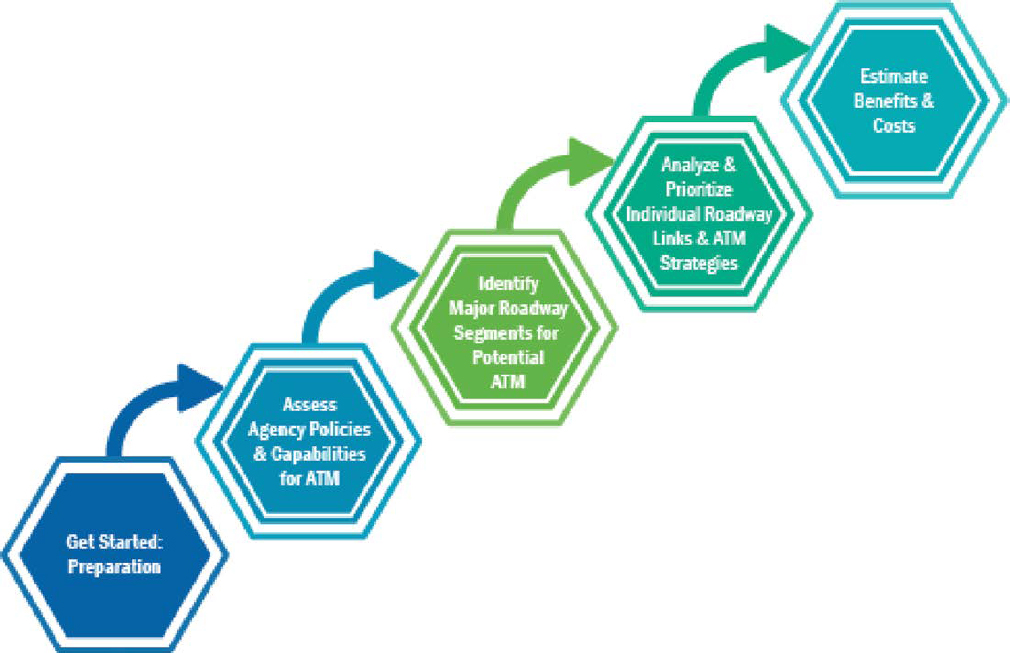
An effort funded by the FHWA developed an Active Traffic Management (ATM) Feasibility and Screening Guide intended to enable agencies to make informed investment decisions in this regard within their established planning and systems engineering processes (Neudorff and McCabe 2015). As part of the guide’s development, the project team created an ATM feasibility and screening process (shown in Figure 4-1) that is not unlike any traditional assessment process for other major projects in a region, including TSMO investments. The remaining sections in this chapter discuss these five steps to provide the overall context of strategy assessment. Additionally, checklists for practitioners to use throughout this process are provided in Appendix E—“Planning and Evaluating ATM Checklists.”

A typical approach to a feasibility and screening assessment process involves sketch planning tools. Sketch planning plays a crucial role in allowing agencies to model and evaluate various
transportation scenarios and ATM strategies before implementing them in the real world. Such tools are invaluable for assessing the feasibility of ATM strategies by providing a cost-effective and data-driven approach to evaluate different scenarios, predict performance outcomes, and make informed decisions. These tools help transportation agencies optimize their resources, reduce risks, and improve mobility and safety for the benefit of both travelers and the environment. It is important to note that sketch planning tools do have limitations, including but not limited to the following:
- An inability to fully account for interactions of several ATM strategies deployed at the same time.
- An inability to fully account for the impacts of an ATM strategy deployed in conjunction with capacity expansion and/or other TSMO strategies.
- An inability to fully account for system reliability.
- An inability to acknowledge that existing infrastructural and operational capabilities can greatly impact a benefit/cost analysis.
- A limited ability to obtain real-world data on which to base projected benefits and costs.
- A limited ability to obtain real-world data representing the full range of demand- and capacity-reducing events to fully capture the impacts of ATM.
Understanding potential shortcomings in sketch planning allows an agency to acknowledge that these tools establish a starting point for determining the appropriate ATM strategy to address a need on a particular facility.
One tool that practitioners can use in assessing the feasibility and screening of select ATM strategies is the Operations Benefit/Cost Analysis Desk Reference (Sallman et al. 2012). This reference, along with the companion “Tool for Operations Benefit Cost Analysis (TOPS-BC)” (FHWA 2023a), helps agencies conduct benefit/cost (B/C) analyses for several ATM strategies. This sketch planning tool is intended to provide support and guidelines to transportation practitioners as they apply a benefit/cost analysis (BCA) for TSMO strategies. It was developed based on input from planning and operations practitioners with the primary purpose of helping to screen multiple TSMO strategies and providing order-of-magnitude BCA estimates (Sallman et al. 2012). While this reference focuses on the broader topic of TSMO strategies, note that the direct connection between TSMO and ATM is discussed in Chapter 1—“Setting the Stage for ATM.” Specifically, the desk reference provides users with the following (Sallman et al. 2012):
- The ability to investigate the expected range of impacts based on previous deployments and analyses of many TSMO strategies.
- A screening mechanism to help identify appropriate tools and methodologies for conducting a BCA based on the user’s analysis needs.
- A framework and default cost data to estimate the life cycle costs of various TSMO strategies, including capital, replacement, and continuing operations and maintenance costs.
- A framework and suggested impact values for conducting simple BCAs for selected TSMO strategies.
The ATM strategies in the desk reference currently include variable speed limits, part-time shoulder use, and ramp metering; however, the general approach outlined in the document can be utilized for other ATM strategies. Additional information that is relevant to the screening process is also included in Chapter 1—“Setting the Stage for ATM.” Other resources that can guide the feasibility and screening of ATM strategies include but are not limited to the following:
- TSMO Strategy Toolkit (FHWA, forthcoming): This FHWA educational tool is intended to inform transportation practitioners of TSMO approaches, strategies, and tactics as well as suggested considerations when evaluating potential TSMO strategies. ATM strategies are included in this toolkit.
- “Organizing and Planning for Operations” (FHWA 2023c): This FHWA website provides a broad range of resources and documents addressing organizing and planning for TSMO, including ATDM. Updated resources are provided as they become available, including guidance, primers, desk references, case studies, reports, white papers, webinars, and training.
Preparation for Feasibility and Screening
Before starting a feasibility and screening exercise for ATM, an agency needs to ensure they have all the resources available to make a sound decision. This step relies on ready access to various documents, a clear understanding of regional goals and objectives that ATM may work to address, identification of the network for ATM implementation, stakeholder engagement, and awareness of the data needed to ensure the feasibility screening process is thorough. The following sections briefly describe these needs and provide links to additional resources an agency can use to prepare for screening for ATM solutions.

Setting Goals and Objectives for ATM
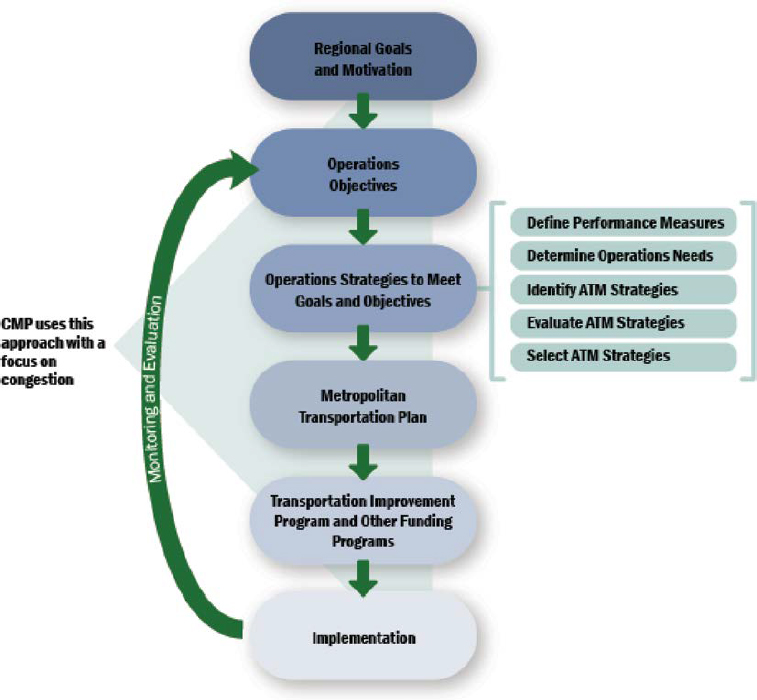
The first step in assessing ATM strategies for regional suitability is identifying regional goals and objectives that the strategies can help meet. These goals and objectives form the backbone of the regional planning process that centers on an objectives-driven, performance-based approach
for operations (Worth et al. 2010). This approach to planning for operations, as illustrated in Figure 4-2, includes a series of steps, some of which are included in the ATM assessment. The preliminary concept exploration is part of the systems engineering process, which is also briefly discussed in Chapter 3—“Enabling ATM.”
Typical regional goals and the motivation behind ATM projects often fall into several broad and somewhat interrelated categories. As illustrated in Figure 4-3, these categories include the following (Neudorff and McCabe 2015):
- Safety: Implement system improvements that improve safety for all users.
- Mobility, accessibility, and equity: Increase mobility, user accessibility, and equity throughout the system by reducing recurrent and nonrecurrent congestion.
- Reliability: Ensure all users of the system, including freight and business communities, have a reliable system that can support economic vitality.
- Sustainability: Enhance the environment, energy conservation, livability, and planned growth.
- Connectivity: Enhance system integration and connectivity to support and facilitate multimodal alternatives.
- System preservation: Emphasize preservation of the existing transportation system by optimizing existing capacity instead of adding new capacity.
(Source: Adapted from Neudorff and McCabe 2015).

As discussed previously, ATM projects are intended to improve transportation system performance by using technology and data to manage traffic flow dynamically and proactively. The goals of ATM projects often reflect regional transportation priorities, such as safety, mobility and accessibility, reliability, sustainability, connectivity, and system preservation. Safety improvements may include things like improved lighting, road markings, and signage, as well as more advanced technologies like VSLs and lane control. Mobility, accessibility, and equity goals may be met by reducing congestion through techniques such as ramp metering and incident management. Reliability is important for the economic vitality of a region, as it ensures that freight and business communities have a predictable and efficient transportation system. Sustainability goals may be addressed through strategies such as encouraging active transportation and using low-emission vehicles. Connectivity is important for supporting multimodal transportation options, such as transit, cycling, and walking, while system preservation emphasizes optimizing existing capacity rather than adding new capacity. Overall, ATM projects aim to improve transportation system performance and support regional goals cost-effectively and sustainably. An agency considering ATM for their jurisdiction can move through the stepwise process illustrated in Figure 4-4 to refine the appropriate regional goals and objectives that will eventually be matched with potential ATM strategies.

The selection of goals and objectives for potential ATM strategies and projects in a region begins with defining high-level goals. These goals should be broad, overarching statements that reflect the region’s transportation priorities related to safety, mobility, reliability, sustainability, connectivity, and system preservation. Once high-level goals have been established, the next step
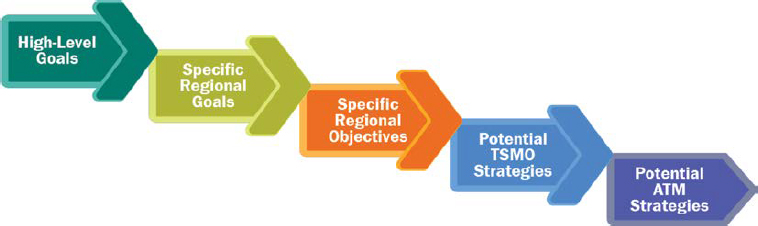
is to develop specific regional goals that align with these broad goals. Regional goals should be tailored to the unique characteristics and needs of the region, considering factors such as population density, land use patterns, and travel demand. Specific performance measures related to these goals are discussed in Chapter 5—“ATM Performance and Data.” During the assessment process, agencies can determine which strategies will help meet the overall goals included in their regional transportation plans.

From the specific regional goals, an agency can then develop specific regional objectives. These objectives should be measurable, achievable targets that support the regional goals. For example, if the regional goal is to reduce congestion along a specific corridor, the objective may be to reduce average travel time by a certain percentage during peak periods. Agencies can then identify potential TSMO strategies to achieve regional goals and objectives. As noted previously, active management of the system lies on a continuum that moves from straightforward time-of-day operations to operations that are truly comprehensive and proactive in nature. Depending on the existing infrastructure and operational capabilities, ATM strategies may emerge as viable alternatives.
Finally, potential ATM strategies can be identified that will help achieve these objectives. These strategies may include a range of technology and operational improvements, such as ramp metering, VSLs, lane control, incident management, and traveler information systems. The specific strategies selected will depend on the region’s goals and objectives, as well as on factors such as available funding, public acceptance, and technical feasibility.
Throughout this process, it is important to engage stakeholders and the public to ensure that the goals and objectives reflect community priorities and values. This collaborative approach can help build support for ATM projects and increase the likelihood of successful implementation. Appendix E—“Planning and Evaluating ATM Checklists” includes worksheets, checklists, and tables to support the goals and objectives selection process for ATM.
Network Selection
After determining the appropriate ATM strategies to meet regional and/or corridor goals and objectives, agencies need to define the roadway network for ATM implementation. This network can vary in size depending on the agency’s needs and the region’s transportation demands. It may include key corridors, highways, or even entire freeway systems.
Stakeholder Engagement
Identifying and engaging stakeholders are critical steps in the preparation process for ATM projects. Stakeholders can include community groups, transportation agencies, emergency responders, freight carriers, and others who may be impacted by the project. Engaging stakeholders early and often can help build support for the project and ensure that their needs and concerns are addressed. Ongoing education and outreach efforts are also important to inform the public about the benefits of ATM and how they will impact their daily travel. Such efforts can include community meetings, social media campaigns, and other forms of outreach.

Selecting Data
Data are one of the fundamental components of a feasibility and screening process. Robust and appropriate data elements support the assessment of strategies as well as the measurement of their performance and success after implementation. These elements also help link specific ATM strategies to regional goals and objectives, thereby directly linking ATM to the regional

planning process. Data types desired for the screening process are illustrated in Figure 4-5. Additional information and specific details related to data and the performance of ATM strategies are included in Chapter 5—“ATM Performance and Data.”
Overall, the preparation process for ATM projects requires careful planning and coordination to ensure that the project meets regional goals and objectives, engages stakeholders, and uses data-driven approaches for decision-making. Through effective preparation, agencies can ensure that ATM projects are successful in improving safety, accessibility, mobility, and reliability in the region’s transportation system.
Assessment of Agency Policies and Capabilities
As discussed in Chapter 3—“Enabling ATM,” the extent to which an agency successfully implements ATM strategies is contingent upon a variety of factors. Figure 4-6 provides an overview of the various steps in assessing an agency’s policies and capabilities for implementing ATM (Neudorff and McCabe 2015). In addition to legislative changes that may need to be implemented, an agency will need to examine institutional and organizational changes in policies, processes, structure, and resources to ensure success in adapting to a more active operations role for managing highway networks. Furthermore, the success of ATM strategies is contingent on the support of a variety of stakeholders, which is facilitated by a strong project champion who organizes and executes carefully considered outreach and education of the public, law enforcement, operators, policymakers, and elected and appointed officials. As a starting point, Table 4-1 provides a list of policy and regulatory considerations agencies may need to address in advance of implementing ATM strategies.
As discussed in Chapter 1—“Setting the Stage for ATM,” agency capabilities play a key role in the successful implementation of ATM strategies. Agencies with very low-level capability in
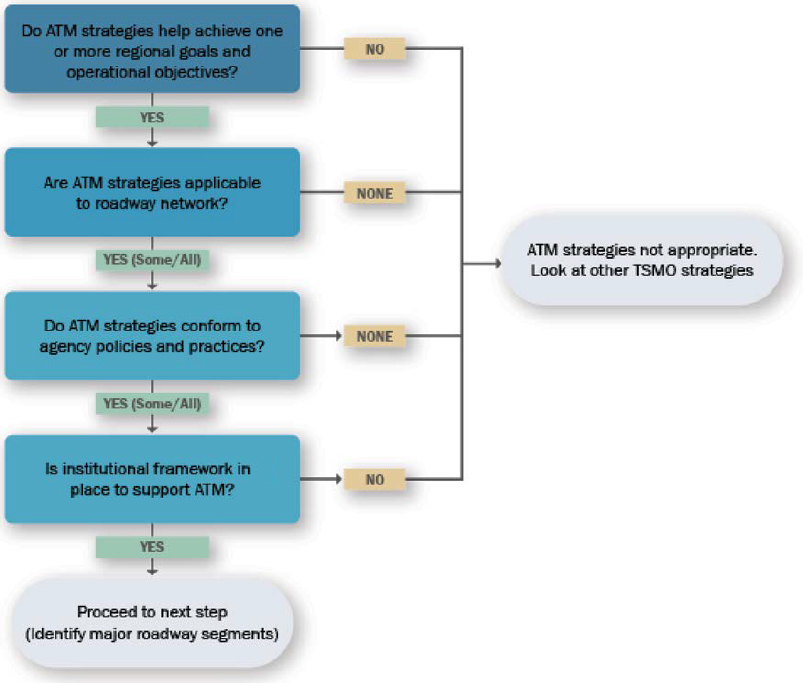
systems management and operations are probably not ready for ATM deployment because they lack adequate business processes, supporting technologies, and the required workforce to be effective. Agencies can conduct a self-assessment using the FHWA’s “Traffic Management Capability Maturity Framework Tool” to understand their current levels of capabilities and identify actions that they can take to improve their readiness for ATM implementation (FHWA 2023b).
Identification of Major Roadway Segments for ATM
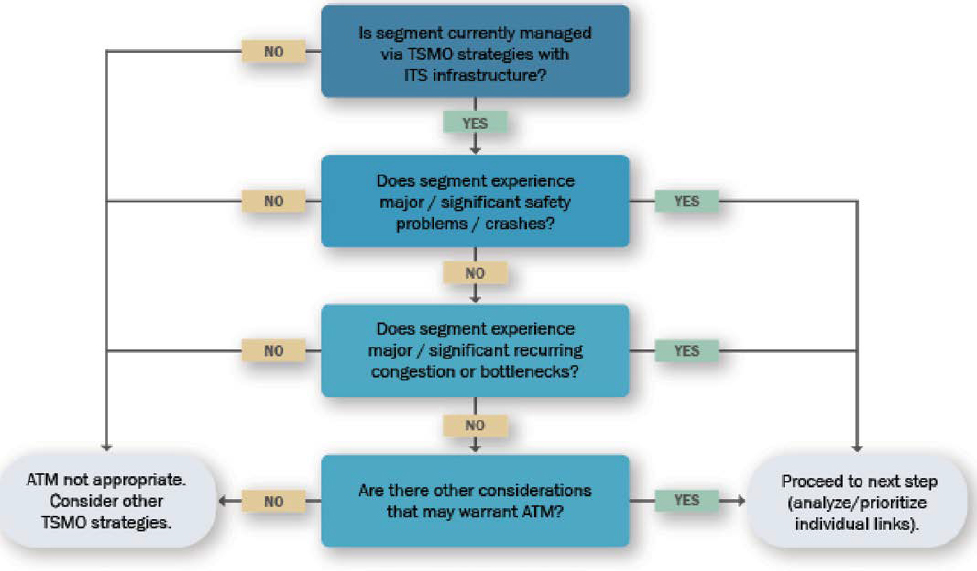
General guidelines on ATM feasibility also identify how an agency determines which major roadway segments are suitable for one or more ATM operational strategies. Figure 4-7 illustrates the steps in this process and highlights the conditions under which ATM is appropriate for a facility. Furthermore, both essential and preferable facility elements that can help agencies determine whether a specific ATM operational strategy may work to address mobility challenges in a particular location must be identified (Levecq et al. 2011). These elements represent specific operating characteristics or conditions that illustrate a problem that ATM may be able to help solve. A summary of these elements for select ATM strategies is provided in Table 4-2. Additional details and processes for identifying potential facilities and segments for ATM strategies are included in the Active Traffic Management (ATM) Feasibility and Screening Guide (Neudorff and McCabe 2015).
Table 4-1. Policy and regulation considerations for ATM strategies.
| ATM Strategy | Policy and Regulation Consideration |
|---|---|
| Adaptive Ramp Metering |
|
| Adaptive Traffic Signal Control |
|
| Dynamic Junction Control |
|
| Dynamic Lane Reversal |
|
| Dynamic Lane-Use Control |
|
| Part-Time Shoulder Use |
|
| Queue Warning |
|
| Transit Signal Priority |
|
| VSLs |
|
| ATM Combined Implementation |
|
Analysis and Prioritization of Facilities and Strategies
Once an agency has identified facilities and segments of facilities for potential ATM strategies, it needs to analyze the potential impacts of those strategies and prioritize facilities accordingly. A variety of tools exist that can assist agencies in conducting these analyses. Traffic analysis tools can be generally grouped into the following categories:
- Sketch planning tools: Appropriate for high-level analysis that can be used to evaluate alternatives or projects without performing a detailed traffic analysis.
- Travel demand models: Mathematical models that predict future travel demand based on existing conditions and projections of socioeconomic characteristics.
- Analytical/deterministic Highway Capacity Manual (HCM)-based tools: Based on HCM methodologies and procedures and used to evaluate the performance of isolated or small-scale facilities (HCM7 2022).
- Real-time datasets: Serve as the basis to analyze existing operations and estimate the effects of changes.
- Macroscopic simulation tools: Based on deterministic relationships of traffic network parameters (speed, flow, density) and simulate traffic on a section-by-section basis.
- Mesoscopic simulation tools: Combine the capabilities of both microscopic and macroscopic simulation models and consider the individual vehicle as the traffic flow unit, whose movement is governed by the average speed on a link.
- Microscopic simulation tools: Rely on car-following and lane-changing theories to simulate the movement of individual vehicles.
- Traffic signal optimization tools: Used to develop optimal signal phasing and timing plans for isolated signal intersections, arterial streets, and signal networks.

Additional information on the appropriate traffic analysis tool categories for modeling and analyzing the various ATM strategies is discussed in Chapter 6—“Analysis, Modeling, and Simulation of ATM.” Further discussion related to this analysis for the various ATM strategies and the prioritization process, along with examples, is included in the Active Traffic Management (ATM) Feasibility and Screening Guide (Neudorff and McCabe 2015).
Estimation of Benefits and Costs
When considering ATM strategies for a region, agencies should consider the potential impacts of those strategies in both near- and long-term scenarios. Typical assessments of the potential benefits of many of these strategies have been provided previously in this guide. Research has
Table 4-2. Essential and preferable elements for ATM strategies.
| ATM Strategy | Essential Elements | Preferable Elements |
|---|---|---|
| Dynamic Junction Control |
|
|
| Part-Time Shoulder Use for All Vehicles |
|
|
| Part-Time Shoulder Use for Transit |
|
|
| Queue Warning |
|
|
| VSLs |
|
|
SOURCE: Adapted from Levecq et al. 2011.
shown that ATM strategies are rarely implemented in isolation. Several strategies are complementary and form a logical relationship within the context of operations. Information regarding compatible strategies is included in Appendix B—“ATM Strategy Fact Sheets.” It is important to note that these strategies do not have to be implemented together. Rather, they work toward similar operational objectives and can capitalize on the same data requirements and ITS infrastructure needed for functionality.
When analyzing ATM strategies for implementation, agencies need to consider the costs associated with those strategies. Key cost factors to consider include capital costs, operations and maintenance costs, replacement costs, annualized and infrastructure costs, and incremental
costs. This cost analysis can be very complex, especially when compared to more traditional infrastructure improvements. Appendix B provides information on the core cost elements along with cost elements for operations and maintenance in terms of their level of investment. Details on conducting a thorough BCA for select ATM strategies are included in both the FHWA Operations Benefit/Cost Analysis Desk Reference (Sallman et al. 2012) and the Active Traffic Management (ATM) Feasibility and Screening Guide (Neudorff and McCabe 2015). The overall process can be utilized for other ATM strategies not included. Other resources that can provide guidelines to practitioners in assessing the potential benefits, costs, and return on investment for ATM projects include but are not limited to the following:
- ITS Deployment Evaluation—Costs (ITS JPO 2023b): A national database of cost estimates for ITS deployments for use on project cost estimates in the planning or preliminary design stages.
- ITS Deployment Evaluation—Benefits (ITS JPO 2023a): A national database of benefits information for ITS projects.
Other Important Considerations
Several other factors are important when evaluating the suitability of ATM strategies for a particular jurisdiction. For example, pilot deployments can provide insights into the effectiveness of ATM strategies and help identify challenges before full deployment. Arterials are also a viable network for applications that can be considered depending on their location. Integration with existing systems and legacy operations is another important consideration to ensure that the new ATM strategies are compatible with existing infrastructure and operations. By carefully considering these factors, agencies can ensure the successful implementation of ATM strategies to improve safety, mobility, and reliability in the transportation system. The following sections provide an overview of these considerations and their relevance when considering ATM for a region.
Pilot Deployments
Deploying a pilot ATM strategy on a limited section of a facility before a full regional deployment can offer several benefits. First, it allows practitioners to test the effectiveness of the ATM strategies in a controlled environment and evaluate how well they meet the goals and objectives of the project. A pilot deployment can help identify issues or challenges that may arise during full deployment and inform any necessary adjustments to the strategies. A pilot deployment can also help build public awareness and support for the project. By deploying ATM strategies on a smaller scale, agencies can demonstrate to the public the potential benefits of the project, such as reduced travel time, improved safety, and more reliable travel. This approach can increase public acceptance and support for the project as it moves toward full deployment. Furthermore, a pilot deployment can provide valuable data and insights into the project’s feasibility and cost-effectiveness. Agencies can use data collected during the pilot to refine the strategies and estimate the costs and benefits of full deployment, helping to ensure that the project is implemented cost-effectively and sustainably. Overall, deploying ATM strategies on a limited section of a facility as a pilot can provide valuable insights and data, build public support, and help ensure the success of the project when implemented on a larger scale.
Arterial Applications
ATM becomes more viable as mobility problems become more complex and unpredictable. This need for effective operations crosses agency boundaries, particularly in urban areas,
necessitating partnership and engagement with local agencies. Challenges may include congestion from a freeway spreading to local arterials when drivers are prompted to detour by a third-party mobile application or when an incident closes the freeway. Planned special events require special operating plans and may leverage existing technology for new types of operating strategies. All these situations often go beyond the purview of state DOTs, requiring supplemental, active operations from local agencies. Local agencies are unique in that they have an acute understanding of their jurisdiction; however, their resources (staff, infrastructure) may be more limited. Unlike freeway facilities, local agencies need to consider multiple modes (pedestrians, cyclists, transit riders, and drivers) when developing and implementing ATM strategies. These factors may add complexity to ATM deployment on arterials.
Agencies need to consider several factors before implementing an ATM project on an arterial roadway. These factors include the following:
- Institutional buy-in:Are partners willing to participate and collaborate? In most cases, a siloed approach will not work effectively. Therefore, consensus building and stakeholder engagement are very important in creating a successful ATM project. Arterial-based multimodal strategies will often need to engage multiple departments within an agency, including planning, bike/pedestrian, safety, maintenance, enforcement/public safety, transit, and, of course, traffic engineering and operations. Some of these stakeholders may have specific roles at various stages of the ATM life cycle, but their active participation and involvement are critical to a successful strategy.
- Technology and resource readiness: Many arterial-focused ATM strategies rely on technologies that may or may not be familiar to agency staff who need to plan, operate, and maintain them. Agencies need to be prepared to develop staff capabilities to calibrate, optimize, and operate new technologies; develop new operating procedures; and plan for how those systems will be maintained. Having a full understanding of how the technology needs to perform will help refine ATM strategies and support successful operations. Staff will also need to be prepared to monitor, analyze, and interpret performance data to identify where ATM strategies may need to be updated or enhanced. In some cases, vendors or contractors can support some of these functions, but these approaches will also require a funding commitment to get contracts in place.
- Balancing modes: A general trend in the industry is to emphasize planning for all modes. Historically, transportation planners and engineers have been critiqued for their designs prioritizing the private automobile. With the rise in greenhouse gas emissions, limited capacity, and push for more equitable planning, multimodal projects are becoming a priority. The balancing of modes considers how they impact one another (e.g., pedestrians may cause automobile delay, but automobiles may pose a safety risk to pedestrians). There will often be trade-offs, but promoting a balancing of modes and enhancing safety for everyone should be emphasized in ATM arterial projects. Arterial agencies need to factor in multiple modes, including pedestrians and bicycles, as part of any ATM or operations strategy; this consideration is not typically an issue for freeway ATM applications.
- Understanding local context: Not all ATM arterial treatments may be appropriate for a particular jurisdiction. It is important to understand the core problem, interrelatedness of systems, potential conflicts, and public perception and comprehension. In some cases, the core problem may not necessitate a technology solution but instead may be related more to organization and management. Many times, systems are interrelated, and therefore the problem is more complex than it appears. Public perception and comprehension are vital to a project’s success. A project is not useful if the public does not want to use it. Finally, the public’s ability to comprehend the new operations is equally important from both an operational and safety standpoint.
Table 4-3 provides an overview of key arterial considerations for ATM, which any agency can consider when evaluating various operational strategies for deployment. The considerations are organized by chapter to facilitate easy cross-referencing. Some major challenges for ATM on arterials include the following:
- Establishing justification for ATM in the local realm: Some local jurisdictions may have standard practices for traditional operations, time-of-day signal timing, traffic controller upgrades, loop detection, and general maintenance. For this reason, it is important to turn to precedent ATM successes and establish a business case for ATM to receive buy-in and funding for new projects and new operating strategies.
Table 4-3. Relevant arterial considerations for ATM across guide topics.
| Chapter 3—“Enabling ATM” |
|
| Chapter 4—“Assessing the Suitability of ATM” |
|
| Chapter 5—“ATM Performance and Data” |
|
| Chapter 6—“Analysis, Modeling, and Simulation for ATM” |
|
| Chapter 7—“Design Considerations for ATM” |
|
| Chapter 8—“ATM Implementation and Deployment” |
|
| Chapter 9—“ATM Operations and Maintenance” |
|
- Training and availability of resources: Many local transportation agencies have limited staff; the same person who is responsible for maintaining signals may also be tasked with reviewing new design plans and responding to inquiries or traffic complaints from the public. In these situations, it is challenging to introduce new technologies and operating procedures. For this reason, it is important to select technologies that can help automate processes to reduce the burden placed on staff. For example, the installation of fiber-optic cable can increase remote capabilities, which in turn reduces the need for a staff member to visit an intersection when a problem arises. Additionally, training is critical to the success of these new implementations. Training can be implemented in-house or through outside experts (e.g., vendors or contractors).
- Establishing technology reliability: Risk always exists when pioneering new technology, particularly for local agencies that may be starting with a smaller geographic area to pilot ATM strategies. The agency’s first challenge is learning how to use the system; the agency may also face additional challenges not posed by an established technology. Picking a reputable vendor for equipment is very important. Because there is risk associated with new technology, it may be valuable to pilot the project along a small segment that can serve as a test bed for future deployments.
- Creating standards, policies, and procedures: In theory, innovative projects are encouraged, but when it comes time for implementation, agencies often face challenges when introducing a project or technology that does not yet have a standard, policy, or operating procedure within their agency. For example, if a DMS does not follow MUTCD standards, its implementation will likely be met with hesitation. Nonetheless, these standards exist because they have been vetted and approved. Without the safety net of standards, agencies fear potential liability. In an ideal situation, a project demonstrates an innovative application of an existing standard so that it does not face challenges to implementation.
Integration with Existing Systems and Legacy Operations
An integral part of ATM strategy effectiveness relies on utilizing multiple data sources and other technology systems. These technologies can include various sensors, real-time data collection and analysis systems, and other automated and dynamic systems used to optimize performance.
However, as new technology becomes available to agencies, these developments present new opportunities and challenges. New technologies can offer ATM strategies more capabilities and robust data to optimize decision-making, but challenges may arise when integrating systems, planning, creating stakeholder buy-in, and preparing for unexpected technological limitations and maintenance.
Currently, technologies and information sources exist to support the deployment of ATM strategies. As ATM systems are increasingly deployed throughout the United States, the potential for new technologies to support them becomes a longer-term investment need, particularly as roadway infrastructure develops and self-driving vehicles emerge (Bayless et al. 2013). Some technologies, such as CVs and autonomous vehicles (AVs), are still developing but may provide valuable information to implement ATM strategies in the future.
ATM strategies attempt to manage recurrent and nonrecurrent congestion dynamically and proactively on an entire facility based on real-time or predicted traffic conditions (FHWA 2012). As such, they rely heavily on sensing technologies such as radar (Bayless et al. 2013).
Inputs are gathered from these sensors, and decision-support systems are used to adapt speed limits or even traffic signal phases. Modifying the signal phase and timing can help maximize traffic flow. Similarly, speed harmonization or adjusting travel speeds based on traffic or other road conditions (Fowler et al. 2022) can also reduce congestion and collision frequency.
Although ATM strategies depend more on sensors and radar technologies, other vehicle communications will significantly impact these systems. For example, as more vehicles become advanced and include advanced driver-assistance systems (ADASs) and other vehicle communications, ATM strategies can leverage these systems to optimize predictability and adaptability. Coalescing active sensing technologies with other applications like connectivity will only improve the robustness of ATM (Bayless et al. 2013). However, like many technological applications, this will depend on the capability or level of automation as well as how many vehicles have these features. Agencies must navigate how connectivity and automation will impact their operations, resources, and maintenance. The combination of ATM strategies with CV and AV technologies may bring opportunities to reach more drivers and enhance safety, but it is unclear what expertise and agency capabilities will be needed to integrate these technologies to reach drivers and enhance ATM implementations.
Furthermore, technology advancements may complicate determining which ATM strategies to deploy and where (Kuhn et al. 2017).
Research indicates that ATM can function with CVs and help deliver ATM-related messages to drivers (Kuhn et al. 2017). In 2015, a demonstration sponsored by FHWA demonstrated the ability for queue warning and speed harmonization messages to be delivered directly to vehicle drivers using cellular and dedicated short-range communications (DSRC) (Kuhn et al. 2017; Stephens et al. 2015). The demonstration showed that the Intelligent Network Flow Optimization (INFLO) System possessed the bandwidth to support ATM functionality in a CV environment (Kuhn et al. 2017; Stephens et al. 2015). Other demonstrations are in the works to create similar environments. The Pennsylvania DOT aims to deploy adaptive traffic signal control along the McKnight Road Corridor as well as DSRC to facilitate CV and AV research (Kuhn et al. 2017; FHWA 2023b).
Table 4-4 provides an overview of key integration considerations for ATM. The considerations are organized by chapter to facilitate easy cross-referencing. Some major challenges and enablers
Table 4-4. Relevant integration considerations for ATM across guide topics.
| Chapter 3—“Enabling ATM” |
|
| Chapter 5—“ATM Performance and Data” |
|
| Chapter 6—“Analysis, Modeling, and Simulation for ATM” |
|
| Chapter 7—“Design Considerations for ATM” |
|
| Chapter 9—“ATM Operations and Maintenance” |
|
for ATM with respect to integration with existing systems and legacy operations include the following:
- Support, trust, and feedback on new technology: When involving a diverse group of stakeholders, especially in terms of expertise, it is important to gain their trust in the new system and its related technology. Stakeholders include anyone who may have a vested interest in current and/or new ATM strategies such as state, county, and/or city agencies; law enforcement; first responders; transit officials; and the traveling public. Public outreach can often assist in building trust and relationships among agencies and the traveling public. By promoting the benefits of newer technology and its purpose as well as educating groups, agencies can foster user acceptance and utilization. Furthermore, as integration challenges emerge with newer ITS infrastructure and the deployment of advanced vehicle technology, a diverse group of stakeholders may offer unique guidelines in planning and data analysis.
- Flexibility: While planning operations for an ATM strategy, an agency needs to consider flexibility in plans to allow future advancements like new equipment, software, and other tools to be swiftly integrated as they emerge. As budgets are created, similar considerations should be made to allow for future innovation as new technologies develop, such as connectivity and AV technologies.
- Collaboration: Collaboration between agencies is necessary to deploy successful ATM strategies and integrate new technologies. These efforts can help ensure success by sharing and addressing concerns and providing agencies with a better understanding of the resources needed to deploy or maintain new technology. Collaboration could occur between jurisdictions, law enforcement, and even the public. It is also important to consider that although a single agency may be deploying a new system, cooperation such as data sharing could benefit many, including other systems and projects.
- Stakeholder engagement: As new technologies and equipment are introduced, agencies have an opportunity to involve stakeholders throughout the planning process. Feedback can offer ideas to the planning agency to ensure the new system’s success and help create buy-in among stakeholders. Furthermore, establishing a clear vision upfront, including new roles and responsibilities other agencies may take, will help yield readiness and a successful deployment.
Final Remarks
Assessing the suitability of ATM strategies requires a comprehensive approach that includes several key factors. Feasibility and screening activities, as well as preparation steps, are important initial stages in the screening process. Assessing agency policies and capabilities is another important factor, along with the identification of major roadway segments for ATM deployment. The analysis and prioritization of facilities and strategies and the estimation of benefits and costs are essential to optimizing the return on investment. Additionally, other important considerations, such as pilot deployments, arterial versus freeway applications, the systems engineering process, and integration with existing systems and legacy operations, must be considered. By carefully considering all these factors, agencies can successfully assess the suitability of ATM strategies and implement them to improve safety, mobility, and reliability in the transportation system.
Chapter 4 References
Bayless, S. H., A. Guan, P. Son, S. Murphy, and A. Shaw. (2013). Connected Vehicle Insights: Trends in Roadway Domain Active Sensing. Developments in Radar, LIDAR and Other Sensing Technologies and Impact on Vehicle Crash Avoidance/Automation and Active Traffic Management. Intelligent Transportation Systems Joint Program Office (ITS JPO), U.S. Department of Transportation. Publication FHWA-JPO-13-086. https://rosap.ntl.bts.gov/view/dot/3397/dot_3397_DS1.pdf. Accessed April 2023.
Federal Highway Administration (FHWA). (2012). ATDM Program Brief: Active Traffic Management. U.S. Department of Transportation. Publication FHWA-HOP-13-003. https://ops.fhwa.dot.gov/publications/fhwahop13003/fhwahop13003.pdf. Accessed April 2023.
FHWA. (2023a). “Tool for Operations Benefit Cost Analysis (TOPS-BC).” U.S. Department of Transportation. https://ops.fhwa.dot.gov/plan4ops/topsbctool/index.htm. Accessed April 2023.
FHWA. (2023b). “Traffic Management Capability Maturity Framework Tool.” U.S. Department of Transportation. https://ops.fhwa.dot.gov/tsmoframeworktool/available_frameworks/traffic.htm. Accessed April 2023.
FHWA. (2023c). “Organizing and Planning for Operations.” U.S. Department of Transportation. https://ops.fhwa.dot.gov/plan4ops/index.htm. Accessed October 2023.
FHWA. (Forthcoming). TSMO Strategy Toolkit. U.S. Department of Transportation.
Fowler, M., T. Geiselbrecht, R. Brydia, G. Geary, and M. Manser. (2022). Addressing the Motorcyclist Advisory Council Recommendations: Synthesis on Intelligent Transportation System Applications and Automated Technologies for Motorcyclists. Federal Highway Administration, U.S. Department of Transportation. https://safety.fhwa.dot.gov/motorcycles/mac.cfm. Accessed April 2023.
Grant, M., B. Bowen, M. Day, R. Winick, J. Bauer, A. Chavis, S. Trainor, and E. Smith. (2011). Congestion Management Process: A Guidebook. Federal Highway Administration, U.S. Department of Transportation. Publication FHWA-HEP-11-011. https://www.fhwa.dot.gov/planning/congestion_management_process/cmp_guidebook/cmpguidebk.pdf. Accessed April 2023.
HCM7. (2022). Highway Capacity Manual: A Guide for Multimodel Mobility Analysis, 7th ed. Transportation Research Board, Washington, DC.
ITS JPO (Intelligent Transportation Systems Joint Program Office). (2023a). ITS Deployment Evaluation—Benefits. U.S. Department of Transportation. https://www.itskrs.its.dot.gov/benefits. Accessed April 2023.
ITS JPO. (2023b). ITS Deployment Evaluation—Costs. U.S. Department of Transportation. https://www.itskrs.its.dot.gov/costs. Accessed April 2023.
Kuhn, B., K. Balke, N. Wood, and J. Colyar. (2017). Active Traffic Management (ATM) Implementation and Operations Guide. Federal Highway Administration, U.S. Department of Transportation. Publication FHWA-HOP-17-056. https://rosap.ntl.bts.gov/view/dot/41042. Accessed April 2023.
Levecq, C., B. Kuhn, and D. Jasek. (2011). Best Practices and Outreach for Active Traffic Management. University Transportation Center for Mobility, Texas A&M Transportation Institute. Publication UTCM 10-01-54-2. https://utcm.tti.tamu.edu/publications/final_reports/Kuhn_10-01-54.pdf. Accessed April 2023.
Neudorff, L., and K. McCabe. (2015). Active Traffic Management (ATM) Feasibility and Screening Guide. Federal Highway Administration, U.S. Department of Transportation. Publication FHWA-HOP-14-019. https://rosap.ntl.bts.gov/view/dot/42540. Accessed April 2023.
Sallman, D., E. Flanigan, K. Jeannotte, C. Hedden, and D. Morallos. (2012). Operations Benefit/Cost Analysis Desk Reference. Federal Highway Administration, U.S. Department of Transportation. Publication FHWA-HOP-12-028. https://ops.fhwa.dot.gov/publications/fhwahop12028/fhwahop12028.pdf. Accessed April 2023.
Stephens, D., T. Timcho, J. Schroeder, J. Brown, P. Bacon, T. Smith, K. Balke, H. Charara, and S. Sunkari. (2015). Intelligent Network Flow Optimization (INFLO) Prototype: Seattle Small-Scale Demonstration Report. Federal Highway Administration, U.S. Department of Transportation. Publication FHWA-JPO-15-223. https://rosap.ntl.bts.gov/view/dot/3548. Accessed April 2023.
Worth, P., J. Bauer, M. Grant, J. Josselyn, T. Plaskon, M. Candia-Martinez, B. Chandler, M. Smith, B. Wemple, E. Wallis, A. Chavis, and H. Rue. (2010). Advancing Metropolitan Planning for Operations: The Building Blocks of a Model Transportation Plan Incorporating Operations. Federal Highway Administration, U.S. Department of Transportation. Publication FHWA-HOP-10-027. https://ops.fhwa.dot.gov/publications/fhwahop10027/. Accessed April 2023.


