Failure Analysis of the Arecibo Observatory 305-Meter Telescope Collapse (2024)
Chapter: 1 Introduction
1
Introduction
The Arecibo Telescope was a 1,000-foot (305-meter) fixed spherical radio/radar telescope and the primary instrument of the National Astronomy and Ionosphere Center, also known as the Arecibo Observatory (AO). The Arecibo Telescope was completed in 1963 and was the world’s largest single-aperture radio telescope until 2016. It was used mainly for research in space sciences, atmospheric sciences, and radio and radar astronomy. With the telescope, the AO made important scientific contributions, such as the creation of the first radar maps of the surface of Venus, the first discovery of a binary pulsar, the first discovery of an exoplanet, and numerous observations of Earth’s ionosphere. Although initial funding for the Arecibo Telescope’s design and construction came from military sources, the National Science Foundation (NSF) became the government agency monitoring the Arecibo contract beginning in 1967. The AO was managed by Cornell University from 1963 to 2011.1
HISTORY OF THE ARECIBO TELESCOPE
Construction of the Arecibo Telescope occurred from 1960 to 1963. A photograph of the telescope at its completion in August 1963 is shown in Figure 1-1.2 The telescope had a cable-suspended 1,220 kilopound (kip)3 (~610 ton [short]) feed platform that supported a rotatable truss. The platform was suspended almost 500 feet above the 1,000-foot diameter spherical reflector (“dish”) from three towers, with each tower connected to the platform by four ~3 inch diameter, ~575 feet long main cables, resulting in a total of 12 main cables.4 These three groups of four main cables were attached to each of the three support towers, as shown. The feed platform’s loading on the towers was counterbalanced by five ~3.25 inch diameter backstay cables on each tower that were, in turn, attached
___________________
1 National Science Foundation (NSF), “Arecibo: Facts and Figures,” https://www.nsf.gov/news/special_reports/arecibo/Arecibo_Fact_Sheet_11_20.pdf, accessed June 1, 2023.
2 M. Zastrow, 2021, “The Rise and Fall of Arecibo Observatory—An Oral History,” Astronomy.com, https://www.astronomy.com/science/the-rise-and-fall-of-arecibo-observatory-an-oral-history.
3 Thornton Tomassetti, Inc. (TT), 2022, Arecibo Telescope Collapse: Forensic Investigation, NN20209, prepared by J. Abruzzo, L. Cao, and P.E. Pierre Ghisbain, July 25, https://www.thorntontomasetti.com/sites/default/files/2022-08/TT-Arecibo-Forensic-Investigation-Report.pdf (hereafter “TT Final Report”), p. 1.
4 G.J. Harrigan, A. Valinia, N. Trepal, P. Babuska, and V. Goyal, 2021, Arecibo Observatory Auxiliary M4N Socket Termination Failure Investigation, NASA/TM−20210017934, NESC-RP-20-01585, NASA Engineering and Safety Center, Langley Research Center, June 15, https://ntrs.nasa.gov/api/citations/20210017934/downloads/20210017934%20FINAL.pdf (hereafter “NESC Report”), p. 18.
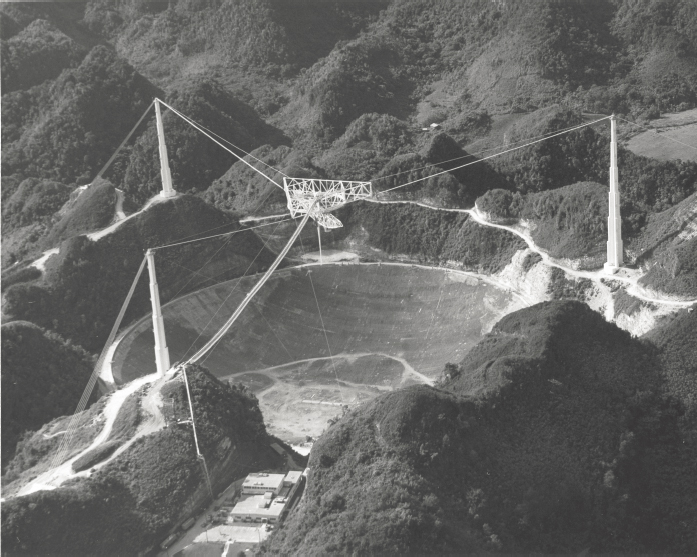
SOURCE: Cornell University, courtesy of AIP Emilio Segrè Visual Archives.
to a backstay anchorage.5 When the Arecibo Telescope was completed in 1963, its radar system was reported to be a “430 MHz system, pulsed transmitter, 2.5 MW peak, 150 kW maximum average power, which enabled the lunar radar mapping at 70 cm wavelength.”6
The Arecibo Telescope received two major upgrades in its lifetime that made significant changes to its structure and equipment. The first upgrade of the telescope was completed in 1974. It replaced the mesh surface of the telescope’s dish reflector with perforated aluminum panels, allowing for higher-frequency observations. The world’s largest radar transmitter was also upgraded with a new S-band radar consisting of a 2,380 MHz continuous wave (CW) transmitter, with a 2.5 MW peak and 450 kW average power.7 The upgrade allowed for S-band transmitting capabilities to improve the radar imaging resolution of the surface of Venus and other objects. The telescope’s platform after this first upgrade is shown in Figure 1-2.8
___________________
5 NESC Report.
6 T.W. Thompson, B.A. Campbell, and D.B.J. Bussey, 2016, “50 Years of Arecibo Lunar Radar Mapping,” URSI Radio Science Bulletin 2016(357):23–35, https://doi.org/10.23919/URSIRSB.2016.7909801, p. 27.
7 Microwave Journal, Volume 25, May 1982, pp. 111, 112, 114 (4 ff.).
8 TT Final Report, Appendix A, Figure 4, p. 4.

SOURCE: Thornton Tomasetti, 2022, Arecibo Telescope Collapse: Forensic Investigation, NN20209, prepared by J. Abruzzo, L. Cao, and P.E. Pierre Ghisbain, July 25, https://www.thorntontomasetti.com/sites/default/files/2022-08/TT-Arecibo-Forensic-Investigation-Report.pdf; modified from photo by Manfred Niermann, Wikipedia, CC BY-SA 4.0; courtesy of Thornton Tomasetti.
Between the first upgrade and the second, the Arecibo Telescope’s structure did not change significantly. Only one noteworthy event occurred between upgrades: the replacement of a backstay cable in 1981. A sixth broken wire was found at the ground end of this cable, pushing the observatory to replace the cable to prevent further wire breaks and potential cable failure.9 Wire breaks are discussed in more detail in Chapter 3.
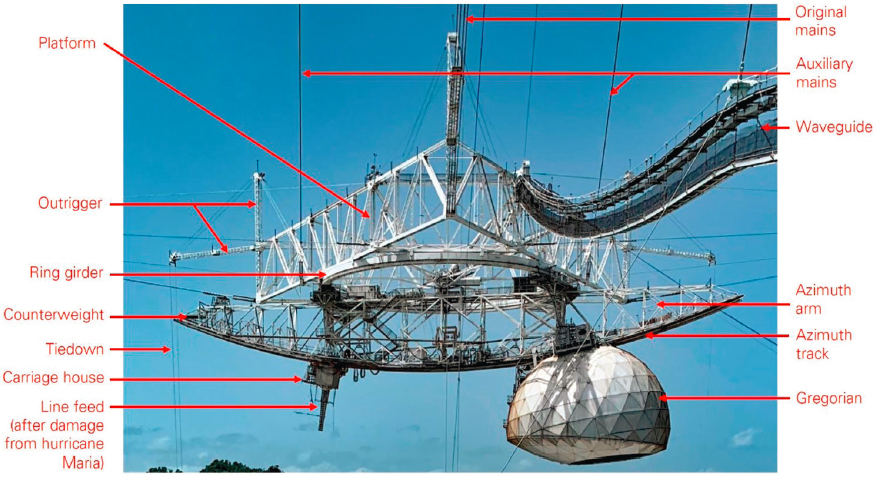
The Arecibo Telescope received a second upgrade, completed in 1997, that significantly changed its suspended structure and cable system. This upgrade involved the addition of the Gregorian dome to the rotatable truss (azimuth arm) below the suspended platform and a second line feed for the ionospheric radar.10 The Gregorian dome provided secondary and tertiary reflectors that corrected the dish’s spherical aberration and provided a multi-beam receiver.11 A more powerful 2,380 MHz CW, 1.0 MW maximum power, radar was installed.12 Since the Gregorian dome added significant weight to the structure—it was five times heavier than the removed carriage house—a counterweight was added to the azimuth arm opposite the Gregorian dome. Finally, 12 auxiliary cables were added to the original cable system. In total, the upgraded suspended platform weighed approximately 1.8 million pounds (~900 tons [short]). In addition, the inclined tie-downs were replaced with vertical tie-downs and linear actuators (jacks) to minimize the elevation fluctuation of the suspended structure during daily temperature cycles. The addition of these linear actuators increased the cable tensions slightly. A log of the tiedown forces recorded from 2004 indicated that the total tiedown force increased by an average of 60 kips at night under the combined effect of temperature and jack pulldown, which increased the tensions in the entire cable system. The original structure was only equipped with passive tiedown cables, and therefore, the impact of day-night cycles on cable tensions was less significant. “The combined effect of the additional tiedown tension and temperature drop is a 3 percent increase in the main and backstay cable tensions.”13
___________________
9 TT Final Report, Appendix C, p. 4.
10 Wiss, Janney, Elstner Associates (WJE), 2021, Auxiliary Main Cable Socket Failure Investigation, WJE No. 2020.5191, June 21 (hereafter “WJE Report”), p. 2.
11 P.A. Taylor and E. Rivera-Valentín, 2021, “Fall of an Icon: The Past, Present, and Future of Arecibo Observatory,” Lunar and Planetary Institute Information Bulletin, Issue 165.
12 T.W. Thompson, et al., 2016, “50 Years of Arecibo Lunar Radar Mapping,” p. 27.
13 TT Final Report, p. 28.
SOURCE: Thornton Tomasetti, 2022, Arecibo Telescope Collapse: Forensic Investigation, NN20209, prepared by J. Abruzzo, L. Cao, and P.E. Pierre Ghisbain, July 25, https://www.thorntontomasetti.com/sites/default/files/2022-08/TT-Arecibo-Forensic-Investigation-Report.pdf; modified from photo by Mario Roberto Durán Ortiz, Wikipedia, CC BY-SA 4.0; courtesy of Thornton Tomasetti.
After this upgrade, the Arecibo Telescope remained substantially unchanged until its collapse in 2020. Its suspended platform and overall configuration after the 1997 upgrade are shown in Figure 1-314 and Figure 1-4,15 respectively.
In 2006, NSF released its Astronomical Science Senior Review Committee Report16 analyzing NSF’s astronomy facilities. The report contained a recommendation to close the AO by 2011 unless other sources could be found to fund its operation.17 In 2011, NSF awarded management of the facility to SRI International with an NSF-reduced annual budget of $8 million and an additional $3.6 million provided by NASA. NSF proposed to reduce its contribution to $6.08 million (a reduction of 24 percent) by fiscal year (FY) 2019 in NSF’s FY2019 Budget Request to Congress.18 On April 1, 2018, the University of Central Florida (UCF) consortium officially took over the operation of the AO facility, with the commitment that “by October 1, 2022, NSF’s contribution will shrink to $2 million per year, with the UCF consortium making up the difference.”19 “Since Fiscal Year 2018, NSF has contributed around $7.5 million-per-year to Arecibo operations and management.”20
Months before UCF took over the operation of the AO, in September 2017, Hurricane Maria, then a Category 4 hurricane,21 struck Arecibo. While the AO’s weather station produced the only local available
___________________
14 TT Final Report, Appendix A, p. 5.
15 TT Final Report, Appendix A, Figure 1-5, p. 2.
16 NSF, 2006, “From the Ground Up: Balancing the NSF Astronomy Program,” Report of the National Science Foundation Division of Astronomical Sciences Senior Review Committee, October 22, https://www.nsf.gov/mps/ast/seniorreview/sr_report_mpsac_updated_12-1-06.pdf (hereafter “NSF Senior Review”).
17 NSF Senior Review, p. 6.
18 NSF, 2018, “FY 2019 NSF Budget Request to Congress,” February 28, https://new.nsf.gov/about/budget/fy2019, p. Facilities-7.
19 D. Clery and A. Cho, 2018, “Iconic Arecibo Radio Telescope Saved by University Consortium,” Science, February 22, https://www.science.org/content/article/iconic-arecibo-radio-telescope-saved-university-consortium.
20 NSF, “Arecibo: Facts and Figures,” p. 1.
21 H. Weitering, 2017, “Hurricane Maria Damages Parts of Puerto Rico’s Arecibo Observatory,” Space.com, September 22, https://www.space.com/38242-arecibo-observatory-hurricane-maria-damage.html.

SOURCE: Thornton Tomasetti, 2022, Arecibo Telescope Collapse: Forensic Investigation, NN20209, prepared by J. Abruzzo, L. Cao, and P.E. Pierre Ghisbain, July 25, https://www.thorntontomasetti.com/sites/default/files/2022-08/TT-Arecibo-Forensic-Investigation-Report.pdf; modified from photo by the National Science Foundation; courtesy of Thornton Tomasetti.
wind speed data, differing analyses have estimated differing peak wind speeds of 105 mph,22 108 mph,23 110 mph,24 110 mph,25 110 mph,26 and 118 mph.27 Most major structures of the Arecibo Telescope stood intact, but some of the damage included the loss of one of the line feeds on the antenna for one of the radar systems, as well as punctures in the telescope’s dish.28 Two million dollars were awarded in the summer of 2018, 9 months after Hurricane Maria, to UCF to be focused on repairs judged to be the most time-critical.29 The bulk of the funding ($12.3 million) for repairs was awarded in the summer of 2019;30 these funds did not cover Tower 4 cable replacement, which had not been identified as a critical need, but did include “Tower 8 spliced main cable replacement.”31
___________________
22 WJE Report, p. 6.
23 TT Final Report, p. 12.
24 WJE Report, p. 43.
25 TT Final Report, Appendix J, p. 1.
26 NESC Report, p. 100.
27 TT Final Report, Appendix J, p. 25.
28 S. Farukhi, 2017, “Latest USRA Update on Arecibo Observatory—September 22, 2017,” Newsroom, Universities Space Research Association, September 22, https://newsroom.usra.edu/latest--usra--update-on-arecibo-observatory.
29 A. VanderLey, 2022, “Arecibo Observatory: Failure Event Sequence,” National Science Foundation presentation to the committee, January 25 (hereafter “NSF presentation”), slide 13.
30 NSF presentation, slide 14.
31 NSF presentation.
On August 10, 2020, one of the auxiliary cables on Tower 4 pulled out of its socket. It struck the Gregorian dome and crashed onto the dish below.32 On November 6, another cable, one of the four main cables on Tower 4, failed.33 NSF announced its decision to decommission the Arecibo Telescope on November 19,34 and they stated that it would be closed in a controlled decommissioning. Finally, on December 1, the remaining cables on Tower 4 failed, and the suspended platform collapsed, smashing through the reflector.35 The collapse of the telescope is discussed in further detail in Chapter 2.
ARECIBO TELESCOPE CABLE SYSTEM
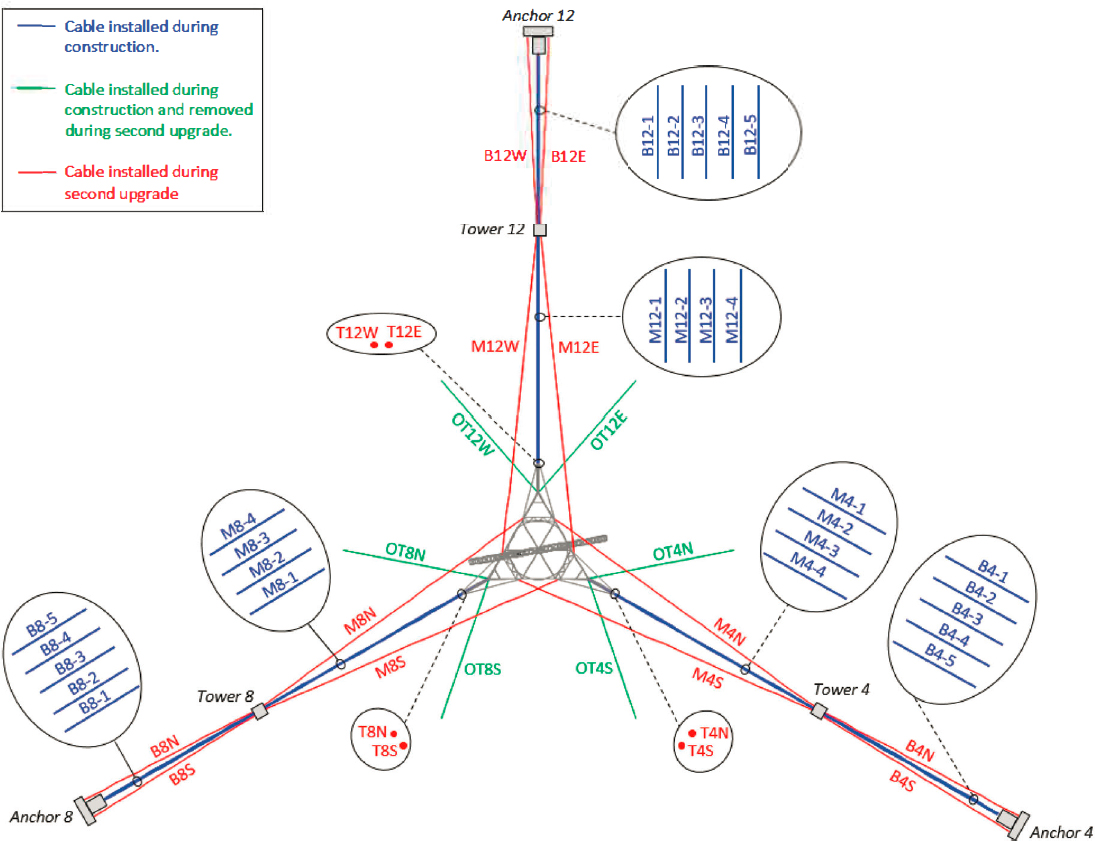
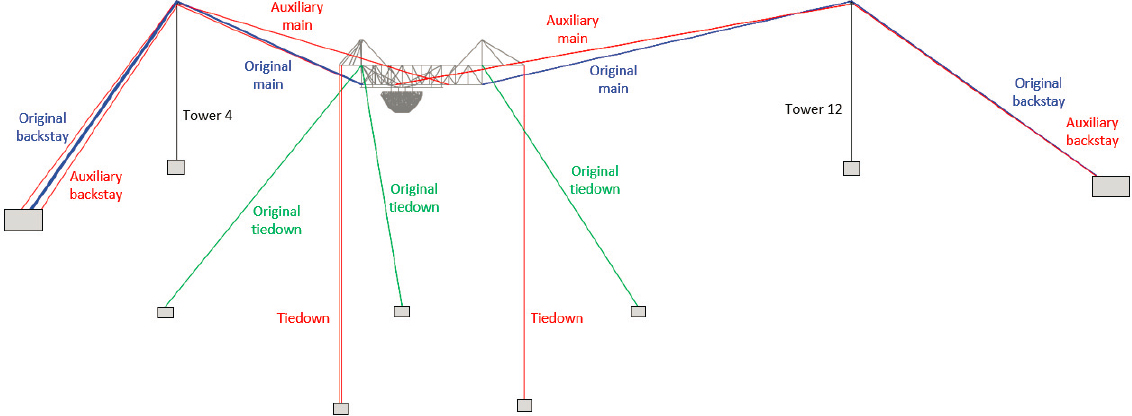
Since the cable system was at the center of the Arecibo Telescope’s collapse, a brief description of the cables and overall system is included here. The telescope’s platform was initially suspended by 12 main cables—4 for each of the 3 towers—and 5 backstay cables attached to each tower to a backstay anchorage behind the tower. In the 1997 upgrade, 12 auxiliary cables were added to the original 12 main cables—for each tower, 2 additional 713-foot-long auxiliary main cables were added to deal with the 40 percent subsequent increase in platform weight (now totaling 913 tons)36 resulting from the dome addition,37 as well as 2 additional auxiliary backstay cables from each tower to react to the additional loading from the new auxiliary platform cables.38 The auxiliary platform cables were isolated and did not run in parallel with the main cables. The main cables were attached to the triangular corners of the platform, and the newly installed auxiliary cables were attached along the respective reinforced transverse steel trusses. Arecibo Telescope’s cable nomenclature and geometry are illustrated and labeled in both the plan view shown in Figure 1-539 and the side view shown in Figure 1-6.40
The physical properties of the five different cable types that suspended the Arecibo Telescope after the 1997 upgrade are illustrated in Figure 1-7.41 As Figure 1-7 illustrates, an auxiliary main cable weighs 22 lb/ft, giving the 713-foot-long cable42 a total weight of ~15.7 kips.
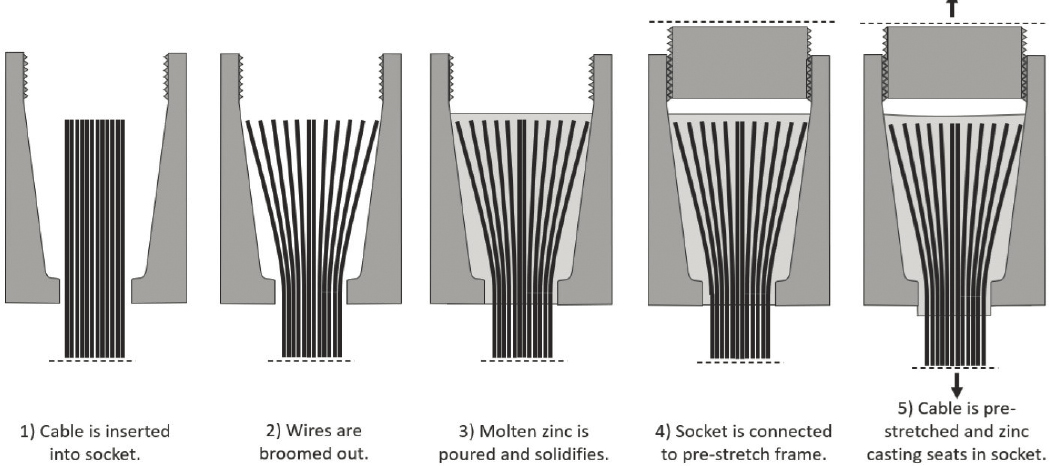
Each of these cables had zinc-filled spelter sockets at both ends.43 A spelter socket is a steel block with a cone-shaped cavity where the cable is inserted. The wires of the cable are spread out before the cavity is filled with molten zinc.44 A diagram of the cable “socketing” and pre-stretching is shown in Figure 1-8.
“The cable-socket assembly is not expected to fail before the cable. Samples of the auxiliary main and backstay cables were tested in 1993 before the second upgrade of the telescope. For both samples, the first wire ruptures occurred several feet away from the sockets and under a load higher than the cable’s Minimum Breaking Strength.”45 These zinc-filled spelter sockets are the key elements in the Arecibo Telescope’s failure and are discussed extensively in Chapter 3.
In engineering, the “safety factor” of a structure is the ratio of its strength to an intended load. More specifically, in cable structural design, the safety factor is “defined as the cable’s minimum breaking strength divided by its actual tension.”46 The Arecibo Telescope’s original cable system had an average safety factor of approximately 2.0 under the self-weight of the telescope, and 1.67 considering a 140-mph wind speed in addition to the dead
___________________
32 M. Williams, 2020, “An Update on the Damage to the Arecibo Observatory,” Universe Today, September 14, https://www.universetoday.com/147782/an-update-on-the-damage-to-the-arecibo-observatory.
33 TT Final Report, p. 13.
34 NSF presentation, slide 38.
35 TT Final Report, p. i.
36 J. Abruzzo, L. Cao, and P. Ghisbain, 2022, “Arecibo Observatory: Stabilization Efforts and Forensic Investigation,” Thornton Tomassetti, Inc., presentation to the committee, February 17, slide 12.
37 TT Final Report, p. 2.
38 TT Final Report, Appendix C, p. 8.
39 TT Final Report, Appendix A, Figure 7, p. 7.
40 TT Final Report, Appendix A, Figure 8, p. 7.
41 TT Final Report, Appendix A, Figure 1-9, p. 9.
42 WJE Report, p. 15.
43 TT Final Report, p. 5.
44 TT Final Report.
45 TT Final Report, p. 5.
46 TT Final Report, p. 6.
SOURCE: Thornton Tomasetti, 2022, Arecibo Telescope Collapse: Forensic Investigation, NN20209, prepared by J. Abruzzo, L. Cao, and P.E. Pierre Ghisbain, July 25, https://www.thorntontomasetti.com/sites/default/files/2022-08/TT-Arecibo-Forensic-Investigation-Report.pdf; courtesy of Thornton Tomasetti.
SOURCE: Thornton Tomasetti, 2022, Arecibo Telescope Collapse: Forensic Investigation, NN20209, prepared by J. Abruzzo, L. Cao, and P.E. Pierre Ghisbain, July 25, https://www.thorntontomasetti.com/sites/default/files/2022-08/TT-Arecibo-Forensic-Investigation-Report.pdf; courtesy of Thornton Tomasetti.

SOURCE: Thornton Tomasetti, 2022, Arecibo Telescope Collapse: Forensic Investigation, NN20209, prepared by J. Abruzzo, L. Cao, and P.E. Pierre Ghisbain, July 25, https://www.thorntontomasetti.com/sites/default/files/2022-08/TT-Arecibo-Forensic-Investigation-Report.pdf; courtesy of Thornton Tomasetti.
SOURCE: Thornton Tomasetti, 2022, Arecibo Telescope Collapse: Forensic Investigation, NN20209, prepared by J. Abruzzo, L. Cao, and P.E. Pierre Ghisbain, July 25, https://www.thorntontomasetti.com/sites/default/files/2022-08/TT-Arecibo-Forensic-Investigation-Report.pdf; courtesy of Thornton Tomasetti.
load. Following the telescope’s second upgrade, the average safety factor of the cable system was 2.25 under dead load and 2.15 during the design windstorm, which specified a wind speed of 110 mph.47
In addition to maintenance operations done on the telescope’s cable system by AO staff, the Engineer of Record Amman & Whitney (A&W) conducted structural inspections between 1972 and 2011. However, the scope of these inspections was reduced after the telescope’s 1997 upgrade.48 A&W noted in both of its 2003 and 2011 inspections of the Arecibo Telescope auxiliary main cables that “cable slip” had occurred in the auxiliary main and backstay cables: “the cast zinc of the spelter sockets had separated from the leading edge of the sockets by up to ½.”49 As described earlier, ⅜ inch of cable pullout was most likely due to fabrication and proof loading. A&W merged with and operated under the name Louis Berger, U.S., in 2016, which was later acquired by WSP Global, Inc., in 2018.
The 2006 NSF Astronomical Science Senior Review Committee Report50 explained, “The National Astronomy and Ionosphere Center (NAIC) is operated by Cornell University and runs the Arecibo Observatory. Its current budget is $12M comprising $10M from NSF/AST and $2M from NSF/Division of Atmospheric Sciences (ATM).”51 It contained a recommendation to close the Arecibo Observatory by 2011 unless other sources could be found to fund its operation.52 In 2011, NSF awarded management of the facility to SRI International with an NSF-reduced annual budget of $8 million and an additional $3.6 million provided by NASA. NSF proposed to reduce its contribution to $6.08 million (a reduction of 24 percent) by FY 2019 in NSF’s FY2019 Budget Request to Congress.53 On April 1, 2018, the UCF consortium officially took over the operation of the AO facility, with
___________________
47 TT Final Report, p. 7.
48 TT Final Report, p. 8.
49 Ammann & Whitney, 2011, Arecibo Radio Telescope Structural Condition Survey, Cornell University Archives, Arecibo Ionospheric Observatory Records #53-7-3581, Division of Rare and Manuscript Collections, Cornell University Library Box 37, Folder 8, March, Section 3.2.4, p. 3.
50 NSF, 2006, “From the Ground Up.”
51 NSF Senior Review.
52 NSF Senior Review, p. 6.
53 NSF, 2018, “FY 2019 NSF Budget Request to Congress,” February 28, https://new.nsf.gov/about/budget/fy2019, p. Facilities-7.
the commitment that “by October 1, 2022, NSF’s contribution will shrink to $2 million per year, with the UCF consortium making up the difference.”54
In September 2017, Hurricane Maria, then a Category 4 hurricane,55 struck Arecibo. Afterward, “The major structures including the 300-m telescope were intact, though suffered some damage when the atmospheric radar line feed broke off and falling debris from it punctured the dish in several places. A separate 12-m dish used as a phase reference for Very Long Baseline Interferometry was lost.”56 Also, “A 96-foot (29-m) antenna that was suspended above the telescope’s 1,000-foot (305-m) dish was lost as a result of the hurricane.”57 The Arecibo Telescope was inspected and $2 million were awarded in the summer of 2018 to UCF to be focused on repairs judged to be the most time-critical.58 Repairs to the transmitter were ongoing in 2020 when the COVID-19 pandemic hit.
On August 10, 2020, one of the auxiliary cables, M4N-T, attached to the top of Tower 4, pulled out of its socket. It struck the Gregorian dome and crashed onto the dish below.59 On November 6, one of the four main cables on Tower 4 failed.60 On November 19, NSF announced its decision to decommission the Arecibo Telescope61 and that it would be closed in a controlled decommissioning. On December 1, the remaining cables on Tower 4 failed, and the 913-ton platform62 collapsed, swung across the dish, and smashed through the reflector.63
The two cable failures that occurred before the collapse and the third cable failure that triggered the collapse all happened near or within zinc-filled spelter sockets at cable ends. No cable failed away from a socket before the collapse. Each failure involved the rupture of some of the cable’s wires and a deformation of the socket’s zinc and is, therefore, the failure of cable-socket assembly.64
While the cable system was designed with safety factors greater than 2, the telescope collapsed after the failure of several cable-socket assemblies.65
STATEMENT OF TASK
This report fulfills the statement of task reprinted in Box 1-1. The committee relied on laboratory testing, analyses, and the excellent graphics and illustrations in three forensic reports. These reports were conducted by Wiss, Janney, Elstner Associates, Inc., Auxiliary Main Cable Socket Failure Investigation—Final Report (2021),66 NASA Engineering and Safety Center Arecibo Observatory Auxiliary M4N Socket Termination Failure Investigation (2021),67 and Thornton Tomasetti, Inc., Arecibo Telescope Collapse: Forensic Investigation (2022).68 In addition to these reports, the committee gathered information from engineering research literature as well as presentations from NSF staff, AO staff, the forensic investigation teams, and structural engineering experts. The committee reviewed inspection reports and photographs and Arecibo Telescope engineering design and repair documents. Lastly, National Academies policy and procedure allows for technical or descriptive portions of text to be reviewed for accuracy by the sponsor, relevant organization, or a content expert. Due to the technical complexity of this report, before the report was finalized, NSF was provided an opportunity to review the text and suggest corrections of any perceived technical inaccuracies or factual errors.
___________________
54 D. Clery and A. Cho, 2018, “Iconic Arecibo Radio Telescope Saved by University Consortium,” Science, February 22, https://www.science.org/content/article/iconic-arecibo-radio-telescope-saved-university-consortium.
55 Weitering, 2017, “Hurricane Maria Damages Parts of Puerto Rico’s Arecibo Observatory.”
56 Farukhi, 2017, “Latest USRA Update on Arecibo Observatory—September 22, 2017.”
57 Weitering, 2017, “Hurricane Maria Damages Parts of Puerto Rico’s Arecibo Observatory.”
58 NSF presentation, slide 13.
59 Williams, 2020, “An Update on the Damage to the Arecibo Observatory.”
60 TT Final Report, p. 13.
61 NSF presentation, slide 38.
62 TT Final Report, p. i.
63 TT Final Report.
64 TT Final Report, p. 1.
65 TT Final Report, p. 15.
66 WJE Report.
67 NESC Report.
68 TT Final Report.
BOX 1-1
Statement of Task
At the request of the Director of the National Science Foundation, the National Academies of Sciences, Engineering, and Medicine will convene an ad hoc study committee to conduct a review of the failure and collapse of the 305-Meter Telescope at the Arecibo Observatory in Puerto Rico. The committee will issue a report explaining the contributing factors and probable cause(s) of the failure and recommendations for measures to prevent similar damage to other facilities in the future. The committee will assess the environmental, physical, and design considerations as well as any administrative or management practices that may have been contributing factors to the failure and include the following tasks:
- Examine the performance of the structures related to:
- Engineering design and material specification for original and subsequent upgrades;
- Documented construction procedures and contractor performance;
- Environmental conditions, loading events (e.g., wind, seismic, multi-hazard), corrosion;
- Maintenance, repair, and recapitalization activities for the telescope;
- Assess oversight and management policies and practices that may have been contributing factors to the failure, including:
- Contractor selection and procurement during construction and repair;
- Maintenance planning and oversight;
- Routine inspection and structural review;
- Identify lessons learned for NSF in general for oversight and response actions for other large facilities physical condition, integrity, and function, including end-of-life considerations; and
- Identify and recommend actions or general best practices for consideration to limit or prevent other large facility engineering failure or damage at other large NSF facilities that would significantly impact ongoing science.


