Innovative Materials in Water Resources Infrastructure: Opportunities for the Corps of Engineers (2026)
Chapter: 5 Opportunities for Innovative Materials: High-Performance Concrete
5
Opportunities for Innovative Materials: High-Performance Concrete
Over the past five decades, the use of high-performance concretes (HPCs) in constructed facilities has grown significantly, driven by the superior properties of these materials compared to conventional concrete. As described in Chapter 1, HPCs are also of priority interest to the U.S. Army Corps of Engineers (USACE). These advanced concretes offer compressive strengths two to six times greater than that of ordinary portland cement (OPC) concrete; enhanced durability, crack resistance, and blast resistance (higher ductility due to fiber inclusion); low permeability; and self-healing capabilities.1 These attributes make HPCs potential candidates for a wide range of USACE civil works, including inland navigation and flood risk management infrastructure.
This chapter introduces HPCs, highlighting high-strength concrete (HSC) and ultra-high-performance concrete (UHPC) as of particular relevance to USACE’s civil works infrastructure. The chapter then discusses experience with UHPC in other domains as well as the use of corrosion-resistant reinforcements in UHPC applications in bridges. The chapter concludes with a review of USACE experience with UHPC and consideration of additional opportunities and knowledge gaps.
___________________
1 American Cement Association. “Applications of Cement.” https://www.cement.org/cement-concrete/applications-of-cement. Accessed June 17, 2025.
OVERVIEW OF HIGH-PERFORMANCE CONCRETES
HPCs are designed to improve upon the performance of OPC concrete, including its compressive strength, ductility, permeability, or durability. Table 5-1 provides a comparison of the properties of HPCs and OPC. As different organizations have adopted different strength ranges for the various types of concrete, the strength ranges listed in Table 5-1 are approximate and reflect the definitions of various organizations. OPC concrete has a typical compressive strength in the range of 2,500–4,000 pound-force per square inch (psi) and low ductility. OPC concrete also has high permeability, meaning that water, air, and other liquids or gases can easily pass through the concrete. High permeability can reduce durability. HPCs substitute or supplement different cementitious (binding) materials for the portland cement and/or use different fillers in place of OPC concrete’s standard aggregate. In infrastructure applications, HPCs can reduce material usage, increase durability, and improve the ability to withstand higher loads (stresses). For example, blended cement concretes substitute specified percentages of OPC with supplementary cementitious materials (SCMs), such as silica fume, fly ash, or slag. These SCMs can improve concrete’s strength and durability, improve workability, reduce water demand (for fly ash), and increase sustainability by using recycled and waste materials instead of energy-intensive portland cement.
Fiber-reinforced concretes (FRCs) of various types have been developed in the past three decades; FRCs use steel fibers to improve concrete properties including flexural strength, shear strength, spalling resistance, and ductility. FRC may also incorporate nonmetallic synthetic fibers such as polypropylene. Although these fibers do not significantly enhance tensile strength, they are effective at controlling plastic shrinkage and microcracking. However, high-strength steel fibers are of particular interest due to their ability to provide the enhanced mechanical properties discussed. Engineered cementitious composites (ECCs) are a special class of FRC that eliminates the use of larger aggregates, incorporates polymeric fibers, and optimizes the microstructural behavior to achieve high ductility in tension.
Geopolymer concretes take advantage of the reactivity of certain earth materials (processed and unprocessed) that show binding characteristics in the presence of an alkaline environment. Certain SCMs also behave in a similar way, showing binding characteristics when exposed to the alkalinity provided by cement. Geopolymer concrete is a relatively new topic for research due to its high potential for sustainable use of abundantly available earth materials.
HSCs have a designated compressive strength higher than 8,000 psi (ACI Committee 363 2005). HSC uses higher binder content to achieve these higher strengths. ECCs, geopolymer concretes, and other FRC can be
formulated as high-strength concretes, with compression strength above 8,000 psi, and certain FRC types can have compressive strengths up to 15,000 psi. UHPC, defined as concrete with a compressive strength higher than 17,000 psi, also uses a high binder content. In addition, coarse aggregates are typically eliminated in UHPC, and the fine aggregates are optimized to achieve a dense compaction. SCMs are used in HSC for several important mechanical, durability, and sustainability reasons. These include reduced porosity and permeability, leading to higher strengths; enhanced durability and corrosion resistance due to a densified microstructure; and reduced heat of hydration, minimizing cracking and improving the dimensional stability of massive or dense elements. SCMs also improve workability and rheology. The use of SCMs and fine filler materials is typical in UHPCs. Steel fibers are also commonly used in UHPC to improve strength and ductility.
The final type of HPC included in Table 5-1 is self-healing concrete. Recent research on self-healing concrete seeks to overcome concrete’s inherent cracking problem due to its quasi-brittle nature. Self-healing allows concrete to close or bind cracks. Self-healing mechanisms under investigation include autonomous (microbial-based and encapsulation-based) and autogenous (through additives that react over time) mechanisms (Sohail et al. 2018, 2021). Although self-healing concrete mechanisms have the potential to lengthen the lifespan of structures, there are very few performance data for evaluation of applications in the field.
Evolution of UHPC and HSC
The development of high- and ultra-high-performance concretes dates back to the early 1980s, and the term UHPC was first coined in 1994 (de Larrard and Sedran 1994). USACE was among the very first to conduct research on UHPC in the late 1980s (Green et al. 2015). In the early studies, high strength could only be achieved using compaction pressure (roughly 7.5 ksi) and high temperatures (250–400°C). Steel or other high-strength aggregates were used. However, the intensive production process made it difficult to use UHPC in many applications. Macro-defect-free cement was developed in the early 1980s using a low water-to-binder ratio and particle packing (Kendall et al. 1983). These same principles underlie the UHPC being produced today. Several other variants then followed, including the dense silica particle cement and slurry infiltrated fiber concrete (Lan Kar 1984). Starting in the 1990s, the main advancements were the development of more effective high-range water reducers (HRWRs) and of reactive powder concrete (Richard and Cheyrezy 1995). Since the beginning of the 2000s, research has focused on reducing the environmental impacts of UHPC and incorporating additional characteristics such as self-healing and self-sensing. By
TABLE 5-1 Characteristics of High-Performance Concretes in Comparison to Ordinary Portland Cement Concrete
| Material | Composition | Compressive Strength (ksi) | Ductility | Permeability | Durability Characteristics | Applications |
|---|---|---|---|---|---|---|
| Ordinary portland cement concrete | Cement, sand, gravel, water, admixtures (optional) | 2.5–8 | Low | High | Moderate sulfate resistance, susceptible to corrosion | Common construction material |
| Blended cement concrete | Cement, fly ash, slag, silica fume, other SCMs | 2.5–8 | Low | Moderate | Higher sulfate, ASR, and chloride resistance; lower heat of hydration | Improves sustainability by reducing OPC content |
| High-strength concrete | Cement, sand, gravel, admixtures | 8–17 | Moderate | Low | High sulfate and chloride resistance, high heat of hydration, prone to shrinkage | High-rise buildings, bridges, and load-bearing structures with high stress |
| Ultra-high-performance concrete | Cement, silica fume, micro- and nano-fillers, fibers, admixtures | >17 | High | Very low | Excellent overall durability, high sulfate and chloride resistance, high heat of hydration, prone to shrinkage with low fiber content | Bridges, precast members, impact- and blast-resistant structures, structures subjected to extreme environments |
| Engineered cementitious composites | Cement, sand, polymeric fibers, fly ash, silica fume | 5–12 | Very high | Low | Multiple cracks with reduced crack widths, autogenous self-healing characteristics | Seismic-resistant structures, bridge decks, thin-walled structures |
| Geopolymer concrete | Fly ash, slag, calcinated clays, natural clays, alkali activators | 4–6 | Low to moderate | Low to moderate | Excellent chemical and acid resistance | Eco-friendly alternative to concrete, fire-resistant structures; field applications very limited |
| Fiber-reinforced concrete | Cement, sand, gravel, steel fibers | 4–15 | High | Low to moderate | Improved freeze-thaw, abrasion, and shrinkage resistance | Seismic structures, pavements, industrial floors |
| Self-healing concretes | Cement composites with bio-based or other healing agents | 2.5–8 | Moderate | Low | Self-repairing cracks, potential to improve lifespan of structures, little to no field data | Long-term durability in marine and infrastructure applications |
NOTE: ASR = alkali-silica reactivity; ksi = kilipound-force per square inch, strength ranges are approximate, vary from source to source, and are subject to change over time as further developments are made with these materials; OPC = ordinary portland cement; SCM = supplementary cementitious materials.
2013 it had become increasingly common to use HSC and UHPC, particularly in transportation projects, to take advantage of the materials’ ability to resist higher stress, thereby reducing the use of materials and improving efficiency (FHWA 2013).
UHPC is particularly well suited for precast and prefabricated applications, where the controlled manufacturing environment ensures optimal curing, quality assurance, and dimensional precision. However, the high material and production costs associated with UHPC remain a limiting factor for widespread use in conventional construction. Therefore, its application is often most economically and functionally justified in localized, performance-critical components, where its exceptional strength, durability, and resilience provide measurable life-cycle benefits that outweigh the initial cost. Examples include use as a connection or joint material due to its high bond strength with other materials such as conventional concrete. At the same time, there are existing examples of UHPC used for pavement repairs as a thin overlay, providing waterproofing and structural support while achieving significant strength quickly, thereby extending the service life of road surfaces and reducing traffic closures.
The basic UHPC design mechanisms include strength-enhancement and porosity-reduction strategies to achieve superior mechanical and durability performance. Reduced pore size, disconnected pore structure, and an overall shift of voids to smaller sizes results in an improved particle packing density. This is achieved by a well-graded mixture of fine aggregates, cement, SCM, and fillers such as silica fume and limestone powder. Although there are several methods for optimizing particle size distribution, the Andreasen and Andersen (1930) particle packing model is most commonly used. A higher packing density results in a more compact matrix with fewer defects, thus improving compressive, flexural, and tensile strength. However, a balance between workability and strength is desired because excessive fine particles will result in a high water demand and agglomeration during mixing, especially in the presence of fibers.
Another important mechanism for designing UHPC is the appropriate control of hydration to keep the porosity low. The water-to-binder (w/b) ratio is typically less than 0.25. While the workability of the concrete is reduced with lowered w/b ratios, the use of HRWRs counterbalances this effect to a good extent.
The other important aspect is that SCMs such as silica fume, fly ash, and rice husk ash provide seeds for pozzolanic activity, thereby increasing the amounts of the main strength-providing agent, calcium silicate hydrate gel, a phenomenon that can also be enhanced and result in early-age higher strength and therefore a denser microstructure through heat curing and pressure (see earlier discussion).
The ability to control cracking in UHPC is one of the essential features to increase the durability of load-bearing structural components. Fiber distribution and orientation contribute to both tensile strength and post-crack behavior. Generally, UHPC uses steel fibers that bridge the microcracks and increase energy absorption and thus delay sudden brittle failure. Optimized fiber distribution allows for homogeneous reinforcement throughout the matrix; controlled orientation through methods of casting or extrusion techniques aligns fibers along high-stress paths suitably for improved mechanical characteristics. Additionally, crack width control is critical to avoid water ingress and corrosion. Synthetic fibers promote the maintenance of microcrack distribution below 100 micrometers, improving durability. In this context, the addition of viscosity-modifying admixtures (VMAs) improves workability and allows for homogeneous fiber distribution. VMAs form a stable gel-like network that retains water, reducing segregation and fiber settlement. Shrinkage-reducing admixtures reduce autogenous shrinkage by decreasing surface tension in pore solutions. Expansive agents, on the other hand, such as magnesium oxide (MgO), counterbalance shrinkage through controlled expansion over time.
UHPC and HSC thus are well researched and tested, and their development and application remain rapid. Several professional organizations including AASHTO, ASTM, and the American Concrete Institute are continually developing technical notes, guides, and standards on high-performance cement composites including UHPC and HSC (e.g., AASHTO 2021).
EXAMPLES FROM OTHER DOMAINS
UHPC has been used for various applications including buildings, bridges, and other structures. For bridges, the first application of UHPC was in 1997 in Sherbrooke, Canada, for a prestressed pedestrian bridge over the Magog River (see Figure 5-1), and bridges continue to be the most commonly used UHPC application. UHPC has also been used in shear connectors and decks, in joints in accelerated bridge construction, in prestressed girders, and for jacketing of columns in repair and retrofit applications. A recent example of UHPC use in bridges is the Delaware Memorial Bridge’s deck rehabilitation project, completed in 2023.2 UHPC was used as an overlay on the entire bridge deck to improve longevity and reduce maintenance costs. Also in 2023 the USACE Tulsa District completed a UHPC overlay of the Eufaula Dam, Oklahoma spillway bridge deck. In buildings, UHPC is commonly used as cladding elements because it allows for thin geometry
___________________
2 Delaware River & Bay Authority. “Construction Projects: Delaware Memorial Bridget: Complete Deck Rehabilitation Project.” https://www.delawarememorialbridge.com/dmb-ultra-high-performance-concrete-project. Accessed July 22, 2025.

NOTES: This is the first application of UHPC in bridges with a 197-foot span open-web truss structure. UHPC is used in both the top and bottom chords as well as in the truss diagonals.
SOURCE: FHWA 2009.
while maintaining structural strength. Additional examples of applications in bridges and buildings are provided in Figure 5-2.
Other applications of UHPC include tunnels, wind turbine towers, nuclear power plants, and stadiums. Using UHPC in tunnels takes advantage of UHPC’s low permeability and high strength. Using very-high-strength UHPC for wind turbine towers reduces material use and cross-sectional geometry. Nuclear power plants use UHPC for its radiation shielding and blast-resistance characteristics. The Jean Bouin Stadium in Paris, France, uses UHPC panels in its facades to reduce weight and improve durability to weathering.
Corrosion-resistant reinforcement for prestressing concrete is another promising material that can further leverage the use of UHPC and/or HPC composites. The National Cooperative Highway Research Program (NCHRP) has funded research efforts to standardize the use of corrosion-resistant reinforcements, specifically, carbon-fiber-reinforced polymers (CFRPs) and stainless steel for prestressing applications. NCHRP project 12-97, completed in 2018, has informed the guidelines for the design of bridge girders using prestressing CFRP (NASEM 2019). These specifications can be extended to other structural members, including concrete components of water resources infrastructure, with relatively minimal research effort. NCHRP project 12-120, completed in 2025, is extending the use of stainless steel in bridge elements (NASEM 2025). Several of these elements have similarities to components in inland water navigation infrastructure. Prestressed UHPC components can potentially result in cost savings while

NOTE: Upper-left, precast waffle bridge deck panels; upper-right, double-T bridge deck girder; lower-left, UHPC cladding panels used in the Qatar National Museum; and lower-right, 4-m-tall UHPC pier built through 3D printing.
SOURCE: Du et al. 2021.
prolonging the life of structures that are prone to corrosion-induced deterioration. UHPC combined with corrosion-resistant reinforcement has the potential to extend lifetimes of structures by several-fold, as reported in recent studies (Fan et al. 2024).
USACE EXPERIENCE AND OPPORTUNITIES
USACE is currently using UHPC for inland navigation lock walls and mass concreting, although much of the advanced concrete expertise is concentrated at the Engineer Research and Development Center (ERDC), supplemented by a limited number of experienced engineers scattered throughout the Civil Works field offices.3
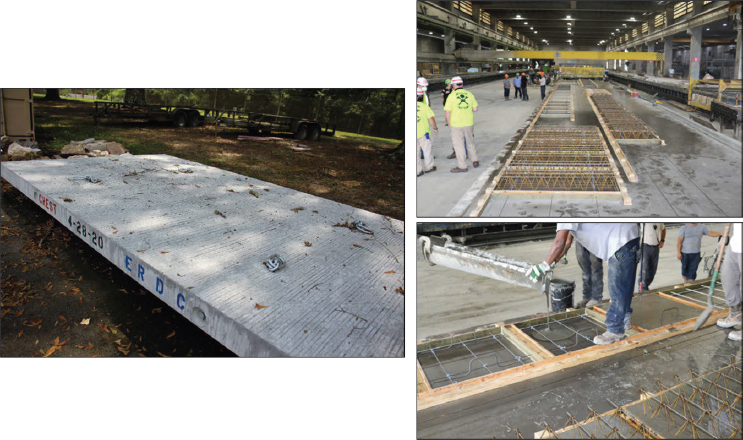
For inland navigation lock walls, USACE has conducted research on using UHPC to replace precast normal-strength concrete panels in instances in which the embedded steel reinforcement has corroded under cyclic drying and wetting (see Figure 5-3). In addition to being significantly more durable,
___________________
3 Brian Lucarelli, USACE, presentation to the committee, October 21, 2024.

SOURCE: Courtesy of Stephanie Wood, USACE, from Ministry of Transport, Public Works and Water Management of the Netherlands Technical Group Meeting, October 13, 2022.
precast UHPC panels offer significant advantages such as being lighter and not requiring embedded steel armor. USACE utilizes both proprietary and commercial HPC mixtures for its navigation lock structures. For example, the “Lock-Tuf” design mixture uses locally available aggregates and has over 20,000-psi compressive strength and over 2,500-psi tensile strength (ERDC 2023). USACE included guidance on UHPC when updating Engineering Manual 1110-2-2000: Standard Practice for Concrete for Civil Works Structures (USACE 1994). USACE has studied using precast UHPC panels to replace aging precast normal-strength concrete panels (see Figure 5-4). USACE research has shown that these precast UHPC panels offer, at a cost similar to that of conventional concrete, advantages including impact resistance, flexural strength, and weight savings. As seen in Table 5-2, in comparison to conventional concrete, the use of precast UHPC panels reduces the panel thickness and material usage, eliminates external armor requirements, and increases the number of panels that can be shipped per truck. The essentially same production cost coupled with other advantages (weight, shipping, etc.) indicate that UHPC will provide a lower initial cost on an installed basis for the lock wall application presented in Table 5-2. The example illustrates the potential for UHPC to provide initial cost savings. Additionally, when the higher performance of UHPC is considered with the high potential to extend lifetime and reduce repair or maintenance costs, life-cycle cost studies become increasingly important to evaluate comprehensively the overall financial implications of using UHPC.
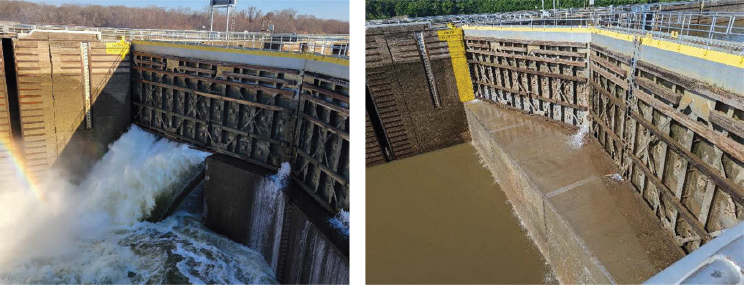
Another application of interest is mass concrete. HSCs and UHPCs can be used to replace mass concrete when the main interest is structural strength. However, because of typically higher cement content in UHPC and
SOURCE: Courtesy of Stephanie Wood, USACE, from Ministry of Transport, Public Works and Water Management of the Netherlands Technical Group Meeting, October 13, 2022.
TABLE 5-2 Comparison of Conventional Concrete and Ultra-High-Performance Concrete Precast Panels for Lock Walls
| Panel Characteristics | Conventional Concrete | UHPC |
|---|---|---|
| Production, $/panela | $8,800 | $9,000 |
| Size | 20 ft × 8.5 ft × 6.5 in. | 30 ft × 10 ft × 3 in. |
| Concrete required per panelb | 3.15 yd3 | 1.57 yd3 |
| Weightb,c | 13,815 lb | 6,500 lb |
| External armor required | Yes | No |
| Internal conventional steel reinforcement | No. 6 bars at 12 in. OC | No. 3 bars at 12 in. OC |
| Shipping logistics | 4 panels/truck | 6 panels/truck |
| Estimated lifespand | 50 years | 200 years |
a Cost ($US in 2022) based on different panel sizes with dimensions provided in next row.
b Based on panel with dimensions 20 ft × 8.5 ft × thickness to provide equivalent comparison. Assumes concrete occupies entire volume. Steel armor is neglected in conventional panel.
c Approximate densities: conventional = 150 lb/ft3; UHPC = 153 lb/ft3.
d Lifespan of conventional concrete panels based on USACE case histories and rehabilitation schedules. Lifespan of UHPC based on documented durability and completed laboratory study.
NOTE: OC = on center; UPHC = ultra-high-performance concrete.
SOURCE: Courtesy of Stephanie Wood, USACE, from Ministry of Transport, Public Works and Water Management of the Netherlands Technical Group Meeting. October 13, 2022.
HSC, temperature control in mass concrete applications should be carefully considered. Mass concrete applications can benefit from the higher strength of these higher-performance materials by reducing the structural dimensions and hence material usage, and in some cases, the reduced dimensions can help with heat dissipation and hence ease the mass concrete placement challenges. Additionally, because of high shear and flexural strength of UHPC, reinforcement can be reduced to avoid congestion. Some examples of mass concreting by USACE are shown in Figure 5-5.
Underwater concrete applications are of great importance to USACE (Yao et al. 1999) and serve as an opportunity for expanded use of UHPC in USACE water resources infrastructure. UHPC’s higher density achieved through particle compaction, high flowability, and rapid curing characteristics as well as higher strength could be beneficial for underwater applications (see, e.g., Figure 5-6). Especially for emergency repairs requiring strengthening, the quick strength gain and the high strength of UHPC can be more resilient in unforeseen situations and allow for quick reopening of a waterway.
Another potential area of interest for USACE is the use of high-strength steel reinforcement in HSC and UHPC. The high strength of these cementitious materials makes it challenging in certain applications to reinforce with traditional mild steels. In addition to the concerns related to durability, adding flexural and shear capacity as well as confinement become challenging with lower-strength reinforcing bars. The use of higher-strength steel reinforcement reaching and exceeding a yield strength of 100,000 psi could increase the effectiveness and extend the application of HPCs.

SOURCE: Brian Lucarelli, USACE Pittsburgh District, presentation to the committee, October 21, 2024.
SOURCE: Brian Lucarelli, USACE Pittsburgh District, presentation to the committee, October 21, 2024.
SUMMARY
- HPC materials (HSC and UHPC) are well researched and their application is a rapidly developing field.
- Benefits of HSC and UHPC have been demonstrated, including high strength, durability, impact and abrasion resistance, and crack control.
- There are numerous applications of HSC and UHPC in other domains, such as transportation infrastructure and buildings.
- There has been research on HSC and UHPC at ERDC laboratories, and applications for lock walls and replacement of mass concrete, but knowledge transfer to and applications by the districts have been limited.
- There are potential cost savings with the use of HSC and UHPC in water resources infrastructure.
REFERENCES
AASHTO (American Association of State Highway Transportation Officials). 2021. Guide Specifications for Structural Design with Ultra-High Performance Concrete (UHPC), 1st ed. Washington, DC.
ACI Committee 363. 2005. “High-Strength Concrete (ACI 363R).” ACI Symposium Publication 228, June. https://doi.org/10.14359/14461.
Andreasen, A. H. M., and J. Andersen. 1930. “Über die Beziehung zwischen Kornabstufung und Zwischenraum in Produkten aus losen Körnern (mit einigen Experimenten).” Colloid and Polymer Science 50(3):217–228 (in German).
de Larrard, F., and T. Sedran. 1994. “Optimization of Ultra-High-Performance Concrete by the Use of a Packing Model.” Cement and Concrete Research 24(6):997–1009.
Du, J., W. Meng, K. H. Khayat, Y. Bao, P. Guo, Z. Lyu, A. Abu-obeidah, H. Nassif, and H. Wang. 2021. “New Development of Ultra-High-Performance Concrete (UHPC).” Composites Part B: Engineering 224:109220.
ERDC (Engineer Research and Development Center). 2023. Development and Characterization of Ultra-High-Performance Concrete for the Rehabilitation of Navigation Lock Structures (ERDC/GSL TR-23-16). Navigation Systems Research Program, U.S. Army Corps of Engineers. https://dx.doi.org/10.21079/11681/47684.
Fan, J., Y. Shao, M. J. Bandelt, M. P. Adams, and C. P. Ostertag. 2024. “Sustainable Reinforced Concrete Design: The Role of Ultra-High Performance Concrete (UHPC) in Life-Cycle Structural Performance and Environmental Impacts.” Engineering Structures 316:118585.
FHWA (Federal Highway Administration). 2009. “Executive Summary: Completed North American Ductal® Bridges.” Highways for Life. October. https://www.fhwa.dot.gov/hfl/innovations/uhpc_bridges_in_north_america.cfm.
FHWA. 2013. An Overview of the Safety Focused Projects in the FHWA Office of Safety R&D (Report No. FHWA-HRT-13-060). U.S. Department of Transportation. https://highways.dot.gov/sites/fhwa.dot.gov/files/FHWA-HRT-13-060.pdf.
Green, B. H., R. D. Moser, D. A. Scott, and W. R. Long. 2015. “Ultra-High Performance Concrete History and Usage by the Corps of Engineers.” Advances in Civil Engineering Materials 4(2):132–143.
Kendall, K., A. J. Howard, and J. D. Birchall. 1983. “The Relation Between Porosity, Micro-structure and Strength, and the Approach to Advanced Cement-Based Materials.” Philosophical Transactions of the Royal Society A: Mathematical, Physical and Engineering Sciences 310(1511):139–153.
Lan Kar, D. R. 1984. “Properties, Applications: Slurry Infiltrated Fiber Concrete (SIFCON).” Concrete International 6(12):44–47.
NASEM (National Academies of Sciences, Engineering, and Medicine). 2019. Design of Concrete Bridge Beams Prestressed with CFRP Systems (NCHRP Research Report 907). Washington, DC: The National Academies Press. https://doi.org/10.17226/25582.
NASEM. 2025. Stainless Steel Strands for Prestressed Concrete Bridge Elements. Washington, DC: The National Academies Press. https://doi.org/10.17226/29245.
Richard, P., and M. Cheyrezy. 1995. “Composition of Reactive Powder Concretes.” Cement and Concrete Research 25(7):1501–1511.
Sohail, M. G., B. Wang, A. Jain, R. Kahraman, N. G. Ozerkan, B. Gencturk, M. Dawood, and A. Belarbi 2018. “Advancements in Concrete Mix Designs: High-Performance and Ultrahigh-Performance Concretes from 1970 to 2016.” ASCE Journal of Materials in Civil Engineering 30(3):04017310.
Sohail, M. G., R. Kahraman, N. Al Nuaimi, B. Gencturk, and W. Alnahhal. 2021. “Durability Characteristics of High and Ultra-High Performance Concretes.” Journal of Building Engineering. 33(January):101669.
USACE (U.S. Army Corps of Engineers). 1994. Standard Practice for Concrete for Civil Works Structures (Engineer Manual 1110-2-2000). https://www.publications.usace.army.mil/Portals/76/Publications/EngineerManuals/EM_1110-2-2000.pdf.
Yao, S. X., D. E. Berner, and B. C. Gerwick. 1999. Assessment of Underwater Concrete Technologies for in-the-Wet Construction of Navigation Structures (Technical Report INP-SL-1). U.S. Army Corps of Engineers. https://apps.dtic.mil/sti/pdfs/ADA369259.pdf.


