Public Transit Workforce Development for Zero-Emission Vehicles (2025)
Chapter: Appendix A: Methodology

APPENDIX A
Methodology
The goal of this research was to provide answers to the following questions:
- How prepared is the public transportation industry workforce in the United States to introduce, implement, and sustain zero-emission fleets and technologies?
- How will introducing and expanding zero-emission fleets affect employee job skills and workforce requirements, especially in operations and maintenance?
- How are public transportation agencies addressing recruitment, training, retraining, and retention of new hires as well as seasoned employees as zero-emission fleets and technologies are implemented and expanded?
- Which domestic and international public transportation agencies are at the forefront of innovation and success in adapting to new job skill requirements for zero-emission fleets and technologies? How has their success been achieved? What key challenges have they faced? What are the key lessons learned?
- What traditional and innovative training approaches are being applied to foster holistic, safe, and comprehensive training regarding zero-emission fleets and technologies? What training approaches should be added to achieve better outcomes?
- What are OEMs doing to support their clients and how are public transportation agencies securing near- and longer-term commitments from OEMs in all facets of implementation, operations, and training of zero-emission fleets and technologies?
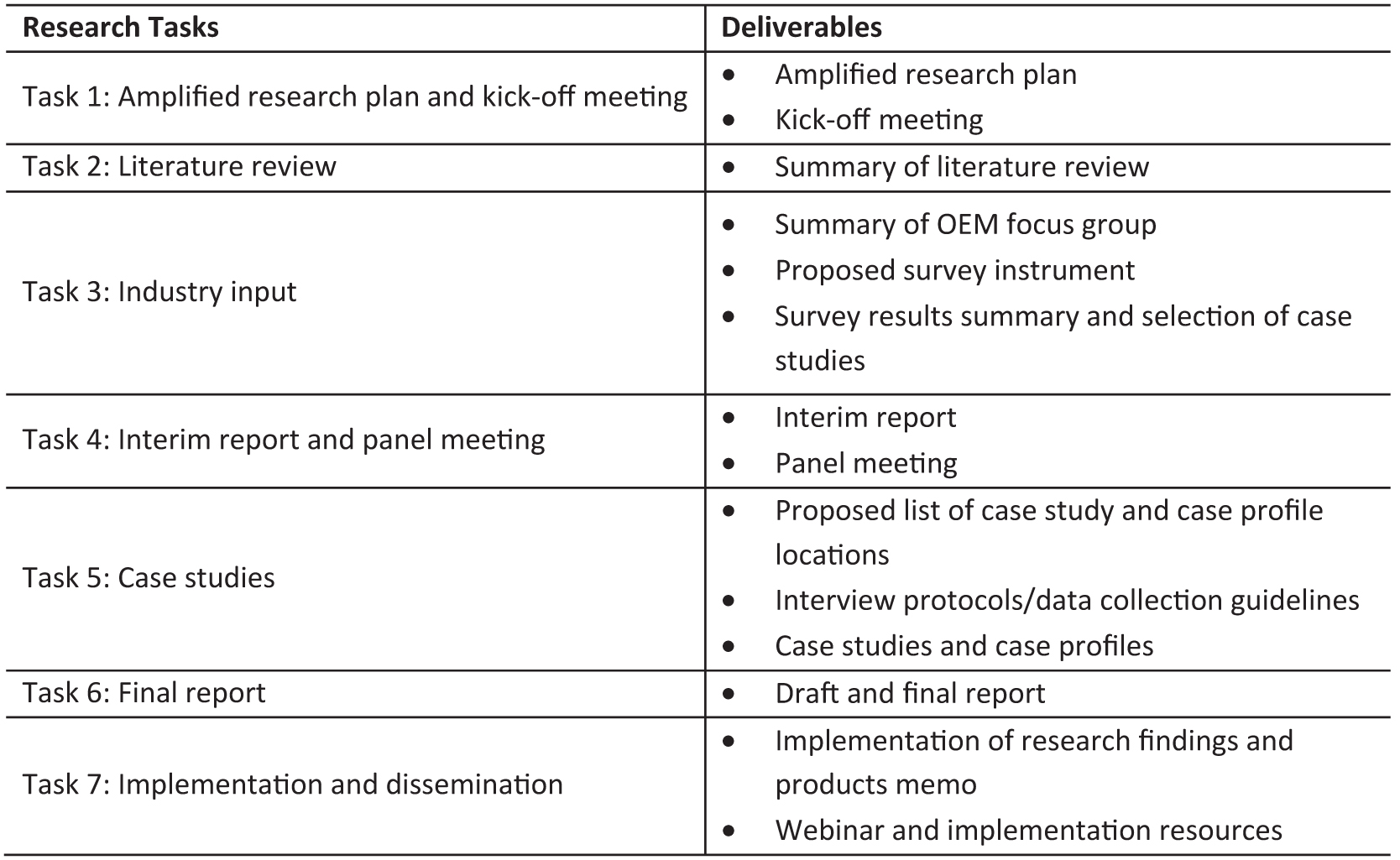
To answer these questions, the research team developed a plan, outlined in Table 1, that leverages existing information and resources available and builds on them by gathering input from industry stakeholders and public transit agencies. This research was conducted over an 18-month period. Four lines of research were used to address the key objectives of the study: a literature review, industry input and feedback, case studies, and development of a final report. The research tasks also included panel reviews.
Literature Review
The research team conducted a literature review to provide an overview of the existing research on the workforce needs for developing the skills to operate and maintain zero-emission transit fleets. In the literature review, the research team scanned TRBʼs Transport Research International Documentation (TRID) database, conducted searches on Google Scholar for relevant documents, and used other relevant online and internal resources. The results of the literature review are interspersed in relevant sections throughout this report. The research team drew from research reports, government documents, news articles, and publicly available datasets on various aspects of the workforce implications of zero-emission fleets.
Long Description.
Column 1 heading: Research Tasks, and Column 2 heading: Deliverables. Row 1, Column 1: Task 1. Amplified research plan and kick-off meeting, Column 2: Amplified research plan, Kick-off meeting, Row 2, Column 1: Task 2: Literature review, Column 2: Summary of literature review; Row 3, Column 1: Task 3: Industry input, Column 2: Summary of OEM focus group, Proposed survey instrument, Survey results summary and selection of case studies; Row 4: Task 4, Column 1: Interim report and panel meeting, Column 2: Interim report, Panel meeting; Row 5, Column 1: Task 5: Case studies, Column 2: Proposed list of case study and case profile locations, Interview protocols/data collection guidelines, Case studies and case profiles
Row 6, Column 1: Task 6: Final report, Column 2: Draft and final report
Row 7, Column 1: Task 7: Implementation and dissemination, Column 2: Implementation of research findings and products memo, Webinar and implementation resources
For some of the areas explored as part of this research effort, there is limited existing research because of the relative newness of this technology. For example, there is little literature on how zero-emission fleets affect the amount and type of training needed for new and incumbent workers and how frequently refresher training should be completed. This original research adds new insights where there is minimal existing information available.
Focus Groups
The research team conducted two focus groups to reach representatives of organizations outside of transit agencies that are major stakeholders: (1) OEMs, (2) advocacy and technical assistance organizations that encourage transit agencies to include ZEVs in their fleets, and (3) other stakeholders that were important to elements of the research approach. Conversations with stakeholders provided insight into research topics such as industry preparedness for zero-emission fleet expansion and served as a first step toward identifying existing programs at transit agencies that could be considered for further analysis (e.g., for the case studies). The findings from the focus groups were generalized so that they would be beneficial to a range of transit agencies. Focus group data also established themes that guided and shaped the industry survey questions.
- The first focus group consisted of one or two representatives from each of the leading manufacturers of ZEBs sold in the United States. Conducting this focus group allowed the research team to understand the current role played by OEMs in workforce development and the common practices OEMs have used in collaborations with public transportation agencies.
- The second focus group consisted of representatives from advocacy and technical assistance organizations that provide guidance, resources, and information to transit agencies that are planning to purchase or are operating zero-emission vehicles, as well as other stakeholders that were important to elements of the research approach. These stakeholders provided insight
- into the level of preparation of the industry (research question 1) and current methods that transit agencies are using for recruitment, training, and retention of the operations and maintenance workforce (research question 3).
Industry Survey
In the summer of 2024, the research team designed and administered a digital survey to gather qualitative and quantitative data on the workforce impacts of including zero-emission vehicles in a transit agencyʼs fleet, as well as information on associated policy changes, strategies, training needs, challenges, and potential benefits. The research team used the results of the literature review, focus groups, and panel feedback to inform the design of the survey. Questions included a mix of multiple choice, sliding scale, and open-ended formats. See Appendix D for survey instrument design.
The survey audience included trainers, maintenance technicians, supervisors, and other transit agency staff as well as labor union representatives. Participants were encouraged to include responses from multiple staff members at their agency. The survey was distributed through the following channels:
- APTA Workforce Development Committee
- APTA Zero-Emission Fleet Committee
- Community Transportation Association of America
- ATU
- Transport Workers Union
- ITLC newsletter (over 3,000 contacts)
- Transit agencies with published zero-emission transition plans compiled by planning communities prior to project initiation (over 200 contacts), plus follow-up with direct contacts
The survey was distributed via mass email by ITLC and further promoted on social media. Initial survey distribution took place on July 8, 2024, with a stated closing date of July 28, 2024. A reminder email was sent via the distribution list on July 22, 2024. On July 30, 2024, another email was sent to announce an extension of the closing date to August 1, 2024.
A total of 101 responses were received (see Table 2). Two responses were removed: one from a respondent who noted that they completed the survey to see the content, and another that was a duplicate response, for a final total of 99 responses. Fifty responses were received from labor union representatives, and 49 were received from transit agencies (50.5% and 49.5%, respectively).
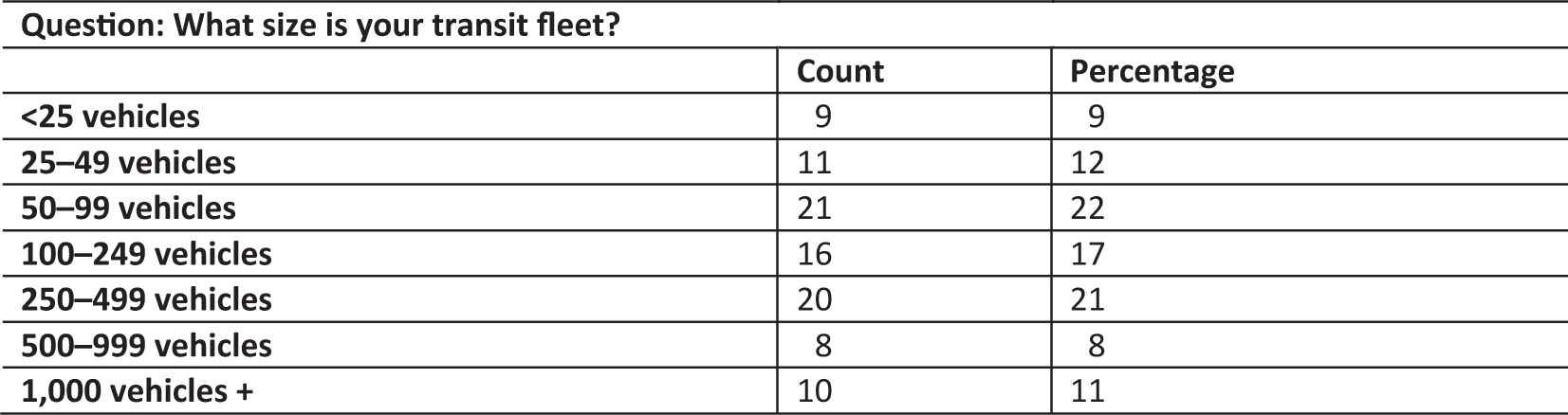
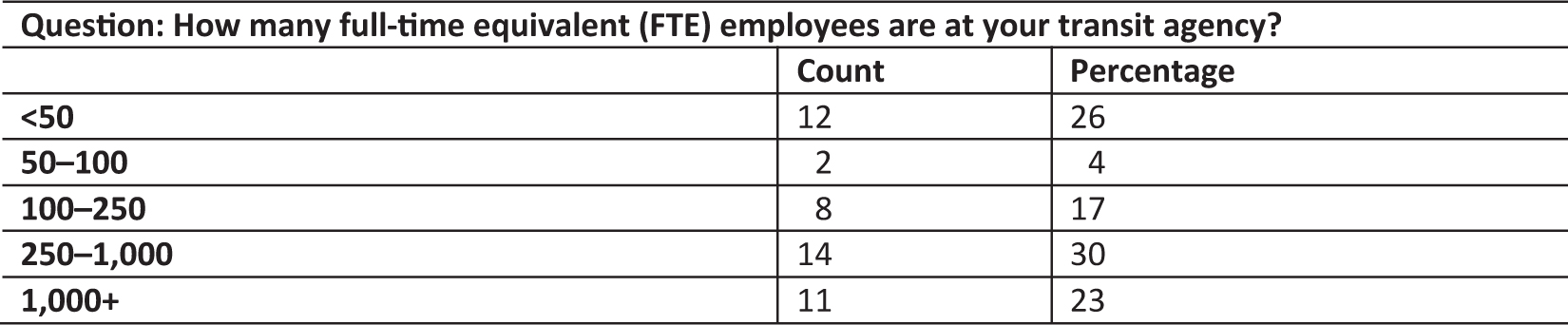
Survey respondents represented a range of transit agency sizes, as measured by the fleet size (Table 3) and number of employees (Table 4).
Survey respondents were primarily from transit agencies with directly operated service (53%), and the remaining 47% had contracted service or both contracted and directly operated service. Survey respondents were primarily from transit agencies with the FTA classification of urban (74%), while 20% were rural, and 6% were tribal.

Source: TCRP Project J-11/Task 46 industry survey, summer 2024.
Long Description.
Row 1, Column 1: Question: What type of public transportation organization do you represent? Row 2: Column 1: Blank; Column 2: Count; and Column 3: Percentage. Row 3: Column 1: Union Local; Column 2: 50; and Column 3: 50.5 percent. Row 4: Column 1: Transit Agency; Column 2: 49; and Column 3: 49.5 percent.
Source: TCRP Project J-11/Task 46 industry survey, summer 2024.
Long Description.
Row 1, Column 1: Question: What size is your transit fleet? Row 2: Column 1: Blank; Column 2: Count; and Column 3: Percentage. Row 3: Column 1: Less than 25 vehicles; Column 2: 9; and Column 3: 9 percent; Row 4: Column 1: 25 to 49 vehicles; Column 2: 11; and Column 3: 12 percent; Row 5: Column 1: 50 to 99 vehicles; Column 2: 21; and Column 3: 22 percent; Row 6: Column 1: 100 to 249 vehicles; Column 2: 16; and Column 3: 17 percent; Row 7: Column 1: 250 to 499 vehicles; Column 2: 20; and Column 3: 21 percent; Row 8: Column 1: 500 to 999 vehicles; Column 2: 8; and Column 3: 8 percent; Row 9: Column 1: 1,000 vehicles plus; Column 2: 10; and Column 3: 11 percent.
Source: TCRP Project J-11/Task 46 industry survey, summer 2024.
Long Description.
Row 1, Column 1: Question: How many full-time equivalent (FTE) employees are at your transit agency? Row 2: Column 1: Blank; Column 2: Count; and Column 3: Percentage. Row 3: Column 1: Less than 50; Column 2: 12; and Column 3: 26 percent. Row 4: Column 1: 50 to 100; Column 2: 2; and Column 3: 4 percent. Row 5: Column 1: 100 to 250; Column 2: 8; and Column 3: 17 percent. Row 6: Column 1: 250 to 1,000; Column 2: 14; and Column 3: 30 percent. Row 7: Column 1: 1,000 plus; Column 2: 11; and Column 3: 23 percent.
Case Studies and Case Profiles
Three case studies and five case profiles were finalized in January of 2025. The case studies draw out solutions that show innovative or particularly effective components or programs; the case profiles provide snapshots of the transit agenciesʼ ZEV workforce skill-development approach for ZEVs as a whole and focus on the “what,” “why,” and “how” of the transit agenciesʼ approach.
Identification Protocol and Development Process
Based on the results of prior research tasks, the team identified transit locations suitable for a case profile or case study (Task 4). Case studies present the transit agencyʼs frontline workforce ZEV training system and practices as a whole and focus on the innovative or particularly effective components or programs. Effective strategies, practices, and programs are presented, including agreements between labor and management that these programs or practices were well-designed and implemented.
An effective program uses data to identify specific training and skill gaps, designs a plan that effectively addresses the multiple variables that contribute to the problems, sets reasonable process and outcome goals, evaluates processes and outcomes, monitors and adapts implementation as the program or strategy proceeds, and produces significant measurable improvements in metrics related to the operation and maintenance of ZEVs. In excellent programs, each of these areas of action receives management commitment and labor involvement or support.
Data collection methods included interviews with individuals and small groups as well as collection and review of organizational data. Transit senior management, training program managers, and local union presidents were recruited for the interviews, which covered varying areas of expertise and experience related to the ZEV workforce development.
The research team created a proposed list of locations for case studies or case profiles based on the selection criteria outlined in the next section. Transit agencies that satisfied all aspects of the criteria, employed innovative methods or programs, or were suggested to the research team
through at least two research activities (e.g., OEM focus group and literature review) were nominated for case studies. Transit agencies that satisfied all or most aspects of the selection criteria, employed successful methods or programs, or were suggested to the research team through one research activity were selected for case profiles.
Selection Criteria
Range of Descriptive Factors
The team looked for case studies and profiles that represented different characteristics of transit providers, including a range of geographic area sizes (large urban, small urban, suburban, rural, and tribal) and geographies (e.g., FTA regions 1–10), transit agencies in various phases of introducing ZEVs to their fleets, and a mix of transit agency sizes based on the number of vehicles and the number of operators and technicians employed.
Demonstrated Innovative and Effective Programs Based on Analysis From the Literature Review, Focus Groups, and Survey
Prime candidates for case studies and profiles included transit agencies that were using novel practices as identified in existing literature or those that were mentioned in another phase of the research for this work. For example, the research team specifically asked focus group participants about transit agencies with exemplary programs to address ZEV workforce challenges. Gathering input across all of the research phases, the team identified case studies that highlighted best practices for ZEV workforce training and development.
Effectiveness Indicated by Other Sources
The research team looked for supporting evidence that a transit agencyʼs workforce had developed the skills necessary to operate and maintain ZEVs. These agencies include those identified for case studies using the FTAʼs TWC, NTD data on miles per year for ZEVs, and other information available online.
Multiple Perspectives
The research team identified transit agencies from which it could gather multiple perspectives. In particular, the team sought to gather perspectives from both the workforce and management in each case study. Management included CEOs and general managers, directors of human resources, and directors of training. Labor included transit agencies represented by multiple unions; the team gathered input from unions representing the frontline transit workforce at that transit agency.
Quantitative Metrics Based on Survey Responses
The research team evaluated survey data that indicated particularly promising or effective programs. The team used the criteria listed in the following to determine potential case studies or profiles and prioritized potential case studies effective across multiple topic areas. Because the industry survey was distributed to transit agencies and unions in the United States, these criteria do not apply to international case studies and profiles. Survey responses that indicated willingness to participate in a case study and satisfied at least one of the following criteria were added to the proposed list of case study/profile locations:
ZE Impacts on Recruitment and Retention
- What programs or initiatives have most helped you retain qualified ZE-skilled staff? Select all that apply. Answered one or more
- Career ladder/career progression
- Dedicated training staff
-
- Higher pay for ZE-skilled staff
- Incentive programs for ZE operators (e.g., gift cards for driving efficiency)
- Educational incentives
- Positive working conditions (including benefits)
- Worker engagement in decision-making and transition planning
- Other – please specify
ZE Skills-Gap Analysis
- Has your transit agency performed a skills-gap analysis for technicians? Answered yes
- Yes
- No
ZE Impacts on Training and Training Methods
- Which employees have received ZE training? Check all that apply. Answered one or more
- Operators
- Maintenance staff
- Managers/general staff
- Other (please specify)
- Is lack of training impacting your ability to provide service using ZEVs? Answered d.
- Yes, we are unable to put any ZEVs into service.
- Yes, we are unable to put some ZEVs into service.
- Yes, we are unable to put ZEVs in for a full day of service (additional vehicle to operate full span of service).
- No, we are able to put all of our ZEVs into service.
- N/A, we do not currently have any ZEVs to put into service.
The Role of OEMs
- How effective have your procurement practices been in getting the training and support you need from OEMs? Answered d. or e.
- Not effective at all
- Not very effective
- Neutral
- Somewhat effective
- Very effective
- How effective has the training offered by the OEM been? Answered d. or e.
- Not effective at all
- Not very effective
- Neutral
- Somewhat effective
- Very effective
Case Study Interview Questions
- How did your agency identify the specific skill sets needed by (a) operators and (b) technicians to properly maintain/operate ZEVs? How was it done? Did you experience any challenges in that process?
- Regarding technicians, are you familiar with the national maintenance training standards developed for ZEVs by APTA? If so, have they been useful to your agency in establishing the skill sets needed by technicians? If not, make them aware of this link: https://www.apta.com/wp-content/uploads/APTA-BTS-ZBT-RP-001-23.pdf
- If applicable, how has your agency incorporated the identification of skill sets into the development of your ZEV training program? For example, have you used the identified skill sets, however obtained, as a checklist to ensure training delivers the necessary skills? If not, are you planning to do so in the future?
- Is your workforce prepared to take on additional ZEVs at your agency? If so, why? If not, why not?
- How does your agency assess whether (a) operators and (b) technicians are prepared to operate and maintain ZEVs? (How are their skills validated?) Regarding operators, does your agency have a way to track their effectiveness at maximizing battery state of charge and vehicle range? If so, describe.
- If you used a skills-gap analysis, what is your approach to the timing and frequency of this kind of assessment?
- (See survey questions 23–26) If your agency did not conduct a skills-gap analysis, why not and how did you determine where the skill shortages are?
Developing Systematic Process for Building Skills of Technicians and Operators
- Was developing a systematic process for building the skills of technicians and operators a challenge at your agency?
- If so, how did your agency approach this challenge?
- Was this approach effective?
- What resources did you find helpful in the process?
- Any lessons learned?
Basic Electrical Skills
- There appears to be widespread basic electrical skill weakness among transit technicians. Is this a challenge at your agency?
- How did your agency approach this challenge?
- Was this approach effective?
- What resources did you find helpful in the process?
- (See survey questions 35–36) Understanding that additional technicians require basic electrical training as a prerequisite to ZEV high-voltage training, how does your agency plan to provide them with this training? In your opinion, how much of this training should be performed by your agency, the bus OEM, or other training providers? Are you using any innovative techniques to provide or refresh technicians with basic electrical understanding? If so, explain.
- What percentage of your maintenance technicians would you say are proficient at using a digital multimeter (i.e., to measure voltage drop)?
- Any lessons learned in addressing electrical skill weakness?
Training Resources
- In your estimation, how much additional training does it take to get diesel technicians fully capable of repairing and maintaining ZEVs? Operators?
- Do you feel like the training resources and capacity at your agency are sufficient to provide this additional training? Do you require additional resources and capacity?
- If lacking, how did your agency approach the challenge of acquiring additional training resources and capacity? How have you added capacity? Whatʼs preventing you from obtaining more?
- Is your agency pooling resources with other agencies? If so, are they close geographically? Similar in size? Part of a similar cohort procuring a specific type of ZEB from a specific OEM?
- Are state DOTs, state transit associations, FTA regional offices, etc. playing any role in supporting your agency develop or pool training materials/resources?
- Any lessons learned when it comes to acquiring needed ZEV training resources and capacity?
- If money and resources were not an issue and you could have anything you wanted, how would you structure a program to thoroughly train (a) technicians and (b) operators for ZEV deployment?
OEM Relationship
- Have you experienced challenges in your agencyʼs relationship with the OEM of the ZEVs in your fleet?
- If not, what approaches do you think helped to ensure you made the most out of the relationship with the OEM?
- How much training in hours did the OEM provide to operators and technicians? Was it direct training, train-the-trainer, both?
- How much of the training was provided by the bus builder itself, and how much by a vendor/supplier to that builder?
- How could OEM/vendor training be improved to help satisfy your agencyʼs ZEV training needs? What are the strengths and weaknesses of OEM/vendor training?
- What are the lessons learned when it comes to obtaining OEM training?
Recruitment and Retention
- Have you faced hesitation or resistance from technicians to work with ZEVs? If so, how have you overcome that resistance?
- Have you had challenges with recruiting or retaining technicians to maintain ZEVs?
- Are you recruiting new workers from certain industries (e.g., automotive) to work on your ZEVs? If so, why and what is the benefit?
- Do you have any prerequisite requirements/qualifications when hiring new technicians to work on ZEVs? If so, what are they?
- What approaches and resources have you found useful in recruiting new technicians to work on ZEVs?
- How have recruitment practices changed to accommodate new staffing needs for ZEV fleets? Have you increased staffing to accommodate ZEVs?
- What is your agency doing to retain ZEV technicians? Operators?
Other/Miscellaneous
- Are there any other workforce challenges not already covered that your agency is facing as it adds ZEVs? If so, what are they and what is being done to overcome them?
- Are there any success stories or lessons learned not already covered? If so, what are they and how have you benefited from them?
- Which aspects of your ZEV training program are you most satisfied with, which training areas need improvement, and what are your plans to make your overall ZEV training program more effective?
- Does your agency have any innovative methods that are particularly effective at delivering needed ZEV skills to (a) operators and (b) technicians? If so, describe.
- Does your agency have established criteria for determining whether technicians are qualified/certified to safely repair and maintains ZEVs? If so, how are those criteria established and by whom? If not, how does your agency become certain that technicians have the necessary skills to safely repair and maintain ZEVs?
Case Profile Template
- Agency name
- Union status
- Geographic area
- # of operators
- # of maintenance staff
- # of ZEVs purchased
- # of ZEVs in service
- # of ZEVs planned/goal year for complete transition
- # and % of operator workforce that have received training for ZEVs
- # and % of technician workforce trained for ZEVs
- Narrative to describe:
- Approach for operator training
- Approach for technician training
- Resources used


