Full-Depth Reclamation: Current Practices (2025)
Chapter: 1 Introduction

CHAPTER 1
Introduction
This chapter introduces background information on practices and guidelines for full-depth reclamation (FDR). The survey and interview processes, as well as the organization of the report, will also be described.
1.1 Background
FDR is an in-place recycling method for the reconstruction and rehabilitation of flexible pavements. The full thickness of the existing asphalt pavement and a portion of the underlying base or subgrade materials are pulverized and blended to provide a base for a new surface-wearing course. The pulverized roadway materials may be blended with additional granular materials or stabilizing additives such as emulsified asphalt, foamed (expanded) asphalt, calcium chloride, or Portland cement. The pulverized material is then graded and compacted to form the new base. A curing period may be required before placing the surface wearing course, depending on the stabilizing additives used and the ambient conditions. An FDR equipment train includes a reclaimer unit, stabilizing additive unit(s), graders, and rollers. FDR treatment depths generally range from 4 to 12 inches, depending on the existing pavement structure and the equipmentʼs capacity. FDR can be used for realignments, lane widening, minor profile improvements, and increased structural capacity. By making effective use of existing pavement materials, paving projects using FDR may have a less impactful environmental impact and achieve reduced costs. FDR is a widespread practice; however, state departments of transportation (DOTs) employ diverse construction practices and quality assurance procedures for FDR.
1.2 Synthesis Objective
The primary objective of this synthesis is to document the current state of DOT practices and guidelines for the use of FDR. Information about the use of FDR includes aspects such as:
- State DOT classification of FDR types and site selection, as well as pre-design investigation for FDR.
- Existing specifications and guidelines related to FDR mix design, including the selection of stabilization method and test methods to evaluate FDR quality.
- FDR design criteria and consideration of traffic loads, environmental conditions, and properties of the FDR base used in pavement design, along with methods to mitigate cracking in hot mix asphalt (HMA) overlay on the FDR layer.
- Current practices in FDR construction and quality assurance (QA), including post-construction verification of FDR properties and tests to make time-critical decisions regarding opening to traffic and surfacing of the FDR base.
- Efforts to quantify the sustainability and potential cost and time savings associated with FDR.
The synthesis also includes suggestions for future research based on existing gaps identified through the literature review, survey, and case example interviews. This synthesis is intended to serve as a reference to transportation agencies and other entities regarding existing practices and guidelines for the use of FDR.
1.3 Study Approach
A multifaceted approach was taken to document the various efforts made by transportation entities in recent years regarding the use of FDR. There is a need to quantify these efforts and document examples of practices that are reported to be effective, facilitating the exchange of information and helping other agencies and industry partners. The approach to this study included a literature review; surveys of state DOTs, other agencies, and FDR contractors; and interviews with transportation agencies in states identified as having existing practices and experience with the use of FDR. The following sections provide more detail.
1.3.1 Literature Review
The project team consulted a number of resources, including the Transport Research International Documentation database, FHWA and DOT reports, journal publications, conference proceedings, transportation agency specifications and standards, resources of professional associations, and web searches. A comprehensive literature review of sources from both the United States and internationally was conducted to establish current practices and emerging trends related to the use of FDR. Particular attention focused on summarizing the characterization of FDR properties, methodologies used to determine the type and dosage of stabilizing additives, mixture and structural design methodologies used, and construction and performance of FDR projects.
1.3.2 Survey of State Transportation Agencies
A survey consisting of 34 questions was sent to members of the AASHTO Committee on Materials and Pavements (COMP), with a suggestion that it be distributed to the appropriate agency personnel for completion. The agency survey was sent to contacts in each of the state DOTs, the District of Columbia DOT, and the Puerto Rico Highway and Transportation Authority. Ninety-four percent (or 49 of 52) of all DOTs responded and completed the agency survey. Their responses are included in the survey analysis. The primary intent of the survey was to document the state of the practice reported by the state DOTs on their current practices and guidelines for FDR, which included collecting information on the type of roadways on which they perform FDR; the stabilizing methods, selection processes, and dosages that they use in FDR projects; design methodologies for FDR-rehabilitated pavements; and construction practices employed when performing FDR. In addition, the survey was used to gather information on potential barriers that pose challenges for agencies to start or continue employing FDR on pavements, as well as the knowledge gaps that their agencies have regarding FDR. The survey also aimed to identify past performance challenges experienced by their agencies in FDR-rehabilitated pavements.
The map in Figure 1 shows the DOTs in the United States that completed the agency survey, along with specific DOTs that were selected to serve as case examples. The agency survey questions are presented in Appendix A of this report, while Appendix B presents the responses to each question by the agency. In addition to the survey distributed to the state DOT agencies, an identical survey was sent to other agencies that conduct FDR. Appendix C of this report presents the survey results from the other agencies. Furthermore, a similar survey was developed and distributed to FDR contractors who work with state DOT agencies, as presented in Appendix D.
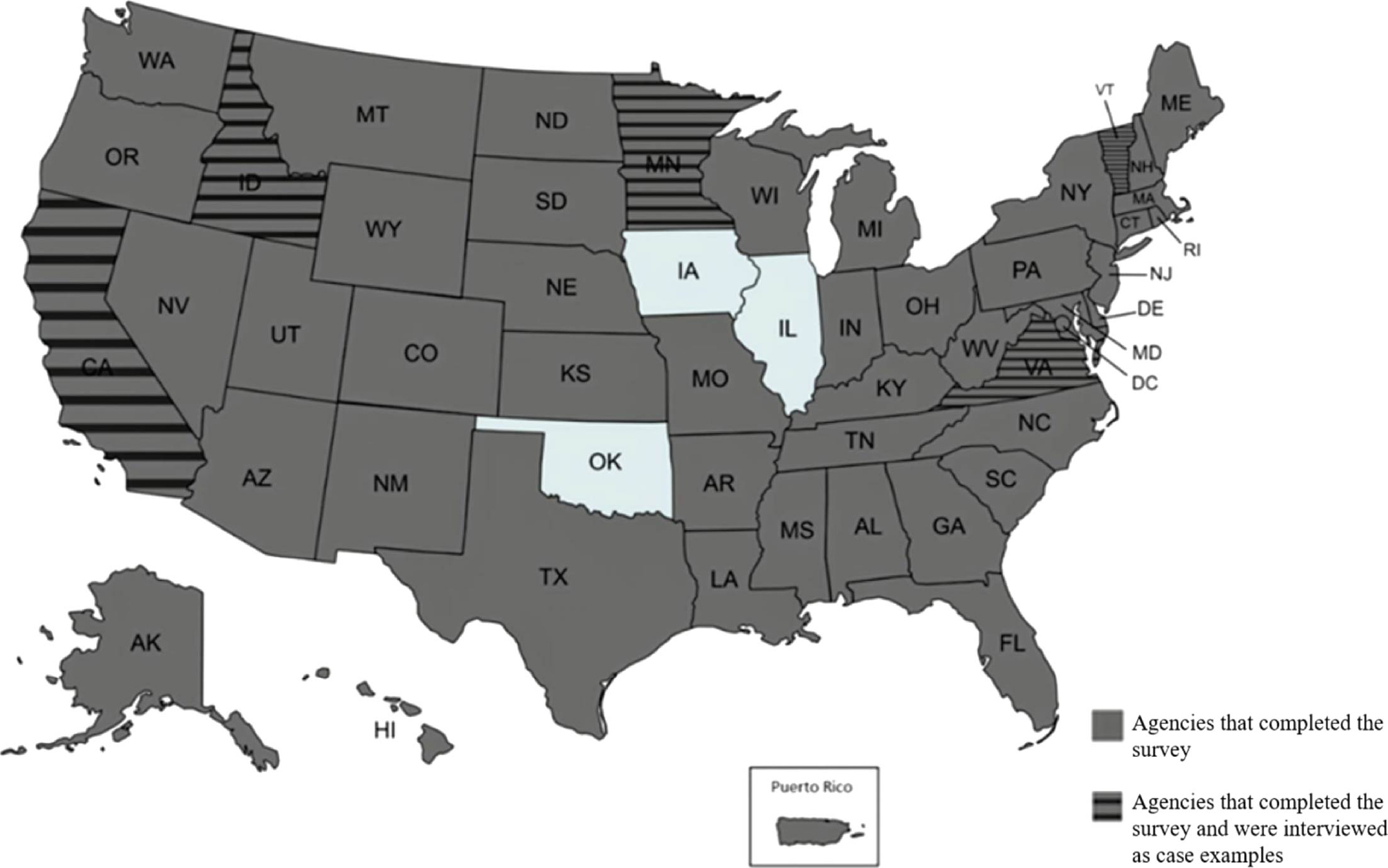
Created with mapchart.net
Long Description.
The map shows various states in two different categories as follows.
- Agencies that completed the survey. WA, OR, NV, UT, AZ, AK, HI, Puerto Rico, MT, WY, CO, NM, TX, ND, SD, NE, KS, MO, AR, LA, MS, AL, GA, FL, SC, NC, TN, KY, IN, WV, OH, MI, PA, NY, ME, NH, MA, CT, RI, NJ, DE, MD, and DC.
- Agencies that completed the survey and were interviewed as case examples. CA, ID, MN, VA, and VT.
1.3.3 Interviews of Transportation Practitioners for Case Examples
Based on the survey results, five states were selected for further data collection on practices and guidelines related to the use of FDR. The criteria considered in the selection of the case example agencies were (1) experience with the use of FDR (e.g., history of FDR usage, projects per year); (2) types of stabilization used (mechanical, chemical, bituminous); and (3) geographical distribution of states to reflect varying climatic conditions. At least one representative from each organization was interviewed to gather input on issues and practices in their state related to the use of FDR.
1.4 Organization of the Report
This synthesis report is organized into six chapters. The balance of Chapter 1 presents the reportʼs structure with brief explanations of each chapterʼs content. Chapter 2 introduces the details published in the literature and in online sources related to the practices of FDR use. It includes information from published DOT reports, academic publications, and NCHRP reports. There is a section that introduces basic information about FDR, including its benefits and limitations. A section on the key properties of FDR materials follows, including methods to characterize FDR in both the laboratory and the field. Stabilization agents, mixture design, and structural design are discussed, and construction and QA processes are presented. The chapter concludes with a discussion of ongoing research related to the evaluation of the performance and sustainable aspects of FDR.
Chapter 3 provides an overview of the state of the practice reported by the state DOTs through the agency survey on the use of FDR. The results include the history and extent of use of FDR by the agencies. It also summarizes practices for structural pavement design with FDR layers and the use and choice of stabilizing agents. Mix design and construction procedures are covered, along with specific methods used by agencies to evaluate properties in the laboratory and the field prior to overlaying with HMA. In addition, the performance of FDR as observed by agencies is presented. The challenges and roadblocks identified by agencies are also summarized.
Chapter 4 examines the specific practices regarding the use of FDR reported in case example interviews with selected state DOTs. The majority of the information presented in this chapter was gathered through detailed interviews with personnel from various agencies in each of the five selected states.
Chapter 5 provides a summary of the key findings and conclusions of the project, including the agenciesʼ use of FDR, methodologies for conducting mixture and pavement design, procedures for construction and quality assurance, and long-term performance. The roadblocks and challenges related to the use of FDR are also discussed. Additionally, this chapter highlights the knowledge gaps identified through the agency surveys and case example interviews. The suggestions and needs for further research to promote the use of FDR are also presented.
References and four appendices follow these chapters. Appendix A includes a copy of the agency survey questions, and Appendix B presents the individual responses by state. Appendices C and D present the survey results from other agencies and FDR contractors, respectively.


