Operational and Service Factors When Integrating or Consolidating ADA Paratransit and On-Demand Services (2025)
Chapter: Appendix A: Survey Instrument

APPENDIX A
Survey Instrument
Introduction
The Texas A&M Transportation Institute (TTI) is conducting research for the Transit Cooperative Research Program (TCRP) on integrating/consolidating ADA paratransit and on-demand microtransit services. This research, TCRP Synthesis SB-42: Operational and Service Factors When Integrating/Consolidating ADA Paratransit and On-Demand Services, will document the types of transit systemsʼ integrations/consolidations of ADA (or coordinated) paratransit service with microtransit service and the associated outcomes from customer and agency perspectives. The results from the research will provide an overview of:
1) Service designs and parameters of these trips in microtransit,
2) Technology and reservation features for customers,
3) Fleet mixtures and providers in service delivery,
4) Adherence to ADA compliance requirements,
5) Considerations for different types of disabilities, and
6) Benefits and impacts of the integration/consolidation.
This survey is the first step in the research project and needs to be completed by March 27, 2024. This survey will take approximately 20–25 minutes to complete. The survey saves your responses as you move from section to section. You can finish the survey later from the same IP address (using the same computer) within a two-week period.
This survey will ask questions about your agencyʼs ADA paratransit integration/consolidation with microtransit, including but not limited to the following:
- Service designs, policies and parameters
- Partners and technologies
- Booking and scheduling
- Fare payment and communication
- Decision-making in commingling trips
- ADA customer considerations by type of trip
- Disability accommodations and assistance
- Fleet mixture and providers
- Dispatching and optimization
- Benefits and impacts
- Commingling benefits
- Customer and agency impacts
- Challenges and lessons learned
The information you provide will be synthesized with information collected from other transit professionals. Your answers will be confidential to the extent permitted or required by law.
Your participation is greatly appreciated. If you have questions, concerns, or complaints regarding this study, you may contact [TTI]. You must be at least 18 to participate in the survey. You may be contacted by TTI to help clarify your answers or gather additional information.
- Do you agree to participate in this research?
- Yes
- No → THANK AND TERMINATE
Introductory Questions
The following questions ask about the agencyʼs integration/consolidation of ADA paratransit with on-demand microtransit service and confirmation of relevance.
- Please confirm your name (first and last) and organization/affiliation for the transit agency to which youʼll complete this survey.
- Record open text response
For this survey, we are interested in any integrations/consolidations of ADA paratransit with microtransit services and its associated outcomes for transit agencies as well as ADA or coordinated paratransit customers. We are seeking to learn more about how transit agencies and their technology partners design these services with respect to the associated technologies, scheduling, and reservations parameters, grouping and routing of trips, stop locations by trip type, zone size parameters, performance goals and evaluation, and customer assistance policies or additional accommodations for ADA or coordinated paratransit customers using microtransit.
This research is concerned with ADA or coordinated trips that are commingled together with other general public trips in the same vehicles of the on-demand microtransit services. Microtransit is a technology-enabled demand-responsive transit service, typically using shuttles or vans with dynamic, real-time routing and scheduling. Microtransit pools passenger trips together, using pick-up and drop-off points at common destinations, generated in real-time for efficient routing or sometimes at the direct curb point the passenger is travelling to or from. By commingling, the two trip types may be served in the vehicle simultaneously rather than only being transported exclusively in separate vehicles. These integrations of service can include trips that are commingled in the same vehicle either using the same software or with different software systems for different trip types.
Here are some terms used throughout the survey questions about paratransit and commingling – take note now!
- Consolidated service is when one uniform fleet (using the same vehicle type for the entire fleet), one set of drivers (all ADA paratransit–certified), and the same scheduling software is used for both ADA paratransit and microtransit service.
- Commingled trips are when two trip types (e.g., ADA or coordinated paratransit with general public) are served in the same vehicle together (sometimes as shared rides) rather than transported exclusively in separate vehicles.
- Integrated service is when the commingled services use either different vehicle types, different sets of drivers, and/or different software platforms from each other, but some trips are commingled together.
- Paratransit in the context of this research includes ADA complementary paratransit and coordinated paratransit services; these coordinated services could include sponsored human service agency (HSA) trips or other sponsored trip types.
- WAVs stands for wheelchair-accessible vehicles. These vehicles allow a passenger using a wheelchair, motorized scooter, or other mobility device to board and alight the vehicle using a lift or foldable ramp; vehicles also include securement spots for the wheelchair or scooter to be secured by the driver.
- Dedicated service means that the vehicles are dedicated exclusively to customers of the given service type (or to the integrated/consolidated services); vehicles are not used to service other non-transit riders. Dedicated service can be operated in-house by the transit agency or by a contractor providing the service.
- Non-dedicated service means that the vehicles may also provide transportation for non-transit riders while being available for transit service. Typical non-dedicated service providers include taxicab and transportation network companies (e.g., ridesharing or ridesourcing).
This research is not concerned with alternative services, interchangeable assets between services, or emergency-only commingling.
- Alternative service is an on-demand service in which ADA paratransit customers choose to take their trip using a for-hire ride service (such as a taxi or transportation network company) instead of using paratransit, typically with the transit agency subsidizing a portion of the trip cost on the customerʼs behalf.
- Interchangeable vehicles and drivers (sometimes called commingled fleets and shifts) between paratransit and microtransit service in which the services are operated separately (i.e., trips between these types of customers are not grouped together) likewise does not count as commingling of trips.
- Commingling customer trips together only in emergency situations (such as an evacuation or extreme weather event) is also outside the scope of this research.
SUB-SECTION DIVIDER HERE - - - - - - - -- - - - - - - -
- Does your transit agency currently have or previously had an integration/consolidation of ADA or coordinated paratransit with on-demand microtransit service?
- Yes, we are currently operating/contracting for microtransit service that is integrated with our ADA or coordinated paratransit service as described above. → Q5
- Yes, we previously integrated our ADA or coordinated paratransit service with our microtransit service. → Q4
- No, we do not have integrated/coordinated services → THANK AND TERMINATE
- When did integrated/consolidated ADA or coordinated paratransit and microtransit service operate (please provide a range of years)?
- Record open text response
- Do you personally have knowledge of the transit agencyʼs integration/consolidation of ADA or coordinated paratransit with on-demand microtransit service, including aspects of service design, associated technologies, and customer accommodations?
- Yes, all aspects or some aspects and can work with other staff on remaining information. → Q8
- No/not sure
- Do you know who has knowledge of the transit agencyʼs integration/consolidation of ADA or coordinated paratransit with on-demand microtransit service?
- Yes
- No/not sure → THANK AND TERMINATE
- Please provide the contact information of the individual who has knowledge of the transit agencyʼs integration/consolidation of ADA or coordinated paratransit with on-demand microtransit service.
Name: ___________________________________
Email: ___________________________________
Phone: ___________________________________
→ THANK AND TERMINATE
Service Design and Parameters
- Please clarify whether your ADA or coordinated paratransit services are either consolidated or integrated with the on-demand microtransit service. As a reminder:
Consolidated service is when one uniform fleet (using the same vehicle type for all vehicles), one set of drivers (all ADA paratransit-certified), and the same scheduling software is used for both ADA paratransit and microtransit service.
Integrated service is when the commingled services use either different vehicle types, different sets of drivers, and/or different software platforms from each other, but some trips are commingled together.- Consolidated service
- Integrated service
- [If Q8 = B] For your integrated service, which aspects of the service have different (e.g., non-uniform) sets of vehicles, drivers, or software platforms between ADA or coordinated paratransit and microtransit? (check all that apply)
- Vehicles
- Drivers
- Software platforms
- Please use the table below to provide the names of the Service Operators (with drivers and vehicles) for your ADA or coordinated paratransit and microtransit services. Enter the name of the operator for each dedicated service (either directly operated or contracted) or non-dedicated service provider (if applicable).
- If the transit agency is the dedicated service operator, you can enter “Transit Agency”
- You can enter multiple operator names in the cell if multiple entities or companies provide the type of service
- For any service types that are not applicable, you can leave the cell blank

Long Description.
The column headers of the table are Service Operator, Directly Operated – Dedicated, Contracted – Dedicated, and Non-Dedicated. The data given in the table row-wise are as follows: Row 1: Paratransit: Blank; Blank; Blank. Row 2: General Public Microtransit: Blank; Blank; Blank.
- [If Q10 = Contracted – Dedicated] What are the roles and responsibilities of the contracted partner(s) for the consolidated/integrated service? (select all that apply)
- Reservations
- Scheduling
- Dispatching
- Call and control center (handling customer calls)
- Vehicles provision
- Vehicle maintenance
- Vehicle operators
- Other [record open text response]
- [If Q10 = Non-Dedicated] What are the roles and responsibilities of the non-dedicated service provider(s) for the consolidated/integrated service? (select all that apply)
- Reservations
- Scheduling
- Dispatching
- Call and control center (handling customer calls)
- Vehicles provision
- Vehicle maintenance
- Vehicle operators
- Other [record open text response]
- Please use the table below to provide the names of the Software Platform (used for scheduling and dispatching) for your ADA or coordinated paratransit and microtransit services. Enter the name of the operator for each dedicated service (either directly operated or contracted) or non-dedicated service provider (if applicable).
- You can enter multiple software names in the cell if more than one software or companiesʼ platform is used for the type of service
- For any service types that are not applicable, you can leave the cell blank

Long Description.
The column headers of the table are Software Platform, Directly Operated – Dedicated, Contracted – Dedicated, and Non-Dedicated. The data given in the table row-wise are as follows: Row 1: Paratransit: Blank; Blank; Blank. Row 2: General Public Microtransit: Blank; Blank; Blank.
- Prior to implementing microtransit, was your paratransit service just serving ADA paratransit-eligible customers or was it also serving human service agency sponsored (funded or co-funded) trips?
- Our paratransit service was just serving ADA paratransit-eligible customers.
- Our “coordinated” paratransit service served both ADA paratransit-eligible customers and human-service agency sponsored trips in an integrated manner.
- Our “coordinated” paratransit also served other sponsored (“contract”) trips
- Other [record open text response]
- [If Q14 = B or C] Are any of these sponsoring organizations also currently sponsoring (on-demand) microtransit trips?
- Yes, the names of the organizations are: ________________ (Record open text response)
- No
SUB-SECTION DIVIDER HERE - - - - - - - -- - - - - - - -
- What are the primary goals (either currently or upcoming) for the transit agency in commingling the ADA or coordinated paratransit and microtransit services? (select top 3 options)
- Improve cost efficiency and effectiveness
- Improve service productivity
- Increase service capacity for paratransit
- Improve on-time performance
- Provide on-demand/same-day trip reservation options for paratransit customers
- Increase transit options for paratransit customers
- Provide technology tools for paratransit customers (e.g., smartphone app, mobile payment, etc.)
- Bolster ridership on the fixed-route bus network
- Other [record open text response]
- From a geographic perspective, in which manner does the ADA or coordinated paratransit service area overlap with the microtransit service zone?
- Paratransit service area is entirely within/covered by microtransit service zone
- Microtransit zone is within the ADA paratransit service area
- Microtransit zone and the ADA paratransit service area partially overlap
- Pilot customer group in the microtransit zone only
- Other [record open text response]
- From a service times perspective, in which manner does the ADA or coordinated paratransit service times overlap with the microtransit service?
- Paratransit and microtransit service times are the same
- Microtransit service times are within (e.g., shorter than) the paratransit service times
-
- Microtransit service times extend beyond (e.g., longer than) the paratransit service times
- Microtransit zone and the paratransit service times partially overlap
- Other [record open text response]
- For microtransit trips, where can customers travel in the service zone area?
- Any destination within the geofenced zone
- Selected destinations (e.g., shopping centers, medical clinics, transit hubs, etc.)
- Transit stops/hubs only
- Other [record open text response]
- For ADA or coordinated paratransit on the integrated/coordinated service, are there any differences in destination eligibility?
- Yes [record open text response]
- No
- For general public microtransit service, what are the stop design types for the service [select all that apply]
- Curb-to-curb, anywhere/most places in the service zone area (i.e., any specified address)
- Dynamic/virtual stops (determined by the technology)
- Fixed stops
- Transit/shopping center hubs
- Walk-ons permitted
- Other [record open text response]
- For ADA or coordinated paratransit trips served on microtransit, which level of assistance do drivers provide for these customers? (select all that may be applicable)
- Curb-to-curb
- Door-to-door
- Door-through-door
- Hand-to-hand
- Other [record open text response]
- Typically ADA paratransit customers are required to schedule their paratransit trip prior to the day of scheduled service. On-demand microtransit service usually allows general public customers to request a trip for immediate fulfilment, meaning a vehicle will be dispatched to them once the request is confirmed (or soon afterward).
Can ADA or coordinated paratransit customers schedule a paratransit trip on the same day of service (i.e., not merely as a general public on-demand trip)?- Yes, for on-demand/immediate fulfillment
- Yes, but not for immediate fulfillment
- No
- Can general public customers schedule a trip on microtransit in advance (before the same day and/or not for immediate fulfillment)?
- Yes
- No
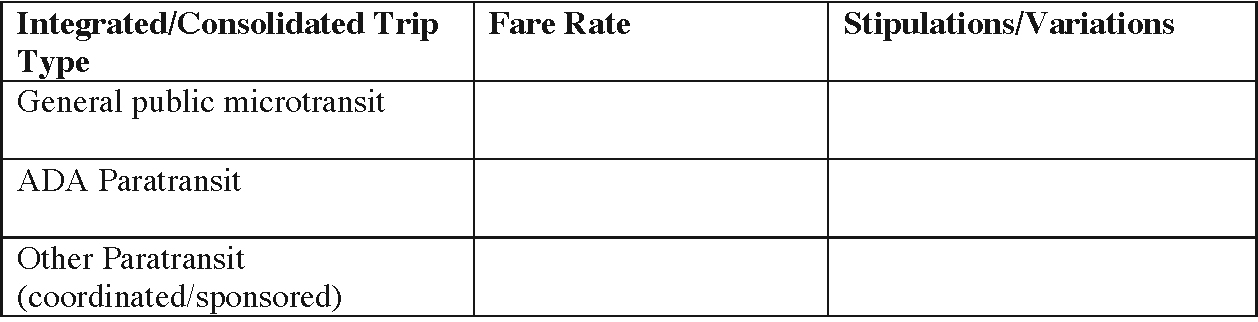
- Please provide information on fare rates and structures for the following service and trip types:
Long Description.
The column headers of the table are Integrated or Consolidated Trip Type, Fare Rate, Stipulations, and Variations. The data given in the table row-wise are as follows: Row 1: General public microtransit: Blank; Blank; Blank. Row 2: ADA Paratransit: Blank; Blank; Blank. Row 3: Other Paratransit (coordinated or sponsored): Blank; Blank; Blank.
SECTION DIVIDER HERE - - - - - - - -- - - - - - - -
Booking, Scheduling, and Communication
The following questions ask about information involving the booking and scheduling processes along with communication procedures concerning different types of trips on integrated/consolidated services. These questions include discussion of technologies and staff resources used in these topical areas for both the transit agency and customer perspectives. This section also includes questions about fare payment options and scheduling change procedures for different types of trips.
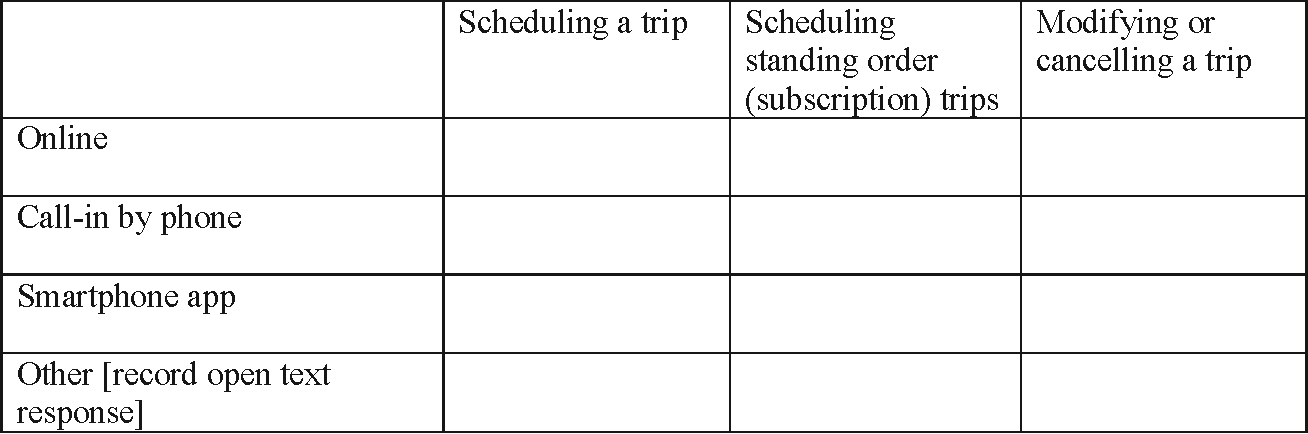
- Please use the table below to indicate which options are available for ADA or coordinated paratransit customers in trip scheduling (select all that apply):
Long Description.
The column headers of the table are Blank, Scheduling a trip, Scheduling standing order (subscription) trips, Modifying or cancelling a trip. The data given in the table row-wise are as follows: Row 1: Online: Blank; Blank; Blank. Row 2: Call-in by phone: Blank; Blank; Blank. Row 3: Smartphone app: Blank; Blank; Blank. Row 4: Other [record open text response]: Blank; Blank; Blank.
- How does the transit agency/service provider communicate with the ADA or coordinated paratransit customer on any scheduling changes or modifications? (select all that apply)
- Online
- Call by phone
- IVR system
- Smartphone app
- Text message
- Other [record open text response]
- Which types of ADA or coordinated paratransit service trips are scheduled to be commingled with general public microtransit trips? (select all that apply)
- All trips are commingled
- Trips that do not require WAVs
- Trips that do not require additional assistance (e.g., door-to-door, etc.) for the customer
- Trips that are going to certain destinations
- Trips that do not have rider compatibility concerns (e.g., intellectual and developmental disabilities)
- Based on available capacity in dedicated vehicles
- Customer-elected option on all or some trips
- Other [record open text response]
- [If Q28 = D] What types of trip destinations are determined to be factors for commingling these trips? [record open text response]
- [If Q28 = E] Please describe considerations in rider compatibility that apply to commingling decision-making. [record open text response]
- [If Q9 = C] How are ADA or coordinated paratransit trip reservations transferred/input into the integrated/coordinated service software platform?
- Automatically transferred via link between the two software systems
- Transfer link capable with trips verified by staff to be commingled
- Manually input into the microtransit software platform by staff
- Other (record open text response)
- How are commingling determinations/decisions made?
- Automatically by the software
- Automatically by the software, then checked by staff
- Manually by transit agency/service provider staff
- [If Q32 = B or C] When are commingling decisions manually done or confirmed by staff?
- Before the day of service
- On the day of service (in the morning)
- On the day of service (in real-time)
- Other [record open text response]
SUB-SECTION DIVIDER HERE - - - - - - - -- - - - - - - -
The following questions consider whether continuous dynamic optimization is applied towards ADA or coordinated paratransit trips in the integrated/consolidated service.
Continuous dynamic optimization (CDO), as applied to ADA paratransit services, is an automated process by which a scheduling and dispatching technology continuously or frequently considers additional trips just booked, changes to booked trips, cancellations, and day-of-service events to solve problems or to take advantage of opportunities. In view of those changes, the CDO process then re-optimizes the assignment of trips to achieve the transit agencyʼs desired balance of service/cost efficiency and service quality (definition from TCRP Synthesis 168).
- Does the integrated/coordinated service use continuous dynamic optimization (CDO) on ADA or coordinated paratransit scheduled for service?
- Yes
- Depending on trip/customer type
- No
- [If Q34 = B] What types of trips does the software apply continuous dynamic optimization (CDO) towards in its re-scheduling processes?
- All except subscription trips (subscription trip anchored)
- All trips except _____________________Record open text response
- [If Q34 = A or B] When does the software apply continuous dynamic optimization (CDO) towards these trips in its re-scheduling processes?
- ONLY before the service day (including when new trips are added for future days)
- Before the service day AND on the service day itself
- When an ADA or coordinated paratransit trip is scheduled on the integrated/consolidated service, what system(s) is used to communicate the original confirmed pickup and drop-off windows to the customer? (select all that apply)
- Call by phone
- IVR system
- Smartphone app notification
- Text message
- Other [record open text response]
- [If Q34 = A or B] If the pick-up and drop-off times are changed by the software platform, how are these new times communicated to ADA or coordinated paratransit customers? (select all that apply)
- Call by phone
- IVR system
- Smartphone app notification
- Text message
- Other [record open text response]
- Do customers scheduled on microtransit receive imminent vehicle arrival notifications through any of the following communication means? (select all that apply)
- Call by phone
- IVR system
- Smartphone app notification
- Text message
- Other [record open text response]
- How can ADA or coordinated paratransit customers pay for their fares on the integrated/consolidated service? (select all that apply)
- Cash (at time of boarding)
- Tap debit/credit card (at time of boarding)
- Integrated electronic fare (e-fare)
- Over the phone
- Smartphone app
- Passbooks (purchased in advance)
- Other [record open text response]
- [if 40 = C or E] Is the smartphone app available to pay for ADA or coordinated paratransit trips the same app used to make trip reservations?
- Yes
- No
SECTION DIVIDER HERE - - - - - - - -- - - - - - - -
Customer Considerations and Accommodations
The following questions ask about further considerations in commingling for different customer types, any additional accommodations made for some ADA or coordinated paratransit customers on the integrated/consolidated service with microtransit, driver training for microtransit operators, and customer education available. This section also asks questions on ADA compliance considerations and how they are tracked for ADA paratransit trips commingled in microtransit.
- Does the microtransit software platform include information on emergency contacts for ADA or coordinated paratransit riders?
- Yes
- No
- Can dwell/wait times and alighting times be adjusted in the microtransit software system for ADA or coordinated paratransit trips?
- Yes, based on trip/customer parameters
- Yes, on an individual trip basis
- No
- How many additional companions or personal care attendants (PCAs) can ADA or coordinated paratransit customers have with them on the integrated/consolidated service?
- 1
- 2
- Unlimited
- Other (record open text response)
- At which point are companions or personal care attendants (PCAs) scheduled into the software platform of the integrated/consolidated service? (select all that apply)
- Automatically scheduled based on customer parameters in the software
- Logged at the time the trip is scheduled
- Not logged in the system; allowed at the time of boarding
- [If Q8 = B] Are all vehicle operators trained in wheelchair and mobility device securement?
- Yes
- No
- [If Q28 = E] If because of rider compatibility considerations the trips are determined to not be commingled with general public trips, in what manner are they scheduled?
- Onto separate designated vehicles in the integrated/consolidated fleet
- With non-microtransit dedicated vehicles and drivers
- Does the software platform provide extra notification time for the vehicle arrival to ADA or coordinated paratransit trip riders using integrated/consolidated service (compared to general public microtransit riders)?
- Yes, automatically based on the customer type
- Yes, as part of the customerʼs profile
- No
- What other types of assistance and accommodations can ADA or coordinated paratransit customers request?
- Record open text response
- [If Q11 or Q12 = A, B, or D] Do reservationists and call center staff from the contracted dedicated or non-dedicated providers receive training on disability awareness and sensitivity of ADA or coordinated paratransit customer needs?
- Yes
- No
SECTION DIVIDER HERE - - - - - - - -- - - - - - - -
Fleet Mixture and Dispatching
The following questions are focused on delivery of the integrated/consolidated on-demand service, in particular commingled trips. Topics explored will include the fleet mixture used for the service(s) and dispatching assignments to those vehicles based on the type of trip.
- [if Q8 = A] Please use the table below to indicate how many WAVs (wheelchair accessible vehicles) and non-WAVs are dedicated to the consolidated on-demand service for the typical maximum level of service daily. Please leave the cell blank if provider type is not applicable.

Long Description.
The column headers of the table are Number of Vehicles, Directly Operated – Dedicated, and Contracted – Dedicated. The data given in the table row-wise are as follows: Row 1: WAVs: Blank; Blank; Blank. Row 2: Non-WAVs: Blank; Blank; Blank.
- [If Q8 = B] Please use the table below to indicate how many WAVs (wheelchair accessible vehicles) and non-WAVs are dedicated to the integrated on-demand service for the typical maximum level of service daily. For Contracted – Dedicated or Non-Dedicated service with multiple providers, you can sum together the total number of vehicles between providers. Please leave the cell blank if provider type is not applicable.

Long Description.
The column headers of the table are Number of Vehicles, Directly Operated – Dedicated, Contracted – Dedicated, and Non-Dedicated. The data given in the table row-wise are as follows: Row 1: WAVs: Blank; Blank; Blank. Row 2: Non-WAVs: Blank; Blank; Blank.
- [If Q10 = Directly Operated] Which ADA or coordinated paratransit trips are scheduled and dispatched with vehicles of the directly operated service?
- All ADA or coordinated paratransit trips
- ADA paratransit trips only
-
- Other coordinated paratransit trips only
- Only trips requiring a WAV
- Only trips with specific accommodation or customer consideration needs
- Other (record open text response)
- [If Q10 = Contracted] Which ADA or coordinated paratransit trips are scheduled and dispatched to the contracted service provider(s)?
- All ADA or coordinated paratransit trips
- ADA paratransit trips only
- Other coordinated paratransit trips only
- Only trips requiring a WAV
- Only trips with specific accommodation or customer consideration needs
- Other (record open text response)
- [If Q10 = Non-Dedicated] Which ADA or coordinated paratransit trips are scheduled and dispatched to the non-dedicated service provider(s)?
- All ADA or coordinated paratransit trips
- ADA paratransit trips only
- Other coordinated paratransit trips only
- Only trips requiring a WAV
- Only trips with specific accommodation or customer consideration needs
- Other (record open text response)
- Which staff/entity is responsible for handling customer service calls from ADA or coordinated paratransit customers related to pick-ups, cancellations, and vehicle arrival issues (e.g., “Whereʼs my ride?” calls) for the integrated/coordinated service?
- Transit agency call specialist
- Transit agency dispatcher
- Transit agency scheduler (if different from dispatcher)
- Contracted provider staff
- Software technology company call specialist
- Third party call specialist (hired by Software technology company)
- Other (record open text response)
- [If Q10 = Non-Dedicated] Who is the primary backup service operator if an ADA or coordinated paratransit trip is denied by the non-dedicated service provider?
- Transit agency (directly operated service)
- Other contracted provider (dedicated service)
- Other (record open text response)
- Please rank the following options by priority for serving an ADA or coordinated paratransit trip on the integrated/consolidated service if a vehicle breakdown (i.e., road call) occurs on the road:
- Another vehicle dispatched from the same provider
- Transit agency/contractor road supervisor fulfills the trip
- Other (record open text response)
- [If Q34 = A or B] Thinking about use of continuous dynamic optimization (CDO), if the trip times are changed how are the originally scheduled pickup and drop-off times for the ADA/paratransit trip communicated to the driver? (check all that apply)
- Tablet or driver smartphone app
- Paper backup manifest
- Over radio/phone by the dispatcher
- Not communicated
- Other (record open text response)
- How are the actual pick-up and drop-off vehicle arrival times for ADA or coordinated trips commingled in the service vehicles determined?
- Input by the driver on their tablet or smartphone app
- Calculated automatically by the microtransit software
- Other (record open text response)
SECTION DIVIDER HERE - - - - - - - -- - - - - - - -
Benefits and Impacts
The following questions asked measure impacts of the integrated/consolidated service from the perspectives of the transit agency and ADA or coordinated paratransit customers. This section will also pose questions on impacts to ADA compliance for complementary paratransit service from commingling.
- For paratransit ridership and number of trip requests, please indicate using a scale of 1 (made significantly worse – decreased) to 5 (made significantly better – increased) the effect of commingling ADA or coordinated paratransit trips with general public trips on microtransit service. Select one choice.

Long Description.
The column headers of the table are Factor, 1 Made Significantly Worse (Decreased), 2 Made Somewhat Worse (Decreased), 3 No Impact, 4 Made Somewhat Better (Increased), 5 Made Significantly Better (Increased), N or A or not Measured. The data given in the table row-wise are as follows: Row 1: Number of Paratransit Trips and Requests: o; o; o; o; o; o.
- For cost efficiency (cost per ADA or coordinated paratransit trip), please indicate using a scale of 1 (made significantly worse – increased) to 5 (made significantly better – decreased) the effect of commingling ADA or coordinated paratransit trips with general public trips on microtransit service. Select one choice.

Long Description.
The column headers of the table are Factor, 1 Made Significantly Worse (Decreased), 2 Made Somewhat Worse (Decreased), 3 No Impact, 4 Made Somewhat Better (Increased), 5 Made Significantly Better (Increased), N or A or not Measured. The data given in the table row-wise are as follows: Row 1: Cost Efficiency: o; o; o; o; o; o.
- Please provide an estimated (or actual) percentage of ADA or coordinated paratransit trips which are commingled with the microtransit service relative to total trips on the service. (drag the slider to indicate this percentage)
- Record open text response
- Please provide the current or most recent productivity (trips per revenue hour) stat for weekdays and weekends on the integrated/consolidated microtransit service:

Long Description.
The column headers of the table are Period of Service, Productivity (Trips or VRH). The data given in the table row-wise are as follows: Row 1: Weekdays: Blank. Row 2: Weekends: Blank.
- How does the microtransit software company provide data to the transit agency? (select all that apply)
- Live online dashboard with exportable reports
- Raw data files sent regularly or on request
- Prepare reports sent regularly
- Other (record open text response)
- [If Q10 = Contracted] Are there any differences in data available on commingled trips dispatched to the contracted – dedicated service provider(s)?
- Yes
- No
- [If Q66 = Yes] Please describe the differences in data available on these trips performed by the other contractor.
- [If Q10 = Non-Dedicated] Are there any differences in data available on commingled trips dispatched to the non-dedicated service provider?
- Yes
- No
- [If Q68 = Yes] Please describe the differences in data available on these trips performed by the non-dedicated service provider.
- Which of the following performance factors (if any) are not able to be measured specifically for ADA or coordinated paratransit trips commingled within the microtransit service? (select all that apply)
- Productivity
- Cost efficiency & effectiveness
- On-time performance
- Customer call-hold times
- No-shows
- Late cancellations
- WAV wait times
- Customer complaints
- Service rating
- Other, record open text response
- [If Q34 = A or B] Thinking about continuous dynamic optimization (CDO), does the microtransit software platform data measure ADA or coordinated paratransit on-time performance based on the originally scheduled pick-up and drop-off time windows?
- Yes
- No
- Unknown/not sure
- Other, record open text response
- Is the microtransit software platform able to produce a report on ADA compliance of commingled trips?
- Yes
- No
- Unknown/not sure
- [If Q70 = A] Please indicate the performance indicators on ADA compliance included in the report (select all that apply):
- Denials
- Late trips
- Missed trips
- Excessively long trips
- Telephone call and hold times
- On-time performance
- WAV wait times
- Other, record open text response
- Has the transit agency experienced/encountered any issues with meeting reporting and compliance requirements for ADA or coordinated paratransit services as a result of commingled service design or data availability?
- Yes
- No
- [If Q74 = Yes] Please describe the issues in reporting and compliance requirements encountered.
- Record open text response
- [If Q74 = Yes] What adjustments were made to the commingled service design as a result? (select all that apply)
- Ended commingling for some paratransit trip types
- Increased provision of dedicated vehicles
- Adjusting dispatching of trips to some providers
- Increased staff available for customer calls
- Worked with microtransit technology company to improve data tracking
- Other [record open text response]
- None yet/still in progress
- Have you surveyed ADA or coordinated paratransit customers about their experience using the microtransit service?
- Yes
- No
- Please summarize any ADA or coordinated paratransit customer feedback received on the integrated/consolidated service rider experience.
- Record open text response
SECTION DIVIDER HERE - - - - - - - -- - - - - - - -
Lessons Learned and Challenges
For the remaining questions in the survey, weʼd like to ask about the transit agencyʼs overall experience with the integration/consolidation of ADA or coordinated paratransit with general public microtransit service at your agency.
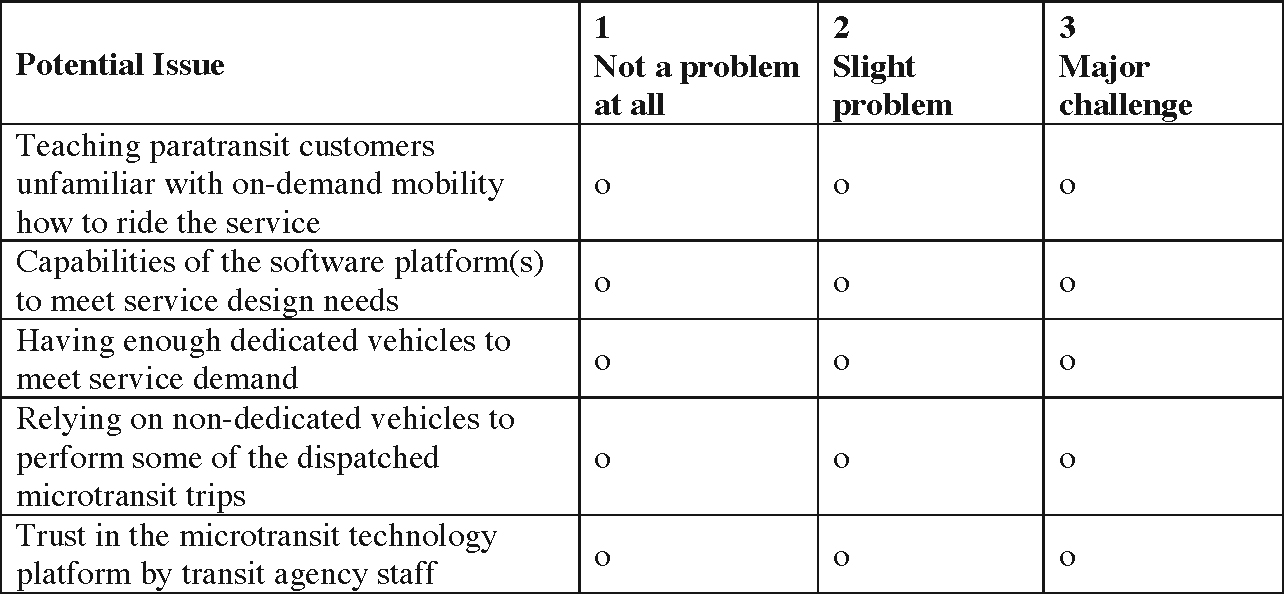
- Using a scale of 1 (not a problem at all) to 3 (major challenge), please indicate your agencyʼs experience with the service delivery or administration issues presented below.
Long Description.
The column headers of the table are Potential Issue, 1 Not a problem at all, 2 Slight problem, and 3 Major challenges. The data given in the table row-wise are as follows: Row 1: Teaching paratransit customers unfamiliar with on-demand mobility how to ride the service: o; o; o. Row 2: Capabilities of the software platform(s) to meet service design needs: o; o; o. Row 3: Having enough dedicated vehicles to meet service demand: o; o; o. Row 4: Relying on non-dedicated vehicles to perform some of the dispatched microtransit trips: o; o; o. Row 5: Trust in the microtransit technology platform by transit agency staff: o; o; o.
- What lessons learned could your agency share with the industry regarding integration/consolidation of ADA or coordinated paratransit service with microtransit?
- Record open text response
SECTION DIVIDER HERE - - - - - - - -- - - - - - - -
Further Participant Information
Weʼd like to quickly ask a couple questions about other agency participants you believe should be included in this survey research.
- Would you be interested in participating further in this study as a case example transit agency for this research?
- Yes
- No
- [FOR TERMINATIONS and SURVEY COMPLETES] Thank you for participating in this survey. Your responses have been recorded and your input is greatly appreciated. We may reach out to you in the future to obtain additional clarification or information. In the meantime, if you have any questions about this research, please contact [ . . . ], the projectʼs principal investigator.
Please advance so your information will be recorded.
SECTION DIVIDER HERE - - - - - - - -- - - - - - - -


