Resilient Zero-Emission Transit Bus Fleets: A Guide (2025)
Chapter: Appendix B: Literature Review

APPENDIX B
Literature Review
This appendix provides a detailed summary of the literature review conducted in the development of this guide.
Resilience Planning
Resilience is a broad concept with many definitions, and establishing a common terminology is critical to a productive conversation. While resilience is often used in the context of climate adaptation and increasing natural hazards, the scope of this guide covers not only climate-related natural hazards such as extreme heat and sea level rise but also threats from energy systems, cybersecurity, and market development (U.S. DOT 2021a). Based on a literature review and transportation stakeholder interviews, Weilant, Strong, and Miller (2019) defined resilience in transportation as “the ability to adapt to, recover from, respond to, and bounce back quickly” from threats. Transit agencies are resilient when they can meet service needs when faced with adverse conditions. The scope of these guidelines focuses on operational resilience and maintaining service levels in day-to-day and emergency situations.
Resilience planning within public transit is important for ensuring the needs of communities, especially those that are most vulnerable, continue to be met when adverse events occur. Extreme weather events create ripple effects and disruption for energy systems and infrastructure that a transit agency depends on (U.S. Department of Transportation 2021a). In many places, communities that rely the most on public transit are also those that are being affected most by extreme weather events (Pulcinella et al. 2019; U.S. DOT 2021a; Stechemesser and Wenz 2023). Transit agencies recognize their importance in serving communities, and establishing resilience plans is a necessary step to providing service despite adverse conditions.
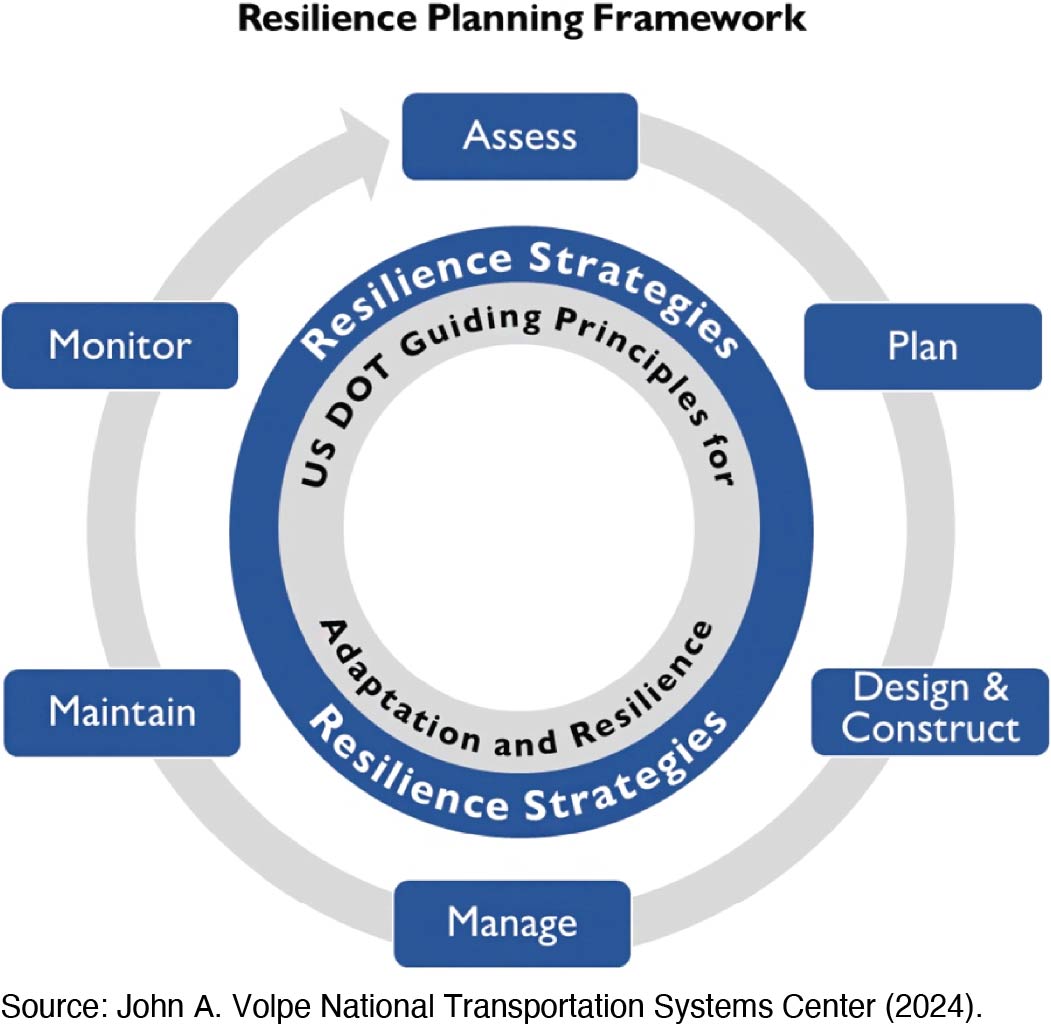
There are many existing guidelines for resilience in a transit or transportation context. FTA published its Transit Resilience Guide in 2024, providing transit agencies with recommendations for identifying climate vulnerabilities and building resilience into agency projects (John A. Volpe National Transportation Systems Center 2024). It presents a framework (Figure 15) for planning. First, agencies should assess their assets and populations most at risk to current and future natural hazards, as well as which assets are most critical for prioritization. Criticality could include assets that have the worst consequences for safety upon failure, the highest potential to disrupt service, or assets that serve the most transit-dependent users. Then, agencies should incorporate resilience into planning for future projects. In the design and construction phase, agencies should consider potential hazards and incorporate adaptation measures in the project. Four broad types of resilience strategies are highlighted: avoiding risk by relocating assets, maintaining assets preventatively, managing response to emergencies through preparation, strengthening assets to withstand future adverse conditions, and enhancing redundancy with alternatives. In
Long Description.
The illustration is titled Resilience Planning Framework and shows three concentric circles. The innermost circle reads, USDOT Guiding Principles for Adaptation and Resilience. The middle circle reads, Resilience strategies. The outermost circle, in the form of an arrow, reads, Assess, Plan, Design and construct, Manage, Maintain, and Monitor. Monitor leads to Assess, thus forming a cyclic process. Source: John A. Volpe National Transportation Systems Center (2024).
transit asset management, it is recommended that agencies integrate the resilience and vulnerability of assets into their assessment of their condition. In operations and maintenance activities, agencies should incorporate resilience to prevent hazardous conditions. Finally, the guidelines recommend that agencies monitor and quantify the effectiveness of resilience actions and revise their approach as necessary. While this guide provides a comprehensive guide to general resilience to climate threats and hazards, it includes little specific guidance for ZE technologies.
Another key resource is TCRP Web-Only Document 70: Improving the Resilience of Transit Systems Threatened by Natural Disasters, Volume 1: A Guide, and the partnering web database of resources (Matherly et al. 2017; Alan M. Voorhees Transportation Center n.d.). This guide provides a comprehensive review of case studies, resilience approaches, terms, worksheets, and tools for transit agencies, but it does not cover ZE transit aspects and focuses only on natural hazards.
Outside of climate resilience, APTA provides recommended practices for emergency planning, cybersecurity considerations, continuity of operations, and other general resilience practices specific to public transit agencies (APTA 2024, 2014, 2008). These do not account for the different threats and possible consequences relevant to ZE vehicles, and thus provide a starting point but not a complete picture for an agency with predominantly ZE vehicles in its fleet.
Zero-Emission Fleets
Many transit agencies are moving beyond their initial deployments of ZEB to larger fleets and planning how they will convert their entire fleets to ZE propulsion technologies. Starting in 2022, FTA required that transit agencies submit transition plans as part of their applications for funding for vehicles and infrastructure under the 5339(c) Low or No Emission Vehicle Program (FTA 2022). Resilience is a key consideration for large deployments of ZEB and transition planning, and current practice lacks industry standards for how to approach these questions.
The ZE fleet transition in the U.S. is in early stages but growing quickly. Currently, approximately 10% of the total U.S. transit bus fleet are ZEBs, 94% of which are BEBs and the remaining 6% are fuel cell electric buses (FCEBs) (Lowell and Gupta 2024). Few agencies are 100% ZE; in California, the state with the most stringent transition requirements, only three agencies have already completely transitioned. Nationwide, transit agencies have a median of eight full-size ZEBs, and 60% of fleets have ten or fewer ZEBs (Hynes et al. 2024). Thus, most agencies are able to rely on existing resilience measures for ICE fleets due to their low percentage of their fleet comprised of ZEBs; however, that will not be sufficient as agencies increasingly transition.
A number of regulations and funding opportunities are driving increased adoption of ZEBs, the previously mentioned year, FTA 5339(c) Low or No Emission Vehicle Program being one of them. Those transition plans must demonstrate the agenciesʼ long-term fleet management plans and the availability of resources for their transition, including evaluating facilities, relevant policies, workforce capabilities, and partnerships with utilities or fuel providers (FTA 2022). Individual states are also mandating transitions. Californiaʼs Innovative Clean Fleets regulation requires all transit agencies to plan for full transitions by 2040, with increasing ZEB purchase requirements until 2029, when all bus purchases must be ZE (California Air Resources Board 2018). Based on current commitments, 40% of transit buses in the U.S. are expected to be ZE by 2050 (Lowell and Gupta 2024). The widespread shift to ZE technology requires updated resilience planning and measures.
Zero-Emission Fleet Resilience
As described above, very few of the existing resilience planning guidance documents address ZE technologies, and very few of the transition plan requirements address resilience.
Many agencies already have hazard analyses and resilience or mitigation plans to varying levels of completeness, but very few resilience plans have been updated for ZEB. Resilience to climate threats in public transit has been a focus for many cities globally, such as planning for extreme heat and precipitation. The C40 Cities consortium highlighted adaptations including nature-based solutions such as planting vegetation along tramways for better rainwater infiltration or reducing temperatures for passengers by adding water misters at stations, adding air conditioners, and tinting bus windows (C40 Cities Climate Leadership Group 2019).
One of the few published whitepapers on resilience for a ZEB fleet is an analysis of the New York City MTAʼs response to Hurricane Sandy and recommendations for resilience as its fleet electrifies (Bailey et al. 2020). It recommends siting future charging facilities out of current and 2050-projected flood zones, raising chargers on concrete pads to avoid floodwaters, and using fossil-fueled generators to maintain power. It further discusses the impact of cold temperatures on BEB range and potential solutions for energy security. It ends with recommendations that the New York MTA include electric bus infrastructure in its resilience planning. While it provides resilience examples in the context of New York City and its specific threats, it does not cover the range of conditions agencies contend with across the U.S., nor does it provide guidelines for agencies to use. Another example is a case study published by the World Bank Transport Global Practice of the Shenzhen (China) Bus Group, which is the worldʼs first and largest fully electric bus fleet (The World Bank 2021). It specifies that the fleet has emergency response plans in place for shock scenarios ranging from extreme weather to electricity outages to passenger surges, but does not provide sufficient detail for replication by another transit agency. A broad set of potential threats, consequences, adaptations, and guidelines is needed for transit agencies in the transition process.
Specific to ZEB, FTAʼs Procuring and Maintaining Battery Electric Buses and Charging Systems mentions the need for specific resilience measures for BEBs, specifically surrounding power
availability; however, it does not provide detailed or extensive recommendations for increasing resilience to grid outages (Godfrey and Sipiora 2023). It does not address threats or consequences related to the performance differences of ZEBs vs. ICEBs or include challenges specific to FCEBs.
Though agencies are often required to create a plan to transition to ZE by funding agencies, state regulations, or internal goals, these plans seldom include a resilience component (FTA 2022, California Air Resources Board 2020). When planning for fleet operations for the future, resilience planning and implementation of adaptation measures are often difficult to conceptualize and prioritize, especially when planning for the adoption of new transportation technologies. Obstacles that agencies face that affect the development of resilience planning often include competing priorities, lack of funding, staff time, data availability, and the difficulty in choosing from the variety of resilience planning methodologies (Matherly et al. 2017). It can be difficult to prioritize investment of limited resources for a risk that may or may not manifest in the short term. To project realistic cost-benefits, agencies need high-quality data on the likelihood of threats such as natural disasters and tools to estimate the consequences of asset damage or service disruptions (Transportation Research Board 2021). Compounding existing difficulties with planning for novel fleet technologies and the ensuing novel risks emphasizes the need for ZE fleet resilience guidelines.
As described previously, having systems in place to ensure a resilient ZE transit fleet also protects all the members of our communities. Transit service is critical for providing access to food, medical care, education, and other essential services for those who do not have other means of transportation, and transit serves as an emergency response capability during natural disasters to evacuate people.
In addition, ZEB fleet and infrastructure resilience are critical to the successful widespread deployment of ZE fleets. This type of planning is often driven by specific operational needs and site constraints. Conducting resilience assessments and developing transition plans for transit agencies is only one aspect of creating resilient ZE transit fleets; ensuring that the technology for implementing adaptation strategies is available and affordable is another. It can be difficult to prioritize investments in solutions that may or may not be needed in the future, depending on whether or not a particular scenario occurs, especially when faced with the everyday challenges that arise when providing reliable service. The more economical the technology solutions are, and if they can address resilience not only in an emergency response scenario but in daily operations as well, the more likely it is for transit agencies to adopt them. Encouraging research in new, flexible adaptation measures is one strategy that could be used to help enable transit agencies to implement technologies that will increase the resilience of their fleets.
A resilient ZE transit fleet is critical to protect all members of our communities. Transit service is critical for providing access to food, medical care, education, and other essential services for those who do not have other means of transportation, and transit serves as an emergency response capability during natural disasters to evacuate people. If these services become more susceptible to disruption in adverse conditions during the ZE transition, it is the most vulnerable who will be affected by a failure.


