Overview
The United States and other countries have developed policies, guidance, and safeguards aimed at reducing risks associated with dual-use research of concern (DURC)1 and research involving pathogens with enhanced pandemic potential (PEPP).2 These efforts have focused primarily on overseeing research conducted in physical laboratory settings where biological materials are directly handled, commonly referred to as “wet labs.” Research conducted in computational environments (“in silico” research) also plays an essential role in advancing scientific knowledge and enhancing capabilities such as predictive modeling, data analysis, and system simulation, and also may fall under the DURC and PEPP research categories. In response to recent advances in generative artificial intelligence (AI), computational modeling tools, and approaches in biological research, the scientific community has focused on the benefits and potential biosecurity risks associated with communicating studies that use in silico methodologies to understand and design biological systems.
The National Science Foundation sponsored a workshop hosted by the National Academies of Sciences, Engineering, and Medicine (the National Academies) on Navigating the Benefits and Risks of Publishing Studies of In Silico Modeling and Computational Approaches of Biological Agents and Organisms. The hybrid workshop was held April 3-4, 2025, and convened 250 participants from government, industry, academia, and nonprofit and philanthropic sectors, as well as scientific publishing and policy-focused organizations to explore existing policies and guidance on DURC and research involving PEPP and their relevance to in silico research, as well as lessons learned and possible guidance from past biotechnology governance and other domains. They also examined the criteria that could be considered to assess the benefits and risks of in silico research and possible strategies to facilitate the responsible dissemination of this research. The workshop featured a series of expert presentations and panel discussions, along with two interactive breakout sessions designed to discuss
___________________
1 Defined in the United States Government Policy for Oversight of Dual Use Research of Concern and Pathogens with Enhanced Pandemic Potential (issued May 6, 2024) as “life sciences research that, based on current understanding, can be reasonably anticipated to provide knowledge, information, products, or technologies that could be misapplied to do harm with no, or only minor, modification to pose a significant threat with potential consequences to public health and safety, agricultural crops and other plants, animals, the environment, materiel, or national security.” The policy was rescinded on May 5, 2025, by Executive Order 14292, and the Director of the Office of Science and Technology Policy and the National Security Advisor are charged with conducting a 120-day review to replace this policy.
2 Defined in the United States Government Policy for Oversight of Dual Use Research of Concern and Pathogens with Enhanced Pandemic Potential (issued May 6, 2024) as a “pathogen that is likely capable of wide and uncontrollable spread in a human population and would likely cause moderate to severe disease and/or mortality in humans.” The policy was rescinded on May 5, 2025, by Executive Order 14292, and the Director of the Office of Science and Technology Policy and the National Security Advisor are charged with conducting a 120-day review to replace this policy.
key challenges to and opportunities for in silico research in biological systems and to elicit suggestions for implementing proposed scientific and policy strategies to safeguard the benefits and advances of research while reducing the risks posed by funding and disseminating research information and resources involving DURC or research involving PEPP. The purpose of the workshop is outlined in Appendix A (Statement of Task), the agenda is provided in Appendix B, and recordings and slides from the workshop are available on the project website.3 This proceedings was prepared by the workshop rapporteurs as a factual summary of what occurred during the workshop. The planning committee’s role was limited to planning and convening the workshop. The views contained in the proceedings are those of individual workshop participants and do not necessarily represent the views of all workshop participants, the planning committee, or the National Academies.
During the workshop discussions, participants highlighted the trade-offs between openness and controls in sharing scientific results and tools. They also examined various approaches to assessing current risks and monitoring future developments that could increase those risks, while preserving the benefits of the research. They discussed how tiered and layered approaches could be leveraged to identify higher-risk research—and potentially restrict such research or its dissemination—without unduly hindering low-risk research. Because any strategy has trade-offs and potential implementation challenges, participants also offered suggestions for involving and incentivizing multiple stakeholders in supporting responsible research dissemination. Of note, while the workshop was framed around the dissemination of in silico research and the risks it may pose, many participants emphasized the importance of addressing steps earlier in the research lifecycle, such as upstream oversight, risk assessment, and development of responsible research norms, which are essential to any effective dissemination strategy.
TRADE-OFFS BETWEEN OPENNESS AND CONTROL
A central tension exists between the desire to maximize the benefits of science and the need to minimize the risk that scientific tools and knowledge could be used to cause harm. Many participants noted the benefits of openly sharing scientific data, tools, information, and results. By enabling the research community to validate study results and drive scientific progress, open science not only accelerates advancements in research and applications broadly but also facilitates the development of countermeasures against threats to human health—whether they emerge from nature or purposeful attacks. Measures to restrict the open sharing of in silico biological research could potentially come at the cost of undermining those benefits.
In addition, several participants described how in silico biological models, increasingly aided by AI and other computational biology tools, could enable capabilities that meet or surpass those addressed by existing DURC and PEPP oversight structures. These capabilities may pose new biosecurity risks by making it easier for researchers to design, test, and deploy physical biological agents with the potential of causing harm. Biological design and synthesis capabilities are now more accessible than ever, even to individuals without deep expertise or access to traditional laboratory infrastructure, largely because of advances in AI and computational tools. However, combining in silico tools and wet lab research to physically produce a harmful biologic agent, such as toxins, engineered viruses, or modified bacteria, still typically requires a level of specialized knowledge, resources, and access to a laboratory setting. Against this backdrop, the open sharing of increasingly sophisticated data and in silico tools could increase biosecurity risks significantly if such capabilities fall into the hands of people who possess sufficient knowledge and resources and intend to cause harm.
Finally, several participants noted that broad generative in silico tools (e.g., AI foundational models) may pose risks that are not immediately apparent. For example, a model designed to predict protein function from de novo DNA sequences could be repurposed to engineer harmful biological agents, particularly if protective
___________________
3 See https://www.nationalacademies.org/event/44297_02-2025_navigating-the-benefits-and-risks-of-publishing-studies-of-in-silico-modeling-and-computational-approaches-of-biological-agents-and-organisms-a-workshop (accessed June 24, 2025).
guardrails are weak or removed—an outcome made more likely with open-source tools. This challenge complicates efforts to identify and assess risk based solely on a tool’s intended use or stated application, for example, a three-dimensional (3D) printer, which is a technology capable of producing guns. This example reflects the broader concern that general-purpose tools may enable misuse in ways not anticipated by their developers, reinforcing the need for risk assessments that consider how general-purpose tools might be applied in unforeseen ways and evolve alongside other technologies.
INFORMING RISK ASSESSMENT FRAMEWORKS
Throughout the workshop, many participants underscored the importance of proactively assessing the biosecurity risks of in silico biological research rather than waiting for a bad outcome before implementing risk assessment or control mechanisms. Given the rapid pace of development of in silico research tools and approaches, some participants emphasized the importance of risk assessment frameworks that address current capabilities and anticipate the implications of future capabilities that may be enabled as technologies advance. Drawing on existing policy frameworks, participants discussed a variety of technical, ethical, societal, and governance considerations for assessing risk of in silico models and suggested possible criteria for the assessment of benefits and risks related to societal advancements; predictive power and scope of models; technical capability and design potential; accessibility and ease of use; oversight, provenance, and access control; potential for misuse and malicious intent; and disproportionate impacts. These criteria are discussed in more detail in the section on “Challenges and Examples of Needs to Effectively Safeguard Benefits and Promote Advances.”
In contrast to wet lab research, which may present direct physical risks as described above, in silico work typically does not present standalone risks (NASEM, 2025). However, in silico research outputs may become concerning when combined with other data, tools, or systems, especially when transitioned from digital to the physical world—a transition that many participants emphasize is complex and fraught with challenges. Recognizing that this risk is dynamic and often cumulative, several participants suggested that dissemination policies could account not only for the risks of individual outputs but also for how newly shared work might enable dangerous combinations or linkages when layered onto existing knowledge. For example, several participants emphasized the importance of monitoring developments that could be considered “game-changing” in terms of reducing barriers to using in silico information to inform the production of hazardous physical products or circumventing existing biosecurity or biodefense mechanisms. They suggested that incorporating clear “if-then” commitments in frameworks for evaluating in silico capabilities and products could aid efforts to assess risks and benefits as knowledge and technologies evolve.
A TIERED AND LAYERED APPROACH TO MANAGING RISKS
One theme present throughout the workshop was the use of a tiered approach to identify which in silico research activities or products pose a higher risk of misuse and which pose a lower risk. This tiered approach would provide a mechanism to trigger further risk assessment—and potentially restrictions on dissemination—for high-risk research while allowing lower-risk research to proceed and be shared openly. Criteria to define high risk versus low risk were discussed during the breakout group discussions. Previous discussions on criteria related to DURC and research involving PEPP have primarily focused on physical, laboratory-based experiments. Many of the criteria developed in those discussions may be relevant to in silico research; however, participants noted the need to expand these frameworks to explicitly address computational approaches. Although some participants acknowledged that security is never 100 percent, they explained that a tiered approach creates points of friction that can help prevent the release of potentially dangerous information (i.e., defined as DURC potential or research involving PEPP) without appropriate consideration and controls. Several participants
shared that these friction points, such as responsible editorial oversight, red teaming, and selective access models, could act as cumulative hurdles that may deter misuse while preserving scientific openness. As one speaker commented, this layered strategy resembles “death by a thousand paper cuts” for bad actors, making malicious use too burdensome to pursue. In addition, many participants suggested that this tiered strategy could be most effective if implemented within a “Swiss cheese” approach to biosecurity throughout the research pipeline, whereby multiple layers of controls, each of which is imperfect, collectively create enough checks to minimize the risk of dangerous capabilities being released.
Many participants emphasized that dissemination, which encompasses various outlets in addition to traditional journals (see below), is instantly global and permanent. Once data, models, or other research products are released, controlling their access becomes impossible, highlighting the importance of oversight mechanisms that support risk assessment as early as possible and at multiple stages of the research process. Such risk assessments could be conducted much earlier than the submission of research involving in silico models or tools for dissemination. Although some participants recognized that oversight cannot be one-size-fits-all, they stressed the importance of supporting responsible conduct across the full range of environments in which in silico biological research and model development occur, including in academia, government labs, startups, large corporations, and international collaborations.
SUGGESTIONS FOR FACILITATING THE IMPLEMENTATION OF RISK MITIGATION STRATEGIES
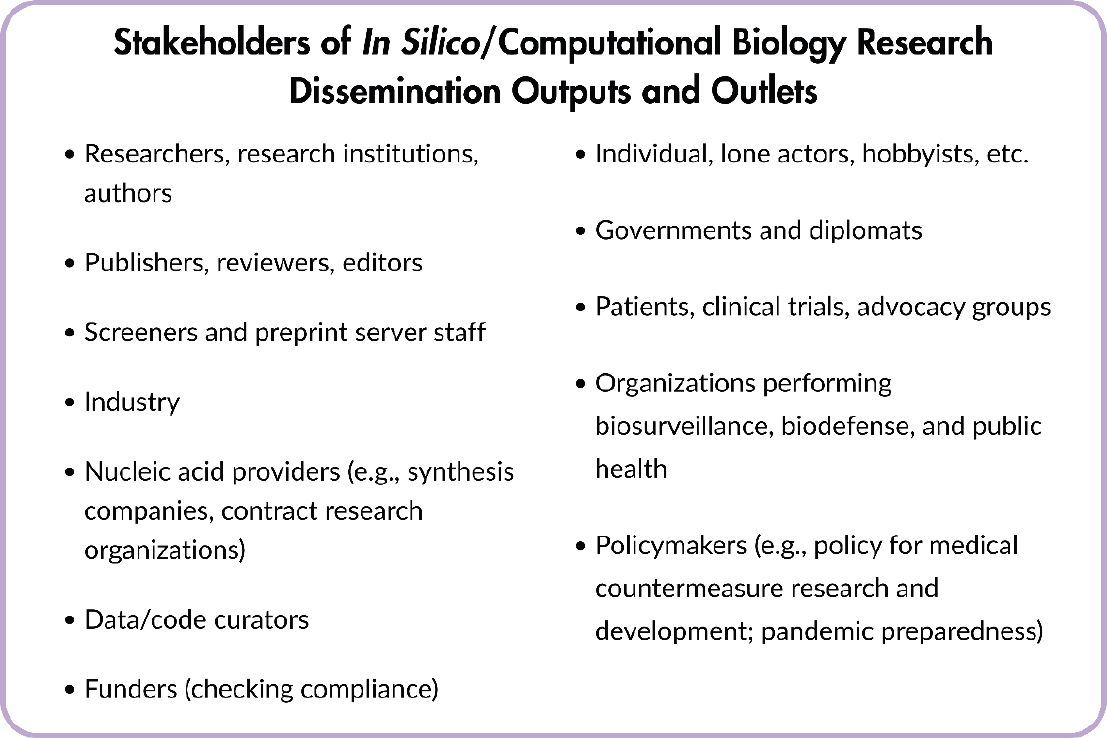
Because any strategy for conducting risk assessment or restricting research dissemination has trade-offs and potential implementation challenges, several participants highlighted the importance of involving and incentivizing multiple stakeholders (see Figure 1) in supporting responsible research dissemination. They discussed ways that research funders, researchers and institutions, journal and preprint servers publishers, editors, and reviewers, and other dissemination mechanisms, and many other groups can contribute to the efforts of promoting responsible dissemination. Participants also discussed a variety of technical solutions (see section on “Potential Solutions and Considerations for Implementation”) that could be employed to aid in silico research documentation, monitoring, and risk assessment.
Participants discussed a primary strategy to creatinga tiered framework with clear thresholds, responsibilities, and practical risk mitigations at each step. To realize this goal, a majority of participants suggested convening an authoritative working group to examine not only ethical frameworks from other communities but also regulatory, security, and governance models, both domestic and international (OECD, 2025), which would inform the creation of an information hazards framework with an initial focus on defining and mitigating the most high-risk activities.
To increase the likelihood that mechanisms for research review and risk mitigation will be effective and sustainable, several participants emphasized the importance of fostering a culture of risk–benefit analysis within the scientific community. If a suitable criteria-based assessment is used earlier in the research process and researchers truly understand the risks and are encouraged to act responsibly, they may be less inclined to turn to alternative dissemination pathways when some paths are blocked or to pursue higher-risk research. Many participants suggested that this culture change, emphasizing risk assessment and bioethics, could be supported through robust and comprehensive biosecurity training at all levels of scientific education and staffing, as well as through incentives linked to research publication and commercialization—thereby helping to embed biosecurity risk assessment as a standard and expected component of any bioscience research career.