Objectives, Components, and Measures of Effective Traffic Safety Public Awareness and Education Efforts (2025)
Chapter: 1 Background
Chapter 1. Background
Traffic safety professionals deploy a variety of countermeasures to improve roadway user safety, including behavioral outreach, infrastructure modifications, regulations and law enforcement. Outreach is a compelling option for improving safety, as it presents a relatively low-cost and broad-based way for highway safety offices to discourage unsafe behaviors and encourage safe behaviors without requiring the same logistics and resources as deploying enforcement or changing infrastructure. Given that behavior can rarely be changed directly, the goal of outreach is to influence attitudes and behavioral intentions by imparting knowledge or affecting social attitudes. However, outreach—or encouraging voluntary action—faces substantial challenges to effectiveness, including altering ingrained behaviors, recipient resistance to lecturing, and an optimism bias that relatively infrequent traffic crashes only happen to “other” drivers.
Traffic safety campaigns use various modalities of communication with the public and largely rely on three key mechanisms to influence behavior change—information, persuasion, and motivation—which may be thought of as ways to change knowledge, attitudes, and awareness, with the goal of changing behavior (Catalán-Matamoros, 2011). In terms of traffic safety, for instance, driver attitudes, subjective norms, and perceived behavior control have been shown to significantly affect traffic violations (Tan et al., 2022). Delhomme et al (2009) highlighted the use of mass media to reach a large group of people or expose them to a particular message at a certain time. Thus, exposure to a traffic safety message is assumed to increase awareness in a community of a given traffic problem (i.e., knowledge that the problem exists). Ideally, knowledge that the problem exists also leads to knowledge of the prevalence and severity of the problem and to safe alternatives to risky or hazardous traffic behavior, which have been shown to be effective motivators of behavior change (Tay, 2005; Tay and Watson, 2002). However, merely increasing knowledge, for example, will not necessarily change behavior (McCluskey and Lovarini, 2005). Campaigns seek to change attitudes through a variety of means. As attitudes shift, individuals may be persuaded or motivated to change their behaviors and ultimately reject risky behaviors and adopt safer practices.
However, it is difficult to measure the effectiveness of the messaging at each of these stages. Campaigns assess exposure by estimating potential impressions or views of a message, considering media channels used and their audience size, including subscribers, users, or viewers. Awareness is assumed to result from this exposure. To gauge knowledge change, campaigns use quantitative methods to collect data from representative samples of the exposed population. However, measuring shifts in attitude depends on self-reported qualitative data from a smaller subset, which limits generalizability. As illustrated in the left half of Figure 1, each stage of this process experiences some attrition, forming a messaging funnel. Of all the message impressions received, only a fraction is retained as knowledge. From that, an even smaller portion leads to attitude changes, and an even smaller subset ultimately results in actual behavior change.
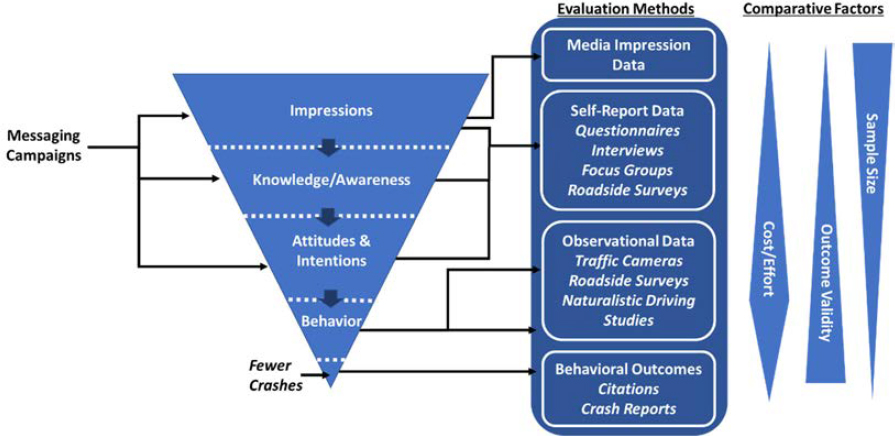
While traffic safety campaigns and messaging are widely employed, the effectiveness of such campaigns has not been widely investigated. There are multiple considerations for the most appropriate method of evaluation, hinging on both the relative efficacy of a chosen metric for evaluating the most appropriate outcome(s) and the relative cost and other comparative factors among options. As illustrated in the right half of Figure 1, different evaluation methods can map to different levels of the messaging funnel. For example, self-report data (via questionnaires, surveys, etc.) can be useful for determining whether drivers’ knowledge and attitudes have changed following exposure to a campaign. However, these data are not particularly reliable at determining whether actual behaviors or crash rates have changed.
The goal of traffic safety campaigns is to improve safety performance (e.g., reducing crashes) by influencing the public to behave more safely when driving. Campaigns attempt to change attitudes and/or behavior using different types of communication to inform, persuade, and motivate the public. However, only a fraction of traffic safety campaigns is currently evaluated, making it challenging to use lessons learned to improve current and future campaign effectiveness.
Project Objectives
The objectives of this research are to:
- Identify current practices utilized by State Highway Safety Offices (SHSOs) and other entities to evaluate the effectiveness of traffic safety campaigns and associated outcomes
- Develop a practical and scalable framework for how to evaluate efforts to effectively engage road users, through traffic safety campaigns, to change behavior, and improve safety performance.
Research Approach
This research project used a phased approach with Phase I largely comprising information gathering and synthesization tasks, while Phase II focused on the development of the framework and associated toolkit. There was a total of eight tasks that were executed in a sequential manner with each task building on the previous and informing the next with the goal of developing a practical framework for evaluating efforts that effectively engage road users in making behavioral changes to improve safety performance. The remaining chapters of this report will summarize key takeaways from these tasks, grouped as follows:
- Chapter 2 provides a summary of the methods and metrics to evaluate the effectiveness of traffic safety campaigns.
- Chapter 3 presents an assessment of the strengths, weaknesses, and resources required for current evaluation methods.
-
Chapter 4 presents an overview of the practical framework developed to assist SHSOs and other end users in selecting and implementing traffic safety campaign evaluations. The framework includes three separate documents:
- A Guide for Evaluating Traffic Safety Campaigns
- Interactive Costing Tool
- Quick Reference Guide


