Agency Implementation of Alternative Contracting Methods (2024)
Chapter: Agency Implementation of Alternative Contracting Methods
1.0 Introduction
The use of alternative contracting methods (ACMs) has accelerated the delivery of highway design and construction projects. The changes have come through the innovative efforts of the Federal Highway Administration (FHWA) and departments of transportation (DOTs) around the county over the last 30 years. Led by documented successes on large, high-profile projects such as I-15 in Utah, the Intercounty Connector in Maryland and the Sellwood Bridge in Oregon, ACMs have resulted in shorter project delivery times with less disruption to the travelling public. The use of ACMs is becoming commonplace, but not just for large projects. Our data show that almost half of the states are routinely using ACMs on projects less than $20 million in value (Alleman et al. 2016, Procedia Engineering Vol.145).
The innovative efforts of the FHWA and state DOTs should not be underestimated. The development of ACMs such as design–build (D-B) and construction manager/general contract (CM/GC) requires significant procedural and cultural changes on the part of agency staff and the construction industry. Therefore, it is not surprising that initially DOT ACM manuals and national research efforts have focused on the early project phases, namely procurement and project delivery method decisions. A review of current ACM manuals reveals only a few manuals that address contract administration processes in detail, with the New York State DOT (NYSDOT) and Minnesota DOT (MnDOT) being perhaps two of the best examples. Similarly, the American Association of State Highway and Transportation Officials (AASHTO) Guide for D-B Procurement and the Guidebook for CM/GC Contracting primarily focus on setting projects up for success by focusing mostly on the pre-award phases of the process.
Therefore, National Cooperative Highway Research Program (NCHRP) recently funded research to address the need for national guidance on ACM contract administration. Our team was honored to conduct the research over the last couple of years. We worked with more than 100 engineers and project managers in dozens of highway agencies and a distinguished panel of ACM experts to develop two new guidebooks, which are now available to help agencies across the nation administer their D-B and CM/GC transportation projects. These documents include more than 30 successful practices and tools for agencies to use, organized along a typical project lifecycle.
This implementation project, NCHRP Project 20-44(42), focuses on disseminating this new information, ensuring that practitioners are well versed with it, and training the agencies on when and how to use these impactful processes and tools. Our team has designed and conducted a nationwide, multi-faceted implementation effort to deliver training to a diverse set of participants and agencies ensure the guidebooks achieve their full potential and make a significant impact on our U.S. highway system.
2.0 Objective
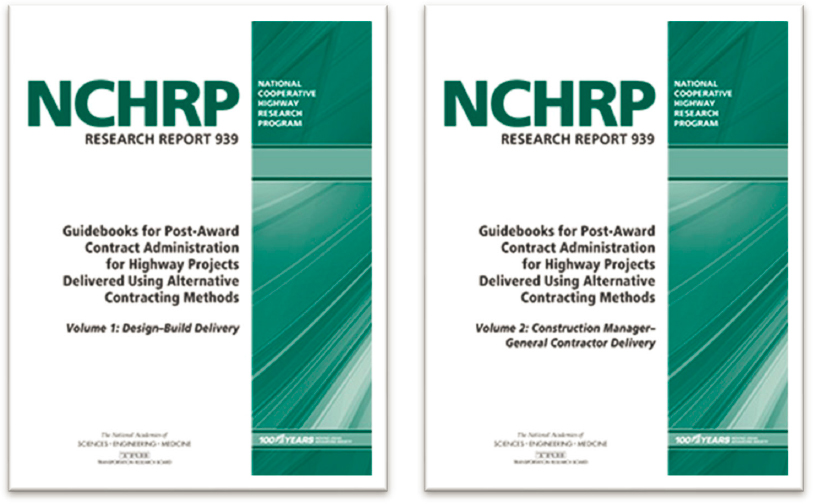
The objective of this project is to ensure agencies have the practical methods and tools that will improve their ACM contract administration. With this in mind, we have worked with highway agencies to efficiently implement and use the findings of NCHRP Research Report 939: Guidebooks for Post-Award Contract Administration for Highway Projects Delivered Using Alternative Contracting Methods, Volume 1: Design–Build Delivery, Volume 2: Construction Manager–General Contractor Delivery, and Volume 3: Research Overview. This effort will maximize the impact of the research through widespread implementation of the practices and tools documented in the new guidebooks (shown in Figure A).
The project also facilitated the engagement of agency practitioners with the original research team and with their peers from other agencies that are implementing the tools, to encourage sharing, exploration, and learning.
The audience consisted of agency personnel working in D-B and CM/GC environments, specifically project managers of such projects, as well as the agencies’ ACM leadership. Many individuals who joined are currently leading D-B and CM/GC projects and were able to use the tools and apply them directly on their ongoing projects.
Several state DOTs had initially expressed interest in participating in this work. This opportunity was also made available to agencies serving on the panel, and we disseminated it broadly through Transportation Research Board (TRB), NCHRP, and AASHTO to all interested agencies that use and/or have an interest in using D-B and CM/GC, to reach and represent the largest number of agencies.
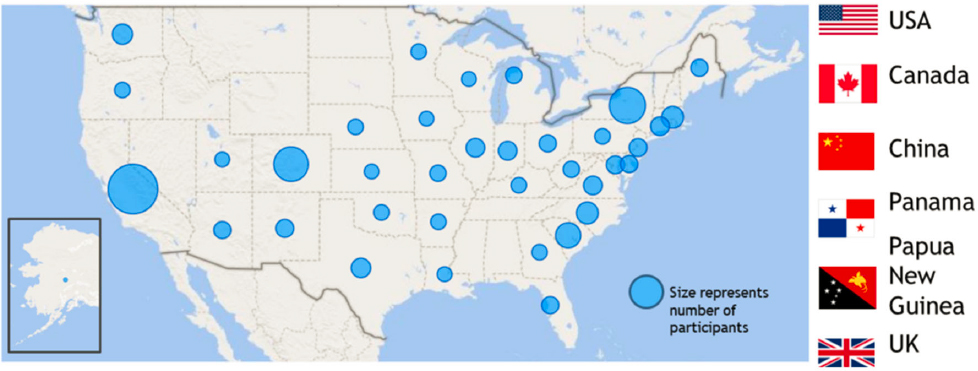
We invited 500+ individuals representing all state DOTs as well as consultants, contractors, and academia that support them. We received RSVPs from 306 participants geographically distributed across 38 states in the U.S., plus international participants representing five additional countries, as shown in Figure B. It was a pleasure working with all of these participants who are interested in improving their ACM contract administration practices within their agencies. Knowledge was shared widely with highway agencies nationally. Participants were also very open to share their own experiences with others and compare case studies and lessons learned.
3.0 Completed Tasks
The project objective was met through five tasks. The first two tasks provided a training opportunity to all interested agencies (unlimited capacity); whereas the remaining tasks were tailored to a subset of states that attended all eight sessions, were most prepared to implement the guidebooks working closely with the research team and expressed interest in further collaboration and individualized personalized support. The five completed tasks are described below.
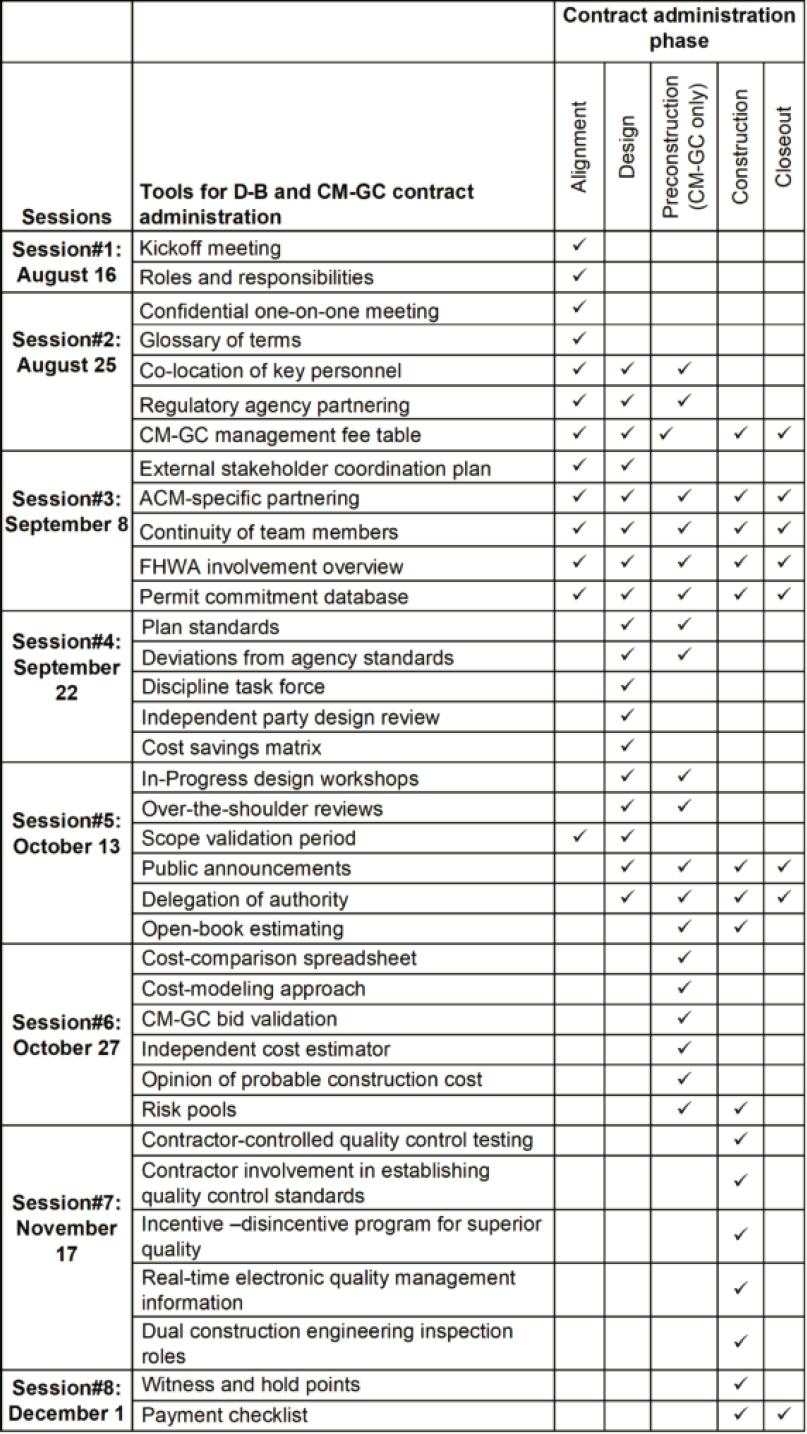
3.1 Webinars/Training Classes: We prepared and presented interactive webinars for all interested agencies, over a period of 4 months. These modules were incremental and followed the guidebooks which are organized by project phase. They also served as a basis for the peer-exchange forums and the knowledge implementation that will occur in the next tasks. Interactive activities involving case studies and actual DOT examples were used to engage participants. We provided opportunities for participants to actively engage by sharing how they are implementing what they are learning from the guidebooks. Participants brought issues and questions to the group and received feedback from the instructors, guest speakers, and other colleagues and participants. Each webinar was 2-hours long. The schedule of sessions is presented in Figure C, showing the tools that were discussed each session, along with the project phase covered.
3.2 Peer-Exchange Forums: Delivery of content was interspersed with hands-on activities that encourage familiarity with the guidebooks and application of the tools to the participants’ own projects. We moderated peer-exchange forums that immediately followed each webinar, to facilitate peer-to-peer interaction/sharing throughout the training timeframe and ensure participants can share and receive suggestions for their ongoing projects. The forums followed the same schedule as the sessions and provided additional experiences and perspectives on implementation of these tools, from a diverse set of experts. A list of expert speakers and guest panelists, who joined us from more than a dozen states to share their experiences with the group in these active peer-exchanges, is provided next:
- Kevin Hagness, CM/GC Program Manager, Minnesota DOT
- Eric Kahlig, Administrator for Alternative Project Delivery, Ohio DOT
- David Simmons, D-B Coordinator, Missouri DOT
- Abra Geissler, Project Director, Colorado DOT
- R. David Unkefer, PE Senior Engineer Construction and Project Management Team FHWA
- Chris Gaskins, Design–Build Engineer, South Carolina DOT
- Daniel D’Angelo, Applied Research Associates, Inc. New York, NY
- Keli Wylie, PE. Alternative Project Delivery Administrator, Arkansas DOT
- Jeffrey T. Folden, PE, DBIA. Director, I-495 & I-270 P3 Office. Maryland DOT
- Bryan Stevenson, PE, DBIA. Alternate Project Delivery. Virginia DOT
- Holli Pick, Alternative Delivery Program Manager, Oregon DOT
- Ben Rowles, Construction Manager, Colorado DOT
- Matthew Pacheco, PE. Alternative Delivery Program Manager, Colorado DOT
- Saad Samani, Alternative Delivery Engineer, Caltrans
- Lisa Washington, CEO, DBIA
- Erika Drury, PE. Alternative Delivery Program Manager, Kentucky Transportation Cabinet
The training sessions focused on how to use the tools documented in the two guidebooks for D-B and CM-GC contract administration. Volume 1 is a guide for design–build delivery, while Volume 2 is a guide for construction manager–general contractor delivery. Each two-hour session presented new tools and strategies from the guidebook in an engaging format including case studies that illustrate principles of implementation at an agency. Group discussions drew on the diversity of experiences shared by the presenters and participants. Sessions included case studies, interactive exercises, keynote speakers, roundtable discussions, panels, and more.
3.3 Individualized Agency Training: The team conducted individualized training with five agencies to support their D-B and CM/GC projects, help pilot their implementation of the guidebooks, including selecting tools for each phase of their own project(s), evaluating the agency’s implementation strategy, and offering guidance as needed. Agencies participating in this task needed to have fully participated in Tasks #1 and #2 which gave them the
foundational knowledge required, had to have an active D-B or CM/GC project to implement the tools on, plus having expressed interest in further engagement as part of an in-class survey conducted with all the participants. With each DOT, we followed a converging approach to identify one or two tools to focus on for implementation, with their current “anchor” project of theirs in mind. We met with each DOT once or twice a month, to identify a specific tool of interest, answer questions around it, and follow through its implementation while also being available to do additional research on the topic as an extension of the DOT staff, report out on the findings, compare with other DOTs’ practices, and document the learning. Participation from the selected DOTs has been excellent, with the exchanges often taking longer than initially planned and participants staying in the meetings to discuss implementation strategies and examples from other DOTs that can be implemented in their agency, comparing practices, and so on.
3.4 Final Implementation Workshop and Lessons Learned: We also conducted a final implementation workshop with the agencies, in which they were invited to take turns and present how they used the guides for various projects, concluding with lessons learned. We have documented the learning from this workshop in a technical paper which we are sharing here, as discussed in the next task.
Concluding Workshop Agenda
- Welcome and introductions (All)
- Project overview (Mounir El Asmar)
- Sharing of experience: Wisconsin DOT (Ben Thompson)
- Sharing of experience: Minnesota DOT (Kevin Hagness)
- Sharing of experience: Alaska DOT (Brian Shumacher/Jacob Gondek)
- Break
- Sharing of experience: Connecticut DOT (Rick Prescott)
- Sharing of experience: Caltrans (Troy Tusup)
- Path Forward (Mounir El Asmar)
- Open discussion and closing remarks (All)
- Adjourn
3.5 Documenting the Use of Guidebook through Case Studies: Throughout the engagement, we have documented how the 32 CM/GC tools and 28 D-B tools from the guidebooks are being selected and applied and proposed a tool selection framework for practitioners. This has been documented in a case study paper that was accepted for presentation and presented by the research team at the annual TRB 2024 meeting, which created even more interest in additional agencies implementing the guidebooks. The technical paper is included in this report as Appendix A.
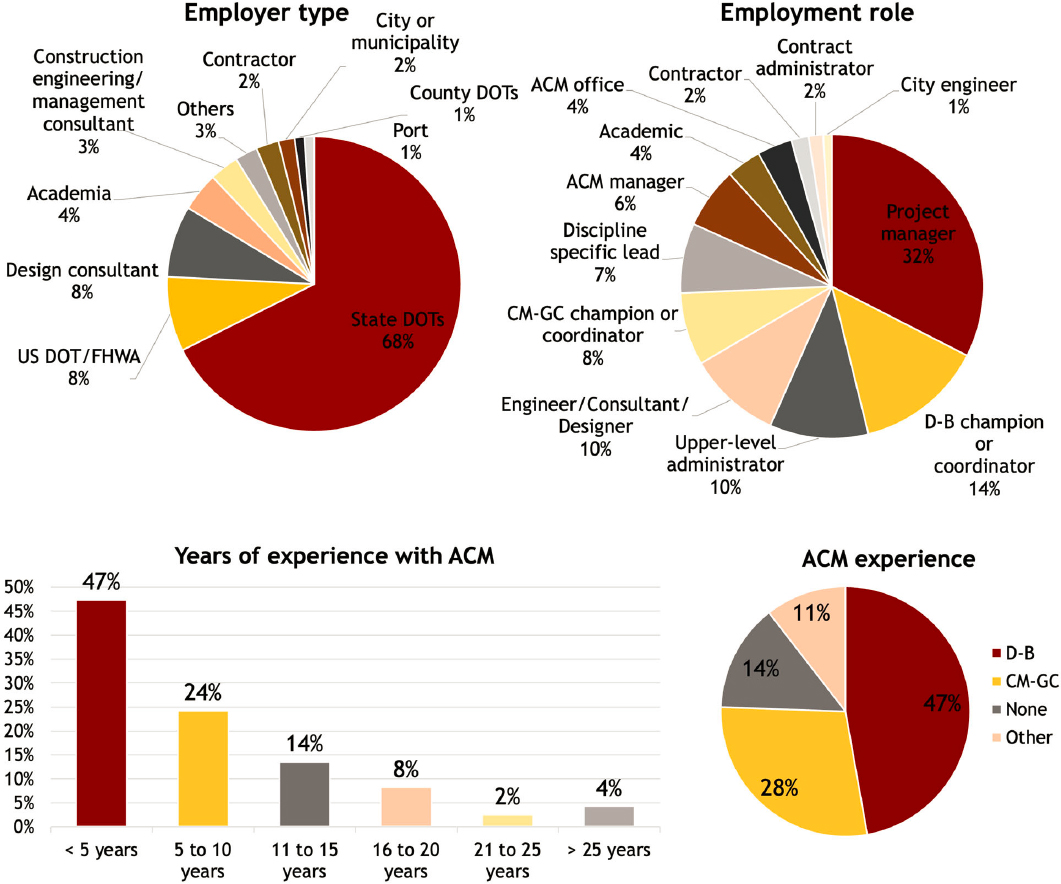
As shown in Figure D, about two thirds of our participants are from state DOTs. Others include consultants, academics, FHWA, and more. About a third of the participants are project managers; another third have a D-B or CM-GC focused role for their agency; 10% are upper level
administrators and executives. About half of the participants have less than 5 years of experience with DB and CM-GC; about a third have more than 10 years of experience with these methods. Finally, the group has more experience in DB than in CM-GC.
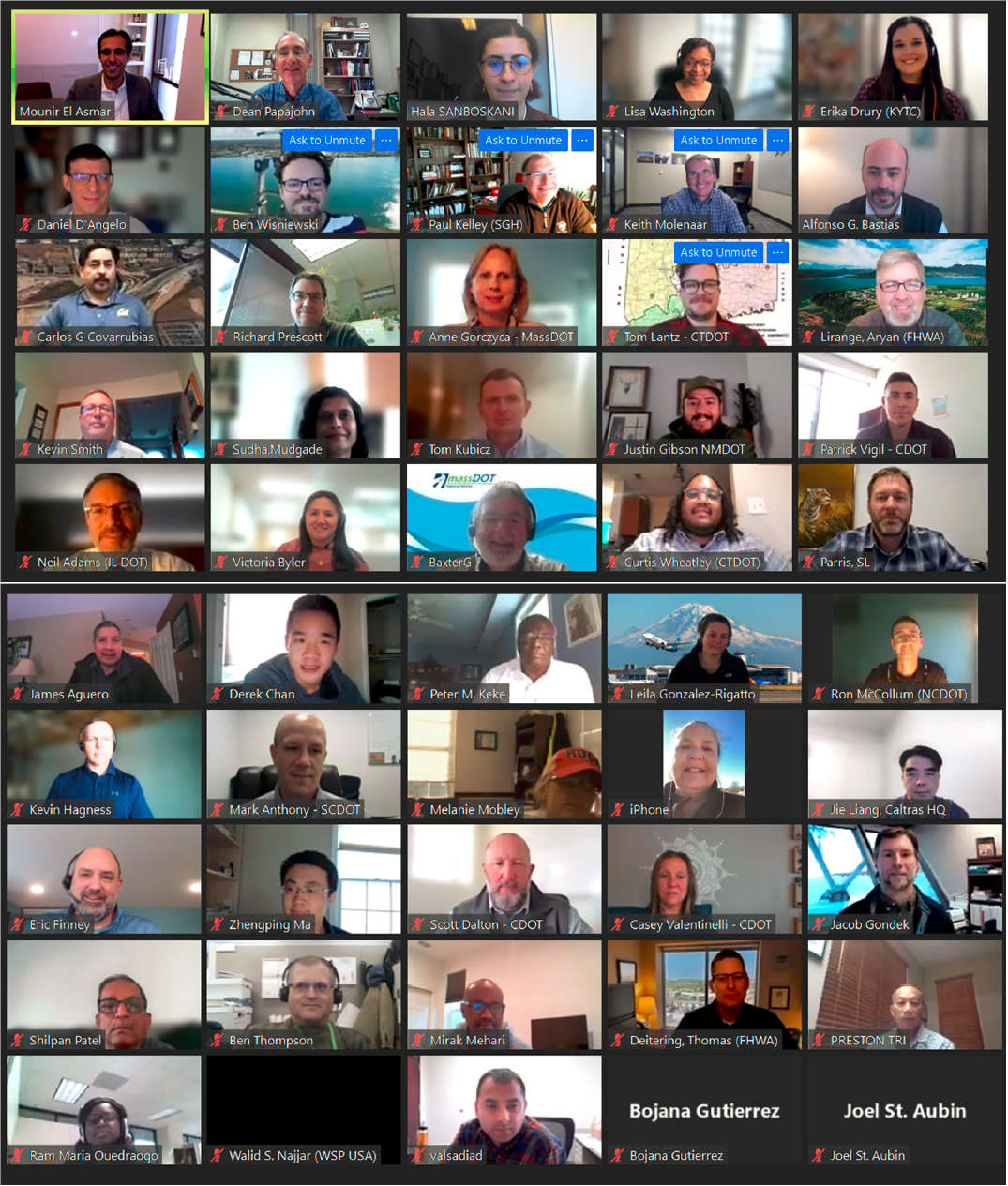
Next, Figure E shows a graduation photo taken with a number of participants in the program. Continuing education credits (CEU) or a certificate of accomplishment was offered from Arizona State University to all participants who completed the course of eight webinars, at no charge, to acknowledge their time spent and learning gained in this training and implementation effort.
4.0 Summary of Contributions
As part of the regulations following the Moving Ahead for Progress in the 21st Century Act (MAP–21) and the Fixing America’s Surface Transportation Act, each DOT is required to improve the performance of their highway projects, and this implementation effort can play a pivotal role in improving ACM projects’ performance. Our team has offered an innovative implementation effort that leverages the framework we have developed to support and improve agencies’ post-award ACM contract administration processes.
Post-award contract administration has always had a significant importance, especially to public entities such as state DOTs and the FHWA. While contract administration processes and tools have evolved and continue to develop, the increase in the use of alternative contracting brings new challenges and the opportunity to institute forward-thinking methods for their use.
State highway agencies need to use an effective process to implement alternative delivery post-contract administration tools in their projects. Prior to this work, alternative post-contract administration processes and tools were often implemented in reaction to the needs of individual projects. In contrast, the training delivered in this project supports establishing institutional-level processes, rather than ad-hoc trials, that will ultimately expose a potential paradigm-shift in thinking about post-contract administration.
In this light, we have trained more than 300 DOT and engineering practitioners in real-time, offered each of them continuing education certificates, and have developed an asynchronous mode to offer access to this material and these sessions into the future, all recorded and professionally edited. The fully developed course can be accessed at your own convenience and pace at https://acm.engineering.asu.edu/workshops/ to prolong the contributions of this work even further.


