Airfield Vehicle Service Road Design and Operations (2025)
Chapter: 1 Introduction

CHAPTER 1
Introduction
Background
In the airport planning and design process, vehicle service roads (VSRs) are often a secondary consideration to the primary planning and design efforts associated with the safety and efficiency of moving aircraft. The safe and predictable movement of employees, baggage, cargo, and aircraft and airport support vehicles throughout the airfield and terminal area is similarly important.
Information on VSRs from the FAA and other industry sources is limited and spread across many documents. This scarcity of readily available recommendations leaves the planning and design of VSRs primarily in the hands of individual airports. The approach to and practices used in developing VSR layouts vary across the industry, often influenced by unique operational demands, vehicle types, facility configurations, and other user-, operator-, and airport-specific characteristics. This synthesis describes the existing guidelines and current practices related to planning, designing, operating, and maintaining airfield VSR systems for airports of varying sizes and operational characteristics.
Methodology
The information synthesized in this report was primarily collected from a literature search and interviews with airport personnel. The first task of the study was to conduct a literature review to identify industry guidelines, recommendations, and regulations related to the planning, design, and operation of VSRs. The literature review included information published by domestic and international industry organizations, studies, and U.S. federal regulations. The literature review included information published by the FAA, Airlines for America (A4A), Airports Council International (ACI), the International Air Transport Association (IATA), the International Civil Aviation Organization (ICAO), and the Transportation Security Administration (TSA). The literature review included other industry documents and the U.S. Code of Federal Regulations (CFR). Sources also included suggestions from ACRP Synthesis Topic Panel members for this study and the TRB-maintained Transport Research International Documentation database (http://trid.trb.org). Information was reviewed and organized by different topics under the categories of planning and design, operations, and construction and maintenance. Appendix A contains a table summarizing the information uncovered in the literature review and the associated VSR topic covered in the literature.
The results of the literature review were used to develop questions for interviews with airport personnel. The questions focused on gathering and documenting VSR practices from U.S. airports that were not covered in the literature review. The interviews focused on questions centered around several key areas: vehicles and personnel using VSRs, planning and design considerations, operational aspects, and maintenance and construction practices.
Interviews were conducted with personnel of 10 U.S. airport operators representing 22 airports (referred to as the interviewed airports from this point forward). The interviewed airports were selected to represent varying activity levels, airfield sizes, weather conditions, geographic locations, and activity types. Five of the 10 airport operators included reliever or general aviation airports. Table 1 identifies the airport operators interviewed for this report, the airport category, and the number of passenger enplanements and aircraft operations for each airport. Figure 1 illustrates the location of the primary airport for each operator.
The questionnaire used for the interviews can be found in Appendix B.
Table 1. Interviewed airport operators.
| Airport Operator/Airport | Airport Code | NPIAS Airport Category (FY 2023) | Passenger Enplanements (CY 2023) | Aircraft Operations (CY 2023) |
|---|---|---|---|---|
| Allegheny County Airport Authority | ||||
| Pittsburgh International Airport | PIT | Medium Hub | 4,492,980 | 128,173 |
| Allegheny County Airport | AGC | Reliever | 320 | 72,555 |
| Arapahoe County Public Airport Authority | ||||
| Centennial Airport | APA | Reliever | 665 | 360,725 |
| Burbank-Glendale-Pasadena Airport Authority | ||||
| Hollywood Burbank Airport | BUR | Medium Hub | 3,132,019 | 141,678 |
| City and County of Denver, Department of Aviation | ||||
| Denver International Airport | DEN | Large Hub | 37,863,966 | 663,961 |
| Indianapolis Airport Authority | ||||
| Indianapolis International Airport | IND | Medium Hub | 4,788,308 | 193,372 |
| Eagle Creek Airpark | EYE | Reliever | 4 | --- |
| Hendricks County Airport-Gordon Graham Field | 2R2 | Reliever | --- | --- |
| Indianapolis Regional Airport | MQJ | Reliever | 28 | --- |
| Metropolitan Airport | UMP | Reliever | 70 | --- |
| Metropolitan Nashville Airport Authority | ||||
| Nashville International Airport | BNA | Large Hub | 11,227,159 | 271,842 |
| John C. Tune Airport | JWN | Reliever | 530 | 95,564 |
| Miami-Dade Aviation Department | ||||
| Miami International Airport | MIA | Large Hub | 24,716,890 | 461,792 |
| Dade-Collier Training and Transition Airport | TNT | General Aviation | --- | --- |
| Miami Executive Airport | TMB | Reliever | 283 | 269,962 |
| Miami Homestead General Aviation Airport | X51 | General Aviation | --- | --- |
| Miami-Opa Locka Executive Airport | OPF | Reliever | 6,378 | 173,897 |
| Ontario International Airport Authority | ||||
| Ontario International Airport | ONT | Medium Hub | 3,181,161 | 104,923 |
| Port of Portland | ||||
| Portland International Airport | PDX | Medium Hub | 8,123,024 | 190,150 |
| Hillsboro Airport | HIO | Reliever | 46 | 183,771 |
| Troutdale Airport | TTD | Reliever | --- | 104662 |
| Port of Seattle | ||||
| Seattle-Tacoma International Airport | SEA | Large Hub | 24,594,202 | 422,497 |
Notes: The two FAA sources for Passenger Enplanements and Aircraft Operations do not have any information for the airports; these appear as “---.” NPIAS: National Plan of Integrated Airport Systems; CY:calendar year; FY: federal fiscal year.
Sources: Federal Aviation Administration, National Plan of Integrated Airports Systems, 2023–2027, September 30, 2022; Federal Aviation Administration, Calendar Year 2023 Enplanements at All Commercial Service Airports—Preliminary, June 18, 2024; Federal Aviation Administration, The Operations Network (OPSNET), June 2024.
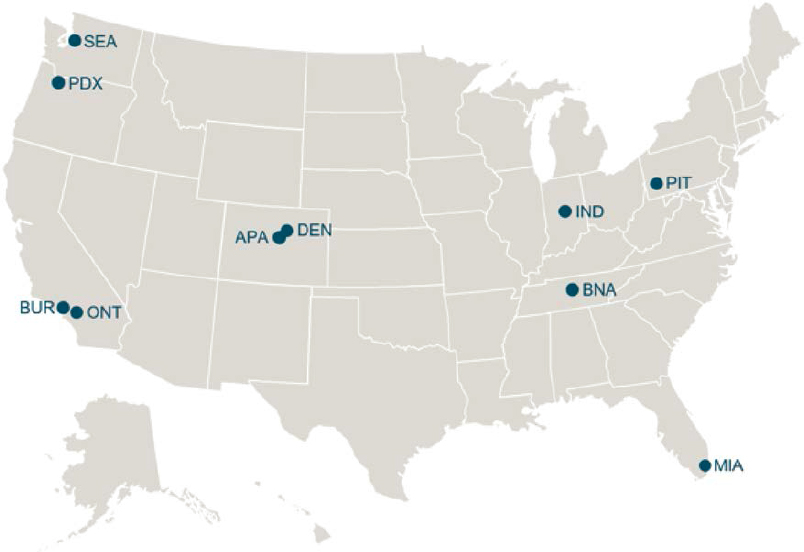
Figure 1. Map of interviewed airports.
This report is structured to cover various VSR topics with applicable case examples provided throughout the report. This synthesis report is organized into five chapters with additional sections for references and appendices.


