Roundtable on Obesity Solutions 10th Anniversary: Looking Back, Moving Forward: Proceedings of a Symposium (2025)
Chapter: 1 Introduction
1
Introduction
On July 24, 2024, the Roundtable on Obesity Solutions of the National Academies of Sciences, Engineering, and Medicine (the National Academies) held a symposium in honor of its 10th anniversary. The symposium, titled Obesity Solutions: Looking Back, Moving Forward, was planned by a committee according to a Statement of Task (Box 1-1).1 Nicolaas (Nico) Pronk, HealthPartners Institute and HealthPartners Inc., chair of the Roundtable on Obesity Solutions (hereafter “the roundtable”), welcomed participants to the event and explained that the symposium was designed to mark the previous 10 years of the roundtable and to build momentum for the next 10. The objectives of the symposium were threefold:
- Review the history of the roundtable, its evolution, and how it has informed research, policy, and practice.
- Explore the major developments toward the prevention, treatment, and management of obesity, and the roundtable’s role in impacting the field.
- Feature discussions about the future of obesity and ideas for how the roundtable can build on its accomplishments and meet new challenges.
___________________
1 The planning committee’s role was limited to planning the symposium, and the Proceedings of a Symposium has been prepared by the symposium rapporteur as a factual summary of what occurred at the symposium. Statements, recommendations, and opinions expressed are those of individual presenters and participants, and are not necessarily endorsed or verified by the National Academies of Sciences, Engineering, and Medicine, and they should not be construed as reflecting any group consensus.
Marcia McNutt, president, National Academy of Sciences, offered her opening remarks. Over the past decade, said McNutt, the roundtable has facilitated a highly unique obesity-specific dialogue in the United States, involving a multisectoral membership and thousands of attendees at workshops and events. Its efforts have yielded many discussion papers, workshop reports, and other communications. McNutt said the focus of, and content generated from, these activities is intentionally innovative and include both the evidence-based and on-the-ground perspectives that are needed for obesity prevention, treatment, and management. With this history, she said, the Roundtable on Obesity Solutions will continue to be the venue for bringing together perspectives from public health, academia, government, community-based nonprofits, education, school-based organizations, employers, health systems, and those with the lived experience of obesity to confront the most challenging and pressing issues related to obesity.
Monica Feit—executive director, Health and Medicine Division, National Academies of Sciences, Engineering, and Medicine—joined Pronk and McNutt in welcoming participants to the symposium. She observed that
the roundtable is the only national, multisector group with a shared and dedicated focus on obesity. The roundtable’s ability to pull together a variety of perspectives to focus on shared areas of importance is an incredibly important contribution, she said, and its reach and impact on the field are “impressive.” Feit noted that the roundtable takes a systems approach, which shifts the narrative away from individual responsibility and toward the upstream drivers that affect obesity. The obesity field is at a transitional moment, she said, and leaders from all sectors will be looking to the roundtable for ongoing, timely, and in-depth dialogue. This symposium was designed to cover the foundational work on obesity at the National Academies, the roundtable’s evolution and accomplishments over the last 10 years, and the future of the obesity field and how the roundtable will inform that future.
THE OBESITY LANDSCAPE PRIOR TO THE ROUNDTABLE ON OBESITY SOLUTIONS: CRISIS CONTROL
To set the stage for the symposium, Shiriki K. Kumanyika, University of Pennsylvania and Drexel University, painted a picture of the years before the roundtable was formed in 2014. Around 1980, said Kumanyika, there was a call for public health to shift focus from infectious diseases to chronic diseases. The publication of Healthy People: The Surgeon General’s Report on Health Promotion and Disease Prevention in 1979 (USPHS, 1979) called attention to the threat of cardiovascular diseases, and also emphasized the importance of shifting or expanding the focus on hunger to include overconsumption of food. The perspective at this time, said Kumanyika, was one of individual lifestyle change, rather than policy and environmental change. The first Dietary Guidelines for Americans (DGA) were published in 1980 (HHS and USDA, 1980), and the second guideline was “maintain ideal weight.”
It took a number of years for obesity to be recognized as an epidemic, said Kumanyika. In 1994 and 1995, data from the National Health and Nutrition Examination Survey (NHANES) led the Centers for Disease Control and Prevention (CDC) to acknowledge a trend of increased overweight in adults and children (Kuczmarski et al., 1994; Troiano et al., 1995). The National Heart, Lung, and Blood Institute (NHLBI) published the Clinical Guidelines for Obesity Identification, Evaluation, and Treatment in 1998 (NHLBI, 1998); these guidelines identified body mass index (BMI) cutoffs for overweight and three grades of obesity. “Things really took off” with the CDC’s publication of obesity maps in 1999 (Mokdad et al., 1999), said Kumanyika. Analysis of data from the CDC Behavioral Risk Factor Surveillance System revealed a “shocking” increase in the prevalence of obesity, and accompanying maps gave a visual demonstration of the pace of the increase across all states.
This process was controversial from the beginning, said Kumanyika, with a number of unresolved questions: Should overweight and obesity be measured with BMI or skinfold calipers? Where should the cutoffs for overweight and obesity be? Should the increase in obesity really be described as an “epidemic”? Should the focus be on adults, children, or all ages? What is the role of parental responsibility? What role does personal responsibility play vis-à-vis the societal context? Are there biological differences that explain some of the racial and ethnic disparities? Kumanyika emphasized that this conversation was not uniquely American. The International Obesity Task Force (IOTF) was formed in 1996 and the World Health Organization declared a global epidemic of obesity in 1997. There were efforts to look at obesity as a structural issue, said Kumanyika. The IOTF (now known as World Obesity Federation) developed a graphic to show societal influences on obesity (Figure 1-1) said Kumanyika, and a group of researchers looked at other social movements (e.g., seat belts, breastfeeding) to see what lessons could potentially be applied to obesity (Economos et al., 2001).
A major milestone came in 2001 with the publication of the Surgeon General’s Call to Action to Prevent and Decrease Overweight and Obesity (HHS, 2001). This report was pivotal, said Kumanyika; it laid out all of the issues, answered questions, and called on people in all sectors to take action using the CARE framework (communication, action, research, and evaluation). Following this report, the National Institutes of Health (NIH) developed the Strategic Plan for Obesity Research, and the CDC held a “Weight of the Nation” conference. Federal guidance was developed for physical activity, food marketing, and updated dietary guidelines. Around 2010, First Lady Michelle Obama launched her “Let’s Move” campaign, and the White House published a task force report on childhood obesity prevention. Federal policies relevant to obesity that were enacted between 2001 and 2012 included the Child Nutrition and WIC Reauthorization, Safe Routes to School Program, a U.S. Department of Agriculture (USDA) interim rule to modify the WIC food package, and the Healthy, Hunger-Free Kids Act of 2010 (IOM, 2012). These policy advances were supported by consensus studies done under the auspices of the Institute of Medicine’s (IOM’s) Food and Nutrition Board, now known as the Health and Medicine Division of the National Academies.
The nonprofit and private sectors were active as well, said Kumanyika. In 2007, the Robert Wood Johnson Foundation (RWJF) committed $500 million to address childhood obesity and set a goal of reversing the epidemic by 2015. This was the largest amount of money RWJF had ever committed as a foundation, she said, and was a “game changer.” Other nonprofit activities around this time included the formation of the Alliance for a Healthier Generation, a partnership between the American Heart Association and the Clinton Foundation; the National Collaborative on
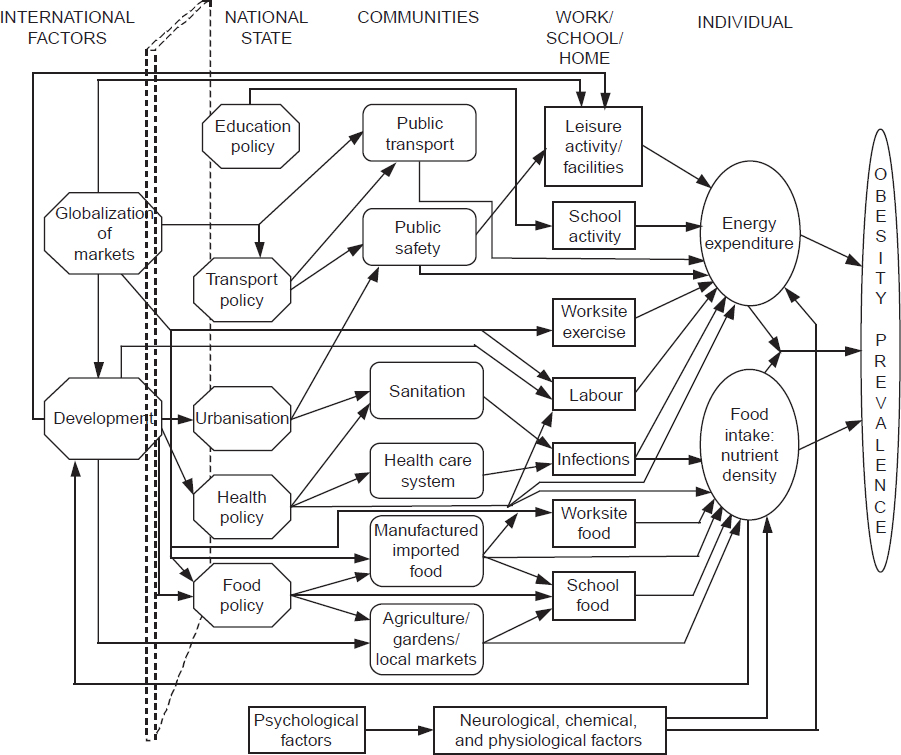
NOTE: Figure modified from International Obesity Task Force (website no longer available); figure developed by C. Ritenbaugh, S. Kumanyika, A. Morabia, R. Jeffrey, and V. Antipatis, 1999.
SOURCES: Presented by Shiriki Kumanyika, July 24, 2024; Popkin, B. M. 2005. 2007 © Cambridge University Press, reproduced with permission.
Childhood Obesity Research, a collaboration among NIH, CDC, RWJF, and USDA; and the Convergence Partnership for Healthy Eating and Active Living, a collaboration among private and public funders. On the industry side, said Kumanyika, food and beverage producers created the Children’s Food and Beverage Advertising Initiative as a commitment to improve the types of foods marketed to children, and food manufacturers committed to removing calories from the food supply in the Healthy Weight Commitment. In 2010, a Partnership for a Healthier America was founded with private, nonprofit, and government partners to encourage industry–government collaboration, in tandem with Mrs. Obama’s Let’s Move campaign.
During this period, IOM published several consensus reports on issues surrounding obesity; these reports were sponsored by many of the same players taking other actions, including RWJF, CDC, NIH, USDA, and Kaiser Permanente. Relevant reports included
- Preventing Childhood Obesity (IOM, 2005),
- Food Marketing to Children and Youth (IOM, 2006),
- Progress in Preventing Childhood Obesity (IOM, 2007),
- Local Government Actions to Prevent Childhood Obesity (TRB et al., 2009),
- Bridging the Evidence Gap in Obesity Prevention (IOM, 2010),
- Early Childhood Obesity Prevention Policies (IOM, 2011),
- Accelerating Progress in Obesity Prevention (IOM, 2012), and
- Educating the Student Body (IOM, 2013).
In 2007, the IOM Standing Committee on the Prevention of Childhood Obesity was formed, funded by RWJF. The standing committee provided stability and continuity, said Kumanyika. In contrast to the process of stand-alone consensus studies, the standing committee could meet to talk about issues and review data over time. In 2014, the standing committee transitioned into the Roundtable on Obesity Solutions.
Kumanyika highlighted the impact of one IOM study in particular. A consensus study, Accelerating Progress in Obesity Prevention (APOP) (IOM, 2012), was conducted, and the chairperson was former USDA Secretary Dan Glickman. The choice of chair was intended to emphasize the point that obesity is a policy issue, said Kumanyika. The meetings of the study committee were filmed by HBO and became part of its television series The Weight of the Nation. The report, published in 2012, used a framework to communicate its recommendations (Figure 1-2); the framework depicted the overlapping types of environments that could be settings for obesity prevention: message environments, which include both public health and commercial messaging; schools; any settings where physical activity or food and beverage consumption could take place; and health care and work environments. Kumanyika said that systems thinking was key to the report and its recommendations.
What was missing from the APOP report, she said, were recommendations about achieving health equity. Disparities among different racial and ethnic groups and people of different incomes were mentioned in the report but recommendations were not made, partly owing to a lack of evidence. To address this gap, a workshop on Creating Equal Opportunities for a Healthy Weight was held in 2013 to discuss the issues, challenges, and evidence needs in the area of health inequities in obesity. This topic was part of the mandate the roundtable took up when it was launched in 2014, said Kumanyika.

SOURCES: Presented by Shiriki Kumanyika, July 24, 2024; IOM, 2012. Reprinted with permission from The National Academies Press.
Following Kumanyika’s remarks, she took questions from symposium participants. The first question concerned the intersection between the APOP report and the African American Childhood Obesity Research Network, Salud America, and other equity-focused funding initiatives. Kumanyika said that while there was a lot of information and discussion about disparities at the time of the APOP report, the evidence was “not at a volume or a level” to support a recommendation. She noted that the committee reviewed 800 recommendations that had been made by experts and examined the evidence to determine which ones had enough support to move forward. There were two recommendations that touched on disparities, however; one addressed racial disparities in breastfeeding rates,
and the other was aimed at getting supermarkets into low-income neighborhoods. Another symposium participant noted that there have not been many consensus studies on obesity in the last 8 to 10 years. Given the shifts toward systems thinking and multisector structural determinants, she asked Kumanyika whether it is time for another consensus study. Kumanyika said it would be helpful to have a consensus study that could bring together some of the newer evidence on concepts such as structural racism, policy issues, and upstream and downstream approaches to obesity.


