Electronic Surveillance of Railroad-Highway Crossings for Collision Avoidance: State of the Practice (2024)
Chapter: Appendix C: Survey Responses
APPENDIX C
Survey Responses
A summary of the survey responses follows; not all respondents answered all questions.
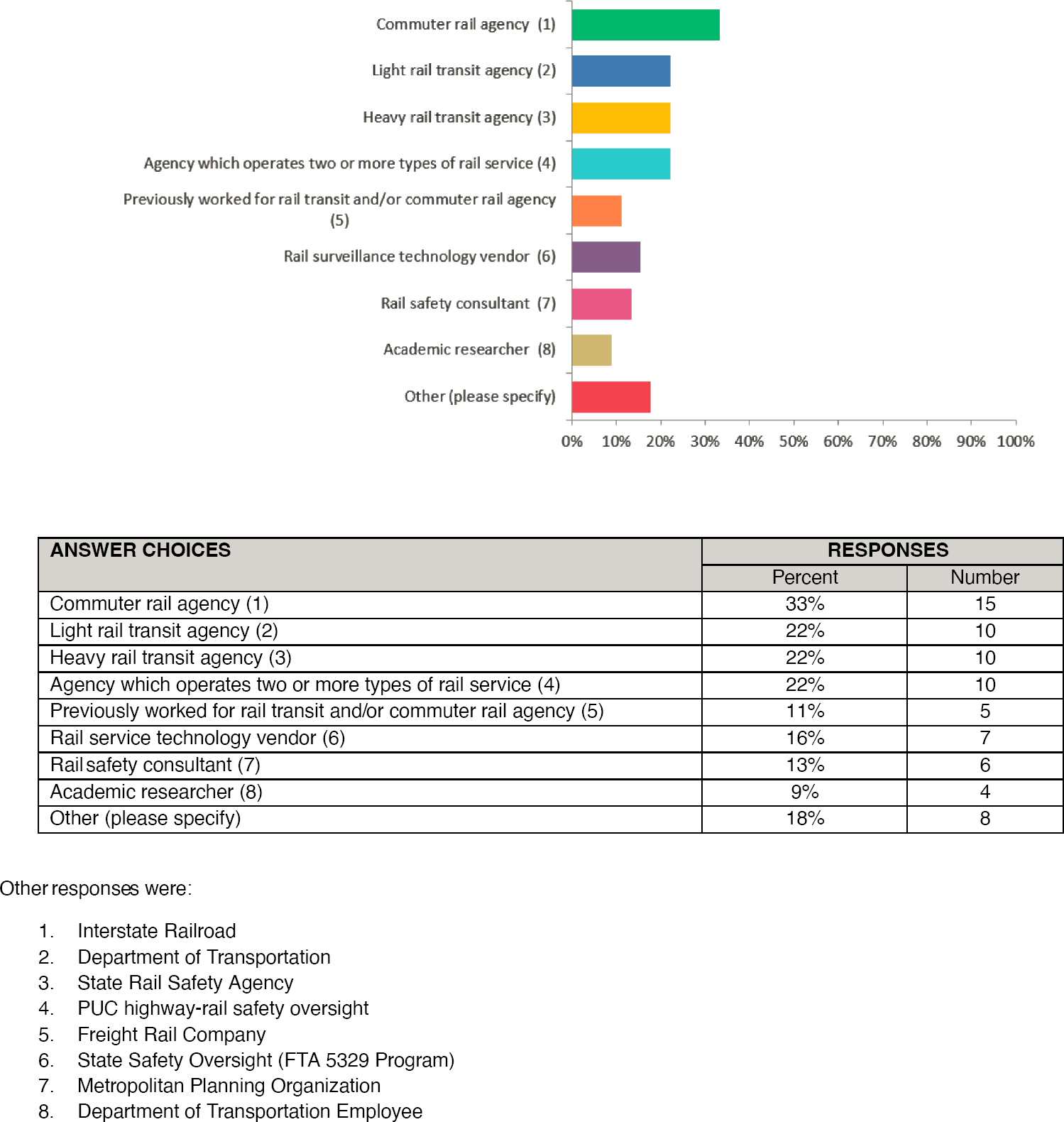
Q1. Please describe your affiliation/background (Select all that apply).
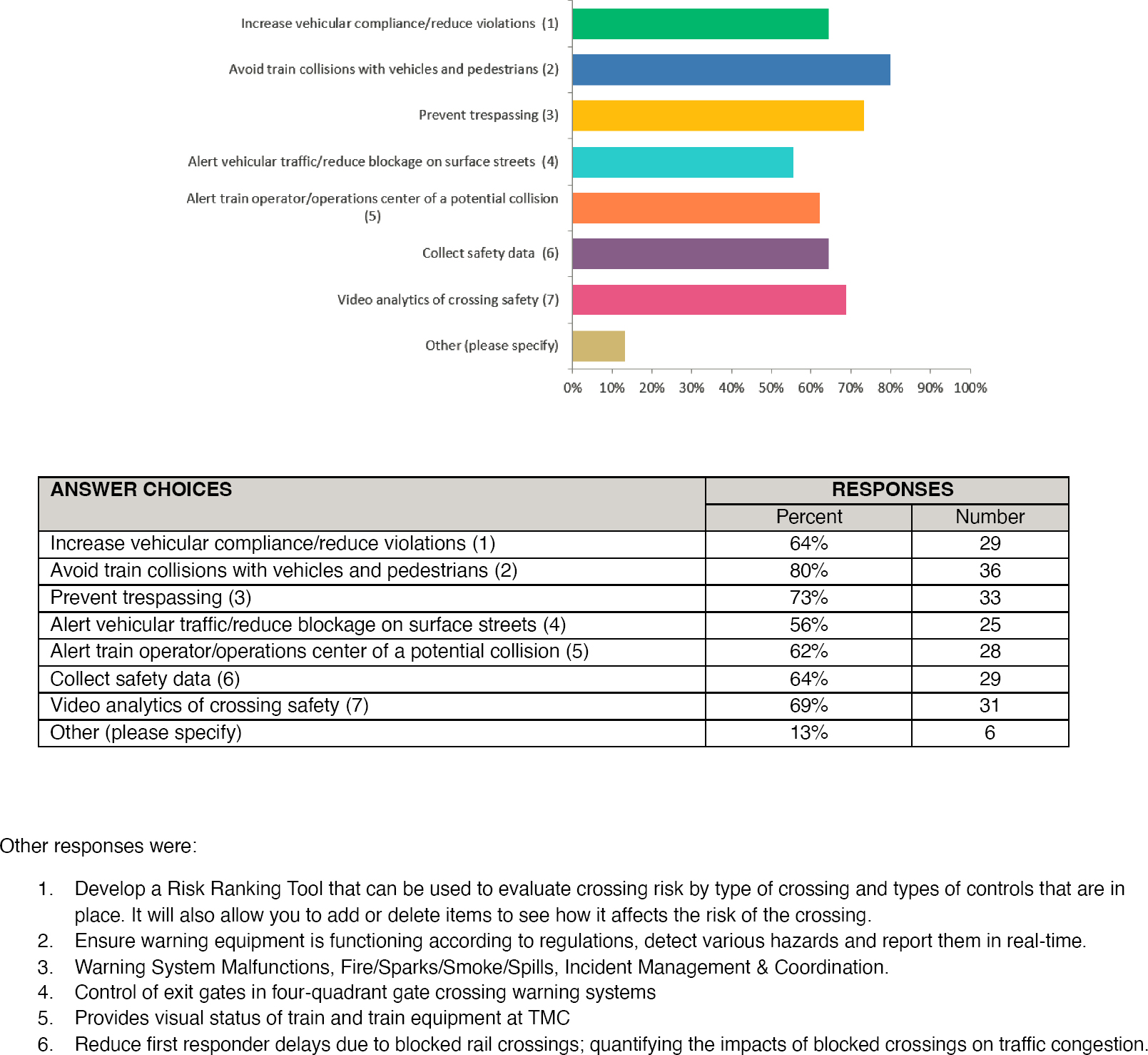
Q2. What are the reasons for using electronic surveillance at rail crossings? (Select all that apply).
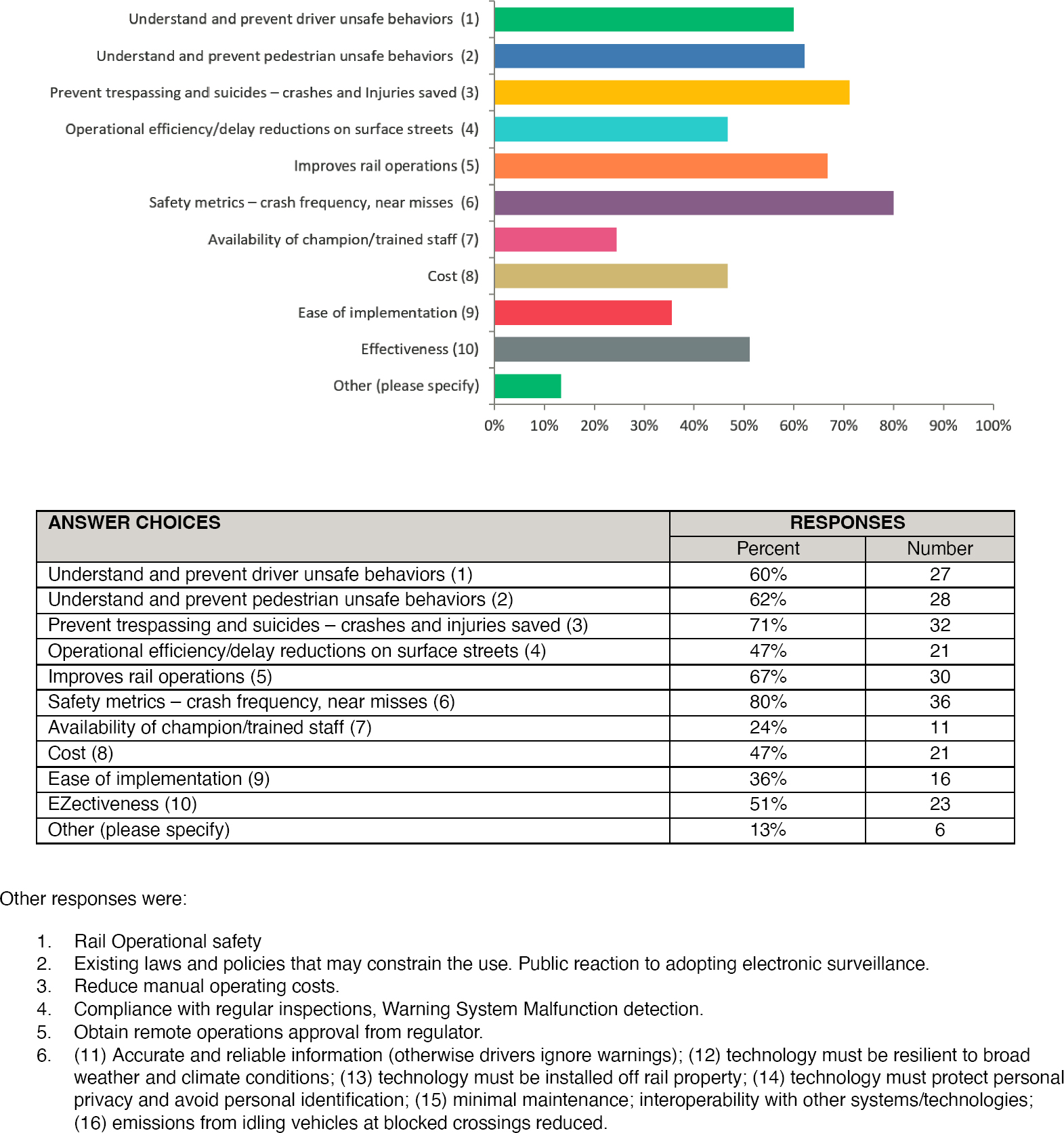
Q3. What are the decision criteria used in adopting electronic surveillance at rail crossings? (Select all that apply).
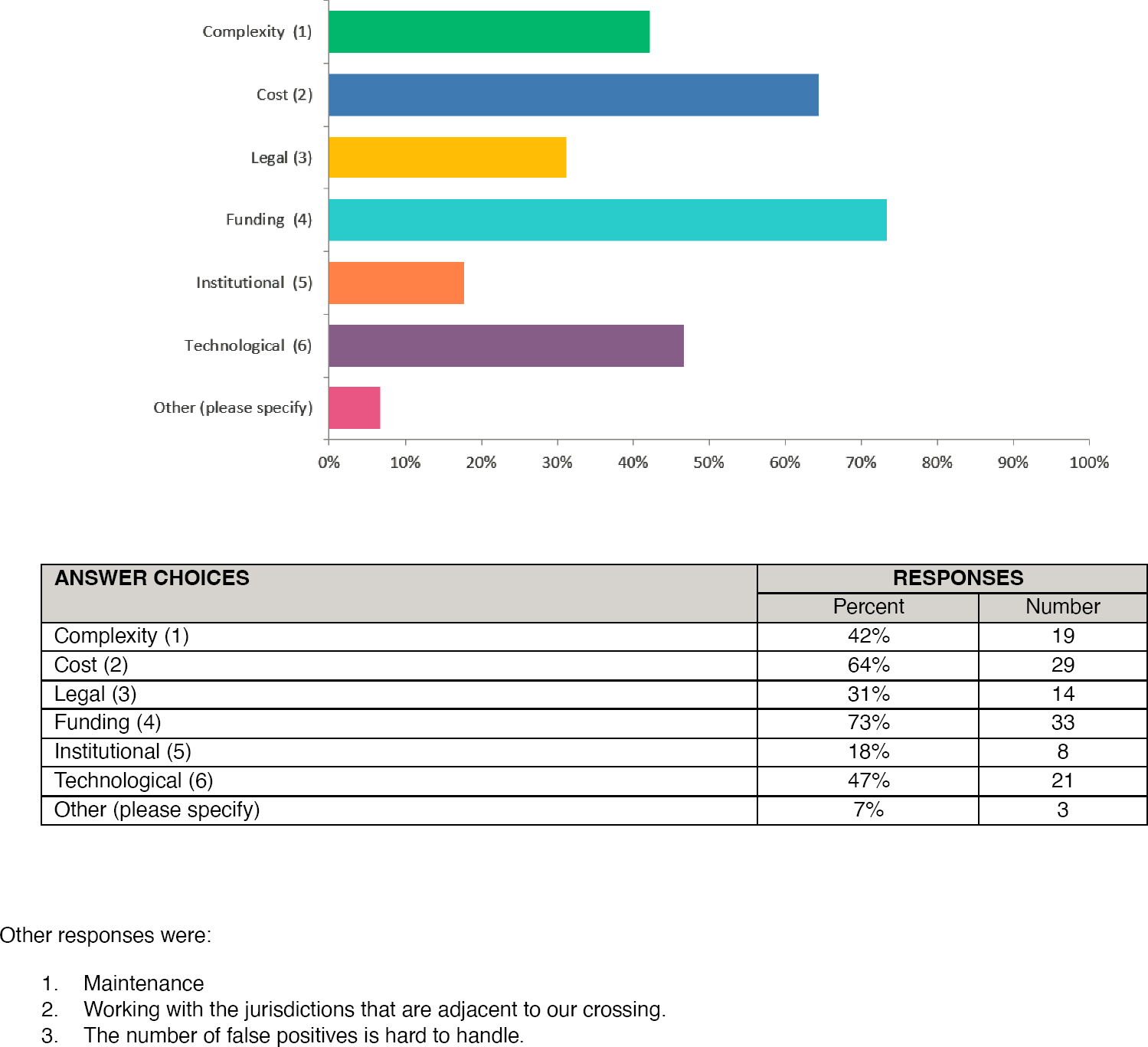
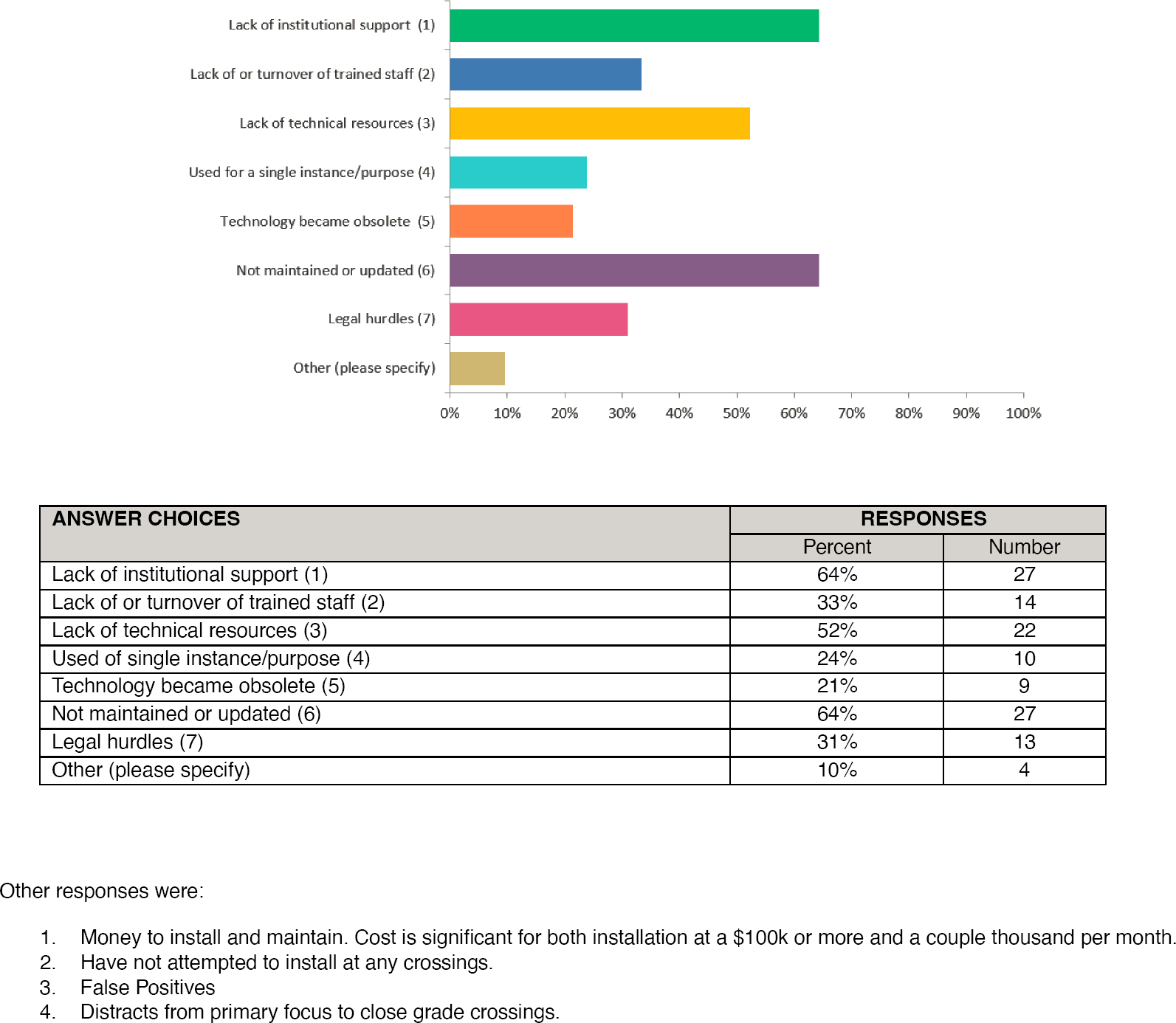
Q4. What are the barriers, challenges, and constraints? (Select all that apply).
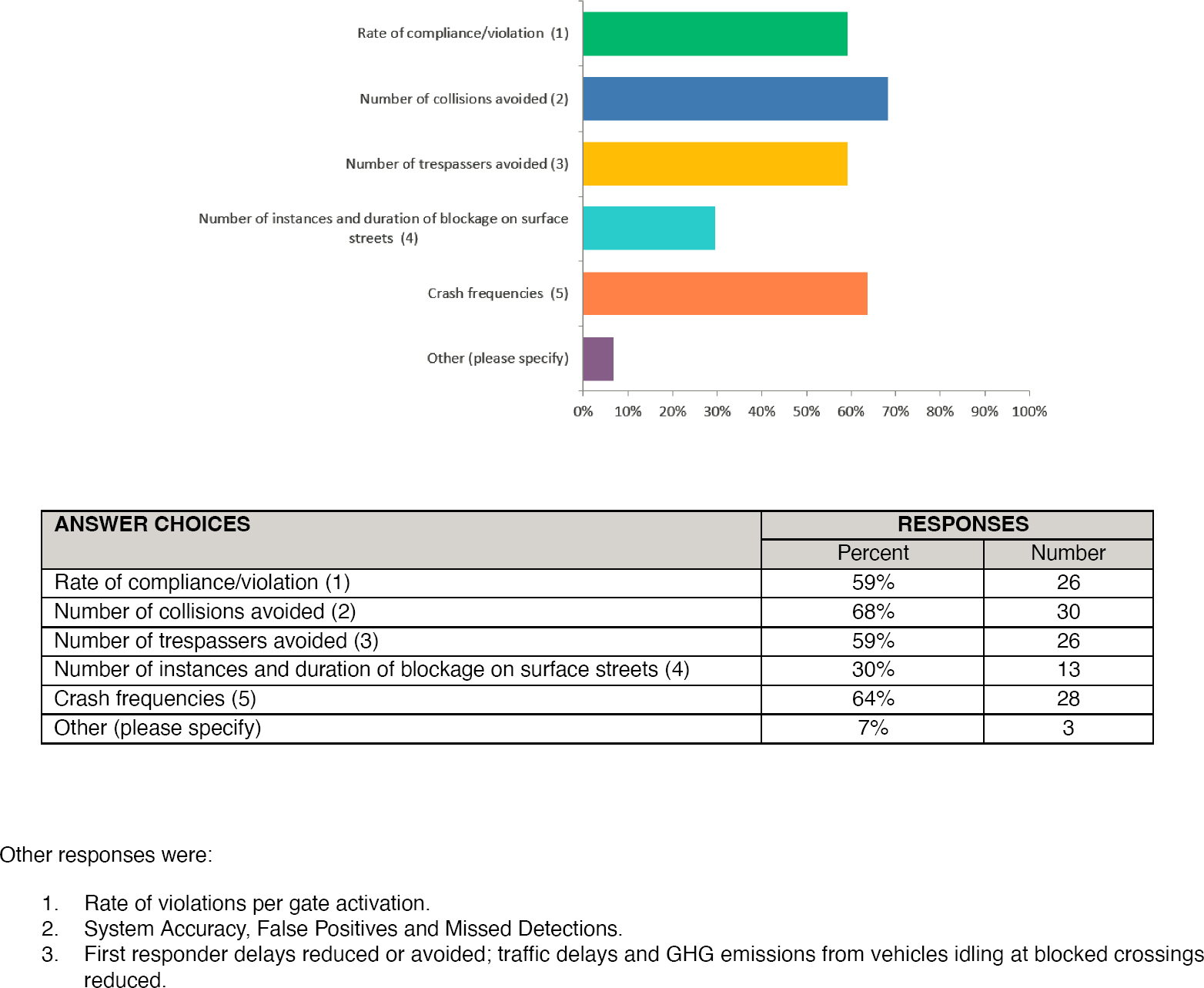
Q5. What are the measures of effectiveness? (Select all that apply).
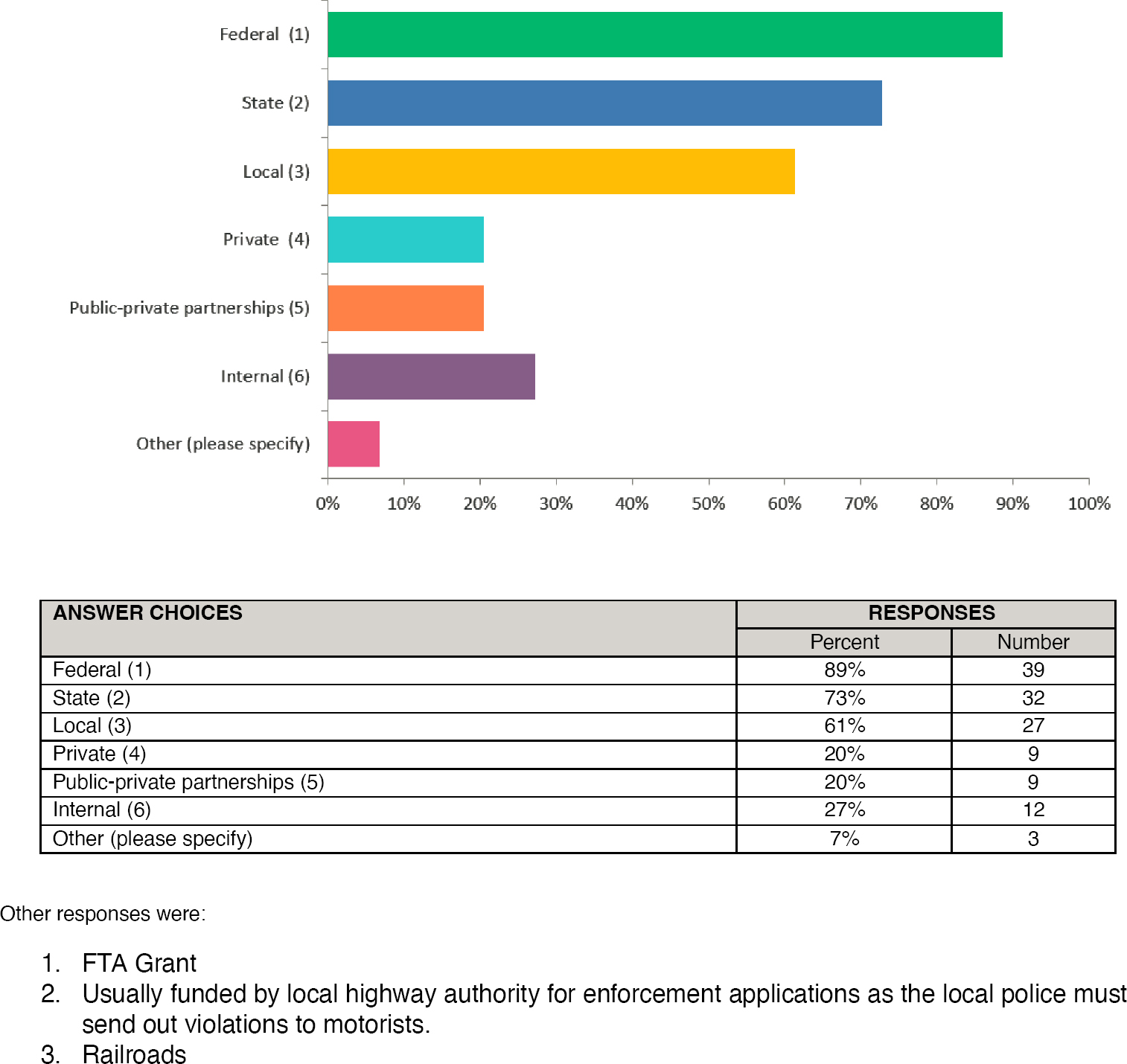
Q6. What are the sources of funding for purchase and installation? (Select all that apply).
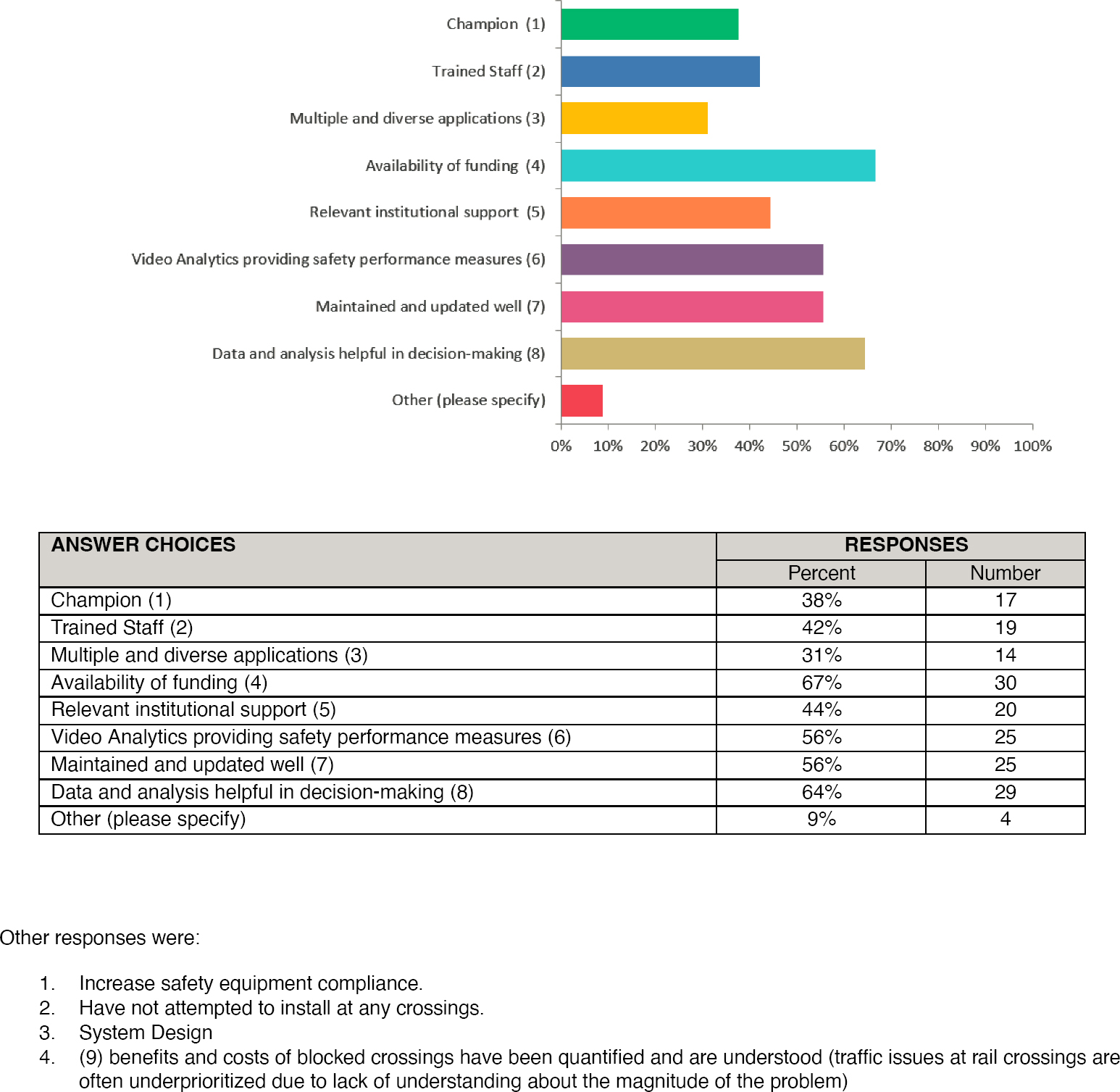
Q7. What are the reasons for success? (Select all that apply).
Q8. What are the reasons for failure? (Select all that apply).
Q9. Have you installed electronic surveillance at rail crossings or have experience with it?
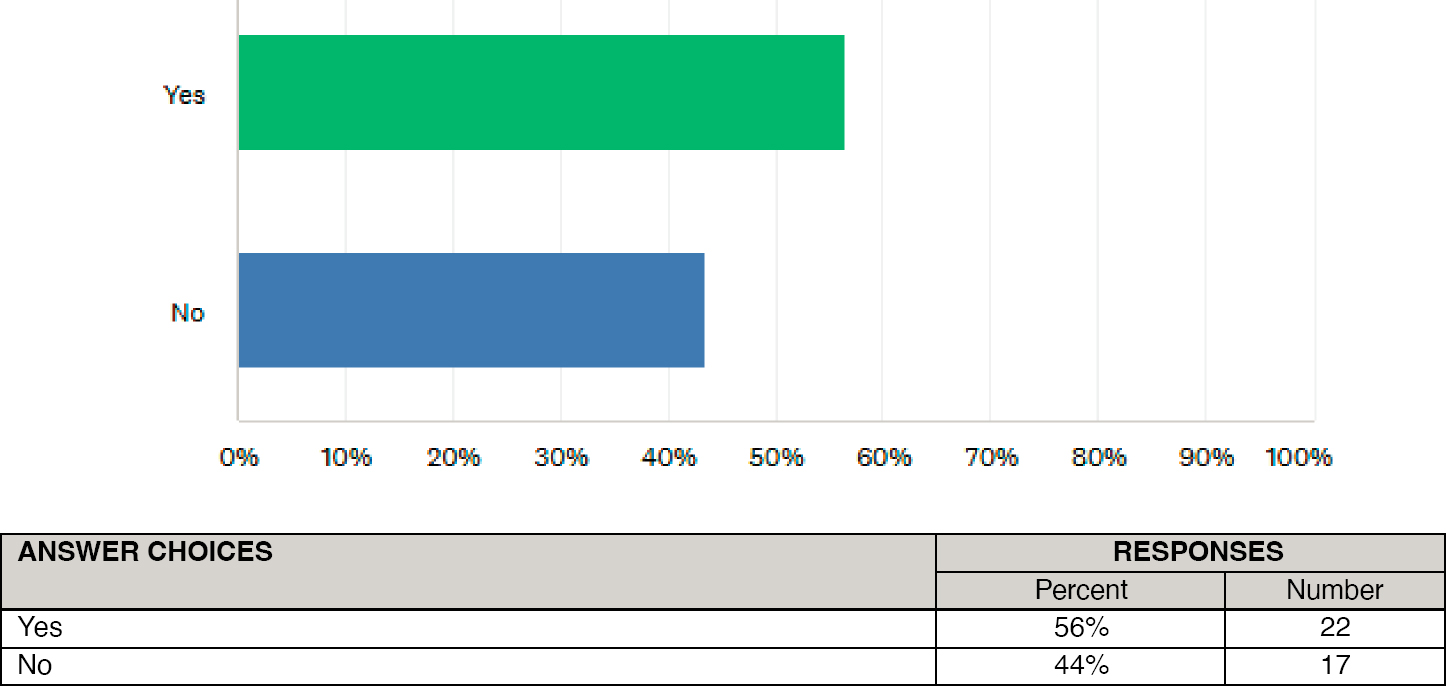
Q10. If yes to Q9, do you share the information you collect with law enforcement?

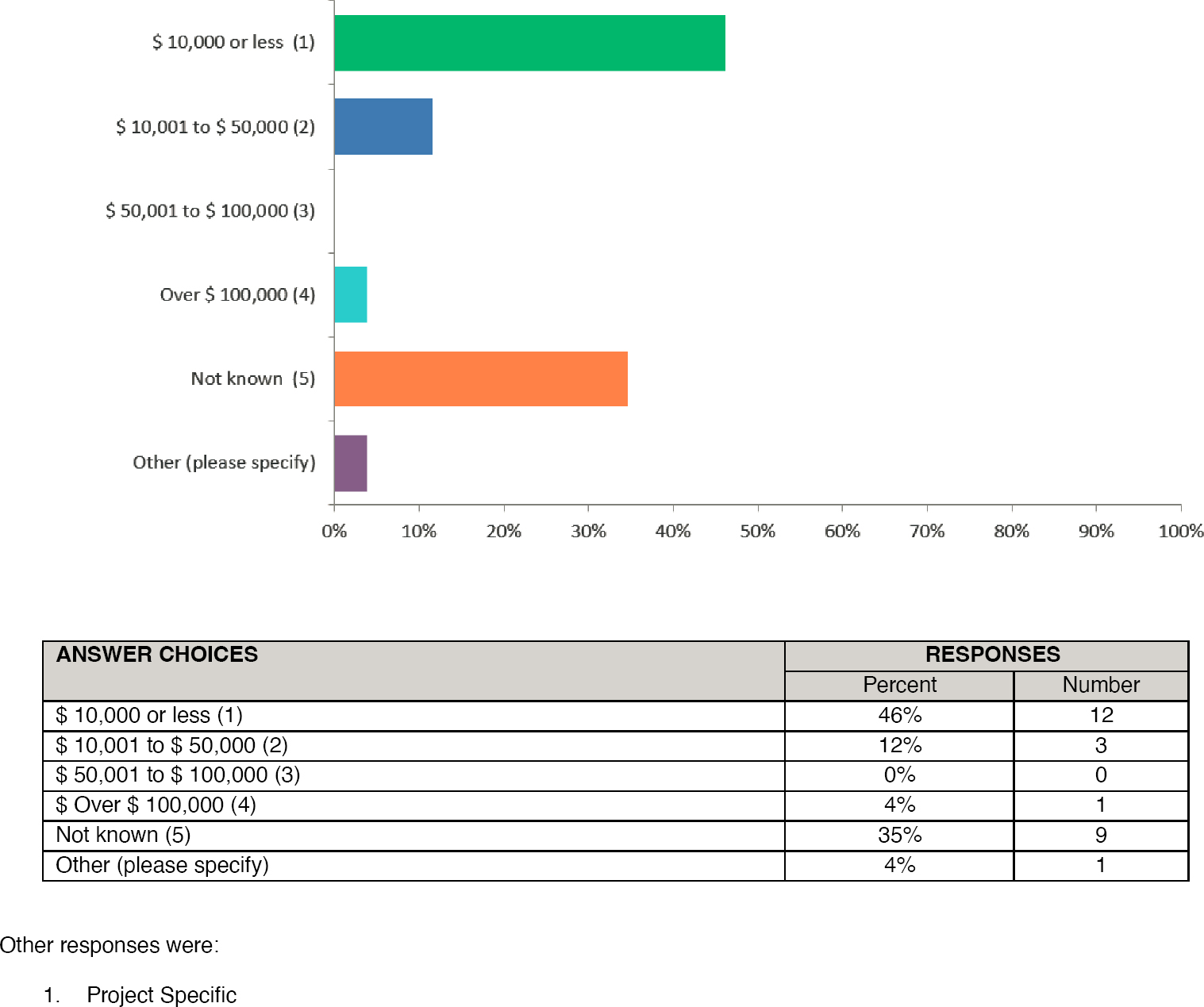
Q11. If yes to Q9, what was the cost to set up a system at one location or per location?

Q12. If yes to Q9, what is the recurring annual cost to operate the setup at one location or per location?
Q13. If yes to Q9, briefly describe the system’s characteristics, components, and technologies.
- Fixed cameras, at crossings, to view crossings, one single camera viewing crossing to watch for crashes, peds walking down the alignment.
- CCTV Camera
- Fiber infrastructure, Switches, NEMA Box, PTZ or Fixed Camera
- Not at liberty to discuss the pilot. It is advanced analytical video technology.
- Cameras at crossings.
- Grade Crossing Monitors which record grade crossing operation and generate alerts for abnormal behavior.
- You can set up rules within the software that observes trespassing and vehicle problems.
- Total of 113 cameras on 4 Light Rail lines and a dedicated Busway.
- Detection of trespassers, collisions, vehicle dwell, blocked crossing, fire, equipment failures, timing, and other data.
- Sent attached docs for answers to 13 – 18.
- Primarily dual 24GHz RADAR systems interfaced to crossing controllers and to communications networks.
- Camera attached to a pole monitoring crossings for gate violations.
- Https://de.wikipedia.org/wiki/Gefahrenraum-Freimeldeanlage
- It is a wayside device installed in the railroad equipment enclosures interconnected serially to the traffic control system. Monitors preemption, XR (crossing relay) and other track related data. By using vital message protocol, the traffic signal preemption is enhanced with better data than typical relay contact.
- Rutgers (we) have an Al system that automatically detects grade crossing violations, traffic, trains and signal activations. The hardware on the edge consists of a networking equipment and a modem. Cloud services include Amazon AWS EC2 Instances and Continued Internet 4G Service.
- Trains are detected with acoustic sensors; video cameras can be added if visual features are needed. Data is wirelessly sent to the cloud for analysis. Sound signatures are developed to determine train movement characteristics and predict when crossings will be blocked and cleared. Traffic data can be integrated to predict travel time delays for motorists up to 10 minutes before the train arrives. Application programming interfaces are used to integrate this information into roadside signs, traffic management centers, computer-aided dispatch software, and mobile apps.
- Video recording
- Obstacle detection systems using RADAR/LIDAR Obstacle detection systems using CCTV feed.
- CCTV cameras are triggered whenever the rail crossing control devices are activated. DC powered digital video recorder in crossing cabinet can only be accessed locally. No real time monitoring is required.
Q14. If yes to Q9, briefly describe the different applications of the system.
- Watch for crashes, peds walking down the alignment.
- Trespassing, video analytics
- There are many systems used. TDX, Cameras, GPS tracking
- Recorded cameras for review after incident
- Monitor approach and island circuits and record gate and bell operation.
- It automatically counts the identified issues. Then we can change the location treatments and observe the results in comparison to the previous version.
- Used to capture Left Turn violations and issuance of citation by the Los Angeles Sheriff’s Department
- Research, real-time hazard detection, maintenance support.
- Photo enforcement only.
- Detecting vehicles obstructing crossings for opening exit gates or communicating to a train control system in a wireless crossing application.
- Safety data analysis.
- At railway crossings in Germany with full barriers pretty common.
- Communicates vital health status of the traffic signal, status of the gates, island relay, and direction of the travelling train. Uses less conductors for the interconnection.
- The system has been used to identify types of violations to formulate better engineering and enforcement solutions. The system is being used to evaluate the effectiveness of applied engineering solutions. Ex. How effective were quad gates at a particular crossing.
- TRAINFO’s applications include traveler information systems, traffic management, emergency services, and analytics. Traveler information systems: TRAINFO notifies road users about blocked crossings, expected delays, and re-route options through various methods such as roadside signs and mobile apps. Traffic management: Information is integrated into traffic signal management systems to adjust signal timing before, during, and after a blockage event to reduce traffic congestion; it can also be used as an alternative to signal pre-emption. Emergency services: Information is integrated into tactical maps and computer-aided dispatch software for call-takers and dispatchers to help first responders re-route or to select units that will not be impacted by a train. Analytics: TRAINFO offers an online data portal with interactive graphs that provide blockage trends and detailed statistics (e.g., blockages by time, duration, train speed, train length). TRAINFO also produces risk models for first responders to identify which crossings impact emergency calls the most and the magnitude of this impact. Future applications in the R&D phase include connected and automated vehicle information and integration into CarPlay and Android Auto.
- Obstacle detection (road vehicle, pedestrian etc.) Interlocked with train control system
- CCTV cameras mounted on poles next to grade crossing bungalow, complete view of crossing area to see railroad, roadway, and pedestrian traffic.
Q15. If yes to Q9, briefly describe the costs involved.
- 10,000 to 30,000
- Labor, material, maintenance
- Costs all come from building out infrastructure to site or splicing into already ran infrastructure
- It’s a Pilot, minimal costs currently
- Not known, done by others on division
- 10k-15k USD
- Overall, with software, cameras and monitoring 2 million to Develop the risk tool.
- Cost of $1,850 per camera per month. @7 million $ total installation costs of 113 locations.
- Expensive especially if need to tie into railroad warning systems.
- About $35K per crossing
- Small startup cost to place cameras off RR right-of-way. Minor annual maintenance costs.
- Unknown
- Cost of the unit itself, cost of the hardware and labor hours for wiring and testing.
- Labor: Continued Validation and Development Material: One time cost for hardware install. Services: Internet Fees and Cloud Computing Process
- Costs involve hardware, software, integration, operations & support. Additional costs for installation and roadside signs may be necessary.
- Significant capital costs for hardware/software solution. Testing and commissioning costs due to specialist skills involved. Cost to train and maintain competent maintenance/operations personnel on equipment.
- CCTV Camera, cable, digital recorder, 12V battery & charger, installation under $10K.
Q16. If yes to Q9, briefly describe the challenges, constraints, and barriers involved.
- Infrastructure constraints, building out everything to support a new. switch, and camera
- Institutional support
- There is always a spending challenge when adding new cameras to crossing locations due to no infrastructure.
- Network availability, Costs
- Typically funding and prioritization
- Multiple permits and Jurisdictions involved, Contract with a local Police agency to process and issue citations.
- In Illinois, money needed to pursue railroad crossings due to high setup cost.
- None, although effective periodically maintenance (i.e. verification of system settings) is required and there are typically frequent personnel changes
- Who maintains and is responsible for the equipment? What is done with collected data?
- False positives
- Many contractors are unfamiliar with how to wire and connect the unit; agency would need to provide a circuit diagram; some rail agencies are reluctant to install as they feel it is non-standard.
- Obtaining access to RR ROW to install the system and defining the direct cost/benefit of the system for adoption. Some engineers are finding it difficult to derive suggestions based on the data.
- The biggest barrier is coordination amongst diverse stakeholders. Crossings are commonly on local streets, but local governments require county/state funding. Counties and states often seek federal grants. MPOs and COGs are sometimes involved. DOTs and 911 agencies may also need to coordinate on various projects. Challenges include finding a champion, getting all stakeholders to understand how big the problem is (most don’t have data to measure the problem - “what gets measured, gets managed”), aligning stakeholder goals, coordinating funding, long timelines for project scoping and procurement, resistance to innovative solutions.
- Determining appropriate safety criticality thresholds for new and novel equipment Resistance to change in operations by organization.
- Easier and less costly if CCTV camera design done as part of overall grade crossing improvement project; use vandal resistant equipment, provide space in grade crossing signal bungalow. Remote monitoring is available in special circumstances at additional cost.
Q17. If yes to Q9, briefly describe the funding sources.
- Capital budgets, federally funded
- Federal grant
- Capital projects
- Anything | can get from Federal Grants to Internal financial requests.
- Local funding
- State via Federal
- Internal and FTA Grant
- We have great support from our Board of Directors to provide local funding.
- ICC pilot project at 3 initial locations was paid for with funds from Illinois’ Grade Crossing Protection Fund. https://www.icc.illinois.gov/rail-safety/crossing-safety-improvement-program
- Typically railroads
- Local/State/PPP
- Federal Internal
- Depending on the project, the funding source could be Federal, State, Local, and private or a combination.
- Federally funded research followed by direct Transit Corporation Funding, and State DOT Funding
- Federal grants (CRISI, RCEP, SMART, Section 130, CMAQ), state grants, DOT budgets (state, county, local, MPO/COG).
- Federal
- Normally state funded
- FHWA section 130 grade crossing funding, federal (FRA/FTA) rail project funding; state funding when available.
Q18. If yes to Q9, briefly describe how effective was the system setup.
- When infrastructure is already built out it makes the process so much easier.
- Quite effective
- Very effective, adding more views to asset operations to keep the system moving smoothly. Along with training team members to use for investigation on violations, crashes, etc.
- Good set-up for a pilot
- Worked shortly after installation. A train car collision determined car drove around the gate.
- Generally effective but very basic
- Extremely
- Depends on the Contractor involved. Last installation efforts went smoothly despite COVID restrictions.
- Good at identifying areas of concern, time of day, sources, etc.
- Currently the GFR are very reliable.
- The unit is installed in the railroad enclosure, and the system setup is relatively basic.
- The system is over 95% accurate (false positives of legal occupiers, signal maintainers etc.). The system has informed a solution which reduced stopped on tracks by 50%. We piloted our system at over 16 locations in 11 states.
- Train detection is 99.99% accurate. Traffic delays are reduced by up to 30%, collision risks are reduced by up to 25%, first responder delays are reduced by up to 91%.
- Used several hundred times and generally smooth process from testing to operational service. Initial teething issues relating to system installation.
- The setup was very effective, consistent across dozens of grade crossings, upgradeable, easily maintained.
Q19. Are there any topics we have missed in our questions? Or is there something you wish to add? (Please note if you want this response to remain anonymous).
- Automated enforcement is not popular in Illinois due to the abuse by local municipal officials several of whom were caught taking bribes, so we have a huge credibility gap in Illinois.
- Locomotive based camera recording and its role in the big picture.
- When it comes to rail crossings, there are 3 types of people/public agencies: 1. Those that don’t have a problem. They don’t have crossings or haven’t had major issues, yet. 2. Those that have a problem and are actively trying to solve it. However, many of these are unaware of technological solutions. 3. Those that don’t know they have a problem or deny that they have a problem. Many public agencies fall into this category because they don’t have good data to quantify the problem and/or the problem has existed for so long that it has become an accepted part of life and people don’t complain about it anymore; i.e., no political motivation and no administrative budget for the issue. The biggest problem is awareness—making Type 3 agencies aware of the problem and converting them to Type 2, and making Type 2 agencies aware of cost-effective technological solutions. Once the awareness and energy to solve the problem exist, the funding and implementation become the easy part.
- Closing grade crossings is more important than surveillance.
- Special surveillance conditions for 4-quadrant gate crossings, remote video surveillance of 4Q crossings can be available to train dispatchers and others.
Abbreviations and acronyms used without definitions in TRB publications:
| A4A | Airlines for America |
| AAAE | American Association of Airport Executives |
| AASHO | American Association of State Highway Officials |
| AASHTO | American Association of State Highway and Transportation Officials |
| ACI–NA | Airports Council International–North America |
| ACRP | Airport Cooperative Research Program |
| ADA | Americans with Disabilities Act |
| APTA | American Public Transportation Association |
| ASCE | American Society of Civil Engineers |
| ASME | American Society of Mechanical Engineers |
| ASTM | American Society for Testing and Materials |
| ATA | American Trucking Associations |
| CTAA | Community Transportation Association of America |
| CTBSSP | Commercial Truck and Bus Safety Synthesis Program |
| DHS | Department of Homeland Security |
| DOE | Department of Energy |
| EPA | Environmental Protection Agency |
| FAA | Federal Aviation Administration |
| FAST | Fixing America’s Surface Transportation Act (2015) |
| FHWA | Federal Highway Administration |
| FMCSA | Federal Motor Carrier Safety Administration |
| FRA | Federal Railroad Administration |
| FTA | Federal Transit Administration |
| GHSA | Governors Highway Safety Association |
| HMCRP | Hazardous Materials Cooperative Research Program |
| IEEE | Institute of Electrical and Electronics Engineers |
| ISTEA | Intermodal Surface Transportation Efficiency Act of 1991 |
| ITE | Institute of Transportation Engineers |
| MAP-21 | Moving Ahead for Progress in the 21st Century Act (2012) |
| NASA | National Aeronautics and Space Administration |
| NASAO | National Association of State Aviation Officials |
| NCFRP | National Cooperative Freight Research Program |
| NCHRP | National Cooperative Highway Research Program |
| NHTSA | National Highway Traffic Safety Administration |
| NTSB | National Transportation Safety Board |
| PHMSA | Pipeline and Hazardous Materials Safety Administration |
| RITA | Research and Innovative Technology Administration |
| SAE | Society of Automotive Engineers |
| SAFETEA-LU | Safe, Accountable, Flexible, Efficient Transportation Equity Act: A Legacy for Users (2005) |
| TCRP | Transit Cooperative Research Program |
| TEA-21 | Transportation Equity Act for the 21st Century (1998) |
| TRB | Transportation Research Board |
| TSA | Transportation Security Administration |
| U.S. DOT | United States Department of Transportation |