Development of a MASH Barrier to Shield Pedestrians, Bicyclists, and Other Vulnerable Users from Motor Vehicles (2024)
Chapter: 18 Conclusions, Recommendations, and Suggested Research

CHAPTER 18
Conclusions, Recommendations, and Suggested Research
Summary and Conclusions
Under this project, research was performed to (a) develop a new multifunctional barrier system that complied with the specific requirements needed for the accommodation of pedestrians (including those with disabilities), bicyclists, and motor vehicles; and (b) conduct full-scale crash tests and provide standard drawings for the system. The research approach included collecting relevant literature and information on current practices pertaining to the separation of vulnerable users from traffic, conducting a survey to identify barrier systems commonly used to separate vulnerable users from traffic and the desired/needed improvements to those systems, and developing design options for a new multifunctional barrier system and transition.
Six different barrier design options were proposed. The design concept selected by the project panel was developed by using FE impact simulations. The final barrier system design was tested and evaluated according to the requirements of MASH Tests 3-10 and 3-11. Both tests successfully met MASH TL-3 evaluation criteria.
The new multifunctional barrier system met goals for both the traffic and vulnerable user sides of the barrier. The maximum dynamic deflection under MASH TL-3 impact conditions was only 16 in., which was significantly less than the target deflection limit of 24 in. established by the project panel at the onset of the project. No debris was generated by the barrier during the design impacts under MASH conditions. Some inevitable debris from the vehicle was present, but this was primarily composed of lightweight plastic pieces and should not pose a significant threat to vulnerable users outside the deflection limits of the multifunctional barrier.
Additionally, this research developed a transition system to connect the new multifunctional barrier to a conventional strong-post W-beam guardrail installation. The selected Thrie beam transition system was tested and evaluated in accordance with the specifications of MASH Tests 3-20 and 3-21, and the system met the MASH TL-3 evaluation criteria.
Table 105 shows that both the multifunctional barrier and the transition met the performance criteria for MASH TL-3 longitudinal barrier systems. Because the multifunctional barrier and transition met the MASH TL-3 performance criteria for barrier systems, a letter to request Federal Aid Reimbursement Eligibility of Highway Safety Hardware was drafted. The contents of that letter are presented in Appendix J.
Recommendations
On the basis of the outcomes of this research, the new multifunctional barrier and associated transition system that were developed are recommended for use when site conditions require positive barrier protection to separate traffic and nonmotorized transportation facilities such
Table 105. Assessment summary for MASH TL-3 tests of multifunctional barrier and transition.
| Evaluation Criteriaa | Description | MASH 3-10: Crash Test 612541-01-2 | MASH 3-11: Crash Test 612541-01-1 | MASH 3-20: Crash Test 612541-01-4 | MASH 3-21: Crash Test 612541-01-3 |
|---|---|---|---|---|---|
| A | Contain, redirect, or controlled stop | S | S | S | S |
| D | No penetration into occupant compartment | S | S | S | S |
| F | Roll and pitch limit | S | S | S | S |
| H | OIV threshold | S | S | S | S |
| I | Ridedown threshold | S | S | S | S |
| Overall evaluation | Pass | Pass | Pass | Pass |
Note: S = satisfactory.
a See Table 51 in Chapter 8 for details.
as sidewalks, bicycle facilities, and shared-use paths. The barrier and transition systems satisfy MASH TL-3 criteria and are, therefore, considered acceptable for use on high-speed facilities. Detailed drawings of the multifunctional barrier system are provided in Appendix B. Detailed drawings of the transition from the multifunctional barrier system and conventional strong-post W-beam guardrail are provided in Appendices E and F. These detailed drawings can be used by interested transportation agencies to develop standards for the implementation of these systems. Their use at appropriate locations should enhance the safety of vulnerable users while maintaining MASH TL-3 performance for motorists.
Although the approach guardrail attached to the developed transition was terminated with a downstream anchor terminal, termination with a MASH-crashworthy terminal is an acceptable option when the end of the terminal will be within the clear zone of opposing traffic. A MASH-compliant TL-3 terminal can be connected anywhere beyond the asymmetric Thrie beam to W-beam transition section from an impact performance standpoint. The need and length of any associated approach rail between the MASH terminal and multifunctional barrier transition should be determined on the basis of a user agency’s design manual.
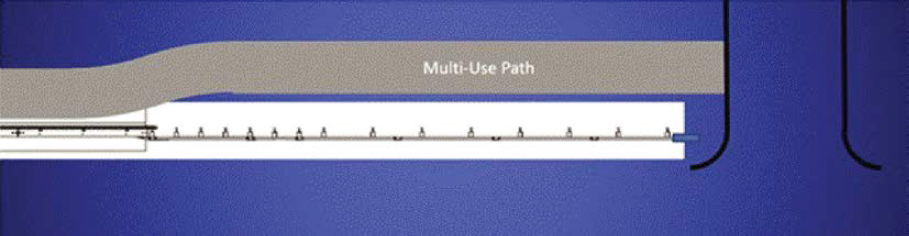
Note that the transition and its approach guardrail will not provide the same level of protection for vulnerable users behind the barrier as the multifunctional barrier system. Any standard approach guardrail or terminal system beyond the multifunctional barrier and its transition will have considerably more deflection and potentially more debris. Such circumstances may arise when an intersecting roadway is encountered, and the multifunctional barrier needs to be terminated with a crashworthy MASH terminal. In this or similar scenarios, user agencies may consider transitioning the nonmotorized transportation facilities further from the barrier at these locations, as depicted in Figure 158.
Suggested Research
This research has led to the development of a new multifunctional barrier. It was developed to have limited dynamic deflection under a design traffic impact for MASH TL-3 conditions to limit its penetration into the shared use space behind the barrier. The barrier system that was developed has a maximum dynamic deflection of 16 in. compared to conventional strong-post
W-beam guardrail that typically has dynamic deflections in the range of 42 in. or more. Additional research can be performed to develop other multifunctional barrier systems that have different ranges of deflection if desired. As deflection is permitted to increase, the cost of a barrier typically decreases.
A MASH TL-3 compliant transition system was also developed to transition the stiffness and geometry of the multifunctional barrier system to a conventional strong-post W-beam guardrail to permits its termination with a MASH compliant W-beam guardrail terminal. This transition incorporates nested Thrie beam rail and reduced post spacing. As described herein, the impact performance of an alternate W-beam transition with extended rub rail appears promising and could provide a more cost-effective transition system for the multifunctional barrier. Further research and testing are needed to verify if this design will comply with MASH criteria.
Additional research could also be conducted to assist user agencies with determination of site criteria that merits the implementation of the new multifunctional barrier system, including the proximity of the shared-use path from vehicular traffic. While implementation at many locations may be intuitive, a more comprehensive benefit-cost or risk analysis could assist the decision process at some locations. In-service performance evaluation of the new multifunctional barrier system and transition would also be useful in understanding its in-field impact performance for both traffic and vulnerable users, and determining if improvements could be incorporated into future versions of the system. This includes evaluation of potential debris from a vehicle impact onto the trail side of the barrier.
Future research could evaluate the comfort levels of vulnerable users on the trail side of the barrier and its utility and function for those users, including those with disabilities. Such research would assist with understanding how the barrier could be improved.


