Effective Low-Noise Rumble Strips (2024)
Chapter: 1 Background

CHAPTER 1
Background
Problem Statement
Rumble strips are proven safety countermeasures for roadway departure crashes. They produce vibration and noise to alert drivers that they are drifting from the travel lane. Neighboring residents—contiguous to roadways with rumble strips—often complain about the noise generated by these appurtenances. This has prompted a need to simultaneously study noise mitigation and rumble strip design and application. Preliminary studies by California and Minnesota state transportation agencies indicate significant potential for sinusoidal rumble strips to provide adequate alerting noise and vibration for the driver while significantly reducing exterior noise. While NCHRP Report 641: Guidance for the Design and Application of Shoulder and Centerline Rumble Strips, showed commendable crash reductions for traditional milled rumble strips, with dimensions of approximately 7 × 12 inches and ½ inch depth, other designs have been used extensively by a number of state agencies to address pavement width or bicycle accommodation issues without documentation of their comparative safety effects or noise impacts (Torbic et al. 2009). Other states are exploring the effectiveness and appropriateness of various low-noise designs (e.g., varying widths, depths, and shapes).
While there have been a few independent studies of the noise associated with various rumble strip designs, they are difficult to compare because they use different vehicle types, acoustical equipment and procedures, and rumble strip designs. Due to the scope of the issue, expertise from both transportation safety and noise professionals are required to study the issue. Providing state, local, and federal agencies with suggested rumble strip designs that offer adequate alerting driver feedback and reduced external noise would potentially increase their use and expand opportunities for agencies to reach safety performance goals.
The objectives of this research are to: (1) identify or design and evaluate alternative rumble strips that provide effective alerting noise and vibration within vehicles and minimize perceived external noise, while considering several variables (e.g., vehicle types, pavement types, and speed); (2) propose low-noise rumble strip designs that accommodate all users; and (3) develop suggestions for standard testing and measurement protocols.
Previous Research and Current Practice
Roadway departure warning indicators, also known as rumble strips, are a proven safety countermeasure intended to alert drivers when they leave the roadway across the edge line or center line. Centerline rumble strips (CLRSs) are used to reduce head-on, opposite-direction sideswipe crashes and lane departure crashes, and shoulder rumble strips (SRSs) and edge-line rumble strips or stripes are used to reduce roadway departure crashes. Rumble strips are constructed in/on pavement as longitudinal patterns of variable surface profile, which alert the driver with both an audible noise and tactile vibration (Himes et al. 2017).
Rumble strips have received a considerable amount of attention in recent years, particularly from a safety and noise point of view. Recent analysis by FHWA has found that around half of the roadway fatal crashes occur from lane departures. State agencies have become increasingly aware of noise concerns generated by rumble strips both due to complaints from people living in the vicinity of rumble strips where rumble strips are installed, as well as concerns about noise effects on protected species. As a result of these two apparent conflicting needs, reducing roadway departure crashes and lowering noise, state agencies have recently been conducting research on low-noise rumble strips. Results of the various research studies are summarized in this literature review and additional information is provided in Appendix A.
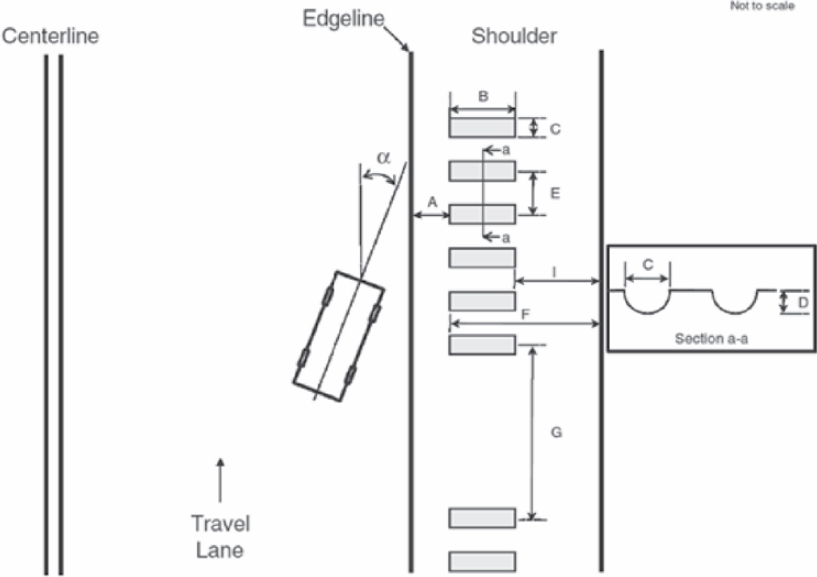
There are two primary types of rumble strips, milled and raised. Milled strips are created by a milling machine that cuts indentations in asphalt and concrete pavements in various designs and dimensions. Designs typically are rectangular, cylindrical, or football-shaped, and more recently sinusoidal. Raised strips are most commonly rubber buttons or plastic strips adhered to a pavement surface, usually restricted to warmer climates that don’t require snow removal. For milled rumble strips, Figure 1 depicts standard design parameters for non-sinusoidal strips. Some parameters can be optimized to minimize noise and maximize bicycle safety. The following design parameters can be considered for a traditional type of rumble strip (assumes rectangular), understanding that there may be limitations based on what a particular facility can accommodate (Rochat et al. 2017):
- Offset (A) to minimize accidental strikes and lateral offset (L) to provide clearance for bicycles,
- Length (B) perpendicular width,
- Width (C) parallel to the travel lane,
- Depth (D) which may be optimized to minimize noise and bicycle discomfort,
- Spacing (E) which affects pitch of tonal aspects of associated noise, and
- Gap (G) to allow bicycles to cross.
Additional design parameters include: (F) recovery area, and (α) departure angle.
The most promising low-noise rumble strip design philosophy has been sinusoidal shapes milled into the pavement surface. In the 2000s, European research indicated that lower pass-by noise levels could be achieved with the sinusoidal design. Research in the United States followed, with several state agencies testing sinusoidal rumble strips. Studies showed that a rumble strip with a sinusoidal shape can reduce exterior noise levels compared to conventional designs by 1 to 11 dB. The different studies used different design parameters (wavelength, depth, and perpendicular width), different vehicles, and different measurement set-ups which makes direct comparisons among measurement results difficult. Please refer to Appendix A, Table A-1 for the various parameters applied. Generally, sinusoidal rumble strips with wavelengths much greater than 0.35 m (14 in) may not produce sufficient increase in noise and vibration inside the vehicle to alert drivers and sinusoidal rumble strips with wavelengths much less than 0.35 m (14 in) may not provide as much roadside noise benefit. Studies have shown that sinusoidal rumble strips may not alert operators of heavy trucks sufficiently. Appendix A, Table A-5 lists state guidance, and Table A-6 shows the design parameters of the sinusoidal rumble strips used in different states.
Designing an optimal rumble strip for alerting drivers and reducing wayside noise should consider bicyclist and motorcyclist safety. The main concerns for bicyclists are to have adequate space between the rumble strip and edge of road, gaps for crossing, and a maximum depth between 6 and 10 mm (0.25 and 0.4 in). Sinusoidal designs are preferable for bicyclists, however, the longer and deeper the rumble strips become, the more uncomfortable and less controllable they will be for bicyclists when maneuvering over them. In general, motorcyclists can safely traverse rumble strips. There may be some difficulty associated with raised strips. Difficulty may also arise from being unaware of centerline rumble strips.
In communities, rumble strips can increase noise by 5 to 25 dB near the road and cause annoyance and sleep disturbance. The effect is dependent on distance from the road with residences within 91 m (300 ft) being most affected, while for those 500 m (1,600 ft) away, the noise from rumble strips is negligible. Noise complaints from the public generally occur in locations where the speed is low, the roadways are rural or semi-rural, and nighttime background sound levels are lower. Some state departments of transportation (DOTs) specify a particular distance from residences at which rumble strips should be discontinued. In general, states discourage the use of rumble strips in areas with relatively high levels of residential development.
Regarding alerting drivers, NCHRP Report 600C: Human Factors Guidelines for Road Systems, provides a review of human factors in relation to rumble strips (Campbell et al. 2010). Rumble strips are intended to provide a tactile/haptic and auditory alert to drivers who stray from a travel lane. When a vehicle’s wheels traverse a rumble strip, they generate both an increase in sound and haptic (physical) vibrations that drivers feel through their seat, foot pedals, floor, and steering wheel. Rumble strips can potentially wake drivers who fall asleep; however, this result typically requires a greater level of sound and vibration. In general, rumble strips must produce sound and vibration levels that are easily detectable, yet not so loud and jarring that they startle drivers. The following parameters are based on multiple studies: an increase in noise level of 3 to 15 dB above the ambient; increases in steering wheel vibration of 1.5 m/s2 (vertical), 1.0 m/s2 (perpendicular to direction of travel), and 0.5 m/s2 (in direction of travel).
Many state and federal agencies have carried out noise and vibration studies of traditional and sinusoidal rumble strips. However, the measurement procedures are inconsistent from one study to the next. Table A-3 in Appendix A summarizes the measurement procedures and general conclusions of the major rumble strip noise and vibration evaluations. For noise to the neighboring community, exterior data collection typically follows the AASHTO Statistical Isolated Pass-By procedure TP98-13 (AASHTO 2012). For interior vehicle noise measurements, a microphone location is typically placed at the head position of the passenger’s seat. For interior vehicle vibration, standards SAE and ISO 2631 advise that human exposure to vibration
should be measured at the interface between the human body and the respective vehicle surface, specifically at the seat-buttocks surface, seat-back surface, and the floor-feet surface (SAE 2013, ISO 2018). For other measurement positions, ISO standard 5349 addresses hand-transmitted vibration, and it is typical for vehicle manufacturers to measure the outboard seat track (ISO 2001, Meinhardt et al. 2011). Measurements should be for a duration of 8 seconds, or, for transient events, multiple measurements are suggested, and an assessment of accuracy based on the observed run-to-run variations.
State-of-practice resources include:
- NCHRP Report 641: Guidance for the Design and Application of Shoulder and Centerline Rumble Strips (Torbic et al. 2009).
- Ahmed 2015 (FHWA-WY-15/02) includes a summary of the rumble strip/stripe practice in all 50 states (Ahmed et al. 2015).
- NCHRP Synthesis 490: Practice of Rumble Strips and Rumble Stripes. The synthesis compiles current practices used by states installing rumble strips and explores variations in practice in terms of design, criteria, and locations for installation, maintenance, perceived benefits, communication of benefits, and what are considered important issues (Smadi and Hawkins 2016).
- Report No. FHWA-HRT-17-026 State of Practice for Shoulder and Center Line Rumble Strip Implementation on Non-Freeway Facilities identifies the state of knowledge and practice among state transportation departments. There is also an FHWA decision support guide for the installation of shoulder and center line rumble strips on non-freeways (Himes et al. 2017, Himes and McGhee 2016). In addition, the FHWA has compiled its guidance on rumble strips on its website (Himes et al. 2017).
Scope of the Research
The NCHRP Project 15-68(01), “Effective Low-Noise Rumble Strips” research was completed to identify or design and evaluate alternative rumble strips that provide adequate noise and vibration response within vehicles to effectively alert drivers of lane departure while minimizing perceived external noise; suggest low-noise rumble strip designs that accommodate all users; and develop proposals for standard testing and measurement protocols. The research was completed in two phases. In Phase I, the relevant literature was reviewed and the current state of the practice for effective and low-noise rumble strips was assessed. Metrics and data collection methods were identified for measuring the response of motor vehicle inputs from rumble strips in terms of interior noise and vibration and exterior noise generation. From this activity, appropriate initial test procedures were developed. These procedures were then applied to the testing of nine vehicles, including compact sedans, mid-size sedans, sport utility vehicles (SUVs), and full-size trucks. These vehicles were tested on two types of rumble strips: one of standard design (see Figure 1) and one of sinusoidal design. The results of this testing were used to finalize test procedures for use in Phase II of the research.
The second phase of the research was directed at determining a suggested design for effective, low-noise rumble strips. Based on the Phase I research and previous research in the literature, the effort was placed on sinusoidal designs, as these had been shown to produce interior noise and vibration equal to or exceeding that produced by more conventional rumble strips. Initially, testing focused on existing sinusoidal strips installed in the Midwest. Four different sinusoidal designs were tested following the test procedure developed in Phase I. Based on the results of these measurements, 20 different sinusoidal designs were installed on a highway in Washington State. From this measurement program, an optimum design was developed specifying the sinusoidal wavelength, the peak-to-peak amplitude of the sinusoid, and the recess of the strips into the pavement.
Research Approach
The ultimate goal of this NCHRP project was to develop a suggested low-noise, effective rumble strip design. There have been a number of studies that included the apparently quieter sinusoidal designs, but the test methods and vehicles vary from one study to the next, making comparison of results problematic. As a first step in this research, it was necessary to develop a uniform method of measuring the exterior noise and the interior noise and vibration generated by rumble strips on the shoulder and centerline. To develop these procedures, measurements were conducted in Northern California on US 101 and California 299 in the vicinity of Arcata. These rumble strips were the subject of previous research supported by the California Department of Transportation (Caltrans) (Donavan and Rymer 2015, Donavan 2018). As the performance of rumble strips has previously been found to vary by vehicle design, measurements included eight vehicles ranging from small subcompact cars to large, full-frame SUVs with an additional full-size pickup truck tested later. The measurements included conventional pass-by testing, interior noise, and vehicle vibration measurements on and off the strips. Using the results, suggested testing procedures were developed and used in later rumble strip testing on existing sinusoidal designs in Indiana and Michigan. Based on these results, 20 experimental sinusoidal rumble strips were installed in Washington State to optimize the sinusoidal design parameters. Analysis of these results led to the suggested design documented in this report.


