Preparing the Future Workforce in Drug Research and Development: Proceedings of a Workshop (2024)
Chapter: 6 Scaling and Sustainability of Workforce Programs
6
Scaling and Sustainability of Workforce Programs
Highlights of Key Points Made by Individual Speakers
- Diversifying the R&D workforce is not just an issue of social justice—it is an issue of doing the best possible science. (Bernard)
- Mentorship is essential for students and early career professionals; interactions between working scientists and the leaders of tomorrow can inspire and motivate both parties. (Fathallah)
- Students and young professionals need education and training on how the drug development ecosystem works and on the roles and skills that are involved. (Granger)
- Young professionals benefit from exposure to multiple types of workplaces, including distinct government agencies, to learn about different roles and cultures within the R&D enterprise. (Araojo)
- Initial smaller efforts may be scaled up through institutional word-of-mouth as institutions may seek to replicate successful efforts with their own funding. (Lindstaedt)
This list is the rapporteurs’ summary of points made by the individual speakers identified, and the statements have not been endorsed or verified by the National Academies of Sciences, Engineering, and Medicine. They are not intended to reflect a consensus among workshop participants.
STRATEGIES, APPROACHES, AND SUCCESS STORIES
Building a person-centered, culturally aware workforce will require not just recruitment of diverse students, but also retention, Butts said. In this session, Butts held a “fireside chat” with Marie Bernard, the chief officer for scientific workforce diversity in the Office of the Director at the National Institutes of Health (NIH), to explore ways that stakeholders can better prepare the next-generation workforce and to consider opportunities to scale up efforts to support the workforce. Butts began by asking Bernard to comment on what strategies she has found to be effective in incentivizing underrepresented groups to pursue careers in both behavioral and biomedical research. Butts said that she deliberately included behavioral science because while conversations about the clinical research workforce tend to focus on biomedicine, behavioral science is also critically important. Bernard agreed that it is important to be “mindful of the full range of talent and individuals and disciplines” that contribute to clinical research. NIH has taken a multifaceted, coordinated approach to work toward “inclusive excellence” in science (Figure 6-1). It is important to think broadly about how to foster a scientific enterprise that is diverse, inclusive, and welcoming, Bernard said, so the NIH model
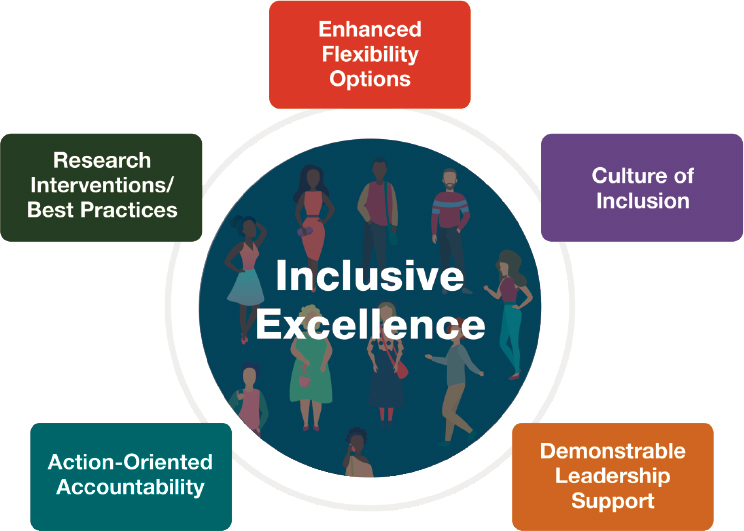
SOURCES: As presented by Marie Bernard on October 17, 2023; adapted from Ten Hagen et al. (2022); CC BY 4.0.
emphasizes efforts in multiple areas. According to Bernard, inclusive excellence requires a commitment to diversity from leadership, an action-oriented plan with measurable targets, and flexibility from all stakeholders. Bernard said that the barriers to participating in science can be more burdensome for people from underrepresented groups. These barriers need to be considered and accommodated, Bernard said, as inclusive excellence requires a culture of inclusion that recognizes the value that each participant brings to the table.
Butts responded that creating a culture of inclusion is sometimes thought of as “too hard,” but that it does not have to be. She gave the example of the deaf resident at University of Rochester who worked with the faculty to educate them on creating a welcoming environment (see Chapter 4). Engaging with other cultures and communities—and trying to walk in their shoes—can allow stakeholders to find that other people are “not that different,” Butts said. While there are cultural nuances, she said, “everybody wants to be seen as human.” Bernard agreed and said that seeking diversity and inclusion is not just a social justice issue— “it is an issue of doing the best science.” There are growing data that show that diversity matters; it invites creativity, innovation, and thinking differently (Handelsman, 2015). Bernard gave an example from a clinical trial for an Alzheimer’s drug called Aduhelm. The population recruited for the study, which was the basis of the approval, was 89 percent non-Hispanic white, 9 percent Asian, and the rest other populations (Lin et al., 2021). However, Alzheimer’s in the United States is much more prevalent among African Americans, Blacks, and Hispanics/Latinos, and the way the condition expresses itself in those populations may be different (Mayeda et al., 2016). Bernard said that to have a generalizable drug, the study population needs to be more diverse. The scientists working on this study—both at the industry and NIH level—were a “pretty homogenous population,” according to Bernard. If there were more people at the table from different backgrounds who could think about potential barriers for the target population (e.g., misdiagnosis or late diagnosis), she said, it is likely that the study population would have been more diverse and the data more generalizable.
There are many publications detailing “what’s wrong with the system,” Butts said, but we need examples of what actually works. She asked Bernard to share examples of successful programs, either within NIH or funded by NIH, that are working toward fostering a more diverse scientific workforce. Bernard said that there is a broad array of external programs directed at enhancing diversity in science, from high school through early faculty and beyond, and these are beginning to show progress. Diversity supplements are a “great means of helping scientists from diverse backgrounds to be successful,” she said, and this mechanism
is underused—less than 5 percent of NIH R01-equivalent grants have diversity supplements (Hill et al., 2021). To address these concerns, NIH held seminars on the importance of diversity in the scientific workforce in 2022,1 she said.
Within NIH, the Distinguished Scholars Program (DSP) is built on the evidence behind recruiting cohorts of diverse people rather than individuals. Around 2010, NIH launched the Stadtman2 and Lasker3 programs, which used cohort recruitment. Before these programs launched, Bernard said, the proportion of tenure-track investigators who were female or from underrepresented communities was flat or declining. These initial cohort recruitment programs had an immediate impact, and in 2018 the DSP was added. In the DSP, individuals in cohorts who have demonstrated an interest and record in diversity, equity, and inclusion get additional mentoring and resources. The NIH Equity Committee4 meets regularly to make sure that program participants are treated fairly in terms of salary, space, equipment, and other issues. This program has been associated with a significant increase in the diversity of the tenure track program at NIH (Bernard, 2021). Not every participant in the program is from an underrepresented group, but “that’s the point,” Bernard said.
Bernard said that the NIH-funded Faculty Institutional Recruitment for Sustainable Transformation5 (FIRST) program is based on the success of the DSP. Within the FIRST program, there are 15 sites for cohorts, and the Morehouse School of Medicine has been given funding over the next 5 years to serve as the coordinating center. The intent of FIRST is to bring in early career professionals who have an interest in and commitment to diversity, equity, and inclusion and support their journey to becoming a tenured faculty member. As with the DSP, Bernard said, participants receive extra mentoring and extra resources for their labs. In addition, there is attention to ensuring that the internal environments at the institutions are welcoming and inclusive. If this program is successful, Bernard said, it will add 150 people to tenured positions, many of whom are from underrepresented racial and ethnic groups. While this number may seem
___________________
1 For more information, see https://diversity.nih.gov/disseminate/swd-seminar-series (accessed February 27, 2024).
2 For more information, see https://irp.nih.gov/careers/trans-nih-scientific-recruitments/stadtman-tenure-track-investigators (accessed February 27, 2024).
3 For more information, see https://www.nih.gov/research-training/lasker-clinical-research-scholars (accessed February 27, 2024).
4 For more information, see https://irp.nih.gov/catalyst/27/3/from-the-deputy-director-for-intramural-research (accessed February 27, 2024).
5 For more information, see https://www.first-cec.net/ (accessed February 27, 2024).
small, she said, it is a “considerable contribution” given the existing numbers.
Butts highlighted three important points about the programs Bernard described. First, she said, there are many benefits of cohort recruitment. She explained that it is difficult and isolating to be the “N of 1” in a professional program, and a cohort increases retention by forming a community of people who can relate to and support each other. It is important that these programs are open to people of all backgrounds who have an interest in diversity, equity, and inclusion, she added, as efforts that rely solely on marginalized people to solve problems are imposing a “diversity tax” on those individuals. That is, people from underrepresented communities are expected to not only do their jobs but also to “fix” structural racism, inequities, and other issues. Opening these programs to all interested people, Butts said, takes the burden off members of marginalized communities and emphasizes that these issues are the responsibility of everyone. Finally, Butts noted that the institutions involved in DSP and FIRST include some predominantly white institutions. Placing professionals with a commitment to diversity, equity, and inclusion in these environments has the potential to affect the culture of these institutions and create a “domino effect” among leaders and other individuals at the institution, Butts said.
Butts asked Bernard to discuss partnerships or collaborations that are working to achieve a more person-centered, culturally aware ecosystem. Bernard said that the NIH UNITE6 initiative is a great example of this type of work. UNITE has the “audacious goal” of ending structural racism, she said. The idea for the initiative came about in 2020, at the beginning of the pandemic and at a time when racialized violence was getting public attention. While structural racism is an issue that is much broader than the purview of NIH, Bernard said, NIH has a “bully pulpit” as the largest funder of biomedical and behavioral research. All 27 institutes and centers at NIH came together to work on this initiative, which is “quite a feat” in itself, she said. The institutes and centers are working to look at everything through an equity lens, working collaboratively to be people-focused and data-driven with a focus on health disparities and minority health research, the internal NIH workforce, and the external biomedical and behavioral research workforce. The initiative focuses on both making changes internally at NIH and providing external opportunities. In the health disparities space, there is a new program called Com-PASS (Com-
___________________
6 For more information, see https://www.nih.gov/ending-structural-racism/unite (accessed February 27, 2024).
munity Partnerships for Advancing Science and Society)7 that has $400 million over the next 10 years to build relationships between communities and academic institutions to address community-identified problems. Five academic institutions will work with 25 communities, and a coordinating center will ensure that the focus stays on the issues identified by the community. Our hope, she said, is that these collaborations will “move the needle” on health disparities.
To wrap up the discussion, Butts asked Bernard for her thoughts on how stakeholders can work individually and collectively to ensure the success and sustainability of efforts directed at DEIA (diversity, equity, inclusion, and accessibility). Bernard said that these efforts are hard work and need to be motivated at the core by the principle of having “as many people at the table as possible so you can get those differing perspectives.” Bringing people from different disciplines and different places on the career ladder together to develop and implement ideas is sometimes like “talking different languages,” she said, but it is a rich and productive process. Stakeholders working on these efforts, Bernard said, need to acknowledge that it will be work and need to value the process and outcomes. She added that stakeholders need to be evidence-based. For example, the UNITE initiative began with an external focus until scientists brought data to NIH leadership that demonstrated that there were problems within NIH as well. Bernard said that “there is risk in speaking truth to power,” but with evidence in hand, progress can be made.
THE POWER OF COLLABORATION
Following the fireside chat with Bernard, Butts welcomed four other panelists to join the discussion. After a robust discussion, workshop participants were given the opportunity to pose questions to the panelists on stage.
Promoting Partnerships
Noting that many workshop participants had talked about the power of collaboration, Butts asked panelists to comment on how academia, industry, and government can better collaborate to create clear and attractive career paths for individuals interested in pursuing drug research and development (R&D), particularly for those from diverse backgrounds. In response, Bill Lindstaedt, a co-investigator in pd|hub Collections at the Professional Development Hub, shared details on the Research Mentor/-
___________________
7 For more information, see https://commonfund.nih.gov/compass (accessed February 27, 2024).
People Manager Training8 at the University of California, San Fransisco. The program is focused on “inclusive supervision” in research groups and is a collaborative effort among the local biotech community, Lindstaedt said. Supervisors in biotech companies, labs, and university research centers undergo training designed to teach seven components of inclusive supervision. In addition, students and postdocs are trained in “managing up” in an inclusive way. This collaborative model is corporate- and government-funded, but university-led, he said.
Anne Granger, the head of the postdoctoral program within the Biomedical Research Division at Novartis, said that in her discussions with grad students who are interested in working in R&D, she has found that they generally do not have a good understanding of how the drug development ecosystem works. Granger suggested that the metro map presented at the workshop (Figure 1-2) should be shared with all grad students so that they can understand each stop on the “train line.” When Novartis welcomes trainees to biomedical research, Granger said, emphasis is placed on exposing them to “how we do science” and on what skills are needed to do science in an inclusive way. Novartis’ postdoc program has about 600 alumni, Granger said, and these alumni act as ambassadors between academia and industry within their schools and networks.
Richardae Araojo, the associate commissioner for minority health and the director of the Office of Minority Health and Health Equity within the Office of the Commissioner at U.S. Food and Drug Administration (FDA), spoke about the FDA’s work on career readiness. Araojo said that the agency has embraced its responsibility to help train the next generation of public health professionals, scientists, and health care providers so that they are equipped with the knowledge, tools, and skills needed to address health disparities and health equity. There are a wide variety of fellowship and internship opportunities across the agency, some of which are offered in collaboration with other agencies. For example, Araojo said, a joint postdoctoral fellowship in collaboration with the National Human Genome Research Institute at NIH offers fellows the opportunity to use genetic, genomic, and pharmacogenomic approaches to advance minority health and health equity.9 In addition, fellows have the unique experience of having mentors at two agencies. Araojo expressed her hope that these types of programs will help young professionals advance their careers and encourage FDA to recruit a high-quality workforce. One of the challenges, she said, is ensuring that students and young professionals are
___________________
8 For more information, see https://career.ucsf.edu/mentor-manage (accessed February 26, 2024).
9 For more information, see https://www.fda.gov/consumers/minority-health-and-health-equity/fellowship-genomic-science-and-health-equity (accessed February 27, 2024).
aware of the opportunities that exist. FDA also offers funding through mechanisms such as the Enhance Equity Initiative, which offers support to diverse researchers and scientists across various career levels.10 These types of programs, Araojo said, can advance the work on health disparities and health equity, grow the next generation of scientists and researchers, and inform the work of FDA. Butts added that it is important for students and professionals to have these types of opportunities early in their careers so that they can learn about the different roles and cultures within certain organizations.
Bernard said that mentorship is immensely important for early career professionals and that mentors themselves need to be supported and compensated. She told participants about two programs at NIH that are directed at supporting mentorship. Administrative supplements are available for already-funded scientists to get extra money in recognition of their work in DEIA mentoring. Another initiative, Research With Activities Related to Diversity, offers funding to scientists who are making significant contributions to DEIA but are not currently funded by NIH.11 Together, these programs help to support mentors and their trainees, she said. Marwan Fathallah, the president and global chief executive at Drug Information Association, Inc. (DIA), agreed that mentorship is essential for students and early career professionals. Fathallah commented that DIA has embraced the ambassador and mentorship concepts touched on by fellow panelists. He said that DIA has a program in which individuals with accomplished careers in industry, academia, and regulatory science from around the globe are paired with students.12 Through one-on-one interaction, this program inspires the “leaders of tomorrow” to contribute to work aimed at improving and diversifying the research ecosystem.
Scaling up Efforts
Butts asked panelists for their thoughts on best practices to sustain and scale efforts aimed at making progress in this space. Granger responded that the impact of a program is multiplied when participants go back out into the world. For example, Novartis has a summer internship program focused on military veterans and underserved populations
___________________
10 For more information, see https://www.fda.gov/consumers/minority-health-and-health-equity/enhance-equity-initiative (accessed February 27, 2024).
11 For more information, see https://www.ninds.nih.gov/funding/about-funding/types-research-support/research-project-grants/research-activities-related-diversity-reward-r01 (accessed February 27, 2024).
12 For more information, see https://www.diaglobal.org/en/flagship/dia-europe-2024/program/about-our-offerings/emerging-professionals/leader-of-tomorrow (accessed February 27, 2024).
which brings in about 35 students per year.13 Following the program, the students take their newfound knowledge back to their respective communities or universities, thus amplifying its impact. Similar programs directed at students and professionals in other phases of their training also create alumni who go back into their communities and share their experiences. This sharing of personal experiences, Granger said, is important as it helps to cultivate new relationships. She said that while she can go to career fairs and talk to people, it has a far greater impact when program participants share their stories and connect on a personal level with others. Lindstaedt added that word of mouth can also have great impact at the institutional level. He gave the example of the NIH Broadening Experiences in Scientific Training awards, which provided universities with grants to create career development programs for their graduate and postdoc students.14 Lindstaedt commented that leaders at universities that did not receive grants felt like they needed to “keep up with the Joneses.” That is, they heard that other institutions were developing programs to help students transition into careers, and they created similar programs. Lindstead said that this is a model for scalability as there are now hundreds of graduate-level career counselors funded by institutions themselves.
Araojo said that efforts to improve and scale their programs have been complemented by continuous feedback from interns, funded researchers, and fellows. Further, when these participants share their experiences and bring others into the fold, it supports the pipeline for a diverse workforce. From a workforce diversity perspective, Araojo said, sustainability and scalability require organizational commitment to DEIA and a concrete plan that is based on evidence and best practices. Bernard said that many DEIA efforts are “push–pull” in that they are trying to “push people through the system and smooth out the pathways of success for early career scientists” while encouraging leadership and institutions to be pulling and facilitating this work. One new initiative at the NIH, called Engagement and Access for Research-Active Institutions,15 is targeted at supporting institutions with a historical commitment to underrepresented populations that produce individuals with STEM degrees and do not currently receive much funding from NIH. According to Bernard, engaging
___________________
13 For more information, see https://www.novartis.com/careers/early-careers/us-biomedical-research-internship-programs#ui-id-2=0 (accessed February 27, 2024).
14 For more information, see https://commonfund.nih.gov/workforce (accessed February 27, 2024).
15 For more information, see https://diversity.nih.gov/build/engagement-and-access-research-active-institutions-eara (accessed March 1, 2024).
and developing relationships with these institutions will help accelerate the pace of progress.
Cross-Training and Early Outreach
A workshop participant noted that moving careers between academia, industry, and government can be difficult, in part because of different expectations and metrics. She asked panelists for their thoughts on “cross-training” for people working in clinical research to facilitate these transitions. Araojo responded that there are some existing mechanisms for cross-training such as fellowships that are split among industry, academia, and FDA.16 Another way to cross-train, she said, is having mentors across different fields and institutions who can help individuals navigate different opportunities. Fathallah emphasized the importance of people having exposure to the different sectors involved in clinical research. Clinical research is an ecosystem, Fathallah said, and exposure to different parts of the system gives a broader view of how to get products and services to patients. These experiences affect not only the individual but also the people they work with in each space, he said. Granger added that Novartis focuses on training people in “the pillars of drug-hunting.” This curriculum covers the process from target identification through registration and looks at the business side of science to understand how decisions are made. Butts agreed that every person working in clinical research should learn the business side of science. She added that she initially moved to Biogen from FDA to understand why drug applications looked the way they did; while she is still at Biogen, her initial plan was to become a “more sympathetic reviewer” by broadening her exposure to different parts of the R&D ecosystem.
A workshop participant asked whether efforts to improve and diversify the pipeline for the future R&D workforce are starting early enough. Fathallah responded that while there are great institutions in the United States, it is important to “dig deeper” in both the college and high school realm. Bernard agreed but said that pipeline efforts should start even earlier than high school as there are data that show that science identity can be developed as early as middle school (Vincent-Ruz and Schunn, 2018). Bernard added that NIH has expanded its Science Education Partnership Award17 for K–12 programs because of the importance of early outreach. “You can’t start too young,” Bernard said, and there is a need for engagement with students along the education continuum.
___________________
16 For more information, see https://www.fda.gov/about-fda/center-drug-evaluation-and-research-cder/regulatory-pharmaceutical-fellowship-program (accessed March 1, 2024).
17 For more information, see https://nihsepa.org/ (accessed March 1, 2024).
Person-Based Funding
A workshop participant floated the idea of person-based funding rather than project-based funding as one approach for developing a more culturally aware and inclusive workforce. He asked panelists for their thoughts and if they were aware of any data on this issue. Bernard responded that colleagues at the National Institute of General Medical Sciences (NIGMS) are working to gather these data and that the institute’s Maximizing Investigators’ Research Award18 provides funding to an individual for 4 to 7 years. While NIH would need evidence that changes to the funding process should be made, Bernard said she is hopeful that NIGMS will soon have data to potentially support this new strategy. Granger added that Novartis has experimented with this approach with their postdocs. For example, instead of advertising a big project, Novartis decided to “open the door and focus on talent” and what people could contribute, Granger said. Araojo noted that this is an important distinction between academia and industry. She said that fully funding a person instead of a project is “not so different of a way of looking at it,” but could have a “fundamental impact” on the important topics being discussed at this workshop and beyond.
___________________
18 For more information, see https://www.nigms.nih.gov/Research/mechanisms/MIRA (accessed March 1, 2024).
This page intentionally left blank.


