A Research Agenda Toward Atmospheric Methane Removal (2024)
Chapter: Summary
Summary
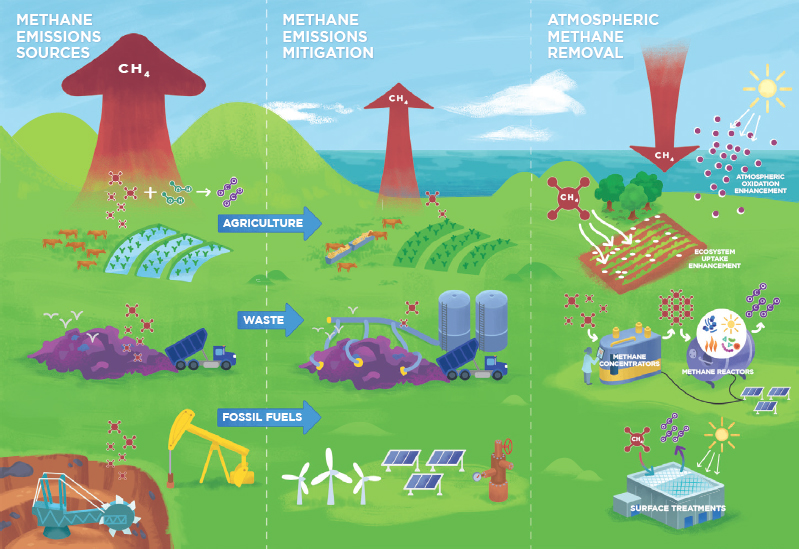
Methane is the second most important greenhouse gas (GHG) contributing to human-driven warming, behind carbon dioxide (CO2). Methane has an atmospheric lifetime of 9–12 years and is more than 80 times more potent than CO2 at trapping heat over a 20-year period, meaning that changes in atmospheric methane concentrations can impact the timing and magnitude of mid-century peak warming significantly. Together with zeroing out CO2 emissions, large reductions in methane emissions are needed to limit end-of-century warming to 1.5°C or 2°C with limited overshoot; however, global methane emissions continue to rise. Many well-established approaches reduce anthropogenic methane emissions at their source (i.e., emissions mitigation),1 and accomplishing these reductions must remain a top priority. But given the urgent need to limit both near- and long-term warming, and the many barriers to achieving needed mitigation at scale, researchers have begun to explore the concept of atmospheric methane removal (see Box S-1 and Figure S-1).
Conclusion: Together with reduced carbon dioxide emissions, rapid and sustained reductions in anthropogenic methane emissions are critical to limit warming in future decades. Atmospheric methane removal technologies, even if successfully developed, will not replace mitigation on timescales relevant to limiting peak warming this century.
In addition to GHG emissions mitigation, approaches that remove GHGs are also considered in policy planning scenarios as part of the portfolio to achieve net-zero GHG emissions. Large-scale deployment of carbon dioxide removal (CDR)—anthropogenic
___________________
1 Examples of mitigation strategies for anthropogenic methane sources include leak detection and repair (fossil fuel sector); energy recovery or collection and flaring of landfill gas (waste sector); and feed changes, supplements, and breeding for livestock (agricultural sector). Mitigation technologies are not currently available for natural methane sources (e.g., wetlands, freshwater systems, geologic sources).
BOX S-1
Key Definitions and Atmospheric Methane Removal Technologies Considered in This Report
Atmospheric methane: Methane that is in the free atmosphere (currently about 2 parts per million). Methane in the atmosphere naturally converts to carbon dioxide via oxidation and has a lifetime of 9–12 years.
Atmospheric methane removal: Human interventions to accelerate the conversion of methane in the atmosphere to a less radiatively potent form or to physically remove methane from the atmosphere and store it elsewhere. The term “atmospheric methane removal” is also used when human interventions increase the sink and decrease the net flux from ecosystems to the atmosphere, or make this flux negative.
Methane emissions mitigation: Any human intervention to reduce methane emissions at the source, typically anthropogenic in origin.
Methane reactors: Purpose-built, physically bounded systems that use the active flow of air to capture or convert methane to a different chemical species with lower atmospheric warming potential.
Methane concentrators: Materials or devices that can separate or enrich methane with some degree of selectivity relative to other atmospheric components. A methane concentrator itself may not be a stand-alone form of atmospheric methane removal but may be a core component for enabling atmospheric methane removal technologies.
Surface treatments: Application of a catalyst to a built or other surface that contacts air naturally to convert methane to a different species with lower atmospheric warming potential.
Ecosystem uptake enhancement: An amendment or practice that augments the in situ net uptake of methane by or within primarily managed ecosystems but with potential to apply to natural ecosystems.
Atmospheric oxidation enhancement: Accelerated conversion of methane via the augmented abundance or lifetime of reactive species, such as chloride or hydroxyl radicals, in the free atmosphere. This includes activity in the troposphere and stratosphere of the Earth’s atmosphere.
activities that remove CO2 from the atmosphere and reliably store CO2 in geological, terrestrial, or ocean reservoirs or products—is needed to achieve net-zero targets and limit peak warming to below 2°C.
While CDR technologies have advanced over decades, analogous removal for other GHGs has not been considered. Given the potency and short atmospheric lifetime of methane, sustained removal efforts could potentially address or offset hard-to-abate anthropogenic or natural methane emissions, for which mitigation technologies are not currently available.
Research on methane removal is just beginning. Few relevant peer-reviewed publications exist, reflecting limited research investments to date. Compared with methane
mitigation or even CDR, for which decades of research have led to technologically and economically feasible solutions (in the case of methane mitigation) and early-stage demonstrations (in the case of CDR), atmospheric methane removal is in its earliest stages of discovery; while several potential technologies exist, information is limited, and many key questions remain unanswered. At this critical moment for decision making around climate action and investment, ClimateWorks Foundation requested an authoritative study on the state of knowledge about atmospheric methane removal.
This report assesses the need and potential for atmospheric methane removal and recommends research that would improve understanding. In interpreting its task, the Committee acknowledged that atmospheric methane removal, like any climate intervention, is fundamentally a sociotechnical problem. Any technological approach under consideration will be shaped by and have consequences for human societies. A useful knowledge base must therefore consider technology and humans in concert.
WHY IS METHANE DIFFERENT FROM CARBON DIOXIDE?
While the knowledge base around CDR can be informative, unique attributes of methane and methane removal technologies make CO2 and CDR imperfect analogs. Key differences relevant to this report include the following:
- CO2 has a lifetime of hundreds to thousands of years, whereas methane is short-lived, with an average lifetime of 9–12 years. These different lifetimes and methane’s greater warming potency mean that methane and CO2 emissions or mitigation have different impacts on climate and are not directly exchangeable or fungible.
- While CO2 emissions are the major determinant of longer-term warming, methane emissions and mitigation measures will impact the timing and magnitude of peak warming significantly by mid-century.
- Methane is naturally oxidized in the atmosphere to form CO2. Atmospheric methane removal technologies would generally accelerate this process by reducing the lifetime of methane in the atmosphere.
- The main natural process that oxidizes methane in the atmosphere is reaction with the hydroxyl radical (OH). From a policy perspective, mitigating methane emissions is attractive because reducing methane emissions shortens methane’s lifetime in the atmosphere through the OH feedback.
- The concentration of methane in the atmosphere is about 200 times lower than that of CO2. For a given quantity of GHG removal, the minimum amount of air that must be processed is inversely proportional to the concentration of the GHG, holding all else constant.
- Anthropogenic methane emissions mostly come from smaller, distributed point and non-point sources. Natural methane sources (~40% of annual emissions) are also diffuse, and mitigation technologies are not currently available. Efforts to reduce methane emissions may turn out to be insufficient if natural methane-climate feedback processes (i.e., amplified natural emissions from global
- warming) accelerate; however, increases in natural emissions are not currently accounted for in emissions targets for decision making.
Climate action has many priorities, so it is necessary to consider why researchers, industry, governments, and communities would invest in atmospheric methane removal technologies. The Committee was tasked with exploring a range of use cases for research and development of atmospheric methane removal. For example, a technology gap exists in which no commercial mitigation technologies oxidize methane at concentrations below 1,000 parts per million (ppm) even though most methane emissions are found at concentrations closer to 2 ppm. Pursuing research on atmospheric methane removal would lower this threshold and expand opportunities for reducing methane emissions from more sources.
Achieving net-zero CO2 emissions is essential to stabilizing climate, but that alone may not be sufficient to limit warming to the Paris Agreement goal of “well under 2°C” with no or limited overshoot. In this context, another use case for considering atmospheric methane removal is the potential for a “gap” between the methane emissions reductions needed to meet climate goals and the technical potential for methane emissions mitigation—due in part to large and potentially growing, primarily natural methane emissions sources for which no mitigation technologies currently exist. This potential “methane emissions gap” has two components: the technical limitations for mitigation of anthropogenic methane emissions, particularly residual emissions from the agricultural sector, and anticipated increasing emissions from natural methane sources that could exacerbate the gap.
Conclusion: There will likely be a substantial methane emissions gap between the trajectory of increasing methane emissions (including from anthropogenically amplified natural emissions) and technically available mitigation measures, impeding emissions reductions needed to limit peak warming. The scale of carbon dioxide removal required to compensate for these residual methane emissions may not be feasible. Furthermore, it may not be appropriate to treat carbon dioxide and methane emissions reductions or compensatory removals as fungible, particularly for considering climate impacts in the near term.
ATMOSPHERIC METHANE REMOVAL TECHNOLOGIES
The five atmospheric methane removal technologies considered in this report are described in Box S-1. These technologies capture a comprehensive range of approaches with the potential to reach effectiveness at atmospheric concentrations of methane (2 ppm). In this report, atmospheric methane removal technologies are categorized as either partially closed or open systems.2
___________________
2 Partially closed systems—methane reactors and methane concentrators—are those bounded by physical barriers where the reactive species (e.g., catalysts) are retained inside the physical barrier, but air and energy are allowed to flow through the system. Open systems—surface treatments, ecosystem uptake enhancement, and atmospheric oxidation enhancement—are defined as those that lack a physical boundary, where reactive species or other management actions are introduced into the atmosphere or other environmental compartments.
The Committee assessed the five technology categories using limited available information against a set of criteria developed as indicators of the advancement of each toward a pathway for methane removal at atmospheric concentrations.
Table S-1 summarizes the current research status of each technology relative to 2 ppm atmospheric methane concentrations and the associated major technological challenges and opportunities. Based on the technology assessment, the Committee drew the following technology-specific conclusions:
- Methane reactors: Limited to no data are available for methane reactor design and operation at 2 ppm methane concentration. Research reactors are operating down to ~1,000 ppm methane today. The greatest barriers to making reactors climate-beneficial or cost-effective are the need to heat bulk air to temperatures notably above ambient levels and the energy required for moving air and reactor operations.
- Methane concentrators: Limited to no data are available for methane concentrators operating at 2 ppm methane concentration. The physical and chemical properties of methane do not make methane amenable to size- or chemical affinity–based separations. If a technology could efficiently concentrate methane from low (2 ppm) to modestly elevated concentrations, it could enable methane reactor technologies.
- Surface treatments: Limited to no data are available that describe the use of surface treatments for conversion of 2 ppm methane concentrations to products of low global warming potential. Surface treatment approaches are available to remove other reactive species. The most effective surface treatments would have high fluxes of air pass over the treated surfaces but would be limited in impact by the scale of surfaces coated as well as by temperature and material reactivity. Coatings would also be subject to fouling and would need to be durable to be cost-effective.
- Ecosystem uptake enhancement: Ecosystem amendments are known and available for enhancing soil services and could be promising for 2 ppm methane applications. Interventions through management practices and/or managed ecosystem amendments have been shown to reduce net methane emissions, though it is challenging to measure and attribute the change in methane uptake versus emissions to these interventions. Ecosystem amendments would likely need to be reapplied and could potentially provide co-benefits for managed ecosystems, but unintended consequences for nutrient cycling, biodiversity, ecosystem services, and other attributes are not well understood.
- Atmospheric oxidation enhancement (AOE): Limited to no data are available on the application of AOE to 2 ppm methane concentrations. Analogs to natural processes in the atmosphere could potentially be enhanced to accelerate methane oxidation. Continuous application of large quantities of AOE materials would be required for a climate-relevant impact, potentially making it resource-intensive, but this approach does not have the same energy and heating requirements as other atmospheric methane removal technologies. The potential unintended consequences of AOE approaches are substantial and not well understood.
Additionally, the Committee drew the following conclusions that are relevant to multiple technologies:
- Technology readiness levels (TRLs): The TRLs of methane reactors and ecosystem uptake enhancement are currently the highest of the categories evaluated, although both are assessed at a TRL of 4 (out of 9) at the most. This level reflects that the technology components have been tested in laboratory and field experiments. Reflecting a lack of research to date, surface treatments and AOE have TRLs between 2 and 3, and methane concentrators have a TRL of 1. Accordingly, all technologies are still firmly in the research and development stages.
- Unintended consequences: The unintended consequences of atmospheric methane removal technologies—particularly the production of non-target gases in open system technologies—may be significant. Information and research capabilities are insufficient to assess these potential unintended consequences fully.
CROSSCUTTING CONSIDERATIONS FOR RESEARCH AND DEVELOPMENT OF ATMOSPHERIC METHANE REMOVAL TECHNOLOGIES
The Committee also considered issues cutting across all technology categories and drew the following overarching conclusions:
- Governance: Governance proposals for analog technologies are plentiful and could inform the development of research governance structures for atmospheric methane removal technologies, particularly open system technologies. Although empirical testing of proposed structures is only beginning, their design is based on governance theory. This theory has limitations but has provided a foundation for governance design for decades.
-
Public engagement: Large uncertainties remain about the potential social impacts of all atmospheric methane removal technologies, and little is known about what perspectives will begin to emerge among the public. In line with recommendations from social science research, public engagement will be critical to informing decision making on technological development and/or deployment.
- Drawing on lessons from other climate intervention technologies, early and broad public engagement would help shape research and research governance in the public interest and ameliorate negative consequences. Recent experience with proposed experiments suggests that a lack of engagement can contribute to the cancellation of potentially valuable experiments.
- Engagement with relevant parties and communities will be important for all atmospheric methane removal technologies, especially open system technologies, prior to consideration of deployment and in tandem with ongoing small-scale research.
TABLE S-1 Summary of the State of Atmospheric Methane Removal Technology Research Relative to 2 Parts Per Million (ppm) Atmospheric Methane Concentrations
| Technology | Technically Feasible at ~1,000 ppm Today? | Technically Feasible at 2 ppm Today? | Technically Feasible Path to Working at 2 ppm, without Technological Breakthroughs? | Potential Technical Challenges | Potential Acceptability Challenges | Potential Technological Opportunities |
|---|---|---|---|---|---|---|
| Methane Reactors | Yes, technologies in use | No known technology | Technological breakthrough needed (due to energy use and volume of air requirements) | Energy use, volume of air, and critical materials requirements | Potential land use disruptions (depending on scale of operation) and emissions from added energy and manufacturing needs | Novel materials and novel adsorption systems design; coupling with other forced-air systems could reduce energy needs |
| Methane Concentratorsa | Likely, but no known technology | No known technology | Technological breakthrough needed (due to methane’s physicochemical properties) | Identification of suitable materials, energy use requirements, and physicochemical properties of methane | Impacts of needed manufacturing and siting new infrastructure | Novel materials and novel adsorption systems design; potential to couple with other forced-air systems and/or methane reactors |
| Surface Treatments | Likely, but no technology in use | No known technology | Technological breakthrough needed (due to low temperature and low reactivity) | Large surface area requirements and durability | Possible by-products produced from removal process; impacts and exposures from energy and upstream material production and infrastructure implementation | Could enhance structure durability and provide local air quality benefits (with appropriate coating design) |
| Ecosystem Uptake Enhancement | Existing process, but no enhancement technology in use | Existing process, but no known enhancement technology in use | Likely | Potential reapplication needs, interactions with ecosystems, and unintended consequences for nutrient cycling and biodiversity | Connection with open natural systems may present significant environmental impacts (unintended consequences) and public contestation | Connection primarily with managed systems could provide potentially measurable co-benefits |
| Atmospheric Oxidation Enhancement | Existing process, but no enhancement technology in use | Existing process, but no known enhancement technology in use | Likely, but with large uncertainties | Large threshold for required material to be added to the atmosphere; continuous materials supply needed | Applications in the atmosphere may present significant environmental impacts (unintended consequences), both locally and globally, and public contestation | Could enhance atmospheric sink, which reduces impacts of fugitive hydrogen emissions |
a A methane concentrator itself may not be a stand-alone form of atmospheric methane removal but may be a core component for enabling atmospheric methane removal technologies.
- Legal and regulatory frameworks: To the Committee’s knowledge, no specific legal frameworks are directed at governing atmospheric methane removal. Atmospheric methane removal may be subject to a variety of existing international agreements or domestic laws based on the activities involved and/or their collateral environmental or other impacts.
- Monitoring, reporting, and verification (MRV): Researchers lack tools and/or capabilities that are affordable, accurate, precise, portable, and otherwise robust for field-scale application of monitoring, reporting, and verifying the impacts of open system atmospheric methane removal technologies. More tools are available for MRV of partially closed system technologies, although they are currently expensive and have limited scalability.
- Market-based mechanisms: At present, offset markets are used to scale carbon removals and methane mitigation. If atmospheric methane removal technologies were to enter offset markets, additional fundamental policy research and MRV requirements would be essential to ensure that they would contribute to additive reductions in atmospheric methane concentrations.
- Cost targets: Atmospheric methane removal technologies could plausibly be cost-competitive with some methane emissions mitigation approaches if the atmospheric methane removal cost levels and growth rates reach those seen by analogous technologies, such as CDR (which are in early stages of commercial-scale demonstration). Importantly, methane emissions mitigation remains the most cost-effective means of addressing the growing concentrations of atmospheric methane.
- Consequences for atmospheric composition: At climate-relevant scales, atmospheric methane removal technologies are certain to impact the chemical composition of the atmosphere beyond methane concentrations. Partially closed system technologies would be relatively easier to monitor for unintended consequences, whereas open system technologies will result in a larger range of potential consequences.
RESEARCH AGENDA AND RECOMMENDATION
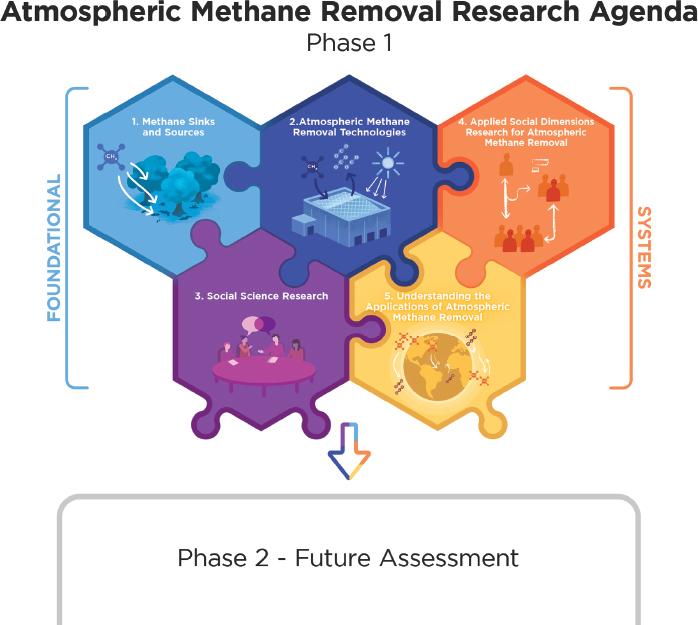
The Committee underscores that atmospheric methane removal is an emerging area of research. Having assessed the currently available information in this report, the Committee recommends that assessing the potential for atmospheric methane removal requires a two-phase approach (see Figure S-2). In this first-phase report, the Committee has identified priority research questions that should be addressed within 3–5 years. With the results from this research, a second-phase assessment could more robustly assess the viability of technologies to remove atmospheric methane at 2 ppm—from the perspective of technical, economic, and broader social viability, and the potential for climate-scale impacts. Advances in the recommended research areas and a second-phase assessment would inform any decision to move from knowledge discovery into more targeted investment in additional research, development, and/or deployment. They would also inform possible off-ramps for technologies not meeting performance and/or
acceptability criteria. It is beyond this Committee’s purview to specify the mechanism, process, or outcomes of any future phase-two assessment.
Recommendation: A two-phase assessment of the need and potential for atmospheric methane removal is needed.
- This report represents phase one, in which the Committee has developed recommendations for priority foundational and systems research across five areas that should be initiated in parallel within 1 year of publication.
- The research in phase one should be completed or significantly advanced to inform a phase-two assessment within 3–5 years of this report.
- In both phases, the research should be transdisciplinary and pursued as convergence research with deep disciplinary integration among research teams in early stages of inquiry to maximize learning across diverse fields.
The research agenda is organized into foundational and systems research needs. The foundational research questions seek to fill knowledge gaps in basic understanding of atmospheric and ecosystem methane sinks, atmospheric methane removal technologies, and social dimensions of how publics and society would interact with research on atmospheric methane removal. The recommended foundational research not only would advance understanding of atmospheric methane removal but also would be an investment in filling knowledge gaps in other related fields, representing a cost-effective use of limited resources for research. The systems questions seek to address what developing and/or deploying atmospheric methane removal at scale would entail from technological and social perspectives. These foundational and systems research questions should be pursued in parallel to enable an informed phase-two assessment; this report prioritizes the questions that would be most useful to answer before a second-phase assessment.
In both phases, the recommended research areas should be integrative and transdisciplinary. The Committee recommends that research on atmospheric methane removal be funded through a convergent approach to maximize learning between, for example, social and biophysical sciences, and ensure that the outputs of the research do not remain siloed but are used and integrated by people from diverse fields.
The Committee suggests that a reasonable initial investment in basic science that would help society understand the prospects of atmospheric methane removal is in the range of $50 million–80 million per year over 3–5 years. A research program of this size would advance the five research areas recommended to inform a phase-two assessment.
Below, the Committee summarizes the five research areas around which the recommended research questions are organized.
Research Area 1: Methane Sinks and Sources
Research on atmospheric and ecosystem methane sinks (and to a lesser extent methane sources) is needed to better understand the potential to enhance natural sinks for atmospheric methane removal, determine removal scales required for climate impacts, and enable MRV of atmospheric methane removal technologies. Research Area 1 includes the following sub-areas:
- Atmospheric methane sinks: New methods for monitoring the oxidative capacity of the atmosphere are needed to understand the potential for and consequences of any atmospheric methane removal technology.
- Methane sinks in managed ecosystems: There are basic gaps in the understanding of methanotrophy in different global ecosystems (e.g., rice paddies) and the potential for different management and/or amendment practices to impact methane fluxes, with implications for the potential and efficacy of ecosystem uptake enhancement.
- Natural methane sources: Natural methane sources are a large contributor to the global methane budget, are the most uncertain, and are expected to increase
- in response to climate change; however, approaches to mitigate these emissions are not available. Research is needed to reduce the uncertainties in current and projected changes in global methane emissions from natural sources to inform potential applications of atmospheric methane removal technologies.
- Anthropogenic methane sources: While anthropogenic methane sources are relatively well characterized, targeted research on hard-to-abate anthropogenic sources that are diffuse and/or have limited or no mitigation options available would inform potential applications of atmospheric methane removal technologies.
Research Area 2: Atmospheric Methane Removal Technologies
The knowledge base for atmospheric methane removal technologies—particularly their application and efficacy for atmospheric methane (2 ppm)—is very limited. Foundational research is needed on their technical potential and to inform each of the other recommended research areas. Research Area 2 identifies research needs for each technology:
- Methane reactors: Reactor feasibility is limited by high energy use and volume of air requirements. Research is recommended that could increase reactor efficiency and performance or reveal technical limitations that would hinder reactor viability.
- Methane concentrators: More efficient methane sorbing materials and concentrating devices would enable subsequent downstream technologies for efficiently combusting or converting methane. Research is recommended for materials selection and efficiency challenges that currently hamper viability.
- Surface treatments: Research on rates of methane destruction under relevant reaction conditions is needed for potentially viable materials. Recommended research could lead to possible improvements in catalytic performance, reaction rates, and materials to address surface area and durability needs.
- Ecosystem uptake enhancement: Research on limits to atmospheric methane uptake by different microbial communities is needed. Recommended research would improve understanding of the durability and scalability of amendments and their impacts on ecosystems.
- Atmospheric oxidation enhancement: Research is recommended to improve understanding of the effects of AOE on methane’s lifetime and atmospheric composition. Research is also needed on the scale and duration of material that would need to be added to the atmosphere to attain sustained climate-scale impacts.
Based on the technology assessment and research needs identified above, the Committee drew the following conclusions:
Conclusion: Currently available mitigation technologies that oxidize methane have a lower operational limit of ~1,000 parts per million (ppm). Pursuing research on methane removal at 2 ppm atmospheric methane concentrations would help lower this concentration limit as technologies are developed.
Conclusion: All research questions identified in Research Area 2 can be assessed without requiring deployment of atmospheric methane removal technologies. Technology research may require thoughtful demonstration efforts coupled with robust monitoring, reporting, and verification tools and structured means for public engagement.
Research Area 3: Social Science Research
Scientifically promising research can be slowed or forestalled by publics who appraise research as risky or harmful. Foundational knowledge is lacking across social and policy dimensions, inhibiting understanding of how research on atmospheric methane removal would affect and be affected by different publics. Research Area 3 includes the following sub-areas:
- Engagement: Research is needed to understand the ways in which engagement efforts affect the process of scientific research and to help scientists use the process of engagement to inform research and policy design.
- Social perspectives and understanding: Social science research can identify factors that shape human perspectives on atmospheric methane removal. Research to understand these perspectives is needed for designing engagement materials, effectively communicating about atmospheric methane removal, and incorporating social perspectives into research and potential deployment.
- Social and environmental implications of policy choices: The social and environmental impacts of using market mechanisms to scale GHG removal approaches, especially for technologies such as atmospheric methane removal at early TRLs, are uncertain. Research is needed on the efficacy of GHG markets to reduce emissions, the co-benefits and harms of GHG markets across geographic scales, and approaches to compare the relative value of carbon and methane action in decision making.
Research Area 4: Applied Social Dimensions Research for Atmospheric Methane Removal
A body of systems research that lays out the frameworks and capacities to move forward will be needed should atmospheric methane removal technologies be developed and/or deployed. Research Area 4 prioritizes social-, justice-, and governance-related questions that would affect potential applications of atmospheric methane removal technologies. It would be informed by Research Area 3. Research Area 4 includes the following sub-areas:
- Social and justice considerations: Research on the relevant social and justice considerations for each atmospheric methane removal technology is necessary to assess whether and how to develop and/or deploy these technologies and to inform choices in research program design. Furthermore, research is needed to understand how these considerations are perceived by those most impacted by climate change and environmental injustice.
- Governance: Establishing early governance of atmospheric methane removal research will be an important tool to foster and facilitate research that enhances benefits, ameliorates costs, and deliberately distributes benefits across populations. Research is needed to map potential atmospheric methane removal–specific risks and benefits and institutional capacities and interests to determine where existing institutions and governance models can be used and if and where any new systems must be developed.
Research Area 5: Understanding the Applications of Atmospheric Methane Removal
Atmospheric methane removal technologies, if developed and/or deployed, would be introduced into a changing climate system with dynamic climate responses. Understanding how atmospheric methane removal technologies would complement, compete against, or interact with other climate responses would inform their optimal potential use. Research Area 5 includes the following sub-areas:
- Optimal systems and tools for potential demonstration and deployment: Research on systems-level considerations to determine optimal systems for demonstration and deployment would reveal areas of opportunity or nontechnological barriers that may limit a technology’s technical efficacy. Research to adapt analytical tools, informed by outputs of Research Area 2, would also inform future decision making on potential demonstration and/or deployment.
- Assessment of synergies and interactions with climate response strategies: Research is needed to assess potential synergistic and antagonistic interactions between atmospheric methane removal technologies and alternative mitigation systems and emerging energy technologies.
It is critical that research in this emergent space be conducted responsibly. The vision behind responsible research and innovation is that research is a transparent, interactive process through which society and researchers are mutually responsive to each other, making sure that science reflects social values. Responsible research and innovation involve democratizing intent and making the research process anticipatory and inclusive. Operationalizing these ideals for research on atmospheric methane removal could include a code of conduct for researchers, a register of research activities to promote transparency, and public deliberation on the formation of potential further phases of research. Additionally, creating transparent funding streams and maximiz-
ing publicly funded research can help build credibility and legitimacy and ensure that publicly interested research remains in the public interest.
The nascent stage of atmospheric methane removal research limited this Committee’s ability to consider the full technical potential for atmospheric methane removal technologies and the complete set of physical and social consequences of their development and/or deployment. The research agenda outlined above represents the Committee’s vision for priority foundational and systems research across five areas that should commence, with urgency, within 1 year of this report’s publication. Within 3–5 years, the Committee recommends a phase-two assessment to revisit the need and potential for atmospheric methane removal based on the knowledge gained through research identified in phase one. The need for additional future assessments could be determined as a function of the evolving state of knowledge and social context.


