Tipping Points, Cascading Impacts, and Interacting Risks in the Earth System: Proceedings of a Workshop (2024)
Chapter: 1 Introduction
1
Introduction
Earth is a complex system, with myriad interactions and feedbacks among the atmosphere, hydrosphere, geosphere, cryosphere, and biosphere, as well as the people, institutions, and technologies that respond to and influence these dynamics. Many pressing societal concerns involve processes that interact in dynamic and often nonlinear ways. A systems-based approach to scientific research can yield understanding across all aspects of Earth’s interconnected processes. Earth systems studies rest on careful analyses of physical, chemical, biological, and behavioral processes and their interactions and feedbacks; these studies are supported by observational platforms, laboratory and modeling facilities, a skilled scientific workforce, and the cyberinfrastructure that connects them to enable new breakthroughs.
In September 2021, the National Academies released the consensus study report, Next Generation Earth Systems Science at the National Science Foundation (NASEM, 2022), which identified key characteristics for next generation Earth systems science. To continue a robust post-release engagement aligned with the overall study’s goals, this workshop was organized to explore the approaches to Earth systems science through the lens of a critical topic—tipping points—and to cultivate cross-disciplinary collaborations and prime new research communities to discuss examples of research needs in a broader context of Earth systems science. This rich topic emphasizes the importance of research on complex interconnections and feedbacks between natural and social processes, and illuminates how the next generation of Earth systems science can help develop different pathways to address the challenges society faces.
Here, tipping points refers to the concept that climate change could drive elements of Earth’s environment past a threshold, leading to abrupt, irreversible shifts with dangerous consequences. The risks of tipping points in important aspects and processes in the physical and ecological systems have long been explored, including those related to runaway loss of polar ice sheets and resulting sea level rise; rapid release of greenhouse gases from thawing permafrost; major disruptions to ocean circulation and dynamics; and rapid drying of forest ecosystems that alters regional hydrology, fire regimes, and carbon sources/sinks. Recent interest in the concept of “social tipping points” has emerged, where major societal stresses such as food, energy, or water shortages, devastation from extreme weather, or pandemics and other health risks can accumulate to a point that society is pushed into radically new dynamics (e.g., conflict, mass migration, major demographic shifts), and adds a layer of interconnectedness and complexity.
Tipping points can only be fully understood when their connections to related cascading impacts and interacting risks are known. Cascading impacts are a sequence of events where abrupt changes in one component lead to abrupt changes in other components. Interacting risks are best conceptualized as tipping elements whose interaction on a global scale could have stabilizing or destabilizing effects, thereby increasing or decreasing the probability of cascading impacts.
To address these challenges, this workshop convened experts across social, natural, computational, and engineering sciences to engage in transdisciplinary dialogues about advancing understanding, prediction, and preparation for tipping points, cascading impacts, and interacting risks in the Earth system—drawing connections to the research insights conveyed in the Next Generation Earth Systems Science at the National Science Foundation (NASEM, 2022) report.
WORKSHOP DESCRIPTION
The National Academies of Sciences, Engineering, and Medicine convened a workshop on January 17–19, 2023, in Washington, DC, and online, to consider the state of understanding and integrated approaches for climate tipping points, cascading impacts, and interacting risks in the Earth system. A planning committee was chosen to plan the workshop.1
The workshop focused on applying Earth systems science approaches to explore understanding, prediction, and preparation for both environmental and social tipping points in the Earth system and to foster connections among the transdisciplinary research community. The workshop explored historical examples of past biogeophysical and social tipping points and a range of regional U.S. perspectives on climate tipping points and cascading impacts through a mix of presentations, panel discussions, and interactive breakout sessions. Finally, the workshop culminated with group and breakout discussions, during which workshop participants focused on discussing aims and opportunities for interdisciplinary research. See Appendix A for the workshop agenda, Appendix B for the Statement of Task, and Appendix C for Planning Committee biographies.
WELCOME FROM THE NATIONAL SCIENCE FOUNDATION
The workshop opened with brief welcomes from sponsors Dr. Anjuli Bamzai and Dr. Candace Major from the National Science Foundation (NSF). They noted the importance of the consensus study that produced Next Generation Earth Systems Science at the National Science Foundation (NASEM, 2022) and this workshop in gathering
___________________
1 These proceedings have been prepared by the workshop rapporteur as a factual summary of what occurred at the workshop. The planning committee’s role was limited to planning and convening the workshop. The views contained in the proceedings are those of individual workshop participants and do not necessarily represent the views of all workshop participants, the planning committee, or the National Academies of Sciences, Engineering, and Medicine.
community input on emerging research questions that have significant societal implications in order to inform the work of NSF, particularly its geosciences directorates.
BACKGROUND AND MOTIVATION FOR WORKSHOP
Following the welcome from NSF, the workshop planning committee chair, Dr. Kristen St. John, James Madison University, introduced workshop goals and results from an informal pre-workshop poll. She then reviewed the study premise, vision, and key characteristics and recommendations from the report to connect to the workshop framing. St. John explained that the study called for an integrated approach between natural and social sciences and processes to understand the Earth’s systems and capacity for sustaining life now and in the future, and as such, that this was also a key component of the workshop. St. John then presented the six key characteristics of an integrated approach to next generation Earth systems science, as identified in the report, which are to:
- Advance both curiosity-driven and use-inspired basic research on the Earth’s systems across spatial, temporal, and social organization scales.
- Facilitate convergence of social, natural, computational, and engineering sciences to advance science and inform solutions to Earth systems–related problems.
- Ensure diverse, inclusive, equitable, and just approaches to Earth systems science.
- Prioritize engagement and partnerships with diverse stakeholders to benefit society and address Earth systems–related problems at community, state, national, and international scales.
- Use observational, computational, and modeling capabilities synergistically to accelerate discovery and convergence.
- Educate and support a workforce with the skills and knowledge to effectively identify, conduct, and communicate Earth systems science.
She drew connections between these characteristics and the framing and guiding questions of the workshop, including advancing curiosity- and use-inspired research across a range of scales; facilitating convergence across a wide range of disciplines; and ensuring diversity, inclusivity, and equity are incorporated into Earth systems science research approaches and outcomes. Particularly, she noted, this workshop topic on tipping points, cascading impacts, and interacting risks in the Earth system benefits from including broad transdisciplinary2 perspectives to address contemporary societal challenges through open exchanges of information, and shared learning, as described in the consensus study report.
___________________
2 As defined in Next Generation of Earth System Science at the National Science Foundation (NASEM, 2022), transdisciplinary research transcends disciplinary approaches to create a new framework and approach fostering collaboration among researchers and communities across a range of disciplines to address shared societal needs and challenges.
St. John guided the participants deeper into the workshop tasks, explaining that in addition to incorporating the report’s key characteristics, the committee was tasked to apply Earth systems science approaches to explore understanding, prediction, and preparation for Earth system tipping points, and to support cultivating connections among transdisciplinary research communities to address questions and brainstorm potential opportunities, barriers, and strategies. She noted that this workshop fits best into the first two of the four phases of the Hall model of transdisciplinary team-based research, which are developmental, conceptual, implementation, and translational (Hall et al., 2012). This workshop has a goal of understanding tipping points with a team-type of a community or network of experts from a range of disciplines and a process of working toward a shared goal on the workshop topic. To foster completion of these phases and bridge-building across the broad range of disciplines, she emphasized the workshop would encourage idea sharing on these key themes through a combination of plenary and interactive breakout sessions.
St. John then briefly reviewed the workshop agenda, which included an overview on tipping points; historical analyses and perspectives on tipping points, cascading effects, and interacting risks over different time periods and regions; and discussions of opportunities and research questions for transdisciplinary research. She discussed the results from an informal, three-question, pre-workshop poll, which informed development of workshop content and structure. The first question asked poll participants to “briefly summarize what tipping points in the Earth’s system mean to you.” The results, St. John explained, revealed two types of responses. The first theme considered tipping points to be more technically defined as something with rapid nonlinear changes to a different state that is often irreversible. The second theme defined tipping points around looser narratives regarding impacts, e.g., social or economic, resulting from crossing tipping points, such as the destabilization of Earth system components like ecosystems, and the resulting detrimental implications to human civilization. The second question asked poll participants “What are key outstanding research questions on natural (physical, chemical, biological, and social) tipping points, their interacting risks, and their cascading impacts?” St. John noted that five main topics arose from the responses:
- Conflict and social response
- Better evidence, reduced uncertainty, and model improvements and related early warning systems
- Policy responses, institutional responses, and resiliency management
- Interconnections between tipping points
- Communicating the issues
St. John summarized the results of the third poll question—“What are the major barriers and opportunities to accelerate progress to advance these areas of research?” Barriers identified by workshop poll participants listed data availability, particularly for social data; missing processes due to limited model resolution and system complexity; and challenges
to performing interdisciplinary3 research as barriers. Opportunities lay in integration of models, access to big data and improved Earth observations, and cultivation of interdisciplinary connections. St. John noted that data and interdisciplinary research spanned both barriers and opportunities.
St. John then described how the poll participants ranked topics of interest under three categories: (1) research topics, (2) geographic U.S. regions, and (3) strategies for moving forward—which helped the committee select topics and structure the workshop. She concluded her introduction by emphasizing the importance of developing strategies to research tipping points that support inclusive and equitable participation and engagement. St. John noted that, in alignment with this aim, the workshop and poll participants are experts and stakeholders across a range of disciplines (e.g., natural science, social science, and other technical fields), organizations, and career stages.
OVERVIEW ON TIPPING POINTS AND EXPERT RESPONSE
Workshop committee member Dr. Tim Lenton, University of Exeter, provided a deeper overview of tipping points. This overview was followed by two expert responses, with perspectives on climate tipping points provided by Dr. Jeffrey N. Rubin and Dr. Robert Kopp, Rutgers University.
Tipping Points Overview
Dr. Lenton began his introduction with a description of a simple model of a system with two alternative stable states. The system starts in one stable state, and the model allows for variations. With time, as one state becomes less stable, the model forces the system past a tipping point, where reinforcing feedbacks take over and lead to self-propelling, irreversible change to the other state. Lenton noted that lower stability amplifies the effects of the same amount of variance of the system, which could trigger early warning signals for tipping points through changes in the system autocorrelation.
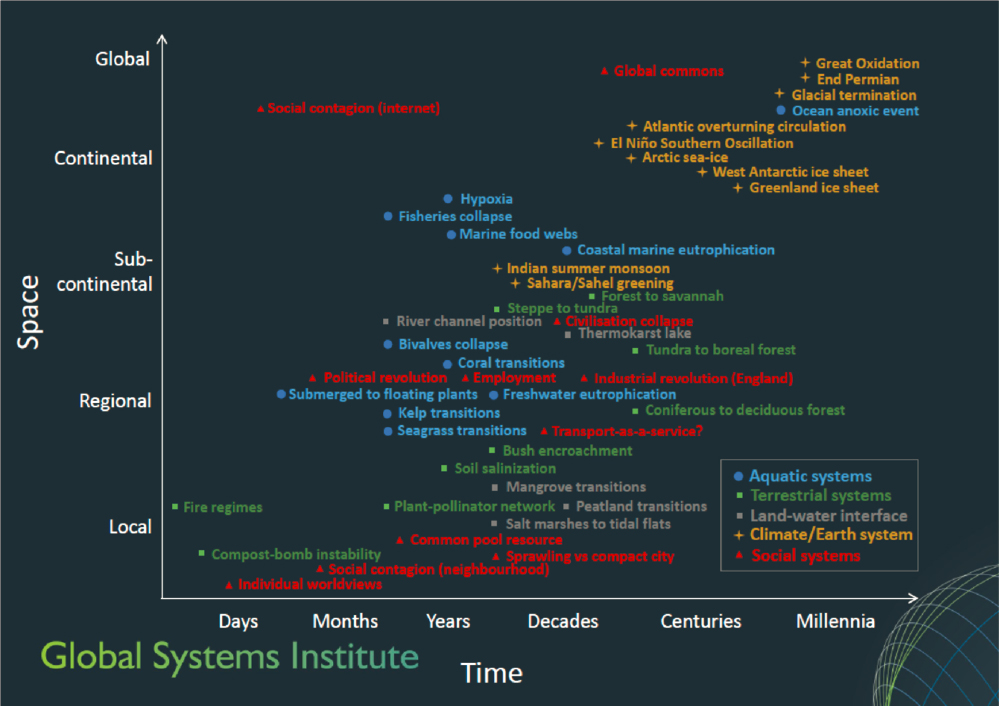
Lenton described how tipping points exist across the entire range of scales, from Earth, to climate, and to ecological systems, and can be positive,4 negative,5 or somewhere in between. Using a schematic of examples plotted against spatial scale and timescale (Figure 1-1), Lenton provided several examples of tipping points from Earth’s history (Lenton, 2020). Hundreds to tens of millions of years ago, profound global tipping point
___________________
3 As defined in Next Generation of Earth System Science at the National Science Foundation (NASEM, 2022), interdisciplinary research integrates information, data, techniques, tools, perspectives, concepts, and/or theories from two or more disciplines focused on a complex question, problem, topic, or theme.
4 Lenton defines a positive tipping point as one that increases sustainability and social justice, such as a tipping point leading to a significant reduction in cumulative greenhouse gas emissions.
5 Lenton defines a negative tipping point as one that leads to net harm to a significant number of people, noting that most climate tipping points are negative.
SOURCE: Lenton (2020).
events occurred, such as the Great Oxidation Event, when the Earth’s atmosphere abruptly and irreversibly switched from anoxic to oxidizing. Over this timescale and up to more recent events (within the past few millions of years), Lenton explained that the Earth oscillated between various global climate states, sometimes with abrupt climate change transitions in between, as evidenced by temperature proxy records within Greenland ice cores. Lenton explained that these abrupt climate changes have global effects throughout both hemispheres, with past changes correlating to the rise and fall of past civilizations through the abrupt switching on and off of the tropical monsoon systems.
Lenton described a recent study (Armstrong McKay et al., 2022) that synthesized around 230 studies on tipping points to identify tipping elements, defined as parts of the climate system that could be tipped within this century. He explained that the researchers categorized the tipping elements into (1) global core climate tipping elements (examples in Figure 1-2a), tipping elements that when tipped would be felt throughout the entire climate system, and (2) regional impact tipping elements (examples in Figure 1-2b), which when tipped may not be felt in the whole climate system but could still have significant regional impacts. These tipping elements were spatially identified over particular regions that display evidence of being tipped and experiencing abrupt shifts in the past. Furthermore, Lenton explained that by using observational data, model projections, and offline models, the researchers found that several of these abrupt shifts of the tipping elements occur at relatively low levels of global warming above pre-industrial conditions.

SOURCE: Armstrong McKay et al. (2022).
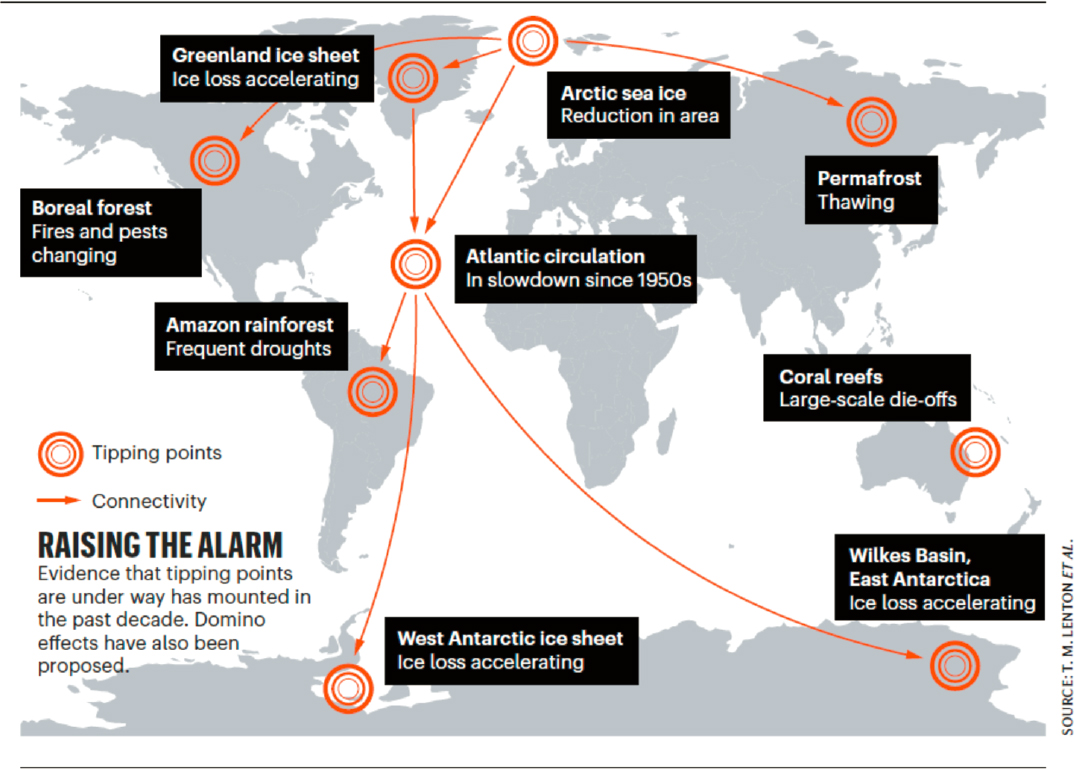
Lenton provided an example of a tipping point that occurs within a model, where 2°C of global mean warming results in a tipping point that connects large changes across Antarctic ice sheet loss, Arctic sea ice loss, changes in the Atlantic overturning circulation, and droughts in the Amazon. Changes in the mean state of systems and more persistent and larger amplitude fluctuations in the system can provide insights and early warning signs into where and when tipping points are being approached. After surveying the studies, Armstrong McKay et al. (2022) identified five systems that are potentially at risk of tipping at the current level of approximately 1.2°C global warming: Labrador Sea subpolar gyre,
Greenland ice sheet, West Antarctic ice sheet, low-latitude coral reefs, and portions of the boreal permafrost. Lenton explained that each of the five systems has its own characteristic timescale over which the tipping is expected to unfold. Lenton warned that under current policy, society may continue to expect global warming to reach levels of 2.7°C, which may place approximately 13 of McKay et al.’s identified tipping elements at risk. Furthermore, Lenton noted that because of the interconnected nature of the Earth system, the occurrence of one tipping point may increase the likelihood of another tipping point occurring, creating cascading effects (Figure 1-3).
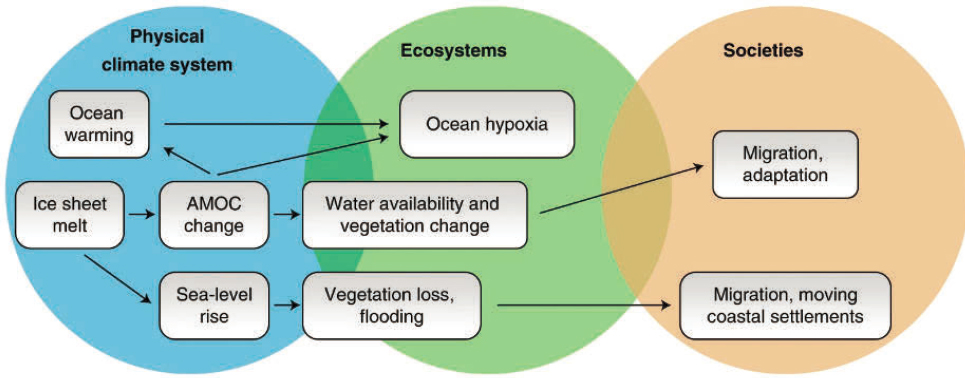
Dr. Lenton next drew attention to the relative scarcity of research focused on the impacts of passing tipping points. Using the example of collapse of the Atlantic Meridional Overturning Circulation (AMOC) with 2.5°C global warming, Lenton noted that this tipping point would result in severe global temperature and precipitation changes that would impact regional and global agriculture and water resources, which may have additive and/or multiplicative implications worldwide (Figure 1-4). Lenton emphasized that climate tipping points may likely interact with tipping points on other scales of system, resulting in cascading tipping points across and between the climate, ecological, and social systems.
SOURCE: Lenton et al. (2019).
SOURCE: Brovkin et al. (2021).
Lenton concluded his presentation by looking forward, noting that transdisciplinary work is still needed to better understand the implications of fundamental tipping points within the climate and environment on tipping points in other scales of systems. Lenton noted that 1.5°C of global warming can potentially trigger several climate tipping points, which have early warning signs that have been observed recently. He underscored that these climate tipping points will add to the effects of global warming, potentially resulting in existential risks. Lenton stressed the need for more work to understand fundamental aspects of tipping points to better assess and address their associated risks across scales and systems.
Expert Response on Local-Level Adaptation Actions
Dr. Jeffrey Rubin followed Lenton’s overview with an expert response. Relating to the potential impacts of climate change and tipping points, he emphasized the need to consider the local level when addressing the effects of climate change, especially in terms of adaptation actions. Rubin noted that the concept of the “inverse care law” is useful when considering choices for effective adaptation. The inverse care law highlights that critical services such as medical care, social services, and other basic needs tend to be less accessible to populations most in need of them (Hart, 1971).
Rubin discussed four examples of local adaptation choices in the United States and their unique challenges:
- Managed retreat strategies in New Jersey and accommodation approaches in New York City following Hurricane Sandy.
- Puerto Rico’s adaptation actions to address environmental challenges despite limited resources.
- Large-scale managed retreat efforts and the related social and political challenges experienced in the U.S. Gulf Coast region, including Texas, Louisiana, and Florida.
- Oregon’s response and recovery from the wildfires in 2020, which had a disproportionate and lasting impact on vulnerable communities, such as through the destruction of affordable housing.
To conclude, Rubin underlined the importance of focusing on society’s most vulnerable populations in local climate change adaptation efforts, where the challenges and nature are inherently complex, multifaceted, long-term, and expensive. Rubin urged scientists to address the needs of those who are least able to independently navigate these issues.
Expert Response on the Use of “Tipping Points” and Relevance to Policy
Next, Dr. Robert Kopp, Rutgers University, provided an alternate perspective on the concept of tipping points in climate science. Acknowledging the fundamental impact of Lenton’s and other’s climate tipping points work on scientific understanding of the Earth system, Kopp noted that the term tipping points was initially a metaphor borrowed from sociological work, primarily adopted into the climate literature for communication purposes. First used academically in the 1950s in sociological literature on housing segregation, the term was especially popularized by Malcolm Gladwell in The Tipping Point: How Little Things Can Make a Big Difference in the late 1990s (Gladwell, 2000). Kopp pondered whether the term brings more clarity or confusion when communicating with the broader public on societally relevant climate risks. Elaborating on this point, he posited that the framing of tipping points might be influenced by communication choices rather than the science itself.
Kopp expressed skepticism about the effects of tipping points discourse on public understanding and referred to limited literature attempting to investigate empirically the effects of “tipping points” on this discourse. He cited a recent study that found that nonlinear portrayals of climate risk, such as those invoked by using the term tipping points, may not significantly impact perceptions of the potential for climate catastrophes or the controllability of consequences (Formanski et al., 2022).
Furthermore, Kopp questioned the relevance of global-scale climate tipping points for mitigation policies and local adaptation decisions, and whether they should have a substantial impact on these policies and decisions, as opposed to considering regional ecosystems. He emphasized the broad uncertainty surrounding global-scale climate tipping points and suggested that, although useful because of differences in spatial and timescales, study of the integrated Earth system may not directly influence the mitigation strategies happening now.
Kopp reiterated that despite his skepticism, he still believes that studying large-scale climate tipping points and their potential impacts are important but urged awareness of the communicative effects of the “tipping point” metaphor. He suggested that the tipping points analogy may be better suited for deliberations about how changes in the Earth system may affect human systems. As such, Kopp proposed that a focus on the interaction between the Earth system and human systems, including social tipping points, might be more urgent and relevant for mitigation and adaptation decision making. He added that
abrupt nonlinear changes in social systems can occur with or without necessary reliance on physical tipping points in the Earth system and climate. To conclude, Kopp argued for a critical examination of the term tipping points and suggested that understanding the linear and nonlinear relationships between climate changes and human system responses and how those responses interact should be a research priority for informing mitigation and adaptation strategies.
MODERATED Q&A DISCUSSION WITH EXPERT SPEAKERS
Following the presentations, Kopp, Lenton, and Rubin took questions from workshop participants. The next sections recount some of the key themes that emerged from the discussion.
Preventing Negative Tipping Points versus Achieving Positive Tipping Points
Regarding the feasibility of preventing negative tipping points and potentially achieving positive tipping points, Lenton emphasized the importance of studying positive tipping points. He defined these as self-reinforcing, self-propelling changes, such as transitions to renewable energy, because they provide an empowering sense of agency in addressing climate change. After reiterating his consideration of tipping points for social systems, Kopp agreed with Lenton regarding the potential to achieve positive tipping points and the benefits of framing environmental governance using this concept. Kopp further suggested that prevention of negative tipping points and achievement of positive ones are interconnected and that catalyzing positive societal tipping points is perhaps a prerequisite for preventing negative Earth system tipping points.
Study of Past Global Warming Events
When asked about the importance of studying historical global warming events to understand the potential for future tipping points, Lenton noted the usefulness of studying past events such as the Paleocene-Eocene Thermal Maximum to understand potential feedback processes and the fundamental and nonlinear aspects of the behavior of Earth’s system. Lenton cautioned, however, that scientists should be careful about carrying insights about past events to the present, because the background climates for these events were drastically different. Kopp added that the paleorecord of these past global warming events serves as a source for natural experiments that take the climate system out of its current state to test and improve climate models.
Timescales of Societal System versus Earth System Tipping Points
All three speakers agreed that societal tipping points generally happen more rapidly than Earth system tipping points, although sometimes they may overlap. Lenton and Kopp noted examples, such as social systems, population growth, resource use, technological
advancement and adoption, and land use change, that may exhibit tipping behavior on faster timescales. Rubin stressed the challenges of framing the geological timescales of Earth system tipping points for policy and decision-making, which generally focus on timescales on the order of 10 years. Kopp added that given the drastic difference in timescales associated with social versus Earth system tipping points and the relevant decadal timescale for policymakers, he would prioritize exploration of how society will respond to more frequent and longer compound extremes over the next couple of decades.
Completeness of and Potential Geographic Biases in Current Understanding of Physical Tipping Points
Lenton expressed that current understanding of physical tipping points is likely below 50% and emphasized that there are many remaining known unknowns and unknown unknowns. He noted a likely clustering of understanding around the North Atlantic region, because it is a key part of the Earth system dynamics involved in past tipping points, leading to a potential bias toward this research topic and region. Lenton emphasized that physical understanding of climate tipping points is one of many important aspects of a well-rounded climate risk assessment. Other aspects have received less attention, such as potential impacts, vulnerability, and insights for risk management for society and decision-makers. Kopp added that current climate models suggest that Southern Ocean cloudiness may influence climate sensitivity and emphasized that it could be another potential area on which to focus tipping points research. Kopp noted that there are overlaps between what are considered tipping points and low-likelihood high impact events and outcomes, and how that body of work can also help characterize current understanding.
Modeling Tools and Quantitative Understanding
A participant inquired about the sufficiency of current modeling tools and quantitative understanding of processes related to tipping points and social impacts to support assessment of climate risks associated with transient high-overshoot scenarios. Lenton responded that current models are useful, but the room for improvement is substantial, especially regarding the potential social impacts. He suggested the usefulness of mapping out the potential physical impacts of tipping point potential scenarios to social impacts related via ecological and resource system nonlinearities and linearities. Kopp and Rubin also emphasized the lack of meaningful modeling for potential social impacts and the urgency of mapping out potential impacts, exposure, and cascading risks. Kopp highlighted the challenge of uncertainties in climate models and suggested a focus on adapting to using storyline approaches rather than narrowing down uncertainties. Rubin pointed out the challenges in making adaptation decisions due to a lack of meaningful standards beyond the built environment and suggested there is a need to determine useful baselines. Both Lenton and Kopp acknowledged the challenge of assessing risks associated with transient high-overshoot scenarios, given uncertainties in Earth system responses, and the need for a qualitative understanding of storylines.
Tipping Into Instability
Regarding the possibility for a tipping point to tip toward an unstable state, Lenton clarified that although, technically, the system will always find some stable equilibrium, reaching that equilibrium may take a very long time. Therefore, tipping a system may lead to a chain of events that continue for a long time before they settle, which on shorter timescales may appear unstable. Lenton discussed the possibility of the current climate state tipping into a different stable climate state and emphasized the importance of ongoing research in ruling out such scenarios.
The Q&A session highlighted the complexities and challenges associated with tipping points in both Earth systems and societal contexts. The speakers emphasized the importance of continued research to improve modeling, understanding potential social impacts, and addressing uncertainties regarding, for example, scenario plausibility and interconnectedness and coupling of systems and their potential impacts and tipping points. The session stressed the importance of relating tipping points research to societally relevant decision and actions with which decision-makers and policy-makers are currently grappling.


