Combat Vehicle Weight Reduction by Materials Substitution: Proceedings of a Workshop (2018)
Chapter: Plenary Session: Combat Vehicle Weight Reduction - The U.S. Army Research Challenge
Plenary Session: Combat Vehicle Weight Reduction—The U.S. Army Research Challenge
Robert Carter, U.S. Army Research Laboratory, and Erik Polsen, U.S. Army Tank Automotive Research, Development and Engineering Center (TARDEC)
Robert Carter of the U.S. Army Research Laboratory and Erik Polsen of the U.S. Army TARDEC provided an introduction to combat vehicle weight reduction from the U.S. Army perspective. Carter and Polsen explained that Army combat vehicle weight has increased over time as threats have increased. They noted that in the 1980s, the primary threat to vehicles was from the front, but over time the threats became hemispherical and, increasingly, fully spherical. They said that this change has required increased armor protection for vehicles and has thus increased their weight.
Additionally, Carter pointed out that soldiers use ground vehicles beyond their design requirements due to combat needs. He said this includes climbing hills, busting through walls, fording water, and knocking down trees, among other field activities. In addition, vehicles should operate and be sustained in all environments; they have to withstand heat, cold, thermal cycling, solar radiation, rain, humidity, salt fog, sand and dust, vibration, shock, and other forces and environments. He noted that threats to vehicles include kinetic energy from bullets (small arms, medium cannon, and large caliber rounds), chemical energy from shape charge jets and explosively formed projectiles, and underbody threats from mines and improvised explosive devices.
At the same time vehicle weight was increasing, the military invested in re-
search and development (R&D) to achieve greater mass efficiency, said Carter. This included ballistics science, such as investigating explosive physics and fracture. It also included material science and the development of high-strength, low-density metals. Designers also looked at structural design, such as vibration mounting, dynamics, and damage control.
Over the past several decades, Carter explained, this research has advanced to include composite-laminate and encapsulated ceramic materials and changes in structural design to confine damage. Today, more advanced concepts are being considered, such as electro-magnetic armor.
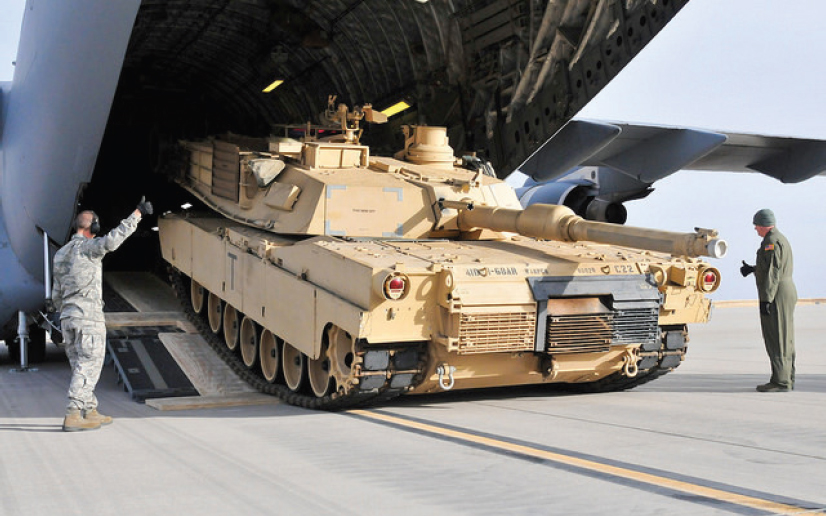
However, despite intensive effort, the materials efficiencies have not kept up with the vehicle weight. This has had numerous impacts, particularly on transportation. For instance, Carter stated that only a single M1 Abrams tank can be carried by a C-17 transport aircraft due to its weight (see Figure 1).
Carter explained that combat vehicle design requires a balance among many competing requirements. This includes protection, mobility, automotive requirements, deployment and transportability, and a host of other considerations. However, he also noted that cost has been a direct or indirect driver in ending each of the previous efforts to reduce weight.
Carter emphasized that the military should consider designing in weight classes: 20 tons, 30-40 tons, and 60 tons. Lighter vehicles can be wheeled and can use most roads and bridges, but heavier vehicles have to use tracks and are more restricted in what roads and bridges they can use. Weight also affects fuel economy as well as transportation.
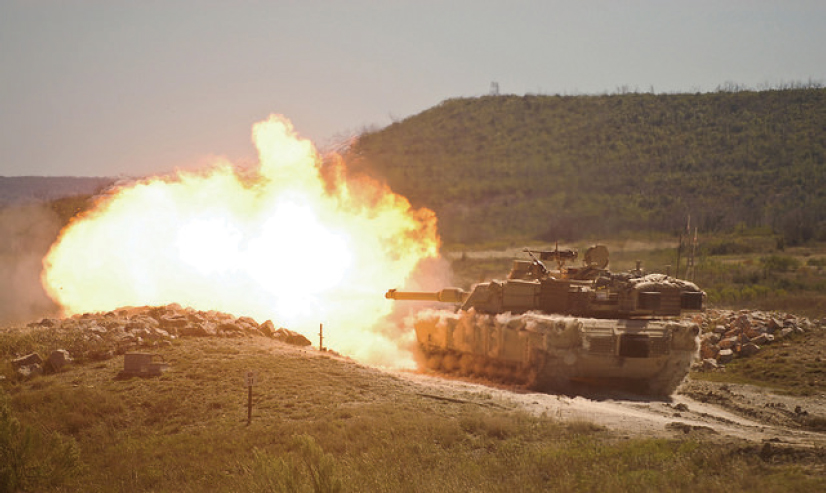
The Army is currently undertaking a Lightweight Combat Vehicle Science and Technology Campaign, he explained. The objective is to develop a portfolio plan to realize a 30- to 35-ton vehicle by 2030 that meets the capabilities and mission of today’s 40- to 75-ton fleet (see Figure 2). He said that this will involve technology advances in survivability, lethality, materials, power, and energy, among other supporting areas, and that the plan is to identify technologies, materials, and vehicle and component designs that can meet this objective.
Carter stated that the baseline is the current Abrams and Bradley vehicles. Researchers are asking how much materials science alone can achieve with the Lightweight Combat Vehicle Science and Technology Campaign objectives as opposed to other solutions. They are investigating direct material replacement and the secondary weight savings with new materials. However, based on the desired performance and the time frame with which to achieve the reduced vehicle weight, Carter stated that the consensus within the scientific community is that additional solutions for weight reduction will have to be applied.
Porter mentioned that materials science is not the only solution to achieving this goal. Vehicle design and changes in doctrine can have an effect. Carter provided examples such as using automation to reduce the number of crew required, applying weight optimization to component designs, and applying technologies such as Adaptive Armor and Active Protection Systems. Materials science solutions can then be integrated with these technology solutions to achieve the weight reduction and performance desired from the vehicle system.
To demonstrate the current situation, Carter showed a graph that identified the different contributors to the weight of a 75-ton Abrams tank. Of the total, he said that 40.7 tons, or greater than 50 percent, is armor and structure, 12 tons is running gear, 11.6 tons is for the weapons including the main gun and ammunition, and the remainder is distributed among powertrain, auxiliary automotive, and crew equipment. He noted that the Army ran several simulations and came up with a “very high risk” approach that would reduce the vehicle to 35 tons, with 13.5 tons of armor, achieving this with broad material science advances and other technology improvements. But Carter posed a rhetorical question: “How do you get 40.7 tons of protection with 13.5 tons [of armor]?”
The Lightweight Combat Vehicle Science and Technology Campaign effort produced a number of material recommendations.1 These were divided into four areas, shown by Carter on his slides as follows:
-
Armor and structure
- Recommendations for specific material investments include continued long-term research in nano-materials, self-healing/diagnosing materials, multi-functional materials, and environmentally acceptable materials
- Metals—next-generation alloys (ultra-high-strength steel, Al, Ti, and Mg), nano-crystalline alloys, dual-hard materials
- Ceramics—next-generation ceramics for opaque and transparent armor, ductile deformation mechanisms
- Composites—including carbon nano-tubes and graphene
- Polymers
-
Automotive/mobility
- Leverage materials being developed within the automotive industry and the Department of Energy Vehicle Technologies Office
- Metals—Al, Mg, and Ti alloys, Gen III high-strength steel, Eglin steel, transformation-induced plasticity steel
- Ceramics—wear- and impact-resistant weld-on coatings
- Composites—resin composite w/metal alloy, Al/SiC, multi-metallics,
___________________
1 D. Lafontaine, “Researchers Focus on Reducing Weight of Army Combat Vehicles,” Army Worldwide News, August 4, 2014, http://www.army.mil/article/131126.
-
-
fiber-reinforced nylon, fiber-reinforced rubber, nanofluids and advanced lubricants, Al/diamond, boron nitride, carbon fiber Al composites, carbon nanotube and graphene composites
- Polymers—advanced polymers for energy storage (e.g., capacitors), urethanes
-
-
Armaments
- Develop and continue multiple material technology investments to reduce gun barrel weights and recoil loads while maintaining or improving energy-on-target metrics
- Assess the state of the art in ceramics/ceramic matrix composites/metal matrix composites for use in gun bores to determine potential
- Develop and continue energetic material programs to facilitate smaller munitions with similar energetics to current ammunition and higher Ph and Pk
-
Electronics/Sensors/Other (ESO)
- Continue to invest in efforts to consolidate vehicle architecture
- Metals/semiconductors—carbon nanotubes, graphene, SiC
The campaign also produced the following overarching recommendations:
-
Organizational recommendations
- Utilize an existing Army-wide governing body with a board of directors (BoD) to ensure purposeful focus on light-weighting Army combat vehicles
- The BoD and cross-organizational team will publish light-weighting metrics/requirements for research, development and acquisition programs
- Incentivize Program Management Offices to encourage lightweight technology insertion on future and currently fielded platforms
-
Design recommendations
- Continue investment in programs like Materials in Extreme Dynamic Environments (MEDE) for creating materials on demand and by providing input to Integrated Computational Materials Engineering (ICME) ballistic material programs
- Immediate and continuing investment in building an Army core competency in design optimization for weight reduction using commercially available design tools
- Provide and promote the opportunity for using prototype demonstration vehicles and experimental laboratory-demonstrations to drive technology advancement
-
Manufacturing recommendations
- Increase investment in joining and advanced manufacturing technologies for emerging materials through ManTech and other manufacturing avenues where external (industry, other government agency, academia) investments fall short
- The Army must become an active voice in the National Network of Manufacturing Innovation hubs and provide the requirements of the Army to the consortia as derived from ICME and design optimization programs
The future tank is not alone in posing difficult challenges for weight reduction, said Carter. In comparison, the Bradley Infantry Fighting Vehicle weighs 39.3 tons. Fifty-four percent of that weight is in armor and structure, and 27 percent is in automotive and mobility, adding up to 81 percent of the vehicle weight. Thus, a future infantry fighting vehicle design with similar capabilities will have to overcome similar subsystem weight challenges.
Carter and Polsen also noted that the enemy is much faster at changing tactics than the military is at fielding new vehicles—the enemy is “inside the development cycle,” to use a common military term. This is because modern communications make it possible for the enemy to communicate about tactics and adapt to new threats far more rapidly than in the past.
They explained that cost has been a direct or indirect driver in the demise of past efforts to achieve greater material efficiencies—as development projects have gotten more expensive they eventually reached a point where the political leadership would no longer fund them, and they were canceled. There are many reasons for this cost growth, including cost of materials and manufacturing costs. The speakers also noted that modern vehicles use many additional types of materials compared to previous models and are therefore more expensive.
A workshop participant pointed out that cost was not a factor 5 years ago when the military was heavily involved in Iraq. He suggested that they “not get hung up on cost” and noted that the military spends a lot of money protecting an aircraft, so additional money to protect a vehicle with many soldiers inside is a given. It could certainly be cheaper than the cost of treating wounded soldiers for the rest of their lives.
Some participants also discussed whether or not the age of the tank is over. Tanks are now defeatable by many other threats, but some participants pointed out that it is still safer inside the tank than outside, and any other armored vehicles cannot destroy a tank. The speakers also stressed that the military is not interested in applying new materials only to tanks. They are also concerned about artillery, armored fighting vehicles, and tankers (refueling vehicles), as well as protection to the individual warfighter (body armor). All of these are being attacked on the battlefield, and all can benefit from increased armor protection at lighter weights.


